

Revenue, 2025
$4.9Bn
Forecast, 2035
$39.8Bn
CAGR, 2025-2035
23.3%
Report Coverage
Global
Market Size and Forecast
2025
$4.9Bn
2035
$39.8Bn
CAGR
23.3%
The global AI Trust, Risk and Security Management (AI TRiSM) Market was valued at USD 4.9 billion in 2025 and is projected to reach around USD 39.8 billion by 2035, growing at a CAGR of 23.3%. The market growth is supported by rising AI adoption across enterprises, increasing need for model governance, stronger data privacy requirements, and growing focus on secure, transparent, and compliant AI systems.
North America led the AI TRiSM market with a 46.1% share in 2025, valued at USD 2.2 billion , and is expected to grow at a CAGR of 23.1%. The region’s dominance can be attributed to strong enterprise AI deployment, advanced cybersecurity infrastructure, strict regulatory focus, and high investment in responsible AI frameworks.
The U.S. AI TRiSM market was valued at USD 1.3 billion in 2025 and is projected to expand at a CAGR of 22.7% . Growth in the country is driven by rapid adoption of generative AI, rising demand for AI governance platforms, increasing enterprise risk management needs, and stronger focus on compliance across BFSI, healthcare, technology, and government sectors.
Market Key Insights
Solutions led the AI TRiSM market with 69.1% share, supported by rising demand for AI governance platforms, risk monitoring tools, model security systems, and compliance management solutions.
Machine learning-based TRiSM accounted for 39.1% share, driven by its use in model validation, anomaly detection, bias monitoring, and automated risk assessment.
Model governance and compliance captured 36.6% share by application, supported by growing regulatory pressure, internal audit needs, and responsible AI deployment across enterprises.
Cloud deployment held the largest share at 72.2% , driven by easier scalability, faster implementation, lower infrastructure cost, and centralized monitoring of AI systems.
Large enterprises represented 69.6% share, supported by wider AI adoption, higher compliance exposure, and greater need for structured AI risk controls.
BFSI led the industry vertical segment with 37.8% share, driven by strong use of AI in fraud detection, credit risk, customer analytics, compliance, and financial decision-making.
North America accounted for 46.1% share of the AI TRiSM market, supported by strong AI investment, advanced cybersecurity infrastructure, and rising focus on AI governance. The North America AI TRiSM market was valued at USD 2.2 billion and is projected to grow at a CAGR of 23.1%.
The U.S. AI TRiSM market was valued at USD 1.3 billion and is expected to expand at a CAGR of 22.7%.
AI TRiSM Statistics
Documented AI incidents increased to 362 in 2025, up from 233 in 2024. This shows that AI risks are rising as organizations deploy generative AI , autonomous agents , and decision-making models across business functions.
13% of organizations reported breaches involving AI models or AI applications in IBM’s 2025 breach study. Among those AI-related breach cases, 97% reported lacking proper AI access controls.
63% of breached organizations studied by IBM had no AI governance policy in place. Only 37% had approval processes or oversight mechanisms for AI use, showing a clear gap between AI adoption and AI control.
The global average cost of a data breach was USD 4.44 million in 2025, while the average U.S. breach cost reached USD 10.22 million . These costs are supporting stronger investment in AI security, identity control, data governance, and automated risk management.
IBM found that organizations using AI-powered defenses reduced breach identification and containment time, with the mean time falling to 241 days, the lowest level in nine years. This supports adoption of AI-enabled security monitoring and automated threat response.
ISO/IEC 42001 supports AI governance by focusing on accountability, transparency, ethics, risk management, and data privacy. This is making AI management system certification more relevant for regulated sectors such as finance, healthcare, insurance, government, and critical infrastructure.
OWASP’s 2025 Top 10 for LLM applications identifies prompt injection, sensitive information disclosure, supply chain vulnerabilities, improper output handling, excessive agency, and misinformation as major generative AI risks. These risks are increasing demand for LLM firewalls, red teaming, content controls, and runtime monitoring.
Market Overview
The AI Trust, Risk and Security Management market covers software, services, and governance practices used to make artificial intelligence safer, more transparent, and more controlled. It supports model monitoring, data protection, bias checks, explainability, security testing, and compliance management across AI systems. The market is gaining importance as companies use AI in decision-making, customer service, finance, healthcare, cybersecurity, and business operations. AI TRiSM is now viewed as a core layer for responsible AI adoption because it helps reduce operational, legal, ethical, and reputational risks.
The main factor driving the AI TRiSM market is the rapid use of AI across regulated and data-sensitive industries. Banks, insurers, healthcare providers, government agencies, and large enterprises are using AI for decisions that require accuracy, accountability, and audit support. These organizations need systems that can track model behavior, identify bias, and control data exposure. The growth of AI adoption has therefore increased the need for strong trust, risk, and security controls.
Strong investment opportunities are expected in AI governance platforms, model monitoring tools, explainable AI systems, privacy protection, AI security testing, and compliance automation. Enterprises are expected to spend more on tools that can manage AI risks across multiple business units and cloud environments. Service providers also have opportunities in consulting, implementation, model validation, audit readiness, and AI policy design. Demand is likely to remain strong as more organizations move AI from pilot projects into production workflows.
By Component
The solutions segment dominated the AI TRiSM market with 69.1% share, supported by rising demand for AI governance platforms, model monitoring tools, bias detection systems, explainability dashboards, data protection tools, and AI security controls. Enterprises are moving from manual AI policies to automated systems that can track model behavior, validate outputs, manage risk alerts, and create audit records.
The growth of this segment can be attributed to the increasing need for trusted and secure AI deployment across regulated and data-heavy industries. For instance, as organizational AI adoption reached 88% in 2026 and documented AI incidents increased to 362, businesses started investing more in automated TRiSM solutions to reduce compliance gaps, model errors, and reputational risk.
By Technology
The machine learning-based TRiSM segment accounted for 39.1% share, driven by the need to detect model drift, abnormal outputs, bias patterns, adversarial risks, and data quality issues in real time. Machine learning-based controls are widely used because they can monitor large volumes of model activity faster than manual review methods.
This segment is gaining strong traction as enterprises deploy more AI models across customer service, fraud detection, risk scoring, operations, and decision support. For instance, AI agents reached nearly 66% task success on real computer-task benchmarks in 2026, but they still failed in about one out of three attempts, which shows why continuous model monitoring and validation are becoming essential.
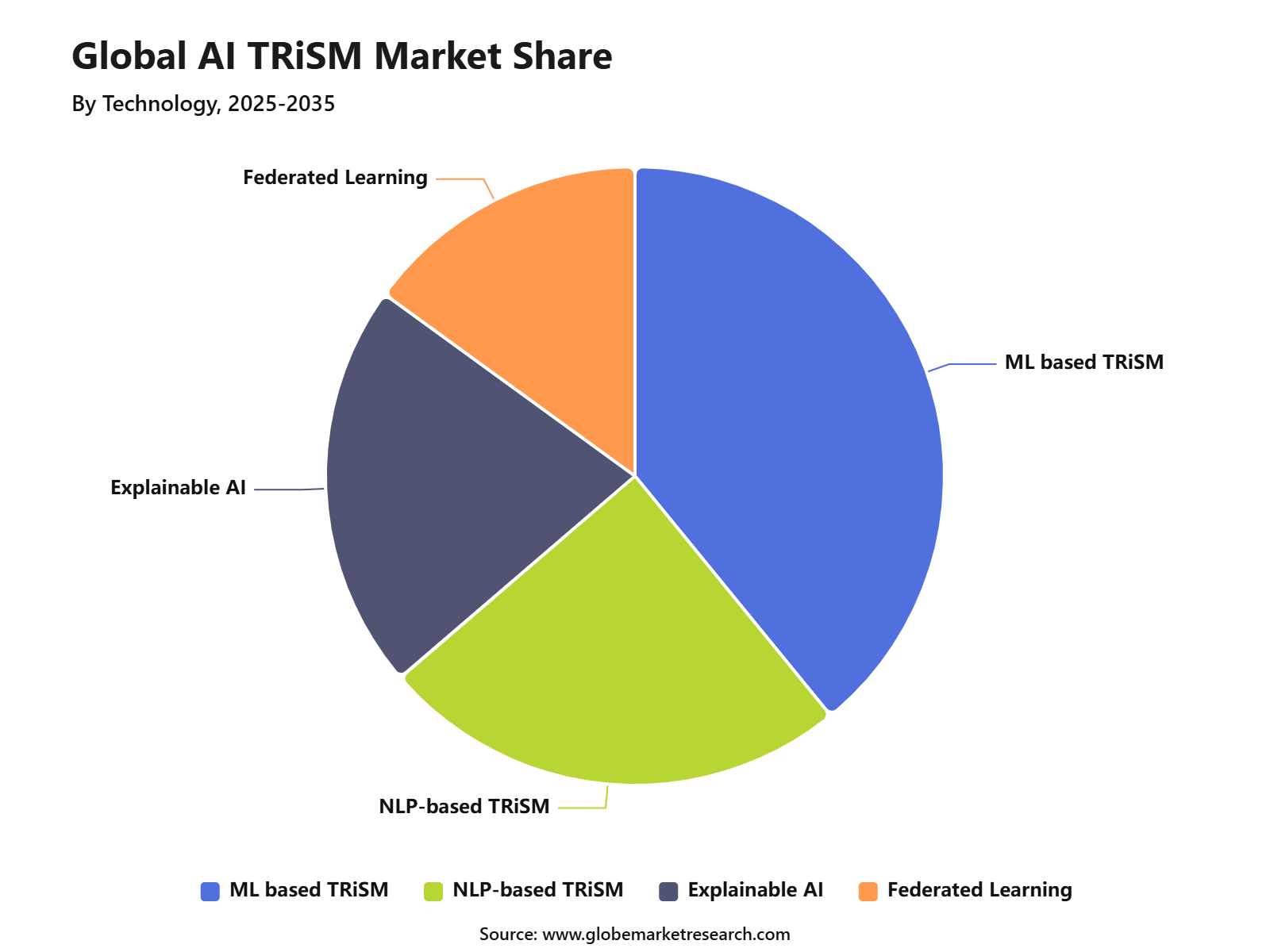 iThe graph shows projected market growth until 2035 based on CAGR analysis. Actual outcomes may vary depending on changing demand, competition, and economic factors.To gain greater insights - request a sample report PDF
By Application
The model governance and compliance segment captured 36.6% share, supported by stricter enterprise controls around model approval, documentation, explainability, audit readiness, and regulatory reporting. The segment is gaining importance as companies need to prove how AI models are built, trained, tested, deployed, and monitored.
The growth of this application area is also supported by rising pressure from regulators, boards, and internal risk teams. For instance, in 2026, 77% of surveyed organizations reported that AI adoption was moving faster than their current governance capabilities, while only 11% said they were fully prepared for large-scale AI agent deployment.
By Deployment
The cloud segment led the market with 72.2% share, supported by scalable AI workloads, centralized model monitoring, faster integration with enterprise applications, and easier deployment of governance tools across global teams. Cloud-based TRiSM platforms help companies manage AI risk across multiple models, business units, and third-party systems from a single control environment.
The demand for cloud deployment is expected to remain strong as enterprises expand AI use across distributed teams and multi-region operations. For instance, the United States hosted 5,427 AI data centers in 2026, reflecting the rising scale of AI infrastructure and the need for cloud-based governance, security, and compliance systems.
By Organization Size
Large enterprises accounted for 69.6% share, as they operate complex AI systems across departments such as compliance, cybersecurity, finance, customer service, operations, and product development. These organizations require stronger model inventories, approval workflows, human oversight, vendor risk controls, access governance, and incident response systems.
The adoption of AI TRiSM is higher among large enterprises because their AI risks are broader and more visible to regulators, customers, and shareholders. For instance, a 2026 global study of 2,000 senior technology executives found that 70% said business teams were deploying technology faster than IT could track, while two-thirds of CIOs and CTOs were accountable for AI systems they did not fully control.
By Industry Vertical
The BFSI segment held 37.8% share, driven by high AI usage in fraud detection, credit underwriting, customer verification, anti-money laundering, risk scoring, claims processing, and regulatory monitoring. Banks and financial institutions face strong pressure to ensure AI systems are fair, explainable, secure, and compliant.
The segment is expected to remain a leading adopter of AI TRiSM due to strict compliance requirements and high exposure to financial, legal, and customer trust risks. For instance, in June 2026, U.S. banking regulators increased scrutiny of AI use in financial companies, with focus areas including lending decisions, data access, third-party vendors, governance controls, human oversight, and emergency shutdown mechanisms.
Regional Insights
North America dominated the AI TRiSM market with 46.1% share and a market value of USD 2.2 billion. Growth in the region is supported by strong enterprise AI adoption, high cloud infrastructure maturity, advanced cybersecurity spending, and early adoption of AI governance frameworks.
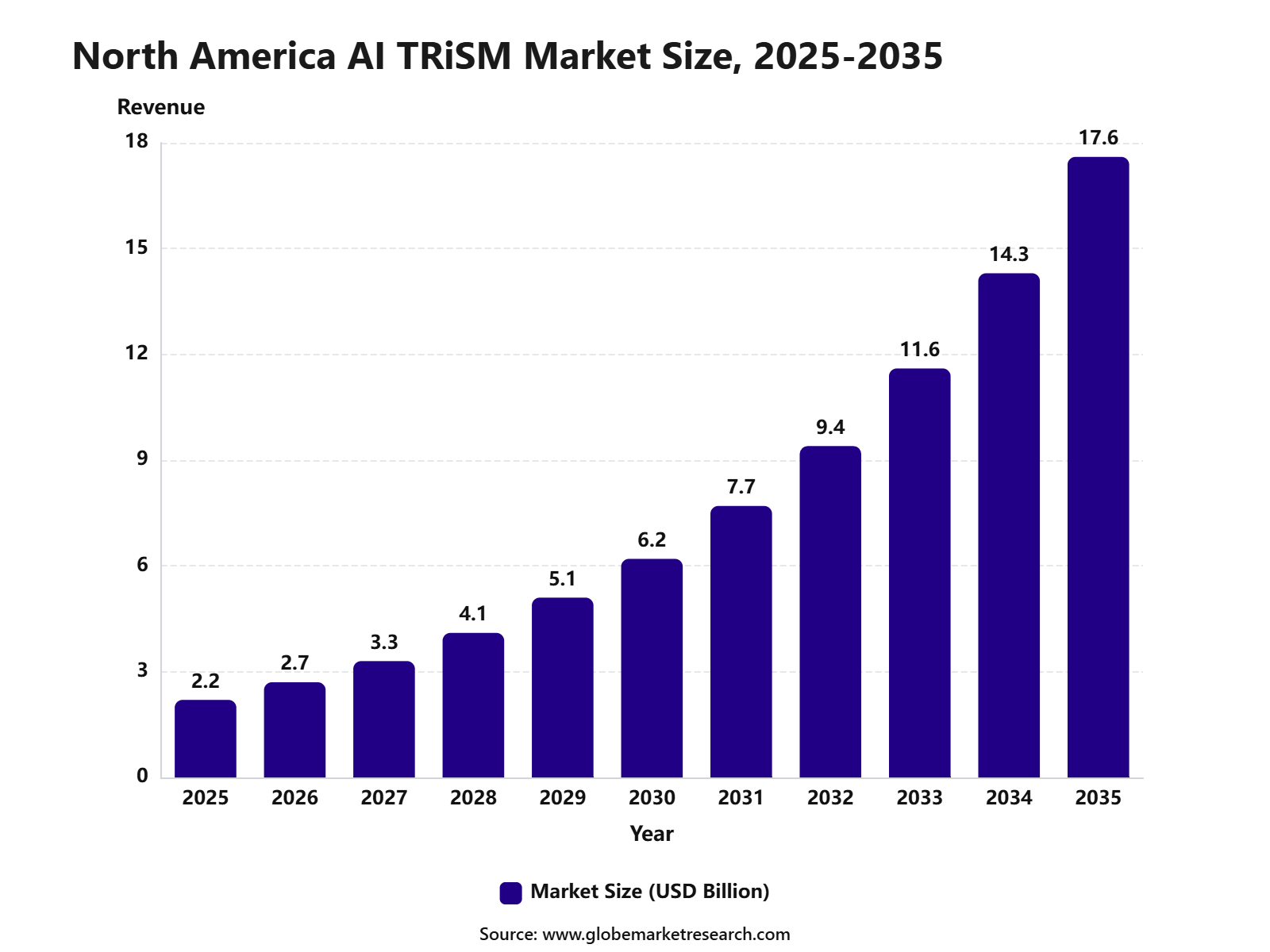 iThe graph shows projected market growth until 2035 based on CAGR analysis. Actual outcomes may vary depending on changing demand, competition, and economic factors.To gain greater insights - request a sample report PDF
The region is also supported by strong AI investment activity, enterprise-grade software adoption, and a mature regulatory discussion around responsible AI. For instance, U.S. private AI investment reached USD 285.9 billion in 2025, creating higher demand for trusted, secure, and compliant AI deployment models across finance, healthcare, technology, insurance, and public sector applications.
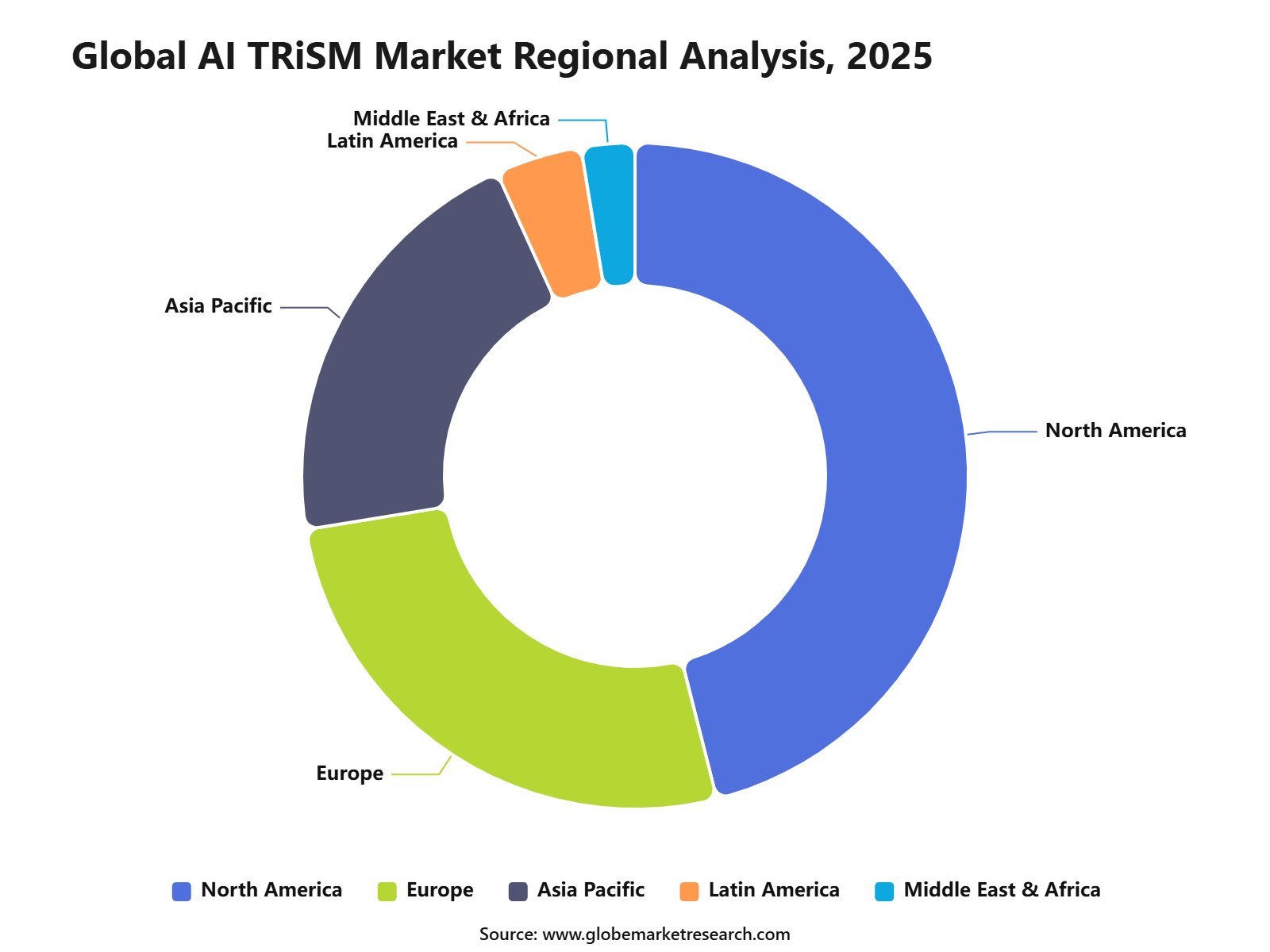 iThe graph shows projected market growth until 2035 based on CAGR analysis. Actual outcomes may vary depending on changing demand, competition, and economic factors.To gain greater insights - request a sample report PDF
Regional Impact Analysis
Impact Factor | Estimated CAGR Impact | Regional Relevance | Market Impact |
|---|---|---|---|
North America market leadership | +6.3% | U.S. and Canada | Leads enterprise adoption. |
Europe AI regulation-driven growth | +5.5% | UK, Germany, France, Nordics | Supports compliance demand. |
Asia Pacific AI governance expansion | +5.1% | China, India, Japan, South Korea, Singapore | Driven by AI adoption. |
Middle East AI security investment | +3.6% | UAE, Saudi Arabia, Qatar | Builds early demand. |
Latin America emerging adoption | +2.9% | Brazil, Mexico, Chile, Colombia | Shows gradual growth. |
The U.S. market reached USD 1.3 billion and is projected to grow at a CAGR of 22.7%. The country remains a major adoption center due to strong AI deployment across banking, healthcare, insurance, retail, defense, technology, and enterprise software. AI risk control has become more important in the U.S. as companies increase their use of generative AI, AI agents, predictive models, and automated decision systems. For instance, recent breach analysis found that 63% of breached organizations lacked AI governance policies, while 97% of organizations with AI-related security incidents lacked proper AI access controls.
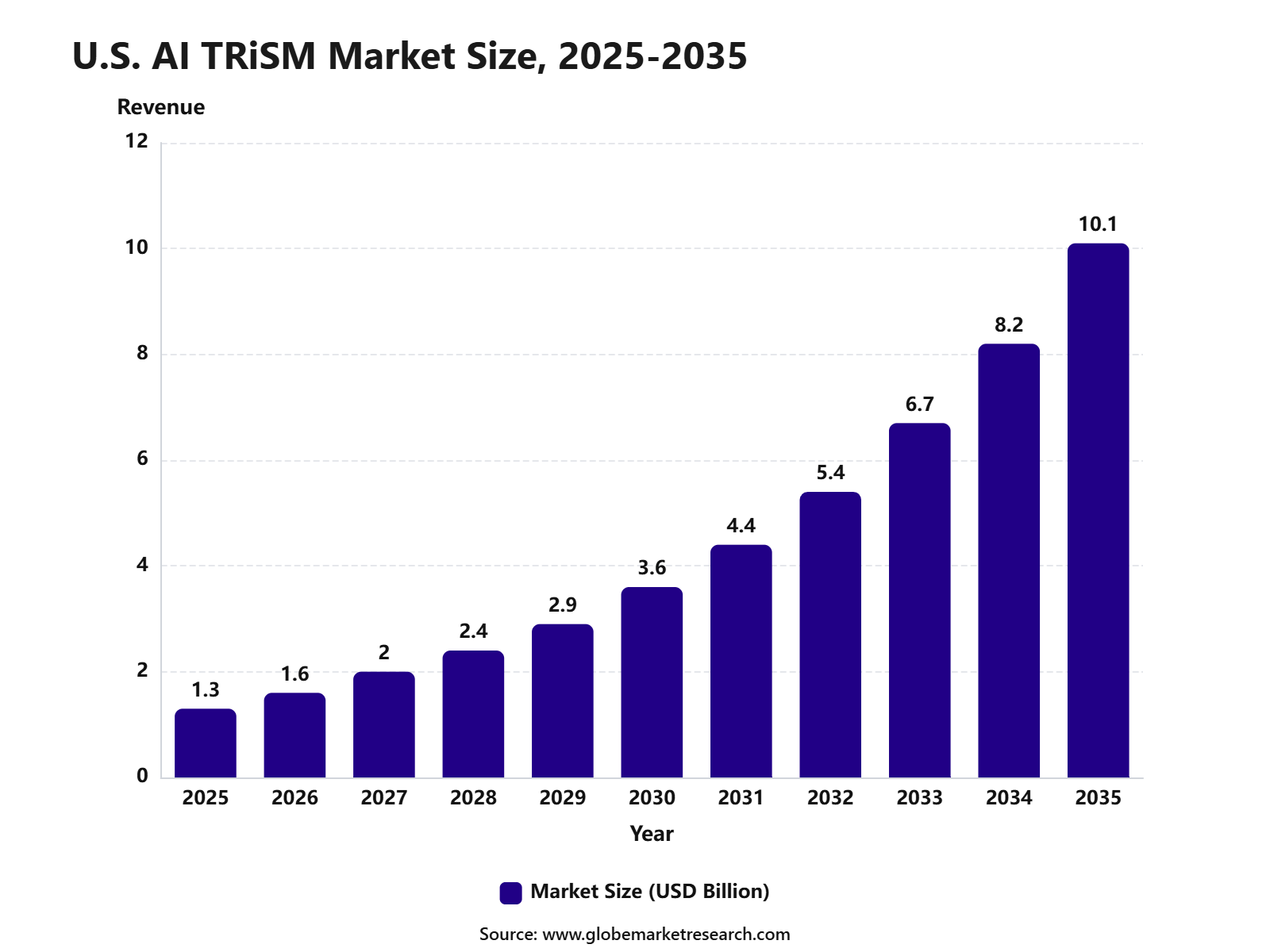 iThe graph shows projected market growth until 2035 based on CAGR analysis. Actual outcomes may vary depending on changing demand, competition, and economic factors.To gain greater insights - request a sample report PDF
Drivers Impact Analysis
Impact Factor | Estimated CAGR Impact | Regional Relevance | Market Impact |
|---|---|---|---|
Rising enterprise AI adoption | +6.1% | North America, Europe, Asia Pacific | Increases need for AI governance. |
Growing AI security risks | +5.6% | Global | Drives risk management demand. |
Regulatory pressure on AI systems | +5.1% | U.S., Europe, China, India | Supports compliance spending. |
Increasing model monitoring needs | +4.8% | Global enterprises | Improves AI reliability. |
Rising demand for explainable AI | +4.3% | BFSI, healthcare, government | Builds user trust. |
Restraints Impact Analysis
Impact Factor | Estimated CAGR Impact | Regional Relevance | Market Impact |
|---|---|---|---|
High implementation cost | -3.0% | SMEs and emerging markets | Limits adoption speed. |
Lack of AI governance expertise | -2.7% | Global | Slows deployment. |
Complex integration with AI workflows | -2.4% | Large enterprises | Delays implementation. |
Limited awareness among small firms | -2.0% | Asia Pacific, Latin America, MEA | Restricts market reach. |
Rapidly changing AI regulations | -1.8% | U.S., Europe, Asia Pacific | Raises compliance uncertainty. |
Opportunities Impact Analysis
Impact Factor | Estimated CAGR Impact | Regional Relevance | Market Impact |
|---|---|---|---|
Growth in responsible AI platforms | +5.8% | North America, Europe, Asia Pacific | Expands trusted AI adoption. |
AI risk management in BFSI | +5.2% | U.S., Europe, Singapore, India | Supports secure financial AI. |
Expansion of model governance tools | +4.9% | Global | Improves model control. |
AI compliance automation | +4.5% | U.S., Europe, developed Asia | Reduces regulatory workload. |
Growth in AI security testing | +4.2% | Global | Strengthens AI system protection. |
Challenges Impact Analysis
Impact Factor | Estimated CAGR Impact | Regional Relevance | Market Impact |
|---|---|---|---|
Model bias and fairness concerns | -2.8% | Global | Reduces AI trust. |
AI hallucination and output errors | -2.5% | Global | Affects business confidence. |
Lack of standard AI audit frameworks | -2.2% | Global | Creates governance gaps. |
Data privacy and access risks | -2.1% | North America, Europe, Asia Pacific | Increases security burden. |
Vendor lock-in risk | -1.7% | Enterprise AI users | Limits platform flexibility. |
Segments Covered in the Report
By Component
Solutions
Services
By Technology
Machine Learning-based TRiSM
Natural Language Processing-based TRiSM
Explainable AI (XAI)
Federated Learning/Privacy-Preserving ML
By Application
Model Governance & Compliance
Model Monitoring & Observability
Data Privacy & Security
Bias Detection & Mitigation
Identity & Access Security for AI
By Deployment
On premises
Cloud
By Organization Size
Large Enterprises
Small & Medium Enterprises (SMEs)
By Industry Vertical
BFSI
Healthcare
Retail & E-commerce
IT & Telecom
Government & Defense
Manufacturing
Transportation & Logistics
By Region
North America
Europe
Asia-Pacific
Latin America
Middle East and Africa
Market Trend Analysis
Impact Factor | Estimated CAGR Impact | Regional Relevance | Market Impact |
|---|---|---|---|
Responsible AI adoption | +5.7% | U.S., Europe, Asia Pacific | Builds trusted AI systems. |
AI model governance expansion | +5.2% | Global | Strengthens model oversight. |
Continuous AI risk monitoring | +4.8% | BFSI, healthcare, telecom | Improves real-time control. |
AI security and threat detection | +4.5% | Global | Protects AI workflows. |
Explainable AI integration | +4.1% | Regulated industries | Supports transparent decisions. |
Investor Type Impact Matrix
Investor Type | Estimated CAGR Impact | Regional Relevance | Market Impact |
|---|---|---|---|
Venture Capital Firms | +5.2% | U.S., Europe, India, Israel | Supports AI security startups. |
Strategic Technology Investors | +5.0% | U.S., Europe, Japan, South Korea | Expands governance capabilities. |
Cybersecurity Investors | +4.7% | Global | Strengthens AI protection. |
Private Equity Firms | +4.1% | North America, Europe, Asia Pacific | Supports scaling. |
Government and Sovereign Funds | +3.8% | Europe, GCC, Singapore, China | Supports trusted AI programs. |
Real-Time Use Cases
AI Trust, Risk and Security Management is being used in real business environments where AI systems make decisions, generate content, process sensitive data, and interact with customers. The market is gaining importance because enterprises are moving from small AI pilots to large-scale AI deployment across banking, healthcare, retail, manufacturing, public services, and cybersecurity. As AI adoption increases, organizations need stronger controls for model governance, explainability, security, privacy, compliance, and continuous monitoring.
A key real-time use case is fraud detection in banking and financial services. Banks use AI models to detect unusual transactions, identify suspicious payment behavior, and reduce financial crime. AI TRiSM helps these institutions monitor model performance, explain why a transaction was flagged, track model drift, and maintain audit records for regulators. For instance, when an AI system blocks a high-value card transaction, AI TRiSM tools can support real-time review by showing the risk score, data inputs, model logic, and confidence level before a final decision is taken.
Another important use case is credit scoring and loan decision governance. Financial institutions use AI to assess customer risk, repayment capacity, and application behavior. AI TRiSM is used to reduce bias, improve transparency, and ensure that lending decisions are fair and explainable. This is especially important when AI models influence consumer credit, mortgage approvals, insurance pricing, or business loan decisions, as poor governance can increase legal, financial, and reputational risk.
Recent Developments
June 2026 - IBM reported that many enterprises are still underprepared for AI governance. In its survey of 2,000 CIOs and CTOs, only 11% said they were fully prepared for large-scale AI deployment. The study also found that 77% believed current governance frameworks were inadequate, while organizations faced an average of 54 AI-related incidents in the prior year.
January 2026 - CrowdStrike agreed to acquire SGNL for about USD 740 million . The deal strengthens real-time identity controls across human, machine, and AI-based identities. This is important for AI TRiSM because autonomous agents need stronger access governance and continuous identity verification.
December 2025 - ServiceNow agreed to acquire Armis for USD 7.75 billion in an all-cash transaction. The acquisition supports ServiceNow’s security, risk, operational technology, and AI governance strategy. Armis reported more than USD 340 million in annual recurring revenue and over 50% year-over-year growth.
Report Scope
Report Highlights | Details |
|---|---|
Market Revenue (2025) | USD 4.9 Bn |
Forecast Revenue (2035) | USD 39.8 Bn |
CAGR (2025-2035) | 23.3% |
Base Year for Estimation | 2025 |
Historic Data | 2020-2024 |
Forecast Period | 2025-2035 |
Report Coverage | AI market impact analysis, Market surveys, trade analysis, Industry & competitive intelligence, Revenue projections, company positioning, competitive analysis, growth drivers, and emerging market trends, Strategic Consultation & Advisory Services |
Segments Covered | By Component (Solutions, Services), By Technology (ML based TRiSM, Natural Language Processing based TRiSM, Explainable AI (XAI), Federated Learning/Privacy-Preserving ML), By Application (Model Governance & Compliance, Model Monitoring & Observability, Data Privacy & Security, Bias Detection & Mitigation, Identity & Access Security for AI), By Deployment (On-premises, Cloud), By Organization Size (Large Enterprises, Small & Medium Enterprises), By Industry Vertical (BFSI, Healthcare, Retail & E-commerce, IT & Telecom, Government & Defense, Manufacturing, Transportation & Logistics) |
Regional Analysis | North America - US, Canada; Europe - Germany, France, The UK, Spain, Italy, Russia, Netherlands, Rest of Europe; Asia Pacific - China, Japan, South Korea, India, New Zealand, Singapore, Thailand, Vietnam, Rest of Latin America; Latin America - Brazil, Mexico, Rest of Latin America; Middle East & Africa - South Africa, Saudi Arabia, UAE, Rest of MEA |
Key companies profiled | IBM, Microsoft, Google, Amazon Web Services (AWS), SAS Institute, Deloitte, PwC, Accenture, H2O.ai , DataRobot, Arthur AI, TruEra, Fiddler AI, ModelOp, Credo AI |
Customization Scope | Tailored insights for specific regions, countries, and market segments can be provided. Additional report customization is available upon request. |
Competitive Landscape
The market is characterized by intense competition among established players and emerging companies. Strategic partnerships, mergers and acquisitions, and product innovation are key strategies employed by market participants.
Key Market Players
Microsoft
IBM
Amazon Web Services (AWS)
SAS Institute
Deloitte
Accenture
PwC
H2O.ai
DataRobot
Arthur AI
TruEra
Credo AI
Fiddler AI
ModelOp
Other Key Players
Meet the Team
This report was prepared by our expert analysts with deep industry knowledge and research experience.
Pratiksha K. is market research analyst with strong experience in industry research, market forecasting, and competitive analysis. She specializes in identifying market trends, evaluating growth opportunities, and preparing data-driven insights across global industries. Her work supports businesses in understanding market dynamics, customer demand, regional opportunities, and strategic investment areas.
Suraj is a seasoned Senior Management Consultant with over 7 years of experience in market research, business strategy, and consulting. He has worked with Fortune 500 companies as well as emerging startups, supporting clients in cross-border expansion, market entry strategies, and growth planning. He has played a key role in delivering strategic viewpoints and actionable insights across various client projects. His expertise includes demand analysis, competitive analysis, market opportunity assessment, channel partner identification, and business expansion strategy. His analytical approach and industry understanding help clients make informed decisions and enter new markets with greater confidence.
Frequently Asked Questions
Related Reports
More in Information and Technology
Voice AI Agents Market to Hit USD 113.7 Billion by 2035
Global Voice AI Agents Market Size, Share Analysis Report By Solution (Voice AI Platform, Services (Professional Services(Implementation & Integration, Consulting & Training Services, Support and Maintenance Services), Managed Services)), By Deployment (Cloud Based, On Premises), By Enterprise Size (Small & Medium Enterprise Size, Large Enterprises), By Industry (BFSI, Automotive, Healthcare, Retail & E-commerce, IT & Telecom, Aerospace & Defence, Others (Utilities, Media & Entertainment)), By Regional Insights, Business plan and Project Report, Investment Opportunities, Profitability, Industry Trends, Leading Companies and Growth Forecasts by 2025-2035
K-12 Education Technology (EdTech) Market to hit USD 491.5 Bn by 2035
Global K-12 Education Technology (EdTech) Market Size, Share Analysis Report By Component (Hardware, Software, Services), By Deployment Mode (Cloud-Based, On-Premises), By Technology Type (Learning Management Systems (LMS), Student Information Systems (SIS), Gamification & Game-based Learning, AR/VR in Education, AI-enabled Learning Tools, Adaptive & Personalized Learning, eContent & Digital Courseware), By Application (Classroom Learning, Remote Learning / Online Learning, Curriculum Management, Content Delivery & Digital Textbooks and Others), By End User (Public K-12 Schools, Private K-12 Schools, Charter Schools, Home Schools), By Regional Insights, Business plan and Project Report, Investment Opportunities, Profitability, Industry Trends, Leading Companies and Growth Forecasts by 2025-2035
US Esports Market to hit USD 29.3 Bn by 2035
US Esports Market Size, Share Analysis Report By Revenue Source (Advertising & Sponsorships, Media Rights, Merchandise & Tickets, Others), By Platform (PC Gaming Platforms, Console Gaming Platforms, Mobile & Tablet Platforms, Others), By Game Genre (MOBA Games, First-Person Shooter Games, Battle Royale Games, and Others), By Streaming Type (Live Streaming, On-Demand Streaming, Hybrid Streaming), By Device Type (Smartphones, PC, Console, Others), By End User (Advertisers & Sponsors, Game Publishers, Streaming Platforms, Tournament Organizers, Teams & Players, Viewers/Fans), By Regional Insights, Business plan and Project Report, Investment Opportunities, Profitability, Industry Trends, Leading Companies and Growth Forecasts by 2025-2035
Italy Agentic AI Market to hit USD 5.7 Bn by 2035
Italy Agentic AI Market By Offering (Solutions, Services), By Deployment Mode (Cloud-Based, On-Premise), By Agent System (Multi-Agent Systems, Single-Agent Systems), By Technology (Generative AI and LLM-Based Agents, ML Agents, NLP-Based Agents, Rule-Based and Hybrid Agents), By Function (Operations and Process Automation, Customer Service and Support, Sales and Marketing Automation, Risk, Compliance, and Fraud Management, IT, Cybersecurity, and Others), By Enterprise Size (Large Enterprises, SMEs), By End Use (BFSI, Manufacturing, IT and Telecommunications, Healthcare and Life Sciences, Retail and E-Commerce, Public Sector, Others), Business plan and Project Report, Investment Opportunities, Profitability, Industry Trends, Leading Companies and Growth Forecasts by 2026-2035