

Revenue, 2025
$20.9Bn
Forecast, 2035
$46.8Bn
CAGR, 2025-2035
8.3%
Report Coverage
Global
Market Size and Forecast
The Global Airport 4.0 Market reached USD 20.9 billion in 2025 and is expected to grow to USD 46.8 billion by 2035, registering a CAGR of 8.3% from 2025 to 2035. North America held the largest regional share of 46.8% in 2025, driven by strong investment in smart airport infrastructure, digital passenger services, airport security modernization, and automation across airport operations. Growth in the region is also supported by the early adoption of biometric screening, IoT-enabled infrastructure, AI-based passenger support, and advanced baggage handling systems.
The growth of the Airport 4.0 market can be attributed to rising air passenger traffic, increasing pressure to reduce airport congestion, and the growing need for faster, safer, and more connected airport operations. Airports are adopting automated check-in systems, biometric identity verification, smart baggage tracking, predictive maintenance, and real-time passenger flow management to improve efficiency and reduce operational delays. These technologies are helping airport operators improve security, enhance passenger experience, and optimize resource use.
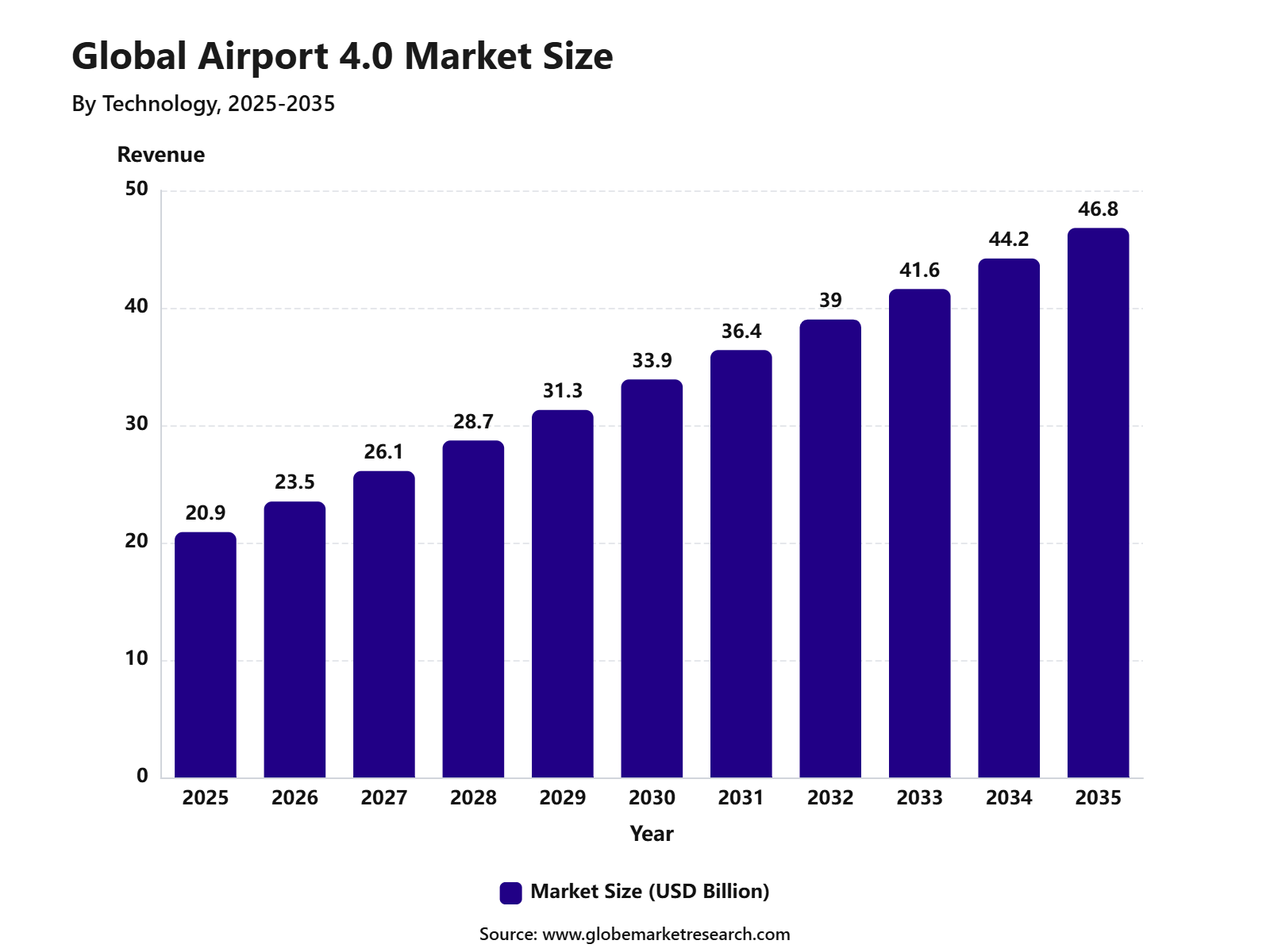 iThe graph shows projected market growth until 2035 based on CAGR analysis. Actual outcomes may vary depending on changing demand, competition, and economic factors.To gain greater insights - request a sample report PDF
Key Market Insights
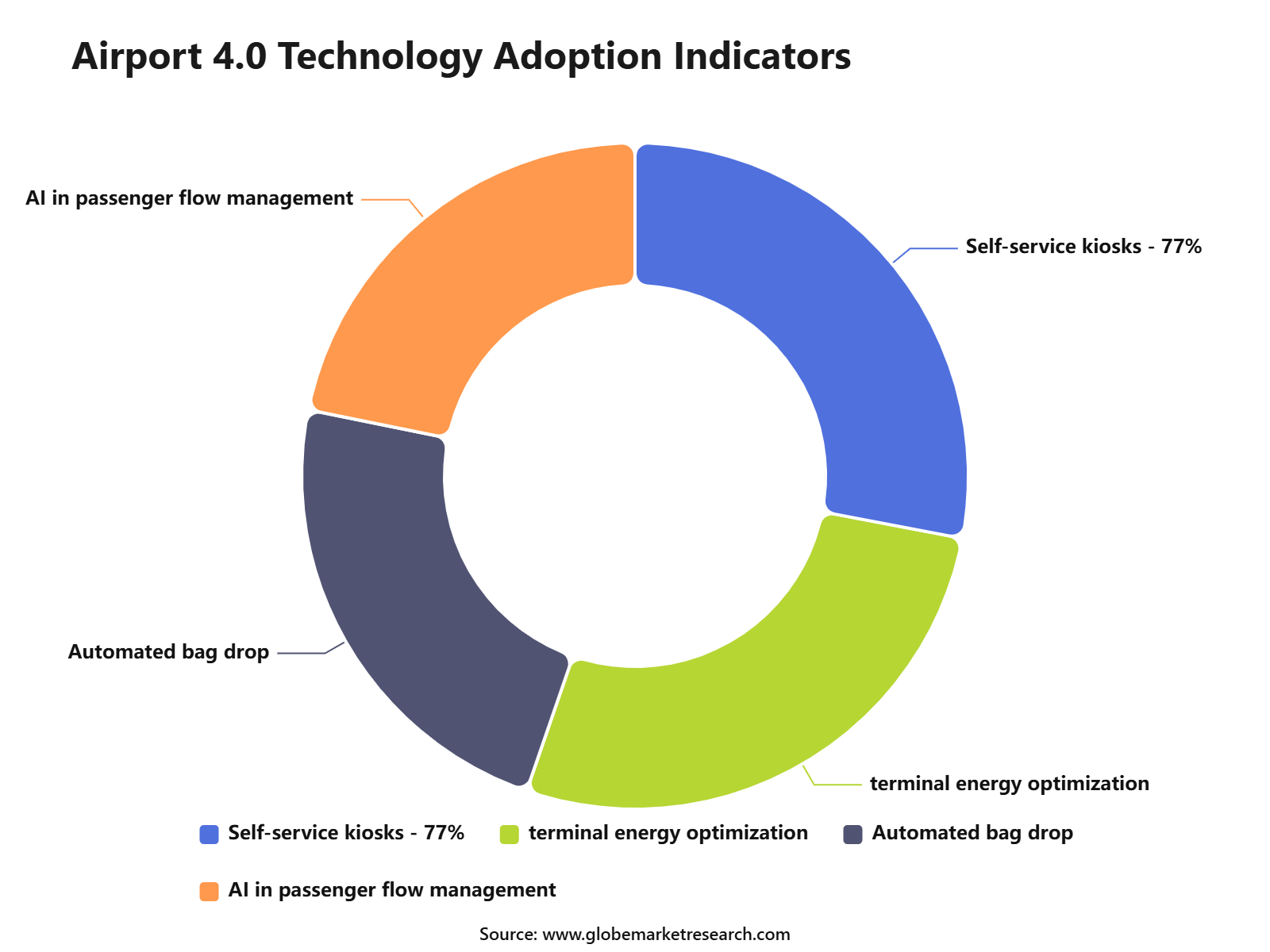
Automated check-in systems led the technology segment with an estimated 26.9% share, supported by faster passenger processing, reduced queue time, and wider use of self-service airport solutions.
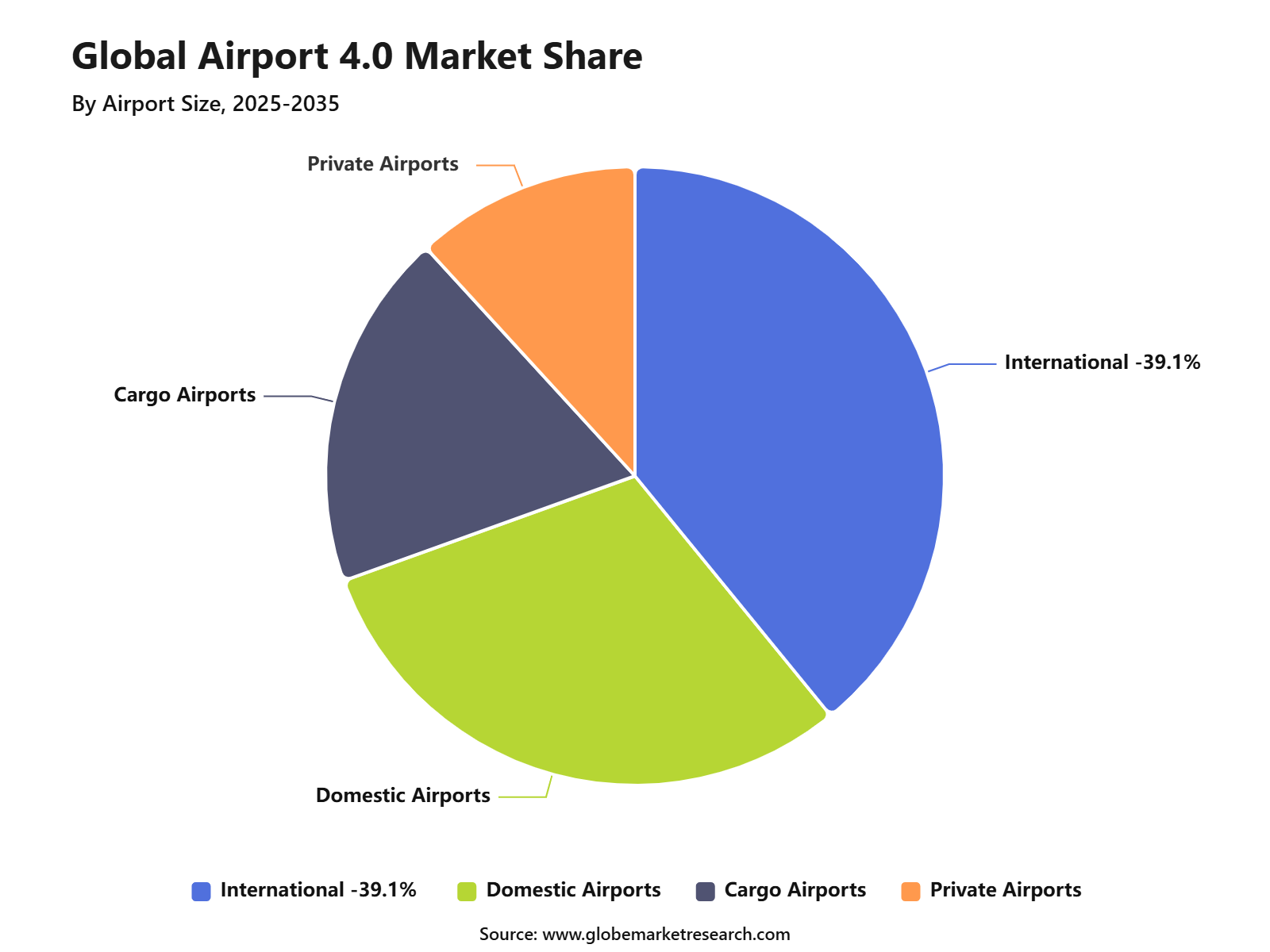
International airports accounted for an estimated 39.1% share, driven by higher passenger traffic, complex operations, and stronger investment in smart airport infrastructure.
Passenger services held 40.3% share by service type, supported by demand for smoother travel experiences, real-time assistance, digital boarding, baggage tracking, and automated customer support.
Passenger flow management captured 32.2% share by operational functionality, driven by the need to improve crowd control, reduce congestion, and optimize airport movement from check-in to boarding.
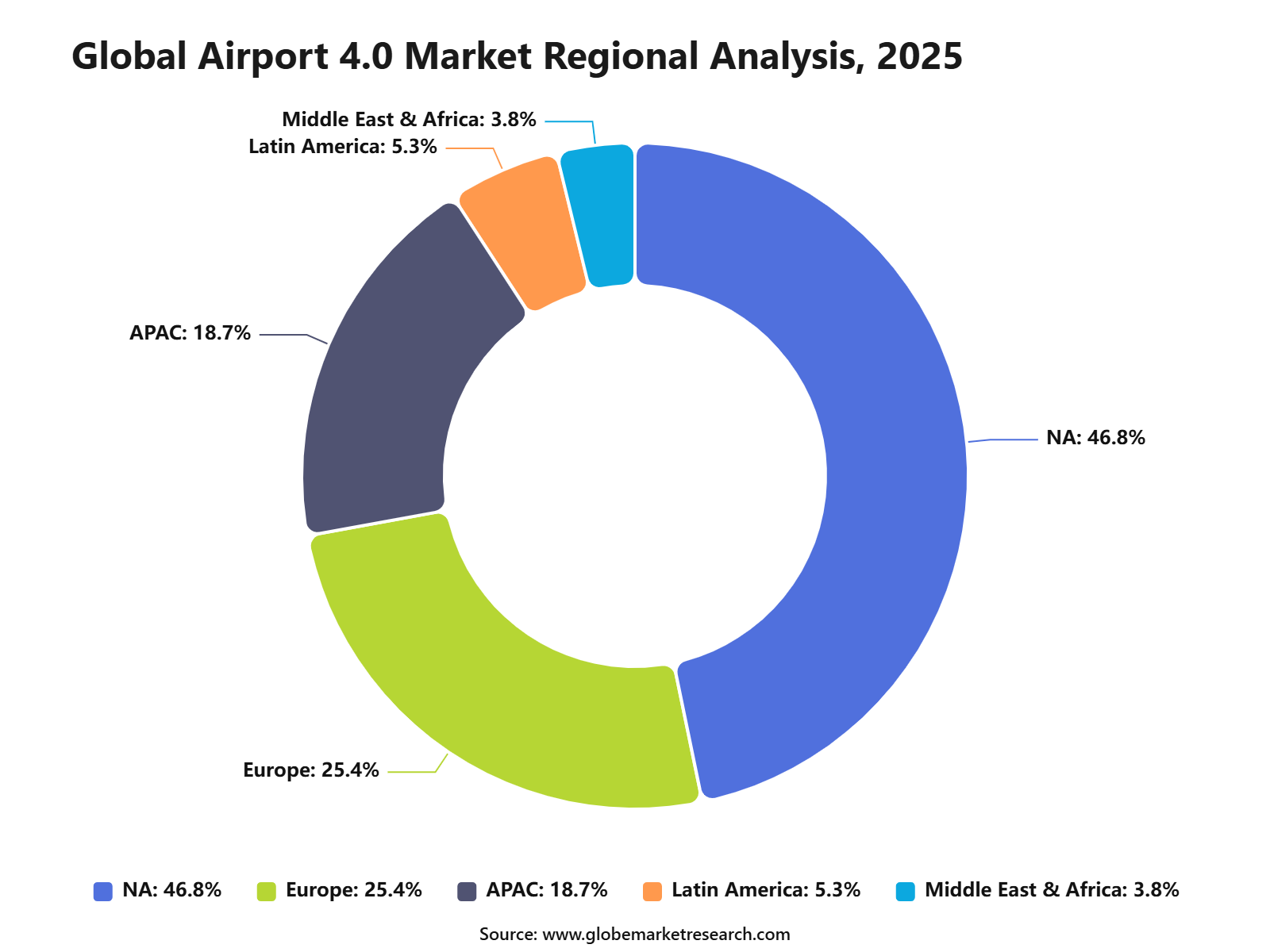
North America led the Airport 4.0 market with 46.8% share, supported by advanced airport modernization programs, strong technology adoption, and continued investment in connected aviation infrastructure.
Customer Acquisition Strategy
The Airport 4.0 Market needs an operations-led go-to-market strategy because airports adopt technology to solve capacity, security, baggage, passenger flow, energy, and safety problems. Vendors should position solutions around measurable outcomes such as shorter queues, faster check-in, better baggage visibility, improved airside safety, stronger cybersecurity, lower energy use, and higher non-aeronautical revenue. SITA reported that 63% of airports plan to increase IT spending in 2026, while 60% already use AI in passenger flow management, showing that airport digitization is moving from pilot projects to operational deployment.
Sales economics are strongest when technology is sold as a platform, managed service, or long-term integration contract rather than only as hardware. Airports need systems that connect passenger identity, baggage handling, airside operations, security screening, retail, parking, maintenance, and facility management. SITA reported that the air transport industry invested USD 50.8 billion in technology in 2025, but also noted that fragmented data remains a key barrier to value creation. This supports demand for cloud platforms, AI-based operations control, data-sharing systems, and integrated command centers.
 iThe graph shows projected market growth until 2035 based on CAGR analysis. Actual outcomes may vary depending on changing demand, competition, and economic factors.To gain greater insights - request a sample report PDF
Tariff Impact
Tariffs can affect the Airport 4.0 Market through imported electronics, semiconductors, sensors, servers, kiosks, biometric gates, surveillance systems, baggage handling equipment, telecom devices, and automation hardware. The U.S. Trade Representative confirmed tariff increases on selected China-origin products, including semiconductors moving to 50% in 2025 and lithium-ion non-EV batteries moving to 25% in 2026. This can raise procurement costs for smart airport systems that depend on chips, batteries, controllers, and connected devices.
Tariff pressure also affects construction-linked airport modernization. Smart terminals require steel, aluminum, copper, wiring, HVAC equipment, security lanes, automated gates, and baggage infrastructure. The White House announced further tariff adjustments for aluminum, steel, and copper imports in June 2026, noting that construction equipment and material-handling equipment are important for domestic infrastructure and logistics. For airport owners, tariff exposure can increase capital costs, delay procurement, and make phased technology deployment more attractive than large one-time upgrades.
Technology Analysis
Automated check-in systems led the Airport 4.0 Market with 26.9% share, supported by rising demand for faster passenger processing, reduced waiting time, and smoother airport operations. These systems include self-service kiosks, mobile check-in, biometric check-in, automated bag drop, and digital identity-based passenger verification. The growth of this segment can be attributed to increasing passenger traffic and the need to reduce congestion at airport terminals.
Automated check-in systems help airports improve operational efficiency, reduce staff workload, and provide passengers with greater control over their journey. The segment is expected to remain important as airports continue to invest in contactless travel, biometric processing, mobile-first services, and integrated passenger data platforms. Strong adoption is likely across busy airports that need faster passenger movement and improved service quality.
Airport Type Analysis
International airports accounted for 39.1% share of the Airport 4.0 Market, supported by high passenger volumes, complex operations, cross-border travel requirements, and larger investment capacity. These airports require advanced digital systems to manage check-in, baggage handling, security, immigration, boarding, retail, and passenger communication.
The growth of this segment is being driven by rising international travel, airline network expansion, and the need for better coordination across multiple stakeholders. International airports are adopting smart technologies to improve passenger processing, aircraft turnaround, security screening, and real-time operational control.
International airports are expected to remain leading adopters of Airport 4.0 solutions because they face higher pressure to improve capacity, security, and passenger experience. Demand is likely to remain strong for automation, AI-based operations, biometric identity systems, smart baggage handling, and connected airport platforms.
 iThe graph shows projected market growth until 2035 based on CAGR analysis. Actual outcomes may vary depending on changing demand, competition, and economic factors.To gain greater insights - request a sample report PDF
Service Type Analysis
Passenger services led the service type segment with 40.3% share, driven by rising demand for faster, safer, and more convenient airport experiences. These services include automated check-in, wayfinding, baggage tracking, digital boarding, passenger alerts, self-service kiosks, and mobile-based travel support. The growth of this segment can be linked to changing traveler expectations.
Passengers increasingly prefer digital services that reduce manual steps, improve transparency, and provide real-time information throughout the airport journey. Passenger services are expected to remain a major focus area as airports compete on service quality and operational reliability. Investments are likely to increase in personalized travel updates, queue management, digital identity, mobile applications, accessibility services, and contactless passenger processing.
Operational Functionality Analysis
Passenger flow management accounted for 32.2% share, supported by the need to manage crowd movement, reduce queues, improve terminal capacity, and support safer airport operations. This functionality uses sensors, cameras, analytics, AI, and real-time data systems to monitor passenger movement across check-in, security, immigration, gates, and baggage areas. The segment is growing as airports face higher passenger volumes and capacity constraints.
Passenger flow management helps airport operators identify congestion points, adjust staffing, improve security lane planning, and provide better real-time guidance to travelers. Demand is expected to remain strong as airports shift toward data-based operations. Passenger flow systems are becoming important for improving terminal efficiency, reducing delays, enhancing passenger satisfaction, and supporting long-term airport capacity planning.
Regional Analysis
North America led the Airport 4.0 Market with 46.8% share, supported by advanced airport infrastructure, strong technology adoption, high air travel volumes, and continued investment in digital airport modernization. The region has a mature aviation ecosystem with large international airports, strong airline networks, and high demand for efficient passenger handling.
The growth of North America is being supported by rising use of self-service systems, biometrics, smart security, cloud-based airport platforms, and real-time operational tools. Airports in the region are focusing on reducing congestion, improving passenger experience, strengthening cybersecurity, and increasing operational resilience.
 iThe graph shows projected market growth until 2035 based on CAGR analysis. Actual outcomes may vary depending on changing demand, competition, and economic factors.To gain greater insights - request a sample report PDF
North America is expected to remain a leading market for Airport 4.0 solutions as passenger traffic continues to rise and airports invest in next-generation digital infrastructure. Future opportunities are likely to be seen in automated check-in, biometric boarding, AI-based passenger flow management, smart baggage systems, and connected airport operations.
Regional Impact Analysis
Impact Factor | Estimated CAGR Impact | Regional Relevance | Market Impact |
|---|---|---|---|
North America market leadership | +2.4% | U.S. and Canada | Leads airport modernization. |
Asia Pacific passenger growth | +2.1% | China, India, Japan, Southeast Asia | Drives airport upgrades. |
Europe smart airport adoption | +1.6% | UK, Germany, France, Netherlands | Supports digital travel. |
Middle East aviation hub investment | +1.4% | UAE, Saudi Arabia, Qatar | Builds premium airport systems. |
Latin America gradual modernization | +0.8% | Brazil, Mexico, Chile, Colombia | Supports future adoption. |
Risk Factors & Market Barriers
The main risk in the Airport 4.0 Market is integration complexity. Airports operate many systems from different vendors, including airline systems, border control platforms, baggage systems, security systems, air traffic interfaces, ground handlers, retail systems, and facility management tools. If data does not move smoothly across these systems, AI and automation cannot deliver full operational value. This is why the market is shifting toward connected airport platforms, shared data layers, and interoperable systems rather than isolated technology purchases.
Based on CSIS, Cybersecurity is another major barrier because digital airports have a wider attack surface. In September 2025, a ransomware attack on Collins Aerospace’s vMUSE airport operations platform disrupted check-in and boarding systems at Heathrow, Brussels, and Berlin airports, forcing manual processing and causing major delays. This type of incident shows that airports need stronger vendor risk checks, zero-trust security, backup systems, and incident response planning before expanding digital operations.
Regulatory & Compliance Risks
According to PCLOB, Regulatory and compliance risks are high because Airport 4.0 systems handle passenger identity, biometric data, border control data, payment data, airline records, video surveillance, and operational security information. Biometric systems must comply with privacy rules, consent requirements, data minimization, retention limits, and cybersecurity standards. A U.S. oversight report stated that, as of April 2025, TSA had deployed more than 2,100 facial-recognition-enabled CAT-2 devices at more than 250 U.S. airports, showing that biometric use is expanding but requires strong governance.
Compliance also extends to safety-critical airside systems. Airport 4.0 tools such as vehicle tracking, runway monitoring, digital towers, and surface awareness systems must meet aviation safety expectations because system failure can directly affect aircraft movement. Reuters reported that the FAA planned to spend USD 16.5 million to equip about 1,900 airport vehicles with transponders across 264 airports after a fatal collision at LaGuardia. This highlights the rising importance of real-time airside visibility and regulated safety technology.
Market Adoption Barriers
Market adoption barriers are mainly linked to budget cycles, legacy infrastructure, vendor lock-in, cybersecurity concerns, and passenger trust. Many airports want AI, biometrics, automation, and digital twins, but they must operate 24/7 without service disruption. This makes implementation slower because airports often prefer phased upgrades, pilot testing, parallel operations, and long validation periods before full rollout. Smaller airports may also struggle with funding, skilled IT staff, and cybersecurity readiness.
Passenger acceptance is improving, but privacy concerns remain important. IATA’s 2025 Global Passenger Survey found that 50% of passengers had used biometrics at some point in the airport journey, up from 46% in 2024, and 85% of users said they were satisfied with the experience. This supports adoption of biometric boarding, automated border control, and touchless passenger processing, but airports still need clear communication on consent, data use, and opt-out options.
Revenue Potential Analysis
Revenue Landscape Across
Based on data from ACI World, Revenue opportunities in the Airport 4.0 Market are spread across passenger processing, biometric identity, self-service kiosks, smart baggage, AI-based queue management, digital signage, cybersecurity, cloud operations, energy management, predictive maintenance, airside safety, parking systems, retail analytics, and airport command centers. Passenger growth supports the need for these systems because airports must handle more travelers without always adding new physical capacity. ACI World estimated that global airport passenger traffic reached 9.8 billion in 2025 and forecasted 10.2 billion passengers in 2026.
The strongest revenue landscape is expected in solutions that help airports expand capacity through better operations. AI-based passenger flow tools, automated check-in, baggage tracking, biometric e-gates, and airside visibility systems can reduce congestion and improve aircraft turnaround. IATA also reported that global air passenger traffic grew 5.7% year-on-year in 2025, which supports continued airport investment in digital systems that improve throughput, resilience, and passenger experience.
Financial Impact
The financial impact can be positive because Airport 4.0 systems can improve operational efficiency, reduce manual processing, support higher passenger throughput, and increase non-aeronautical revenue from parking, retail, food service, advertising, and premium services. Better data visibility can help airports manage staffing, gates, baggage, security lanes, energy use, and maintenance more efficiently. For vendors, recurring revenue can be created through software subscriptions, managed cybersecurity, data analytics, cloud hosting, equipment maintenance, and long-term service agreements.
Financial risk remains high because airport technology projects require large upfront spending, long procurement cycles, public-sector approvals, and strict reliability testing. Demand can also be affected by geopolitics and fuel shocks. Reuters reported that European airport passenger traffic fell 0.7% year-on-year in April 2026, the first such decline since the post-COVID recovery, with Middle East conflict and higher oil prices weighing on aviation activity. This means Airport 4.0 investments are likely to continue, but airport operators may prioritize systems with fast payback, safety value, and clear capacity benefits
Segment covered in the Report
By Technology
Automated Check-in Systems
Biometric Security Systems
Smart Baggage Handling
IoT-Enabled Infrastructure
AI-Powered Customer Service
By Airport Size
Small Airports
Medium Airports
Large Airports
By Airport Type
International Airports
Domestic Airports
Cargo Airports
Private Airports
By Service Type
Passenger Services
Cargo Services
Maintenance and Ground Services
Airport Security Services
By Operational Functionality
Passenger Flow Management
Baggage Management
Security Screening
Flight Operations Management
By Region
North America
Europe
Asia Pacific
Middle East and Africa
South America
Drivers Impact Analysis
Impact Factor | Estimated CAGR Impact | Regional Relevance | Market Impact |
|---|---|---|---|
Rising airport automation | +2.2% | North America, Europe, Asia Pacific | Improves operating efficiency. |
Growth in air passenger traffic | +1.9% | Asia Pacific, Middle East, Europe | Drives digital upgrades. |
Faster passenger processing needs | +1.6% | Global airports | Reduces waiting time. |
Smart security system adoption | +1.4% | U.S., Europe, GCC, Singapore | Strengthens airport safety. |
Connected airport infrastructure | +1.2% | Major transit hubs | Supports real-time operations. |
Restraints Impact Analysis
Impact Factor | Estimated CAGR Impact | Regional Relevance | Market Impact |
|---|---|---|---|
High implementation cost | -1.2% | Emerging markets, small airports | Limits fast adoption. |
Cybersecurity and data privacy risks | -1.0% | Global | Raises operational concerns. |
Legacy system integration issues | -0.9% | Older airport infrastructure | Delays modernization. |
Complex regulatory approvals | -0.7% | North America, Europe, Asia Pacific | Slows project execution. |
Shortage of digital skills | -0.6% | Emerging airport markets | Affects system management. |
Opportunities Impact Analysis
Impact Factor | Estimated CAGR Impact | Regional Relevance | Market Impact |
|---|---|---|---|
Biometric passenger processing | +2.0% | U.S., Europe, Asia Pacific, GCC | Improves travel flow. |
Automated check-in systems | +1.8% | Global | Supports passenger convenience. |
Smart baggage handling | +1.5% | Major international airports | Reduces baggage delays. |
AI-based airport operations | +1.4% | North America, Europe, Asia Pacific | Optimizes airport workflows. |
IoT-enabled infrastructure | +1.2% | Global transit hubs | Improves asset visibility. |
Challenges Impact Analysis
Impact Factor | Estimated CAGR Impact | Regional Relevance | Market Impact |
|---|---|---|---|
System interoperability issues | -1.0% | Global airports | Increases integration complexity. |
Need for uninterrupted operations | -0.9% | Major airports | Requires careful deployment. |
Cyberattack risk | -0.8% | North America, Europe, Asia Pacific | Raises security burden. |
Budget constraints | -0.7% | Regional and emerging airports | Delays technology investment. |
Passenger biometric acceptance | -0.6% | Europe, North America, Asia Pacific | Slows full adoption. |
Recent Developments
January 2026, Heathrow completed CT scanner deployment: Heathrow completed the full rollout of advanced CT security scanners across all four terminals. The upgrade allows passengers to keep liquids and laptops inside hand luggage during screening, which helps reduce friction at security checkpoints. The modernization cost was reported at GBP 1 billion, or about USD 1.35 billion, making it one of the most visible Airport 4.0 security upgrades in Europe.
February 2026, Dubai International Airport was forecast to handle about 99.5 million passengers in 2026 after serving 95.2 million passengers in 2025. Dubai Airports also continued investment in advanced hand baggage screening technology to improve traffic flow. The broader Dubai aviation plan includes the USD 35 billion expansion of Al Maktoum International Airport, which is expected to support long-term smart airport capacity with up to 150 million passengers annually in the coming decade and a longer-term capacity target of 260 million passengers
Report Scope
Report Highlights | Details |
|---|---|
Market Revenue (2025) | USD 20.9 Billion |
Forecast Revenue (2035) | USD 46.8 Billion |
CAGR (2025-2035) | 8.3% |
Base Year for Estimation | 2025 |
Historic Data | 2020-2024 |
Forecast Period | 2025-2035 |
Report Coverage | AI market impact analysis, market surveys, trade analysis, Industry & competitive intelligence, Revenue projections, company positioning, competitive analysis, growth drivers, and emerging market trends, Strategic Consultation & Advisory Services |
Segments Covered | By Technology (Automated Check-in Systems, Biometric Security Systems, Smart Baggage Handling, IoT-Enabled Infrastructure, AI-Powered Customer Service), By Airport Size (Small Airports, Medium Airports, Large Airports), By Airport Type (International Airports, Domestic Airports, Cargo Airports, Private Airports), By Service Type (Passenger Services, Cargo Services, Maintenance and Ground Services, Airport Security Services), By Operational Functionality (Passenger Flow Management, Baggage Management, Security Screening, Flight Operations Management) |
Regional Analysis | North America - US, Canada; Europe - Germany, France, The UK, Spain, Italy, Russia, Netherlands, Rest of Europe; Asia Pacific - China, Japan, South Korea, India, New Zealand, Singapore, Thailand, Vietnam, Rest of Latin America; Latin America - Brazil, Mexico, Rest of Latin America; Middle East & Africa - South Africa, Saudi Arabia, UAE, Rest of MEA |
Key companies profiled | Cisco Systems, Honeywell International Inc., IBM, RTX, Siemens AG, SITA, Smart Airport Systems SAS, Thales Group, T-Systems International, Huawei Technologies Co., Ltd. |
Customization Scope | Tailored insights for specific regions, countries, and market segments can be provided. Additional report customization is available upon request. |
Competitive Landscape
The market is characterized by intense competition among established players and emerging companies. Strategic partnerships, mergers and acquisitions, and product innovation are key strategies employed by market participants.
Key Market Players
Honeywell International, Inc.
IBM
Raytheon Technologies
Cisco system
Siemens AG
SITA
Smart airport system SAS
Thales
T-system international
Huawei Technologies Co, Ltd.
Other Key Players
Meet the Team
This report was prepared by our expert analysts with deep industry knowledge and research experience.
Pratiksha is market research analyst with strong experience in industry research, market forecasting, and competitive analysis. She specializes in identifying market trends, evaluating growth opportunities, and preparing data-driven insights across global industries. Her work supports businesses in understanding market dynamics, customer demand, regional opportunities, and strategic investment areas.
Sayali brings more than 5 years of experience to Globe Market Research, supporting the accuracy, clarity, and relevance of research content across multiple industries. She reviews market data, segment analysis, competitive insights, and industry trends to ensure each report meets strong quality standards and provides practical value to business decision-makers. Her expertise spans healthcare, information technology, consumer goods, and diverse cross-industry domains. With a strong focus on data reliability, structured analysis, and clear presentation, Sayali helps ensure that each research output delivers well-reviewed insights for clients, investors, consultants, and industry stakeholders.
Frequently Asked Questions
Related Reports
More in Aerospace and Defence