
Research Methodology
This Research Methodology document governs all market intelligence outputs produced by Globe Market Research. It establishes the standards, processes, verification protocols, and quality controls that underpin every assessment, forecast, and analysis we publish — whether for global biofuels, smartphones, semiconductors, energy transition materials, or any other market sector covered by our practice.
We publish this methodology openly because transparency is the foundation of trust. In an era when AI-generated content is widespread, clients deserve to know exactly how intelligence is gathered, who gathers it, how data is ranked and normalised, and what checks exist before any figure or trend is committed to a published output. This document is reviewed and updated at least annually.
This document is divided into six substantive parts that mirror the lifecycle of a market intelligence assessment, followed by a glossary and revision history.
Part I
Source Management & Input Data Standards
Who provides data, how sources are qualified, and what types of evidence are admissible.
Part II
Research Scope & Market Coverage
How we define the markets we assess and the parameters that govern each product.
Part III
Data Collection, Verification & Submission
The mechanics of gathering, cross-checking, and hierarchically ranking evidence.
Part IV
Assessment Determination & Quality Controls
How raw data becomes a published assessment — normalisation, expert judgement, and outlier exclusion.
Part V
Publication, Corrections & Revision
Our publication schedule, corrections policy, and methodology review cycle.
Part VI
Independence, Ethics & Complaints
Conflict-of-interest policies, editorial independence, and how clients raise concerns.
Part I
Source Management & Input Data Standards
The reliability of any market intelligence output is only as strong as the reliability of its inputs. This part establishes who qualifies as an approved data source, what types of information are admissible, how sources are onboarded and periodically reviewed, and how data submissions are recorded.
1.1 Rationale for Source-Based Intelligence
Our methodology prioritises primary market evidence — company-level revenues, production capacity utilization and channel sell-through data, consumption intensity — over secondary or derived data. This hierarchy exists because primary evidence is observable, timestamped, and, in principle, verifiable by counterparties. Credible published data (published indices, trade association databases, surveys, press reports) may supplement primary evidence but does not substitute for it in price-sensitive or market-moving assessments.
Where primary evidence is unavailable — as is common in illiquid, nascent, or opaque markets — we employ structured expert judgement governed by the protocols described in Part IV. We never suppress an assessment solely due to thin data; we make explicit what type of evidence underpins the final figure.
AI language models are NOT used as primary data sources. Publicly accessible AI-generated text does not constitute market evidence. We do use computational tools to assist in data processing, translation, and pattern-flagging, but every published assessment must be anchored in human-verified, primary market contact.
1.2 Source Classification Framework
We classify all data sources on a four-tier hierarchy. Higher-tier sources receive greater weight in assessment determination. Sources at Tiers 3 and 4 may only be used where Tier 1 and 2 evidence is absent or insufficient.
Primary Direct
Highest evidentiary weightNamed, identifiable stakeholders with direct operational or financial exposure to the market under study. Includes C-level executives, BU heads, procurement directors, production managers, channel partners, distributors, OEM shipment controllers, regulatory compliance officers, and counterparties confirming executed transactions, shipment volumes, capacity utilization, pricing structures, contracts, or strategic decisions. May include audited internal records, invoices, shipment logs, signed contracts, production schedules, or regulatory filings.
Primary Corroborated
Requires independent corroborationMarket participants or ecosystem actors with indirect but verifiable knowledge of market activity. Includes brokers, consultants, logistics providers, system integrators, EPC contractors, retail channel managers, customs agents, patent attorneys, or financial intermediaries confirming market activity, deal structures, shipment flows, adoption trends, or contract frameworks. Requires corroboration from at least one independent source or dataset before inclusion in core estimates.
Institutional & Published
Institutionally credible, may lag market realityGovernment statistics, trade association data, regulatory filings, annual reports, investor documents, peer-reviewed research, and verified exchange data. These sources carry institutional credibility but may lag market reality by days or weeks.
Supplementary & Indicative
Context only — never sets a figure aloneIndustry media, expert commentary, conference intelligence, and structured surveys. Used only to corroborate direction and context, never to set a price or market-size figure without higher-tier support.
1.3 Source Qualification & Onboarding
Before any individual or organisation is admitted to our source network, they must satisfy the following qualification criteria:
Relevance
The source must hold a current, active role with direct or indirect exposure to the market being assessed — typically a sales, procurement, trading, origination, or analytical function.
Independence
The source must not have an undisclosed financial or personal interest that would systematically bias the data they provide.
Accountability
Sources must be willing to provide their full name, company, and role to our research team, even if their individual identity is kept confidential in published materials.
Track Record
For returning sources, we maintain a running record of data quality — timeliness, accuracy when independently verified, and internal consistency across submissions.
Sources who provide persistently inaccurate, unverifiable, or late data may be downgraded or removed from the approved network. A source removed on quality grounds is recorded in our internal source registry with the reason noted.
1.4 What Data May Be Submitted
Admissible data types, in descending order of evidential weight, are:
- 1Verified operational and financial records: Audited or internally validated documents including production reports, shipment logs, sell-through data, procurement contracts, revenue disclosures, regulatory filings, capacity utilization reports, and executed commercial agreements. Records must specify value/volume, timing, specification, geography, and counterparties where permissible.
- 2Confirmed commercial signals: Named, firm bids, offers, purchase commitments, distribution agreements, announced capacity expansions, investment decisions, or product launch confirmations, with stated specifications, timing, and commercial terms. Must be attributable and open to verification.
- 3Corroborated market intelligence: Transaction confirmations from intermediaries, channel checks, structured executive interviews, ecosystem partner confirmations (logistics, EPCs, integrators), or multi-source industry verification. Inputs must be clearly described and independently cross-validated before influencing core estimates.
- 4Structured surveys and field research: Responses to standardized survey instruments, expert panels, or demand-side questionnaires where the sampling framework, respondent segmentation, weighting methodology, and collection period are documented and auditable.
- 5Published institutional and regulatory data: Appropriately cited and dated statistics from government agencies, customs authorities, central banks, regulatory bodies, stock exchanges, multilateral organizations, and recognized industry associations. Definitions and classification systems must align with the market scope under study.
Data received after the applicable collection window closes will not be incorporated into the analysis cycle it was intended for, but may be retained, logged, and applied to subsequent reporting or forecasting periods following validation.
1.5 Submission Channels & Record-Keeping
Sources may submit data through the following channels: direct telephone call with a research analyst (call notes recorded and retained), secure email to a designated research inbox, our proprietary survey platform, or direct interview — in-person or via video conference (notes retained with source consent).
All submissions are timestamped and assigned a unique reference number. The complete submission log, including source identity (held confidentially), data type, and collection timestamp, is retained for a minimum of one year. This audit trail supports both internal quality review and, where contractually required, client audits.
Part II
Research Scope & Market Coverage
Each market product we publish is governed by a formal specification that defines precisely what is being measured. Clients can find the specification for any individual market in the relevant product's specification sheet, available on request or via the client dashboard.
2.1 Market Definition
Every assessed market must be defined along the following dimensions before a first publication:
Product / Service
The exact product, service, technology, or solution category being analysed. Where a market spans multiple models, grades, price bands, or technology variants, the base specification is explicitly stated and segmentation criteria are documented.
Geographic Scope
The precise geographic coverage of the assessment — country, region, trade bloc, global aggregation, or specific trade corridor. For multinational markets, the base geography or reporting standard is defined.
Unit of Measure
All market values and volumes are published in a single, unambiguous unit of measure (e.g., USD billion, million units, metric tons, installed capacity in GW). Conversion factors and standardisation rules are documented.
Currency
The base currency for valuation is clearly stated. Where local-currency equivalents or constant-currency adjustments are used, the exchange-rate source, timing, and inflation adjustments are disclosed.
Reporting Frequency
Annual, quarterly, monthly, or project-based reporting cycles are selected to match the natural data cadence and structural dynamics of the market, and reviewed periodically.
Transaction & Commercial Structure
The dominant commercial model of the market — direct sales, distributor-led, subscription-based, OEM supply, tender-driven procurement, spot transactions, long-term contracts, exchange-traded, or hybrid — is defined.
Technical & Performance Specifications
Minimum technical standards, regulatory certifications, performance benchmarks, or compliance requirements necessary for inclusion in the assessed market are specified, with segmentation rules for technology generations or quality bands.
Market Participant Structure
Identification of whether the market is driven primarily by integrated manufacturers, fragmented SMEs, digital platforms, government procurement bodies, institutional buyers, or retail consumers.
2.2 Reporting Frequencies
The reporting cadence is aligned with market dynamism, data availability, and the strategic decision-making cycles of end users:
Applied to markets characterized by rapid shifts in demand-supply balance, active spot transactions, policy volatility, or short inventory cycles — e.g., renewable energy credits, freight rates, fast-moving consumer electronics channels, short-cycle industrial inputs.
The most common cadence — appropriate for markets where production planning, procurement cycles, and commercial negotiations typically operate on a monthly basis, allowing sufficient primary data collection and model recalibration within a four-week window.
Used for markets driven predominantly by medium- to long-term contracts, structured procurement cycles, capital project milestones, or enterprise budgeting frameworks, where structural indicators meaningfully influence outlooks.
Applied to markets where commercial terms, procurement benchmarks, or pricing agreements are typically established once per year — reflecting consolidated intelligence from producer-consumer negotiations, regulatory disclosures, and consensus industry settlement benchmarks.
Reporting frequency is periodically reviewed to ensure it remains consistent with market evolution, liquidity patterns, data transparency, and client decision-making requirements.
2.3 Market Activation, Suspension & Deactivation
A new market study, forecast coverage, or intelligence track may be activated once sufficient primary and published source coverage has been established, the market definition framework has passed internal methodological review, and minimum data reliability thresholds are met. Activation requires peer validation of scope, segmentation logic, data availability, and modelling approach. Clients are notified in advance of formal publication, including disclosure of scope, assumptions, and reporting cadence.
Coverage may be temporarily suspended if prevailing conditions prevent the production of reliable, defensible analysis — for example during force majeure events, regulatory shocks, geopolitical disruptions, structural supply-chain breakdowns, data blackouts, or periods of extreme illiquidity. In such cases, clients are informed promptly, with a transparent explanation of the constraints and an indicative timeline for reassessment or resumption.
A market coverage area may be permanently deactivated if the underlying industry segment ceases to operate at commercially meaningful scale, consolidates into a broader category rendering the original segmentation obsolete, or undergoes structural transformation such that previously defined specifications are no longer representative. Historical datasets and archived reports remain accessible for continuity and benchmarking purposes, and clients are provided advance notice and, where relevant, a transition plan.
All activation, suspension, and deactivation decisions are documented internally with rationale, supporting evidence, and governance approval records to ensure transparency and institutional consistency.
Part III
Data Collection, Verification & Submission
3.1 Data Hierarchy & Prioritisation
Not all data inputs carry equal analytical weight. Our market intelligence and assessment process prioritises evidence in the following order, consistent with institutional best practice:
- 1Verified operational and commercial records between independent parties — executed contracts, confirmed shipment or production data, audited revenue disclosures, regulatory filings, procurement records, and transaction-level data representing observable economic activity.
- 2Firm, attributable commercial commitments active within the reporting window — confirmed purchase orders, tender outcomes, distributor stocking decisions, capacity expansion announcements, strategic investment commitments, or published pricing schedules open to the market.
- 3Partially confirmed or indicative commercial signals — non-binding quotes, management guidance ranges, preliminary corporate announcements, channel checks, or structured market intelligence clearly identified as indicative and subject to verification.
- 4Structured survey responses from qualified participants — collected through documented research instruments with defined sampling frameworks, respondent segmentation, and transparent weighting protocols.
- 5Institutional and published datasets — government statistics, customs and trade data, regulatory disclosures, exchange datasets, multilateral agency publications, and industry association reports, incorporated following definitional alignment and cross-source validation.
All prioritisation decisions are documented within the research file, and any deviation from this hierarchy requires explicit methodological justification and senior analyst approval.
3.2 Verification Standards
All data submitted for inclusion in a market assessment, sizing exercise, or forecast is subject to verification. The level of verification applied is proportionate to the evidential weight and materiality of the submission:
Tier 1 — Verified Operational or Commercial Records
We seek independent confirmation where feasible, including counterparty validation, reconciliation with regulatory filings, shipment documentation, audited disclosures, or corroboration from intermediaries (logistics providers, financial institutions, channel partners) with direct knowledge of the activity.
Tier 2 & Tier 3 — Intelligence Inputs
We apply cross-verification against at least two independent sources covering the same market segment and reporting period, and assess alignment with historical trends, capacity indicators, and macroeconomic drivers for plausibility.
Structured Survey Data
Individual responses are reviewed for internal consistency, logical coherence, and statistical outliers. Responses identified as anomalous are flagged for clarification or follow-up before aggregation.
Evidence that cannot be verified to an appropriate standard within the applicable collection window is excluded from the analysis. Excluded inputs are logged, with the reason for exclusion documented and retained in the audit archive to ensure transparency and methodological integrity.
3.3 Submissions from Concentrated Sources
Where a single organisation or a limited group of contributors provides a disproportionately large share of total data inputs for a given assessment or reporting cycle, enhanced scrutiny is applied to mitigate concentration risk and potential bias:
- If one source accounts for more than 50% of total material inputs within a reporting period, the lead analyst conducts an independent validation review before incorporating the data, cross-checking against historical trends, alternative datasets, and structural market indicators — with the rationale documented in the project audit file.
- Where source concentration risk is identified, efforts are made to broaden contributor coverage through additional primary outreach, supplementary datasets, or alternative verification channels. If concentration persists across two consecutive reporting cycles, a formal methodology review may be initiated.
- Contributor confidentiality is maintained at all times. Individual source identities are not disclosed in published reports or client materials, except where information originates from publicly attributable documents or regulatory disclosures.
3.4 Primary Research Sampling Framework
Our B2B primary research framework is structured along the industry value chain, enabling a holistic capture of market dynamics across supply creation, production, and end-use demand. Each layer is sampled across four standardised dimensions:
This ensures comparability, balance, and decision relevance across all datasets. The framework is divided into Upstream (Supply Ecosystem), Midstream (Manufacturing & Integration), and Downstream (Market & Demand):
Upstream
Supply Ecosystem
Understanding the fundamental supply-side dynamics that influence cost structures, availability, and technological evolution.
- Assessing raw material availability, pricing trends, and supply volatility
- Understanding supplier concentration and dependency risks
- Tracking input cost inflation/deflation and margin pressures
- Evaluating innovation in materials, components, and technologies
- Identifying capacity expansions, bottlenecks, and supply disruptions
- Understanding supplier-manufacturer relationships and contract structures
Midstream
Manufacturing & Integration
Capturing core market mechanics, including production, pricing, and competitive dynamics.
- Evaluating production capacity, utilisation rates, and expansion plans
- Understanding pricing strategies, discounting practices, and margin structures
- Tracking technology adoption, automation, and product innovation
- Assessing competitive positioning and differentiation strategies
- Identifying supply-demand imbalances and production constraints
- Understanding procurement strategies and supplier dependencies
- Evaluating impact of macroeconomic and regulatory changes on production
Downstream
Market & Demand Layer
Focusing on demand-side intelligence, capturing how markets behave commercially.
- Understanding purchase decision criteria and supplier selection processes
- Tracking demand trends, consumption patterns, and order cycles
- Identifying pricing sensitivity and negotiation dynamics
- Evaluating channel structures, distributor roles, and margins
- Assessing project pipelines (EPC) and capital expenditure trends
- Understanding customer satisfaction, switching behavior, and loyalty drivers
- Identifying emerging applications and unmet needs in end-use markets
Upstream Sampling Distribution
Supply Ecosystem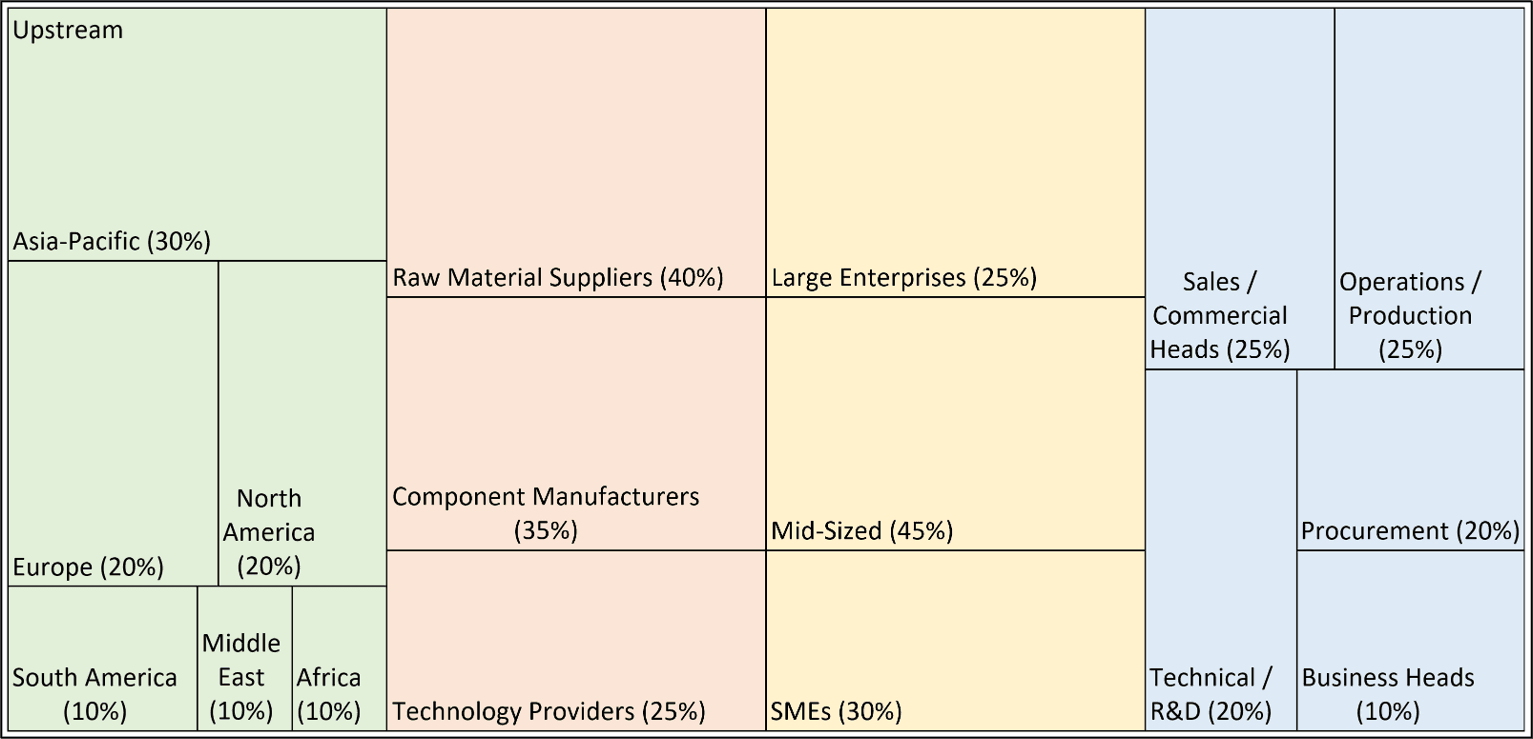
Midstream Sampling Distribution
Manufacturing & Integration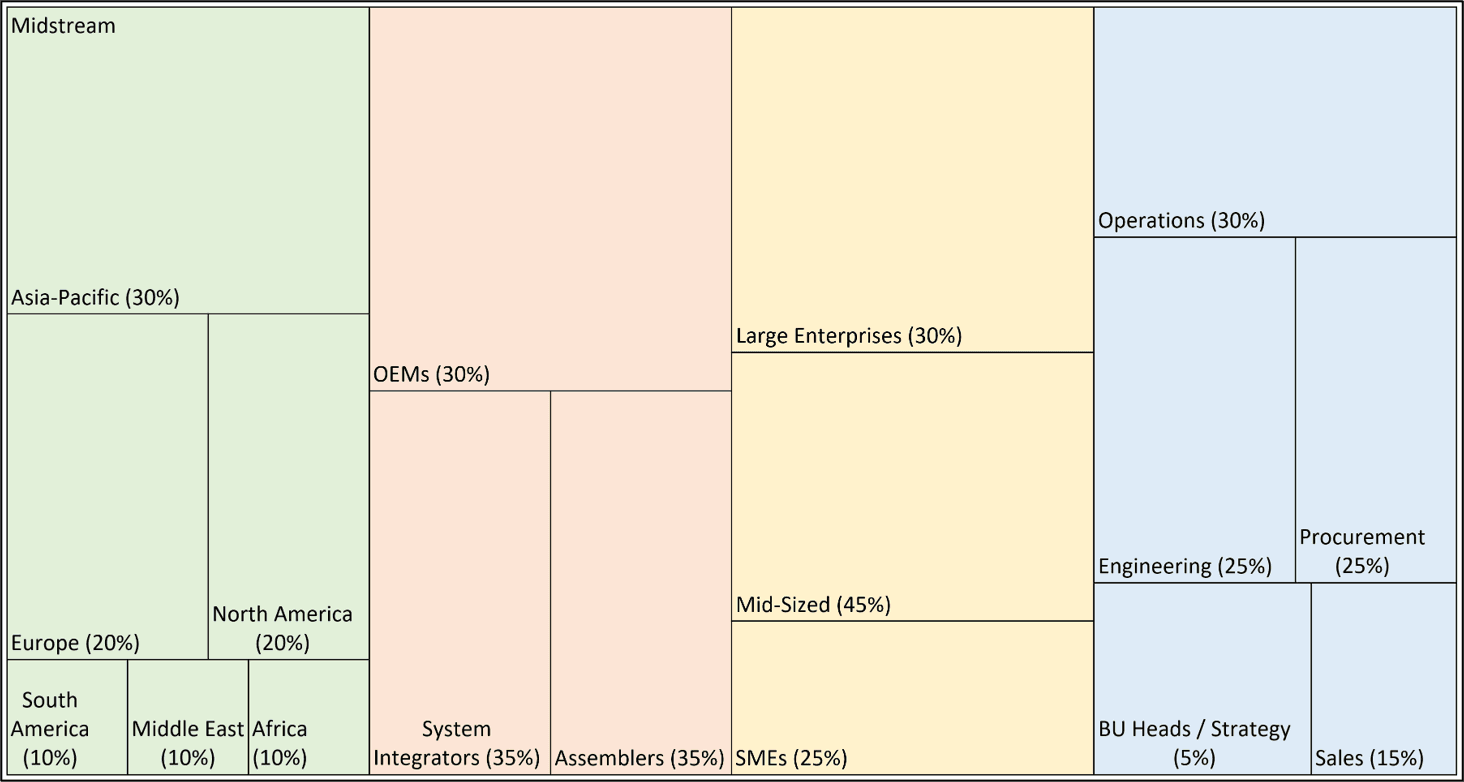
Downstream Sampling Distribution
Market & Demand Layer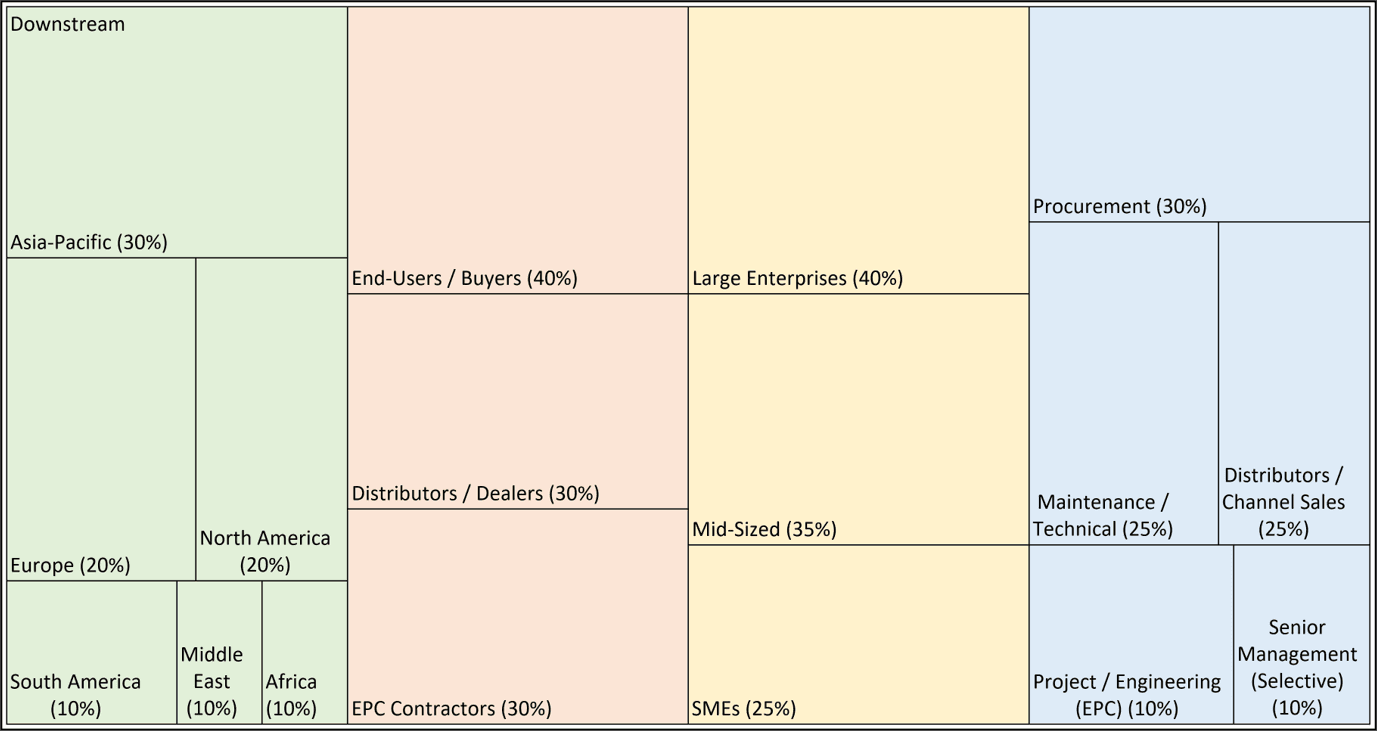
Part IV
Assessment Determination & Quality Controls
This part describes the analytical processes applied to collected data to produce a final, published assessment. It covers normalisation, expert judgement, outlier exclusion, and the special protocols applied in illiquid or data-thin markets.
4.1 Normalisation
Markets and datasets are inherently heterogeneous. Reported information may differ from the defined base specification in geography, product configuration, timing, scale, or currency. Normalisation is the process of adjusting submitted data so that all inputs align with the defined base parameters, allowing consistent comparison, aggregation, and analysis. Common normalisation adjustments include:
Geographic / Market Scope
Adjusting reported values or volumes to the study's base geography using observable regional differentials, trade flow data, logistics costs, or consumption-weighted benchmarks.
Product / Technical Specification
Adjusting for differences in model configuration, technology generation, performance tier, grade, or certification level using established market premiums, discounts, or comparable benchmarks.
Timing
Where data points originate earlier in the reporting window, adjusting for observable market movements between the original data timestamp and the close of the collection window using relevant indices or benchmarks.
Scale or Volume
Where reported volumes, contract sizes, or deployment scales fall outside the typical range for the defined market segment, normalising values to the representative market scale where a measurable volume-value relationship exists.
Currency
Converting local-currency values to the base reporting currency using the prevailing exchange rate at the time the underlying activity occurred, sourced from an independent and widely recognised FX benchmark.
All normalisation decisions are treated as forms of expert analytical judgement and are subject to internal methodological controls. Each adjustment applied during a reporting cycle is recorded in the research file, including the magnitude of the adjustment and the supporting rationale, ensuring transparency and auditability.
4.2 Expert Judgement
Expert judgement is the application of domain expertise and analytical reasoning to decisions that cannot be resolved through mechanical data processing or automated models alone. It is an inherent and legitimate component of market intelligence; our protocols ensure it is applied consistently, transparently, and subject to independent oversight. Expert judgement may be applied when:
- Determining whether a submitted data point meets admissibility and quality criteria.
- Deciding whether and how to apply normalisation adjustments to a data point.
- Identifying, investigating, and excluding statistical or contextual outliers.
- Interpreting incomplete datasets or reconciling conflicting signals across multiple sources.
- Establishing a defensible market estimate or outlook in data-sparse environments where observable evidence is limited.
Controls on Expert Judgement
- 1The lead analyst responsible for a study must document the judgement applied, the supporting information considered, and the conclusion reached within the research file prior to publication.
- 2All analyses are reviewed by a second qualified analyst — either a peer or senior reviewer — before publication. The reviewer may challenge, request clarification, or require re-justification of any judgement exercised.
- 3Judgements that deviate materially from historical precedent, established methodology, or recent market trends are escalated to the Head of Research for additional review and approval.
- 4Consistency across analysts is supported through formal training programs, internal methodology documentation for each covered market, and periodic cross-team calibration exercises.
4.3 Exclusion of Outliers
An outlier is a data point that deviates materially from the central tendency of the remaining evidence in a manner that cannot be explained by legitimate market conditions, structural differences, or definitional variations. The following factors are considered when evaluating whether to exclude a data point:
- The magnitude of deviation relative to other data points collected during the same reporting window.
- Whether the deviation aligns with or contradicts observable movements in related markets, comparable segments, or underlying demand-supply indicators.
- The historical reliability and track record of the submitting source, including consistency with previous submissions.
- Whether the deviation can be reasonably addressed through a documented normalisation adjustment rather than requiring full exclusion of the data point.
Exclusion of a data point is always explicit and documented. Data is never silently discarded. Any excluded submission remains archived in the research audit file with the reason for exclusion recorded to preserve transparency and methodological integrity.
4.4 Determination in Data-Sparse or Illiquid Markets
Not all markets generate sufficient observable data in every reporting cycle. Our methodology accommodates periods of reduced data availability without requiring the suspension of coverage or the introduction of unsupported estimates. Where no admissible primary data is available within a given reporting window, the lead analyst applies structured expert judgement, drawing on:
- The most recent published estimate or benchmark for the same market segment.
- Short-term historical trends and observable direction in demand, supply, or pricing indicators.
- Movements in related markets, substitute technologies, upstream inputs, or downstream demand sectors.
- Qualitative intelligence from verified market participants gathered through ongoing industry engagement.
- Relevant institutional or regulatory datasets that provide contextual signals for the period under review.
If the combined weight of available evidence does not provide a sufficiently clear indication of whether and by how much the market has shifted since the previous reporting cycle, the prior value may be carried forward (“rolled over”) and clearly flagged as such in the published output. A rolled-over figure is never presented as a newly derived market estimate.
4.5 Verification & Pre-Publication Review
Before any market estimate, forecast, or analytical output is published, it undergoes a structured pre-publication review process:
Internal Plausibility Check
The proposed output is compared against prior reporting periods and against movements in related markets or macro indicators to confirm overall consistency and logical coherence.
Peer Review
A second qualified analyst reviews the research file, verifies that all data inputs and adjustments have been applied appropriately, and either approves the output or requests clarification before publication.
Escalation Trigger
Any proposed change that exceeds predefined significance thresholds or materially alters the market outlook requires additional sign-off from the Head of Research.
AI-Output Verification
The lead analyst confirms that no generative AI output has been used as a primary data source and that all analytical conclusions are grounded in verifiable evidence and documented methodologies.
Part V
Publication, Corrections & Revision
5.1 Publication Standards
All published market estimates, forecasts, and analytical outputs include the following standard disclosures, either presented directly in the report or referenced through the methodology documentation:
- Market definition, including product or service scope, geographic coverage, unit of measure, and base currency.
- The published estimate or metric, expressed as a point estimate or range depending on the market structure and data availability.
- Indication of evidential basis, such as primary-data supported analysis, modeled estimation, expert judgement applied, or prior value carried forward where applicable.
- Relevant qualitative context, including regulatory developments, supply-chain disruptions, technological shifts, or seasonal demand factors that influenced the analysis.
Where outputs rely primarily on expert judgement or where prior-period values are carried forward due to limited new evidence, this status is explicitly disclosed. The analytical basis of any published output is never obscured.
5.2 Corrections Policy
We are committed to correcting material errors promptly and transparently. A correction may be issued when:
- An output relied on data that is later determined to be inaccurate, misreported, or submitted in bad faith.
- A calculation, normalization, or conversion error occurred during the preparation of the analysis.
- A data input was included or excluded in a manner inconsistent with the stated research methodology.
Corrections are limited to information that was available — or should reasonably have been available — during the relevant reporting window. Previously published outputs are not retroactively revised solely to incorporate data that emerged after the reporting period closed.
All corrections are published with a clear statement describing what was changed, the reason for the correction, and the date of the update. Both the original value and the corrected value are disclosed, and correction notices remain archived alongside the original publication for transparency.
5.3 Methodology Review & Change Process
This research methodology is reviewed formally at least once per year and additionally when structural changes occur in the markets covered. Reviews are conducted by the Research team and the internal Methodology Committee and may include structured consultation with clients or industry participants. Material changes to the methodology follow a structured process:
- 1A formal change proposal is prepared, outlining the rationale, scope, and expected impact on published outputs.
- 2Affected clients and contributing sources may be consulted for a defined feedback period prior to implementation.
- 3The final change is approved by the Head of Research and recorded in the internal revision history.
- 4Minor or clarificatory updates (such as typographical corrections or explanatory additions) may be implemented without a formal consultation period at the discretion of the Head of Research.
Part VI
Independence, Ethics & Complaints
6.1 Editorial Independence
Our firm maintains strict editorial independence between its research function and all commercial, sales, and advisory activities. Specifically:
- Analysts responsible for producing market intelligence and assessments do not participate in revenue-generating activities that could create a financial interest in the outcome of their analysis.
- Research outputs are determined solely on the basis of verifiable evidence and the methodology described in this document. No client, investor, or external party may direct, alter, or influence the analytical conclusions presented.
- The firm does not accept payments, gifts, or incentives from market participants in exchange for favourable coverage, preferential analysis, or altered market conclusions.
The credibility and value of our intelligence are grounded in objectivity. Any practice that compromises analytical independence would undermine the integrity of the research itself.
6.2 Data Security & Confidentiality
Contributor identities and sensitive data are treated with strict confidentiality. We do not disclose, directly or indirectly, which specific organisations or individuals contributed information to a particular study or dataset. Published outputs present aggregated intelligence without identifying individual sources.
All research data is stored on secure, access-controlled systems. Access to identifiable source information is restricted to authorized research personnel. Research audit files and supporting datasets are retained for a minimum of five years to ensure traceability and methodological accountability.
6.3 AI Transparency Policy
In response to the growing prevalence of AI-generated content and automated analysis, the firm adopts the following explicit safeguards:
- AI systems are never used as primary data sources for any market intelligence output, forecast, or market-size estimate.
- AI tools may be used for limited support functions such as data structuring, translation of source materials, transcription of interviews, or preliminary anomaly detection within large datasets. In all cases, AI outputs are treated as preliminary aids and are subject to full human verification.
- All published analysis must be traceable to human-verified evidence, including primary data sources, documented research inputs, and analyst-reviewed methodologies.
- AI-generated forecasts or third-party automated market estimates are not used as inputs into the firm's research outputs, regardless of the source platform.
This policy ensures that every published insight remains grounded in verified evidence and accountable human analysis.
6.4 Complaints & Clarification Process
Clients, contributing sources, or market participants may request clarification or submit a complaint regarding:
- The methodology applied to a specific study or market estimate.
- Whether a particular data submission was appropriately incorporated or excluded.
- A suspected error, omission, or potential conflict of interest in a published output.
Requests should be submitted in writing to the Head of Research. We commit to acknowledging receipt within two business days and providing a substantive response within ten business days.
Where a matter requires formal investigation, an interim update will be provided within ten business days, with a final response issued within thirty business days. If the complainant is not satisfied with the response, the matter may be escalated to senior management for further review. All complaints and their resolutions are recorded in a central log and reviewed periodically by the internal methodology governance committee.