
Introduction
Generative AI Statistics: Generative AI has moved from early experimentation to everyday business use in 2026. Adoption is being led by content creation, coding, sales support, marketing automation, customer service, data analysis, and knowledge work. Enterprise AI adoption is rising as businesses use it to automate work, improve campaigns, speed up customer response, and support non-technical employees.
AI adoption is now widespread, but enterprise-wide maturity is still developing. In 2025, 88% of organizations reported regular AI use in at least one business function, while only about one-third had begun scaling AI across the enterprise. AI agents are also gaining traction, with 23% of organizations already scaling agentic AI systems and 39% still experimenting.
Generative AI investment remains strong. Global private investment in generative AI reached USD 33.9 billion in 2024, up 18.7% from 2023, and represented more than 20% of all AI-related private investment. This shows that capital is shifting toward foundation models, enterprise AI tools, AI agents, productivity software, and industry-specific applications.

Editor’s Choice
Generative AI adoption reached 54.6% among U.S. adults aged 18-64 in August 2025, a 10% increase in a single year.
88% of organizations reported regular AI use in at least one business function in 2025, up from 78% a year earlier.
92% of Fortune 500 companies now use OpenAI's generative AI products across their organizations.
For every $1 invested in generative AI, companies report an average return of $3.70.
62% of surveyed organizations were either experimenting with or scaling AI agents, showing strong interest in autonomous workflow execution.
ChatGPT held 76.85% of the worldwide AI chatbot market share in April 2026, followed by Google Gemini at 9.0% and Perplexity at 7.73% .
92% of early gen AI adopters say they have seen a positive return on their investments.
Enterprise gen AI spending reached $37 billion in 2025, a 3.2x i ncrease year-over-year from $11.5 billion in 2024.
Only 7% of organizations have fully scaled AI enterprise-wide, despite 88% using it in at least one function.
82% of enterprise leaders use generative AI at least weekly in 2025, up from 37% in 2023.
ChatGPT reached 891 million total monthly users in March 2026.
87% of sales organizations used some form of AI in 2026 for tasks such as prospecting, forecasting, lead scoring, and email drafting.
88% of enterprise leaders anticipate gen AI budget increases in the next 12 months.
The global number of AI tool users is projected to grow from 2.1 billion in 2026 to 3.5 billion by the end of 2027.
91% of customer service and support leaders said they were under executive pressure to implement AI in 2026.
Generative AI Market Size
The generative AI market is one of the fastest-growing technology segments in recorded history, and the estimates for its size depend heavily on what analysts choose to include. The global Generative AI Market was valued at USD 109.3 billion in 2025 and is projected to reach USD 1,651.8 billion by 2035, growing at a CAGR of 31.2% . The market is being supported by rising adoption of large language models, AI-powered search, synthetic content creation, code generation, customer service automation, and AI agents across enterprise workflows.

Key Insights
Software led the generative AI market with 67.1% share in 2025, supported by high adoption of AI platforms, APIs, model development tools, and enterprise generative AI applications.
Transformers dominated by technology with 45.9% share in 2025, driven by their strong role in large language models, coding assistants, image generation, and multimodal AI systems.
Media and entertainment accounted for the largest end-use share of 39.5% in 2025, supported by growing use in content creation, video production, gaming, advertising, and digital media workflows.
Natural language processing led by application with 37.8% share in 2025, driven by demand for chatbots, virtual assistants, translation, summarization, and enterprise knowledge tools.
Large language models held the leading model share of 49.2% in 2025, supported by rapid adoption of AI copilots, conversational AI, coding tools, and automated content platforms.
App builders dominated the customer segment with 58.5% share in 2025, as developers, startups, and enterprises increasingly integrated generative AI into apps, software products, and business platforms.
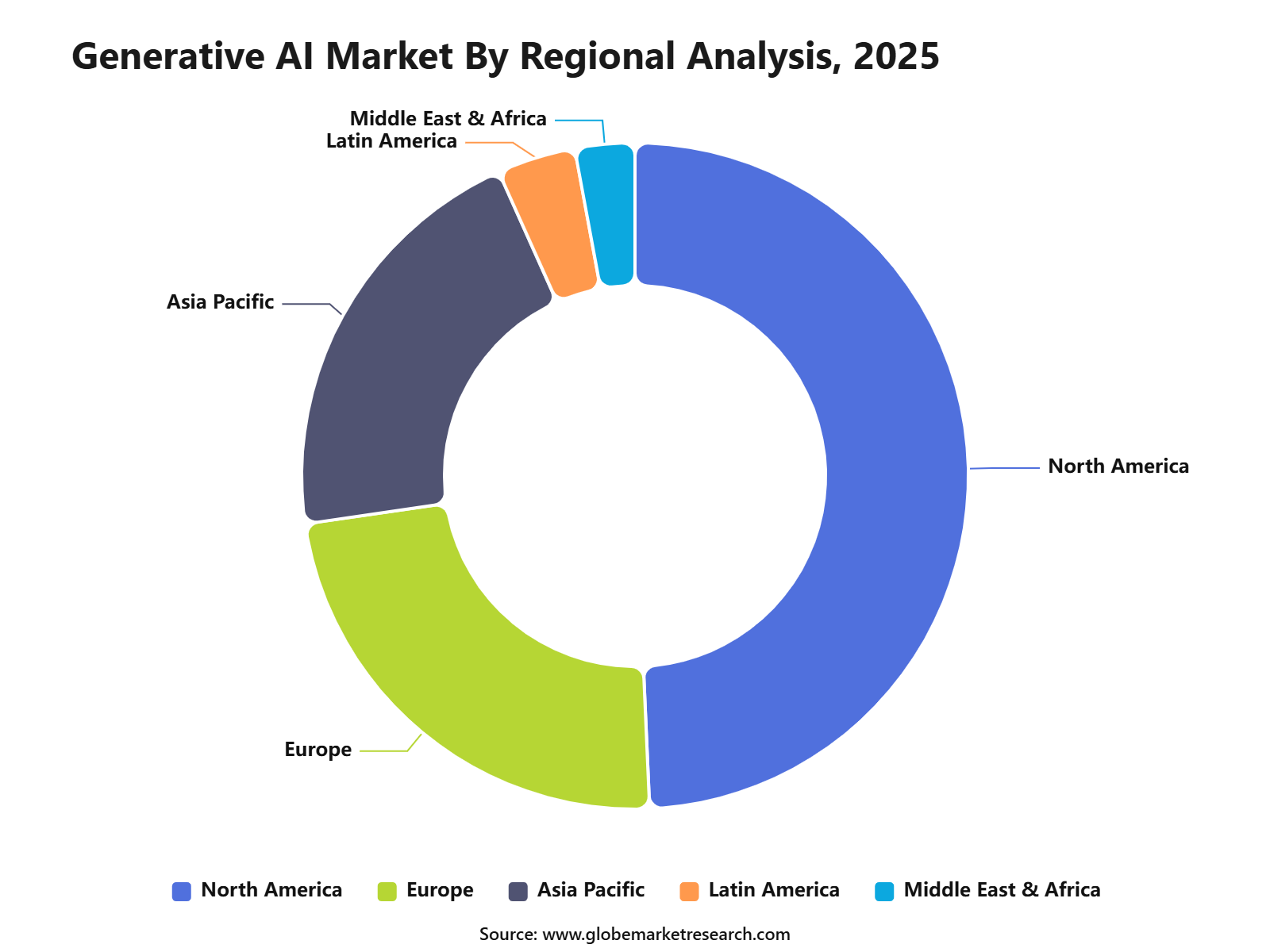
North America led the generative AI market with 49.3% share in 2025, supported by strong AI investment, advanced cloud infrastructure, and early enterprise adoption.
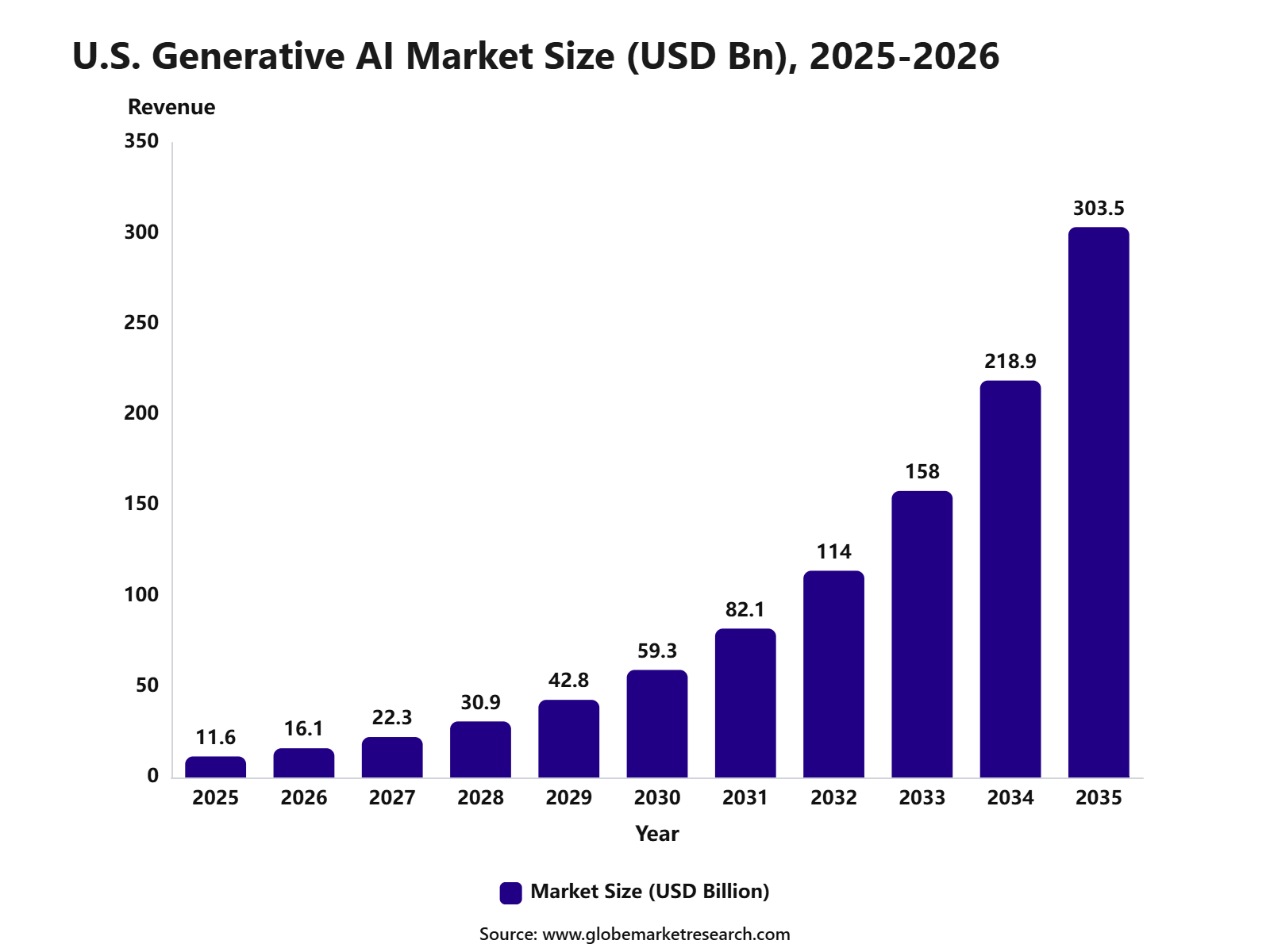
The U.S. generative AI market was valued at USD 11.6 billion in 2025 and is projected to grow at a CAGR of 38.6%.
Looking at the broader infrastructure picture, major technology companies including Amazon, Alphabet, Meta, and Microsoft are projected to spend up to $665 billion on AI infrastructure in 2026, a 74% increase over 2025. NVIDIA controls an estimated 82% of the AI training chip market, with data center revenue reaching $130 billion in fiscal 2026. The AI software market specifically, covering platforms, tools, and applications, is expected to reach $184 billion in 2026, up 42% year-over-year, with over 14,200 active AI tools now available, a 68% increase from 2025.
North America remained the leading region in 2025 with a 49.3% market share, supported by strong cloud infrastructure, early enterprise AI adoption, high venture funding, and the presence of major AI model developers. The U.S. market reached USD 11.6 billion in 2025 and is expected to expand at a CAGR of 38.6% , driven by AI integration across software, media, healthcare, finance, education, marketing, and business operations.
Generative AI Adoption Statistics
62% of organizations are still in the experimentation phase as of 2026
88% of enterprise leaders anticipate AI budget increases in the next 12 months, with 62% expecting increases of 10% or more.
Deloitte reported that companies with 40% or more GenAI projects in production are expected to double within six months, which points to faster enterprise scaling in 2026.
23% of organizations were scaling AI agents somewhere in the enterprise, while 39% were experimenting with agentic AI systems.
64% of organizations said AI was enabling innovation, while 39% reported some level of EBIT impact from AI adoption.
70% of Gen Z report having used generative AI, making them the highest adoption cohort by age group
75% of surveyed ChatGPT Enterprise workers reported that AI improved the speed or quality of their output.
AI-related risk management is becoming more important, as 51% of organizations using AI reported at least one negative consequence, with inaccuracy being one of the most common issues.
In software development, a 2026 academic study found that 79% of surveyed developers used GenAI daily, while more than 70% reported that GenAI helped cut time for boilerplate coding and documentation tasks by at least half.
Generative AI usage varies sharply by country: India at 73% , Australia at 49% , the United States at 45%, and the United Kingdom at 29%.
92% of Fortune 500 companies now use ChatGPT, making it the most embedded AI tool in large-enterprise stacks.
Daily users of generative AI report productivity gains at 92% , compared with 58% among occasional users.
Generative AI Tool Usage Statistics
Based on data from Master of Code, ChatGPT led AI app downloads with 40.52% of total downloads, showing its strong position in the consumer AI tools market.
DeepSeek ranked second with 17.59% share, supported by fast adoption and strong visibility among AI users.
Google Gemini accounted for 9.6% of total downloads, driven by Google’s wider AI ecosystem and mobile reach.
Doubao captured 8.89% share, reflecting strong demand for AI assistant tools in Asian markets.
DeepSeek by Hangzhou Deep Search held 7.76% share, further strengthening DeepSeek’s presence among downloaded AI applications.
PixVerse accounted for 6.19% share, supported by rising demand for AI-powered video and creative content tools.
Talkie captured 4.68% share, driven by growing interest in conversational and character-based AI apps.
Nova held 4.35% share, supported by demand for mobile AI chatbot applications.
Microsoft Copilot accounted for 2.83% share, supported by its integration across productivity and enterprise workflows.
Character AI captured 2.81% share, driven by demand for interactive chatbot and roleplay-based AI experiences.
Most Visited AI Platforms by Monthly Web Traffic
As of November 2025, ChatGPT led AI platform traffic with around 5.6 billion monthly visits, showing its dominant position in global AI usage.
Gemini reached around 650 million monthly users, supported by Google’s broad product ecosystem and AI integration.
DeepSeek recorded nearly 328.2 million monthly visits, reflecting strong adoption across AI search, reasoning, and chatbot use cases.
Perplexity attracted around 239.9 million monthly visits, supported by demand for AI-powered search and answer engines.
Claude recorded approximately 185.3 million monthly visits, driven by adoption among professionals, developers, and enterprise users.
Character.AI reached about 141.1 million monthly visits, supported by demand for conversational and entertainment-focused AI experiences.
Microsoft Copilot accounted for nearly 110.3 million monthly visits, supported by its integration across productivity and enterprise workflows.
QuillBot recorded around 59.0 million monthly visits, driven by demand for writing, paraphrasing, and grammar support tools.
Duolingo attracted around 48 million to 51 million monthly visits, supported by AI-enabled language learning and strong mobile learning adoption.
Top Generative AI Chatbots by Market Share (April 2026)
Rank | Tool | AI Search Market Share | Quarterly User Growth | Primary Strength |
|---|---|---|---|---|
1 | ChatGPT | 60.2% | 4% | General-purpose, writing, coding, research |
2 | Google Gemini | 15.3% | 12% | Google Workspace and multimodal tasks |
3 | Microsoft Copilot | 12.8% | 3% | Microsoft 365 enterprise workflows |
4 | Perplexity | 5.5% | 4% | Accuracy-focused AI search with citations |
5 | Claude AI | 4.9% | 14% | Long documents and nuanced business analysis |
6 | Grok | 0.6% | 4% | Real-time search and trend scanning |
7 | DeepSeek | 0.2% | 7% | Technical reasoning and structured output |
GenAI in Sales Statistics
Sales was one of the first business functions to see both significant AI adoption and clearly measurable outcomes. Generative AI adoption in sales has accelerated in 2026 as companies use AI tools for lead scoring, prospect research, personalized outreach, call summaries, proposal writing, CRM updates, and pipeline forecasting.
83% of sales teams using AI reported revenue growth, compared with 66% of teams not using AI, a 17% point gap
92% of sales reps now use AI in some form, up from 24% in 2023 and 43% in 2024
81% of sales teams are either experimenting with or have fully deployed AI
AI-using sales teams save 40 to 60 minutes per day per representative on research, data entry, and content tasks
ZoomInfo's data shows AI users reporting 81% shorter deal cycles and 73% increases in deal sizes
AI tools cut research and personalization time by 90% for sales development workflows
Sellers currently spend only about 25% of their time actually selling; AI has the potential to double that by automating administrative and research tasks
By 2028, 90% of B2B buying is expected to be intermediated by AI agents, moving from being influenced by AI to being handled by AI
GenAI Implemented in Marketing
Generative AI has become a core marketing tool for content creation, campaign planning, audience segmentation, SEO briefs, email writing, ad copy testing, creative development, and customer journey personalization. HubSpot reported that 66% of marketers globally were using AI in their roles in 2025, based on a survey of more than 1,000 marketing and advertising professionals. This adoption level is expected to strengthen in 2026 as marketing teams use GenAI to produce faster content workflows and improve campaign efficiency.
Marketing teams are also moving from simple content generation to data-driven campaign support. Salesforce’s State of Marketing report highlights that predictive and generative AI are becoming common in marketing, with marketers using AI to create, personalize, and integrate campaigns at scale. The strongest use cases are expected in content operations, customer segmentation, marketing automation, performance analysis, and personalized engagement.
88% of digital marketers use AI in their day-to-day roles
60% of marketers use AI tools daily
93% of marketers use AI to generate content faster
55% of marketers cite content creation as the most common use case for AI in their workflows
AI enables companies to publish 42% more content per month
74% of new web pages now include some form of AI-generated content
68% of businesses have seen increased content marketing ROI from AI tools
65% of businesses saw an uplift in SEO performance from AI marketing tools
AI saves marketers an average of 13 hours per week on daily tasks
Marketers using AI report being 44% more productive on average
AI-driven PPC bid management can reduce wasted ad spend by roughly 37% while increasing overall ad ROI by 50%
GenAI Implemented in Customer Service
Customer service is one of the fastest-growing GenAI use cases because it offers clear benefits in response speed, case routing, agent assistance, self-service support, and customer satisfaction. Salesforce’s 2025 State of Service report found that AI is expected to resolve 50% of customer service cases by 2027, compared with around 30% currently. This shows that AI-based service automation is becoming a major part of contact center modernization.
GenAI is being used in customer service to summarize cases, recommend answers, draft responses, analyze customer sentiment, and support human agents during live interactions. The growth of AI agents is expected to further improve support capacity, especially in high-volume industries such as retail, telecom, banking, travel, software, and healthcare. However, human oversight remains important for sensitive cases, escalations, compliance, and complex customer issues.
56% of customer support interactions are projected to involve agentic AI by mid-2026, according to Cisco's survey of nearly 8,000 decision-makers across 30 countries
91% of customer service leaders report direct executive pressure to implement AI
75% of customer service leaders have increased their AI budgets to match this demand
70% of CX leaders believe chatbots are becoming capable architects of personalized customer journeys
69% of organizations believe generative AI can help humanize digital interactions rather than make them feel robotic
80% of employees say AI has already improved the quality of their work in customer-facing roles
83% of employees say AI's capacity for decision-making is a major highlight of adoption
70% of frontline agents are already using generative AI tools that their companies have not officially sanctioned
72% of CX leaders say they have provided adequate AI training, but fewer than half of their agents agree
Only 34% of customer service agents say they understand their department's AI strategy
59% of consumers believe generative AI will change how they interact with companies in the next two years
48% of customers say it has become harder to tell the difference between AI and human service representatives
GenAI Implemented in Business Operations
Across business operations, generative AI is being adopted for document processing, internal knowledge search, financial analysis, HR support, legal review, procurement, reporting, workflow automation, and strategic planning. Microsoft’s 2026 research on M365 Copilot found that the tool is used weekly by millions of people across more than 1 million companies, with writing, information retrieval, analysis, decision support, and communication tasks among the main workplace use cases.
Business adoption is expected to become more structured in 2026 as enterprises move from individual productivity tools to integrated AI workflows. The main focus areas include productivity improvement, faster decision-making, lower operating costs, improved customer engagement, and better employee support. At the same time, companies are investing in governance, data security, model monitoring, and responsible AI policies to reduce risks linked to inaccurate outputs, privacy exposure, and overreliance on automated decisions.
Global enterprise AI spending is projected to reach $407 billion in 2026, up 34.8% from 2025
Generative AI accounts for $127 billion of that total, growing at 59% year-over-year
For every $1 invested in generative AI, companies report an average return of $3.70, with financial services leading at 4.2x ROI
92% of early generative AI adopters report a positive return on investment
92% of businesses intend to invest in generative AI tools over the next three years
Workers using generative AI save 5.4% of their work hours weekly, equivalent to a 33% productivity gain for every hour spent
Knowledge workers save an average of 6.4 hours per week using AI tools for routine tasks
More than 80% of organizations still report no measurable impact on enterprise-level EBIT from generative AI
95% of enterprise AI pilots deliver zero measurable profit-and-loss impact, according to MIT research
Organizations that buy from specialized AI vendors succeed at double the rate of those building internally, 67% versus 33%
61% of CEOs say their organization is actively adopting AI agents and preparing to implement them at scale
Recent Developments
May 2026 – Anthropic raised USD 65 billion in Series H funding, increasing its post-money valuation to USD 965 billion. The funding is expected to support Claude model development, enterprise AI adoption, and large-scale computing infrastructure.
March 2026 – OpenAI closed a major funding round with USD 122 billion in committed capital at a post-money valuation of USD 852 billion. The company stated that the capital will support AI infrastructure, enterprise deployment, developer tools, and broader ChatGPT adoption.
November 2025 – NVIDIA reported quarterly revenue of USD 57.0 billion, up 62% year over year. Its data center revenue reached USD 51.2 billion, supported by strong demand for Blackwell GPUs used in generative AI training and inference.
Future Outlook
The future outlook for the Generative AI Market remains highly positive. Growth will be supported by wider enterprise adoption, AI assistants, agentic AI systems, multimodal models, industry-specific copilots, AI-enabled software, and rising demand for automation across knowledge work.
However, future growth will also depend on trust, regulation, copyright clarity, data security, and measurable business value. Companies that use generative AI with strong governance and clear use cases are expected to gain more value than those using it only for disconnected experiments.