Introduction
AI in B2B sales and marketing refers to the use of artificial intelligence tools to improve lead generation, customer targeting, campaign planning, content creation, sales outreach, forecasting, and buyer engagement. The technology is now being used across the full B2B revenue cycle, from identifying high-value accounts to personalizing email campaigns and improving sales conversations. In 2026, 95% of B2B marketers were using AI at least weekly, while 65% were using it daily, showing that AI has moved from a test tool to a regular part of marketing work.
The growth of AI in B2B sales and marketing can be attributed to rising pressure on companies to improve productivity, reduce manual work, and reach buyers with more relevant content. Sales teams are also using AI at scale, with 87% of sales organizations using AI for tasks such as prospecting, forecasting, lead scoring, and email drafting. AI is becoming especially important as B2B buyers conduct more independent research before speaking with sales teams, which makes timely insights, stronger content, and data-led engagement more valuable.
Editor’s Choices
The global AI market was valued at USD 432.5 billion in 2025 and is projected to reach USD 7,268.1 billion by 2035, growing at a CAGR of 32.6%.
North America led the market with a 42.4% share in 2025, while the U.S. market reached USD 133.2 billion and is expected to grow at a 28.9% CAGR
95% of B2B marketers use AI at least weekly, while 65% use it daily.
87% of sales organizations use AI for prospecting, forecasting, lead scoring, or email drafting.
Based on data from hubspot, 80% of marketers use AI for content creation, and 75% use it for media production.
B2B marketers save around 20 hours per week on average by using AI for content, research, analysis, and campaign management.
according to salesforce, 89% of sellers using AI say it improves customer understanding, while 87% say it makes their job less stressful.
40% of B2B marketers expect more spending on AI for content optimization and performance, while 39% expect higher spending on AI for content creation.
84% of sales teams without an all-in-one platform plan to consolidate their technology to improve AI outcomes.
46% of sales professionals with AI agents say data quality issues hurt sales performance.
According to InsightMark Research, The AI SDR (Sales Development Representative) market specifically is projected to reach $15.01 billion by 2030, growing at 29.5% CAGR, with 22% of teams already having fully replaced human SDRs with AI agents as of 2025.

AI Market Size
Software remained the leading component in the AI market, capturing 53.4% share in 2025. Growth was supported by higher enterprise use of AI platforms, analytics systems, automation tools, and business software applications.
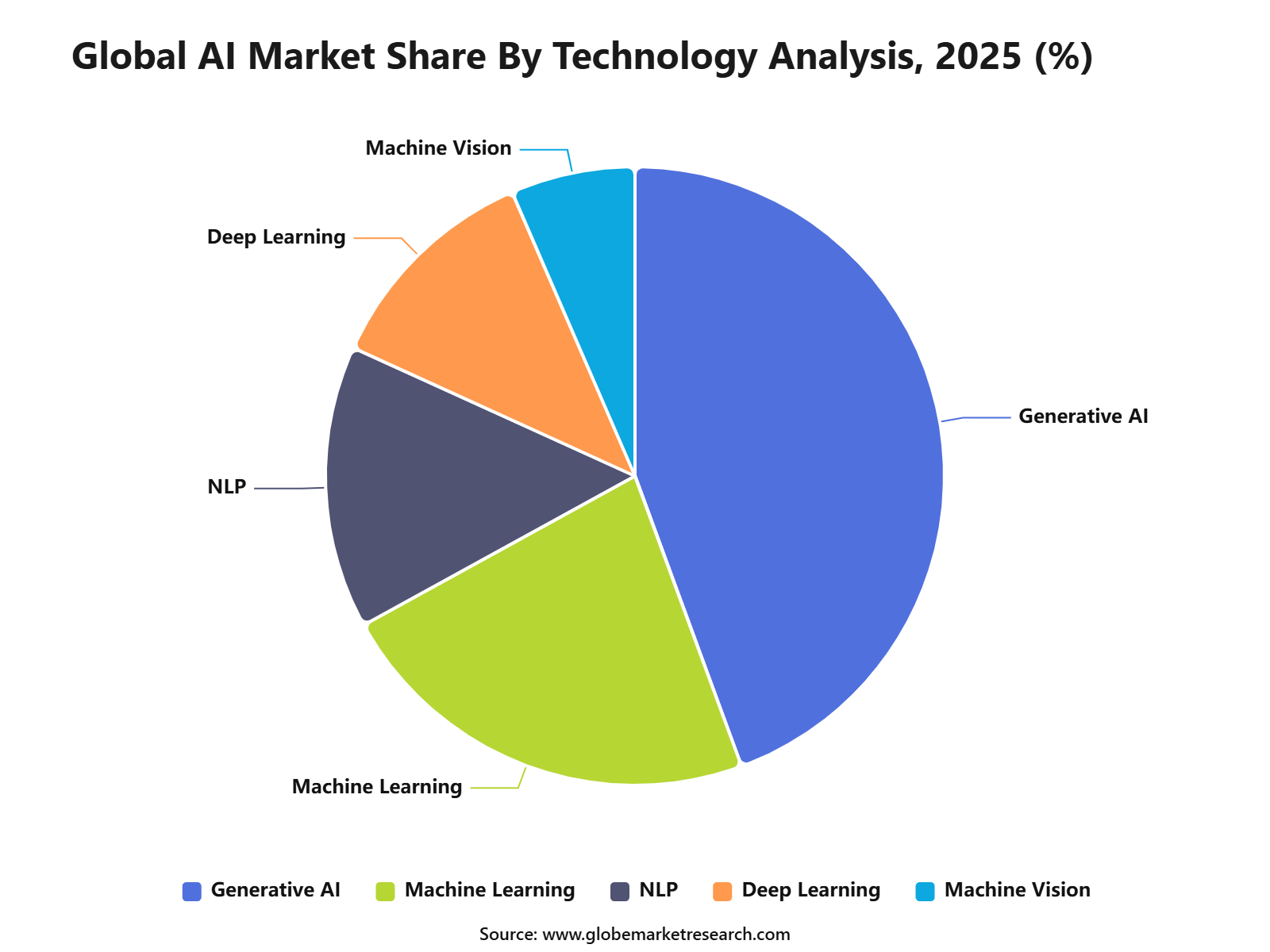
Generative AI emerged as the dominant technology segment with 44.4% share in 2025. Its strong position was driven by increasing use in content creation, coding support, customer engagement, research workflows, and productivity improvement.
Operations accounted for the highest functional share at 23.2% in 2026. The segment gained momentum as companies adopted AI to automate workflows, improve process efficiency, strengthen supply chain planning, and support faster decision-making.
BFSI led the end-use segment with 22.6% share in 2025. Adoption was driven by the use of AI in fraud monitoring, credit scoring, risk management, customer support, compliance tracking, and financial data analysis.
North America held 42.4% share of the AI market, supported by strong digital infrastructure, high technology spending, advanced cloud adoption, and early enterprise-level AI deployment.
The U.S. AI market reached USD 133.2 billion and is expected to grow at a CAGR of 28.9%, supported by rising investment in AI software, cloud-based AI systems, and business automation.

AI Market Share Statistics
Adoption Rates
Area | Statistic | Market Meaning |
|---|---|---|
B2B marketing AI use | 95% use AI at least weekly | AI has become a standard work tool for B2B marketers. |
Daily AI use in B2B marketing | 65% use AI daily | Frequent use shows deeper workflow integration. |
Sales organization AI use | 87% use AI in sales tasks | AI is now widely used across core selling activities. |
AI agent use in sales | 54% of sellers have used agents | Agent-based selling is moving beyond early trials. |
Planned AI agent use | Nearly 90% plan to use agents by 2027 | Adoption is expected to expand quickly across sales teams. |
B2B AI adoption is being led by daily workflow needs rather than long-term experimentation. The strongest use is seen in content creation, lead work, data analysis, customer understanding, and productivity support.
AI in B2B Sales Performance
Based on data from salesforce, AI is improving sales performance by reducing manual work and supporting faster decision-making. Sellers using AI report clear benefits, with 89% saying AI deepens customer understanding and 87% saying it reduces job stress. Sales teams also expect AI agents to reduce prospect research time by 34% and email drafting time by 36% once fully implemented.
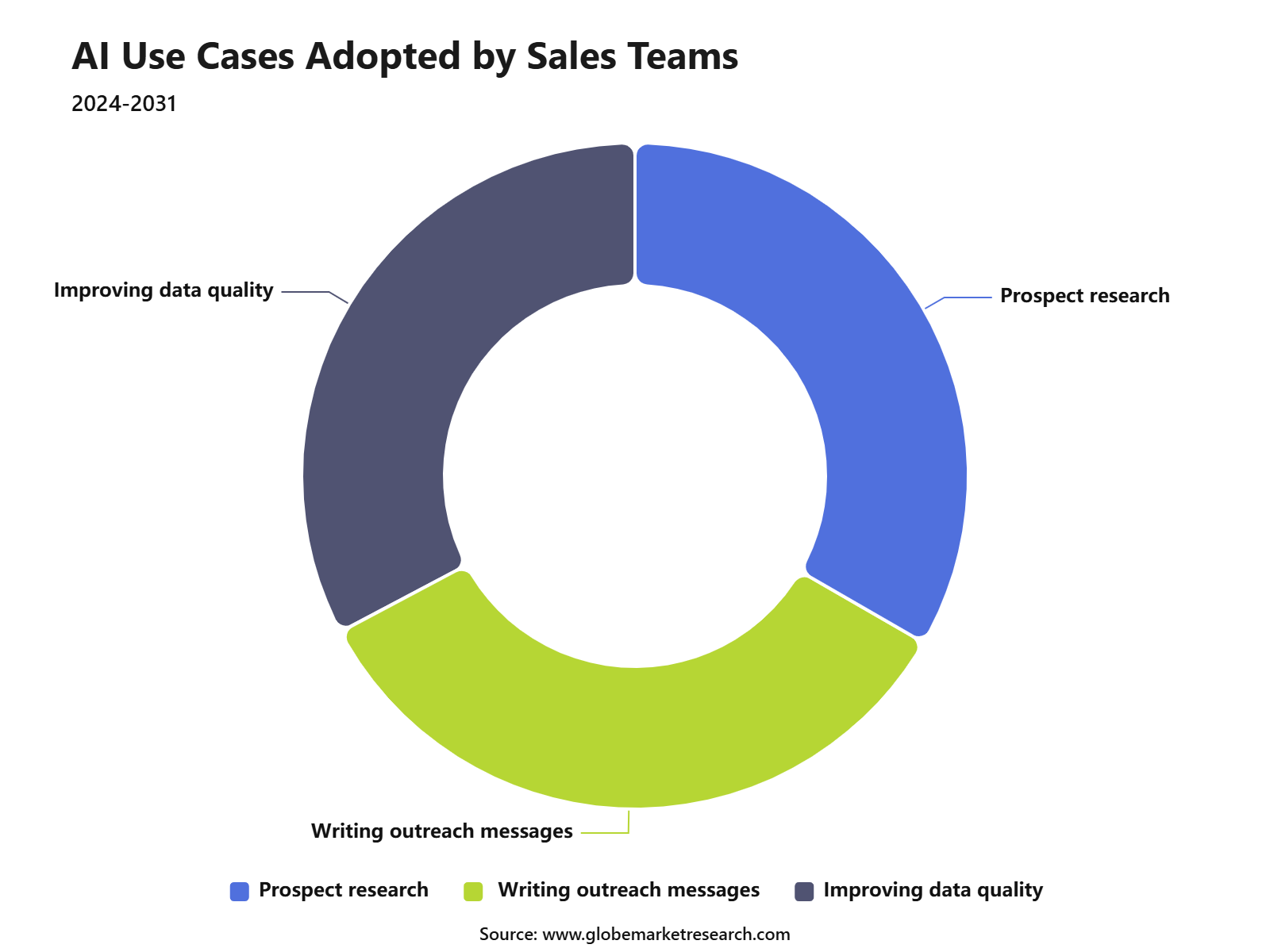
AI agents are being used across the sales cycle, including order fulfilment, product usage tracking, quote creation, commission management, and prospecting. High-performing sellers are 1.7 times more likely than underperformers to use prospecting AI agents, which indicates a link between AI use and stronger sales execution.
B2B Marketing AI Budgets
According to Content Marketing Institute, B2B marketing budgets are shifting toward AI-enabled content and campaign performance. In 2025, 40% of B2B marketers expected higher investment in AI for content optimization and performance, while 39% expected increased spending on AI for content creation. Video remained the top spending area at 61%, but AI entered the budget mix as a major new investment category.
This spending pattern shows that B2B marketers are not only using AI for writing support. Budget is also being allocated to performance improvement, campaign testing, search visibility, reporting, and conversion-focused content workflows.
AI Usage in B2B Marketing
Use Area | Adoption / Usage Fact | Business Impact |
|---|---|---|
Content creation | 80% of marketers use AI | Faster production of blogs, emails, ads, and landing pages. |
Media production | 75% use AI | Supports images, video, and creative asset development. |
Content planning | 94% plan to use AI in content creation processes in 2026 | AI is becoming embedded in editorial and campaign workflows. |
Marketing automation | 93% use automation for administrative tasks | Reduces manual scheduling, documentation, and routine work. |
Data analysis and reporting | 92% use automation | Improves reporting speed and campaign visibility. |
AI usage in B2B marketing is strongest where speed, scale, and repeatable work are important. Content, reporting, campaign testing, and administrative workflows are the most common areas where marketers are applying AI and automation.
Benefits of AI for B2B Marketing
AI is helping B2B marketing teams improve speed, personalization, campaign execution, and customer insight. B2B marketers reported saving around 20 hours per week on average by using AI for content creation, research, analysis, and campaign management. This is important for lean teams that need to manage more campaigns with limited resources.
AI is also changing demand generation. Around 37% of marketers say leads are more informed because of AI, while nearly 70% say leads now come later in the buying process after completing more AI-assisted research. This makes educational content, buyer intent data, and sales-marketing alignment more important for B2B companies.
Impact AI Is Having on B2B Marketing
AI is reshaping how B2B buyers search, compare, and shortlist vendors. More than two-thirds of software buyers now actively consider AI capabilities when selecting software. Four out of five buyers reported positive returns from AI-powered software investments, while 32.5% said AI exceeded expectations and 38.2% said it met expectations.
The impact is also visible in vendor switching. In 2025, 49.5% of enterprise buyers switched to software with better AI features. Better insights and decision-making were the top reason for switching, followed by operational efficiency and cost savings.
Leading AI Tools in Use in B2B Marketing
The most widely used AI tools in B2B marketing are general AI assistants, productivity copilots, CRM-based AI, marketing automation AI, predictive audience tools, sales intelligence AI, and content optimization platforms. These tools are mainly used for research, content drafting, campaign planning, segmentation, reporting, sales outreach, meeting summaries, and customer data analysis.
Common tool categories include:
Tool Category | Main B2B Marketing Use |
|---|---|
Generative AI assistants | Content ideas, email copy, blogs, ad copy, summaries, research support |
CRM AI tools | Lead scoring, account insights, forecasting, sales notes, next-best action |
Marketing automation AI | Email flows, audience triggers, campaign personalization |
Predictive targeting tools | Buyer intent, account scoring, audience discovery |
SEO and content AI tools | Keyword research, content briefs, search optimization, AI search readiness |
Sales intelligence AI | Prospect research, outreach personalization, account monitoring |
Reporting AI | Dashboard summaries, trend detection, campaign performance analysis |
AI and B2B Marketing Strategy
AI is becoming a core part of B2B marketing strategy because buying journeys are more self-directed and research-heavy. Nearly 70% of marketers say leads now arrive later in the buying process after doing more AI-assisted research. This means B2B brands need stronger educational content, clearer product proof, and better visibility across search, social, communities, and AI-powered discovery platforms.
Marketing strategy is also shifting toward data quality and measurement. Around 40% of marketers say lead quality and marketing qualified leads are their most important success metric, followed by lead-to-customer conversion rate at 34%, ROI at 31%, customer acquisition cost at 30%, and lead generation volume at 29%.
AI B2B Marketing Challenges
AI adoption is creating new challenges in data quality, skills, governance, security, and measurement. Only 32% of B2B marketers rated their AI expertise as extremely good, while only 38% of CMOs felt highly confident in their AI skills. This shows that AI usage is high, but advanced capability remains uneven.
Data is another key barrier. In sales teams using AI agents, the top data issues include manual errors, duplicate data, security concerns, incomplete data, and corrupt data. About 51% of sales professionals said security concerns delayed AI initiatives, while 46% said data quality issues hurt sales.
Emerging Trends
AI-powered account-based marketing is becoming a major trend as B2B teams use AI to identify high-value accounts, track buyer intent, and personalize outreach by industry, company size, and decision-maker role.
Generative AI is increasingly being used for B2B content production, including blogs, white papers, email campaigns, landing pages, ad copy, video scripts, and product explainers, helping teams reduce content turnaround time.
AI sales agents are gaining traction for prospect research, lead qualification, follow-up reminders, quote support, and meeting preparation, allowing sales teams to focus more on relationship building and deal conversion.
Predictive analytics is being used more widely to improve lead scoring, sales forecasting, churn risk detection, and campaign performance measurement, making B2B revenue planning more data-driven.
AI governance, data quality, and human review are becoming essential as companies work to reduce inaccurate outputs, protect customer data, maintain brand consistency, and improve trust in AI-supported marketing decisions.
Conclusion
AI is becoming a core part of B2B sales and marketing as companies seek faster execution, better targeting, and stronger customer engagement. Its value is being seen across content creation, lead generation, account-based marketing, sales forecasting, personalization, and revenue operations.
The market is expected to benefit as more companies connect AI tools with CRM systems, marketing platforms, buyer intent data, and sales workflows. However, long-term success will depend on clean data, trained teams, clear governance, and a balanced approach where AI supports human decision-making rather than fully replacing it.