
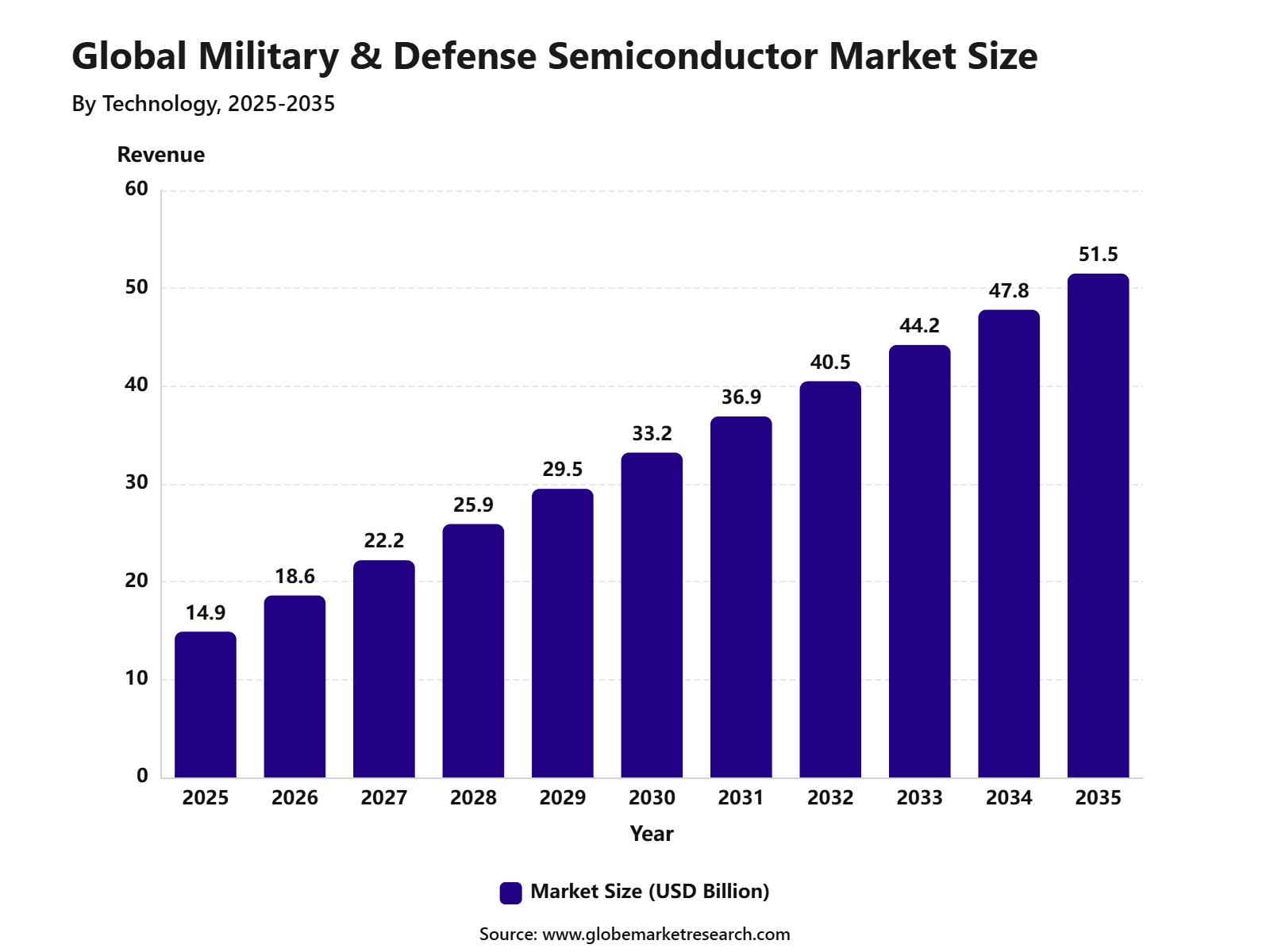
Globe Market Research has published a new report on the Global Military & Defense Semiconductor Market, which was valued at USD 14.9 billion in 2025 and is projected to reach USD 51.5 billion by 2035, growing at a CAGR of 13.2% from 2025 to 2035. The growth of the market is supported by rising defense modernization programs, higher use of advanced electronics in military platforms, and increasing demand for secure chips used in radar, communication, electronic warfare, surveillance, and command-and-control systems.
Key Parameter | Report Details |
|---|---|
Market Revenue, 2025 | USD 14.9 Billion |
Projected Revenue, 2035 | USD 51.5 Billion |
CAGR (2025-2035) | 13.2% |
Largest Region | North America |
Market Concentration/Structure | Medium/Moderately Consolidated |
Base Year | 2025 |
Forecast Period | 2025-2035 |
What is Military and Defense Semiconductors?
Military and defense semiconductors are used across mission-critical systems such as radar modules, satellite payloads, electronic warfare systems, guided weapons, drones, aircraft, naval systems, and protected computing platforms. These chips are different from consumer electronics because they require higher reliability, traceability, long service life, secure architecture, and stable performance in harsh operating conditions.
The market is gaining strong momentum as defense budgets move toward precision weapons, autonomy, missile defense, cyber resilience, and space capability. The growing use of advanced semiconductors in autonomous defense platforms, next-generation fighter aircraft, drones, naval systems, satellite communication, and high-performance computing is expected to support steady market expansion.
Download PDF Brochure: https://www.globemarketresearch.com/request-sample?reportId=1145
“Military and defense semiconductor demand is being shaped by the need for secure, reliable, and high-performance electronics across modern defense platforms. As radar, electronic warfare, unmanned systems, satellite defense, and AI-enabled military systems become more advanced, the use of trusted semiconductors is expected to increase across both military and aerospace applications,” said Manoj H., Head of Client Relations at Globe Market Research.
Key Market Insights
Microprocessors and microcontrollers led the component segment with 30.1% share. Growth was supported by their critical role in mission systems, command-and-control platforms, navigation equipment, and secure defense electronics.
Radar and surveillance systems accounted for 29.6% share by application. The segment was driven by rising investment in threat detection, border security, intelligence gathering, battlefield monitoring, and advanced surveillance platforms.
Surface Mount Technology held 76.3% share by technology. Its adoption was supported by compact design, high reliability, and strong suitability for aircraft, missiles, drones, satellites, radar modules, and portable military devices.
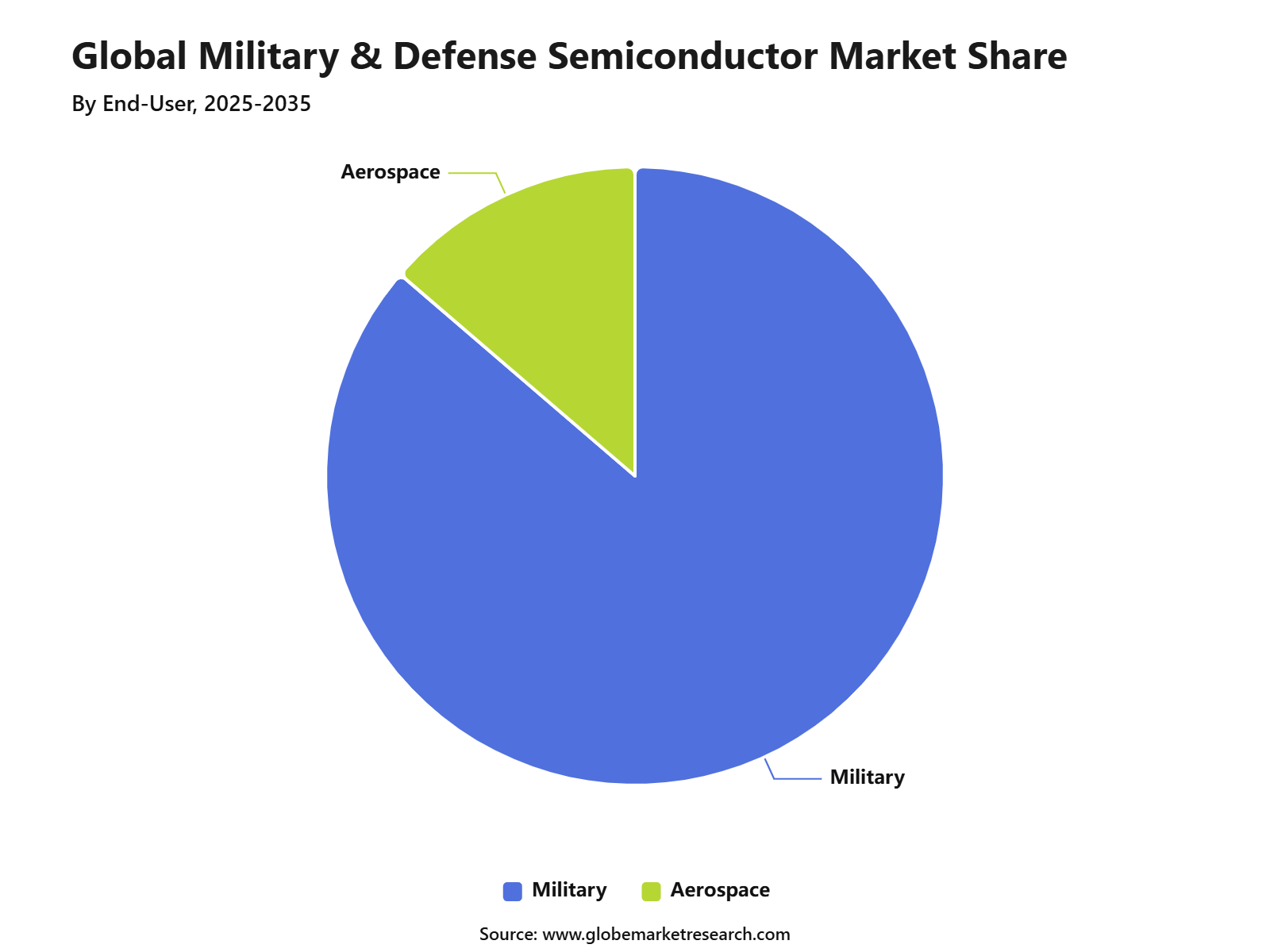
The military segment held 86.3% share by end user. Demand was driven by defense modernization programs, procurement of advanced weapons systems, and rising need for trusted electronic components.
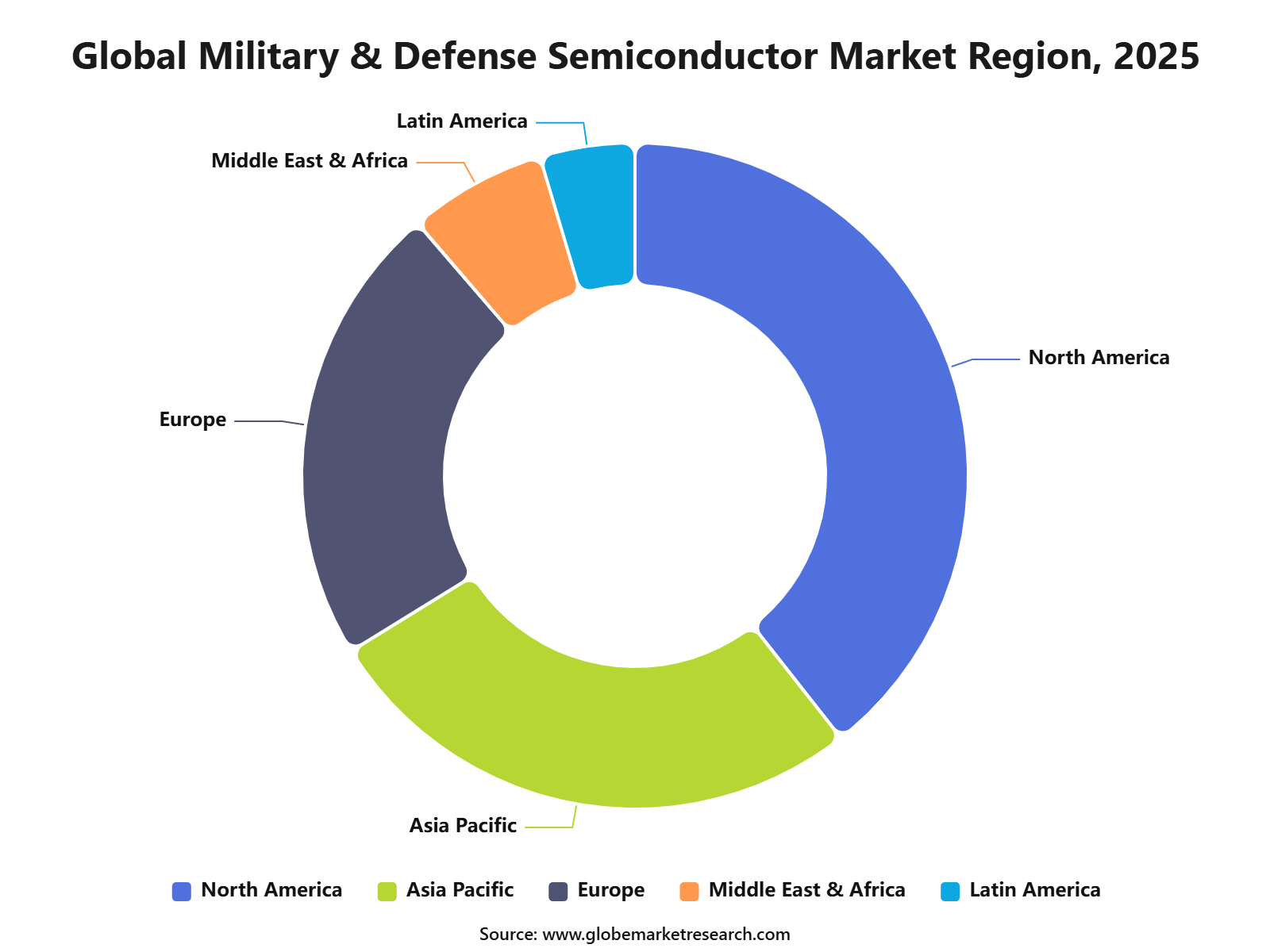
North America accounted for 39.4% share in 2025. The region was supported by strong defense spending, advanced semiconductor capabilities, trusted foundry programs, and ongoing military technology upgrades.
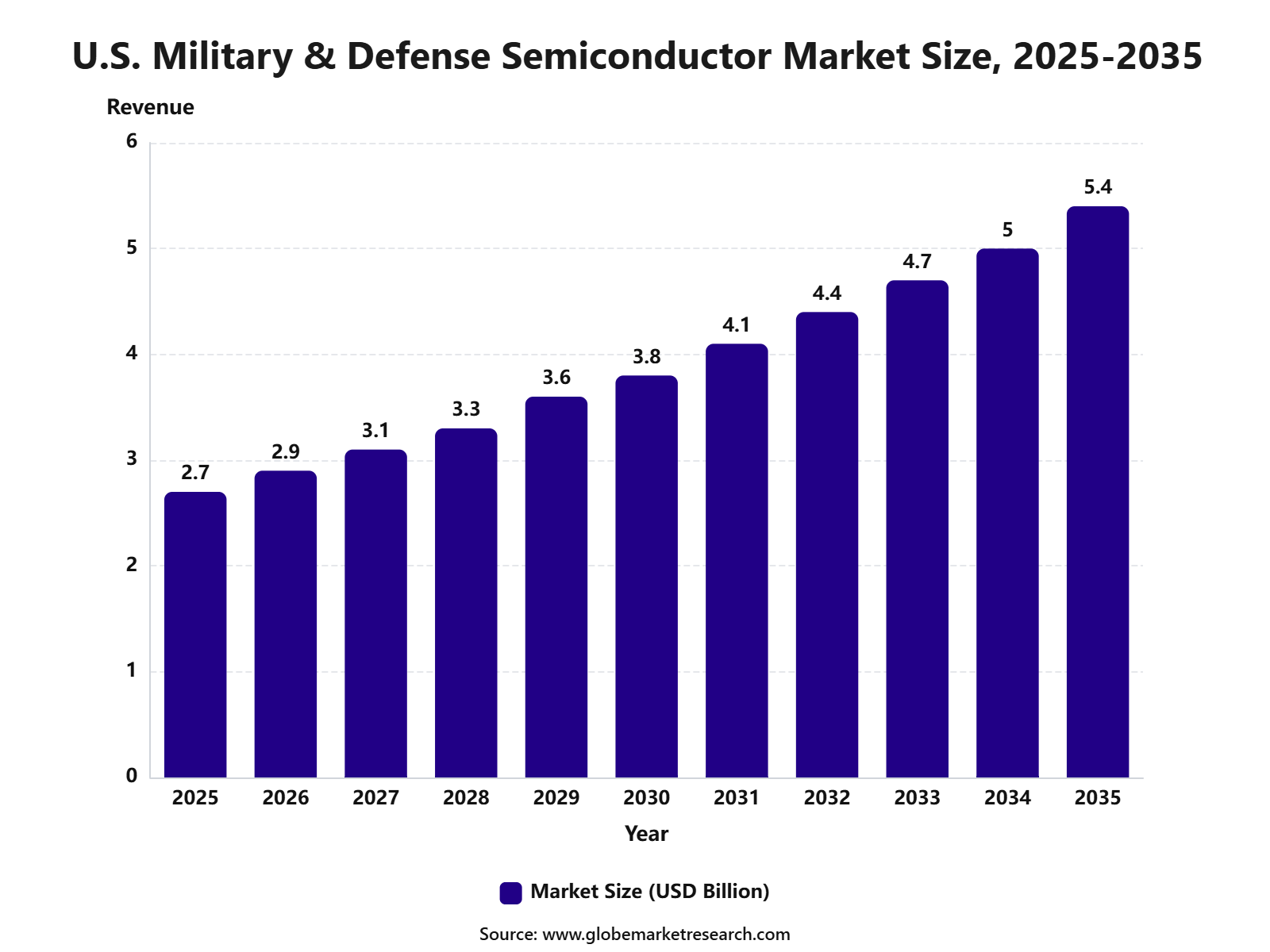
The U.S. Military & Defense Semiconductor Market was valued at USD 2.7 billion in 2025 and is expected to grow at a CAGR of 7.1%. Growth is supported by defense-grade microelectronics, AI-enabled military systems, space and missile defense programs, and secure domestic chip supply chains.
Component Insights
Microprocessors and microcontrollers led the component segment with 30.1% share, as these chips form the control base of mission-critical defense electronics. Their use remains strong in command-and-control systems, navigation units, secure communication devices, weapon control modules, avionics, drones, and embedded computing platforms. Defense microelectronics are described by the U.S. Department of Defense as the "brain" of electronic functional systems, with almost every military and commercial system depending on them.
Demand is also supported by the shift toward trusted and assured semiconductor supply chains. Defense agencies are placing higher focus on secure access, component traceability, and hardware assurance because microprocessors and microcontrollers directly affect system integrity, mission continuity, and cyber resilience. The Trusted and Assured Microelectronics program also highlights the need to modernize defense systems through advanced and secure microelectronics technologies.
Application Insights
Radar and surveillance systems accounted for 29.6% share by application, supported by their central role in early warning, target tracking, border monitoring, airspace security, and battlefield awareness. Radar systems are increasingly used to detect intrusions at night and during adverse weather, while sensor fusion is being adopted to reduce false alarms and improve threat visibility across land, air, and perimeter security environments.
The segment is also gaining strength from growing investment in counter-drone defense, intelligence gathering, and persistent surveillance. Recent defense procurement activity has placed strong attention on air defense, anti-drone systems, surveillance, and unmanned warfare, showing that radar-linked electronics are becoming a priority area in modern military planning.
Technology Insights
Surface Mount Technology held 76.3% share by technology, mainly because it supports compact, lightweight, and high-density circuit designs. This is important in defense electronics where space, weight, power efficiency, and signal performance are critical. SMT enables smaller components, shorter signal paths, and efficient board space use, which makes it suitable for aircraft electronics, missile systems, drones, satellites, radar modules, and portable military devices.
Its wider use is also linked to the reliability needs of harsh operating environments. Aerospace and defense systems require electronic assemblies that can perform under vibration, temperature variation, shock, and long mission cycles. High-reliability soldering standards for surface-mount and mixed-technology assemblies are used in space and mission-critical electronics, supporting confidence in SMT-based designs.
End User Insights
The military segment held 86.3% share by end user, as armed forces remain the primary buyers of secure, rugged, and mission-grade semiconductor components. Demand is being supported by defense modernization programs, advanced weapons procurement, command network upgrades, electronic warfare systems, drones, missile defense platforms, and secure communication equipment. Global military spending rose in 2025, with Europe and Asia showing strong increases, which reflects higher priority for defense readiness and advanced capability development.
The segment’s dominance is also supported by long procurement cycles and strict qualification requirements. Military users need components that can meet security, reliability, confidentiality, performance, and delivery needs across mission-critical systems. NATO’s 2025 commitment for allies to invest 5% of GDP annually on defense and security-related priorities by 2035 further supports long-term demand for trusted military electronics and semiconductor-enabled platforms.
Regional Insights
North America led the Military & Defense Semiconductor Market with 39.4% share in 2025. The region benefits from high defense spending, advanced semiconductor manufacturing capacity, trusted foundry programs, and a strong military electronics supply chain. Demand is especially high across radar systems, aerospace electronics, secure communication infrastructure, radiation-hardened chips, and defense-grade microelectronics.
The U.S. remains the major contributor to regional growth. The country is investing in secure chip supply chains, AI-enabled defense systems, space programs, missile defense, and advanced military computing. These investments are improving domestic semiconductor capability and reducing dependence on vulnerable supply chains.
Market Concentration/Structure
The Military & Defense Semiconductor Market shows a medium to high concentration structure. The market is not fully fragmented because defense-grade semiconductors require trusted suppliers, secure design flows, long qualification cycles, radiation tolerance, export compliance, and stable supply contracts. U.S. defense microelectronics programs also focus on secure supply from design to final package delivery, which increases the importance of approved and reliable suppliers.
Consolidated Structure
The market is more consolidated in advanced and mission-critical areas such as radiation-hardened chips, secure processors, RF semiconductors, FPGAs, ASICs, radar electronics, and space-grade components. These products require high reliability, strict testing, and defense qualification, which limits the number of capable suppliers.
The concentration is also supported by the high capital requirement of semiconductor manufacturing, as leading foundries operate at very large scale. For example, TSMC served 534 customers, manufactured 12,682 products, and managed annual capacity of more than 17 million 12-inch equivalent wafers in 2025.
Fragmented Structure
The market remains fragmented across standard military electronics, embedded modules, power devices, sensors, packaging, testing, system integration, and regional defense supply chains. Many small and mid-sized suppliers participate in niche areas such as ruggedized electronics, printed circuit assemblies, signal processing boards, component testing, and platform-specific customization.
This fragmentation is driven by the wide use of semiconductors across aircraft, drones, missiles, naval systems, land vehicles, satellites, secure communication systems, and electronic warfare platforms.
Competitive Landscape
The Military & Defense Semiconductor Market is characterized by strong competition among defense contractors, semiconductor manufacturers, and electronic component suppliers.
Companies are focusing on secure chip design, radiation-hardened electronics, RF modules, advanced packaging, microcontrollers, memory chips, and trusted supply chain partnerships. Strategic collaborations, product innovation, and defense-focused semiconductor development remain key competitive strategies.
Key Players
Key companies operating in the Military & Defense Semiconductor Market include:
Northrop Grumman Corporation
Raytheon Technologies Corporation
Lockheed Martin Corporation
BAE Systems
Intel Corporation
NXP Semiconductors
Analog Devices, Inc.
Microchip Technology Inc.
Xilinx, AMD
Infineon Technologies
Texas Instruments
STMicroelectronics
Qorvo Inc.
Teledyne Technologies Inc.
Recent Developments
In May 2026, NASA and Microchip Technology advanced the High-Performance Spaceflight Computing project. The processor is designed to deliver more than 100 times the computing capability of current space processors, supporting future aerospace, defense, lunar, Mars, and autonomous spacecraft missions.
In November 2025, GlobalFoundries and BAE Systems expanded their collaboration on secure semiconductors for space. GlobalFoundries will provide U.S.-manufactured semiconductor technology, while BAE Systems will radiation-harden the chips for harsh space environments.
In November 2025, Microchip Technology launched a new radiation-tolerant communication interface solution for space applications. The product supports high-reliability data communication in satellites, spacecraft, and defense electronics exposed to radiation and extreme operating conditions.
Key Market Segments
By Component
Microprocessors & Microcontrollers
FPGAs
ASICs
Memory Chips
RF Semiconductors
Others
By Application
Radar & Surveillance Systems
Electronic Warfare (EW) & Jamming Systems
Military Communication Systems
Unmanned Systems
UAVs
UGVs
UUVs
Space & Satellite Defense Systems
Others
By Technology
Surface Mount Technology
Through-Hole Technology
By End-User
Military
Aerospace
By Region
North America
Europe
Asia Pacific
Latin America
Middle East & Africa
About Globe Market Research
Globe Market Research is a global market research and consulting firm providing industry reports, syndicated research, custom research, consulting services, and data analytics across major sectors. The company supports businesses, investors, consultants, and industry stakeholders with structured market intelligence, competitive analysis, segment insights, and strategic decision support.
Media Contact
Globe Market Research
Email: [email protected]
Website: www.globemarketresearch.com
Follow us: X | Linkdln | Medium |Tumblr