
Strategic Market Snapshot
Key Parameter | Report Details |
|---|---|
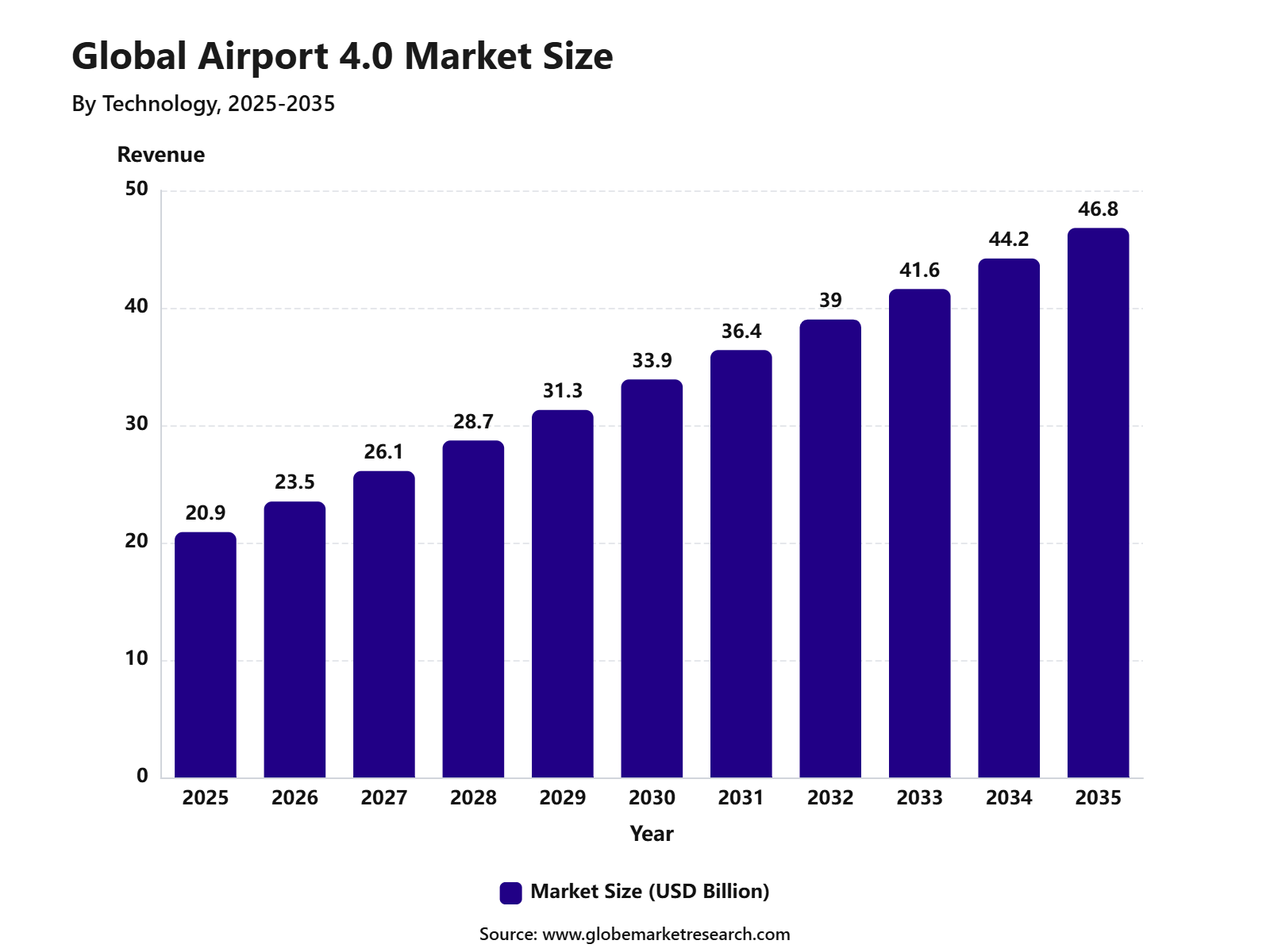
Market Revenue, 2025 | USD 20.9 Billion |
Projected Revenue, 2035 | USD 46.8 Billion |
CAGR, 2025-2035 | 8.3% |
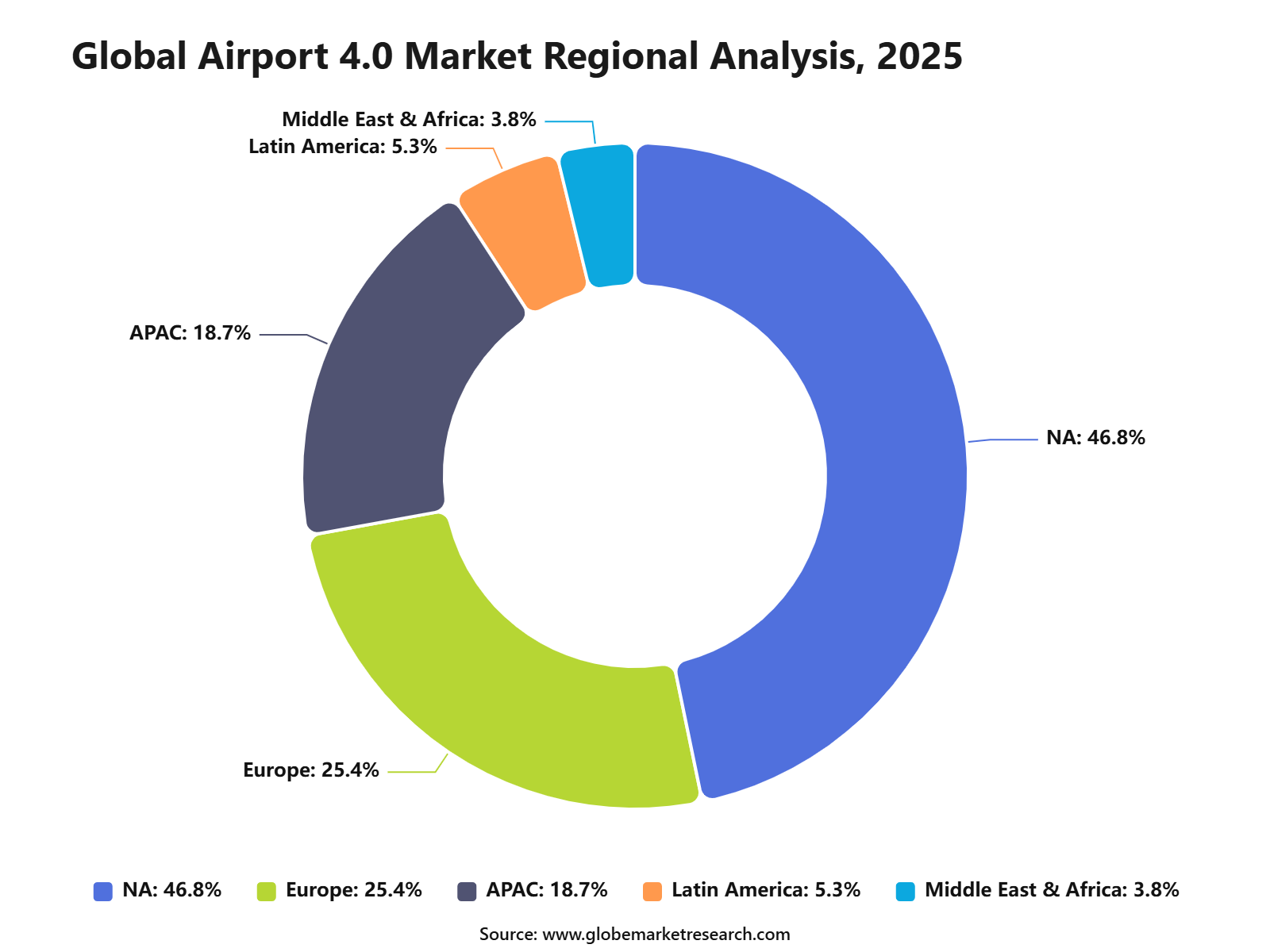
Largest Region | North America, 46.8% Share |
Market Concentration | Medium |
Base Year | 2025 |
Forecast Period | 2025-2035 |
Market Size and Forecast
As per the latest analysis by Globe Market Research, the global Airport 4.0 Market Size reached USD 20.9 billion in 2025 and is expected to grow to USD 46.8 billion by 2035, registering an 8.3% CAGR. North America led the market with 46.8% share in 2025, supported by smart airport infrastructure, digital passenger services, biometric screening, advanced baggage handling, and connected airport operations.
Airport 4.0 refers to the use of digital, automated, connected, and data-driven technologies across airport operations. It includes automated check-in systems, biometric security, smart baggage handling, IoT-enabled infrastructure, AI-powered customer service, digital twins, cloud platforms, cybersecurity, and real-time operational control systems.
The market is gaining importance because airports are facing higher passenger traffic, terminal congestion, security pressure, and the need for faster passenger movement. ACI World reported that global passenger traffic is forecast to reach 10.2 billion passengers in 2026, up 3.9% year over year, while long-term traffic is projected to double by 2045.
Why the Airport 4.0 Market Is Growing
The growth of the Airport 4.0 market can be attributed to rising airport automation, growing passenger traffic, and the need for faster airport processing. Globe Market Research indicates that rising airport automation has an estimated growth impact of +2.2%, while growth in air passenger traffic adds +1.9%. Airport operators are investing in digital systems because physical expansion is expensive and slow.
Automated check-in, biometric verification, AI-based passenger flow tools, real-time baggage tracking, and connected command centers help airports increase throughput without relying only on new terminals or runways. Technology spending also supports market expansion. SITA reported that 63% of airports plan to increase IT spending in 2026, while 60% already use AI in passenger flow management. This shows that airport digitization is moving from pilot projects to operational deployment.
Automated Check-In Systems Lead by Technology
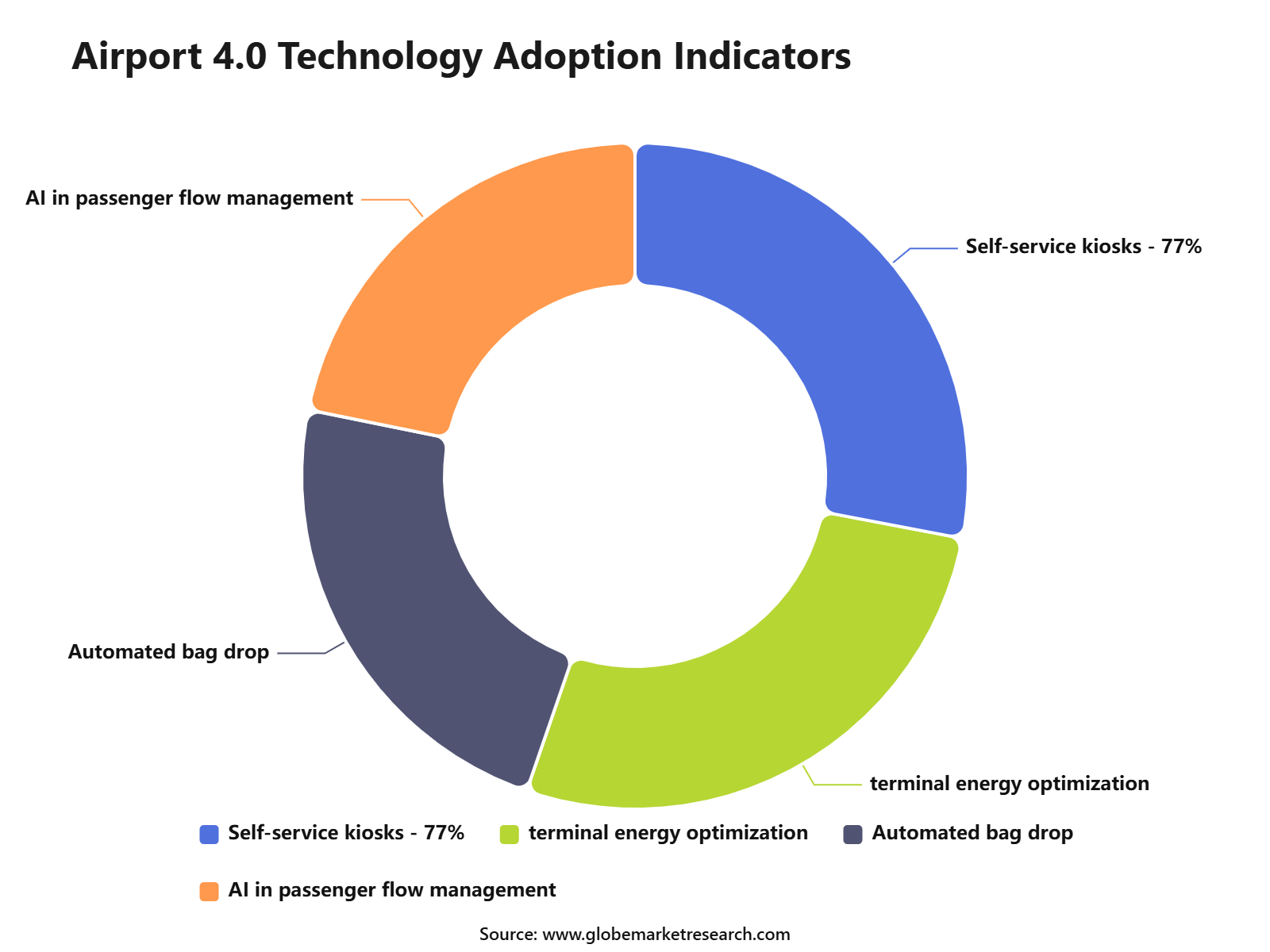
Automated check-in systems led the technology segment with 26.9% share in 2025. These systems include self-service kiosks, mobile check-in, biometric check-in, automated bag drop, and digital identity-based passenger verification. Their adoption is being supported by the need to reduce queues and improve passenger movement across terminals.
Automated check-in helps airports reduce manual processing, improve staff productivity, and give passengers more control over their journey. It is especially useful at busy international airports where passenger peaks can create bottlenecks at check-in counters, bag drop zones, and boarding gates.
Passenger expectations are also changing. IATA’s 2025 Global Passenger Survey found that 78% of passengers want one smartphone app combining digital wallet, passport, and loyalty cards, while 88% would feel more confident if they could track luggage in real time. This supports airport investment in mobile-first and self-service systems.
International Airports Remain the Leading Airport Type
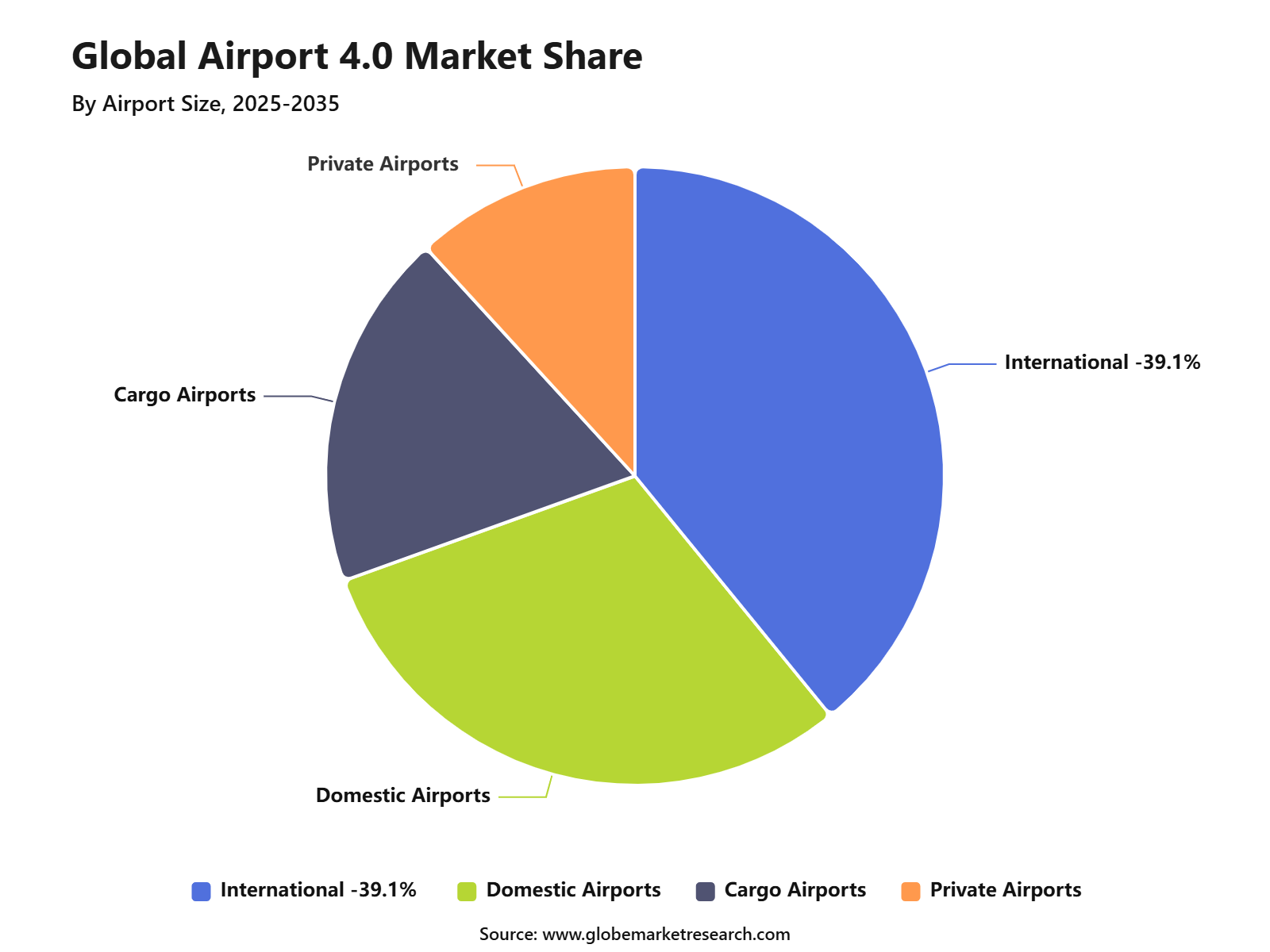
International airports accounted for 39.1% share of the Airport 4.0 market in 2025. This leadership is supported by higher passenger volumes, cross-border processing needs, complex baggage systems, immigration procedures, security screening, airline coordination, and stronger modernization budgets. These airports need advanced digital systems because they manage multiple stakeholders, including airlines, border agencies, ground handlers, security teams, retail operators, and maintenance providers.
Airport 4.0 platforms help connect these groups through shared data, integrated workflows, and real-time operational visibility. International airports are expected to remain early adopters of biometric boarding, smart baggage tracking, automated border control, digital identity platforms, AI-based crowd management, and connected airside operations. This is because delays at large hubs can quickly affect airline schedules, passenger experience, and airport revenue.
Passenger Services Hold the Largest Service Type Share
Passenger services led the service type segment with 40.3% share in 2025. This includes automated check-in, wayfinding, baggage tracking, digital boarding, passenger alerts, self-service kiosks, accessibility support, and AI-powered customer service. The segment is growing because passenger experience has become a competitive factor for airports.
Travelers expect fewer manual steps, shorter queues, real-time information, and smoother movement from arrival to boarding. Airport 4.0 solutions help airports deliver these services while reducing pressure on staff. Biometric acceptance is also improving. IATA reported that 50% of passengers used biometrics at some point in the airport journey in 2025, up from 46% in 2024, and 85% of users were satisfied with the experience. This supports wider adoption of biometric check-in, security, immigration, and boarding systems.
Passenger Flow Management Leads Operational Functionality
Passenger flow management captured 32.2% share by operational functionality in 2025. The segment is supported by demand to reduce congestion, manage crowd movement, improve terminal capacity, and support safer passenger processing. These systems use cameras, sensors, AI analytics, mobile data, queue monitoring, digital signage, and real-time dashboards to track passenger movement across check-in, security, immigration, retail zones, gates, and baggage areas.
Airport teams can use this data to adjust staffing, open lanes, redirect passengers, and reduce waiting times. The commercial value is clear because passenger flow affects both airport operations and non-aeronautical revenue. When passengers spend less time in queues, they have more time for retail, food service, lounges, and other airport services. This makes passenger flow management both an efficiency tool and a revenue support system.
Biometrics and Digital Identity Are Becoming Core Airport 4.0 Technologies
Biometric passenger processing is one of the strongest opportunities in the Airport 4.0 market, with an estimated growth impact of +2.0%. Biometric systems are being used for identity verification, check-in, baggage drop, security screening, immigration, boarding, and trusted traveler programs. The U.S. airport system shows how quickly biometric infrastructure is expanding.
A PCLOB oversight report stated that, as of April 2025, TSA had deployed more than 2,100 facial-recognition-enabled CAT-2 devices at more than 250 U.S. airports. This demonstrates the scale of biometric use, but it also highlights the need for strong privacy and governance. Airport operators must manage consent, data retention, accuracy, privacy, cybersecurity, and passenger opt-out options. Biometric systems can improve speed and security, but trust will remain essential for long-term adoption.
Smart Baggage Handling Is a Major Investment Area
Smart baggage handling has an estimated opportunity impact of +1.5%, supported by demand to reduce baggage delays, improve luggage visibility, and increase operational reliability at major international airports. These systems include RFID tracking, automated conveyors, baggage reconciliation, robotic handling, AI-based fault detection, predictive maintenance, and mobile baggage updates for passengers.
They help airports and airlines identify where bags are located and reduce manual search effort when bags are delayed or misrouted. The business case is strong because baggage issues affect passenger satisfaction, airline cost, and airport reputation. Real-time baggage visibility can also improve transfer efficiency at hub airports, especially where short connection windows and high traffic volumes increase baggage handling complexity.
North America Leads the Airport 4.0 Market
North America held the largest share of the Airport 4.0 market with 46.8% in 2025. The region benefits from advanced airport infrastructure, strong technology adoption, high air travel volumes, and ongoing investment in airport modernization. The U.S. and Canada are adopting self-service systems, biometrics, smart security, cloud-based airport platforms, digital signage, and real-time operational tools. Growth is being supported by the need to reduce congestion, improve passenger experience, strengthen cybersecurity, and increase operational resilience.
Asia Pacific is also becoming an important growth region. Globe Market Research estimates that Asia Pacific passenger growth adds +2.1% to regional impact, supported by China, India, Japan, and Southeast Asia. Europe, the Middle East, and Latin America are also investing in airport upgrades, but adoption speed differs by funding capacity, regulation, and infrastructure maturity.
Analyst Perspective
What Opportunities Are Emerging?
The biggest opportunity is in passenger processing automation. Airports need faster check-in, biometric verification, automated bag drop, queue management, and digital boarding to manage rising traffic without adding the same level of physical infrastructure.
Smart baggage handling and AI-based passenger flow management are also strong opportunities. These solutions reduce operational delays, improve visibility, and support better use of terminal space during peak hours.
Cybersecurity and integrated airport platforms are becoming high-value service areas. As airports connect more systems, vendors that can offer secure data layers, monitoring, backup systems, and long-term managed services will have stronger commercial relevance.
What Risks Should Companies Be Aware Of?
The main risk is system interoperability. Airports use many systems from different vendors, and weak integration can reduce the value of AI, automation, and real-time dashboards.
Cybersecurity risk should also be treated as a top priority. The 2025 European airport disruption showed that a third-party platform failure can quickly affect check-in, boarding, baggage handling, and passenger confidence.
Passenger privacy is another risk. Biometric systems can improve speed, but airports must communicate clearly on consent, data use, retention, accuracy, and opt-out choices to protect trust.
What Decisions Should Clients Make Next?
Clients should first identify which operational bottleneck needs the fastest improvement. Check-in, baggage handling, security queues, passenger flow, airside visibility, or cybersecurity should be prioritized based on airport traffic, delay patterns, and infrastructure condition.
Second, airports should avoid isolated technology purchases. A platform-based approach is likely to create better value because passenger identity, baggage, security, airlines, ground handling, retail, and facility systems must work together.
Finally, clients should select vendors based on integration capability, cybersecurity controls, uptime performance, aviation experience, data governance, and lifecycle support. The best Airport 4.0 partners will be those that improve passenger experience while protecting safety and operational continuity.
Recent Developments
In January 2026, Heathrow completed a GBP 1 billion security screening upgrade using next-generation CT scanners across all four terminals. The upgrade allows passengers to keep laptops and liquids inside hand luggage, reducing friction at security checkpoints.
In February 2026, Dubai International Airport was forecast to handle 99.5 million passengers in 2026 after serving 95.2 million passengers in 2025. Dubai’s wider airport plan also includes the USD 35 billion expansion of Al Maktoum International Airport.
In September 2025, the Collins Aerospace MUSE cyber incident disrupted check-in and boarding systems across Heathrow, Brussels, and Berlin. The incident reinforced the importance of cyber resilience, third-party risk monitoring, backup systems, and manual fallback plans for digital airports.
Competitive Landscape
The Airport 4.0 market is competitive, with technology companies, aviation IT providers, automation vendors, security system suppliers, infrastructure firms, and smart airport platform providers competing across passenger processing, baggage handling, biometrics, IoT infrastructure, and AI-based airport operations.
Top 10 Key Companies
Honeywell International, Inc.
IBM
Raytheon Technologies
Cisco Systems
Siemens AG
SITA
Smart Airport Systems SAS
Thales Group
T-Systems International
Huawei Technologies Co., Ltd.
Other Key Players
Competition is expected to increase as airports demand integrated platforms, smart security systems, biometric processing, baggage visibility, AI operations, and cybersecurity services. Companies with stronger aviation experience, interoperability, cybersecurity readiness, and long-term service support are likely to gain higher trust. The strongest providers will be those that can connect airport operations without adding complexity. Airport buyers will prioritize systems that reduce delays, improve safety, protect passenger data, and support real-time decision-making across terminal and airside operations.
Conclusion
The Airport 4.0 market is entering a stronger digital modernization phase as airports invest in automated check-in, biometric screening, smart baggage systems, AI-powered passenger flow, IoT-enabled infrastructure, cybersecurity, and connected airport platforms. Growth is being supported by rising passenger traffic, capacity pressure, and the need for faster, safer, and more efficient airport operations.
Future growth will be led by automated check-in systems, biometric passenger processing, smart baggage handling, passenger services, passenger flow management, and North American airport modernization. The market outlook remains positive, but success will depend on cybersecurity, system interoperability, passenger trust, and measurable operational value.
Get Category Wise Our Trending Reports Here: https://www.globemarketresearch.com/industry/aerospace-and-defence