
Virtual Tour Market Size and Growth
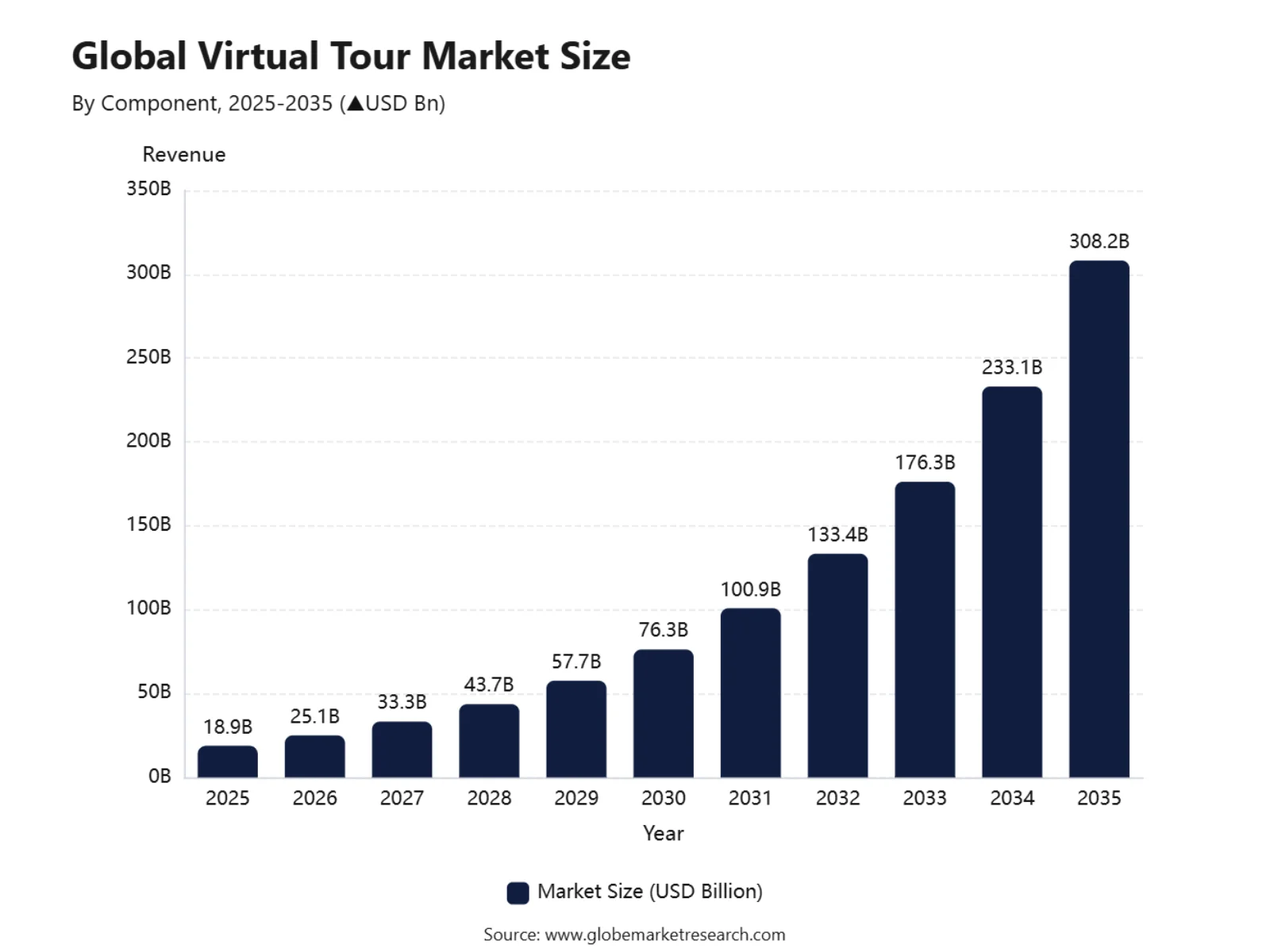
According to Globe Market Research, the global virtual tour market was valued at USD 18.9 billion in 2025 and is projected to reach USD 308.2 billion by 2035, growing at a 18.3% CAGR. North America led with 49.6% share in 2025, while the U.S. virtual tour market was valued at USD 2.2 billion and is expected to grow at a 33.7% CAGR. Growth is being supported by immersive 3D tours, 360-degree video, VR-enabled property walkthroughs, virtual travel previews, and digital customer engagement tools.
Key Parameter | Report Details |
|---|---|
Market Revenue, 2025 | USD 18.9 Billion |
Projected Revenue, 2035 | USD 308.2 Billion |
CAGR, 2025-2035 | 18.3% |
Largest Region | North America, 49.6% Share |
U.S. Market Revenue, 2025 | USD 2.2 Billion |
U.S. CAGR | 33.7% |
Market Concentration | Medium |
Base Year | 2025 |
Forecast Period | 2025-2035 |
A virtual tour allows users to explore a real location through 360-degree images, 3D walkthroughs, interactive floor plans, VR viewing, and digital twins. These tools are being used across real estate, tourism, hospitality, education, retail, museums, commercial spaces, and event venues. The market is expanding because customers now prefer to see spaces online before deciding to visit, book, rent, buy, or engage with a business.
Why the Virtual Tour Market Is Growing
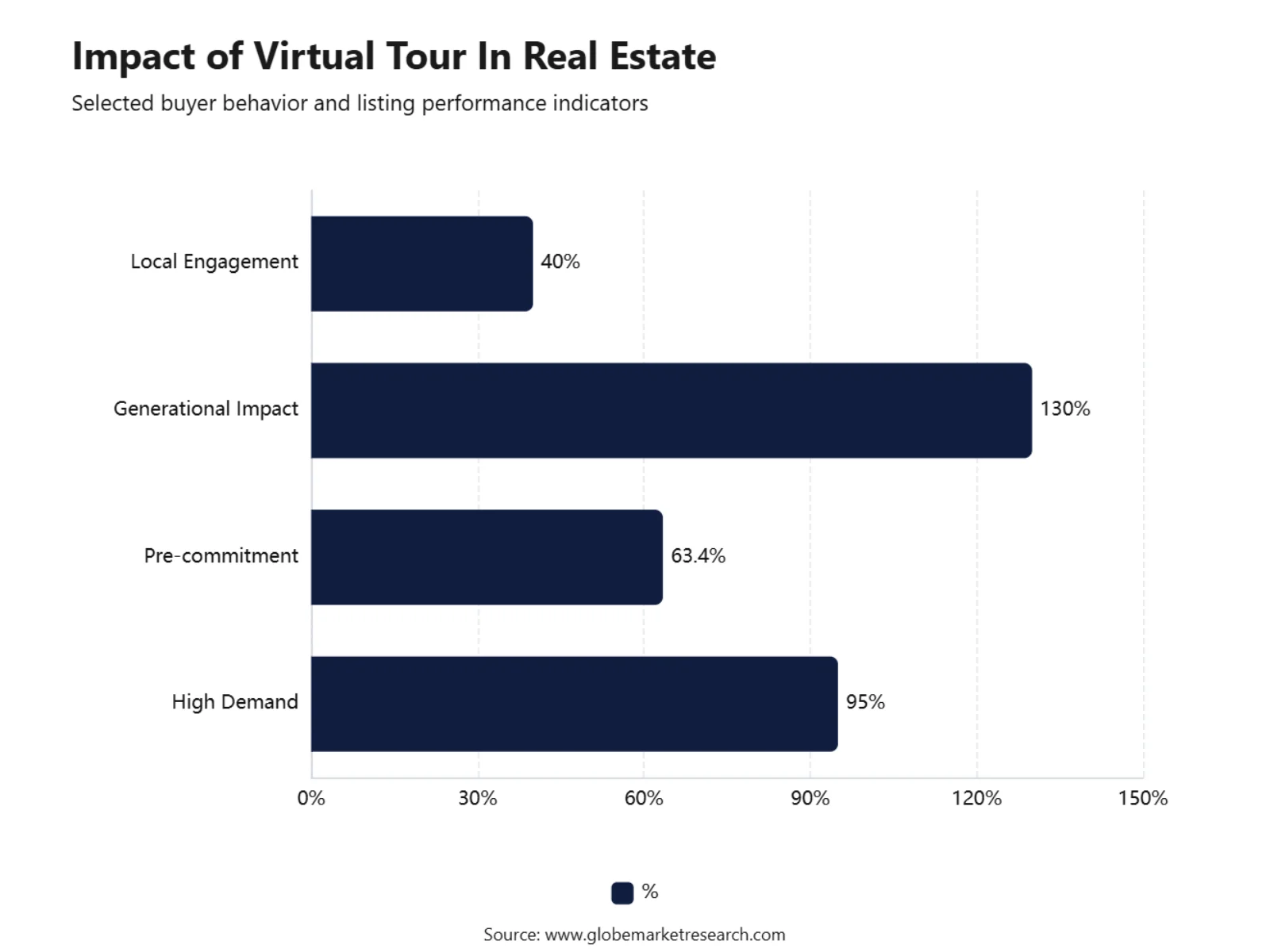
The growth of the virtual tour market can be attributed to digital-first decision-making. Buyers, travelers, students, and business customers now expect clear visual information before making a physical visit. The linked report notes that 87% of homebuyers expect virtual tours on property listings in 2026, showing that virtual viewing is moving from an optional feature to a standard expectation.
Real estate remains one of the strongest adoption areas because virtual tours reduce unnecessary site visits and improve buyer confidence. Zillow also stated in March 2026 that home shoppers rank floor plans, high-resolution photos, and 3D tours among the most valuable listing features, as these tools help buyers understand layout and visualize a home before visiting in person.
Tourism and hospitality are also supporting market growth. UN Tourism reported that international tourist arrivals reached about 1.52 billion in 2025, up 4% from 2024 and nearly 60 million higher than the previous year. This supports the use of virtual destination previews, hotel walkthroughs, museum tours, and travel planning tools.
Software Leads the Virtual Tour Market
Software held around 52.5% share in the virtual tour market in 2025. This segment is supported by demand for 3D tour creation tools, editing platforms, virtual staging systems, hosting solutions, analytics dashboards, and interactive walkthrough software. Businesses prefer software-led platforms because tours can be created, updated, shared, and measured without heavy hardware investment.
Software also improves distribution across property portals, websites, mobile apps, social media, and CRM systems. As AI-assisted image processing and real-time rendering improve, virtual tour platforms are becoming easier to use for real estate agents, hotels, schools, retailers, and small businesses. From a commercial view, software is the best-suited segment for scalable revenue. Subscription pricing, cloud hosting, premium editing tools, analytics modules, and enterprise integrations can help vendors build recurring income while helping customers improve engagement and lead quality.
Semi and Fully Immersive Technology Is Gaining Strong Adoption
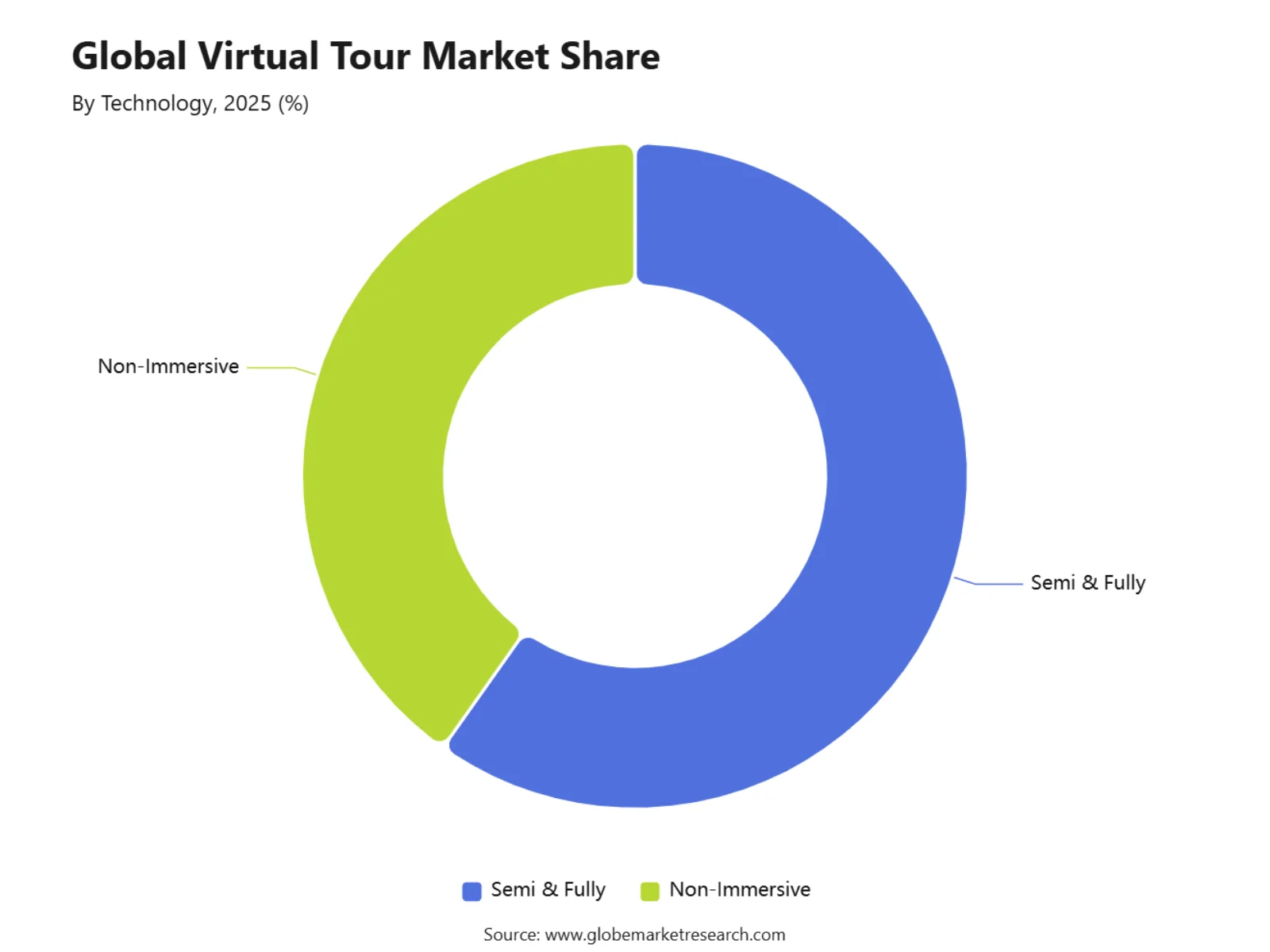
Semi and fully immersive technology led the market with around 59.8% share in 2025. These formats are used for 3D property walkthroughs, VR destination previews, campus tours, training simulations, product demonstrations, and digital showrooms. They improve engagement because viewers can explore spaces in a more realistic and interactive way.
The segment is being supported by better 360-degree cameras, 3D capture tools, spatial mapping, browser-based viewing, and headset-compatible experiences. The industry is also moving toward easier access through mobile phones and desktops, which reduces dependence on expensive VR devices. Zillow’s March 2026 update shows where the technology is moving. Its upgraded 3D Home tours added AI image processing, improved lighting, stronger visual detail, and smoother navigation, making virtual tours feel closer to physical property viewing.
360-Degree Video Remains the Leading Type
360-degree video accounted for around 45.2% share in 2025. Its leadership is supported by easy production, strong mobile compatibility, and wide use across real estate, hospitality, education, museums, tourism, and commercial property marketing. The format is attractive because users can explore a space from different angles without complex navigation. This format is especially useful for small and mid-sized businesses because it is more affordable than advanced 3D modeling.
Hotels can show rooms, schools can display campuses, event venues can present halls, and retailers can create showroom-style experiences without large production teams. The value of 360-degree video is strongest when it is combined with floor plans, hotspots, product labels, booking links, inquiry forms, and guided navigation. This turns a simple visual experience into a more useful customer decision tool.
Real Estate Is the Leading Application Area
Real estate led the virtual tour market with around 47.3% share in 2025. Property buyers, tenants, brokers, developers, and landlords are using digital walkthroughs to review homes, offices, hotels, apartments, and commercial sites remotely. Virtual tours improve listing quality, reduce unnecessary physical visits, and help buyers understand floor plans and room flow before scheduling a visit.
Zillow’s 3D Home Tours app states that listings with an Interactive Floor Plan or 3D Home tour received twice as many views and sold 10% faster on average than listings without those features. This shows that virtual tour tools can improve listing visibility and support faster buyer engagement. For real estate companies, the best opportunity is not only to add a virtual tour, but to connect it with lead capture, inquiry forms, agent contact, mortgage links, and listing analytics. This makes the virtual tour part of the sales funnel, not only a media asset.
Cloud-Based Platforms Dominate Deployment
Cloud-based platforms held about 77.5% share in 2025. Cloud deployment is preferred because it supports easy storage, remote access, faster sharing, smooth updates, and integration with websites, property portals, mobile apps, and marketing systems. Cloud platforms also allow businesses to scale content without maintaining large local infrastructure.
A real estate agency can host hundreds of property tours, a university can manage campus tours, and a hotel group can update location-based tours across markets through centralized platforms. The strongest cloud opportunity is in analytics and conversion tracking. Platforms that show user behavior, viewing time, interaction points, drop-off areas, and inquiry conversion can help companies understand what customers are actually interested in.
North America Leads, While Asia Pacific Shows Strong Expansion Potential
North America led the virtual tour market with 49.6% share in 2025. Growth in the region is supported by high digital adoption, mature real estate technology, advanced cloud infrastructure, and strong online property search behavior. The U.S. market reached USD 2.2 billion and is projected to grow at a 33.7% CAGR.
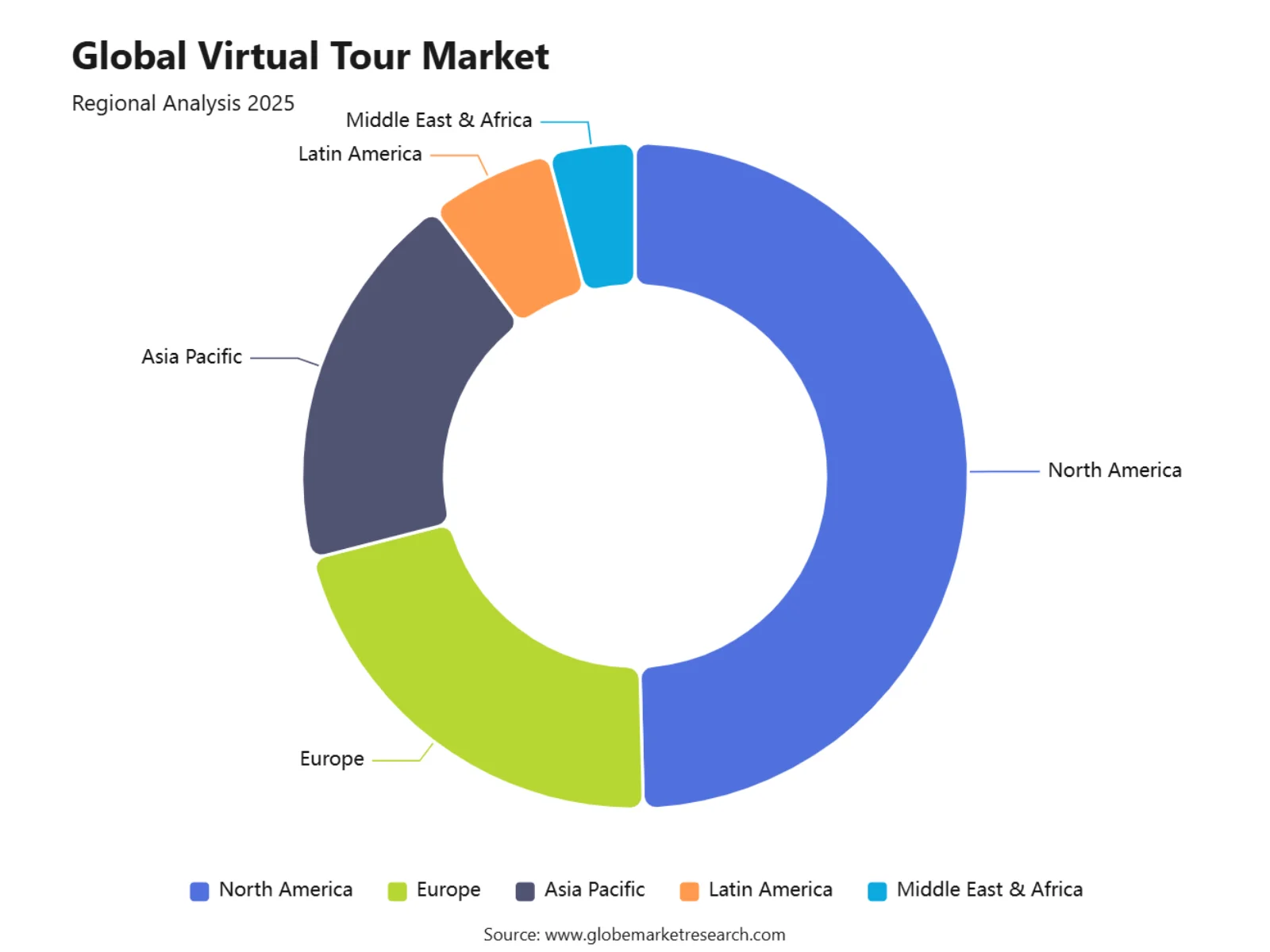
Asia Pacific is also expected to show strong growth due to mobile-first users, expanding digital real estate platforms, tourism recovery, and rising use of immersive tools in education and retail. China, India, Japan, South Korea, and Southeast Asian markets are likely to support adoption as virtual viewing becomes more common across property, travel, and commercial sectors. Europe remains important due to tourism, museums, cultural institutions, universities, and real estate marketing. The Middle East is gaining traction in hospitality, tourism, real estate developments, luxury retail, and destination promotion.
Analyst Perspective
What the Data Is Telling Virtual Tour Companies?
From an analyst perspective, the data shows that virtual tours are becoming a conversion tool, not just a visual add-on. A market value of USD 18.9 billion in 2025 and a forecast of USD 308.2 billion by 2035 indicate strong long-term demand, but adoption will be strongest where virtual tours reduce decision friction and improve customer confidence. The segment data gives a clear signal. Software led with 52.5% share, semi and fully immersive technology held 59.8% share, real estate accounted for 47.3% share, and cloud-based platforms held 77.5% share.
This means the market is shifting toward scalable, software-led, cloud-hosted, and interactive customer experience platforms. For clients, the message is practical. Virtual tours should be used where they help customers make faster and better decisions. Real estate listings, hotel rooms, campuses, showrooms, museums, event venues, and travel destinations are among the best-suited use cases.
What Opportunities Are Emerging?
The first major opportunity is real estate marketing. The linked report identifies expansion in real estate marketing as a key opportunity with a +4.4% CAGR impact, especially across the U.S., Canada, the UK, India, and the UAE. Virtual tours can improve property sales conversion by helping buyers filter options before visiting in person.
The second opportunity is hospitality and travel promotion. Virtual tours can help hotels, resorts, tourism boards, museums, and destination marketers show rooms, facilities, attractions, and experiences before booking. With global tourist arrivals reaching 1.52 billion in 2025, digital previews are becoming more important in travel planning.
The third opportunity is AI-enhanced content creation. Zillow’s 2026 update shows how AI can improve lighting, image detail, and navigation in 3D tours. This can reduce production friction and make virtual tours more realistic, accessible, and useful for everyday business users.
What Risks Should Companies Be Aware Of?
The biggest risk is content production cost. The linked report lists high content production cost as a restraint with a -2.1% CAGR impact, especially for emerging markets and small businesses. If production cost remains high, many SMEs may delay adoption or use only basic 360-degree images. The second risk is limited VR device penetration. Many users still view tours on smartphones, laptops, and tablets rather than VR headsets.
This means companies should not build experiences that depend only on headset use, especially in Asia Pacific, Latin America, and the Middle East and Africa. The third risk is technical quality. Poor lighting, distorted images, slow loading, weak navigation, outdated content, and privacy concerns can reduce user trust. Businesses need clear production standards, regular updates, data security controls, and mobile-friendly performance.
What Decisions Should Clients Make Next?
Clients should first decide where a virtual tour can reduce friction in the customer journey. Real estate companies should use tours to qualify buyers. Hotels should use them to improve booking confidence. Universities should use them for remote student engagement. Retailers should use them for showroom discovery.
Second, clients should choose the right format. 360-degree video is best suited for affordability and broad access, while 3D virtual tours are stronger for real estate, commercial spaces, education, and premium hospitality. Fully immersive VR should be used where the customer experience justifies higher production cost.
Third, clients should treat virtual tours as measurable assets. The next decision should be to connect tours with analytics, inquiry forms, booking tools, CRM systems, and performance tracking. The best returns will come when virtual tours support lead generation, sales conversion, booking confidence, and customer engagement.
Competitive Landscape
The virtual tour market is competitive, with companies offering 3D capture tools, 360-degree tour platforms, digital twin software, virtual staging, cloud hosting, VR content, and interactive floor plan solutions. Key companies include Matterport Inc., Kuula LLC, CloudPano, EyeSpy360, Concept3D Inc., Roundme Limited, 3DVista, iStaging, Zillow 3D Home, Pano2VR, TourWizard, VPIX 360, SeekBeak, Realvision, InsideMaps, Metareal, Virtually Anywhere, Vieweet, Immoviewer, Real Tour Vision, Blue Raven Studios, 360 Imagery, Pan 3Sixty, Starts360, and MI 360.
Competition is expected to increase as AI, cloud hosting, mobile capture, and digital twin tools become easier to use. Vendors that offer low-cost creation, high visual quality, simple sharing, CRM integration, analytics, and regular content updates are likely to perform better.
Recent Developments
Market News
In 2026, Google introduced Gemini-powered updates in Google Maps, including Ask Maps and Immersive Navigation with 3D visuals and real-time guidance. This development supports wider use of immersive location viewing across travel, mobility, and destination discovery.
In 2026, Insta360 integrated its X5 camera with Zillow 3D Home, enabling real estate professionals to create 3D home tours and interactive floor plans for property listings. This strengthens the role of 360-degree cameras in fast and scalable virtual tour creation.
In 2025, Matterport introduced Matterport Marketing Cloud, a platform for real estate agents to order and publish MLS-ready 3D tours, photos, videos, floor plans, and AI-powered property descriptions. This shows that virtual tour platforms are moving toward full listing media management rather than only 3D scanning.
Funding
In 2026, World Labs raised USD 1 billion to advance spatial intelligence and 3D world models. The funding is relevant to the virtual tour market because spatial AI can support the creation of navigable 3D environments from images, videos, and prompts.
In 2025, Cisco Investments invested in World Labs to support large world models that help AI systems perceive, understand, and interact with the physical world in 3D. This reflects growing investment in the core AI infrastructure behind virtual environments and digital twins.
In 2025, Digs raised new seed funding as part of its total USD 19.1 million seed financing to build AI tools for home construction and post-construction management. Its platform creates interactive 3D digital twins of homes, which aligns with the wider use of virtual tours in residential property lifecycle management.
Mergers and Acquisitions
In 2025, CoStar Group completed its acquisition of Matterport, bringing Matterport’s 3D digital twin and virtual tour technology into CoStar’s real estate data and marketplace ecosystem. This is the most important recent M&A event in the virtual tour market because it connects 3D property media with large-scale real estate listing platforms.
In 2025, Rocket Companies completed its acquisition of Redfin, combining a major mortgage platform with a high-traffic real estate search and brokerage platform. While this was not a pure virtual tour software deal, it is relevant because property search platforms increasingly depend on richer listing media, remote tours, and digital buyer engagement.
In 2025, CoStar’s acquisition of Matterport also intensified competition with Zillow over control of 3D tour content, media rights, and listing platform distribution. The later Zillow and Matterport dispute showed that virtual tour assets are becoming strategic data assets, not only marketing visuals.
Conclusion
The virtual tour market is entering a stronger growth phase as businesses use immersive content to improve customer confidence, reduce unnecessary physical visits, and strengthen digital engagement. Growth is being led by software, semi and fully immersive technology, 360-degree video, real estate applications, and cloud-based platforms.
For clients, the best decision is to deploy virtual tours where they directly support sales, bookings, lead quality, or customer education. The strongest opportunities are expected in real estate marketing, hospitality, tourism, education, museums, retail showrooms, and AI-enhanced virtual experiences.