

Revenue, 2025
$89.2Bn
Forecast, 2035
$403.8Bn
CAGR, 2025-2035
16.3%
Report Coverage
Global
Market Size and Forecast
2025
$89.2Bn
2035
$403.8Bn
CAGR
16.3%
The Global Chauffeur Car Market was valued at USD 89.2 billion in 2025 and is projected to reach USD 403.8 billion by 2035, growing at a CAGR of 16.3% during the forecast period. The growth of the market can be attributed to rising demand for premium mobility services, corporate travel, airport transfers, luxury tourism, event transportation, and app-based executive car booking services. Increasing preference for professional, safe, and comfortable travel solutions is also supporting the adoption of chauffeur-driven cars among business travelers, high-net-worth individuals, and premium hospitality customers.
North America held the largest share of 42.1% in 2025, valued at around USD 37.5 billion. The region’s dominance is supported by strong corporate travel activity, high spending on luxury transportation, mature airport transfer networks, and the presence of established premium mobility service providers. The U.S. and Canada continue to show strong demand for chauffeur services across business travel, luxury tourism, hotel partnerships, and private event transportation, which is expected to support steady market expansion through 2035.
Key Market Insights - 2025 Share
Business travel services led the service type segment with 49.3% share in 2025, supported by strong corporate demand for reliable, scheduled, and professional transportation.
Luxury cars dominated the vehicle type segment with 42.3% share in 2025, reflecting rising preference for premium comfort, safety, and high-quality travel experiences.
Corporate clients accounted for 53.3% share in 2025, driven by business travel needs, executive mobility, airport transfers, and client-facing transport services.
North America held 42.1% share of the chauffeur car market in 2025, supported by strong business travel activity, high disposable income, and mature premium mobility services.
The North America chauffeur car market was valued at USD 37.5 billion in 2025, showing its strong position in the global market.
Chauffeur Car Market Overview
Chauffeur car services include premium, scheduled, and professional driver-based transport for business travel, airport transfers, events, hospitality, luxury tourism, and private mobility. The market is positioned above standard ride-hailing because it focuses on service quality, trained drivers, clean vehicles, privacy, punctuality, and a controlled travel experience. Demand is being supported by the continued recovery of business travel, international tourism, airport passenger traffic, and digital booking adoption.
The market is also benefiting from the shift toward planned, reliable, and experience-led transport services. Corporate users prefer chauffeur cars for executive travel, client movement, investor meetings, and high-value business events. Leisure users adopt these services for airport transfers, luxury tours, weddings, destination events, and hotel-based mobility. The long-term outlook remains positive as users increasingly expect premium vehicles, transparent booking, real-time tracking, digital payments, and professional driver standards.
The growth of the chauffeur car market can be attributed to rising business travel and stronger corporate mobility requirements. Airport passenger growth is another major factor supporting the market. ACI World estimated that global airport passenger traffic reached 9.8 billion passengers in 2025, representing growth compared with 2024 and a full recovery above 2019 levels. Higher airport movement directly increases the need for premium pickup, drop-off, hotel transfers, and corporate ground transport. This is especially important in major business cities, tourist hubs, financial centers, and international airport corridors.
Chauffeur Car Statistics
According to GBTA, Corporate travel remains a strong demand base for chauffeur cars, mainly for airport transfers, executive meetings, roadshows, hotel transfers, and client visits. Global business travel spending is projected to reach USD 1.57 trillion in 2025, growing 6.6% year over year. The U.S. is expected to lead with USD 395.4 billion, followed by China at USD 373.1 billion.
Airport mobility is a major growth driver for chauffeur car services. Global air passenger demand increased by 5.3% in 2025, while international passenger demand rose by 7.1%. The global passenger load factor reached 83.6%, a record level for full-year air traffic, which supports higher demand for pre-booked premium airport transfers.
By Reuters, The U.S. airport transfer opportunity remained strong in 2025. TSA screened a record 3.13 million passengers on November 30, 2025, and U.S. airport screening crossed 3 million passengers in a single day eight times during the year. This indicates high passenger movement across major airports, supporting chauffeur, black car, and premium transfer demand.
London remains one of the largest regulated private hire markets. Transport for London listed 108,078 private hire driver licences, 92,738 private hire vehicle licences, and 1,855 private hire operator licences in 2026. The city also had 13,604 taxi vehicle licences, showing the scale of premium and regulated ground transport activity.
By Service Type
Business travel services led the Chauffeur Car Market with 49.3% share in 2025, supported by strong corporate demand for reliable, punctual, and professional transportation. Companies continue to use chauffeur services for executive travel, airport transfers, client meetings, roadshows, conferences, and intercity business movement.
The growth of this segment can be attributed to the recovery of corporate travel and the continued importance of in-person meetings. Business users often prefer chauffeur services because they offer scheduled pickup, route planning, privacy, comfort, and lower travel uncertainty compared with standard ride-hailing options.
Demand is also being supported by large enterprises, consulting firms, financial institutions, legal firms, hospitality companies, and event organizers. As business travel spending continues to recover, chauffeur operators with corporate contracts, premium fleet availability, trained drivers, and strong booking systems are expected to gain higher demand.
By Vehicle Type
Luxury cars dominated the vehicle type segment with 42.3% share in 2025, reflecting strong customer preference for comfort, safety, privacy, and premium travel experience. These vehicles are widely used for executive transfers, airport pickups, diplomatic movement, weddings, private events, and high-end leisure travel.
The segment is growing because customers are placing greater value on service quality, vehicle condition, driver professionalism, and travel reliability. Luxury cars also support brand image for corporate clients that need premium transportation for executives, investors, board members, and high-value guests.
Demand for luxury chauffeur cars is expected to remain strong in major business cities, airport corridors, luxury hotels, financial centers, and event destinations. Operators that maintain clean fleets, high safety standards, digital booking access, and trained chauffeurs are likely to benefit from repeat corporate and premium customer demand.
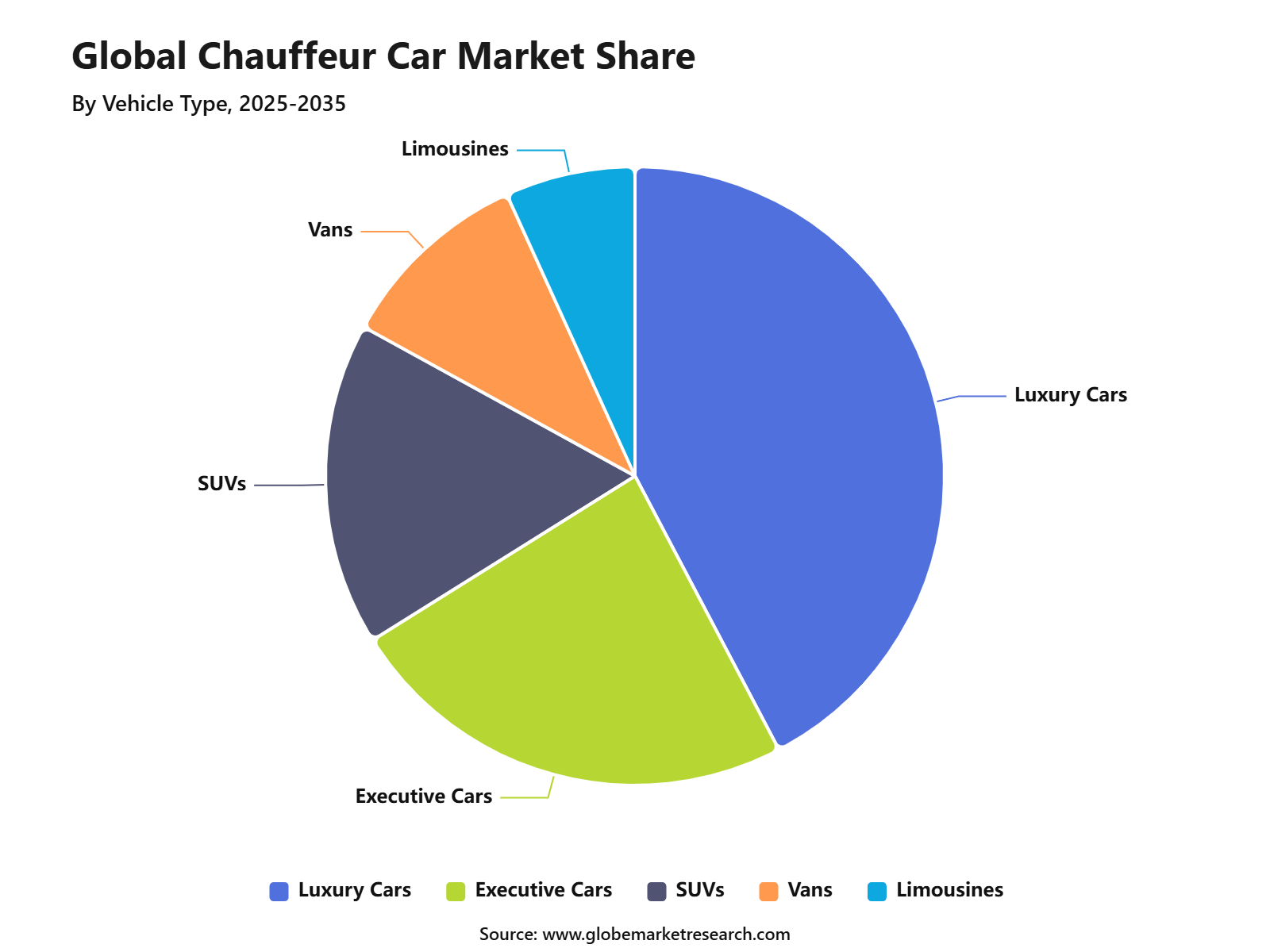 iThe graph shows projected market growth until 2035 based on CAGR analysis. Actual outcomes may vary depending on changing demand, competition, and economic factors.To gain greater insights - request a sample report PDF
By Customer Type
Corporate clients accounted for 53.3% share in 2025, highlighting the strong role of business users in the Chauffeur Car Market. This segment includes companies, business travelers, executives, conference organizers, financial institutions, law firms, consulting groups, and multinational enterprises.
The growth of corporate clients can be linked to the need for dependable ground transport that supports business schedules and professional service expectations. Chauffeur services are used where punctuality, confidentiality, billing control, service consistency, and driver quality are important decision factors.
Corporate demand is expected to remain a major revenue base for chauffeur service providers. Long-term contracts, account-based billing, airport transfer packages, event transportation, executive mobility programs, and technology-enabled booking tools are expected to support further growth in this segment.
By Region
North America held 42.1% share of the Chauffeur Car Market in 2025, valued at USD 37.5 billion, supported by strong corporate travel activity, high premium mobility demand, and mature airport transportation networks. The region has a large base of business travelers, high-income consumers, luxury hotels, corporate headquarters, financial centers, and major event locations.
The regional market is being supported by strong demand from the U.S. and Canada, especially across business hubs such as New York, Los Angeles, Chicago, Toronto, Dallas, San Francisco, Washington, D.C., and Miami. Airport transfers, executive travel, corporate roadshows, conventions, weddings, and luxury tourism continue to support chauffeur service demand.
North America is expected to remain a leading region due to its strong business travel ecosystem and high customer willingness to pay for professional transport. Growth opportunities are likely to be seen in corporate mobility programs, luxury airport transfers, app-based chauffeur booking, electric luxury fleets, event transportation, and premium subscription-based transport services.
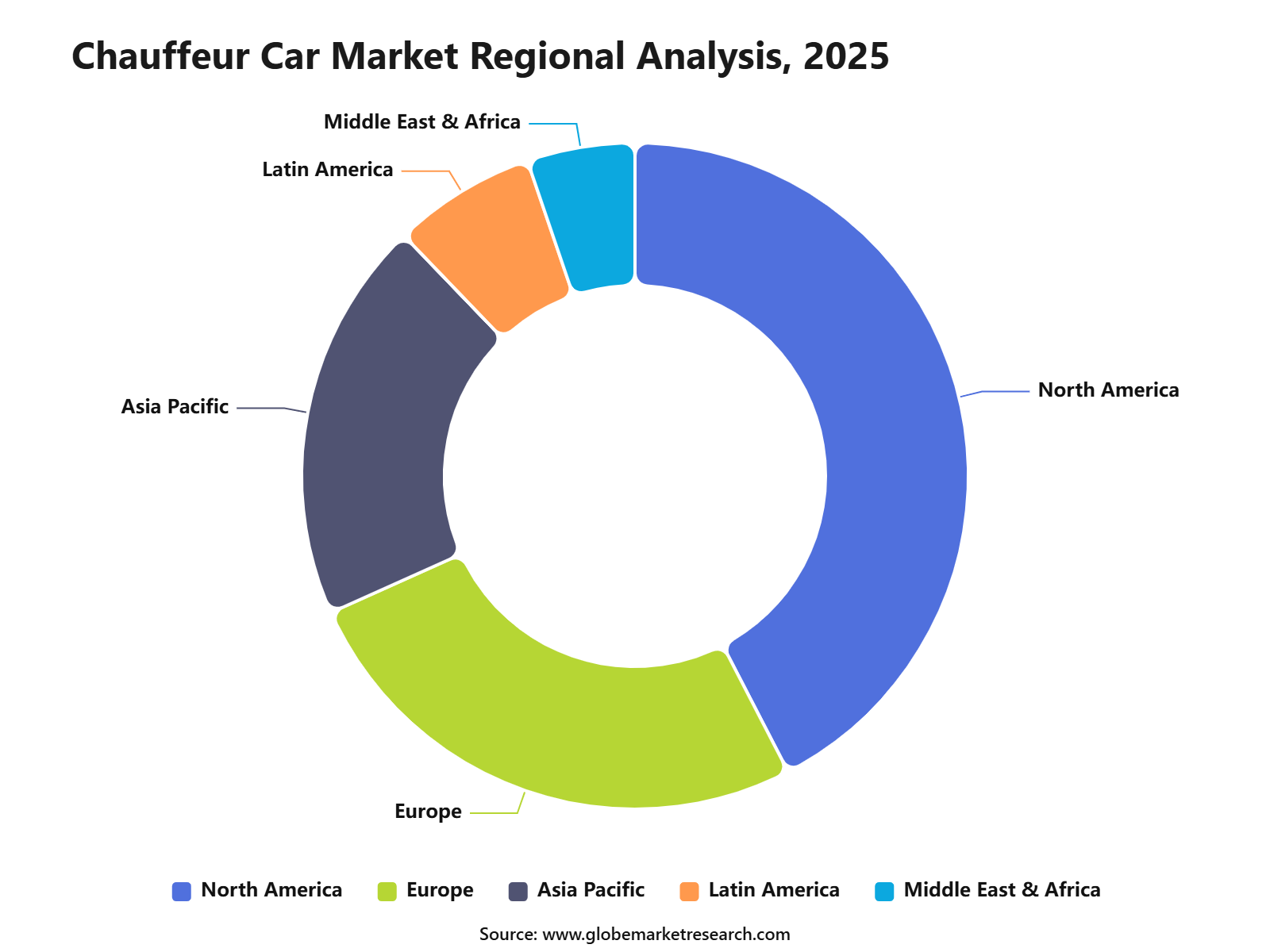 iThe graph shows projected market growth until 2035 based on CAGR analysis. Actual outcomes may vary depending on changing demand, competition, and economic factors.To gain greater insights - request a sample report PDF
Regional Impact Analysis
Impact Factor | Estimated CAGR Impact | Regional Relevance | Market Impact |
|---|---|---|---|
North America market leadership | +4.5% | U.S. and Canada | Leads corporate demand. |
Europe luxury mobility growth | +3.4% | UK, Germany, France, Italy | Supports premium services. |
Asia Pacific business travel expansion | +3.7% | China, India, Japan, Singapore | Drives urban demand. |
Middle East luxury transport demand | +3.1% | UAE, Saudi Arabia, Qatar | Supports high-end services. |
Latin America emerging adoption | +1.9% | Brazil, Mexico, Chile, Colombia | Builds gradual demand. |
Segments Covered in the Report
By Service Type
Business Travel Services
Leisure Travel Services
Airport Transfers
Event-specific Services
By Vehicle Type
Luxury Cars
Executive Cars
SUVs
Vans
Limousines
By Customer Type
Corporate Clients
Individual Customers
Tourist and Leisure Travelers
By Region
North America
Europe
Asia-Pacific
Latin America
Middle East and Africa
Drivers Impact Analysis
Impact Factor | Estimated CAGR Impact | Regional Relevance | Market Impact |
|---|---|---|---|
Rising corporate travel demand | +4.2% | North America, Europe, Asia Pacific | Drives premium bookings. |
Growth in airport transfer services | +3.8% | U.S., Europe, GCC, Asia Pacific | Supports repeat demand. |
Increasing demand for luxury mobility | +3.5% | U.S., UK, UAE, China, Japan | Expands premium usage. |
Rising tourism and business events | +3.1% | Europe, Middle East, Asia Pacific | Increases trip volume. |
Growth in app-based chauffeur booking | +2.8% | Global urban markets | Improves booking access. |
Restraints Impact Analysis
Impact Factor | Estimated CAGR Impact | Regional Relevance | Market Impact |
|---|---|---|---|
High service pricing | -2.1% | Emerging markets, price-sensitive users | Limits mass adoption. |
Driver shortage and training costs | -1.8% | North America, Europe, GCC | Raises operating cost. |
Fuel and maintenance cost volatility | -1.6% | Global | Pressures margins. |
Regulatory licensing requirements | -1.4% | U.S., Europe, Middle East | Increases compliance burden. |
Competition from ride-hailing services | -1.3% | Global urban markets | Affects pricing power. |
Opportunities Impact Analysis
Impact Factor | Estimated CAGR Impact | Regional Relevance | Market Impact |
|---|---|---|---|
Expansion of corporate mobility contracts | +4.0% | North America, Europe, Asia Pacific | Builds stable revenue. |
Growth in luxury tourism | +3.6% | UAE, Saudi Arabia, Europe, U.S. | Supports premium demand. |
Electric chauffeur fleet adoption | +3.2% | Europe, U.S., China, GCC | Improves sustainability value. |
Event and wedding transportation demand | +2.9% | Asia Pacific, Middle East, Europe | Expands service use. |
Premium subscription mobility services | +2.6% | U.S., Europe, GCC | Supports recurring revenue. |
Challenges Impact Analysis
Impact Factor | Estimated CAGR Impact | Regional Relevance | Market Impact |
|---|---|---|---|
Maintaining service quality | -1.8% | Global | Affects customer retention. |
Fleet utilization pressure | -1.6% | Urban and airport markets | Impacts profitability. |
Insurance and liability risks | -1.4% | North America, Europe, GCC | Raises operating cost. |
Traffic congestion in cities | -1.2% | Major urban centers | Affects service reliability. |
Technology integration gaps | -1.0% | Traditional operators | Slows digital adoption. |
Supply Chain and Value Chain Analysis
The chauffeur car market has a service-led supply chain that begins with vehicle procurement, leasing, fleet financing, insurance, driver hiring, driver training, and fleet maintenance. Premium vehicles, executive sedans, SUVs, vans, and electric luxury cars are sourced from automakers, dealers, leasing companies, and fleet management providers. The service layer includes dispatch systems, booking platforms, payment gateways, GPS tracking, customer support, airport coordination, and corporate billing tools. The value chain starts with customer acquisition through corporate contracts, hotel partnerships, travel agencies, airport transfer channels, event planners, and direct mobile bookings.
Value is created through punctual pickup, trained chauffeurs, clean vehicles, privacy, safety, luggage support, fixed pricing, and high service reliability. Technology improves this value chain by enabling route optimization, automated dispatch, live vehicle tracking, digital invoicing, driver performance monitoring, and repeat customer management. Digital payment growth also supports the market, as the World Bank reported that 79% of adults globally now have an account, while 84% of adults in low and middle income countries own a mobile phone and 3 billion have smartphones.
Regulatory Landscape
The chauffeur car market is highly regulated because it involves passenger safety, paid transport, driver verification, vehicle standards, insurance, and customer protection. In many markets, operators must hold private hire, for-hire vehicle, or limousine service licences before offering commercial chauffeur services. In the UK, private hire operators must apply through the relevant local council or Transport for London, and the driver licence, vehicle licence, and operator licence must be issued by the same authority.
In New York City, for-hire vehicle services must be arranged through a TLC-licensed base and performed by TLC-licensed drivers using TLC-licensed vehicles, covering categories such as black cars and luxury limousines. The UK Department for Transport’s best practice guidance recommends annual vehicle testing for taxis and private hire vehicles, daily driver vehicle inspections, and record keeping for inspection failures.
In England, recent licensing discussions also place attention on disability awareness training and accessible service planning for taxi and private hire vehicle operators. Fleet transition is another compliance factor, as the European Commission states that the EU fleet-wide CO2 target for cars and vans is 0 g CO2/km, equal to a 100% reduction target, while the FTC has also identified unfair, deceptive, and anticompetitive conduct in gig work as an enforcement priority.
Market Trend Analysis
Impact Factor | Estimated CAGR Impact | Regional Relevance | Market Impact |
|---|---|---|---|
App-based chauffeur booking | +3.7% | Global | Improves customer access. |
Luxury electric vehicle fleets | +3.3% | Europe, U.S., China, UAE | Supports premium positioning. |
Corporate account-based services | +3.1% | North America, Europe, Asia Pacific | Drives repeat bookings. |
On-demand premium mobility | +2.8% | Urban business hubs | Increases service flexibility. |
Airport and hotel partnerships | +2.6% | Global travel hubs | Strengthens channel reach. |
Investment Opportunity Analysis
Impact Factor | Estimated CAGR Impact | Regional Relevance | Market Impact |
|---|---|---|---|
Premium chauffeur fleet expansion | +3.9% | U.S., Europe, GCC, Asia Pacific | Offers strong growth. |
Corporate mobility platforms | +3.5% | North America, Europe, Asia Pacific | Supports contract revenue. |
Electric luxury fleet investment | +3.2% | Europe, U.S., China, UAE | Builds green mobility value. |
Airport transfer service networks | +3.0% | Global airport hubs | Improves repeat demand. |
Digital chauffeur booking platforms | +2.8% | Global | Expands market reach. |
Recent Developments
March 2026 - Uber agreed to acquire Blacklane, a Berlin-based global chauffeur service provider. The deal value was not disclosed. However, Blacklane was last valued at about USD 547.3 million after its October 2024 funding round. The acquisition is expected to close by the end of 2026, subject to regulatory approval.
March 2026 - Wheely made its U.S. debut in New York City. The luxury chauffeur platform already operates in London, Paris, and Dubai. The company plans to expand into five major U.S. cities within three years, including possible markets in Texas, Miami, Palm Beach, and Washington, D.C.
Report Scope
Report Highlights | Details |
|---|---|
Market Revenue (2025) | USD 89.2 Bn |
Forecast Revenue (2035) | USD 403.8 Bn |
CAGR (2025-2035) | 16.3% |
Base Year for Estimation | 2025 |
Historic Data | 2020-2024 |
Forecast Period | 2025-2035 |
Report Coverage | AI market impact analysis, market surveys, trade analysis, Industry & competitive intelligence, Revenue projections, company positioning, competitive analysis, growth drivers, and emerging market trends, Strategic Consultation & Advisory Services |
Segments Covered | By Service Type (Business Travel Services, Leisure Travel Services, Airport Transfers, Event-specific Services), By Vehicle Type (Luxury Cars, Executive Cars, SUVs, Vans, Limousines), By Customer Type (Corporate Clients, Individual Customers, Tourist and Leisure Travelers), By Regional Insights |
Regional Analysis | North America - US, Canada; Europe - Germany, France, The UK, Spain, Italy, Russia, Netherlands, Rest of Europe; Asia Pacific - China, Japan, South Korea, India, New Zealand, Singapore, Thailand, Vietnam, Rest of Latin America; Latin America - Brazil, Mexico, Rest of Latin America; Middle East & Africa - South Africa, Saudi Arabia, UAE, Rest of MEA |
Key companies profiled | Blacklane, Addison Lee, Sixt Limousine Service (Sixt SE), Carey International, EmpireCLS Worldwide Chauffeured Services, BostonCoach, TBR Global Chauffeuring, Uber Technologies Inc. and Other Key Players |
Customization Scope | Tailored insights for specific regions, countries, and market segments can be provided. Additional report customization is available upon request. |
Competitive Landscape
The market is characterized by intense competition among established players and emerging companies. Strategic partnerships, mergers and acquisitions, and product innovation are key strategies employed by market participants.
Key Market Players
Blacklane
Addison Lee
Carey International
GroundLink
TBR Global Chauffeuring
SIXT
Uber Technologies
Lyft
Limos.com
GetTransfer
Europcar Mobility Group
Allied Limousine International
Other Key Players
Meet the Team
This report was prepared by our expert analysts with deep industry knowledge and research experience.
Pratiksha is market research analyst with strong experience in industry research, market forecasting, and competitive analysis. She specializes in identifying market trends, evaluating growth opportunities, and preparing data-driven insights across global industries. Her work supports businesses in understanding market dynamics, customer demand, regional opportunities, and strategic investment areas.
Suraj is a Senior Management Consultant with over 7 years of experience in market research, business strategy, and consulting. He has worked with Fortune 500 companies and growing startups, helping them with market entry, cross-border expansion, demand analysis, competitive assessment, and growth planning. His analytical thinking and strong industry knowledge help clients make clear, confident, and informed business decisions.
Frequently Asked Questions
Related Reports
More in Automotive and Transportation
Inboard Electric Motors Market to hit 13.1 Bn by 2035
Global Inboard Electric Motors Market Size By Type(Low Power Below 10 HP, Medium Power 10 to 35 HP, Large Power Above 35 HP), By Application (Civil Entertainment, Municipal, Commercial, Other Applications), By Boat / Vessel Type (Recreational Boats, Yachts, Fishing Boats, Workboats, Passenger Boats, Commercial Vessels), By Battery Type (Lithium-ion Batteries, Lead-acid Batteries, Nickel-based Batteries, Other Battery Types), By Sales Channel (OEM, Aftermarket), By End User (Individual Boat Owners, Commercial Operators, Tourism and Leisure Operators, Municipal Authorities, Marine Transport Operators), By Regional Insights, Business plan and Project Report, Investment Opportunities, Profitability, Industry Trends, Leading Companies and Growth Forecasts by 2025-2035
Automotive AI Agents Market to hit 16.5 Bn by 2035
Global Automotive AI Agents Market By Agent Type (Conversational AI Agents, Autonomous Driving AI Agents, Predictive Maintenance AI Agents, Fleet Management AI Agents and Others), By Vehicle Type (Passenger Vehicles, Commercial Vehicles, Electric Vehicles (EVs), Autonomous Vehicles), By Application (Driver Assistance & Safety, In-Vehicle Virtual Assistants, Predictive Maintenance, Fleet & Logistics Management, Infotainment Personalization), By Deployment Type (Cloud-Based AI Agents, Edge/On-Board AI Agents, Hybrid Deployment), By Regional Insights, Business plan and Project Report, Investment Opportunities, Profitability, Industry Trends, Leading Companies and Growth Forecasts by 2025-2035
Automotive Alternator & Starter Motor Market to Hit USD 62.8 Bn by 2035
Global Automotive Alternator & Starter Motor Market Size, Share and AI Impact Analysis By Product (Alternator, Starter Motor), By Vehicle Type (Passenger vehicle, Commercial Vehicle, Off-road Vehicle), By Sales Channel (OEM, Aftermarket), By Regional Insights, Leading Companies and Growth Forecasts By 2025-2035