

Revenue, 2025
$12.6Bn
Forecast, 2035
$35.6Bn
CAGR, 2025-2035
10.9%
Report Coverage
Global
Market Size and Forecast
The Global Pet Toys Market reached USD 12.6 billion in 2025 and is expected to grow to USD 35.6 billion by 2035, registering a CAGR of 10.9% from 2025 to 2035. North America held the largest regional share of 35.6% in 2025, driven by high pet ownership, strong household spending on pet care, and rising demand for premium, safe, and interactive pet toys. Growth in the region is also supported by the increasing treatment of pets as family members, which has encouraged higher spending on toys that support play, comfort, training, and mental stimulation.
The growth of the pet toys market can be attributed to increasing awareness of pet health, physical activity, and emotional well-being. Pet owners are showing stronger interest in chew toys, plush toys, ropes, balls, puzzle toys, and durable toys that help reduce boredom, anxiety, and destructive behavior. The market is also benefiting from wider product availability through online platforms, pet specialty stores, supermarkets, and direct-to-consumer brands.
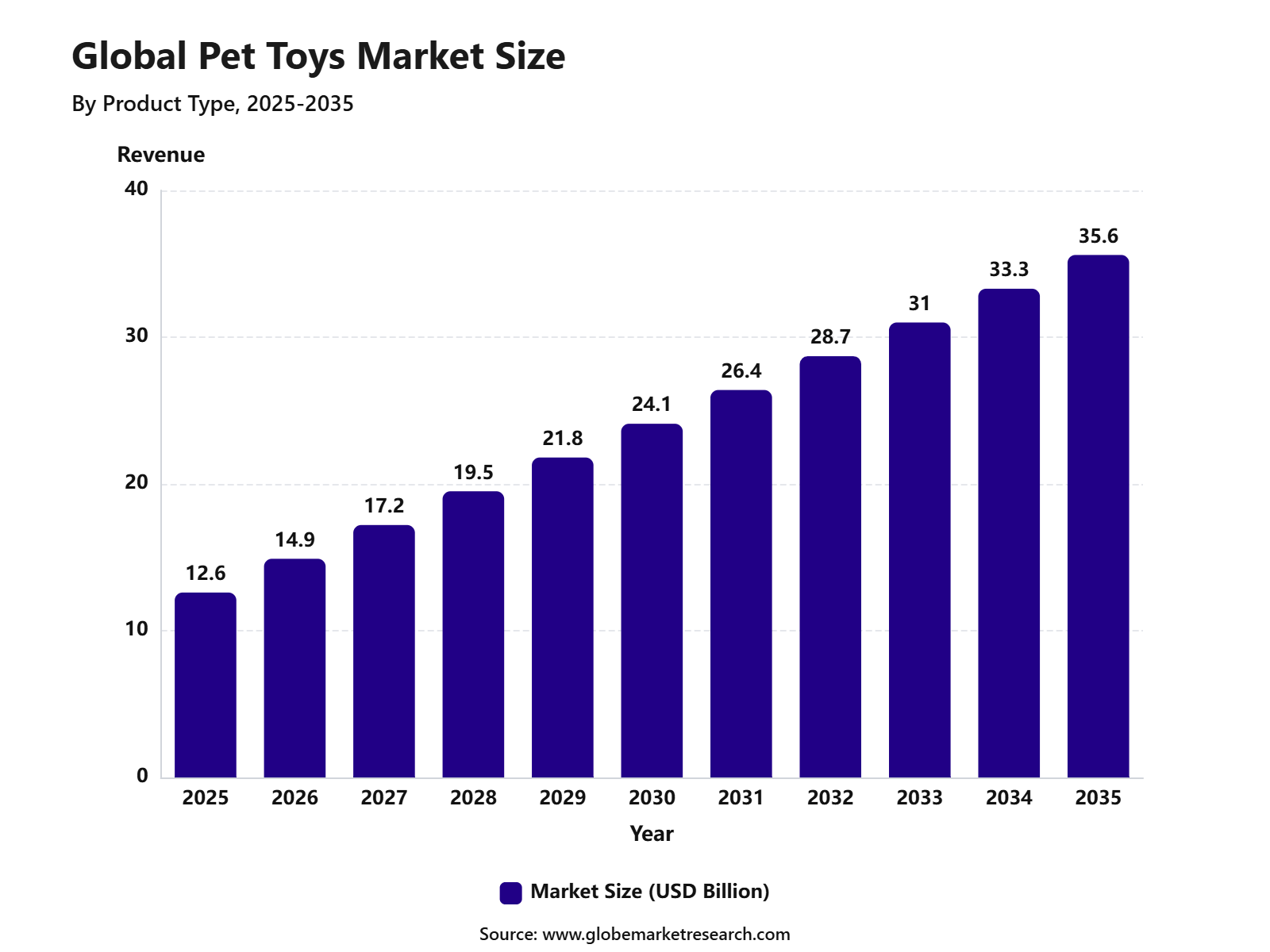 iThe graph shows projected market growth until 2035 based on CAGR analysis. Actual outcomes may vary depending on changing demand, competition, and economic factors.To gain greater insights - request a sample report PDF
Key Market Insights
Balls led the pet toys market with 36.4% share in 2026, supported by strong demand for fetch toys, interactive play products, and affordable pet exercise accessories.
Dogs accounted for 69.7% share by pet type in 2026, driven by higher toy usage, active play behavior, and strong spending on dog enrichment products.
Offline channels held 65.6% share in 2026, supported by pet specialty stores, supermarkets, veterinary outlets, and consumer preference for checking product quality before purchase.
North America held 35.6% share of the pet toys market, supported by high pet ownership, strong spending on pet care products, and wide availability of premium toys across retail and online channels.
Customer Acquisition Strategy
The Pet Toys Market needs a pet-type-led and behavior-led go-to-market strategy. Brands should separate products for dogs, cats, puppies, kittens, aggressive chewers, senior pets, indoor pets, and anxiety-prone pets because buying decisions are linked to safety, durability, enrichment, and emotional bonding. The sales message should focus on chew resistance, non-toxic materials, washable design, mental stimulation, dental support, and size suitability.
APPA reported that 95 million U.S. households owned a pet in its 2025 National Pet Owners Survey, which supports a large and steady buyer base for pet supplies and accessories. Sales economics are strongest when pet toys are sold as repeat-purchase products rather than one-time accessories.
Plush toys, chew toys, rope toys, treat-dispensing toys, puzzle toys, cat teasers, balls, and interactive toys can support frequent replacement because pets damage, lose, or outgrow products. APPA projected U.S. spending on supplies, live animals, and OTC medicine at USD 35.6 billion for 2026, and pet toys are commonly sold within this broader supplies category. This creates a strong retail opportunity across supermarkets, pet specialty stores, online marketplaces, veterinary channels, and subscription boxes.
By Product Type: Balls
Balls led the pet toys market by product type with 36.4% share in 2026. The segment’s leadership can be attributed to its wide use across daily play, fetch activity, exercise routines, and pet-owner interaction. Balls are also easier to replace, available in many sizes, and suitable for both indoor and outdoor use, which supports frequent repeat purchases.
The segment is strongly linked with dog ownership, as dogs remain one of the largest companion pet groups in major pet markets. APPA reported that dog ownership in the U.S. increased from 51% of households in 2024 to 53% in 2025, while AVMA data also shows that 42.6% of U.S. households own dogs. This supports steady demand for simple, durable, and activity-based toys such as balls.
By Pet Type: Dogs
Dogs led the pet type segment with 69.7% share in 2026. The segment’s dominance was supported by higher toy usage frequency, stronger owner engagement, and regular demand for exercise, training, chewing, and interactive play products. Dog owners often buy multiple toy formats because dogs require physical activity, mental stimulation, and replacement toys due to wear and tear.
Growth in this segment is also supported by the expanding dog-owning household base. APPA noted that U.S. dog-owning households reached 71 million in 2025, with growth led by Gen Z, Millennials, and Gen X. This wider ownership base creates consistent demand for toys designed for fetch, chewing, tugging, comfort, and behavior enrichment.
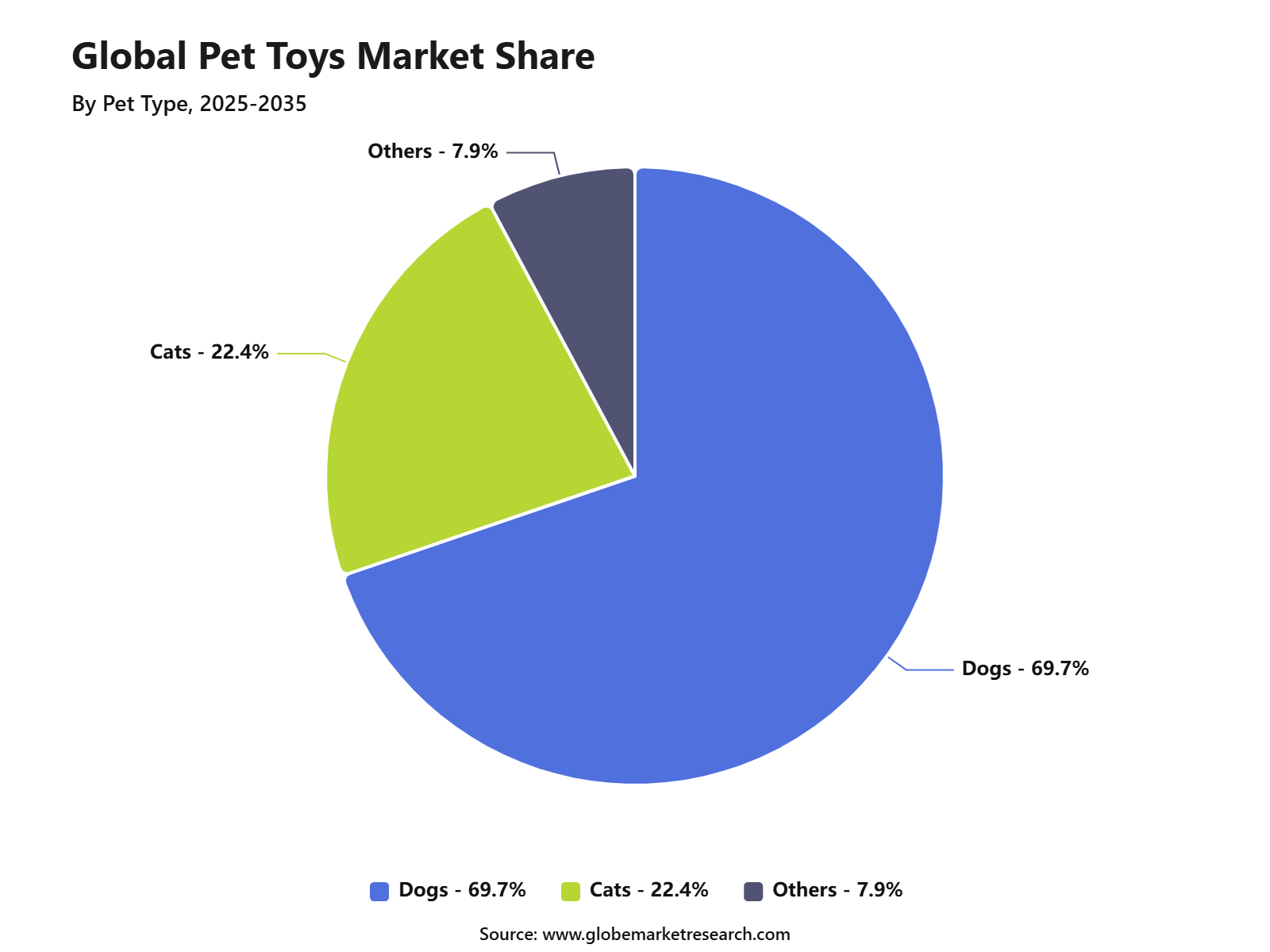 iThe graph shows projected market growth until 2035 based on CAGR analysis. Actual outcomes may vary depending on changing demand, competition, and economic factors.To gain greater insights - request a sample report PDF
By Distribution Channel: Offline Channels
Offline channels held the leading distribution share with 65.6% in 2026. The segment’s strength was supported by consumer preference for checking toy size, material quality, durability, and safety before purchase. Physical stores also benefit from impulse buying, immediate product availability, and staff guidance, especially when pet owners are selecting toys based on breed size, chewing behavior, and age.
Offline sales remain important even as online buying continues to grow. U.S. Census Bureau data shows that e-commerce accounted for 16.9% of total retail sales in Q1 2026, which indicates that physical retail still holds a major role across consumer product categories. In pet toys, this supports the continued relevance of pet specialty stores, supermarkets, hypermarkets, and local retailers for everyday toy purchases.
By Region: North America
North America led the pet toys market with 35.6% share in 2026. The region’s leadership was supported by high pet ownership, strong household spending on companion animals, and the wide availability of pet toys through supermarkets, pet specialty stores, and online platforms. Demand was also supported by the growing view of pets as family members, which increased spending on toys used for exercise, comfort, training, and mental stimulation.
The U.S. remained the main contributor in the region due to its large pet-owning population and mature pet care retail structure. Canada also supported regional growth through steady demand for durable, safe, and activity-based toys for dogs and cats. Product demand remained strong across balls, chew toys, plush toys, rope toys, and interactive formats, as consumers continued to focus on pet wellness and daily engagement.
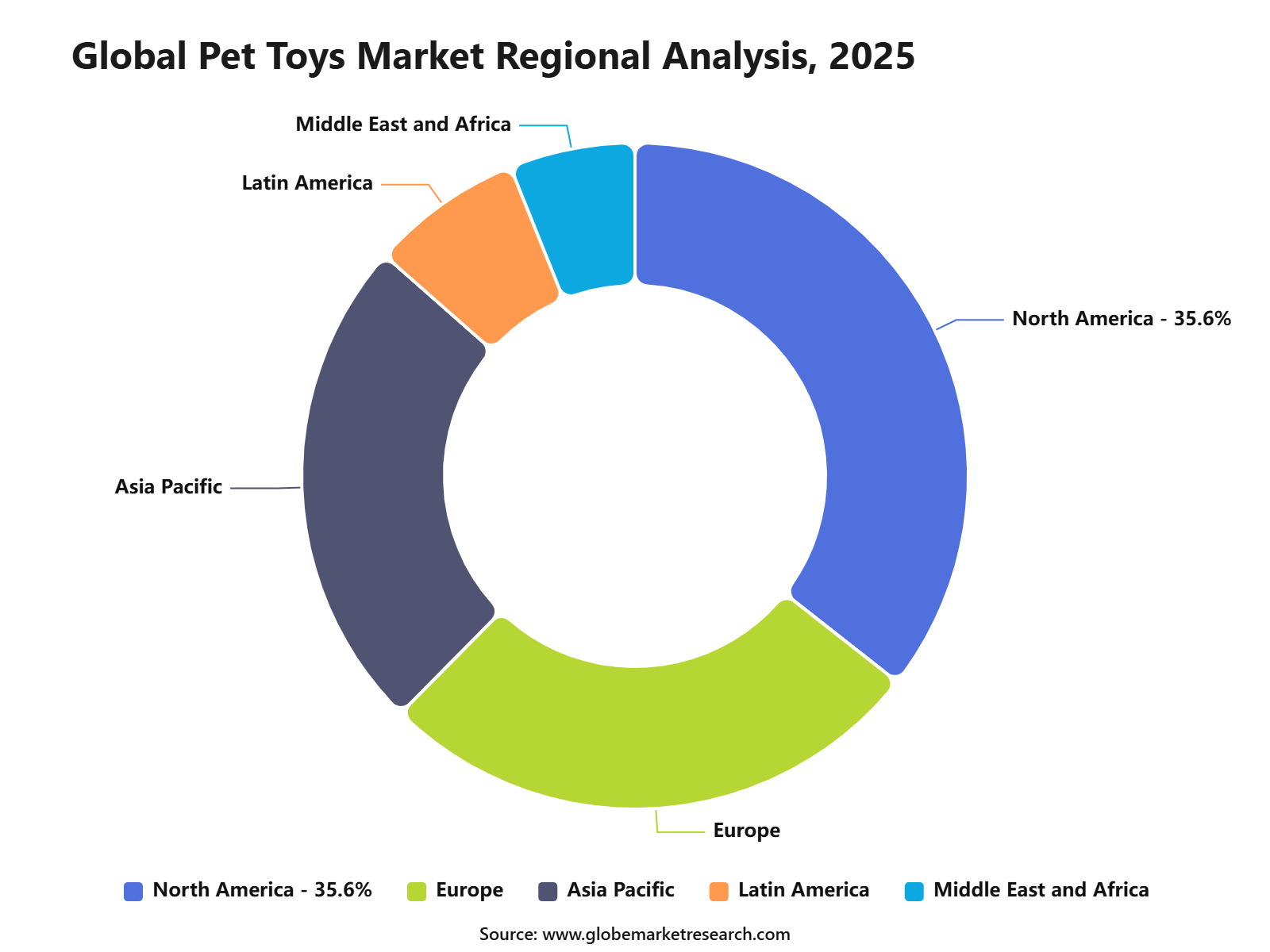 iThe graph shows projected market growth until 2035 based on CAGR analysis. Actual outcomes may vary depending on changing demand, competition, and economic factors.To gain greater insights - request a sample report PDF
Risk Factors & Market Barriers
The Pet Toys Market faces risks from product safety failures, weak durability claims, low-cost imports, tariff volatility, and price-sensitive consumers. Pet toys are handled, chewed, scratched, swallowed, and dragged by animals, so product failure can quickly create brand damage. ASTM highlighted that dogs often destroy toys and may ingest material afterward, creating choking or intestinal blockage risks. This makes safety design, material testing, and controlled breakage behavior important for responsible product development.
Market adoption barriers are mainly linked to consumer trust, product safety concerns, and price sensitivity. Pet owners may want premium toys, but they often compare durability and price before repeat purchasing. A toy that breaks quickly, sheds fibers, loses small parts, or creates a choking concern can reduce repeat sales and damage reviews. This makes product testing and honest performance claims more important than aggressive marketing.
Another barrier is heavy competition in basic toy categories. Low-cost balls, ropes, stuffed toys, and squeaky toys are widely available, which can make it difficult for brands to maintain pricing power. Premium positioning needs clear proof, such as better durability, safer materials, veterinarian input, washable construction, recycled content, or tested enrichment value. Without a clear product difference, retailers may treat toys as seasonal or promotional items, which reduces margins.
Drivers Impact Analysis
Impact Factor | Estimated CAGR Impact | Regional Relevance | Market Impact |
|---|---|---|---|
Rising pet ownership | +2.8% | North America, Europe, Asia Pacific | Drives toy demand. |
Growth in pet humanization | +2.5% | U.S., Canada, UK, Japan | Supports premium purchases. |
Increasing focus on pet health and activity | +2.1% | Global | Boosts interactive toys. |
Higher spending on dogs and cats | +1.8% | North America, Europe, urban Asia | Expands product sales. |
Growth in online pet product retail | +1.6% | Global | Improves product access. |
Restraints Impact Analysis
Impact Factor | Estimated CAGR Impact | Regional Relevance | Market Impact |
|---|---|---|---|
Price sensitivity among pet owners | -1.4% | Emerging markets, mass buyers | Limits premium demand. |
Safety concerns over materials | -1.1% | North America, Europe | Raises quality pressure. |
Short product replacement cycle | -0.9% | Global | Increases value pressure. |
Competition from low-cost toys | -0.8% | Asia Pacific, Latin America | Pressures margins. |
Limited awareness in rural markets | -0.7% | Emerging regions | Slows adoption. |
Challenges Impact Analysis
Impact Factor | Estimated CAGR Impact | Regional Relevance | Market Impact |
|---|---|---|---|
Product durability concerns | -1.2% | Global | Affects repeat buying. |
Pet safety and choking risks | -1.0% | North America, Europe | Increases compliance needs. |
Fast-changing consumer preferences | -0.9% | Global | Requires frequent innovation. |
Supply chain pressure for safe materials | -0.8% | Global | Raises sourcing risk. |
Brand differentiation challenges | -0.7% | Mature markets | Limits pricing power. |
Segment covered in the Report
By Product Type
Plush
Rope
Balls
Others
By Pet Type
Dogs
Cats
Others
By Distribution Channel
Offline
Online
By Region
Asia Pacific
North America
Europe
Middle East & Africa
Latin America
Market Trend Analysis
Impact Factor | Estimated CAGR Impact | Regional Relevance | Market Impact |
|---|---|---|---|
Interactive pet toy adoption | +2.6% | North America, Europe, Asia Pacific | Improves pet engagement. |
Growth in plush and comfort toys | +2.0% | Global | Supports daily use. |
Eco-friendly toy materials | +1.8% | Europe, North America | Supports sustainable buying. |
Breed and size-specific toys | +1.5% | Global | Improves product fit. |
Social media-driven pet product discovery | +1.4% | U.S., Europe, urban Asia | Boosts impulse purchases. |
Investment Opportunity Analysis
Impact Factor | Estimated CAGR Impact | Regional Relevance | Market Impact |
|---|---|---|---|
Smart pet toy development | +2.4% | North America, Europe, developed Asia | Offers premium potential. |
Eco-friendly toy brands | +1.9% | Europe, North America, Australia | Builds sustainable appeal. |
Online pet toy retail | +1.8% | Global | Supports scalable sales. |
Dog toy product lines | +2.2% | Global | Drives category growth. |
Subscription toy services | +1.5% | U.S., UK, Canada, Australia | Creates recurring revenue. |
Recent Developments
January 2026, Ecovacs introduced LilMilo, an AI-powered robotic pet companion, during CES 2026. The product is positioned around emotional companionship and pet-like interaction, showing how pet toys and smart companion devices are moving closer to robotics and AI-based engagement. Pricing and release timing were not confirmed at the time of the announcement.
January 2026, Petkit announced AI-powered pet care devices, including the Yumshare Daily Feast wet food feeder and the Eversweet Ultra water fountain. The fountain was priced at USD 199.99 and included AI-based pet recognition, a 1080P camera, and drinking behavior tracking. Although these are not toys, the launch shows how the pet products market is moving toward connected, sensor-based, and behavior-monitoring products.
Report Scope
Report Highlights | Details |
|---|---|
Market Revenue (2025) | USD 12.6 Billion |
Forecast Revenue (2035) | USD 35.6 Billion |
CAGR (2025-2035) | 10.9% |
Base Year for Estimation | 2025 |
Historic Data | 2020-2024 |
Forecast Period | 2025-2035 |
Report Coverage | AI market impact analysis, market surveys, trade analysis, Industry & competitive intelligence, Revenue projections, company positioning, competitive analysis, growth drivers, and emerging market trends, Strategic Consultation & Advisory Services |
Segments Covered | By Product Type (Plush, Rope, Balls, Others), By Pet Type (Dogs, Cats, Others), By Distribution Channel (Offline, Online), By Regional Insights |
Regional Analysis | North America - US, Canada; Europe - Germany, France, The UK, Spain, Italy, Russia, Netherlands, Rest of Europe; Asia Pacific - China, Japan, South Korea, India, New Zealand, Singapore, Thailand, Vietnam, Rest of Latin America; Latin America - Brazil, Mexico, Rest of Latin America; Middle East & Africa - South Africa, Saudi Arabia, UAE, Rest of MEA |
Key companies profiled | Fluff and Tuff, Inc.; Petsport USA, Inc.; Cosmic Pet; ZyppyPaws; Ethical Products, Inc.; Benebone LLC; Jolly Pets; Honest Pet Products; Petmate; Coastal Pet Products, Inc. and Other Key Players |
Customization Scope | Tailored insights for specific regions, countries, and market segments can be provided. Additional report customization is available upon request. |
Competitive Landscape
The market is characterized by intense competition among established players and emerging companies. Strategic partnerships, mergers and acquisitions, and product innovation are key strategies employed by market participants.
Key Market Players
Fluff and Tuff, Inc.
Petsport USA, Inc.
Cosmic Pet
ZyppyPaws
Ethical Products, Inc.
Benebone LLC
Jolly Pets
Honest Pet Products
Coastal Pet Products, Inc.
Other Key Players
Meet the Team
This report was prepared by our expert analysts with deep industry knowledge and research experience.
Pratiksha is market research analyst with strong experience in industry research, market forecasting, and competitive analysis. She specializes in identifying market trends, evaluating growth opportunities, and preparing data-driven insights across global industries. Her work supports businesses in understanding market dynamics, customer demand, regional opportunities, and strategic investment areas.
Sayali brings more than 5 years of experience to Globe Market Research, supporting the accuracy, clarity, and relevance of research content across multiple industries. She reviews market data, segment analysis, competitive insights, and industry trends to ensure each report meets strong quality standards and provides practical value to business decision-makers. Her expertise spans healthcare, information technology, consumer goods, and diverse cross-industry domains. With a strong focus on data reliability, structured analysis, and clear presentation, Sayali helps ensure that each research output delivers well-reviewed insights for clients, investors, consultants, and industry stakeholders.
Frequently Asked Questions
Related Reports
More in Consumer Goods
Black Hair Care Market to hit 17.1 Bn by 2035
Global Black Hair Care Market By Product Type (Shampoo, Conditioner, Hair Dye, Hair Oils, Hair Serums, Others.), By Application (Household, Commercial Use, Salons, Beauty Parlors, Professional Hair Care Services), By Distribution Channel (Offline Stores, Online Platforms, Supermarkets and Hypermarkets, Specialty Beauty Stores, Retail Stores, Pharmacies, Direct-to-Consumer Channels), By End User (Women, Men, Kids, Professional Stylists, Salons), By Hair Concern (Dryness and Moisture Retention, Scalp Health, Breakage Repair, Curl Definition, Frizz Control, Protective Styling, Hair Growth Support, Chemical-Free Hair Care), By Regional Insights, Business plan and Project Report, Investment Opportunities, Profitability, Industry Trends, Leading Companies and Growth Forecasts by 2025-2035
Halloween Costumes Market to hit 12.2 Bn by 2035
Global Halloween Costumes Market By Product Type (Adult Costumes, Kids Costumes, Pet Costumes, Accessories), By Theme (Superheroes, Movies and TV Characters, Horror, Fantasy, Historical, Others), By Distribution Channel (Online Stores, Specialty Stores, Supermarkets and Hypermarkets, Others), By Regional Insights, Business plan and Project Report, Investment Opportunities, Profitability, Industry Trends, Leading Companies and Growth Forecasts by 2025-2035
Residential Air Purifier Market to Surpass USD 42.1 Billion by 2035
Global Residential Air Purifier Market Size, Share Analysis Report By Product Type (Portable Air Purifiers, Whole-House Air Purifiers, Desktop Air Purifiers), By Technology (HEPA Filtration, Activated Carbon Filtration, UV-C Purification, Ionic Filtration, Hybrid Filtration), By Application (Dust and Allergen Removal, Smoke and Odor Control, Pet Dander Removal, Mold and Bacteria Reduction), By Regional Insights, Business plan and Project Report, Investment Opportunities, Profitability, Industry Trends, Leading Companies and Growth Forecasts by 2025-2035
Trampoline Park Market Revenue to Hit USD 13.8 Billion by 2035
Global Trampoline Park Market Size, Surveys, Revenue, Volume, Production, Trade Analysis Report By Type (Indoor Trampoline Parks, Outdoor Trampoline Parks), By Age Group (Children, Teenagers, Adults), By Revenue Source (Entry Fees, Food & Beverages, Merchandise, Events & Parties, Others), By Ownership (Franchise, Independent), By Regional Insights, Leading Companies and Growth Forecasts by 2025-2035