

Revenue, 2025
$21.3Bn
Forecast, 2035
$42.1Bn
CAGR, 2025-2035
9.5%
Report Coverage
Global
Market Size and Forecast
The global Residential Air Purifier Market reached USD 21.32 billion in 2025 and is expected to grow to USD 42.15 billion by 2035, registering a CAGR of 9.5% during the forecast period. Asia Pacific accounted for the largest share of 42.0% in 2025, supported by high urban pollution levels, rising household health awareness, increasing disposable income, and strong demand for indoor air quality solutions across China, India, Japan, South Korea, and Southeast Asia.
Market growth is being driven by rising respiratory allergies, fine particulate matter exposure, and growing adoption of portable and smart air purifiers in urban homes. WHO data shows that almost the entire global population is exposed to air above recommended quality limits, while EPA findings indicate that some indoor pollutants are often 2 to 5 times higher than outdoor levels, increasing demand among families, children, elderly people, and allergy-sensitive consumers.
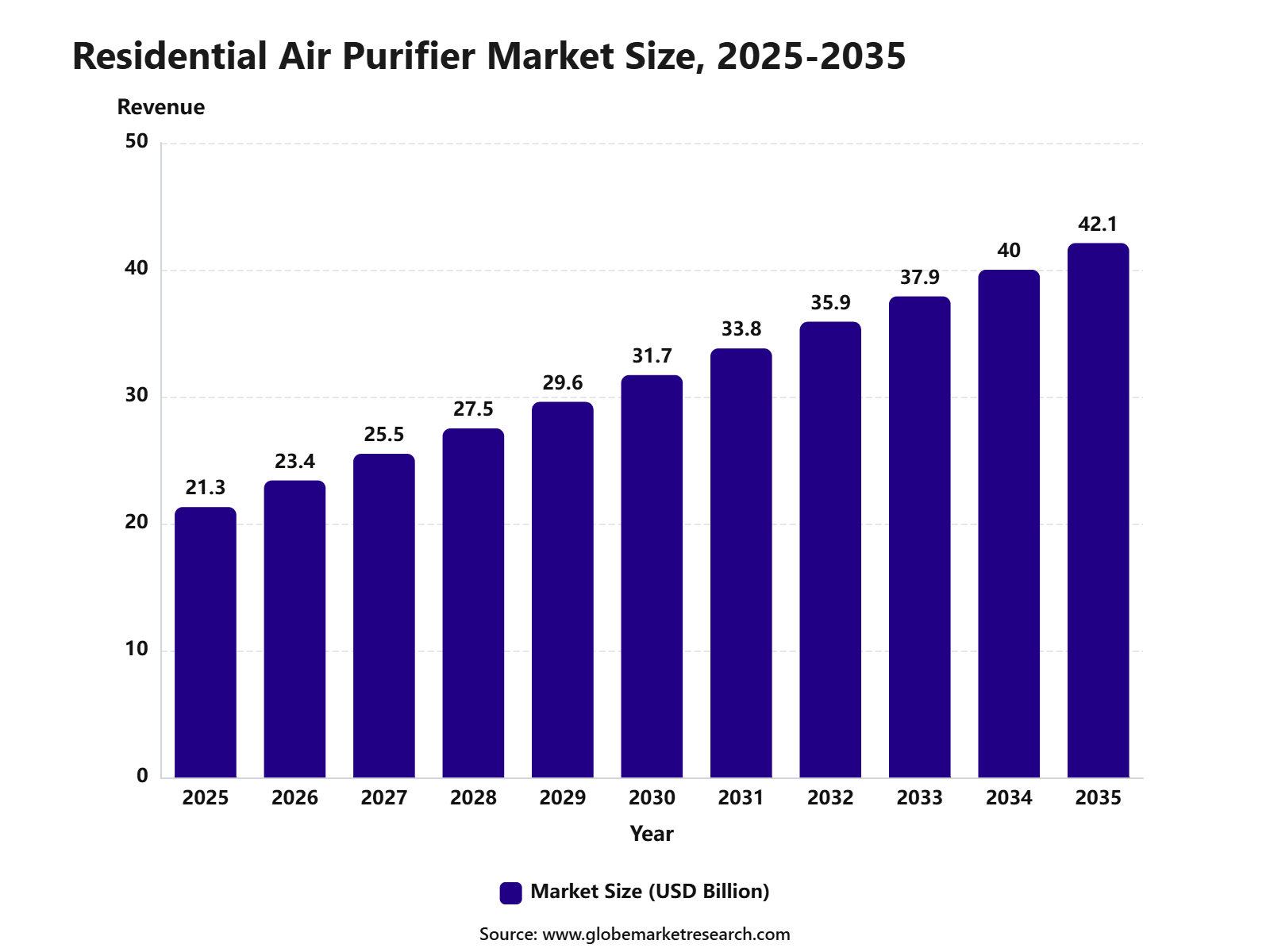 iThe graph shows projected market growth until 2035 based on CAGR analysis. Actual outcomes may vary depending on changing demand, competition, and economic factors.To gain greater insights - request a sample report PDF
Key Insight Summary
Portable air purifiers led the product type segment with 72.4% share. Demand was supported by easy installation, flexible room-to-room use, lower upfront cost, and rising consumer preference for compact indoor air cleaning devices.
HEPA filtration accounted for 53.4% share by technology. The segment remained dominant due to its strong ability to capture fine particles, dust, pollen, pet dander, and other airborne allergens in residential spaces.
Dust and allergen removal held 41.8% share by application. Growth was driven by rising allergy concerns, increasing indoor pollution awareness, and higher use of air purifiers in homes with children, elderly people, and pets.
Asia Pacific accounted for the largest share of 42.0% in 2025
Key Statistics
The premium residential air purifier segment grew by 32% year-over-year during the last peak pollution season, supported by rising demand from urban households with higher indoor air quality concerns.
A high-end premium residential air purifier can cost up to ₹69,900, while entry-level functional models start from around ₹6,999, creating a wide price range for different consumer groups.
The average lifespan of a standard composite residential filter in highly polluted zones is nearly 6 months, making filter replacement an important ownership cost.
Replacement filter costs usually account for 15% to 25% of the original machine purchase price annually, which influences long-term product affordability.
Certified True HEPA air purifiers offer 99.97% particulate matter filtration efficiency for particles as small as 0.3 microns, making them a preferred choice for dust, pollen, smoke, and fine particle removal.
Modern smart residential air purifiers use laser sensors that can refresh ambient air quality index data every 1 second, helping users track real-time indoor air quality.
Online e-commerce portals handle more than 45% of retail order volume during November flash sales, showing the growing role of digital channels in residential air purifier purchases.
By Product Type
Portable air purifiers led the Residential Air Purifier Market with a 72.4% share, supported by their easy installation, flexible placement, and suitability for bedrooms, living rooms, apartments, and small homes. Consumers prefer portable units because they do not require major structural changes and can be moved from one room to another based on air quality needs.
The demand for portable air purifiers is also increasing due to rising urban pollution, seasonal smog, dust exposure, and growing awareness of indoor air health. These products are widely adopted by households with children, elderly people, pets, and individuals with allergies or respiratory sensitivity, as they offer quick and targeted air cleaning for daily use.
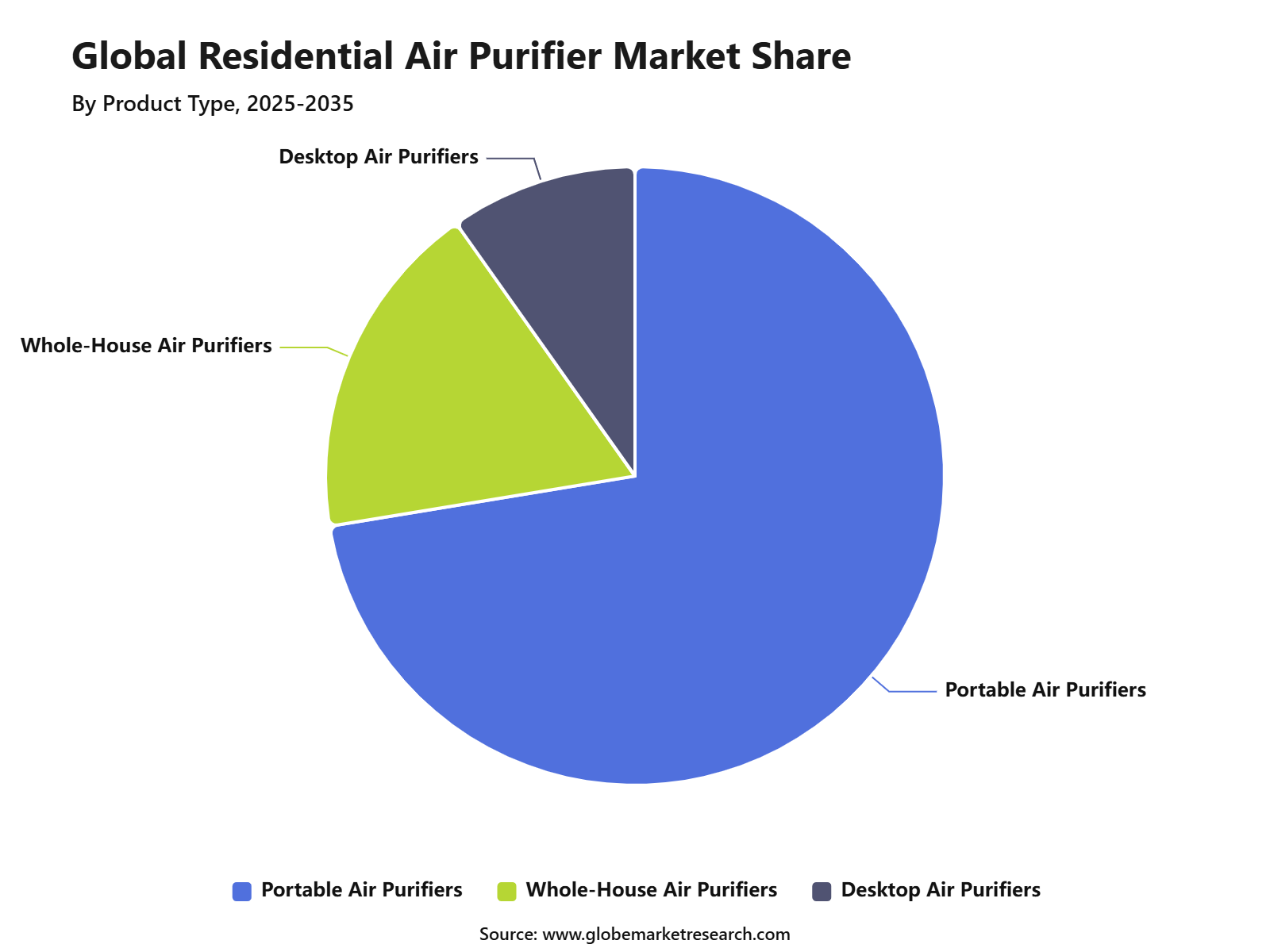 iThe graph shows projected market growth until 2035 based on CAGR analysis. Actual outcomes may vary depending on changing demand, competition, and economic factors.To gain greater insights - request a sample report PDF
By Technology
HEPA filtration held the largest share in the Residential Air Purifier Market, accounting for 53.4% of total demand. The growth of this segment is driven by its strong ability to capture fine particles, including dust, pollen, pet dander, smoke particles, and other airborne pollutants commonly found in homes.
The adoption of HEPA-based air purifiers is increasing as consumers are placing greater importance on cleaner indoor air and certified filtration performance. This technology is preferred in residential spaces because it offers reliable particle removal, supports allergy management, and is commonly used in premium as well as mid-range air purifier models.
By Application
Dust and allergen removal accounted for 41.8% share of the Residential Air Purifier Market, making it the leading application segment. Growth in this segment is mainly supported by rising cases of dust sensitivity, seasonal allergies, pet-related allergens, and indoor pollution caused by construction dust, carpets, furniture, and poor ventilation.
Households are increasingly using air purifiers to reduce exposure to common indoor irritants and improve everyday comfort. Demand is especially strong in urban homes, high-pollution zones, and areas affected by dry weather, pollen seasons, and high particulate matter levels, where consumers are seeking practical solutions for cleaner and healthier indoor air.
By Region
Asia Pacific led the Residential Air Purifier Market with a 42% share, supported by rising urban air pollution, higher population density, rapid industrial activity, and growing health awareness among households. Countries such as China, India, Japan, and South Korea are seeing strong demand as consumers become more focused on indoor air quality, especially in cities affected by dust, smoke, traffic emissions, and seasonal pollution.
The region’s growth is also driven by expanding middle-class income, increasing adoption of smart home appliances, and wider availability of portable air purifiers through online and offline retail channels. Demand is particularly strong among families with children, the elderly, allergy-sensitive consumers, and urban residents living in high-pollution zones, where air purifiers are increasingly viewed as essential home health products.
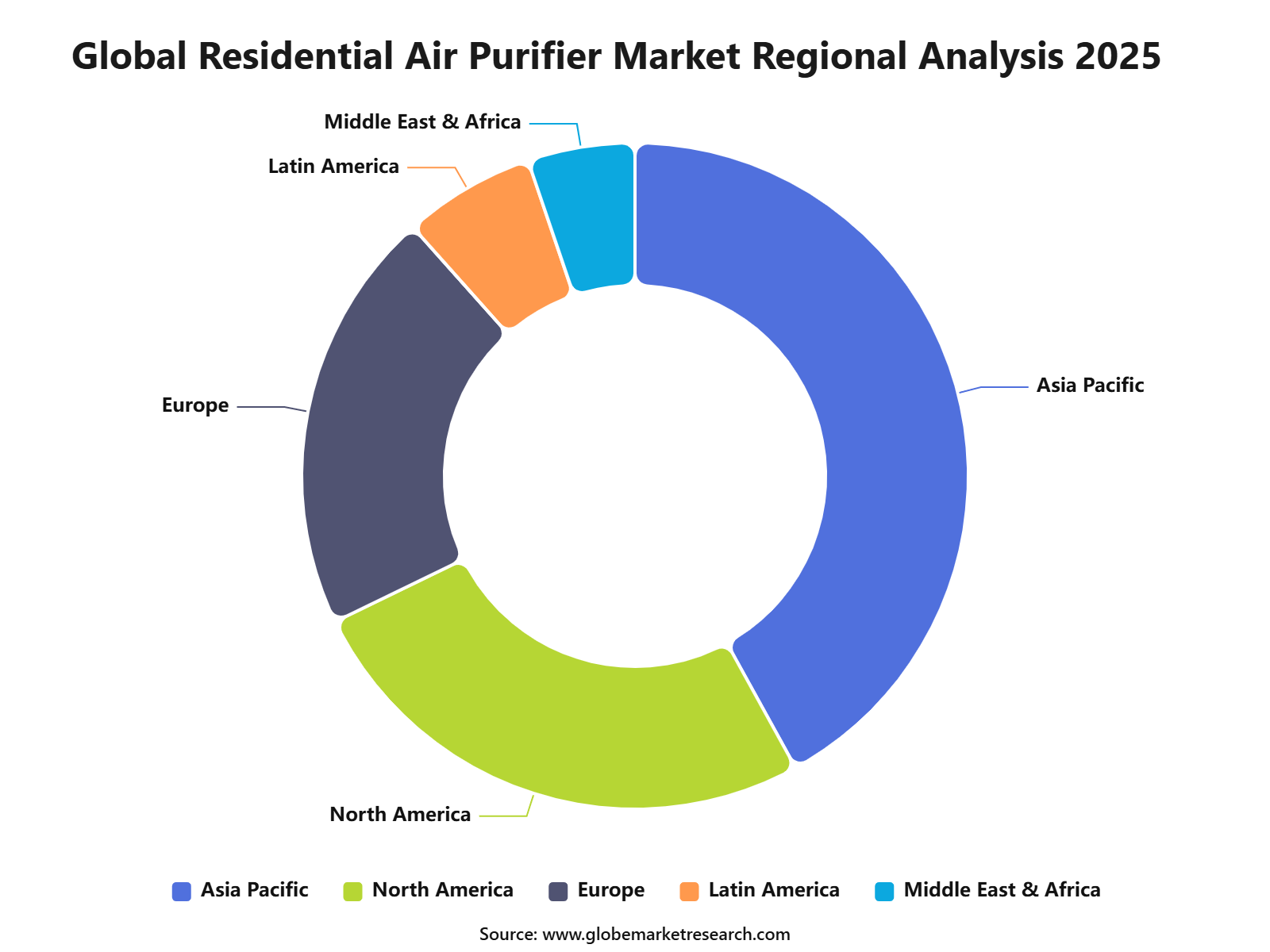 iThe graph shows projected market growth until 2035 based on CAGR analysis. Actual outcomes may vary depending on changing demand, competition, and economic factors.To gain greater insights - request a sample report PDF
Regional Impact Analysis
Impact Factor | Estimated CAGR Impact | Regional Relevance | Market Impact |
|---|---|---|---|
Asia Pacific market leadership | +3.1% | China, India, Japan, South Korea | Leads volume demand. |
North America premium adoption | +2.0% | U.S. and Canada | Supports smart purifier sales. |
Europe health and energy-focused demand | +1.7% | Germany, UK, France, Italy | Drives certified products. |
Latin America urban air quality demand | +1.1% | Brazil, Mexico, Chile | Builds gradual adoption. |
Middle East and Africa emerging growth | +0.9% | UAE, Saudi Arabia, South Africa | Shows early potential. |
Driver Impact Analysis
Impact Factor | Estimated CAGR Impact | Regional Relevance | Market Impact |
|---|---|---|---|
Rising urban air pollution and PM2.5 exposure | +2.8% | High in Asia Pacific, North America, and Europe | Increases household demand for portable and room-based air purification systems, especially in cities with poor outdoor air quality. |
Growing awareness of indoor air quality and respiratory health | +2.4% | Strong in North America, Europe, China, India, Japan, and South Korea | Supports higher product adoption among families, elderly consumers, allergy patients, and health-conscious households. |
Increasing use of HEPA filtration technology | +2.1% | High across developed and fast-urbanizing markets | Strengthens demand for certified filtration products that can remove fine particles, pollen, dust, mold, bacteria, and other airborne pollutants. |
Rising income levels and premium home appliance adoption | +1.8% | Strong in Asia Pacific and Middle East urban households | Encourages consumers to purchase smart, connected, and multi-stage air purifiers with higher pricing and advanced features. |
Growing demand during wildfire, smog, and seasonal pollution events | +1.6% | High in the U.S., Canada, India, China, Australia, and parts of Europe | Creates seasonal demand spikes and increases replacement purchases for filters and portable units. |
Restraints Impact Analysis
Impact Factor | Estimated CAGR Impact | Regional Relevance | Market Impact |
|---|---|---|---|
High cost of premium air purifier models | -1.9% | High impact in price-sensitive Asian, Latin American, and African markets | Limits adoption among middle-income and low-income households where basic appliances are prioritized. |
Regular filter replacement cost | -1.7% | Common across all regions | Increases long-term ownership cost and may reduce continued product usage after initial purchase. |
Low awareness in rural and semi-urban areas | -1.4% | High in emerging markets | Restricts demand outside major cities where indoor air quality risks are less understood. |
Product performance variation and misleading claims | -1.2% | Common in online retail markets | Reduces consumer confidence when low-quality products fail to meet filtration expectations. |
Energy consumption concerns | -1.0% | Relevant in Europe, North America, and high-electricity-cost markets | Encourages buyers to compare efficiency ratings and may slow demand for large-capacity units. |
Opportunities Impact Analysis
Impact Factor | Estimated CAGR Impact | Regional Relevance | Market Impact |
|---|---|---|---|
Smart and connected air purifier adoption | +2.3% | Strong in North America, Europe, China, Japan, South Korea, and urban India | Creates demand for app control, real-time air quality monitoring, auto mode, and smart home integration. |
Expansion in Asia Pacific urban households | +2.2% | Very high in India, China, Southeast Asia, Japan, and South Korea | Supports strong volume growth due to urbanization, pollution exposure, and rising home appliance spending. |
Rising demand for compact and portable units | +1.9% | High in apartments, rental homes, and small urban households | Improves affordability and makes air purifiers accessible to first-time buyers. |
Growth in replacement filters and aftermarket sales | +1.6% | Strong across installed product bases | Builds recurring revenue through HEPA filters, carbon filters, and composite filter replacements. |
Product innovation in low-noise and energy-efficient models | +1.4% | High in Europe, North America, and premium Asian markets | Improves consumer acceptance for bedroom, children’s room, and continuous-use applications. |
Challenge Impact Analysis
Impact Factor | Estimated CAGR Impact | Regional Relevance | Market Impact |
|---|---|---|---|
Difficulty in proving real-world purification performance | -1.8% | Common across all major markets | Creates a gap between laboratory claims and actual household results, especially when room size and airflow are not matched correctly. |
Strong competition from low-cost products | -1.6% | High in Asia Pacific and online marketplaces | Pressures pricing and makes brand differentiation harder for established companies. |
Consumer confusion over filtration standards | -1.4% | Common in emerging and developed markets | Slows purchase decisions as buyers compare HEPA, activated carbon, UV, ionizer, and hybrid systems. |
Noise and maintenance concerns | -1.2% | Relevant in residential bedrooms and small apartments | Reduces continuous usage when devices are loud, bulky, or require frequent filter changes. |
Limited effectiveness without source control and ventilation | -1.1% | High across all households | Reduces overall indoor air improvement when pollution sources, ventilation, humidity, and cleaning habits are not managed together. |
Key Market Segment
By Product Type
Portable Air Purifiers
Whole-House Air Purifiers
Desktop Air Purifiers
By Technology
HEPA Filtration
Activated Carbon Filtration
UV-C Purification
Ionic Filtration
Hybrid Filtration
By Application
Dust and Allergen Removal
Smoke and Odor Control
Pet Dander Removal
Mold and Bacteria Reduction
Key Regions and Countries
Asia Pacific
China
India
Japan
South Korea
Australia
Indonesia
Thailand
Vietnam
Malaysia
North America
United States
Canada
Mexico
Europe
Germany
United Kingdom
France
Italy
Spain
Netherlands
Sweden
Switzerland
Latin America
Brazil
Argentina
Chile
Colombia
Middle East and Africa
Saudi Arabia
United Arab Emirates
South Africa
Egypt
Qatar
Kuwait
Market Trend Analysis
Impact Factor | Estimated CAGR Impact | Regional Relevance | Market Impact |
|---|---|---|---|
Smart sensor-based air purifiers | +2.1% | North America, Europe, Asia Pacific | Improves real-time monitoring. |
HEPA filtration dominance | +2.0% | Global | Strengthens consumer trust. |
Portable air purifier adoption | +1.8% | Asia Pacific, Europe, North America | Supports flexible usage. |
Premium residential models | +1.6% | U.S., China, Japan, GCC | Increases unit value. |
Multi-stage filtration systems | +1.5% | Global | Improves pollutant removal. |
Investment Opportunity Analysis
Impact Factor | Estimated CAGR Impact | Regional Relevance | Market Impact |
|---|---|---|---|
HEPA-based residential purifiers | +2.2% | Global | Offers strong product demand. |
Smart connected air purifiers | +2.0% | North America, Europe, Asia Pacific | Supports premium growth. |
Replacement filter business | +1.8% | Global | Builds recurring revenue. |
Emerging market distribution expansion | +1.7% | India, Southeast Asia, Latin America | Improves market access. |
E-commerce and D2C sales models | +1.5% | Global | Reduces channel dependency. |
Future Outlook
The Residential Air Purifier Market is expected to grow steadily as households give higher priority to clean indoor air, respiratory wellness, and smart home comfort. Demand will be supported by rising urban pollution, increasing allergy and asthma concerns, and wider adoption of HEPA, activated carbon, and sensor-based purification systems. Portable and smart air purifiers are likely to remain key growth areas, while Asia Pacific is expected to offer strong opportunities due to rapid urbanization, rising income levels, and growing consumer awareness.
Recent Development
January 2026 - Zonair3D expanded in India with premium air purification systems, including the ZonAIR+ 300 S and ZonAIR+ 430 S. The ZonAIR+ 300 S was priced at around Rs. 2,25,000 plus 18% GST, targeting large homes, offices, clinics, and hospitals.
November 2025 - Airth gained attention for its retrofit AC air purifier filters in India. The company reported more than 75,000 ACs upgraded, over 7,00,000 m³ of clean air delivered daily, and a cost level at nearly one-fifth of conventional air purifiers.
September 2025 - Dyson introduced its first desktop air purifier, the HushJet Purifier Compact. The product uses a star-shaped nozzle and an electrostatic HEPA filter with a life of up to 5 years. It was scheduled for early 2026 launch in the UK.
Report Scope
Report Highlights | Details |
|---|---|
Market Revenue (2025) | USD 21.32 Bn |
Forecast Revenue (2035) | USD 42.15 Bn |
CAGR (2025-2035) | 9.5% |
Base Year for Estimation | 2025 |
Historic Data | 2020-2024 |
Forecast Period | 2025-2035 |
Report Coverage | AI impact analysis, Revenue projections, company positioning, competitive analysis, growth drivers, and emerging market trends |
Segments Covered | By Product Type (Portable Air Purifiers, Whole-House Air Purifiers, Desktop Air Purifiers), By Technology (HEPA Filtration, Activated Carbon Filtration, UV-C Purification, Ionic Filtration, Hybrid Filtration), By Application (Dust and Allergen Removal, Smoke and Odor Control, Pet Dander Removal, Mold and Bacteria Reduction) |
Key companies profiled | Daikin Industries, Ltd., Honeywell International Inc., Sharp Corporation, Panasonic Corporation, LG Electronics Inc., Samsung Electronics Co., Ltd., Koninklijke Philips N.V., Dyson Limited, Blueair, IQAir, Midea Group, Xiaomi Corporation, Whirlpool Corporation, Winix Inc., Austin Air Systems, Camfil AB, Others |
Customization Scope | Tailored insights for specific regions, countries, and market segments can be provided. Additional report customization is available upon request. |
Competitive Landscape
The market is characterized by intense competition among established players and emerging companies. Strategic partnerships, mergers and acquisitions, and product innovation are key strategies employed by market participants.
Key Market Players
Daikin Industries, Ltd.
Honeywell International Inc.
Sharp Corporation
Panasonic Corporation
LG Electronics Inc.
Samsung Electronics Co., Ltd.
Koninklijke Philips N.V.
Dyson Limited
Blueair
IQAir
Midea Group
Xiaomi Corporation
Whirlpool Corporation
Winix Inc.
Austin Air Systems
Camfil AB
Others
Meet the Team
This report was prepared by our expert analysts with deep industry knowledge and research experience.
Pratiksha is market research analyst with strong experience in industry research, market forecasting, and competitive analysis. She specializes in identifying market trends, evaluating growth opportunities, and preparing data-driven insights across global industries. Her work supports businesses in understanding market dynamics, customer demand, regional opportunities, and strategic investment areas.
Suraj is a Senior Management Consultant with over 7 years of experience in market research, business strategy, and consulting. He has worked with Fortune 500 companies and growing startups, helping them with market entry, cross-border expansion, demand analysis, competitive assessment, and growth planning. His analytical thinking and strong industry knowledge help clients make clear, confident, and informed business decisions.
Frequently Asked Questions
Related Reports
More in Consumer Goods
Pet Toys Market to hit USD 35.6 billion by 2035
Global Pet Toys Market Size, Share Analysis By Product Type (Plush, Rope, Balls, Others), By Pet Type (Dogs, Cats, Others), By Distribution Channel (Offline, Online), By Regional Insights, Business plan and Project Report, Investment Opportunities, Profitability, Industry Trends, Leading Companies and Growth Forecasts By 2025-2035
Black Hair Care Market to hit 17.1 Bn by 2035
Global Black Hair Care Market By Product Type (Shampoo, Conditioner, Hair Dye, Hair Oils, Hair Serums, Others.), By Application (Household, Commercial Use, Salons, Beauty Parlors, Professional Hair Care Services), By Distribution Channel (Offline Stores, Online Platforms, Supermarkets and Hypermarkets, Specialty Beauty Stores, Retail Stores, Pharmacies, Direct-to-Consumer Channels), By End User (Women, Men, Kids, Professional Stylists, Salons), By Hair Concern (Dryness and Moisture Retention, Scalp Health, Breakage Repair, Curl Definition, Frizz Control, Protective Styling, Hair Growth Support, Chemical-Free Hair Care), By Regional Insights, Business plan and Project Report, Investment Opportunities, Profitability, Industry Trends, Leading Companies and Growth Forecasts by 2025-2035
Halloween Costumes Market to hit 12.2 Bn by 2035
Global Halloween Costumes Market By Product Type (Adult Costumes, Kids Costumes, Pet Costumes, Accessories), By Theme (Superheroes, Movies and TV Characters, Horror, Fantasy, Historical, Others), By Distribution Channel (Online Stores, Specialty Stores, Supermarkets and Hypermarkets, Others), By Regional Insights, Business plan and Project Report, Investment Opportunities, Profitability, Industry Trends, Leading Companies and Growth Forecasts by 2025-2035
Trampoline Park Market Revenue to Hit USD 13.8 Billion by 2035
Global Trampoline Park Market Size, Surveys, Revenue, Volume, Production, Trade Analysis Report By Type (Indoor Trampoline Parks, Outdoor Trampoline Parks), By Age Group (Children, Teenagers, Adults), By Revenue Source (Entry Fees, Food & Beverages, Merchandise, Events & Parties, Others), By Ownership (Franchise, Independent), By Regional Insights, Leading Companies and Growth Forecasts by 2025-2035