According to Globe Market Research, The Italy Agentic AI market refers to the use of AI systems that can plan, take actions, complete multi-step tasks, and support decisions with limited human input. These systems are moving beyond basic chatbots and are being applied in customer service, banking operations, manufacturing workflows, software development, public services, and compliance-heavy business processes. Italy is becoming a growing market for agentic AI because companies are under pressure to improve productivity, reduce manual work, and manage complex digital operations.
The main growth factor for Italy’s Agentic AI market is the need to improve business efficiency across small, medium, and large enterprises. According to ISTAT data reported by Reuters, AI use among Italian firms doubled from 8.2% in 2024 to 16.4% in 2025, while it was only 5.0% in 2023. This shows that the enterprise base is moving from early awareness to practical adoption. Agentic AI can build on this trend by helping companies automate customer queries, internal reporting, data extraction, claims processing, procurement support, and IT service workflows.
Key Insights
Solutions accounted for 69.3% share, supported by strong use of AI platforms, automation systems, and enterprise-ready applications.
Cloud-based deployment held 68.6% share, driven by easier scalability, faster setup, and lower infrastructure requirements.
Multi-agent systems captured 56.1% share, supported by their ability to manage complex workflows and coordinate tasks across business functions.
Generative AI and LLM-based agents led the technology segment with 44.8% share, driven by demand for content generation, coding support, customer service, and productivity tools.
Operations and process automation represented 27.1% share, supported by growing enterprise focus on workflow improvement, decision support, and efficiency gains.
Large enterprises held 71.1% share, reflecting stronger investment capacity, higher digital maturity, and broader AI deployment across departments.
BFSI dominated the end-use segment with 35.8% share, supported by rising use of AI agents in fraud monitoring, risk analysis, customer support, compliance, and operational automation.
By Offering Analysis
The solutions segment led the Italy agentic AI market by offering with 69.3% share. The growth of this segment can be attributed to the strong adoption of AI platforms, automation tools, decision-support systems, workflow agents, and enterprise-grade applications across large Italian businesses.
Demand for solutions is increasing as companies look for AI systems that can plan tasks, manage processes, support employees, and improve business productivity with limited manual input. For instance, an Italian manufacturing company can use agentic AI solutions to monitor production schedules, identify supply delays, recommend corrective actions, and support procurement teams in real time.
By Deployment Analysis
Cloud-based deployment dominated the Italy agentic AI market with 68.6% share. The segment is supported by scalability, faster implementation, lower infrastructure spending, and easier access to advanced AI models through cloud platforms.
Cloud deployment is preferred by companies that need flexible AI systems across departments, locations, and business applications. For instance, an Italian retail group can use cloud-based agentic AI to manage inventory, customer service, pricing recommendations, and demand forecasting across multiple stores and online channels.
By Agent System Analysis
Multi-agent systems accounted for 56.1% share, supported by their ability to manage complex workflows and coordinate tasks across functions. These systems are gaining adoption because different AI agents can work together to complete connected business tasks such as planning, analysis, communication, and execution.
The growth of this segment is supported by rising demand for intelligent systems that can handle more than one business process at the same time. For instance, in a logistics company, one AI agent can track shipment delays, another can update customers, another can adjust route planning, and another can support billing or documentation.
By Technology Analysis
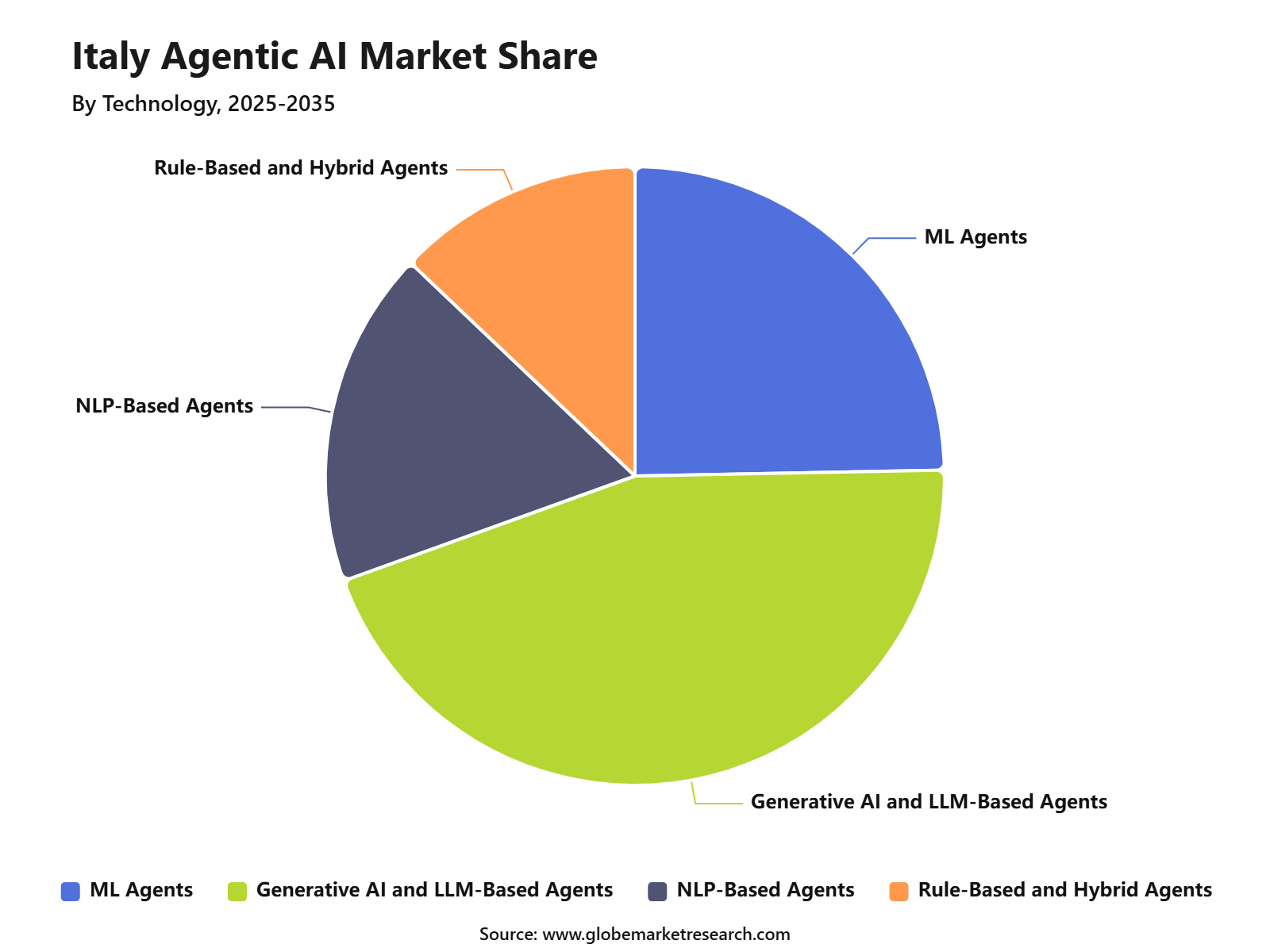
Generative AI and LLM-based agents led the technology segment with 44.8% share. The segment is driven by strong use in content generation, coding support, customer service, document processing, internal knowledge search, business reporting, and employee productivity applications.
These agents are being adopted because they can understand natural language, generate responses, summarize large documents, support decision-making, and automate repetitive knowledge-based tasks. For instance, an Italian bank can use LLM-based agents to support customer queries, summarize compliance documents, draft internal reports, and assist relationship managers with client information.
By Function Analysis
Operations and process automation held 27.1% share by function, supported by demand for workflow optimization, decision support, cost control, and efficiency improvement. Agentic AI is increasingly being used to reduce repetitive work and improve process speed across finance, customer service, procurement, supply chain, and IT operations.
The segment is gaining importance as Italian enterprises focus on faster execution and better use of digital systems. For instance, an insurance company can use agentic AI to collect claim details, verify documents, flag missing information, route cases to the right team, and update customers about claim progress.
By Enterprise Size Analysis
Large enterprises led the Italy agentic AI market by size with 71.1% share. The dominance of this segment reflects higher technology budgets, stronger digital readiness, larger data resources, and greater ability to integrate AI agents into existing enterprise systems.
Large enterprises are also more likely to adopt agentic AI because they manage complex operations across several departments and locations. For instance, a large Italian telecom company can use agentic AI to automate customer support, network issue detection, billing assistance, internal IT helpdesk tasks, and service quality monitoring.
By End Use Analysis
The BFSI segment dominated end use with 35.8% share, supported by growing use of AI agents in fraud detection, risk assessment, customer service, compliance review, loan processing, and operational automation. Banks, insurers, and financial service providers are adopting agentic AI to improve speed, reduce manual work, and strengthen decision support.
The segment is expected to remain a major adopter because financial institutions require secure, explainable, and well-controlled AI systems. For instance, an Italian bank can use agentic AI to review transaction patterns, detect possible fraud, assist customers with account queries, prepare compliance summaries, and escalate high-risk cases to human teams.
Key Market Segments
By Offering
Solutions
Services
By Deployment Mode
Cloud-Based
On-Premise
By Agent System
Multi-Agent Systems
Single-Agent Systems
By Technology
Generative AI and LLM-Based Agents
Machine Learning Agents
NLP-Based Agents
Rule-Based and Hybrid Agents
By Function
Operations and Process Automation
Customer Service and Support
Sales and Marketing Automation
Risk, Compliance, and Fraud Management
IT, Cybersecurity, and Others
By Enterprise Size
Large Enterprises
SMEs
By End Use
BFSI
Manufacturing
IT and Telecommunications
Healthcare and Life Sciences
Retail and E-Commerce
Public Sector
Others
By Country Scope
Italy
Investment Opportunities
Investment opportunities in Italy’s Agentic AI market are expected to be strongest in enterprise workflow automation, AI governance, AI cybersecurity, customer service automation, industrial AI, and sector-specific AI agents. The Italian AI law includes up to EUR 1 billion from a venture capital fund for companies in AI, cybersecurity, and telecom sectors. This funding direction supports the development of trusted AI infrastructure and local innovation. It also creates opportunities for software providers, system integrators, cloud service firms, cybersecurity vendors, and AI governance platforms.
Further opportunities exist in small and medium enterprise enablement because many Italian firms are still at an early stage of AI adoption. Barriers reported by Italian companies include lack of skills at 58.6%, unclear regulations at 47.3%, data protection concerns at 43.2%, and high costs at 43.0%. These barriers create demand for affordable AI platforms, consulting support, employee training, privacy-safe deployment models, and industry-ready AI agent templates. As confidence improves, Italy’s agentic AI market is expected to gain stronger traction in practical use cases that show measurable productivity gains and clear governance controls.
Market Trend Analysis
Impact Factor | Estimated CAGR Impact | Regional Relevance | Market Impact |
|---|---|---|---|
Cloud-based agent deployment | +12.0% | Italy, enterprises and SMEs | Supports faster rollout. |
Generative AI and LLM-based agents | +11.7% | Italy, BFSI, IT, services | Powers advanced automation. |
Multi-agent system adoption | +10.9% | Large enterprises | Handles complex tasks. |
AI agents for operations automation | +10.4% | Manufacturing, BFSI, retail | Improves process efficiency. |
Human-in-the-loop AI governance | +8.9% | Regulated sectors | Improves control and trust. |
Technology Adoption Analysis
Impact Factor | Estimated CAGR Impact | Regional Relevance | Market Impact |
|---|---|---|---|
Large language models | +12.3% | Italy, enterprise software users | Enables reasoning-based agents. |
Cloud AI platforms | +11.5% | Italy, enterprises and public sector | Improves scalability. |
Natural language processing | +9.8% | Customer service, BFSI, telecom | Supports conversational agents. |
API and workflow integration tools | +9.4% | Large enterprises and IT teams | Connects agents to systems. |
AI monitoring and governance tools | +8.6% | Regulated industries | Supports safe deployment. |
Demand Analysis
Impact Factor | Estimated CAGR Impact | Regional Relevance | Market Impact |
|---|---|---|---|
Demand for business productivity tools | +12.1% | Italy, enterprise users | Reduces repetitive tasks. |
Demand for operations automation | +11.3% | Manufacturing, logistics, BFSI | Improves process speed. |
Demand from BFSI sector | +10.8% | Italy banking and insurance | Drives high-value adoption. |
Demand for customer support automation | +9.7% | Retail, telecom, banking | Improves service handling. |
Demand for real-time decision support | +9.2% | Enterprise and public sector | Strengthens business decisions. |
Investment Opportunity Analysis
Impact Factor | Estimated CAGR Impact | Regional Relevance | Market Impact |
|---|---|---|---|
Cloud-based agentic AI solutions | +12.2% | Italy, enterprise market | Offers scalable growth. |
BFSI-focused AI agents | +11.5% | Italy banking and insurance | Supports automation demand. |
Operations automation platforms | +10.7% | Manufacturing, logistics, retail | Improves productivity. |
AI governance and compliance tools | +9.4% | Italy, EU-regulated sectors | Builds trusted AI use. |
Enterprise integration services | +8.9% | Large enterprises and SMEs | Enables faster deployment. |
Recent Developments
April 2026 - EuroHPC JU, CINECA, and E4 Computer Engineering advanced the IT4LIA AI Factory in Bologna. The AI-optimized system has a total budget of EUR 290 million for acquisition, delivery, installation, and maintenance. It is expected to provide over 160 exaflops of AI inference performance for startups, SMEs, researchers, and public institutions.
June 2026 - Lombardy approved a new framework to manage data center growth around Milan. Italy is expected to attract around EUR 22 billion in data center investments over the next five years. Lombardy may receive EUR 10 billion to EUR 12 billion and host 1.5 GW to 2 GW of new capacity. This supports the compute base required for agentic AI deployment.
Conclusion
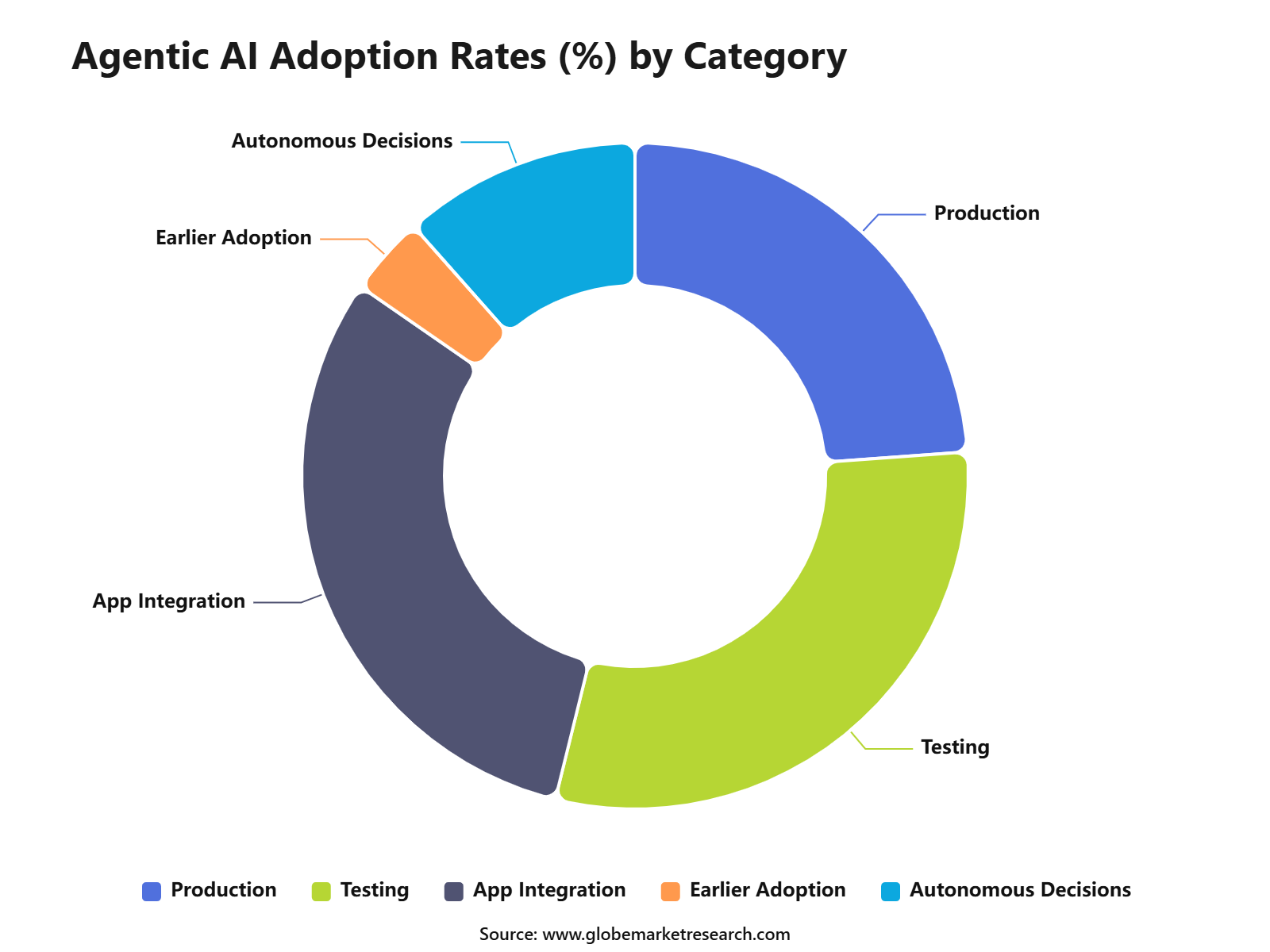
The Italy Agentic AI Market is expected to record strong growth as enterprises move toward autonomous, intelligent, and workflow-based AI systems. Valued at USD 0.1 billion in 2025, the market is projected to reach USD 5.7 billion by 2035, expanding at a CAGR of 49.9%. This growth is supported by rising demand for faster operations, better decision support, lower manual workload, and improved digital service delivery. Banking, insurance, manufacturing, healthcare, retail, telecom, and public services are expected to remain key adoption areas during the forecast period.
The market outlook remains positive as Italian organizations increase investment in generative AI, machine learning, cloud platforms, automation tools, and secure data systems. Agentic AI is expected to become more important as businesses seek systems that can plan tasks, manage workflows, support employees, and improve customer experience with limited human input. Strong opportunities are likely to emerge in enterprise automation, AI governance, cybersecurity, customer service, healthcare administration, financial services, and industrial operations.