

Revenue, 2025
$0.9Bn
Forecast, 2035
$14.0Bn
CAGR, 2025-2035
31.6%
Report Coverage
Global
Market Size and Forecast
The Global Generative AI in Music Market was valued at USD 0.9 billion in 2025 and is projected to reach USD 14.0 billion by 2035, reflecting a robust compound annual growth rate of 31.6%. North America led the market in 2025 with a 38.6% share, supported by the presence of advanced music production infrastructure, high adoption of AI-driven music software, and a strong ecosystem of content creators and streaming platforms. The region’s leadership is further reinforced by significant investment in AI research, technological innovation, and early adoption of generative AI solutions in media and entertainment.
The growth of generative AI in music has been supported by multiple factors. First, investments in computational infrastructure and more sophisticated AI models have accelerated the capability and quality of music generation tools. Second, there is increasing demand for personalized audio experiences among listeners, prompting streaming services to integrate AI-driven music curation and generation into their offerings. Third, artists, producers, and independent creators are adopting AI tools to augment their workflows, reduce production time, and lower creative barriers. These drivers collectively contribute to a rapidly expanding market landscape.
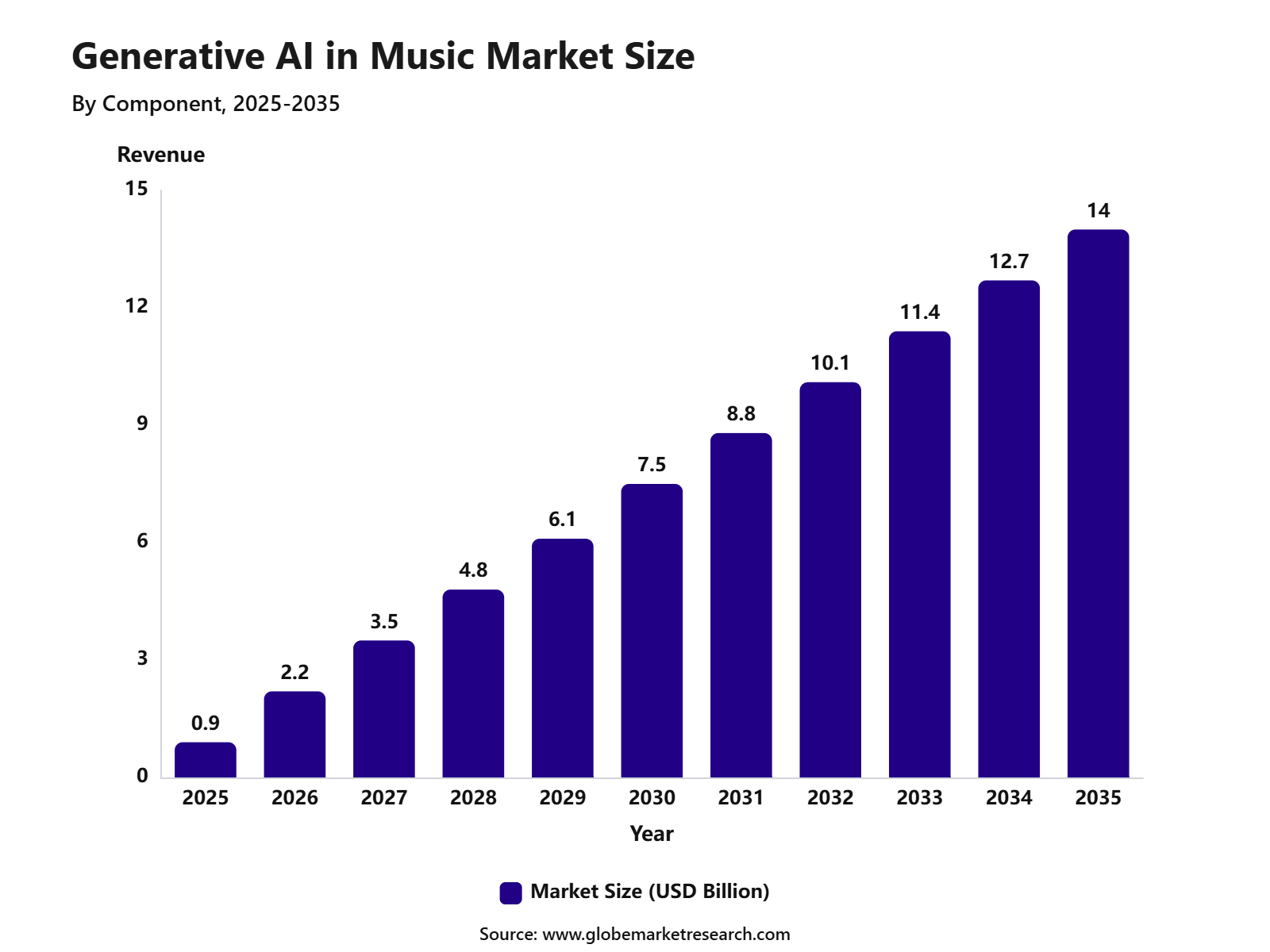 iThe graph shows projected market growth until 2035 based on CAGR analysis. Actual outcomes may vary depending on changing demand, competition, and economic factors.To gain greater insights - request a sample report PDF
Top Market Takeaways
Solutions led the market by component with 69.2% share, supported by widespread adoption of AI platforms, music generation tools, and workflow integration for composers and producers.
Cloud-based deployment dominated with 75.3% share, driven by scalability, remote collaboration, and easier access to AI-powered music tools.
Music composition and generation accounted for 29.6% share by application, supported by growing demand for automated music creation, style transfer, and personalized soundtracks.
North America held 38.6% share of the market, supported by early adoption of AI technologies, strong music production infrastructure, and active digital content consumption.
Market Overview
Demand is rising from music creators who want tools that support idea generation, demo creation, and faster production workflows. Songwriters can use AI to test lyrics, chord progressions, melodies, and vocal styles before entering a full studio process. Producers can use AI to build rough versions of tracks, separate vocals and instruments, or improve sound quality. This demand is especially strong among independent artists who need professional results with limited budgets.
Investment opportunities are growing in AI music creation platforms, production tools, licensing systems, and rights protection technologies. The funding environment also shows strong investor interest, as AI music company Suno raised more than USD 400 million in June 2026. The funding round valued the company at USD 5.4 billion, which reflects rising confidence in AI-powered music creation tools. This indicates that investors are viewing AI music as a serious part of the future creator economy.
Report Highlights | Details |
|---|---|
Market Revenue (2025) | USD 0.9 Bn |
Forecast Revenue (2035) | USD 14.0 Bn |
CAGR (2025-2035) | 31.6% |
Base Year for Estimation | 2025 |
Historic Data | 2020-2024 |
Forecast Period | 2025-2035 |
Report Coverage | Market Surveys, Trade Analysis, Revenue projections, company positioning, competitive analysis, growth drivers, and emerging market trends |
Segments Covered | By Component (Solutions, Services), By Deployment (Cloud-based, On-premises), By Application (Composition and Music Generation, Performance Enhancement and Virtual Collaboration, Personalized Music Recommendations, Music Production and Remixing, Music Transcription and Analysis, Other Applications) |
Regional Analysis | North America – US, Canada; Europe – Germany, France, The UK, Spain, Italy, Russia, Netherlands, Rest of Europe; Asia Pacific – China, Japan, South Korea, India, New Zealand, Singapore, Thailand, Vietnam, Rest of Latin America; Latin America – Brazil, Mexico, Rest of Latin America; Middle East & Africa – South Africa, Saudi Arabia, UAE, Rest of MEA |
Key companies profiled | Aiva Technologies SARL, Boomy Corporation, Ecrett Music, Google LLC, International Business Machines Corporation, LANDR, Meta, Microsoft, OpenAI, Stability AI, Other |
Customization Scope | Tailored insights for specific regions, countries, and market segments can be provided. Additional report customization is available upon request. |
Generative AI Music Industry Statistics
The recorded music industry remains strongly digital. In 2025, global recorded music revenue grew 6.4% to USD 31.7 billion, with streaming accounting for around 70% of global music income.
Generative AI is projected to contribute between $2.6 trillion and $4.4 trillion annually to the global economy by 2030.
The WIPO recommends clarifying AI authorship and copyright ownership by 2025, with 80% of countries supporting updated guidelines.
60% of musicians currently incorporate some form of AI into their creative workflow.
Approximately 35% of artists use AI tools for mastering their tracks.
Over 1 million AI-generated tracks are uploaded to streaming platforms each month.
20% of music producers utilize AI for lyric generation and songwriting support.
47% of independent artists believe AI helps them complete songs more quickly.
There are more than 500 active AI music generation platforms publicly available.
Paid streaming is the main commercial base for music platforms. Paid subscription streaming grew 8.8% in 2025 and reached 837 million paid subscription accounts worldwide.
By Component
In 2025, Solutions accounted for 69.2% of the Generative AI in Music Market, as creators, production teams, advertisers, and media companies prefer ready-to-use platforms over standalone services. These solutions support music composition, melody creation, lyric assistance, sound design, voice synthesis, audio enhancement, and remixing. Their dominance can be attributed to ease of use, faster production cycles, and the ability to support both skilled musicians and non-technical users.
The growth of the solutions segment is also supported by the rising need for controlled and scalable music creation tools. Users are increasingly looking for platforms that can generate background scores, short-form music, demo tracks, and customized audio for digital content. However, solution providers are also being pushed to improve transparency, consent management, and artist protection. This makes trusted, rights-aware software solutions more important for long-term adoption.
By Deployment
In 2025, Cloud-based deployment held the largest share at 75.3%, mainly because generative AI music tools require high computing power for training, inference, storage, and audio rendering. Cloud platforms allow users to access advanced music generation tools without investing in costly local hardware. This model is especially useful for creators, studios, agencies, and app developers that need quick access to AI models through browsers, APIs, and subscription platforms.
The cloud model also supports real-time updates, collaboration, batch music generation, and flexible scaling. Music creators can produce multiple versions of tracks, test different moods, and manage audio files from any connected device. For enterprises, cloud deployment offers better integration with content platforms, licensing systems, and workflow tools. As a result, cloud-based platforms are expected to remain the preferred delivery model for commercial AI music tools.
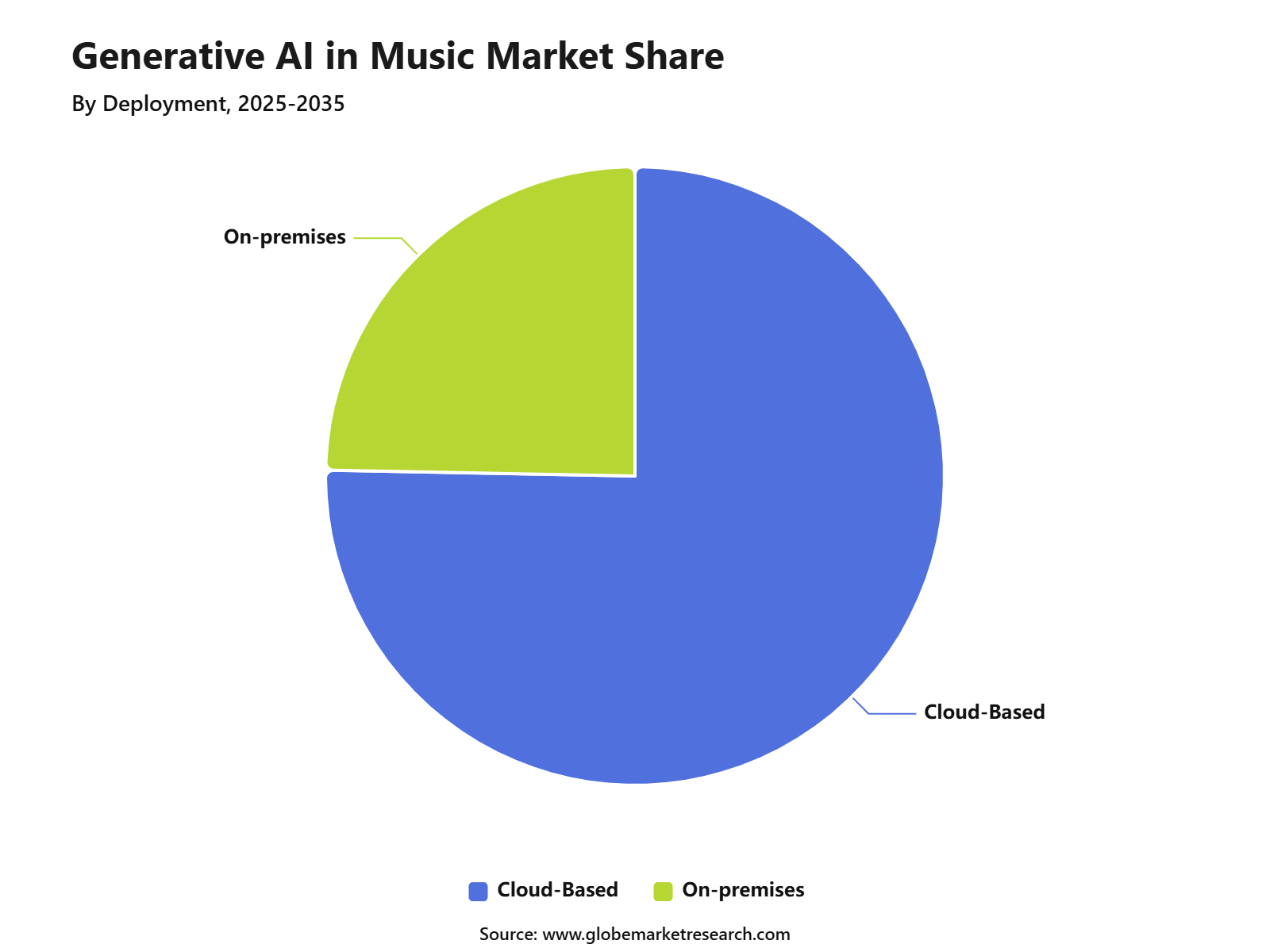 iThe graph shows projected market growth until 2035 based on CAGR analysis. Actual outcomes may vary depending on changing demand, competition, and economic factors.To gain greater insights - request a sample report PDF
By Application
In 2025, Composition and music generation represented the leading application segment with 29.6% share, as this is the most direct and widely used function of generative AI in music. These tools help users create melodies, beats, chord progressions, lyrics, instrumental tracks, and full music samples from text or audio prompts. The segment is gaining traction because it reduces the time required to move from idea to usable sound.
Demand is also rising from content creators, game developers, social media producers, advertisers, and independent artists who need original audio at lower cost and faster speed. AI-generated composition is not replacing human creativity, but it is becoming a useful support tool during ideation, experimentation, and early-stage production. The strongest adoption is seen where AI helps users generate drafts, test styles, and personalize music for specific content needs.
Region Analysis
In 2025, North America held the dominant share of 38.6% in the Generative AI in Music Market, supported by a strong base of AI developers, digital music platforms, investors, cloud infrastructure providers, and entertainment companies. The region has been an early adopter of AI-powered music tools across creator platforms, media production, advertising, gaming, and streaming-related workflows. High digital content consumption further supports demand for faster and more flexible music creation.
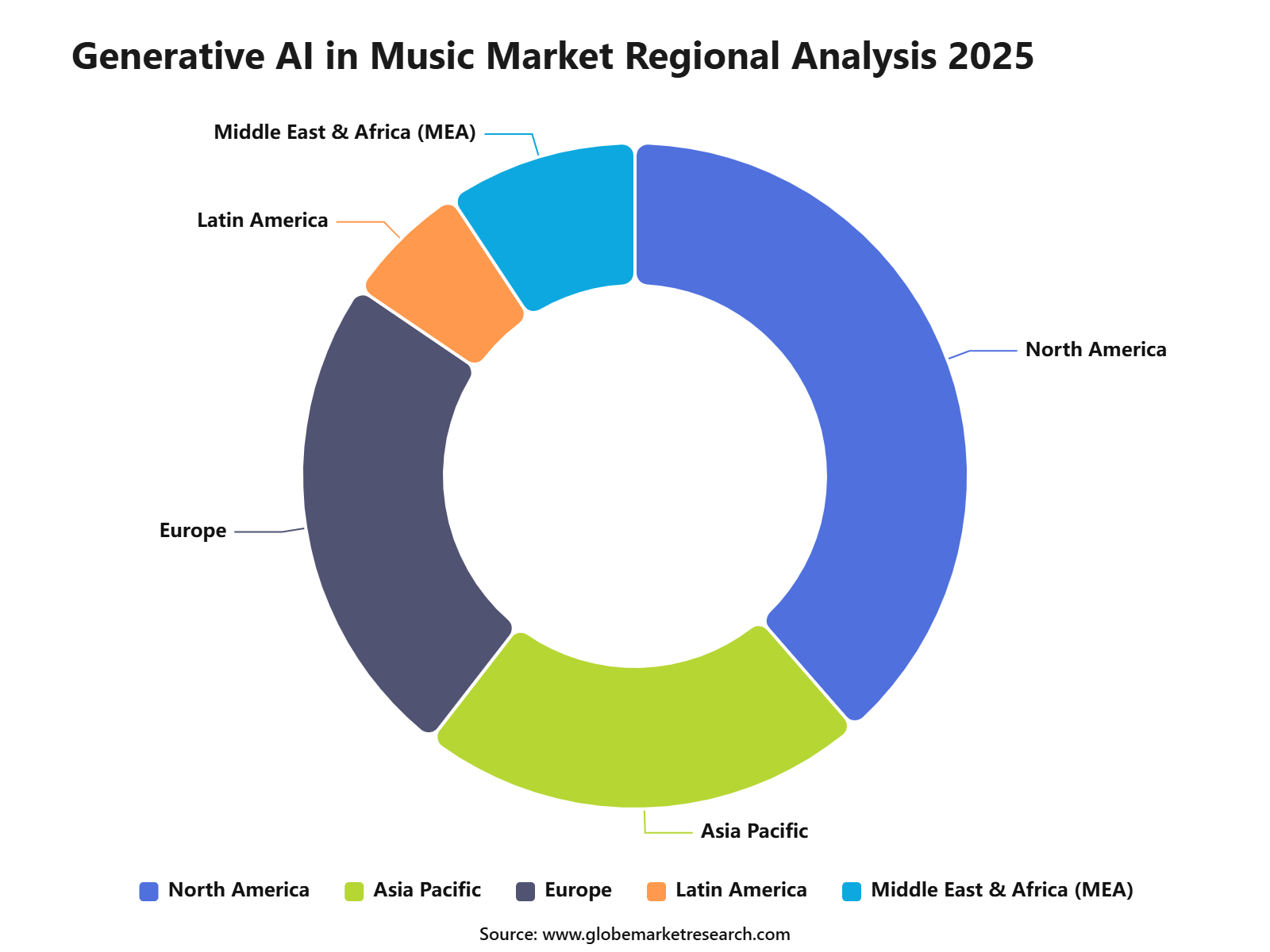 iThe graph shows projected market growth until 2035 based on CAGR analysis. Actual outcomes may vary depending on changing demand, competition, and economic factors.To gain greater insights - request a sample report PDF
The region also plays a major role in shaping the legal and commercial direction of AI music. Copyright, artist consent, voice protection, and licensing are becoming central issues for platform developers and music rights owners. This has encouraged companies to build safer tools with clearer policies, watermarking, licensing controls, and artist-protection features. Due to this mix of innovation, investment, and regulatory attention, North America remains the key region for market development.
Regional Impact Analysis
Impact Factor | Estimated CAGR Impact | Regional Relevance | Market Impact |
|---|---|---|---|
North America market leadership | +8.2% | U.S. and Canada | Drives early adoption and revenue share. |
Europe creative adoption | +6.7% | UK, Germany, France, Italy | Supports music production integration. |
Asia Pacific rapid expansion | +7.0% | Japan, China, South Korea, India | Boosts AI music tool usage. |
Latin America emerging adoption | +5.4% | Brazil, Mexico, Argentina, Chile | Provides new consumer base. |
Middle East and Africa growth potential | +4.9% | UAE, Saudi Arabia, South Africa | Opens early-stage market opportunity. |
Key Market Segments
By Component
Solutions
Services
By Deployment
Cloud-based
On-premises
By Application
Composition and Music Generation
Performance Enhancement and Virtual Collaboration
Personalized Music Recommendations
Music Production and Remixing
Music Transcription and Analysis
Other Applications
By Region
North America
Europe
Asia Pacific
Latin America
Middle East & Africa
Drivers Impact Analysis
Impact Factor | Estimated CAGR Impact | Regional Relevance | Market Impact |
|---|---|---|---|
Rising adoption of AI in music composition | +8.2% | North America, Europe, Asia Pacific | Expands automated music creation demand. |
Growth of streaming platforms and digital music | +7.6% | U.S., China, Europe, India | Drives AI-generated content consumption. |
Increasing demand for personalized music experiences | +7.0% | Global | Enhances user engagement and retention. |
Rising investment in AI-driven music startups | +6.5% | U.S., Europe, China | Supports innovation and new tools. |
Integration of AI in video games, film, and advertising | +6.3% | Global | Expands commercial application of generative music. |
Restraints Impact Analysis
Impact Factor | Estimated CAGR Impact | Regional Relevance | Market Impact |
|---|---|---|---|
High cost of advanced AI music solutions | -3.4% | Global | Limits adoption among smaller studios. |
Limited AI-trained musicians | -3.0% | U.S., Europe, Asia Pacific | Slows creative workflow integration. |
Copyright and intellectual property concerns | -2.7% | Global | Raises legal and licensing challenges. |
Skepticism toward AI-generated content | -2.5% | North America, Europe, Japan | Slows consumer acceptance. |
Integration complexity with existing DAWs | -2.1% | Global | Delays workflow adoption. |
Opportunities Impact Analysis
Impact Factor | Estimated CAGR Impact | Regional Relevance | Market Impact |
|---|---|---|---|
Expansion in AI-assisted music composition tools | +7.8% | U.S., Europe, Japan, China | Supports professional and amateur adoption. |
Growth of AI-generated music for commercials | +7.1% | North America, Europe, Asia Pacific | Creates new revenue streams. |
Rising interest in royalty-free AI music libraries | +6.7% | Global | Enhances licensing flexibility. |
Integration with metaverse and immersive platforms | +6.3% | North America, Asia Pacific | Expands experiential music use. |
Increasing demand for multilingual and cultural music generation | +6.0% | U.S., China, India, Europe | Supports globalized content creation. |
Challenges Impact Analysis
Impact Factor | Estimated CAGR Impact | Regional Relevance | Market Impact |
|---|---|---|---|
Ethical concerns over AI creativity | -3.2% | Global | May slow acceptance by artists and industry. |
Quality limitations of AI compositions | -2.8% | Global | Affects professional adoption. |
Rapid evolution of AI models | -2.5% | Global | Requires continuous investment. |
Dependence on high-performance computing | -2.3% | North America, Europe, Asia Pacific | Raises operational costs. |
Limited standardization of AI-generated music formats | -2.0% | Global | Creates workflow integration issues. |
Recent Developments
June 2026 – Suno raised USD 400 million in a Series D funding round at a USD 5.4 billion valuation. This investment is intended to accelerate expansion of its generative AI music tools and improve creative capabilities amid continued legal scrutiny over copyrighted training data. Institutional backers include Bond Capital, IVP, Forerunner, and Union Square Ventures, reflecting strong investor confidence in AI music innovation.
February 2026 – Google acquired ProducerAI, a generative AI music startup, integrating its team and technology into Google Labs. The acquisition strengthens Google’s AI‑driven music creation stack and aligns with the company’s broader creative AI strategy, including advanced generative models for music generation in mobile and cloud platforms.
January 2026 – BeatStars acquired ethical generative music startup Lemonaide AI to integrate AI‑assisted creation tools into its platform. This deal, following a prior strategic alliance, aims to establish creator‑centric AI features and deepen AI capabilities for music producers and independent artists, though financial terms were not disclosed.
Competitive Landscape
The market is characterized by intense competition among established players and emerging companies. Strategic partnerships, mergers and acquisitions, and product innovation are key strategies employed by market participants.
Key Market Players
Aiva Technologies SARL
Boomy Corporation
Ecrett Music
Google LLC
International Business Machines Corporation
LANDR
Meta
Microsoft
Stability AI
OpenAI
Others Key Players
Research Methodology
This market study is prepared using a combination of primary and secondary research. Primary research includes discussions with manufacturers, suppliers, distributors, consultants, industry experts, and end users. Secondary research covers company reports, government databases, trade associations, technical publications, regulatory sources, and trusted industry documents. The collected information is used to assess market demand, pricing trends, technology adoption, competitive activity, and regional performance.
AI language models are not used as primary data sources, and publicly available AI-generated content is not treated as market evidence. Computational tools may be used to support data processing, translation, data classification, and pattern identification. However, every published assessment is supported by verified sources, human review, and primary market discussions.
Market estimates are developed through top-down and bottom-up approaches and validated using data triangulation. Revenue, production, shipment, pricing, and application-level data are compared across multiple sources. Forecasts consider economic conditions, regulatory changes, investment activity, innovation, supply chain developments, and industry risks. All findings are reviewed through source verification and internal quality checks before publication.
Part I
Source Management & Input Data Standards
Who provides data, how sources are qualified, and what types of evidence are admissible.
Part II
Research Scope & Market Coverage
How we define the markets we assess and the parameters that govern each product.
Part III
Data Collection, Verification & Submission
The mechanics of gathering, cross-checking, and hierarchically ranking evidence.
Part IV
Assessment Determination & Quality Controls
How raw data becomes a published assessment — normalisation, expert judgement, and outlier exclusion.
Part V
Publication, Corrections & Revision
Our publication schedule, corrections policy, and methodology review cycle.
Part VI
Independence, Ethics & Complaints
Conflict-of-interest policies, editorial independence, and how clients raise concerns.
Google · Preferred Sources
Don't miss the latest market research insights and industry updates on Google.
Add Globe Market Research as a preferred source in the Google app to see our reports, analysis, and market stories in your news suggestions.
Meet the Team
This report was prepared by our expert analysts with deep industry knowledge and research experience.
Manoj H. is a Senior Research Analyst with more than 4 years of experience in market research, industry analysis, competitive intelligence, and strategic assessment. He has contributed to syndicated reports, customized research studies, market sizing, forecasting, company profiling, and competitive landscape analysis. His industry expertise covers Healthcare and Pharmaceuticals, Manufacturing and Construction, and Agriculture. He evaluates regulatory developments, production trends, technology adoption, supply chain structures, customer demand, investment activity, and competitive strategies across these industries.
Pratiksha K. is a Senior Research Analyst with more than five years of experience in market research, industry analysis, competitive intelligence, and business strategy. She has contributed to detailed market reports, customized research studies, company profiling, market sizing, trend analysis, and strategic consulting projects for clients across different regions. Her industry expertise covers Chemical and Material, Consumer Goods, Food & Beverages and Energy & Power. She closely evaluates changing customer requirements, technology developments, regulatory conditions, supply chain structures, investment activity, and competitive strategies to provide clear and practical market insights.
Frequently Asked Questions
Related Reports
More in Information and Technology
Shooting Games Market Size to hit USD 238.9 bn by 2035 | CAGR of 10.7%
Shooting Games Market Insights Analysis by Product (Shooting Gallery, Light Gun Shooter, First-Person Shooter, Third-Person Shooter, and Others), by Device Type (PC/MMO, Tablet, Mobile Phone, and TV/Console), by End User (Male and Female), Regional Insights, Technology Trends, Competitive Landscape, Strategic Opportunities, and Growth Forecast, 2026-2035
AI Data Centre Cooling Market Size to Reach USD 52.2 billion by 2035
AI Data Centre Cooling Market Size, Share, Trends and Growth Analysis Report By Cooling Type (Air Cooling, Liquid Cooling, Hybrid Cooling Systems), By Data Centre Type (Hyperscale Data Centres, Colocation Data Centres, Enterprise Data Centres, Edge Data Centres), By Cooling Component (Cooling Units, Chillers, Air Handling Units, Pumps, Heat Exchangers), By End User (Cloud Service Providers, Colocation Providers, Enterprises, Government and Defense), By Regional Insights, Technology Trends, Competitive Landscape, Strategic Opportunities and Growth Forecast, 2026-2035
Agentic AI Security Market Size to hit USD 52.3 billion by 2035 | CAGR of 44.5%
Agentic AI Security Market Size, Share, Trends and Growth Analysis Report By Security Function (Identity and Access Security, AI Governance and Risk Platforms, Threat Detection and Response, Data Security and Privacy, Vulnerability Assessment and Remediation, Security Orchestration, Automation and Response, Security Posture Management, Deception Technology), By Offering (Solutions, Tools and Point Solutions, Managed Security Services, Professional and Integration Services, Training and Certification Services), By Level of Autonomy (Semi-Autonomous Systems, Fully Autonomous Security Agents), By Deployment Layer (Model Layer, Agent and Orchestration Layer, Application Layer, Data Layer, Infrastructure Layer, Integration Layer), By Deployment Mode (Cloud-Based, On-Premises, Hybrid), By Organization Size (Large Enterprises, Small and Medium Enterprises), By Application (Enterprise IT Security, Financial Services Compliance, Healthcare Data Protection, Government and Defense, Cloud Security), By Vertical (BFSI, Healthcare and Life Sciences, Government, Defense, IT and ITES, Telecommunications, Retail and E-commerce, Energy and Utilities, Manufacturing, Other Verticals), By Regional Insights, Technology Trends, Competitive Landscape, Strategic Opportunities and Growth Forecast, 2026-2035
South Korea Physical AI Market Size to Reach USD 3.6 billion by 2035
South Korea Physical AI Market Size, Share, Trends and Growth Analysis Report By Deployment (On-Device AI, Cloud-Based AI), By Component (Hardware, Software, Services), By Technology (Computer Vision, Speech and Natural Language Processing, Gesture and Movement Recognition, Reinforcement Learning and Control Systems, Other Technologies), By Robot Type (Service Robots, Humanoid and Social Robots, Collaborative Robots, Exoskeletons and Prosthetics, Mobile Robots and Drones, Industrial Robots), By Application (Healthcare, Manufacturing and Automotive, Logistics and Warehousing, Retail and Hospitality, Other Applications), By Technology Trends, Competitive Landscape, Strategic Opportunities and Growth Forecast, 2026-2035