
Introduction
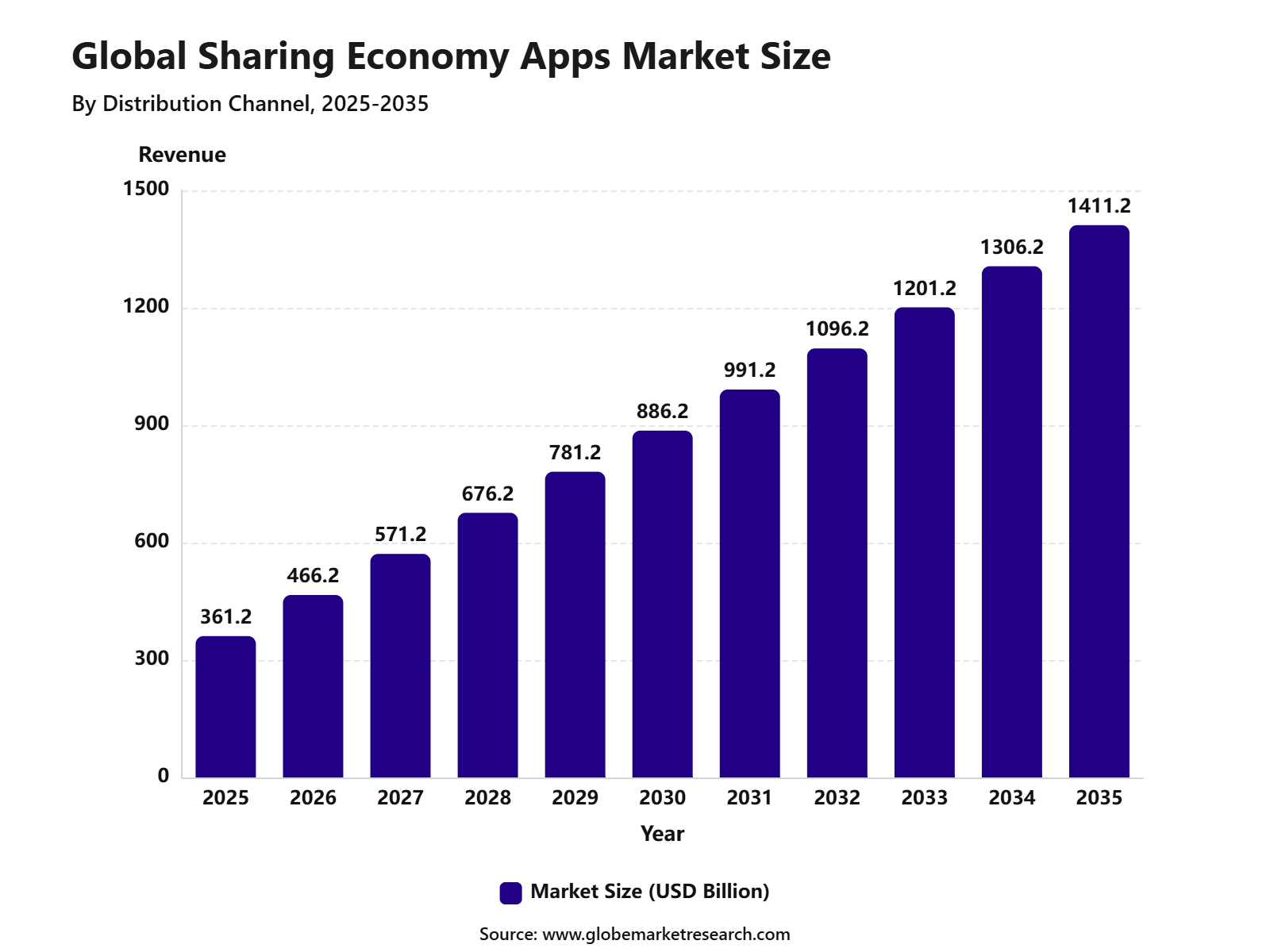
According to Globe Market Research, the Sharing Economy Apps Market covers digital platforms that allow users to access rides, homes, vehicles, tools, services, freelance work, and local tasks without directly owning the asset. The market is estimated at USD 361.2 billion in 2025 and is projected to reach USD 1,411.2 billion by 2035, growing at around 14.6% CAGR. This growth is being supported by rising smartphone use, wider internet access, digital payments, flexible work models, and changing consumer preference toward access instead of ownership.
Sharing economy apps work by connecting people who have an asset or skill with users who need temporary access to it. This model is widely used in ride-sharing, home-sharing, car-sharing, food delivery, freelance services, equipment rentals, peer-to-peer lending, and local task platforms. The value of these platforms comes from convenience, lower upfront cost, wider choice, faster booking, and real-time service access.
Digital adoption is one of the strongest growth drivers for this market. DataReportal reported that global internet users reached 6.04 billion by October 2025, which means a large part of the world’s population is now able to access app-based services. As mobile internet coverage improves, more consumers are using apps to book transport, hire freelancers, rent stays, order local services, and access shared assets.
Key Market Insights - 2025 Share
Shared transportation accounted for 29.90% share in 2025, making it the leading product segment. Growth was supported by rising adoption of ride-sharing, bike-sharing, carpooling, and short-distance mobility services among urban users.
Online platforms held 81.3% share, reflecting their strong role as the main access channel for sharing economy services. The segment benefited from app-based booking, secure digital payments, real-time availability, and location-based service discovery.
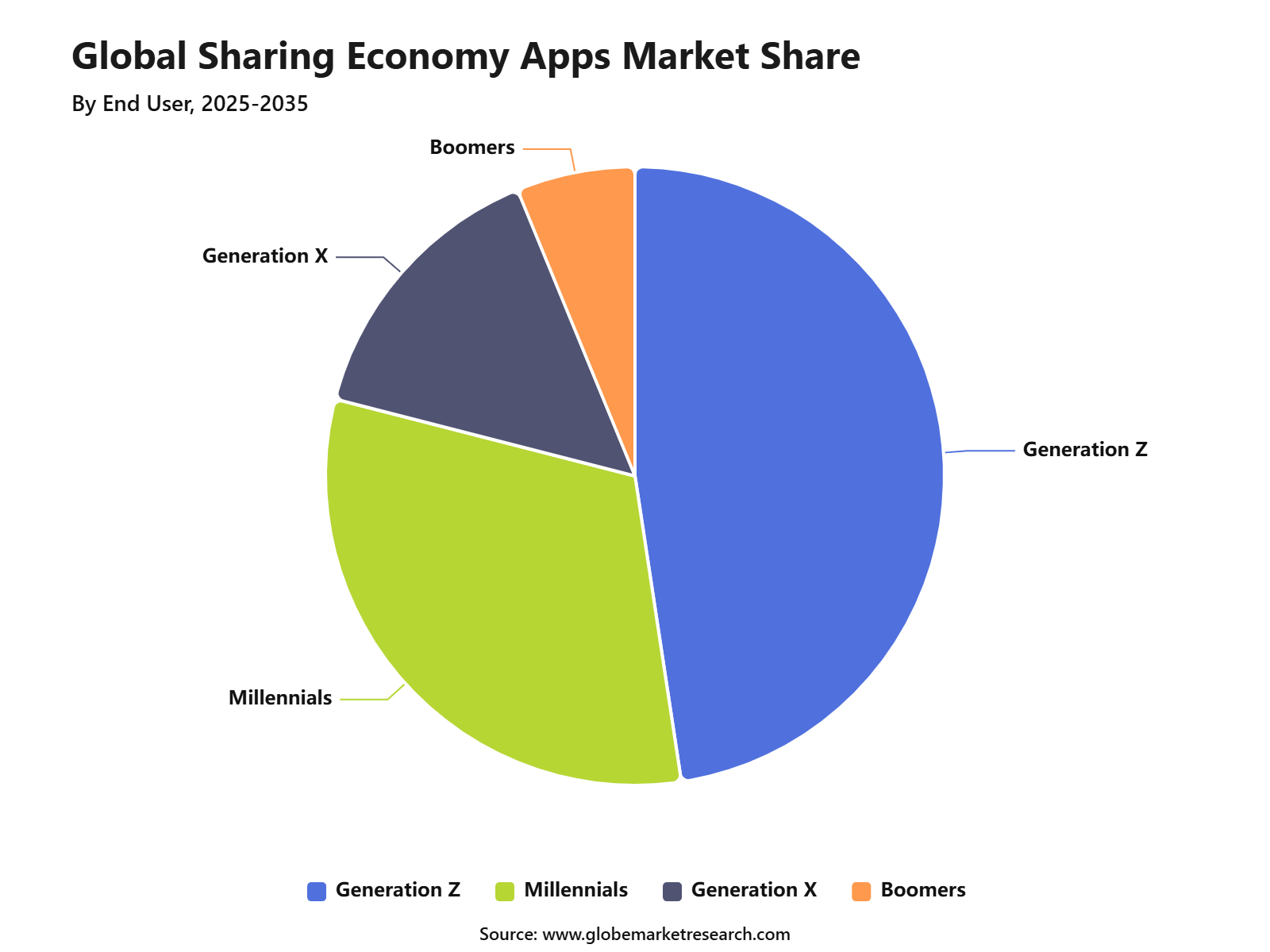
Generation Z represented 47.6% share, making it the leading end-user group in 2025. Strong smartphone usage, comfort with digital payments, and preference for flexible access over ownership supported adoption among this consumer group.
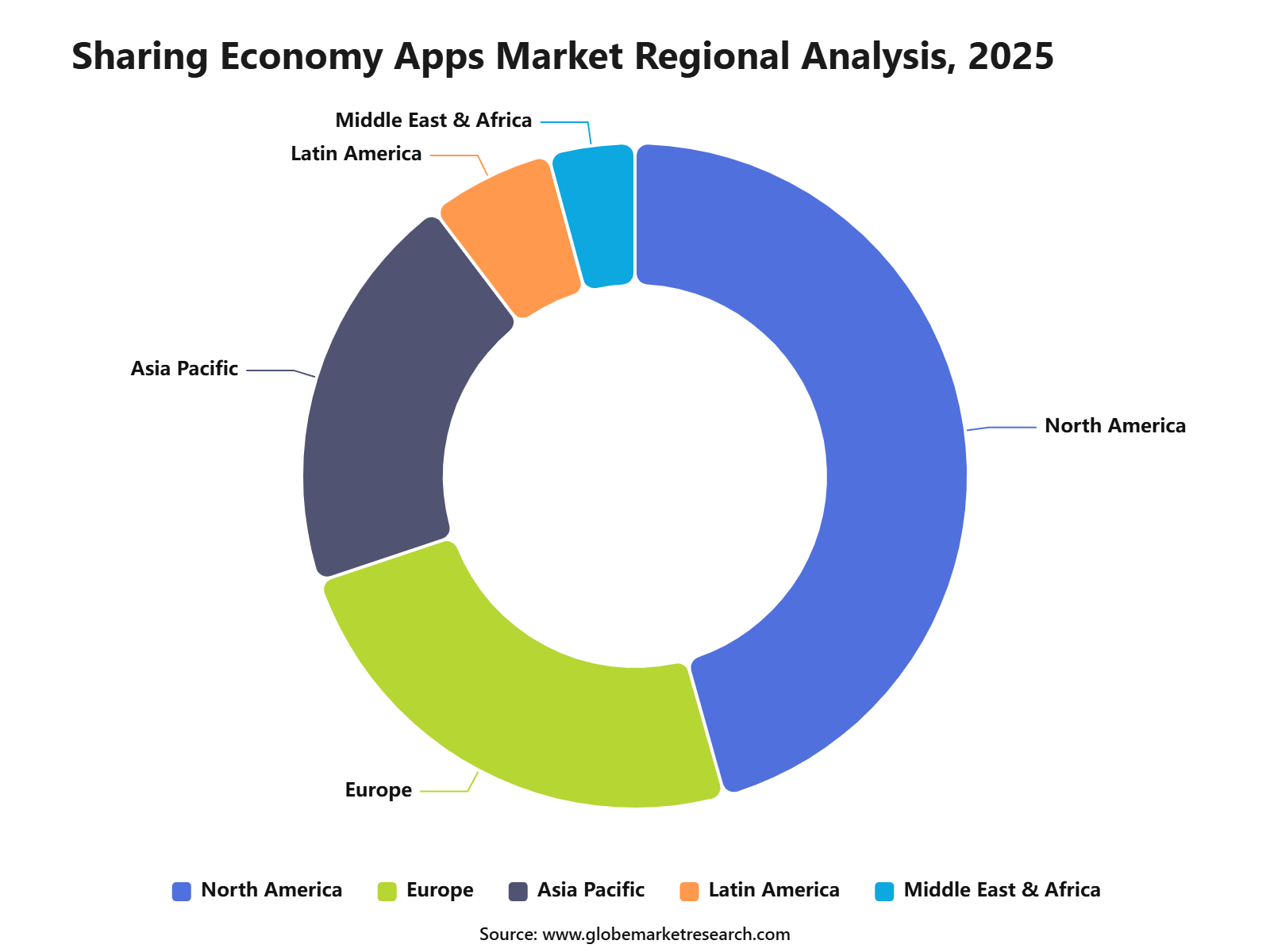
North America captured 45.67% share of the sharing economy apps market. The region’s growth was supported by high internet penetration, mature digital payment infrastructure, strong platform presence, and wide consumer acceptance of app-based services.
Sharing Economy Apps Statistics
Airbnb reported solid Q4 2025 performance, with revenue increasing 12%, Gross Booking Value rising 16%, and Nights and Seats Booked growing 10% year over year. This indicates continued demand for flexible travel stays and experience-based booking models.
Uber reported USD 193.45 billion in full-year 2025 gross bookings and USD 52.02 billion in revenue. These figures highlight the scale of app-based mobility and delivery services, although they should not be treated as total market share.
Lyft reported USD 18.5 billion in full-year 2025 gross bookings and USD 6.3 billion in revenue. The company also recorded 945.5 million rides and 51.3 million annual riders, reflecting steady demand for ride-sharing services.
DoorDash recorded 903 million orders in Q4 2025 and USD 29.68 billion in Q4 Marketplace GOV. The platform ended 2025 with more than 56 million monthly active users, showing strong consumer reliance on app-based local commerce and delivery services.
By Product Segment
Shared transportation led the product segment with 29.90% share in 2025, supported by strong use of ride-sharing, bike-sharing, carpooling, scooter-sharing, and short-distance mobility services. The segment benefits from daily urban travel demand, high fuel and vehicle ownership costs, and the need for flexible mobility in crowded cities. Users prefer shared transportation because it offers quick booking, route visibility, cashless payment, and lower travel effort compared with owning or maintaining a private vehicle.
The growth of shared transportation is also supported by its role in first-mile and last-mile travel. Bike-sharing and scooter-sharing are increasingly used around transit stations, campuses, offices, and dense commercial areas. This makes the segment important not only for personal travel but also for city mobility planning. As urban users continue to look for affordable and flexible transport, shared transportation is expected to remain the most active product category within sharing economy apps.
By Channel
Online platforms dominated the channel segment with 81.3% share in 2025, driven by easy app-based booking, digital payments, live availability, location tracking, and instant service confirmation. Sharing economy apps depend heavily on online channels because users expect fast access to rides, stays, rentals, services, and freelance work through mobile devices. The online model also helps platforms manage pricing, reviews, user identity, payments, and service history in one digital system.
The strength of online platforms is linked to wider internet access and smartphone usage. Consumers are now comfortable using apps for transport, home services, rentals, travel stays, food delivery, and local tasks. Secure digital payments and user ratings have helped reduce trust barriers between strangers. This has made online platforms the preferred channel for both users and service providers in the sharing economy.
By End User
Generation Z represented the leading end-user group with 47.6% share in 2025, supported by high mobile usage, strong digital behavior, and preference for flexible access over ownership. This consumer group is more comfortable using apps to book rides, rent items, find short-term stays, hire services, and access freelance work. The segment also values convenience, price comparison, speed, and user reviews before making service decisions.
Generation Z adoption is also influenced by lifestyle needs. Many younger users live in cities, study, work remotely, travel frequently, or prefer low-commitment service models. Sharing economy apps fit these habits because they allow users to pay only when a service is needed. This has made Gen Z an important user base for mobility apps, rental platforms, freelance services, and peer-to-peer access models.
By Region
North America held 45.67% share of the sharing economy apps market in 2025, supported by high smartphone penetration, strong app adoption, mature digital payment systems, and a large base of platform users. The region has strong demand across ride-sharing, home-sharing, freelance work, shared mobility, rental services, and task-based platforms. Consumers in the region are also familiar with digital ratings, online identity checks, subscription models, and cashless transactions.
The region’s leadership is supported by advanced digital infrastructure and a well-developed urban mobility ecosystem. High internet usage, strong card and wallet payment adoption, and dense city-level service networks make it easier for sharing platforms to scale. North America also has strong demand from both consumers and businesses, especially in transport, travel, flexible work, and local services. This keeps the region at the front of sharing economy app adoption.
Segments Covered in the Report
By Product / Service Type
Shared Transportation
Shared Space
Sharing Financial
Sharing Food
Shared Healthcare
Shared Knowledge & Education
Shared Task Services
Shared Items
Others
By Distribution Channel
Online
Offline
By End User
Generation Z
Millennials
Generation X
Boomers
By Region
North America
Europe
Asia-Pacific
Latin America
Middle East and Africa
Key companies profiled
Uber Technologies, Inc.
Airbnb, Inc.
Lyft, Inc.
DoorDash, Inc.
Upwork Inc.
Fiverr International Ltd.
Turo Inc.
TaskRabbit
Instacart
Deliveroo
Bolt Technology
BlaBlaCar
DiDi Global Inc.
Rapido
Swiggy
Zomato
Thumbtack
Rover
Gojek
Emerging Trends
AI-Led Matching and Personalized App Experience
AI-led matching is becoming a key trend in the sharing economy apps market. Platforms are using automated systems to match users with drivers, hosts, freelancers, rental items, and local service providers more accurately. This improves response time, reduces failed bookings, and supports better service quality.
The trend is supported by the wider digital user base, as around 6 billion people were using the internet globally in 2025, equal to nearly three-fourths of the world’s population. This large connected population gives sharing apps a wider customer base for real-time booking and personalized recommendations. As more users interact through mobile apps, platforms are able to improve pricing, search results, and service matching through data-led tools.
Circular Economy and Product-as-a-Service Models
Circular economy models are becoming more important for sharing economy apps. Consumers are increasingly renting, reusing, reselling, and sharing assets instead of buying products for short-term use. This trend is especially visible in tools, furniture, fashion, vehicles, electronics, and event equipment.
The European Commission has highlighted circular economy policies focused on keeping resources in use for longer and reducing waste. This supports app-based rental and product-as-a-service models because underused assets can be shared with more users. The model also creates income opportunities for asset owners while reducing the need for full ownership among consumers.
Growth Factors
Rising Smartphone, Internet, and Payment Access
The growth of sharing economy apps is strongly supported by wider internet access, smartphone usage, and digital payments. According to the World Bank Global Findex 2025, 79% of adults globally now have a financial account, up from 74% in 2021. This improves the ability of users to pay for ride-sharing, rentals, delivery, shared spaces, and freelance services through digital channels.
Mobile access is also improving financial participation. World Bank data shows that mobile phones are owned by 86% of adults globally, which gives sharing platforms a strong base for app-based service delivery. As mobile payment confidence improves, more users are expected to complete peer-to-peer and on-demand service transactions digitally.
Rising Preference for Online Buying and Booking
Sharing economy apps are benefiting from the wider shift toward online buying and digital booking. In the EU, 95% of individuals aged 16 to 74 used the internet in 2025, and 78% of them bought or ordered goods or services online. This shows that digital purchasing behavior is now common among a large consumer group.
Online transport booking is also becoming a meaningful growth area. Eurostat reported that 27% of EU internet users bought transport services online in 2025. This supports demand for ride-hailing, carpooling, shared mobility, travel booking, and short-distance mobility platforms.
Top Use Cases
Shared Transportation and Mobility Services
Shared transportation is one of the leading use cases for sharing economy apps. Users depend on ride-sharing, carpooling, bike-sharing, scooter-sharing, and short-distance mobility services for daily travel. These services are preferred because they offer flexible access without the full cost of vehicle ownership.
In the EU, 27% of internet users purchased transport services online in 2025, showing strong consumer acceptance of digital mobility booking. In Ireland, 8% of internet users booked transport services from a private person through an online platform in 2025. These figures show that shared mobility is moving from occasional use toward a more regular app-based transport option.
Peer-to-Peer Accommodation and Shared Spaces
Peer-to-peer accommodation and shared spaces are another major use case in the sharing economy apps market. Users book rooms, homes, coworking spaces, storage areas, and event venues through app-based platforms. This model is attractive because it offers flexible access, wider location choice, and often lower costs compared with traditional options.
In Ireland, 18% of internet users booked accommodation from a private person through an online platform in 2025. This indicates that peer-to-peer accommodation remains one of the most visible parts of the sharing economy. Growth is being supported by leisure travel, remote work, short stays, and flexible space usage.
Conclusion
The sharing economy apps market is expected to maintain strong growth as consumers continue to prefer flexible, app-based access to transport, accommodation, rentals, shared spaces, and on-demand services. Rising internet use, smartphone ownership, digital payments, and online booking habits are creating a wider customer base for these platforms. The market is also being supported by changing consumer behavior, where users are increasingly choosing access over ownership to reduce costs and improve convenience.
At the same time, the market will need to manage important risks linked to regulation, worker classification, pricing transparency, data security, and user trust. Platforms that invest in safer transactions, clear fee structures, verified users, reliable service providers, and AI-led matching are likely to gain stronger customer loyalty. Overall, the sharing economy apps market presents significant long-term opportunities, especially for companies that can balance affordability, compliance, service quality, and trust across both users and providers.