Introduction
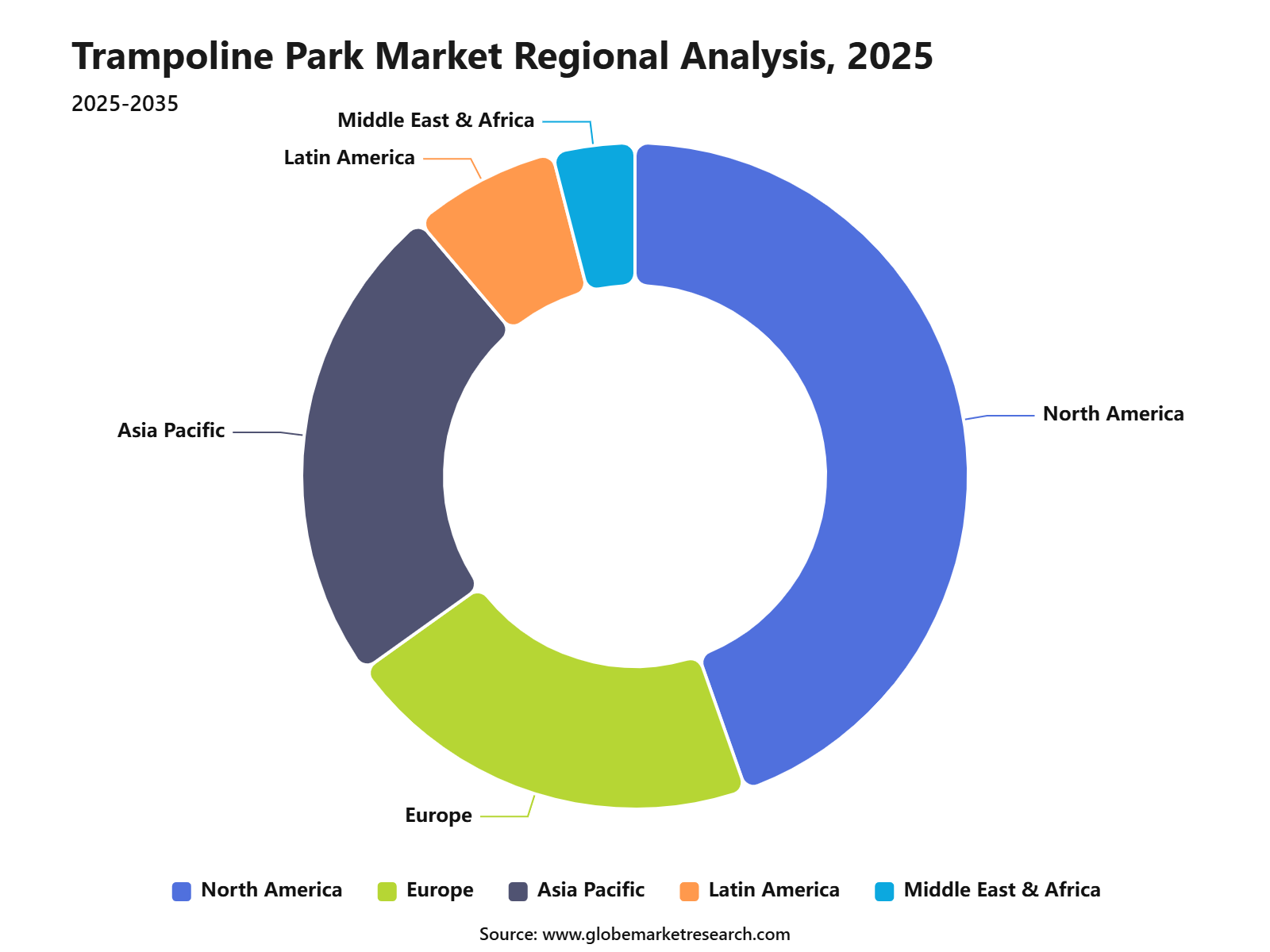
Trampoline parks are becoming more than indoor play areas. They are now part of the wider active entertainment industry, where families, children, teenagers, adults, schools, and corporate groups look for fun, fitness, and social experiences in one place. According to Globe Market Research, The Global Trampoline Park Market was valued at USD 2.9 billion in 2025 and is projected to reach USD 13.8 billion by 2035, growing at a CAGR of 16.9% from 2025 to 2035. North America led the market with 44.6% share in 2025, supported by strong consumer demand for indoor recreation, established park networks, and rising interest in family-oriented entertainment venues.
Key Parameter | Report Details |
|---|---|
Current Revenue, 2025 | USD 2.9 Billion |
Projected Revenue, 2035 | USD 13.8 Billion |
CAGR, 2025 To 2035 | 16.9% |
Largest Region | North America |
Largest Region Revenue, 2025 | USD 1.3 Billion |
Fastest Growing Region | Asia Pacific |
Market Concentration | Medium |
Base Year | 2025 |
Forecast Period | 2025-2035 |
What Is the Trampoline Park Market?
The Trampoline Park Market includes indoor and outdoor recreational facilities built around interconnected trampolines and activity zones. These parks commonly include open-jump areas, foam pits, dodgeball courts, basketball dunk zones, climbing walls, obstacle courses, party rooms, and fitness-focused activities. The market is supported by revenue from entry fees, birthday parties, group bookings, events, food and beverages, merchandise, and franchise operations. Demand is being driven by the need for safe, structured, and weather-independent entertainment spaces where visitors can combine physical activity with social engagement.
The growth of the trampoline park market can be attributed to rising demand for indoor entertainment and active leisure formats. Families are looking for places where children can play safely, stay active, and participate in group-based activities. At the same time, teenagers and adults are using trampoline parks for social outings, fitness sessions, team events, and recreational sports.
The market also benefits from the growing importance of physical activity. CDC guidance states that children and adolescents aged 6 to 17 need at least 60 minutes of moderate-to-vigorous physical activity every day, while activities such as jumping help support bone-strengthening movement. This makes trampoline parks relevant for parents, schools, and communities that are looking for enjoyable activity-based formats.
Key Market Highlights
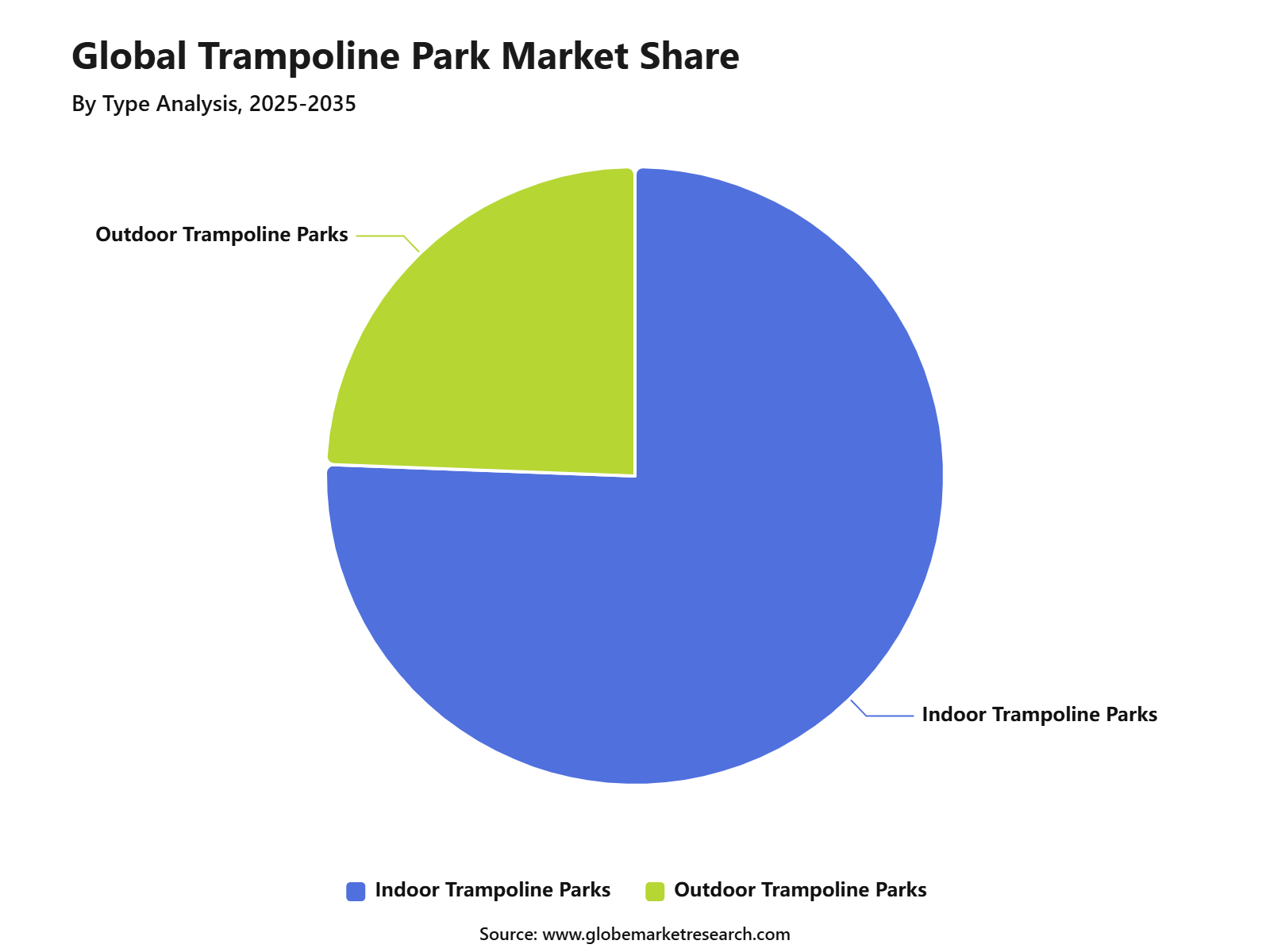
Indoor trampoline parks led the type segment with 75.6% share in 2025. Their growth was supported by year-round operations, weather protection, better safety control, and the ability to offer multiple activities under one roof.
Children accounted for 49.7% share by age group. Demand was driven by birthday parties, weekend family visits, school holidays, youth activity zones, and age-specific play areas.
Entry fees represented 63.5% share by revenue source. This shows that ticketed access remains the main revenue stream for trampoline park operators, supported by timed sessions, day passes, premium packages, and repeat visits.
Franchise-owned parks held 58.1% share by ownership. Franchise models are gaining traction because they offer brand recognition, standardized operations, training support, marketing systems, and faster geographic expansion.
North America commanded 44.6% share of the market. The region benefits from strong urban and suburban participation, higher leisure spending, established indoor entertainment chains, and strong adoption of family-focused recreational venues.
Top Funding and Investment Trends
The Trampoline Park Market is attracting investment through franchise expansion, multi-unit development agreements, mall-based entertainment concepts, and second-generation retail conversions. Funding is not mainly coming through venture capital rounds. Instead, most capital is being deployed through franchise owners, private operators, real estate landlords, and family entertainment chains.
The broader location-based entertainment sector is creating a strong base for trampoline park investment. JLL reported that foot traffic across 20 tracked entertainment concepts reached 217 million visits in 2025, nearly 12% above 2019 levels, with average dwell time of 140 minutes per visit. Trampoline parks and kid zones represented 1,355 existing locations and 355 planned locations, accounting for 61% of planned square footage and 10 million square feet of announced space.
Investment Area | Latest Signal | Market Impact |
|---|---|---|
Franchise expansion | Sky Zone announced 10 new parks across key U.S. markets, including Austin, Seattle, Henderson, Brooklyn, and the Atlanta metro area. | Shows strong franchise capital flow into active indoor entertainment. |
Multi-unit development | Launch Family Entertainment signed new commitments in the San Francisco Bay Area, Denver, and Texas, including a six-unit Texas agreement. | Supports scale-based investment and regional cluster growth. |
Large operator growth | Urban Air ended 2025 with 15 new leases, 30 franchise agreements, and 21 park openings. | Indicates continued demand for larger indoor adventure park formats. |
Retail reuse | New trampoline parks are being opened in former retail spaces and shopping centers. | Reduces buildout complexity and helps landlords fill large-format vacancies. |
Membership-led revenue | Sky Zone reported 500,000+ members, while Altitude reported more than 100,000 memberships sold. | Improves recurring revenue visibility for operators and franchise investors. |
Buildout investment | New U.S. projects are commonly being reported in the multi-million-dollar range, depending on size, attractions, and location. | Confirms trampoline parks are capital-intensive but scalable venue businesses. |
Top Investment Opportunities
Family Entertainment Centers: The strongest opportunity is in parks that combine trampolines with arcade gaming, food and beverage, party rooms, climbing areas, and toddler zones. These formats improve spend per visit and reduce dependence on one activity.
Second-Generation Retail Conversion: Vacant retail boxes and shopping center spaces are attractive because they can reduce site development timelines. Landlords also benefit from higher dwell time and stronger family foot traffic.
Membership-Based Models: Memberships help operators build predictable revenue. They also improve customer retention and create a stronger base for upselling birthday parties, food, events, and merchandise.
Regional Multi-Unit Franchising: Multi-unit franchisees can develop parks across high-density family markets. This model is attractive in suburban areas with strong school networks, birthday party demand, and weekend family traffic.
By Facility Type
Indoor trampoline parks led the market with 75.6% share, supported by strong demand for year-round, weather-independent recreational facilities. Their dominance can be attributed to controlled indoor environments, family-friendly layouts, birthday party packages, group bookings, fitness sessions, and multi-activity zones that combine trampolines with dodgeball, foam pits, climbing areas, arcade sections, and obstacle courses.
The segment also benefits from the broader shift toward location-based entertainment. Foot traffic across 20 tracked entertainment concepts reached 217 million visits in 2025, which was around 12% above 2019 levels, while average dwell time reached 140 minutes per visit. This supports the growth of indoor active entertainment formats, where families prefer shared, time-based experiences close to urban and suburban retail areas.
By Age Group
Children accounted for 49.7% share by age group, driven by family-oriented activities, birthday parties, school outings, weekend recreation, and group play. Trampoline parks are especially attractive for children because they combine physical activity with entertainment, social play, and event-based experiences in a supervised indoor setting.
This segment also requires strong safety management because children form the main user base for trampoline activities. The American Academy of Pediatrics noted in 2024 that more than 800,000 children were hurt on trampolines between 2009 and 2018, while the American Academy of Orthopaedic Surgeons states that more than 90% of trampoline injuries are sustained by children, mostly ages 5 to 14. This makes supervision, age zoning, staff training, and safety rules important for park operations.
By Revenue Source
Entry fees contributed 63.5% of revenue, supported by ticketed access to park facilities, hourly passes, day passes, premium jump packages, party admissions, and bundled activity access. This revenue model remains strong because trampoline parks are largely experience-based businesses where customer spending begins with admission and is then expanded through food, party rooms, grip socks, lockers, games, and memberships.
Entry-fee income is also supported by longer guest stays in indoor entertainment venues. The average dwell time of 140 minutes across tracked location-based entertainment concepts in 2025 shows that consumers are willing to spend meaningful time inside paid recreational venues. This helps operators build layered revenue around access fees, birthday packages, food services, group events, and repeat-visit memberships.
By Ownership
Franchise-owned parks held 58.1% share, reflecting strong brand recognition, standardized operating systems, consistent safety processes, marketing support, and faster expansion strategies. Franchise models are useful in this market because operators can replicate layouts, booking systems, party packages, staff training methods, and customer experience standards across multiple locations.
The share is also supported by continued expansion of branded indoor recreation facilities in the U.S. Recent state filing-based reports showed planned trampoline park projects of around 29,000 square feet in Pearland, Texas, and 28,366 square feet near San Antonio, with the San Antonio project investment reported at around USD 3.5 million. These projects reflect continued interest in scalable, branded indoor activity formats.
By Region
North America commanded 44.6% share of the market, supported by strong urban participation, established indoor entertainment networks, high family recreation spending, and wider acceptance of trampoline parks as birthday, weekend, and group activity destinations. The region also benefits from retail-center redevelopment, where active entertainment tenants are being used to increase foot traffic and improve consumer engagement.
The regional lead is supported by the broader recovery of the amusement and recreation economy. The U.S. Bureau of Labor Statistics reported that amusements, gambling, and recreation industries generated USD 236.8 billion in output in 2023, an increase of 74% from 2020. This recovery provides a stronger base for family entertainment centers, indoor parks, arcades, and active leisure venues.
By Country
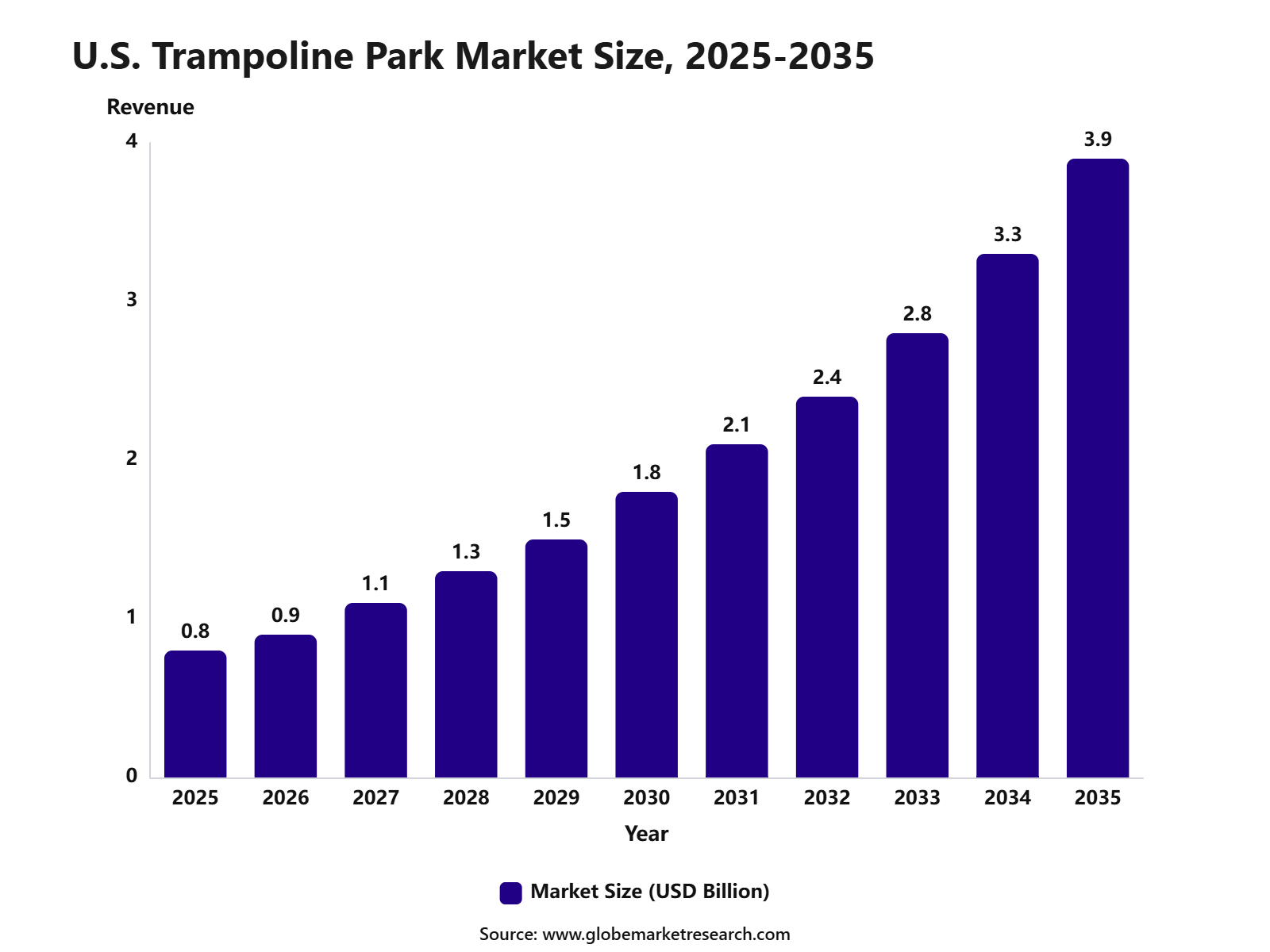
The U.S. trampoline park market was valued at USD 0.8 billion and is projected to grow at a CAGR of 17.1%, supported by strong family entertainment demand, franchise expansion, birthday party spending, and rising preference for indoor active recreation. Growth is being shaped by parents seeking supervised physical activity options for children, while operators are adding memberships, premium attractions, private events, and party-based packages to improve repeat visits.
The U.S. market is also supported by the size of the broader amusement and arcade workforce. Annual employment in U.S. amusement parks and arcades reached 243.1 thousand jobs in 2025, according to BLS data through FRED. This reflects a large operating base for staffed recreation venues, including indoor amusement and active entertainment formats.
Emerging Trends
Indoor active entertainment is becoming a retail anchor
Trampoline parks are increasingly being positioned inside malls, mixed-use centers, and urban entertainment zones. This shift is being supported by consumer preference for shared, activity-based experiences that can be visited on weekends, holidays, and after school. In 2025, foot traffic across 20 tracked entertainment concepts reached 217 million visits, around 12% above 2019 levels, with average dwell time of 140 minutes per visit. This supports stronger demand for indoor trampoline parks as high-engagement leisure destinations.
Safety-led park design is becoming a key differentiator
Safety is becoming a major trend as operators focus on age-based zones, trained supervision, grip socks, padded areas, controlled jump sessions, and clearer rules for high-risk activities. This is important because trampoline park injuries were reported at 1.14 injuries per 1,000 jumper hours, with 11% classified as significant injuries in a Pediatrics study. As a result, parks with stronger safety systems, staff training, and liability controls are likely to gain more trust from parents, schools, and group organizers.
Birthday parties and group packages are gaining stronger revenue importance
Birthday parties, school outings, youth group events, and family packages are becoming important revenue streams for trampoline park operators. The business model is moving beyond simple entry tickets and is being supported by private rooms, food and beverage add-ons, party hosts, socks, arcade zones, and premium play packages. Longer visitor stay times across indoor entertainment venues help operators increase spending per visit through bundled services and repeat memberships.
Franchise-led expansion is supporting standardization
Franchise-owned parks are gaining strength because they offer standardized layouts, booking systems, safety processes, staff training, and brand-based marketing support. This model is useful in trampoline parks because customers expect consistent safety, cleanliness, party handling, and activity quality across locations. It also allows operators to expand faster in suburban areas where family entertainment demand remains strong.
Top Use Cases
Birthday parties and private events: Birthday parties are one of the strongest use cases for trampoline parks because they combine active play, food service, group packages, private rooms, and hosted entertainment. Parents prefer these venues because planning is simple, children remain engaged, and the activity can be managed in a supervised indoor setting.
Family weekend entertainment: Trampoline parks are widely used for weekend and holiday recreation by families looking for active indoor entertainment. The format is especially attractive in urban and suburban areas because it offers physical activity, social play, and weather-independent fun in one location.
Children’s fitness and active play: Trampoline parks are used as active play spaces for children who need movement-based recreation outside school hours. This use case is supported by rising awareness around physical activity, screen-time balance, and structured play. The CDC recommends that children and adolescents need at least 60 minutes of physical activity daily, which supports demand for active recreation formats.
School trips and youth group outings: Schools, camps, sports clubs, and youth groups use trampoline parks for outings, team activities, reward events, and supervised recreation. These visits help parks generate weekday demand, especially during school holidays, summer camps, and community programs.
Corporate and team-building events: Trampoline parks are also used for corporate outings, team-building activities, and informal staff engagement events. Dodgeball courts, obstacle zones, climbing sections, and group challenges make the format suitable for light competition, employee bonding, and casual recreation.
Mall and retail traffic generation: Retail centers use trampoline parks to increase footfall and extend visitor dwell time. Indoor parks can help shopping centers attract families, support food and beverage sales, and turn underused retail space into activity-based entertainment areas. This use case is becoming more important as landlords look for tenants that can bring repeat visitors and longer stays.
Key Market Segments
By Type
Indoor Trampoline Parks
Outdoor Trampoline Parks
By Age Group
Children
Teenagers
Adults
By Revenue Source
Entry Fees
Food & Beverages
Merchandise
Events & Parties
Others
By Ownership
Franchise
Independent
By Region
North America
Europe
Asia Pacific
Latin America
Middle East & Africa
Market Concentration
The Trampoline Park Market has medium market concentration.
It is not highly concentrated because the market includes many local operators, regional family entertainment centers, independent indoor play venues, and franchise-owned parks. The business model is also location-based, so competition is strongly influenced by city-level demand, mall space, rent, safety rules, and local family entertainment spending.
However, it is not low concentration because several large franchise brands hold strong visibility and expansion power. For example, Urban Air Adventure Park has been reported to have more than 350 locations, while new franchise openings are still being added in the U.S. Altitude Trampoline Park also positions itself as a leading trampoline park franchise and highlights recurring revenue streams such as jump time, birthday parties, events, memberships, concessions, and vending machines.
Exact Classification: Medium Concentration
Market Structure: Moderately Fragmented
Competitive Landscape
The Trampoline Park Market is competitive, with franchise chains, independent operators, equipment suppliers, and multi-activity entertainment brands expanding their presence. Companies are focusing on new park openings, larger venue formats, birthday and event packages, safety improvements, and diversified attractions.
Key companies operating in the market include Sky Zone, JumpSport, Springfree Trampoline, Fun Spot Manufacturing, Vuly Trampolines, Altitude Trampoline Park, Urban Air Adventure Park, Big Air Trampoline Park, Bounce Inc., Flip Out, Flight Trampoline Park, DEFY Trampoline Parks, Get Air Trampoline Park, Launch Trampoline Park, Rush Trampoline Parks, Gravity Trampoline Parks, House of Air, Jump In Trampoline Parks, and AirHop Trampoline Parks.
Conclusion
The Trampoline Park Market is expected to grow steadily as consumers continue to prefer active, social, and family-friendly entertainment formats. Indoor parks are expected to remain dominant because they offer year-round access, controlled environments, and multiple activity options. The strongest opportunity will be seen in venues that combine safety, entertainment, fitness, events, and flexible pricing. As families and communities continue to look for healthier leisure experiences, trampoline parks are expected to remain an important part of the active entertainment market.