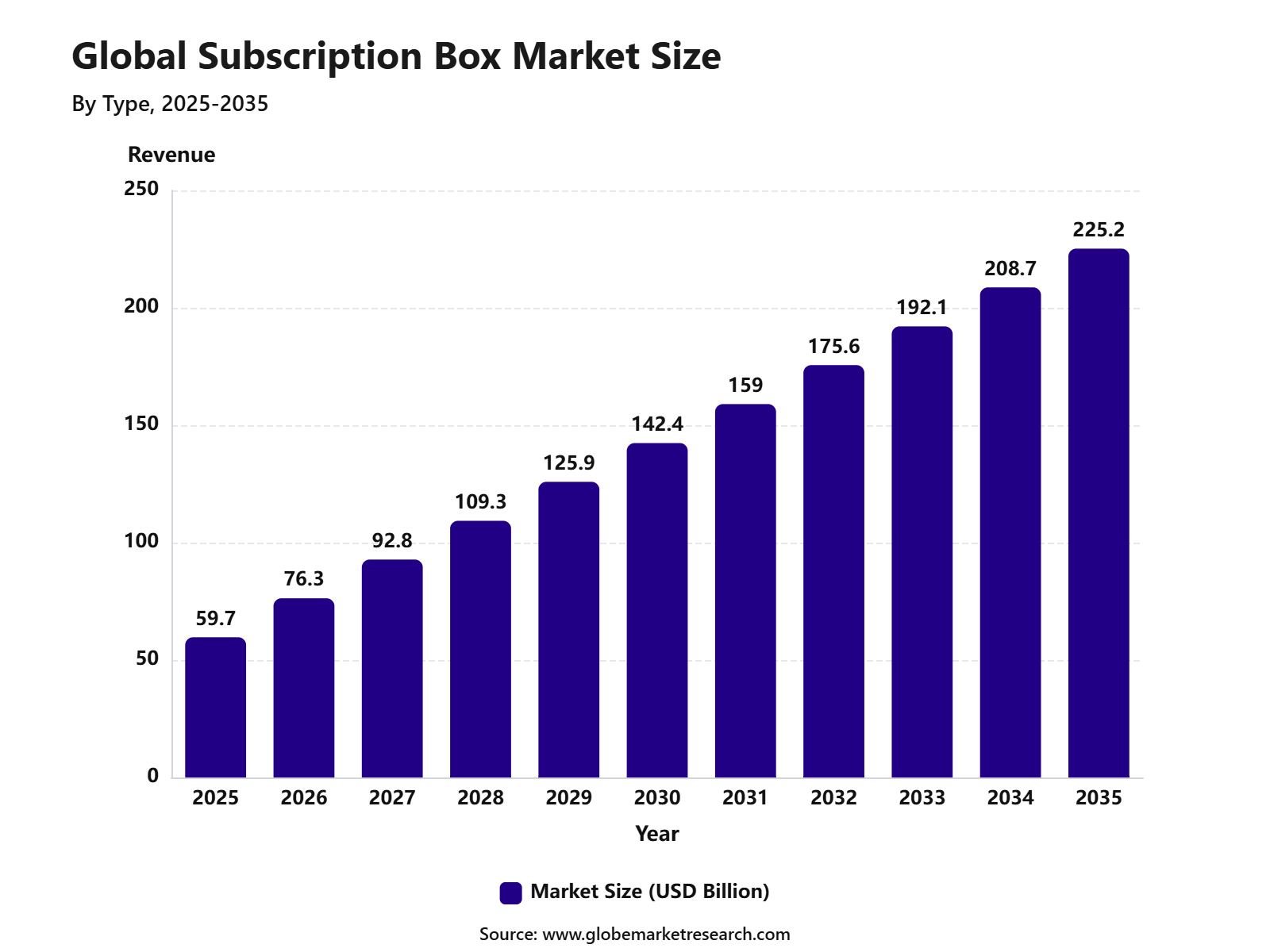
According to Globe Market Research, the global subscription box market was valued at USD 59.7 billion in 2025 and is projected to reach USD 225.2 billion by 2035 , growing at a 14.2% CAGR . North America led the market with 43.2% share in 2025 , supported by strong e-commerce penetration, high digital payment adoption, direct-to-consumer brands, and rising consumer demand for recurring product delivery.
A subscription box is a recurring delivery model where customers receive selected products at fixed intervals, usually monthly, quarterly, or weekly. These boxes are used across food and beverages, beauty and personal care, pet care, fashion, wellness, books, baby products, household items, and lifestyle categories. The model is gaining attention because it combines convenience, product discovery, personalization, and predictable revenue for brands.
Key Parameter | Report Details |
|---|---|
Market Revenue, 2025 | USD 59.7 Billion |
Projected Revenue, 2035 | USD 225.2 Billion |
CAGR, 2025-2035 | 14.2% |
Largest Region | North America, 43.2% Share |
Market Concentration | Medium |
Base Year | 2025 |
Forecast Period | 2025-2035 |
Why the Subscription Box Market Is Growing
The growth of the subscription box market can be attributed to changing online shopping behavior. Consumers are becoming more comfortable with recurring purchases when the product is useful, affordable, and easy to manage. U.S. retail e-commerce sales reached USD 326.7 billion in Q1 2026 , and e-commerce accounted for 16.9% of total U.S. retail sales , showing that online retail continues to support subscription-based commerce.
Subscription boxes are also benefiting from the rise of direct-to-consumer retail. Brands can use these boxes to build a direct relationship with customers instead of depending only on marketplaces or physical stores. This helps companies improve repeat sales, collect preference data, test new products, and increase customer lifetime value.
According to Census, the latest retail environment supports this model. U.S. retail e-commerce sales reached USD 326.7 billion in Q1 2026, rising 9.8% year over year, while e-commerce accounted for 16.9% of total retail sales. This shows that online retail remains a strong base for subscription box services, especially for brands that sell directly to customers and use recurring delivery to improve retention.
Usage Metrics
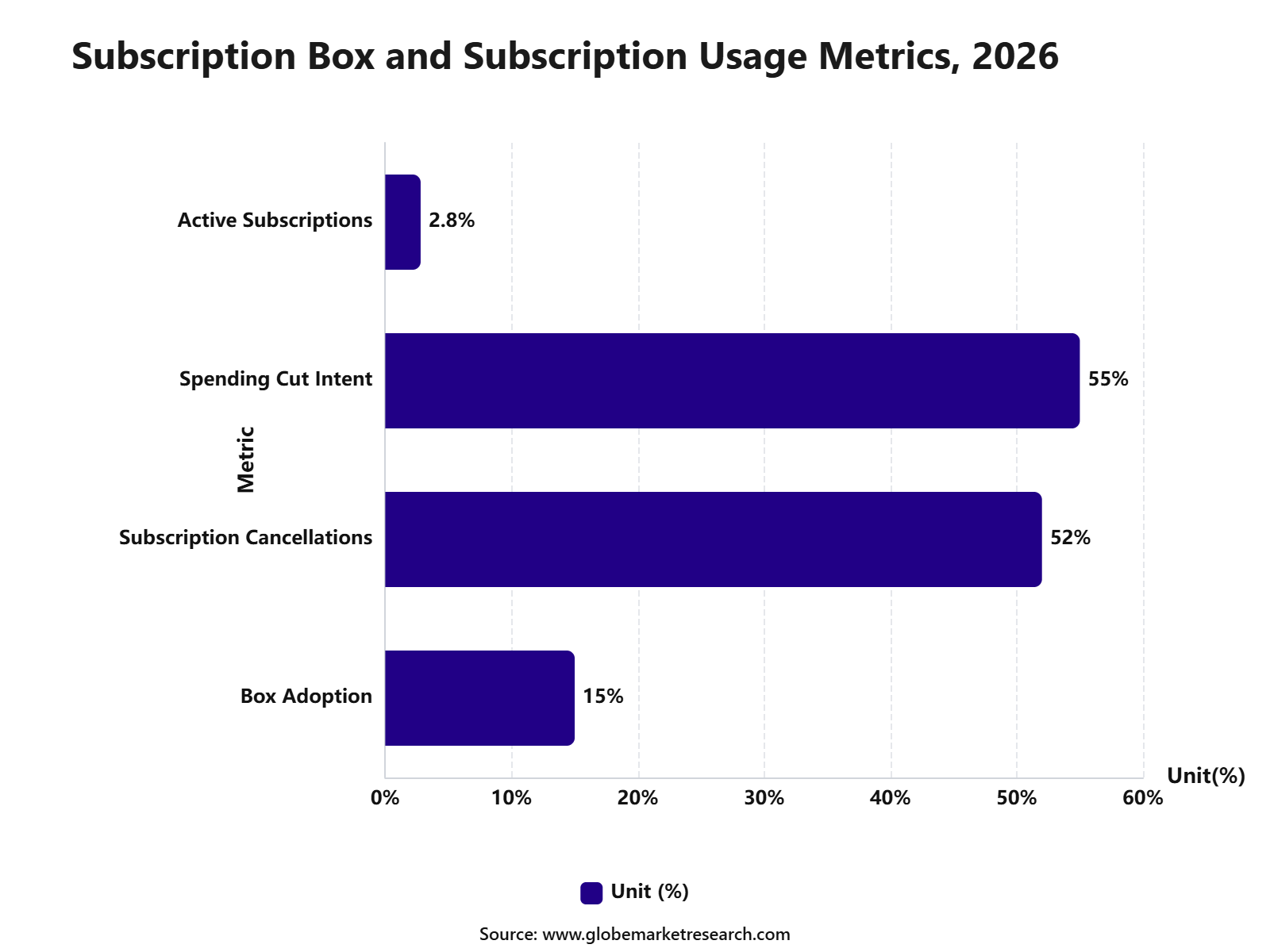
In 2026, spending cut intent was the highest subscription-related metric at 55% , showing that cost sensitivity remained a major challenge for subscription box providers. Subscription cancellations were also high at 52% , indicating strong churn pressure across the market. Box adoption stood at 15% , suggesting that new customer acquisition remained moderate compared to cancellation and spending reduction trends. Active subscriptions were only 2.8% , highlighting the need for stronger retention, flexible pricing, and improved value delivery.
Replenishment Subscriptions Lead the Market
Replenishment subscription boxes led the market with 48.2% share in 2025. This segment is supported by repeat-use products such as food items, beverages, personal care products, grooming products, pet supplies, household essentials, vitamins, and baby care products. The model works because customers do not need to manually reorder products they already use regularly.
The strongest advantage of replenishment subscriptions is reliability. Customers continue using these boxes when they save time, prevent stockouts, and offer better value than one-time purchases. For brands, this model supports recurring revenue, better demand forecasting, and stronger inventory planning.
Replenishment boxes are also better protected from subscription fatigue than surprise-based boxes. When a box contains essential products, the customer is more likely to view it as useful spending rather than discretionary spending. This makes replenishment subscriptions important for categories such as pet food, household refills, coffee, skincare, supplements, and baby essentials.
The latest subscription business data also shows why retention must be prioritized. A 2026 subscription benchmark covering 76 million unique subscribers and 2,200 merchants found that 52% of consumers canceled at least one subscription in the past year due to lack of use. This reinforces the need for product usefulness, flexible delivery schedules, and easy pause options in replenishment models.
Budget-Friendly Subscription Boxes Are Driving Mass Adoption
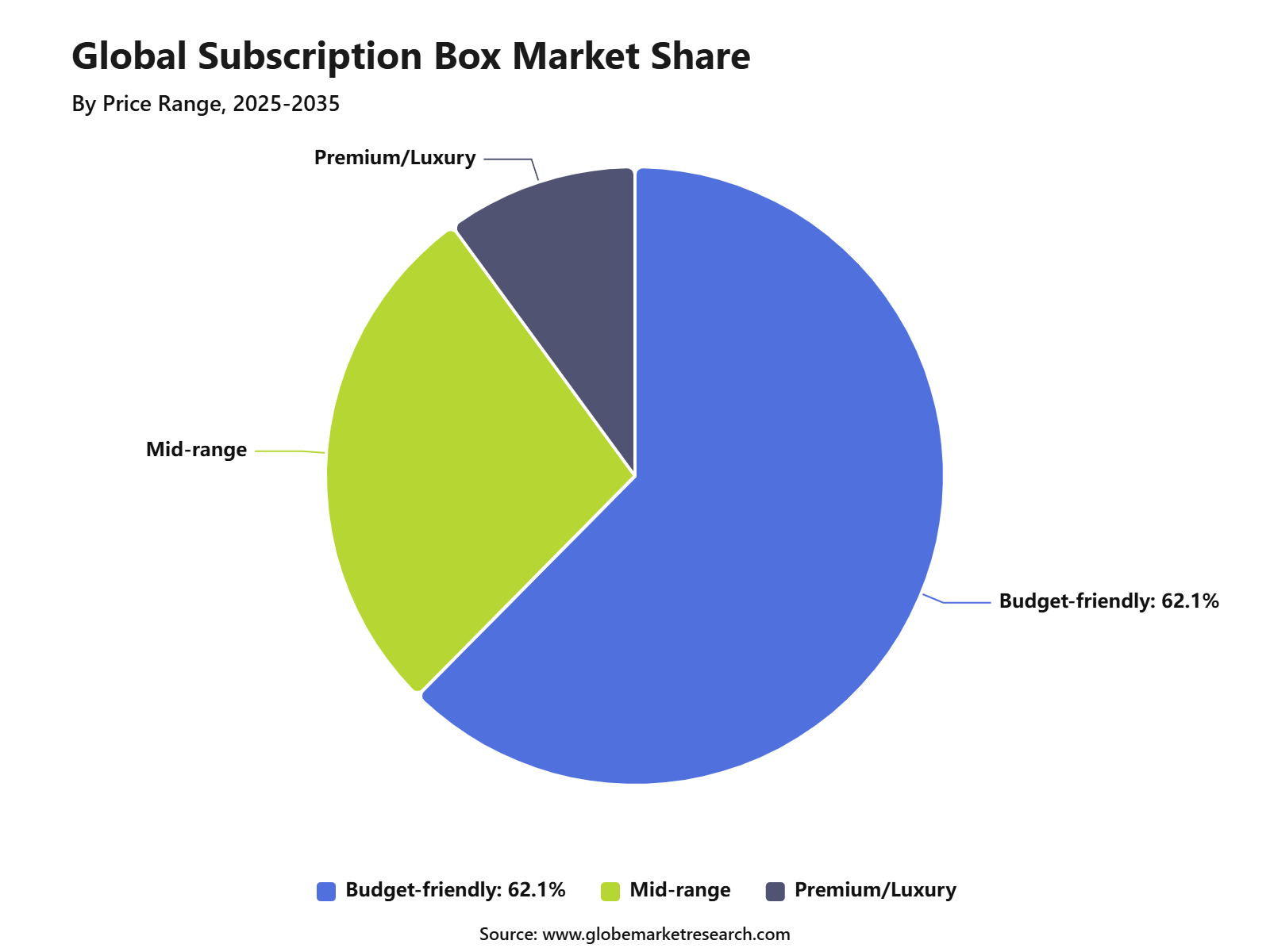
Budget-friendly subscription boxes accounted for 62.1% share, making them the leading price range segment in 2025. This dominance is supported by consumer preference for affordable plans, flexible pricing, trial boxes, smaller packs, and value-based product bundles. Price clarity has become important because households are more careful with recurring payments.
Affordable plans reduce the entry barrier for new subscribers. Customers are more likely to test a subscription box when the first box is low-risk, the cancellation process is clear, and the value is visible from the beginning. This is why budget-friendly plans are performing well across snacks, personal care, pet products, hobby kits, books, and household items.
Premium and luxury boxes still have demand, especially in beauty, gourmet food, wellness, coffee, gifting, and fashion. However, premium boxes must offer stronger differentiation because customers expect better product quality, exclusivity, packaging, and customization. Without clear value, premium subscriptions may face higher cancellation risk.
The wider subscription economy is also moving toward control and flexibility. Visa stated in March 2026 that global subscriptions are approaching 12 billion by 2030, while its Enhanced Subscription Manager was introduced to help users view, manage, switch, and cancel subscriptions inside banking apps. This shows that customer control is now becoming a central feature of recurring payment models.
Food and Beverages Remain the Strongest Application Area
Food and beverages led the subscription box market with 37.4% share in 2025. The segment includes meal kits, snack boxes, coffee subscriptions, tea boxes, health drinks, specialty foods, ready-to-cook products, and curated grocery boxes. This category performs well because food and beverage products are consumed regularly, which supports repeat orders.
The growth of food and beverage subscription boxes is being supported by convenience, changing eating habits, product discovery, and demand for personalized meal options. Consumers use these boxes to save time, try new products, manage dietary preferences, and access products that may not be available in nearby stores. This gives brands a strong opportunity in healthy snacks, premium beverages, regional foods, organic items, and family-focused boxes.
Food subscriptions also fit well with replenishment and curation. Coffee, tea, snacks, meal kits, and grocery refills can be offered through fixed delivery schedules, while specialty foods and limited-edition boxes can create product discovery. This combination can improve both retention and upselling opportunities.
Personalization Is Becoming a Core Growth Driver
Personalization is one of the most important subscription box market trends. Customers are less interested in generic boxes and more interested in products that match their preferences, lifestyle, budget, skin type, pet needs, diet, hobbies, or family size. This is why onboarding quizzes, preference tracking, data-based recommendations, and flexible product selection are becoming more important.
AI can improve subscription box performance by predicting customer preferences, reducing unwanted products, improving box curation, and identifying churn risk earlier. It can also support automated product rotation, customer segmentation, personalized offers, failed payment recovery, and demand forecasting. These features are especially useful for brands managing large subscriber bases.
Recent subscription benchmark data shows that 43% of users are comfortable with AI managing their subscriptions, while consumers are most open to AI use for fraud prevention at 56% and content personalization at 50% . This indicates that AI adoption can support trust and personalization when it is used clearly and responsibly.
Subscription Management and Trust Are Becoming Critical
Subscription trust is now a major market factor. Customers want transparency on billing, renewal dates, cancellation terms, delivery frequency, trial conversion, and refund policies. If a brand makes cancellation difficult, customers may lose trust even if the product quality is strong.
Visa’s Enhanced Subscription Manager shows how payment companies are responding to this shift. The service allows cardholders to view, manage, switch, and cancel recurring subscription payments directly within mobile banking apps. Visa also stated that the tool would be available to North American issuers in summer 2026, followed by expansion to Latin America and the Caribbean.
The same Visa update cited a consumer survey where 75% of consumers expected in-app bill management, and more than 50% of Millennials and Gen Z consumers said they would switch banks to get it. This is important for subscription box brands because younger consumers are more likely to expect simple subscription controls, clear billing, and mobile-first management.
North America Leads the Subscription Box Market
North America held the largest subscription box market share at 43.2% in 2025. The region benefits from high online shopping activity, mature digital payments, strong direct-to-consumer brands, and wide consumer familiarity with recurring delivery services. Subscription boxes are widely used across food, beauty, pet care, wellness, household goods, books, toys, and lifestyle categories.
The U.S. remains the most important local market within North America. Strong e-commerce penetration, fast fulfillment infrastructure, digital payment adoption, and brand-led subscription models support market growth. U.S. e-commerce sales accounted for 16.9 % of total retail sales in Q1 2026, giving subscription box companies a strong base for customer acquisition and retention.
Local subscription opportunities are strongest for brands that offer fast delivery, flexible plans, clear pricing, localized product selection, and reliable customer service. Food boxes, pet boxes, personal care boxes, coffee subscriptions, wellness boxes, and baby care boxes are especially relevant where repeat-use behavior is strong.
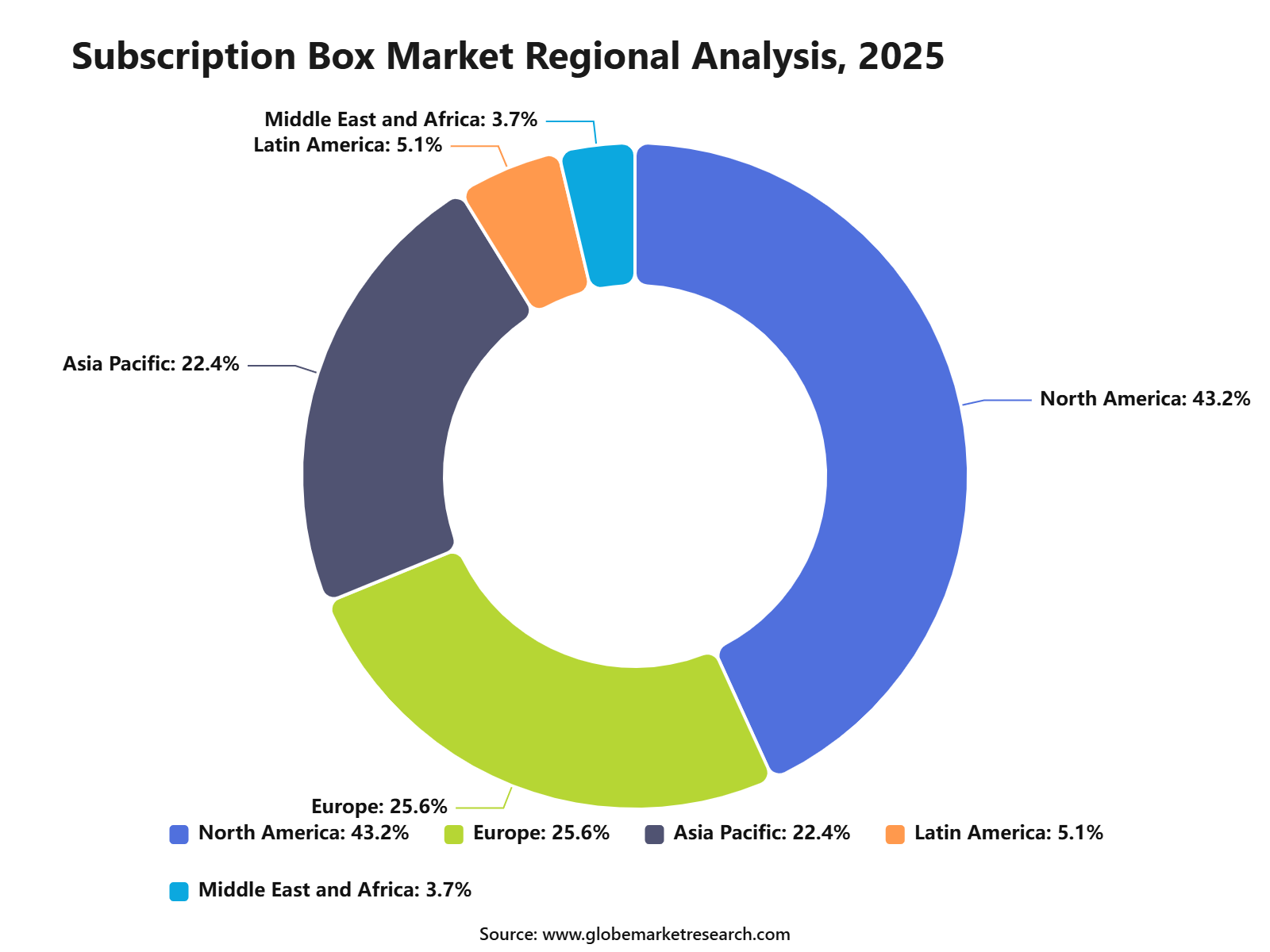
Asia Pacific and Europe also offer growth opportunities. Asia Pacific benefits from mobile commerce, rising middle-class spending, and strong digital adoption, while Europe is supported by premium food, beauty, personal care, wellness, and sustainable packaging demand. Local market success will depend on pricing, delivery infrastructure, payment preferences, and product relevance.
Go-to-Market Strategy for Subscription Box Brands
A successful subscription box go-to-market strategy should be retention-led. First-time sales are important, but long-term value depends on repeat billing, customer satisfaction, and low churn. Brands should focus on product usefulness, clear value per box, flexible plans, loyalty benefits, product quality, and simple subscription controls.
Discount-led customer acquisition should be used carefully. Heavy discounts can create fast sign-ups, but they may attract customers who cancel after the first or second box. Stronger sales economics can be achieved through product quality, private label products, personalized curation, member-only benefits, referral programs, and add-on sales.
Retailers are also testing subscription models to protect loyalty. In March 2026, Dollar General announced plans to pilot a subscription program as part of its loyalty strategy, while its fiscal 2025 net sales increased 5.2% to USD 42.7 billion . This shows that subscription models are moving beyond niche direct-to-consumer brands and entering broader retail strategies.
The best commercial opportunity is expected where the subscription box solves a repeated customer need. Brands should clearly define whether the box is built for replenishment, curation, access, gifting, or membership benefits. This helps improve positioning, pricing, fulfillment planning, and customer communication.
Revenue Potential and Financial Impact
Revenue potential in the subscription box market is spread across monthly boxes, quarterly boxes, refill subscriptions, discovery boxes, gifting subscriptions, premium memberships, corporate gifting, private label products, and add-on sales. The strongest categories are usually those with repeat use, emotional connection, or clear convenience value. Food, beauty, pet care, wellness, coffee, baby products, books, toys, and household essentials remain attractive.
The financial impact can be positive when acquisition cost, fulfillment cost, product cost, packaging cost, shipping cost, churn, and payment failure rates are controlled. Recurring billing can improve cash flow visibility and support better inventory planning. It can also help brands negotiate better supplier terms when demand becomes more predictable.
Shipping remains a major cost factor. USPS announced a time-limited 8% price increase for Priority Mail Express, Priority Mail, USPS Ground Advantage, and Parcel Select, with the adjustment planned from April 26, 2026, through January 17, 2027. This type of logistics pressure can reduce margins, especially for low-ticket monthly boxes.
Subscription box companies can improve financial resilience through lightweight packaging, regional fulfillment centers, local sourcing, supplier-funded samples, private label products, and higher-value bundles. Profitability is likely to be stronger when brands improve retention before scaling paid marketing.
Risk Factors and Market Barriers
The biggest risk in the subscription box market is churn. Customers cancel when boxes feel repetitive, products do not match expectations, prices rise, delivery is delayed, or household budgets tighten. Unlike standard e-commerce, subscription boxes must prove value every billing cycle.
Subscription fatigue is also increasing across recurring payment categories. The 2026 subscription benchmark found that 52% of consumers canceled at least one subscription in the past year due to lack of use. The same data showed that merchants offering pause-before-cancel options saw pause usage increase 337% year over year, and 3 out of 4 subscribers who paused eventually returned.
Regulatory and compliance risk is another major issue. The FTC reported that complaints about negative option and recurring subscription practices reached nearly 70 complaints per day in 2024, compared with 42 per day in 2021. This shows that unclear billing, difficult cancellation, and misleading trial practices remain serious concerns for subscription businesses.
Returns and refunds can also pressure profitability. NRF reported that U.S. retail returns were projected to reach USD 849.9 billion in 2025, while 19.3% of online sales were expected to be returned. This is important for subscription boxes because bundled, sampled, personalized, or consumable products can be harder to return, restock, or resell.
Analyst Perspective
What the Data Is Telling Subscription Box Companies
From an analyst perspective, the subscription box market is not growing only because consumers like convenience. The data shows that customers are becoming more selective about which recurring services they keep. With the market valued at USD 59.7 billion in 2025 and expected to reach USD 225.2 billion by 2035 , demand is strong, but growth will favor brands with better retention and clearer value.
The strongest signal is the shift toward practical subscriptions. Replenishment subscriptions held 48.2% share , while budget-friendly boxes accounted for 62.1% share . This shows that customers are more likely to keep a subscription when it solves a repeated need and fits their monthly budget.
What Opportunities Are Emerging?
The biggest opportunity is in replenishment-led subscription models. Pet care, personal care, food and beverages, wellness, baby care, coffee, grooming, and household essentials are well suited for recurring delivery because these products are used regularly.
Food and beverages remain a strong opportunity, with 37.4% share in 2025 . Meal kits, snack boxes, coffee subscriptions, health-focused beverages, and specialty food boxes can grow further when brands offer freshness, useful product selection, and flexible delivery.
AI-based personalization is also becoming important. Brands can use customer preferences, order history, and feedback to improve box relevance, reduce unwanted items, and lower cancellation risk.
What Risks Should Companies Be Aware Of?
The biggest risk is churn. A 2026 subscription benchmark found that 52% of consumers canceled at least one subscription in the past year due to lack of use . This means brands must prove value in every billing cycle, not only during the first purchase.
Regulatory pressure is also rising. Complaints related to recurring subscription practices reached nearly 70 complaints per day in 2024 , showing that unclear billing, hidden renewal terms, and difficult cancellation can damage trust.
Logistics cost is another major risk. An 8% temporary USPS price increase in 2026 for several shipping services can affect margins, especially for low-priced monthly boxes. Brands must manage packaging, fulfillment, and shipping efficiency carefully.
What Decisions Should Clients Make Next?
Clients should first define their subscription model clearly. A brand must decide whether the box is focused on replenishment, curation, access, gifting, or membership value because each model needs a different pricing and retention strategy.
Second, retention should be prioritized before aggressive customer acquisition. Paid marketing may increase trial users, but long-term growth depends on churn rate, repeat billing success, average order value, shipping cost per box, and customer lifetime value.
Finally, brands should give customers more control. Easy cancellation, pause options, delivery reminders, flexible billing dates, and clear renewal messages can improve trust. The strongest opportunities are likely to come from useful products, fair pricing, reliable delivery, and transparent subscription management.
Competitive Landscape
The subscription box market is competitive because companies operate across meal kits, beauty, grooming, fashion, pet care, household products, wellness, lifestyle, and retail membership models. Key companies include HelloFresh SE, Stitch Fix, Ipsy, BARK, BarkBox, Gousto, Amazon Subscribe & Save, Birchbox, Blue Apron Holdings Inc., Dollar Shave Club, FabFitFun, Glossybox, Grove Collaborative Inc., and Harry’s Inc.
Competition is expected to rise as retailers, marketplaces, consumer brands, and payment platforms improve recurring delivery and subscription management features. Large retailers may use subscriptions to increase loyalty, while niche brands may use them to create stronger customer communities and product discovery experiences.
The companies likely to perform better are those with clear product value, reliable delivery, strong personalization, trusted billing, and controlled unit economics. Generic boxes with weak differentiation may face higher churn because consumers are becoming more selective about recurring spending.
For investors and business leaders, the market should be assessed through retention quality, customer acquisition cost, fulfillment efficiency, product relevance, and subscription flexibility. Strong subscriber growth is useful, but long-term value depends on whether customers stay active and continue seeing value in every box.
Recent Developments
Market News
In 2026, FabFitFun expanded into monthly beauty subscriptions with the Beauty Edit Box, offering customers a lower-price entry point and customizable skincare, makeup, and haircare products. This indicates that large subscription box brands are moving beyond seasonal curation toward more frequent, replenishment-driven formats.
In 2026, Daily Harvest relaunched its direct-to-consumer model with more flexible ordering, allowing customers to buy individual products or opt into auto-replenishment instead of relying only on a fixed subscription box. This reflects a broader shift toward flexible subscriptions and reduced commitment models.
In 2026, FairyLoot prepared the launch of its Cosy Fantasy Quarterly Book-Only Subscription, with the first box scheduled for January 2026. The move shows growing demand for niche, fandom-based subscription boxes with collectible and community-led value.
Funding
In 2026, The EleFant raised USD 1 million in pre-Series funding led by Growth Sense Venture Fund. The capital will be used to strengthen technology infrastructure and expand its toy and book subscription platform across India.
In 2025, Peachies raised GBP 2.1 million to support its nappy subscription service, retail expansion, and new product launches. The funding was led by ArmaVir Partners and Triple B, following an earlier GBP 1.3 million round in 2024.
In 2025, Chobani raised USD 650 million to support U.S. expansion plans. The funding is relevant to the subscription food ecosystem because Chobani also acquired Daily Harvest in 2025 and is expanding into prepared and ready-to-make food formats.
Mergers and Acquisitions
In 2026, FabFitFun purchased Paya Health, strengthening its wellness brand portfolio and supporting its broader move from a single subscription box business into a larger membership and shopping platform.
In 2025, Recurly acquired Prive and Redfast to expand subscription commerce, billing, engagement, personalization, and retention capabilities for digital and physical goods subscription brands.
Conclusion
The subscription box market is entering a more mature growth phase. Consumers still value convenience, product discovery, and recurring delivery, but they now expect stronger value, better personalization, easier cancellation, and more control over billing. Future growth will be led by replenishment subscriptions, budget-friendly plans, food and beverage boxes, AI-based personalization, pet care boxes, wellness products, and direct-to-consumer retail models. Brands that manage churn, shipping costs, product quality, and customer trust will be better positioned in the subscription box industry.