

Revenue, 2026
USD 2.4 Bn
Forecast, 2035
USD 4.12 Bn
CAGR, 2026-2035
6.2%
Report Coverage
Global
Market Size and Forecast
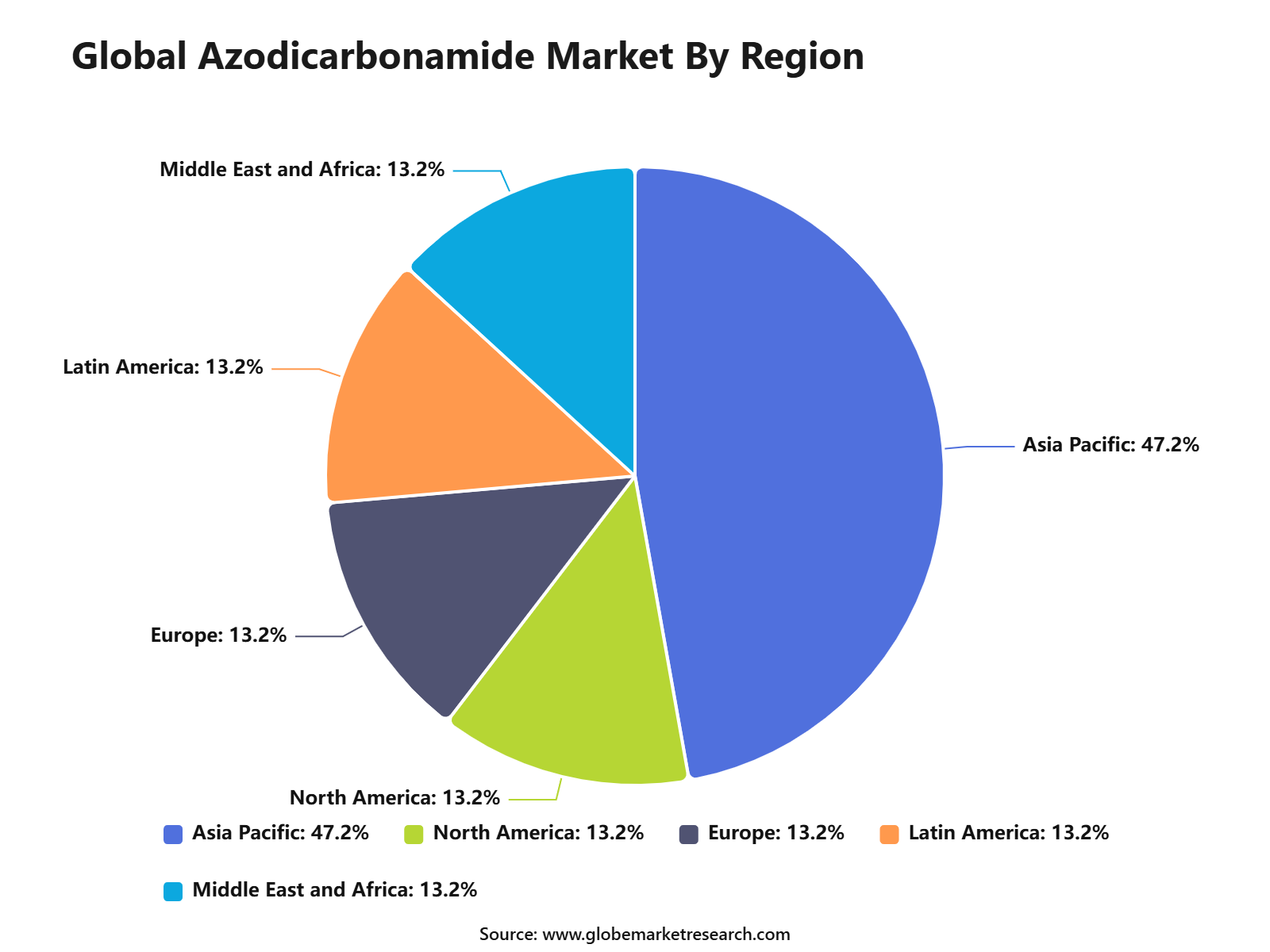
The Global Azodicarbonamide Market was worth USD 2.4 billion in 2026 and is expected to reach USD 4.12 billion by 2035, growing at a CAGR of 6.2% from 2026 to 2035. Asia Pacific held the largest regional share of 47.2% in 2026, valued at around USD 1.1 billion, supported by strong demand from plastics, rubber, footwear, construction materials, packaging, and industrial manufacturing.
The Azodicarbonamide Market includes chemical blowing agents used to create foam structures in polymers and rubber-based products. It is widely used in PVC, EVA, PE, PP, synthetic rubber, footwear soles, yoga mats, insulation materials, gaskets, seals, and lightweight plastic products. The material is valued because it helps improve cushioning, flexibility, thermal insulation, density control, and product performance.
Market growth is being supported by rising demand for lightweight and cost-effective foam materials across consumer goods and industrial applications. Manufacturers are using azodicarbonamide to improve softness, durability, elasticity, and processing efficiency in plastic and rubber products. Demand is also increasing as packaging, automotive interiors, building insulation, and footwear industries continue to use foam-based materials.
Key Parameter | Report Details |
|---|---|
Market Revenue, 2026 | USD 2.4 Billion |
Projected Revenue, 2035 | USD 4.12 Billion |
CAGR (2026-2035) | 6.2% |
Largest Region | Asia Pacific (47.2%, USD 1.1 Bn) |
Market Concentration | Medium |
Base Year | 2025 |
Forecast Period | 2026-2035 |
Asia Pacific is expected to remain the leading region due to its large plastics processing base, strong footwear manufacturing sector, and expanding construction and packaging industries. China, India, Vietnam, Indonesia, South Korea, and other regional markets are supporting demand through large-scale production and export activity. Long-term growth will depend on regulatory compliance, safer handling practices, product quality, raw material stability, and demand for high-performance foamed materials.
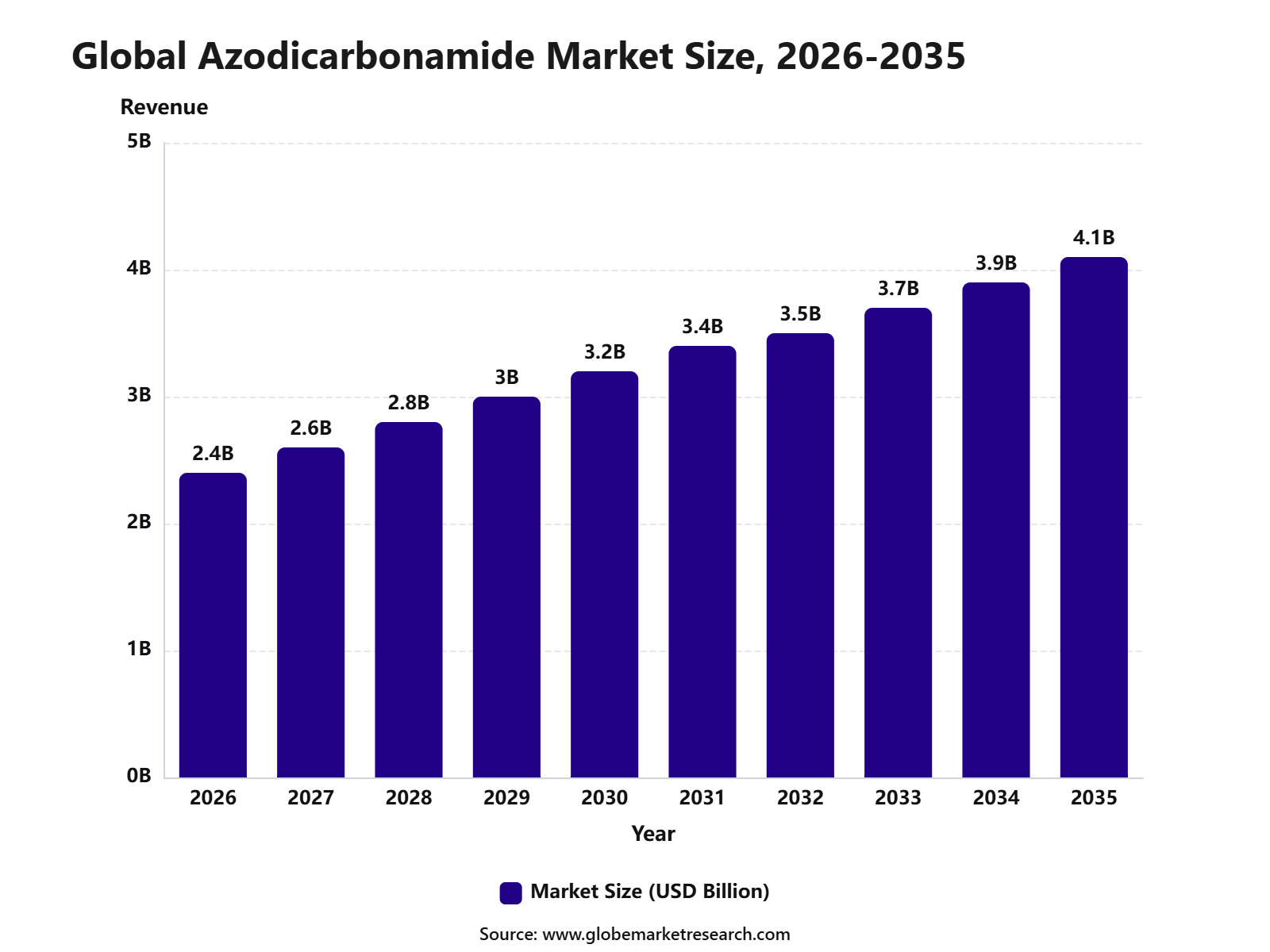 iThe graph shows projected market growth until 2035 based on CAGR analysis. Actual outcomes may vary depending on changing demand, competition, and economic factors.To gain greater insights - request a sample report PDF
Key Market Insights
Plastics led the application segment with 56.5% share, supported by strong use of azodicarbonamide as a foaming agent in polymer products, molded plastics, rubber materials, and lightweight components.
Packaging accounted for 33.2% share by end-user industry, driven by rising demand for lightweight, flexible, and cost-efficient plastic packaging materials.
Powder form held 69.1% share, supported by easier handling, better blending, stable storage, and wide use across plastic and rubber processing applications.
Industrial quality azodicarbonamide captured 56.1% share, driven by strong demand from large-scale manufacturing, polymer processing, and industrial foaming applications.
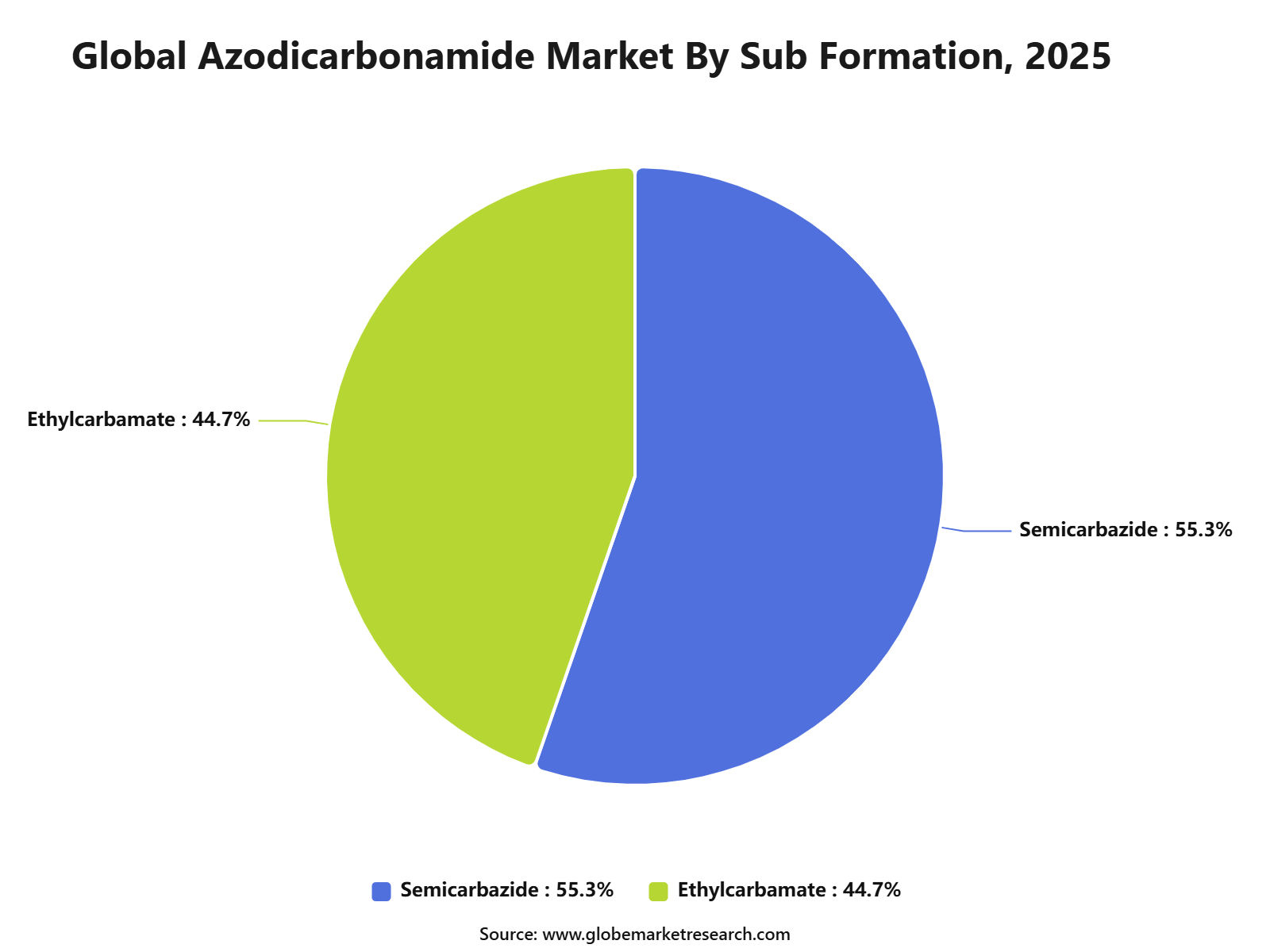
Semicarbazide (SEM) led the sub-formation segment with 55.3% share, supported by its relevance in azodicarbonamide decomposition and chemical processing pathways.
Asia Pacific led the azodicarbonamide market with 47.2% share, valued at USD 1.1 billion, supported by strong plastics manufacturing, expanding packaging demand, and high industrial production across China, India, Japan, and Southeast Asia.
Top Funding and Investment
Top Investments
In 2026, Rianlon Malaysia began developing a RM 1.27 billion research, development, and manufacturing complex in Johor, Malaysia. The facility will produce polymer anti-ageing additives, lubricant additives, and bio-based materials used across plastics and rubber processing. The investment expands the broader polymer-additive supply chain in which azodicarbonamide-based foaming agents are used.
In December 2025, VT Chemical committed more than USD 7 million to establish its first U.S. production and distribution facility in Hitchcock, Texas. The company acquired a 35,000-square-foot facility on five acres to manufacture polyethylene waxes used in PVC compounding, rubber, adhesives, coatings, cables, and plastics processing. The project is expected to create 27 jobs and generate an estimated USD 900,000 economic impact over ten years.
In October 2025, Nouryon announced new investments in China covering additional metal-alkyl capacity, methylaluminoxane production, and an organic-peroxides innovation centre. Organic peroxides and chemical blowing agents are both used as processing additives in polymer and foam manufacturing, although the company did not disclose the investment amount.
Top Acquisitions
In October 2025, Arclin completed the acquisition of Polymer Solutions Group. Arclin acquired PSG’s proprietary polymer additives, dispersions, release agents, production capabilities, technical expertise, and customer relationships across the rubber, plastics, and engineered-wood industries.
In December 2025, Praana Group entered into an agreement to acquire selected plastic-additives businesses from Arkema, with completion planned for the first quarter of 2026. The transaction covers impact modifiers and processing aids used in PVC profiles, pipes, packaging, composites, and engineering plastics. The acquired operations include production assets, product technologies, customer relationships, and additive formulations.
By Application
Plastics accounted for 56.5% share of the Azodicarbonamide Market. This leading position is supported by the wide use of azodicarbonamide as a blowing agent in plastic and polymer foam production.
The segment is widely used in PVC, EVA, polyethylene, rubber, and other polymer-based materials where lightweight structure, cushioning, insulation, and flexibility are required. Azodicarbonamide helps create uniform cellular structures in foamed plastics, improving product performance and reducing material weight.
Demand from plastics is expected to remain strong due to its use in packaging, footwear, insulation, automotive parts, flooring, mats, and consumer goods. The need for cost-effective foaming agents in high-volume plastic processing will continue to support segment leadership.
By End-User Industry
Packaging accounted for 33.2% share of the Azodicarbonamide Market. This dominance is driven by the strong use of foamed plastic materials in protective packaging, cushioning sheets, flexible films, trays, and lightweight packaging components.
Azodicarbonamide-based foaming helps reduce packaging weight while improving shock absorption and material efficiency. It is especially useful in packaging applications where product protection, lower material use, and cost control are important.
The segment is expected to remain a major demand area as packaged goods, e-commerce shipments, consumer products, and industrial packaging continue to expand. Demand will remain supported by lightweight foam packaging and protective material applications.
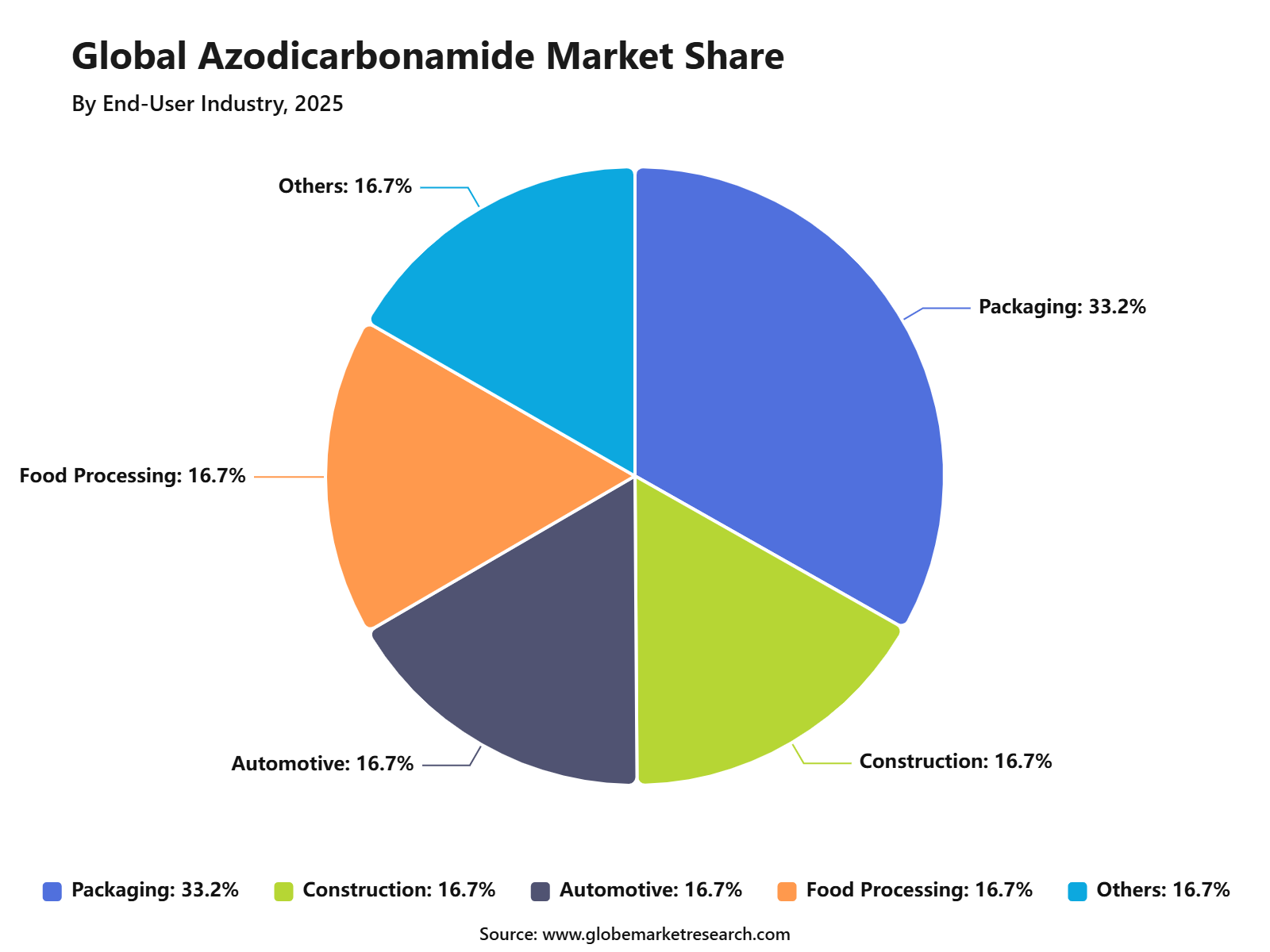 iThe graph shows projected market growth until 2035 based on CAGR analysis. Actual outcomes may vary depending on changing demand, competition, and economic factors.To gain greater insights - request a sample report PDF
By Form
Powder form accounted for 69.1% share of the Azodicarbonamide Market. This leading position is supported by easier blending, accurate dosing, and better compatibility with plastic, rubber, and polymer processing systems.
Powdered azodicarbonamide is preferred because it can be mixed uniformly with resins and additives before foaming. This helps manufacturers achieve consistent cell structure, controlled expansion, and stable product quality during extrusion, molding, and compounding.
Demand for powder form is expected to remain strong as plastic processors require reliable and easy-to-handle blowing agents. Its suitability for large-scale industrial use will continue to support its dominant position in the market.
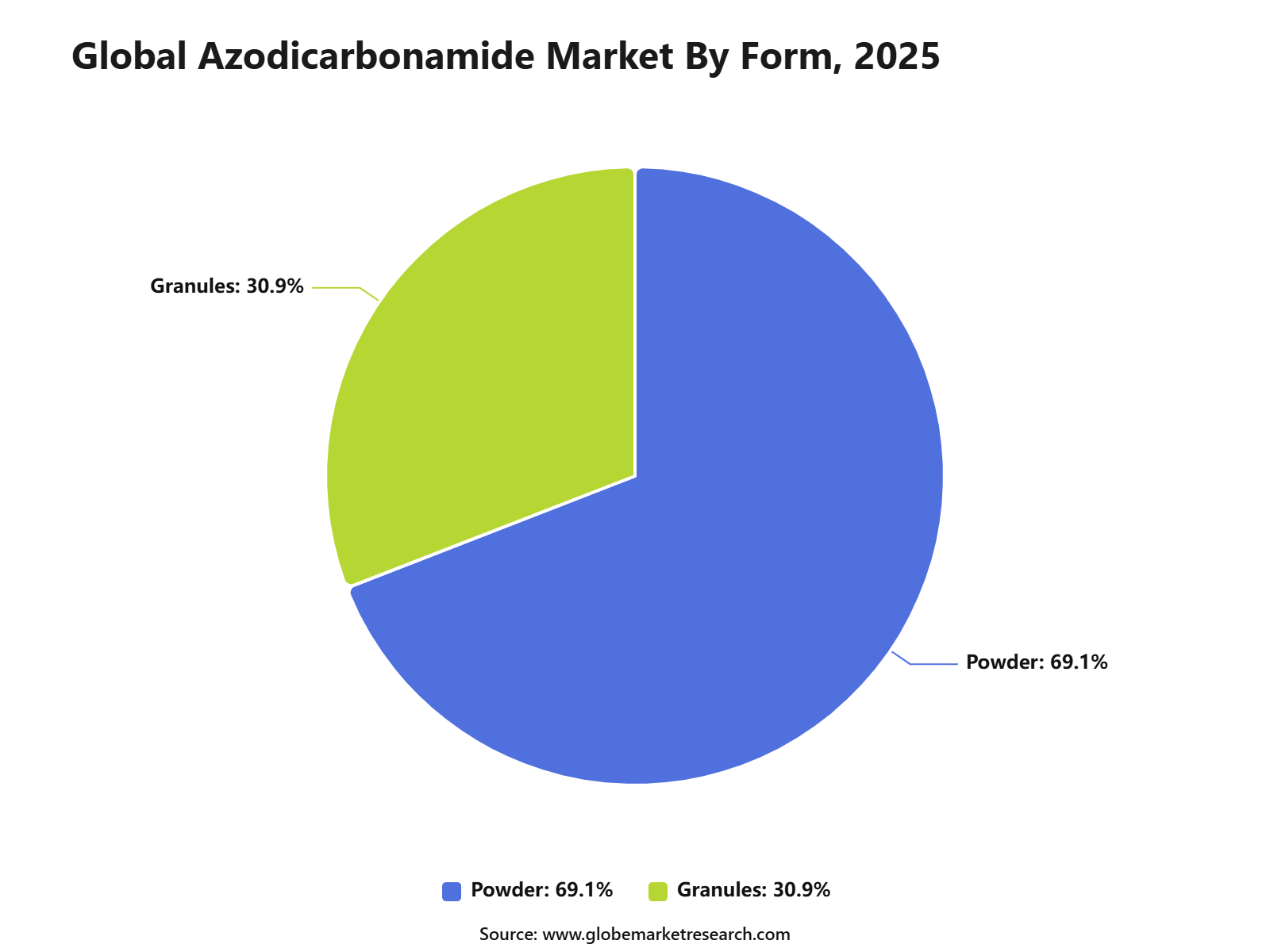 iThe graph shows projected market growth until 2035 based on CAGR analysis. Actual outcomes may vary depending on changing demand, competition, and economic factors.To gain greater insights - request a sample report PDF
By Azodicarbonamide Type
Industrial quality azodicarbonamide held 56.1% share of the Azodicarbonamide Market. This dominance is supported by its broad use in plastic foaming, rubber processing, industrial materials, and polymer-based product manufacturing.
The segment is widely preferred because industrial quality grades provide suitable performance for high-volume production where controlled foaming and cost efficiency are required. These grades are commonly used in applications such as sheets, footwear soles, mats, insulation materials, and molded foam products.
Demand is expected to remain strong as industrial users continue to require scalable foaming solutions. The segment will remain supported by packaging, construction materials, automotive components, and other plastic-based applications.
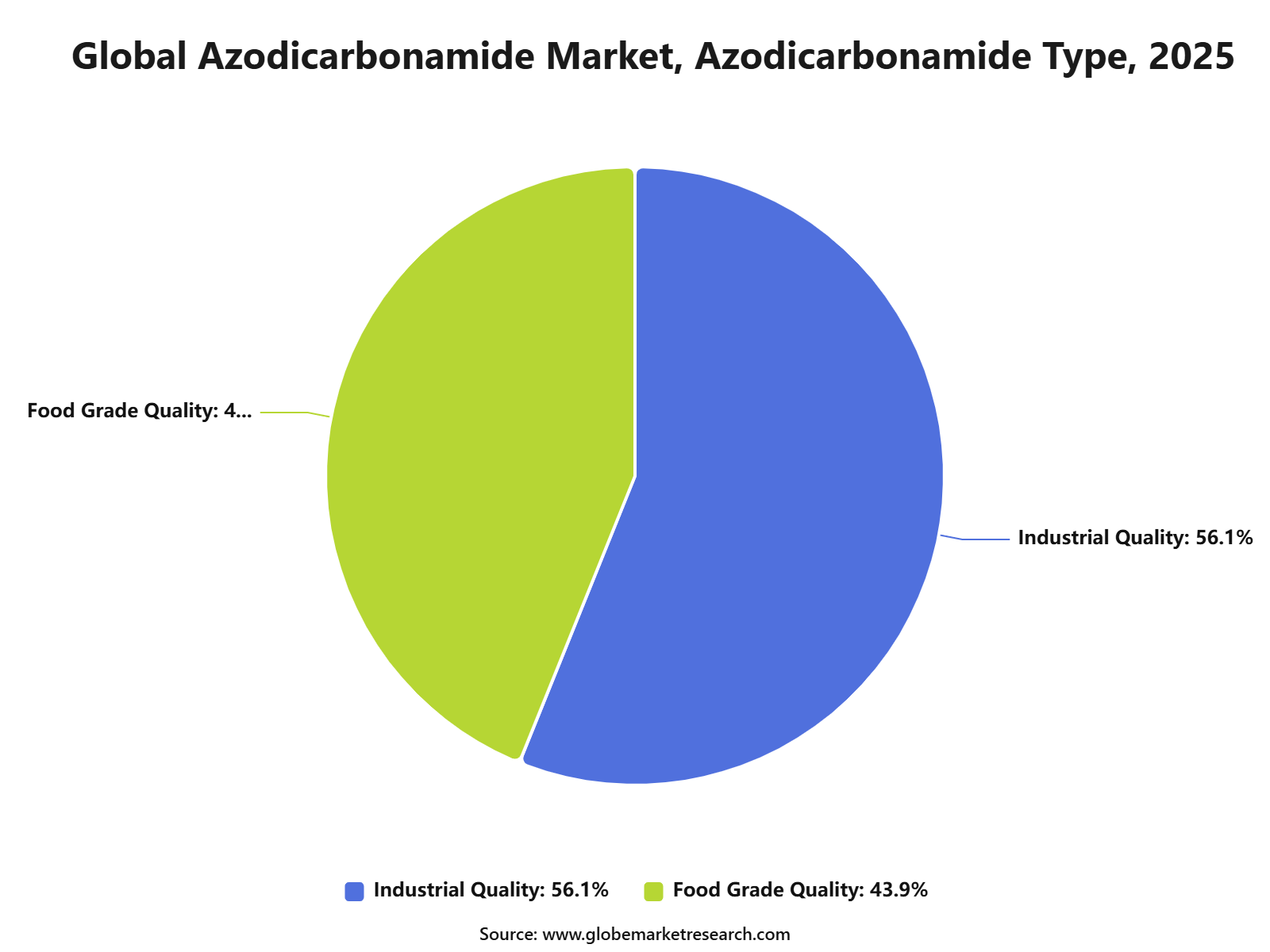 iThe graph shows projected market growth until 2035 based on CAGR analysis. Actual outcomes may vary depending on changing demand, competition, and economic factors.To gain greater insights - request a sample report PDF
By Sub Formation
Semicarbazide accounted for 55.3% share of the Azodicarbonamide Market by sub formation. This leading share is linked to the chemical decomposition pathway of azodicarbonamide during foaming applications.
During thermal decomposition, azodicarbonamide releases gases that create foam structure in polymer materials. Semicarbazide-related formation is closely monitored because product quality, processing temperature, and end-use safety requirements are important in industrial applications.
The segment is expected to remain relevant as manufacturers focus on controlled processing, product consistency, and compliance with application-specific standards. Better formulation control and process optimization will continue to shape demand in this category.
 iThe graph shows projected market growth until 2035 based on CAGR analysis. Actual outcomes may vary depending on changing demand, competition, and economic factors.To gain greater insights - request a sample report PDF
By Region
Asia Pacific accounted for 47.2% share of the Azodicarbonamide Market, reaching USD 1.1 billion. The region’s leadership is supported by strong plastic processing, packaging production, footwear manufacturing, construction materials, and consumer goods output.
China, India, Japan, South Korea, Vietnam, Indonesia, and Thailand are key contributors to regional demand. The region benefits from large polymer manufacturing capacity, cost-efficient production, and high consumption of foamed plastic materials across industrial and consumer applications.
Asia Pacific is expected to maintain its leading position as packaging, footwear, automotive, and construction-related plastic demand continues to grow. Demand will remain supported by powder forms, industrial quality grades, and high-volume use of azodicarbonamide in plastic foaming applications.
 iThe graph shows projected market growth until 2035 based on CAGR analysis. Actual outcomes may vary depending on changing demand, competition, and economic factors.To gain greater insights - request a sample report PDF
Regional Impact Analysis
Asia Pacific leads the Azodicarbonamide Market with 47.2% share in 2026, valued at around USD 1.1 billion, supported by strong plastics processing, footwear manufacturing, rubber goods production, packaging demand, and construction material consumption. China, India, Vietnam, Indonesia, Thailand, Japan, and South Korea remain major regional markets.
North America remains important due to demand from packaging, construction materials, automotive components, and specialty foamed products. Europe supports more selective demand, shaped by chemical safety rules, regulated applications, and movement toward lower-emission blowing agent systems.
Impact Factor | Estimated CAGR Impact | Regional Relevance | Market Impact |
|---|---|---|---|
Asia Pacific market leadership | +1.9% | Asia Pacific, 47.2% share in 2026 | Leads global value demand. |
China plastics and footwear scale | +1.5% | China | Drives high-volume consumption. |
India polymer processing growth | +1.2% | India | Supports future demand expansion. |
Southeast Asia footwear supply chains | +1.0% | Vietnam, Indonesia, Thailand | Adds export-led demand. |
North America and Europe regulated demand | +0.7% | U.S., Canada, Germany, France, UK | Supports compliant and specialty grades. |
Go-To-Market and Sales Economics
Azodicarbonamide suppliers should sell directly to PVC, EVA, polyethylene, rubber, and synthetic-leather foam converters, supported by grade selection and decomposition-temperature testing. U.S. construction spending reached an annualised USD 2.21 trillion in May 2026. Project tracking, approved-converter partnerships, local inventory, and volume contracts can improve order visibility across flooring, insulation, seals, and protective materials.
Footwear sales should be built through compounders, sole manufacturers, and global brand sourcing teams rather than general chemical distribution. Adidas reported that first-quarter 2026 footwear revenue increased 4% on a currency-neutral basis, while direct-to-consumer sales rose 22%. Consistent cell structure, density control, colour stability, and seasonal delivery are important qualification factors.
Automotive programmes require early engagement with seating, interior, gasket, insulation, and wire-harness suppliers. The EU registered 950,521 battery-electric cars during the first five months of 2026, representing 20% of registrations. Suppliers should provide low-odour grades, controlled gas yield, batch traceability, technical documentation, and application trials before entering multi-year platform contracts.
Risk Factors & Market Barriers
Regulatory differences restrict a single global product strategy. The U.S. Food and Drug Administration permits azodicarbonamide as a flour-whitening agent and dough conditioner, while the substance is not authorised as a food additive in the European Union. Producers should separate food and industrial grades, maintain country-specific documentation, and avoid unsupported safety or clean-label claims.
Worker exposure is a significant operating barrier because the UK Health and Safety Executive identifies azodicarbonamide as a substance capable of causing occupational asthma. Cost pressure is also increasing, with U.S. plastic-product producer prices rising 1.6% in June 2026. Enclosed handling, dust extraction, protective equipment, monitoring, and indexed pricing can raise compliance and production costs.
Automotive demand can change quickly, weakening foam-additive orders and plant utilisation. Lear reported that global vehicle production declined 3% year over year in the first quarter of 2026, including a 10% reduction in China. Suppliers should diversify across footwear, flooring, packaging, sports goods, cable insulation, and general rubber products while limiting customer and regional concentration.
Revenue Potential Analysis
Revenue Landscape Across
Construction and renovation provide revenue through vinyl flooring, carpet underlay, insulation, wall coverings, and foam seals. U.S. housing starts fell to an annualised 1.177 million units in May 2026, while completions reached 1.313 million units. Suppliers should balance new-building exposure with refurbishment, replacement flooring, public infrastructure, and commercial-maintenance demand to stabilise volumes.
Footwear provides recurring demand for lightweight EVA and rubber midsoles, insoles, slippers, and protective components. Adidas generated EUR 6.592 billion in first-quarter 2026 revenue, while e-commerce revenue increased 25%. Modified azodicarbonamide grades offering lower activation temperatures, uniform expansion, and precise density can support higher-value programmes across performance, lifestyle, and affordable footwear categories.
Automotive and transport applications provide opportunities in seating foam, interior layers, seals, mats, sound insulation, and cable components. ACEA reported that 260 automobile assembly and production plants operated across the EU and United Kingdom in 2026. Regional technical centres, approved compounders, and just-in-time supply can improve access to manufacturers and component platforms.
Financial Impact
Profitability improves when formulation support and differentiated grades reduce direct price comparison. Avient reported first-quarter 2026 sales of USD 847 million and an adjusted EBITDA margin of 17.7%, while Specialty Engineered Materials sales reached USD 320.2 million. Azodicarbonamide producers should measure margin by grade, customer, application, packaging size, and technical-service requirement rather than total tonnage alone.
Weak industrial demand and high fixed costs can reduce returns even when volumes recover. Celanese reported first-quarter 2026 Engineered Materials sales of USD 1.3 billion, increasing 4% sequentially as volume rose 3%. Producers should align reactors, drying, milling, blending, and packaging capacity with contracted demand while controlling energy, labour, inventory, and maintenance spending.
Customer profitability influences negotiations, qualification spending, and payment terms. Lear generated USD 297 million in core operating earnings during the first quarter of 2026, equal to 5.1% of sales, while adjusted Seating margin reached 6.9%. Suppliers should use escalation clauses, milestone billing, credit controls, and productivity-linked agreements to protect cash flow during automotive price negotiations.
Drivers Impact Analysis
The Azodicarbonamide Market is driven by rising demand for polymer foaming agents used in plastics, rubber, footwear, packaging, construction materials, automotive interiors, and consumer goods. Azodicarbonamide helps produce lightweight foam structures with controlled expansion, softness, insulation, and cushioning performance.
Asia Pacific leads the market due to strong plastics processing, footwear production, packaging manufacturing, rubber goods, and construction material demand. China, India, Vietnam, Indonesia, Thailand, South Korea, and Japan remain key contributors because of large-scale polymer processing and export-oriented manufacturing.
Impact Factor | Estimated CAGR Impact | Regional Relevance | Market Impact |
|---|---|---|---|
Rising demand for foamed plastics | +1.8% | Asia Pacific, Europe, North America | Drives core azodicarbonamide consumption. |
Growth in footwear manufacturing | +1.5% | China, India, Vietnam, Indonesia | Supports EVA and polymer foam use. |
Expansion of packaging applications | +1.2% | Asia Pacific and global markets | Adds lightweight foam demand. |
Construction insulation and foam material demand | +0.9% | Emerging construction markets | Supports polymer foam growth. |
Automotive lightweight material use | +0.7% | China, Japan, South Korea, Europe | Adds demand for foam components. |
Restraints Impact Analysis
The market faces restraints from regulatory pressure, worker safety concerns, food-contact restrictions, environmental scrutiny, and the availability of alternative blowing agents. Azodicarbonamide use requires careful handling, controlled processing, and compliance with chemical safety standards.
Another restraint is the shift toward cleaner and safer foam additives in premium and regulated applications. Manufacturers serving export markets may need to reformulate products or use lower-emission alternatives to meet customer and regulatory expectations.
Impact Factor | Estimated CAGR Impact | Regional Relevance | Market Impact |
|---|---|---|---|
Regulatory restrictions in selected uses | -0.9% | Europe, North America, export markets | Limits use in sensitive applications. |
Health and safety concerns | -0.8% | Chemical and plastics processing sites | Raises compliance requirements. |
Competition from alternative blowing agents | -0.7% | Developed and premium markets | Reduces selected product demand. |
Environmental scrutiny of chemical additives | -0.6% | Global polymer supply chains | Pressures reformulation. |
Raw material and energy cost volatility | -0.5% | Chemical producers | Affects margins and pricing. |
Opportunities Impact Analysis
Opportunities are strong in footwear foams, PVC foam sheets, EVA foam, polyethylene foam, rubber foam, packaging foam, thermal insulation materials, and automotive foam components. These segments benefit from demand for lightweight, flexible, and cost-effective foamed materials.
Higher-value opportunities are emerging in controlled decomposition grades, low-residue products, safer processing formulations, customized particle-size grades, and export-quality blowing agent systems. Producers that offer stable quality, technical support, and compliance documentation can capture stronger demand.
Impact Factor | Estimated CAGR Impact | Regional Relevance | Market Impact |
|---|---|---|---|
EVA and footwear foam expansion | +1.7% | Asia Pacific footwear hubs | Builds high-volume demand. |
PVC foam sheet applications | +1.4% | Construction and signage markets | Supports rigid foam material use. |
Customized blowing agent grades | +1.1% | Polymer processors | Improves product performance. |
Low-residue and safer formulations | +0.9% | Export-focused manufacturers | Supports compliance-led demand. |
Packaging foam applications | +0.7% | Consumer goods and logistics | Adds lightweight material demand. |
Challenges Impact Analysis
The main challenge is maintaining consistent gas release, foam cell structure, and processing stability across different polymers. Azodicarbonamide performance depends on decomposition temperature, formulation balance, activators, particle size, and production conditions.
Another challenge is managing compliance across different end-use industries. Footwear, packaging, automotive, construction, and consumer goods customers may follow different safety and material standards, which increases testing and documentation needs.
Impact Factor | Estimated CAGR Impact | Regional Relevance | Market Impact |
|---|---|---|---|
Foam quality consistency | -0.8% | Plastics and rubber processors | Affects product acceptance. |
Processing temperature control | -0.7% | EVA, PVC, PE, rubber applications | Raises technical complexity. |
Compliance documentation needs | -0.6% | Export and regulated markets | Increases supplier burden. |
Customer shift to safer additives | -0.5% | Premium applications | Limits growth in selected sectors. |
Price competition among suppliers | -0.4% | Asia Pacific chemical markets | Pressures profitability. |
Segment Covered in the Report
By Application
Plastics
Pharmaceuticals
Others
By End-User Industry
Packaging
Construction
Automotive
Food Processing
Others
By Form
Powder
Granules
By Azodicarbonamide Type
Industrial Quality
Food Grade Quality
By Sub Formation
Semicarbazide (SEM)
Ethylcarbamate (Urethane)
By Region
North America
Europe
Asia Pacific
Latin America
Middle East and Africa
Market Trend Analysis
The market trend is moving toward customized azodicarbonamide grades, controlled particle sizes, lower-residue blowing agents, safer handling systems, and application-specific formulations. Polymer processors are choosing materials that provide better foam uniformity, stable expansion, and predictable processing performance.
Asia Pacific remains the largest value region because of its strong base in plastics, footwear, packaging, rubber, and construction material manufacturing. Europe and North America support steady but more regulated demand, where compliance and safer additive choices play a stronger role.
Impact Factor | Estimated CAGR Impact | Regional Relevance | Market Impact |
|---|---|---|---|
Application-specific grades increase | +1.6% | Asia Pacific and global processors | Improves performance in different polymers. |
Controlled foam cell structure demand rises | +1.3% | Footwear, packaging, construction | Supports quality-focused use. |
Lower-residue formulations gain interest | +1.0% | Regulated and export markets | Improves compliance positioning. |
Lightweight material trend continues | +0.8% | Automotive, packaging, consumer goods | Supports foam adoption. |
Localized chemical supply strengthens | +0.6% | Asia Pacific | Improves cost and availability. |
Investor Type Impact Matrix
Investors should focus on companies with strong chemical processing capability, consistent product quality, regulatory compliance, technical formulation support, and access to footwear, plastics, packaging, and rubber customers. Cost control, safety handling, and product consistency are key success factors.
Strategic investors can also target azodicarbonamide producers, specialty blowing agent suppliers, PVC foam product companies, footwear material suppliers, rubber foam manufacturers, and safer additive technology firms. Companies that combine scale with compliance and application support are better positioned for long-term growth.
Investor Type | Estimated CAGR Impact | Regional Relevance | Market Impact |
|---|---|---|---|
Azodicarbonamide Manufacturers | +1.3% | Asia Pacific and global markets | Expands core chemical supply. |
Specialty Blowing Agent Suppliers | +1.0% | Polymer processing markets | Supports customized foam performance. |
Footwear Foam Material Companies | +0.8% | Asia Pacific footwear hubs | Adds high-volume downstream demand. |
PVC and Rubber Foam Producers | +0.7% | Construction, packaging, industrial goods | Builds application-linked growth. |
Strategic Chemical Investors | +0.5% | Global additive supply chains | Funds capacity and compliant formulations. |
Recent Developments
In June 2026, Huntsman agreed to merge with Olin in a transaction creating a North American chemicals company with approximately USD 12.5 billion in combined 2025 revenue and complementary material portfolios.
In June 2026, Kraton reported new sustainability targets, a 7.2% reduction in Scope 1 and 2 emissions from its 2022 baseline, and participation in the Cerisea renewable 5-HMF development project.
In March 2026, Kumyang introduced CELLCOM-OBSH, a newly developed nitrogen-releasing chemical blowing agent for sponge rubber and expanded plastics. It targets EVA, LDPE and PVC processing while avoiding discoloration, staining and odor.
Competitive Landscape
The market is characterized by intense competition among established players and emerging companies. Strategic partnerships, mergers and acquisitions, and product innovation are key strategies employed by market participants.
Key Market Players
Arkema
Honeywell International
Kum Yang
Otsuka Chemical
Weifang Yaxing Chemical
Ajanta Chemical Industries
JingJiang Hangsun Plastic Additives
Jiangxi Selon Industrial
SABIC
Evonik Industries
BASF SE
Huntsman Corporation
Kraton Corporation
Shandong Yanggu Huatai Chemical
Kumar Industries
Other Key Players
Research Methodology
This market study is prepared using a combination of primary and secondary research. Primary research includes discussions with manufacturers, suppliers, distributors, consultants, industry experts, and end users. Secondary research covers company reports, government databases, trade associations, technical publications, regulatory sources, and trusted industry documents. The collected information is used to assess market demand, pricing trends, technology adoption, competitive activity, and regional performance.
AI language models are not used as primary data sources, and publicly available AI-generated content is not treated as market evidence. Computational tools may be used to support data processing, translation, data classification, and pattern identification. However, every published assessment is supported by verified sources, human review, and primary market discussions.
Market estimates are developed through top-down and bottom-up approaches and validated using data triangulation. Revenue, production, shipment, pricing, and application-level data are compared across multiple sources. Forecasts consider economic conditions, regulatory changes, investment activity, innovation, supply chain developments, and industry risks. All findings are reviewed through source verification and internal quality checks before publication.
Part I
Source Management & Input Data Standards
Who provides data, how sources are qualified, and what types of evidence are admissible.
Part II
Research Scope & Market Coverage
How we define the markets we assess and the parameters that govern each product.
Part III
Data Collection, Verification & Submission
The mechanics of gathering, cross-checking, and hierarchically ranking evidence.
Part IV
Assessment Determination & Quality Controls
How raw data becomes a published assessment — normalisation, expert judgement, and outlier exclusion.
Part V
Publication, Corrections & Revision
Our publication schedule, corrections policy, and methodology review cycle.
Part VI
Independence, Ethics & Complaints
Conflict-of-interest policies, editorial independence, and how clients raise concerns.
Google · Preferred Sources
Don't miss the latest market research insights and industry updates on Google.
Add Globe Market Research as a preferred source in the Google app to see our reports, analysis, and market stories in your news suggestions.
Meet the Team
This report was prepared by our expert analysts with deep industry knowledge and research experience.
Pratiksha K. is a Senior Research Analyst with more than five years of experience in market research, industry analysis, competitive intelligence, and business strategy. She has contributed to detailed market reports, customized research studies, company profiling, market sizing, trend analysis, and strategic consulting projects for clients across different regions. Her industry expertise covers Chemical and Material, Consumer Goods, Food & Beverages and Energy & Power. She closely evaluates changing customer requirements, technology developments, regulatory conditions, supply chain structures, investment activity, and competitive strategies to provide clear and practical market insights.
Sayali brings more than 7 years of experience to Globe Market Research, supporting the accuracy, clarity, and relevance of research content across multiple industries. She reviews market data, segment analysis, competitive insights, and industry trends to ensure each report meets strong quality standards and provides practical value to business decision-makers. Her expertise spans healthcare, information technology, consumer goods, and diverse cross-industry domains. With a strong focus on data reliability, structured analysis, and clear presentation, Sayali helps ensure that each research output delivers well-reviewed insights for clients, investors, consultants, and industry stakeholders.
Frequently Asked Questions
Related Reports
More in Chemical and Material
Sulfuric Acid Market to Hit USD 61.5 Billion by 2035
Sulfuric Acid Market Size, Share, Analysis By Raw Material (Elemental Sulfur, Base Metal Smelters, Pyrite Ore, Others), By Application (Fertilizers, Chemical Manufacturing, Metal Processing, Petroleum Refining, Textile, Automotive, Pulp and Paper, Others), By Distribution Channel (Direct Sales, Distributors), By Regional Insights, Business plan and Project Report, Investment Opportunities, Profitability, Industry Trends, Leading Companies and Growth Forecasts by 2026-2035
Powder Metallurgy Market to Hit USD 17.0 Billion by 2035
Powder Metallurgy Market Size, Share, Analysis By Material (Ferrous Metals, Non-Ferrous Metals, Others), By Process (Additive Manufacturing, Powder Metal Hot Isostatic Pressing, Conventional Powder Metallurgy), By Application (Automotive, Aerospace and Defense, Healthcare, Electrical and Electronics, Industrial Machinery, Others) , By Regional Insights, Business plan and Project Report, Investment Opportunities, Profitability, Industry Trends, Leading Companies and Growth Forecasts by 2026-2035
Bromine Market to Hit USD 1.5 Billion by 2035
Bromine Market Size, Share, Analysis By Derivative (Organobromine, Clear Brine Fluids, Hydrogen Bromide, Others), By Application (Flame Retardants, Oil and Gas Drilling, Biocides, PTA Synthesis, Plasma Etching, Pharmaceuticals, Energy Storage, Others), By End-Use Industry (Chemicals, Oil and Gas, Pharmaceuticals, Electrical and Electronics, Automotive, Agriculture, Others), By Regional Insights, Business plan and Project Report, Investment Opportunities, Profitability, Industry Trends, Leading Companies and Growth Forecasts by 2026-2035
Hydrogen Cyanide Market to Hit USD 5.95 Billion by 2035
Hydrogen Cyanide Market Size, Share, Analysis By Product Form (Hydrogen Cyanide Liquid, Hydrogen Cyanide Gas), By Application (Adiponitrile, Acetone Cyanohydrin, Sodium Cyanide and Potassium Cyanide, Methionine, Cyanuric Chloride, Others), By End-Use Industry (Chemicals, Mining and Metallurgy, Pharmaceuticals, Agriculture, Textiles, Others), By Regional Insights, Business plan and Project Report, Investment Opportunities, Profitability, Industry Trends, Leading Companies and Growth Forecasts by 2026-2035