

Revenue, 2026
USD 19.2 Bn
Forecast, 2035
USD 61.5 Bn
CAGR, 2026-2035
13.8%
Report Coverage
Global
Market Size and Forecast
The Global Sulfuric Acid Market was worth USD 19.2 billion in 2026 and is expected to reach USD 61.5 billion by 2035, growing at a CAGR of 13.8% from 2026 to 2035. Asia Pacific held the largest regional share of 48.0% in 2026, valued at around USD 9.2 billion, supported by strong fertilizer production, chemical manufacturing, metal processing, mining activity, and industrial demand.
The Sulfuric Acid Market includes sulfuric acid used across fertilizers, chemicals, petroleum refining, metal processing, wastewater treatment, batteries, detergents, pigments, and industrial manufacturing. It is one of the most widely used industrial chemicals because it supports phosphate fertilizer production, mineral processing, chemical synthesis, and refining operations across multiple end-use industries.
Market growth is being supported by rising demand for phosphate fertilizers, especially as agricultural productivity remains a key priority across high-population regions. Sulfuric acid is also used in copper leaching, nickel processing, petroleum refining, and specialty chemical production. Demand is increasing as industrial sectors require large-volume acid supply for processing, purification, and production efficiency.
Key Parameter | Report Details |
|---|---|
Market Revenue, 2026 | USD 19.2 Billion |
Projected Revenue, 2035 | USD 61.5 Billion |
CAGR (2026-2035) | 13.8% |
Largest Region | Asia Pacific (48.0%, USD 9.2 Bn) |
Market Concentration | High |
Base Year | 2025 |
Forecast Period | 2026-2035 |
Asia Pacific is expected to remain the leading region due to its large agricultural base, expanding chemical industry, and strong demand from China, India, Southeast Asia, Japan, and South Korea. Regional growth is supported by fertilizer consumption, mining expansion, battery material processing, and industrial production. Long-term market growth will depend on sulfur supply stability, environmental compliance, safe handling, logistics efficiency, and sustained demand from fertilizers and industrial chemicals.
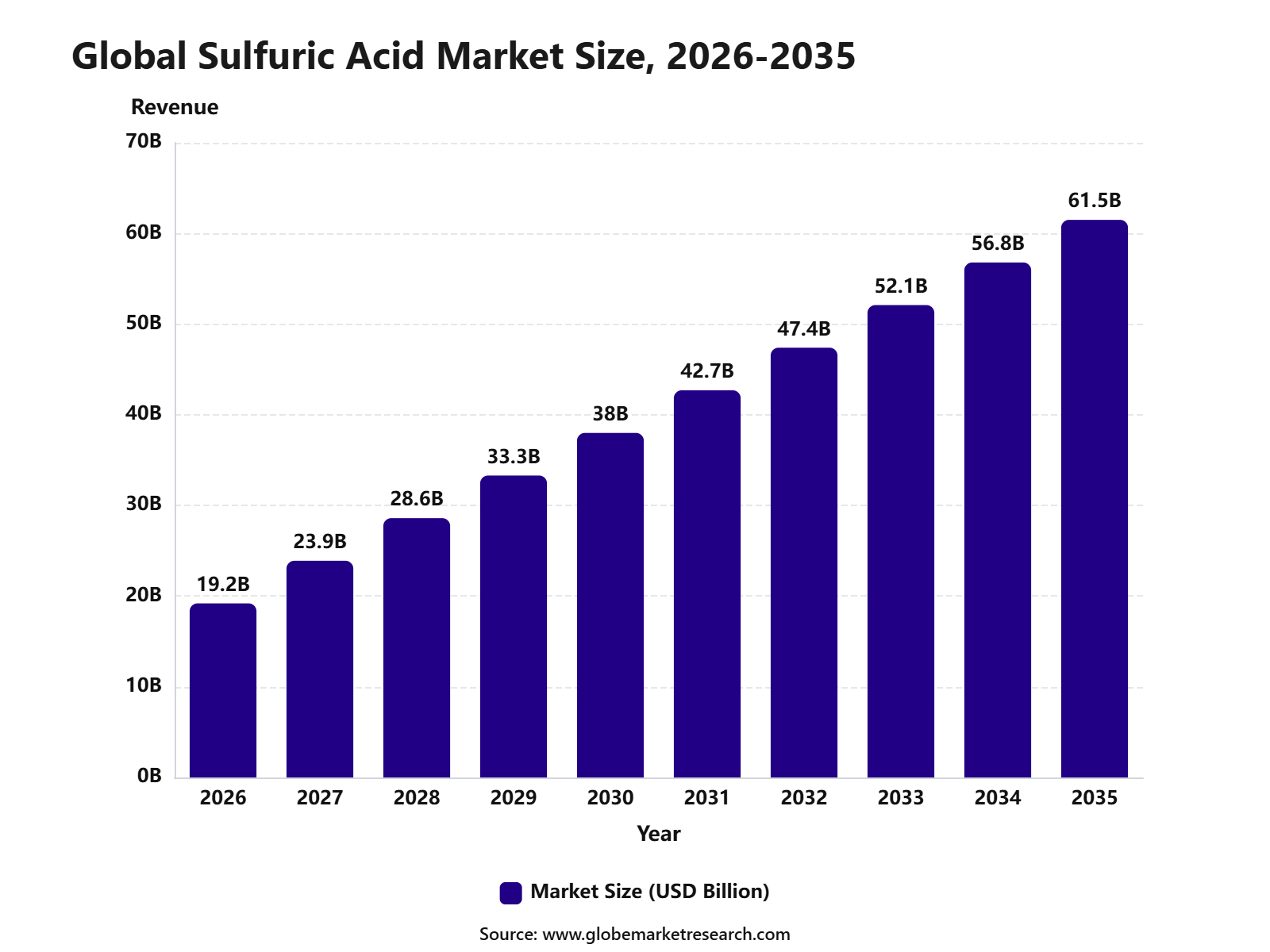 iThe graph shows projected market growth until 2035 based on CAGR analysis. Actual outcomes may vary depending on changing demand, competition, and economic factors.To gain greater insights - request a sample report PDF
Key Market Insights
Elemental sulfur led the raw material segment with 53.6% share, supported by its wide availability, cost efficiency, and strong use as a primary feedstock in sulfuric acid production.
Fertilizers accounted for 57.2% share by application, driven by high sulfuric acid consumption in phosphate fertilizer production and rising demand from agricultural nutrient manufacturing.
Direct sales held 73.2% share by distribution channel, supported by bulk procurement, long-term supply contracts, industrial-scale consumption, and direct purchasing by fertilizer and chemical producers.
Asia Pacific led the sulfuric acid market with 48.0% share, valued at USD 9.2 billion, supported by large fertilizer production, strong chemical manufacturing, expanding agriculture demand, and high industrial consumption across China, India, Japan, and Southeast Asia.
Top Funding and Investment
Top Investments
In February 2026, Jordan Phosphate Mines Company’s subsidiary signed a USD 193 million agreement to construct a sulfuric acid plant at Al-Shidiya in Ma’an, Jordan. The facility will produce 900,000 tonnes of concentrated sulfuric acid annually and support an increase in phosphoric acid capacity from 330,000 tonnes to 550,000 tonnes per year.
In September 2025, Green Metals Refining announced an initial USD 59 million investment in a sulfuric acid plant at Walvis Bay, Namibia. The first phase will provide 175,000 tonnes of annual capacity, with planned expansion to 720,000 tonnes, supplying uranium, copper, manganese, and other mineral-processing operations.
In March 2025, DSM Semichem advanced a USD 176 million expansion of its Plainview, Texas, specialty chemicals facility. The project will increase domestic production of electronic-grade sulfuric acid used in semiconductor wafer cleaning and processing and is expected to create 40 new jobs.
In May 2025, Kazatomprom progressed a sulfuric acid production project in Kazakhstan with a total estimated cost of KZT 113 billion, approximately USD 222.5 million. The plant is scheduled for completion in the first quarter of 2027 and will strengthen sulfuric acid availability for uranium extraction operations.
In September 2025, Vedanta announced plans to recommission the sulfuric acid plant at its Skorpion zinc operations in Namibia. The previously idle facility is designed to produce approximately 1,000 tonnes per day, reducing Namibia’s dependence on imported acid for mining and mineral processing.
Top Funding Developments
In May 2025, the Development Bank of Kazakhstan approved approximately KZT 85 billion in loan financing for a new sulfuric acid plant supporting Kazatomprom’s uranium operations. The financing represents about 75% of the project’s estimated KZT 113 billion development cost.
In March 2025, DSM Semichem received a USD 7.87 million grant from the Texas Semiconductor Innovation Fund. The funding will accelerate expansion of its electronic-grade sulfuric acid plant in Plainview and support increased supply to advanced semiconductor fabrication facilities.
In July 2026, Australia’s federal and Queensland governments arranged a combined AUD 160 million loan package to support continued operation of the Phosphate Hill fertilizer facility. The funding protects an integrated production chain that relies on sulfuric acid for phosphoric acid and ammonium phosphate fertilizer manufacturing.
Top Acquisitions
In May 2025, Ecovyst completed the acquisition of sulfuric acid production assets from Cornerstone Chemical Company in Waggaman, Louisiana, for approximately USD 35 million, with later financial reporting indicating total consideration of around USD 41 million. Ecovyst acquired the plant’s sulfuric acid production capacity, operating assets, customer supply capabilities, and integration potential within its Gulf Coast regeneration network.
In June 2026, Ecovyst completed the USD 190 million acquisition of INEOS Calabrian in Port Neches, Texas. The transaction added sulfur dioxide production, sulfur-based wastewater-treatment chemicals, manufacturing assets, technical capabilities, customer relationships, and one of North America’s largest sulfur-derivatives facilities.
Sulfur Recovery Supports Acid Supply
Sulfur recovery from petroleum refining and natural gas processing is the most important factor influencing the Sulfuric Acid Market because elemental sulfur is the primary feedstock for sulfuric acid production. According to the U.S. Geological Survey, elemental sulfur production reached approximately 7.6 million metric tons, with shipments valued at about USD 1.4 billion. Louisiana and Texas together accounted for about 54% of U.S. sulfur production, highlighting the importance of refinery and gas-processing infrastructure for maintaining sulfuric acid supply.
Agriculture and metal processing continue to sustain sulfuric acid consumption because the chemical is essential for phosphate fertilizer manufacturing and mineral leaching. Domestic sulfur production supplied about 63% of U.S. sulfur consumption, while imported sulfur and sulfuric acid represented about 34%, demonstrating the importance of reliable international supply chains. Stable sulfur availability, efficient recovery systems and integrated production remain the key factors supporting long-term sulfuric acid manufacturing.
By Raw Material
Elemental sulfur accounted for 53.6% share of the Sulfuric Acid Market. This leading position is supported by its wide availability, stable supply from oil and gas refining, and strong suitability for large-scale sulfuric acid production.
The segment is widely preferred because elemental sulfur provides high sulfur content and consistent feedstock quality for the contact process. It helps producers achieve efficient conversion, reliable output, and better control over acid strength in industrial production.
Demand is expected to remain strong as fertilizer producers, chemical manufacturers, and industrial users continue to require high-volume sulfuric acid supply. Elemental sulfur will remain the key raw material due to its cost efficiency, supply reliability, and strong fit with commercial acid plants.
By Application
Fertilizers accounted for 57.2% share of the Sulfuric Acid Market. This dominance is driven by the extensive use of sulfuric acid in producing phosphate fertilizers such as phosphoric acid, single superphosphate, and ammonium phosphate products.
The segment is strongly linked with global agriculture because phosphate fertilizers are essential for crop nutrition, root development, and yield improvement. Sulfuric acid plays a critical role in converting phosphate rock into usable fertilizer inputs for farmers.
Demand from fertilizers is expected to remain strong as food production, crop intensification, and soil nutrient management remain major priorities. Growth will be supported by fertilizer manufacturing capacity, agricultural demand, and continued use of sulfuric acid in phosphate processing.
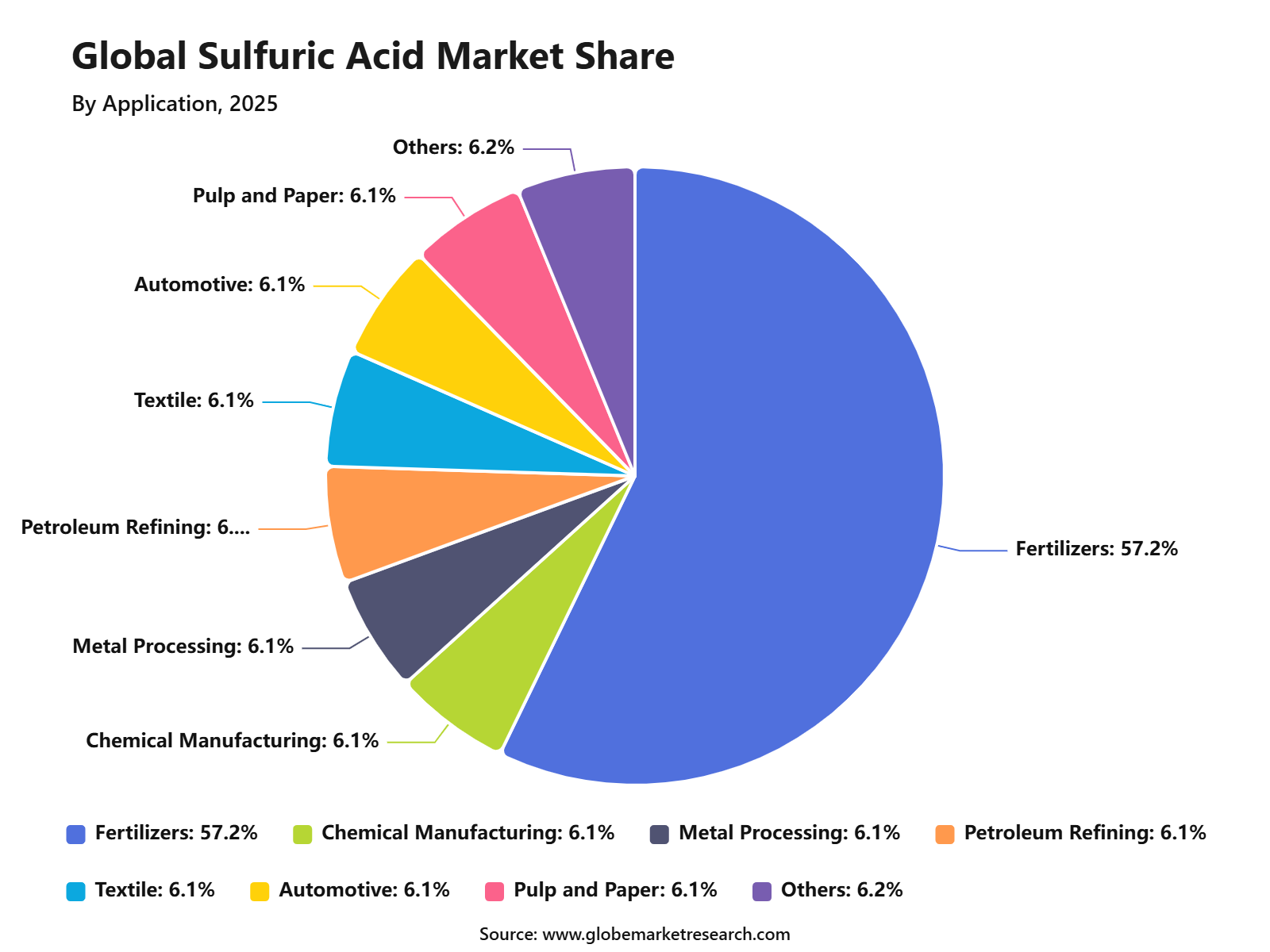 iThe graph shows projected market growth until 2035 based on CAGR analysis. Actual outcomes may vary depending on changing demand, competition, and economic factors.To gain greater insights - request a sample report PDF
By Distribution Channel
Direct sales accounted for 73.2% share of the Sulfuric Acid Market. This leading position is supported by the bulk nature of sulfuric acid, strict handling requirements, and long-term supply relationships between producers and industrial buyers.
The channel is widely preferred because large buyers require reliable delivery schedules, quality assurance, safety documentation, and direct coordination with suppliers. Fertilizer plants, chemical producers, refineries, and metal processing facilities usually purchase sulfuric acid through contract-based supply arrangements.
Direct sales are expected to remain dominant as sulfuric acid demand is concentrated among high-volume industrial users. The need for safe logistics, bulk tank transport, and uninterrupted supply will continue to support direct producer-to-customer distribution.
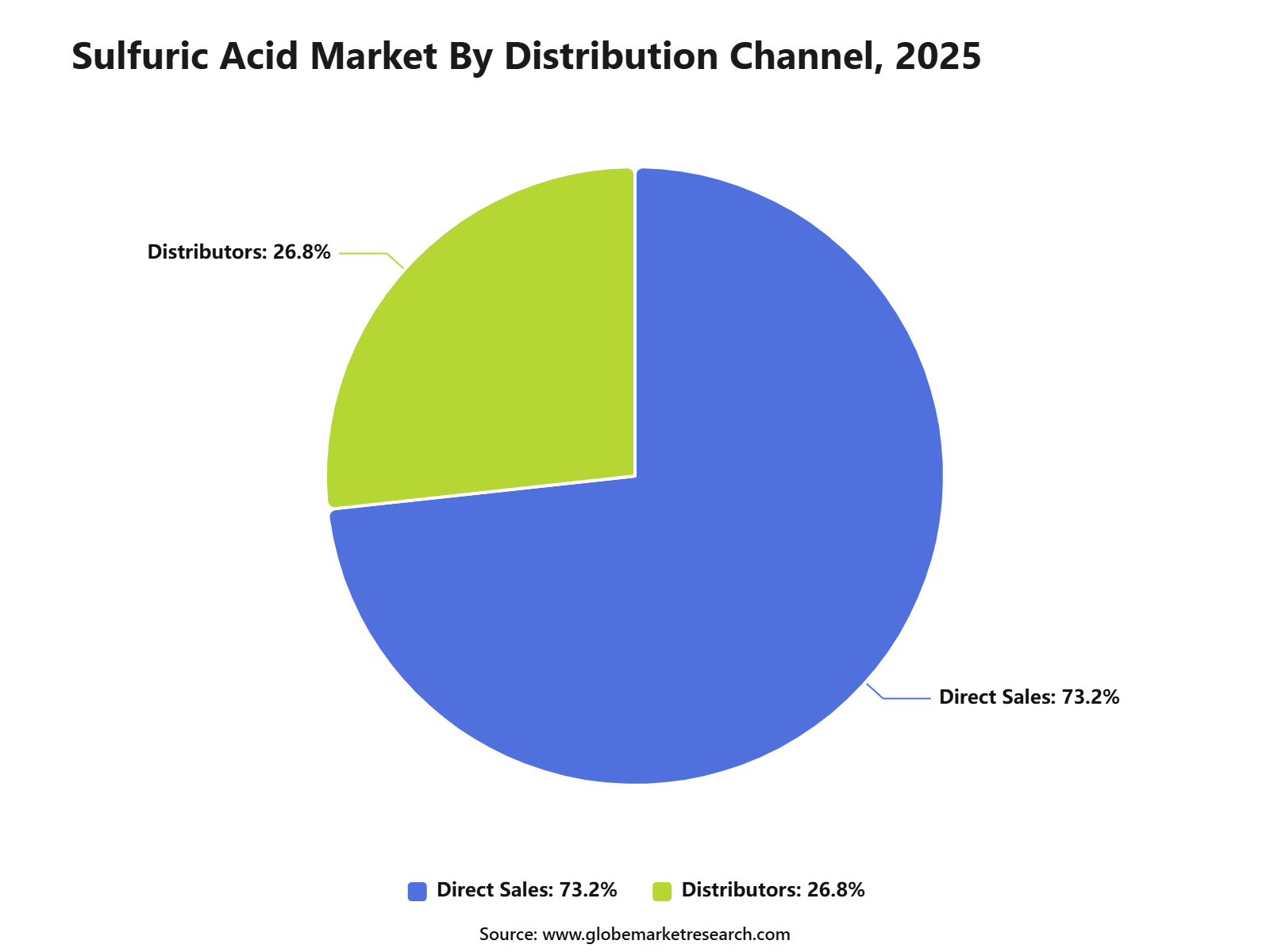 iThe graph shows projected market growth until 2035 based on CAGR analysis. Actual outcomes may vary depending on changing demand, competition, and economic factors.To gain greater insights - request a sample report PDF
By Region
Asia Pacific accounted for 48.0% share of the Sulfuric Acid Market, reaching USD 9.2 billion. The region’s leadership is supported by strong fertilizer production, large agricultural demand, expanding chemical manufacturing, and high consumption from metal processing and industrial applications.
China, India, Japan, South Korea, Indonesia, and Southeast Asian countries are key contributors to regional demand. The region benefits from large phosphate fertilizer production, industrial expansion, and strong need for sulfuric acid in chemicals, mining, refining, and wastewater treatment.
Asia Pacific is expected to maintain its leading position as agriculture, fertilizers, and industrial chemicals continue to expand. Demand will remain supported by elemental sulfur feedstock, fertilizer applications, direct sales channels, and large-scale sulfuric acid consumption across key manufacturing economies.
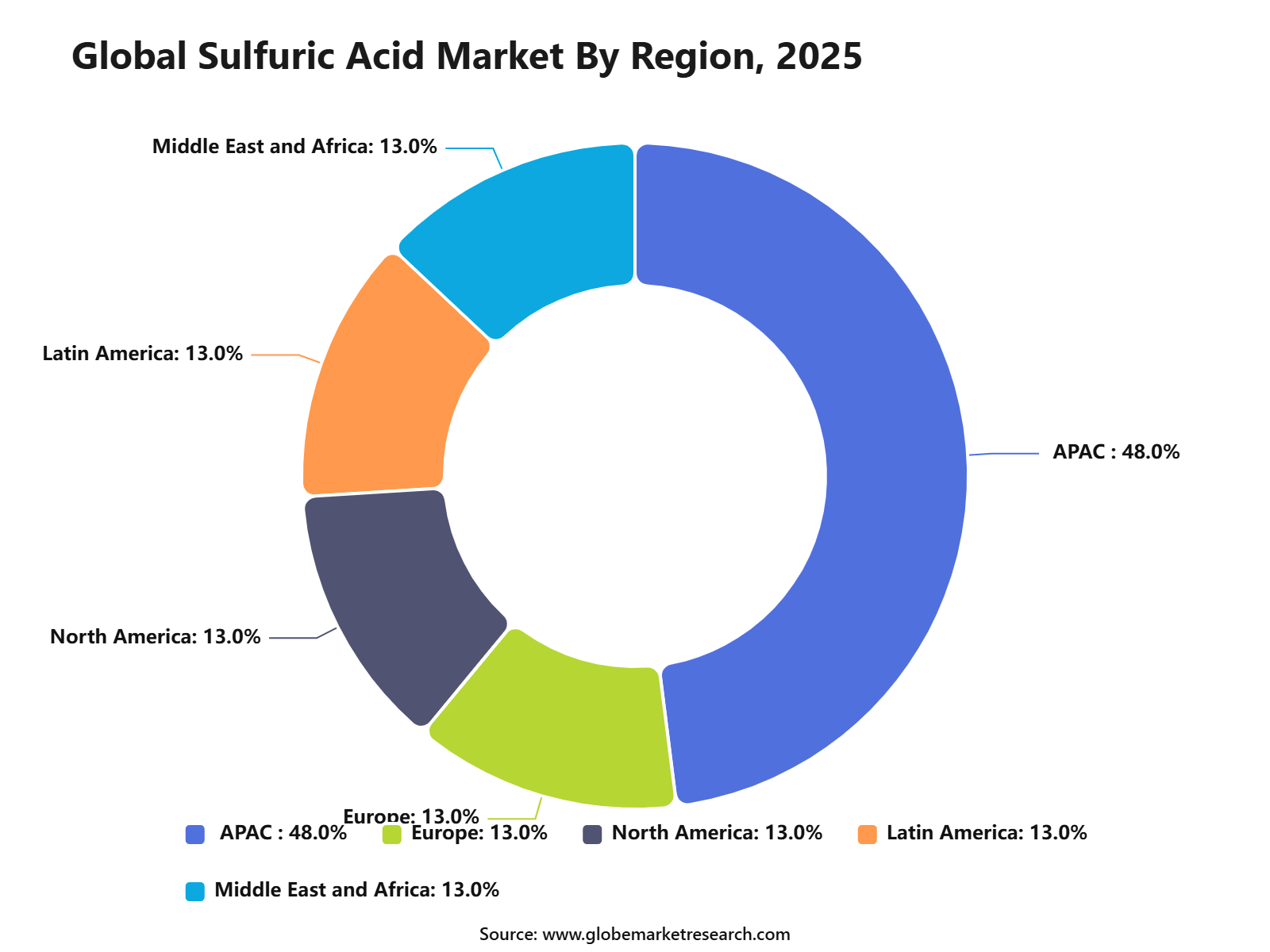 iThe graph shows projected market growth until 2035 based on CAGR analysis. Actual outcomes may vary depending on changing demand, competition, and economic factors.To gain greater insights - request a sample report PDF
Go-To-Market and Sales Economics
Sulfuric acid suppliers should prioritise phosphate fertilizer producers through direct contracts, plant-side storage, and indexed pricing. Mosaic sold 1.9 million tonnes of phosphate products in the first quarter of 2026, while its U.S. phosphoric acid plants operated near 80% of targeted rates. Reliable rail, vessel, and terminal access can strengthen supply assurance.
Refinery and chemical accounts should be served through merchant and regenerated-acid programmes that combine collection, purification, delivery, and inventory management. U.S. refinery utilisation reached 96.2% in the week ending July 10, 2026. Multi-year contracts, emergency stocks, and scheduled turnaround support can improve asset utilisation while reducing disposal and fresh-acid requirements for customers.
Ultra-pure sulfuric acid requires direct qualification with semiconductor manufacturers, chemical-management companies, and fabrication-site contractors. Global semiconductor sales reached USD 120.6 billion in May 2026, increasing 9.2% from April. Suppliers should provide electronic-grade purity, particle control, dedicated packaging, contamination monitoring, and local delivery capacity before high-volume customer approval is secured.
Regional Impact Analysis
Asia Pacific held 13.8% share in 2026, valued at around USD 2.6 billion based on the supplied share, supported by fertilizer demand, phosphate processing, chemical manufacturing, mining, and industrial production. China and India remain key demand centers because of agriculture needs and large chemical production bases.
North America remains important due to phosphate fertilizers, mining, refining, and industrial chemicals. Europe supports steady value growth through chemical manufacturing, environmental compliance upgrades, and specialty acid applications.
Impact Factor | Estimated CAGR Impact | Regional Relevance | Market Impact |
|---|---|---|---|
Asia Pacific demand base | +3.6% | Asia Pacific, 13.8% share in 2026 | Supports regional acid consumption. |
China chemical and fertilizer demand | +2.9% | China | Drives industrial acid use. |
India agriculture input demand | +2.4% | India | Supports fertilizer-linked growth. |
North America phosphate and mining demand | +1.8% | U.S. and Canada | Adds steady industrial consumption. |
Europe specialty and compliance-led demand | +1.4% | Germany, France, UK, Italy | Supports high-value acid applications. |
Risk Factors & Market Barriers
Elemental sulfur pricing is the largest commercial risk because sulfur is the primary feedstock for many acid plants. Mosaic reported an average sulfur cost of USD 379 per long ton in first-quarter 2026 and stated that prices had reached record levels. Pass-through formulas, diversified sourcing, and shorter quotation periods are required to protect producer margins.
Import concentration can expose regional buyers to port disruptions, freight increases, and cross-border supply delays. The 2026 USGS summary estimated U.S. sulfuric acid imports at 1.1 million tonnes in 2025, with Canada supplying 54% and Mexico 22% during 2021–2024. Producers should maintain alternative terminals, supplier approvals, and minimum strategic inventories.
Safety requirements create substantial operating and market-entry costs because concentrated sulfuric acid is highly corrosive and acid mist can damage respiratory health. OSHA sets an eight-hour exposure limit of 1 milligram per cubic metre, while NIOSH lists 15 milligrams per cubic metre as immediately dangerous. Closed transfer, ventilation, detection, training, and emergency response remain essential.
Revenue Potential Analysis
Revenue Landscape Across
Fertilizer production provides the broadest volume opportunity because phosphate rock processing consumes large quantities of sulfuric acid. USGS reported that about 90% of sulfur consumed in the United States was used in sulfuric acid form and identified new fertilizer-related sulfur demand in Africa and West Asia. Suppliers can pursue integrated plants, import terminals, and regional distributors.
Metal smelting and battery-material processing provide revenue through by-product acid and high-pressure acid leaching. Aurubis produced 1.168 million tonnes of sulfuric acid during the first six months of fiscal 2025/26, increasing 5%. Nickel, copper, zinc, and recycling projects can support long-term offtake contracts, particularly where nearby fertilizer or chemical buyers absorb output.
Semiconductor manufacturing offers lower-volume but higher-specification revenue for ultra-pure acid used in wafer cleaning and processing. Global chip sales totalled USD 298.5 billion in the first quarter of 2026, increasing 25% from the previous quarter. Revenue can be expanded through dedicated tanks, reusable containers, automated handling, analytical certification, and site-based chemical services.
Financial Impact
Pricing strength can materially improve producer earnings when feedstock increases are recovered quickly. Chemtrade’s Acid and Sulphur Products segment generated CAD 180.3 million of revenue and CAD 40.2 million of adjusted EBITDA in first-quarter 2026. Higher merchant and regenerated-acid prices more than offset increased sulfur costs, demonstrating the value of indexed customer contracts.
Fertilizer economics show the financial damage caused by rapid sulfur inflation. Mosaic’s phosphate segment generated USD 1.4 billion of first-quarter 2026 sales but recorded a USD 48 million operating loss, as raw-material costs increased by USD 280 million. Producers and customers should use hedging, inventory controls, production flexibility, and margin-based operating decisions.
By-product sulfuric acid can strengthen smelter profitability when concentrate throughput and regional demand remain high. Aurubis reported second-quarter fiscal 2025/26 operating EBITDA of EUR 187 million and operating earnings before taxes of EUR 121 million. Higher sulfuric acid volumes and revenue supported the result, showing how dependable offtake can improve overall metal-processing economics.
Drivers Impact Analysis
The Sulfuric Acid Market is driven by rising demand from fertilizers, phosphate processing, metal leaching, chemical manufacturing, petroleum refining, wastewater treatment, and battery-related applications. Sulfuric acid remains one of the most important industrial chemicals because it supports large-volume production across agriculture, mining, and basic chemicals.
Asia Pacific demand is supported by strong fertilizer production, industrial manufacturing, mining activity, and chemical processing. China, India, Japan, South Korea, and Southeast Asia remain important markets due to agriculture demand, industrial output, and expanding downstream chemical consumption.
Impact Factor | Estimated CAGR Impact | Regional Relevance | Market Impact |
|---|---|---|---|
Rising phosphate fertilizer production | +4.0% | Asia Pacific, North America, Latin America | Drives core sulfuric acid consumption. |
Growth in agriculture input demand | +3.4% | India, China, Southeast Asia | Supports fertilizer-linked demand. |
Expansion of metal leaching applications | +2.8% | Mining regions | Adds demand from copper, nickel, and uranium processing. |
Chemical manufacturing growth | +2.2% | Asia Pacific and global chemical hubs | Supports industrial acid consumption. |
Demand from refining and wastewater treatment | +1.6% | Industrial economies | Adds steady process demand. |
Restraints Impact Analysis
The market faces restraints from hazardous handling, strict safety rules, storage complexity, and corrosion-related infrastructure costs. Sulfuric acid requires specialized tanks, transport systems, worker training, and strong process controls because of its highly corrosive nature.
Another restraint is dependence on fertilizer and mining cycles. When phosphate fertilizer demand, commodity prices, or mining output slow down, sulfuric acid consumption can weaken in key downstream sectors.
Impact Factor | Estimated CAGR Impact | Regional Relevance | Market Impact |
|---|---|---|---|
Hazardous handling and safety cost | -1.8% | Global industrial users | Raises operating and compliance burden. |
Corrosion-resistant storage needs | -1.5% | Chemical and fertilizer plants | Increases capital cost. |
Fertilizer market cyclicality | -1.3% | Agriculture-linked regions | Affects demand stability. |
Sulfur feedstock price volatility | -1.1% | Acid producers | Pressures production economics. |
Emission and waste regulation | -0.9% | Asia Pacific, Europe, North America | Adds environmental control cost. |
Opportunities Impact Analysis
Opportunities are strong in phosphate fertilizers, copper leaching, nickel processing, battery recycling, chemical intermediates, industrial water treatment, and high-purity acid grades. These applications benefit from rising demand for food security, electrification metals, and industrial chemicals.
Higher-value opportunities are emerging in smelter-acid recovery, heat recovery systems, cleaner production technology, high-purity sulfuric acid, and integrated fertilizer complexes. Producers that improve energy efficiency and supply reliability can capture stronger long-term value.
Impact Factor | Estimated CAGR Impact | Regional Relevance | Market Impact |
|---|---|---|---|
Phosphate fertilizer expansion | +3.8% | Asia Pacific, Latin America, Middle East | Builds large-volume demand. |
Battery metals processing | +3.1% | Copper, nickel, and lithium supply chains | Adds electrification-linked demand. |
Smelter-acid recovery | +2.5% | Metal processing regions | Creates supply and sustainability value. |
High-purity sulfuric acid demand | +2.0% | Electronics and specialty chemicals | Adds premium product opportunity. |
Industrial water treatment use | +1.5% | Manufacturing and utilities | Supports steady application growth. |
Challenges Impact Analysis
The main challenge is managing safe transport and storage at scale. Sulfuric acid supply chains must handle corrosion, leakage prevention, temperature control, emergency planning, and strict industrial safety requirements.
Another challenge is balancing capacity with downstream demand. Large producers need stable fertilizer, mining, and chemical customers to maintain utilization and avoid price pressure during demand downturns.
Impact Factor | Estimated CAGR Impact | Regional Relevance | Market Impact |
|---|---|---|---|
Safe logistics management | -1.6% | Bulk chemical supply chains | Raises distribution complexity. |
Storage corrosion risk | -1.3% | Acid producers and end users | Increases maintenance cost. |
Demand dependence on fertilizers | -1.1% | Agriculture-focused regions | Creates cyclical exposure. |
Mining project delays | -0.9% | Metal extraction markets | Slows acid consumption. |
Skilled handling requirements | -0.7% | Industrial facilities | Adds operational training needs. |
Segment Covered in the Report
By Raw Material
Elemental Sulfur
Base Metal Smelters
Pyrite Ore
Others
By Application
Fertilizers
Metal Processing
Petroleum Refining
Textile
Pulp and Paper
Others
By Distribution Channel
Direct Sales
Distributors
By Region
North America
Europe
Asia Pacific
Latin America
Middle East and Africa
Market Trend Analysis
The market trend is moving toward fertilizer-linked growth, metal extraction demand, cleaner acid production, heat recovery systems, and integrated chemical complexes. Industrial users are focusing on stable supply, lower emissions, and safer storage systems.
Asia Pacific remains an important demand region because of fertilizer production, agriculture intensity, chemical manufacturing, and metal processing. North America and Europe support value growth through industrial chemicals, refining, environmental controls, and high-purity acid applications.
Impact Factor | Estimated CAGR Impact | Regional Relevance | Market Impact |
|---|---|---|---|
Fertilizer demand remains dominant | +3.7% | Asia Pacific and agriculture markets | Supports large-scale consumption. |
Metal leaching applications expand | +3.0% | Mining regions | Adds resource-processing demand. |
Heat recovery systems gain adoption | +2.3% | Large acid plants | Improves energy efficiency. |
High-purity acid usage rises | +1.8% | Electronics and specialty chemicals | Adds higher-value demand. |
Integrated fertilizer complexes grow | +1.4% | Asia Pacific and Middle East | Improves supply chain efficiency. |
Investor Type Impact Matrix
Investors should focus on companies with stable sulfur sourcing, integrated fertilizer customers, efficient acid plants, emission control capability, strong safety systems, and long-term industrial supply relationships. Cost efficiency, regulatory compliance, and downstream demand visibility are key success factors.
Strategic investors can also target sulfuric acid producers, fertilizer companies, phosphate processors, mining chemical suppliers, smelter-acid recovery firms, and high-purity acid producers. Companies that combine scale with cleaner production and captive demand are better positioned for long-term growth.
Investor Type | Estimated CAGR Impact | Regional Relevance | Market Impact |
|---|---|---|---|
Sulfuric Acid Producers | +3.1% | Asia Pacific and global markets | Expands core acid supply. |
Fertilizer and Phosphate Companies | +2.5% | Agriculture supply chains | Supports captive demand. |
Mining Chemical Suppliers | +2.0% | Copper, nickel, and uranium regions | Adds extraction-linked growth. |
High-Purity Acid Producers | +1.5% | Electronics and specialty chemicals | Builds premium product value. |
Strategic Chemical Investors | +1.2% | Global industrial chemicals market | Funds capacity and cleaner technology. |
Recent Developments
March 2026: Chemtrade reported C$176.6 million in 2025 capital expenditure, including C$48.2 million of growth spending. Investments supported ultrapure sulfuric acid projects, while the Polytec and Thatcher acquisitions expanded its specialty-chemical operations.
November 2025: Nutrien maintained planned capital expenditure of USD 2.0 billion to USD 2.1 billion, including investments in proprietary products, retail-network optimization, nitrogen brownfield expansions, and automation across its integrated fertilizer operations.
March 2025: Boliden inaugurated its expanded Odda zinc smelter after completing its largest investment. The project added a roasting furnace, sulfuric acid plant, cellhouse, and upgraded facilities, raising annual zinc capacity to 350,000 tonnes.
Competitive Landscape
The market is characterized by intense competition among established players and emerging companies. Strategic partnerships, mergers and acquisitions, and product innovation are key strategies employed by market participants.
Key Market Players
The Mosaic Company
OCP Group
Aurubis AG
PVS Chemicals
Chemtrade Logistics
Nutrien Ltd.
Southern States Chemical
Boliden Group
UBE Corporation
Sumitomo Chemical
Ineos Enterprises
BASF SE
Linde plc
Ma’aden
KMG Chemicals
Other Key Players
Research Methodology
This market study is prepared using a combination of primary and secondary research. Primary research includes discussions with manufacturers, suppliers, distributors, consultants, industry experts, and end users. Secondary research covers company reports, government databases, trade associations, technical publications, regulatory sources, and trusted industry documents. The collected information is used to assess market demand, pricing trends, technology adoption, competitive activity, and regional performance.
AI language models are not used as primary data sources, and publicly available AI-generated content is not treated as market evidence. Computational tools may be used to support data processing, translation, data classification, and pattern identification. However, every published assessment is supported by verified sources, human review, and primary market discussions.
Market estimates are developed through top-down and bottom-up approaches and validated using data triangulation. Revenue, production, shipment, pricing, and application-level data are compared across multiple sources. Forecasts consider economic conditions, regulatory changes, investment activity, innovation, supply chain developments, and industry risks. All findings are reviewed through source verification and internal quality checks before publication.
Part I
Source Management & Input Data Standards
Who provides data, how sources are qualified, and what types of evidence are admissible.
Part II
Research Scope & Market Coverage
How we define the markets we assess and the parameters that govern each product.
Part III
Data Collection, Verification & Submission
The mechanics of gathering, cross-checking, and hierarchically ranking evidence.
Part IV
Assessment Determination & Quality Controls
How raw data becomes a published assessment — normalisation, expert judgement, and outlier exclusion.
Part V
Publication, Corrections & Revision
Our publication schedule, corrections policy, and methodology review cycle.
Part VI
Independence, Ethics & Complaints
Conflict-of-interest policies, editorial independence, and how clients raise concerns.
Google · Preferred Sources
Don't miss the latest market research insights and industry updates on Google.
Add Globe Market Research as a preferred source in the Google app to see our reports, analysis, and market stories in your news suggestions.
Meet the Team
This report was prepared by our expert analysts with deep industry knowledge and research experience.
Pratiksha K. is a Senior Research Analyst with more than five years of experience in market research, industry analysis, competitive intelligence, and business strategy. She has contributed to detailed market reports, customized research studies, company profiling, market sizing, trend analysis, and strategic consulting projects for clients across different regions. Her industry expertise covers Chemical and Material, Consumer Goods, Food & Beverages and Energy & Power. She closely evaluates changing customer requirements, technology developments, regulatory conditions, supply chain structures, investment activity, and competitive strategies to provide clear and practical market insights.
Sayali brings more than 7 years of experience to Globe Market Research, supporting the accuracy, clarity, and relevance of research content across multiple industries. She reviews market data, segment analysis, competitive insights, and industry trends to ensure each report meets strong quality standards and provides practical value to business decision-makers. Her expertise spans healthcare, information technology, consumer goods, and diverse cross-industry domains. With a strong focus on data reliability, structured analysis, and clear presentation, Sayali helps ensure that each research output delivers well-reviewed insights for clients, investors, consultants, and industry stakeholders.
Frequently Asked Questions
Related Reports
More in Chemical and Material
Powder Metallurgy Market to Hit USD 17.0 Billion by 2035
Powder Metallurgy Market Size, Share, Analysis By Material (Ferrous Metals, Non-Ferrous Metals, Others), By Process (Additive Manufacturing, Powder Metal Hot Isostatic Pressing, Conventional Powder Metallurgy), By Application (Automotive, Aerospace and Defense, Healthcare, Electrical and Electronics, Industrial Machinery, Others) , By Regional Insights, Business plan and Project Report, Investment Opportunities, Profitability, Industry Trends, Leading Companies and Growth Forecasts by 2026-2035
Bromine Market to Hit USD 1.5 Billion by 2035
Bromine Market Size, Share, Analysis By Derivative (Organobromine, Clear Brine Fluids, Hydrogen Bromide, Others), By Application (Flame Retardants, Oil and Gas Drilling, Biocides, PTA Synthesis, Plasma Etching, Pharmaceuticals, Energy Storage, Others), By End-Use Industry (Chemicals, Oil and Gas, Pharmaceuticals, Electrical and Electronics, Automotive, Agriculture, Others), By Regional Insights, Business plan and Project Report, Investment Opportunities, Profitability, Industry Trends, Leading Companies and Growth Forecasts by 2026-2035
Hydrogen Cyanide Market to Hit USD 5.95 Billion by 2035
Hydrogen Cyanide Market Size, Share, Analysis By Product Form (Hydrogen Cyanide Liquid, Hydrogen Cyanide Gas), By Application (Adiponitrile, Acetone Cyanohydrin, Sodium Cyanide and Potassium Cyanide, Methionine, Cyanuric Chloride, Others), By End-Use Industry (Chemicals, Mining and Metallurgy, Pharmaceuticals, Agriculture, Textiles, Others), By Regional Insights, Business plan and Project Report, Investment Opportunities, Profitability, Industry Trends, Leading Companies and Growth Forecasts by 2026-2035
Ferroalloys Market to Hit USD 280.3 Billion by 2035
Ferroalloys Market Size, Share, Analysis By Type (Ferro-Manganese, Silico-Manganese, Ferro-Silicon, Ferro-Chrome, Ferro-Molybdenum, Ferro-Vanadium, Ferro-Tungsten, Magnesium Ferro-Silicon, Ferro-Silicon-Zirconium, Ferro-Titanium, Ferro-Boron, Ferro-Niobium), By Production (Blast Furnace, Electric Arc Furnace), By End Users (Steel, Construction, Electronics, Automotive & Transportation, Others), By Regional Insights, Business plan and Project Report, Investment Opportunities, Profitability, Industry Trends, Leading Companies and Growth Forecasts by 2026-2035