

Revenue, 2026
USD 4.5 Bn
Forecast, 2035
USD 17.0 Bn
CAGR, 2026-2035
15.9%
Report Coverage
Global
Market Size and Forecast
The Global Powder Metallurgy Market was worth USD 4.5 billion in 2026 and is expected to reach USD 17.0 billion by 2035, growing at a CAGR of 15.9% from 2026 to 2035. North America held the largest regional share of 35.5% in 2026, valued at around USD 1.5 billion, supported by strong demand from automotive components, aerospace parts, industrial machinery, medical devices, and advanced manufacturing applications.
The Powder Metallurgy Market includes metal powders and powder-based manufacturing processes used to produce high-strength, near-net-shape components with less material waste. It covers iron powder, steel powder, aluminum powder, copper powder, nickel powder, titanium powder, and specialty alloy powders. These materials are widely used in gears, bearings, structural parts, cutting tools, filters, magnets, implants, and precision engineering components.
Market growth is being supported by rising demand for lightweight, durable, and cost-efficient metal parts across high-performance industries. Powder metallurgy helps manufacturers reduce machining needs, improve material utilization, and produce complex shapes with consistent quality. Demand is also increasing as electric vehicles, aerospace systems, additive manufacturing, and industrial automation require advanced metal components with better strength and design flexibility.
Key Parameter | Report Details |
|---|---|
Market Revenue, 2026 | USD 4.5 Billion |
Projected Revenue, 2035 | USD 17.0 Billion |
CAGR (2026-2035) | 15.9% |
Largest Region | North America (35.5%, USD 1.5 Bn) |
Fastest Growing Region | Asia Pacific |
Market Concentration | Medium |
Base Year | 2025 |
Forecast Period | 2026-2035 |
North America is expected to remain a leading region due to its strong automotive, aerospace, defense, healthcare, and industrial manufacturing base. The region benefits from advanced material innovation, high adoption of additive manufacturing, and demand for precision-engineered components. Long-term market growth will depend on metal powder quality, production cost control, recycling efficiency, supply chain stability, and wider adoption of powder-based manufacturing technologies.
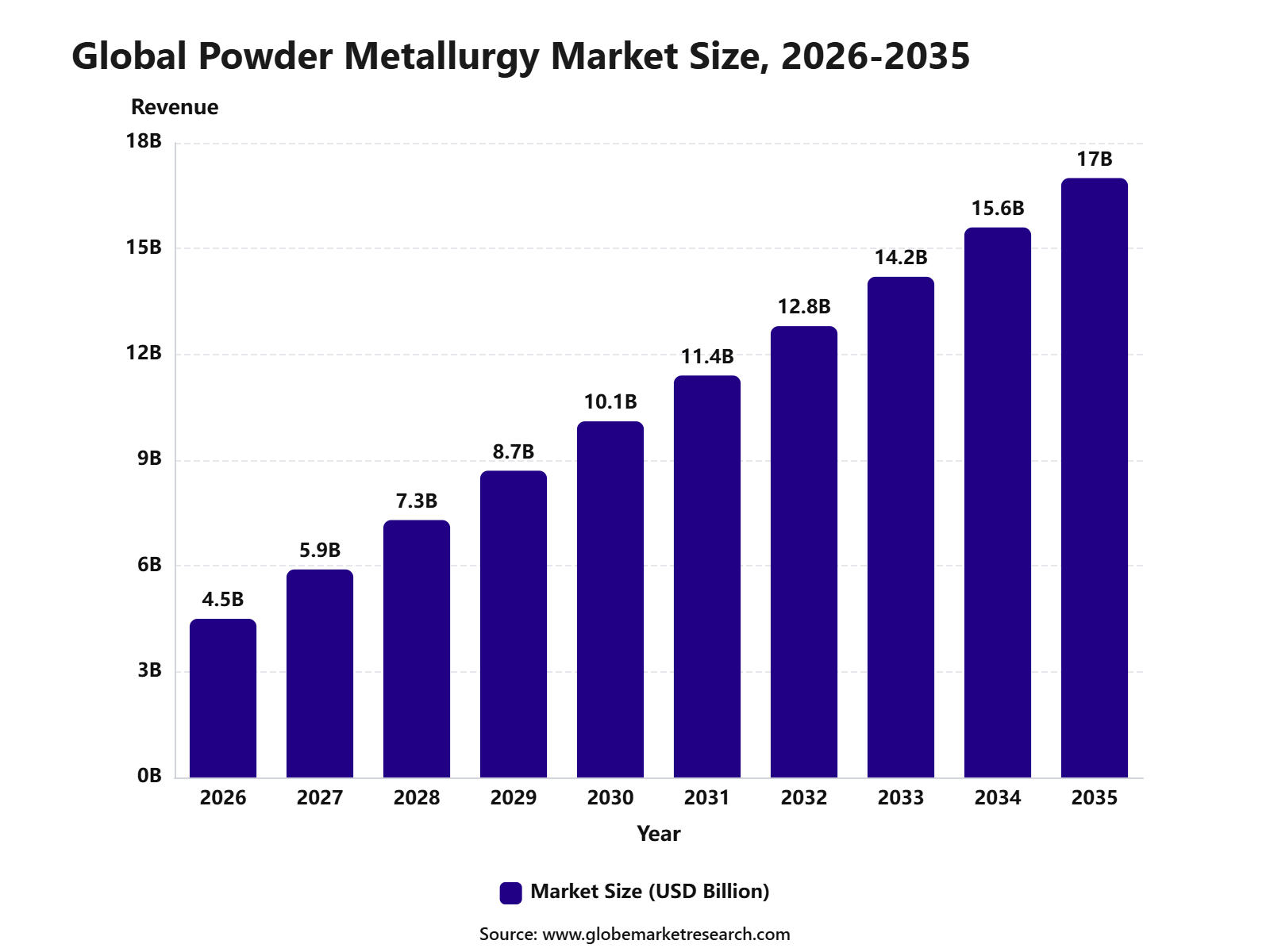 iThe graph shows projected market growth until 2035 based on CAGR analysis. Actual outcomes may vary depending on changing demand, competition, and economic factors.To gain greater insights - request a sample report PDF
Key Market Insights
Ferrous metals led the material segment with 69.3% share, supported by strong use in steel-based components, structural parts, gears, bearings, magnetic materials, and cost-efficient industrial manufacturing.
Additive manufacturing accounted for 45.6% share by process, driven by rising demand for complex metal parts, lightweight designs, material efficiency, and precision-based production methods.
Automotive applications held 37.2% share, supported by high use of powder metallurgy in engine parts, transmission components, filters, bearings, gears, and lightweight vehicle systems.
North America led the powder metallurgy market with 35.5% share, valued at USD 1.5 billion, supported by advanced manufacturing capacity, strong automotive production, aerospace demand, and wider adoption of metal additive manufacturing.
Top Funding and Investment
Top Investments
In February 2025, ATI commissioned a 132,000-square-foot Additive Manufacturing Products facility in Margate, Florida. The vertically integrated site combines metal powder-bed printing, design, heat treatment, machining, and inspection for large aerospace, defence, space, and energy components.
In 2026, IperionX installed a 300-ton, six-axis SACMI powder metallurgy press at its Titanium Manufacturing Campus in Virginia. The equipment increases compaction capacity and enables the manufacture of larger and more complex titanium parts from domestically produced titanium powder.
In May 2025, Outokumpu expanded the commercial use of its stainless steel metal powder operation into aerospace and aviation applications. The company supplied its first industrial batch of a specialized stainless steel powder grade for additive manufacturing, extending the output of its German atomization facility into higher-value aviation components.
In 2025, Titomic expanded its Huntsville, Alabama, operations for cold-spray additive manufacturing, a process that deposits metal powder particles at speeds exceeding Mach 5. The location employed around 20 people, with further workforce and operational growth planned for defence and advanced industrial production.
In 2025, Metal Powder Works expanded its advanced manufacturing platform following its merger with K-TIG. The combined business gained additional capital, patented powder-production technology, welding systems, and commercial resources to increase output of aluminium, copper, and other specialty metal powders. The associated transaction raised A$10 million.
Top Funding
In January 2026, VulcanForms raised USD 220 million in financing led by Eclipse and 1789 Capital. The capital is being used to expand its digitally integrated metal additive manufacturing operations, which produce high-performance components through powder-based laser manufacturing and automated finishing processes.
In December 2025, 6K Additive raised A$48 million through its Australian Securities Exchange initial public offering. The company was valued at approximately A$267 million, with an enterprise value of around A$206 million. The proceeds support production and commercialization of titanium, nickel, refractory, and recycled metal powders for additive manufacturing.
In 2025, Alloyed raised GBP 37 million, taking its total financing to approximately GBP 78.3 million. The capital supports expansion of its metal additive manufacturing network in the United Kingdom and United States, including alloy development, powder-based printing capacity, automation, and production of aerospace and industrial components.
Top Acquisitions
In February 2026, Dauch Corporation, formerly American Axle & Manufacturing, completed its acquisition of Dowlais Group and its subsidiaries, including GKN Powder Metallurgy and GKN Automotive. The transaction was valued at approximately GBP 1.16 billion, or around USD 1.55 billion. Dauch acquired GKN Powder Metallurgy’s metal powder operations, sintered-component plants, engineering expertise, customer contracts, and global manufacturing network.
In April 2025, Nano Dimension completed its acquisition of Desktop Metal in a transaction valued at approximately USD 179.3 million. Nano Dimension acquired Desktop Metal’s binder-jetting systems, metal powder processing technologies, sintering platforms, software, materials portfolio, intellectual property, and brands including ExOne.
By Material
Ferrous metals accounted for 69.3% share of the Powder Metallurgy Market. This leading position is supported by the wide use of iron-based and steel-based powders in automotive parts, industrial machinery, bearings, gears, structural components, and magnetic materials.
The segment is widely preferred because ferrous metal powders offer strong mechanical properties, cost efficiency, durability, and good compatibility with high-volume production. These materials are suitable for producing complex parts with reduced material waste and consistent dimensional accuracy.
Demand is expected to remain strong as manufacturers continue to use ferrous powders for lightweight, high-strength, and precision-engineered components. Growth will be supported by automotive production, machinery manufacturing, electric motors, transmission systems, and industrial equipment applications.
By Process
Additive manufacturing accounted for 45.6% share of the Powder Metallurgy Market. This dominance is driven by rising use of metal powders in 3D printing technologies for producing complex, lightweight, and customized metal components.
The process is preferred because it enables design flexibility, lower tooling requirements, shorter development cycles, and efficient material use. Powder metallurgy-based additive manufacturing is used in automotive, aerospace, medical devices, energy, tooling, and industrial engineering applications.
Demand is expected to remain strong as companies increase adoption of advanced manufacturing for high-performance parts. Growth will be supported by metal 3D printing, rapid prototyping, low-volume production, and demand for complex geometries that are difficult to produce through conventional methods.
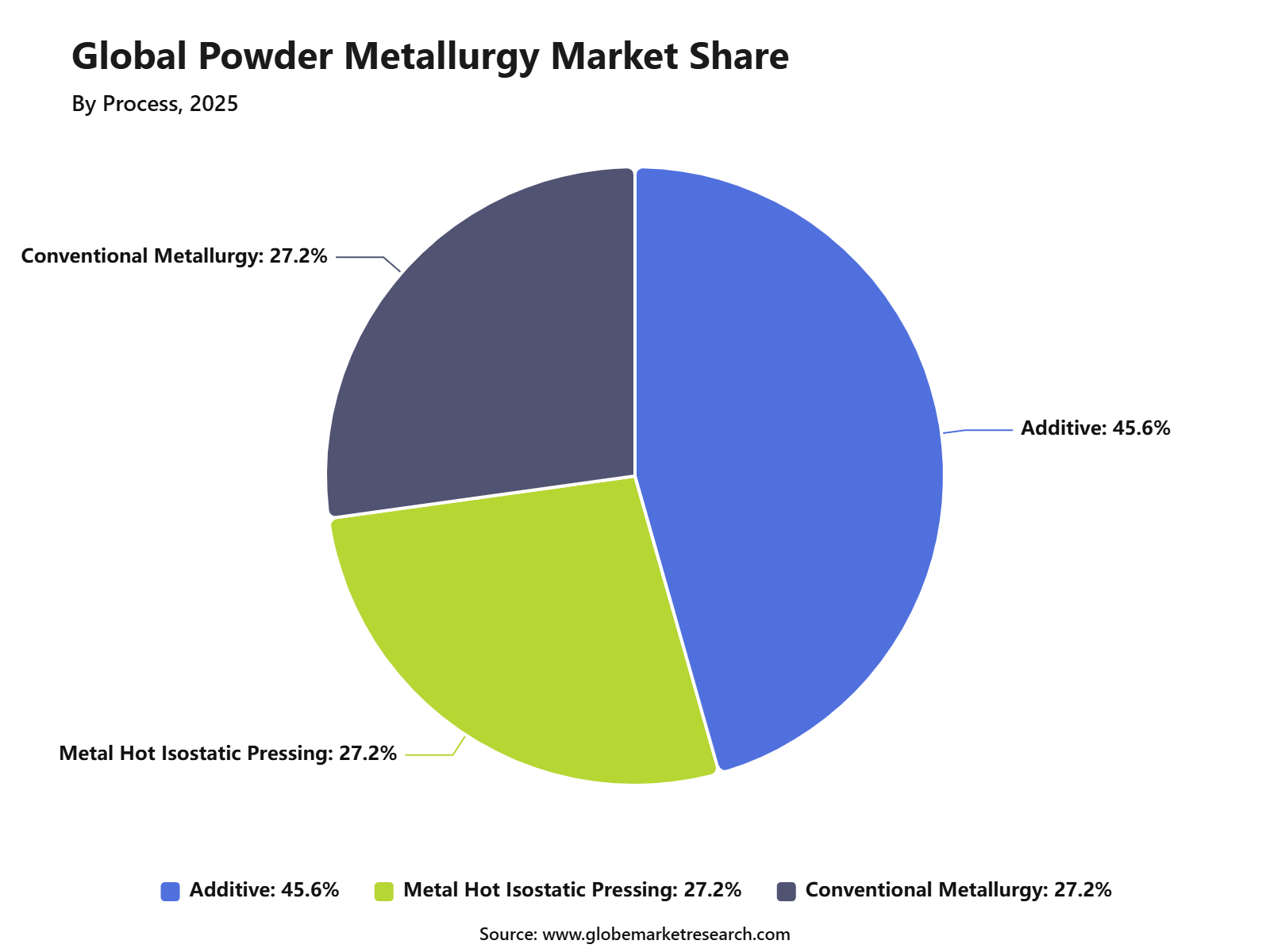 iThe graph shows projected market growth until 2035 based on CAGR analysis. Actual outcomes may vary depending on changing demand, competition, and economic factors.To gain greater insights - request a sample report PDF
By Application
Automotive accounted for 37.2% share of the Powder Metallurgy Market. This leading share is supported by high use of powder metallurgy components in engines, transmissions, braking systems, electric motors, steering systems, and structural assemblies.
Automakers use powder metallurgy because it helps produce lightweight, durable, and near-net-shape components with high material efficiency. The process supports cost-effective mass production of gears, sprockets, bearings, bushings, sensors, and magnetic parts.
Demand from automotive applications is expected to remain strong as vehicle manufacturers focus on efficiency, lightweighting, and electrification. Electric vehicles, hybrid vehicles, and advanced powertrain systems will continue to support the use of powder metallurgy parts.
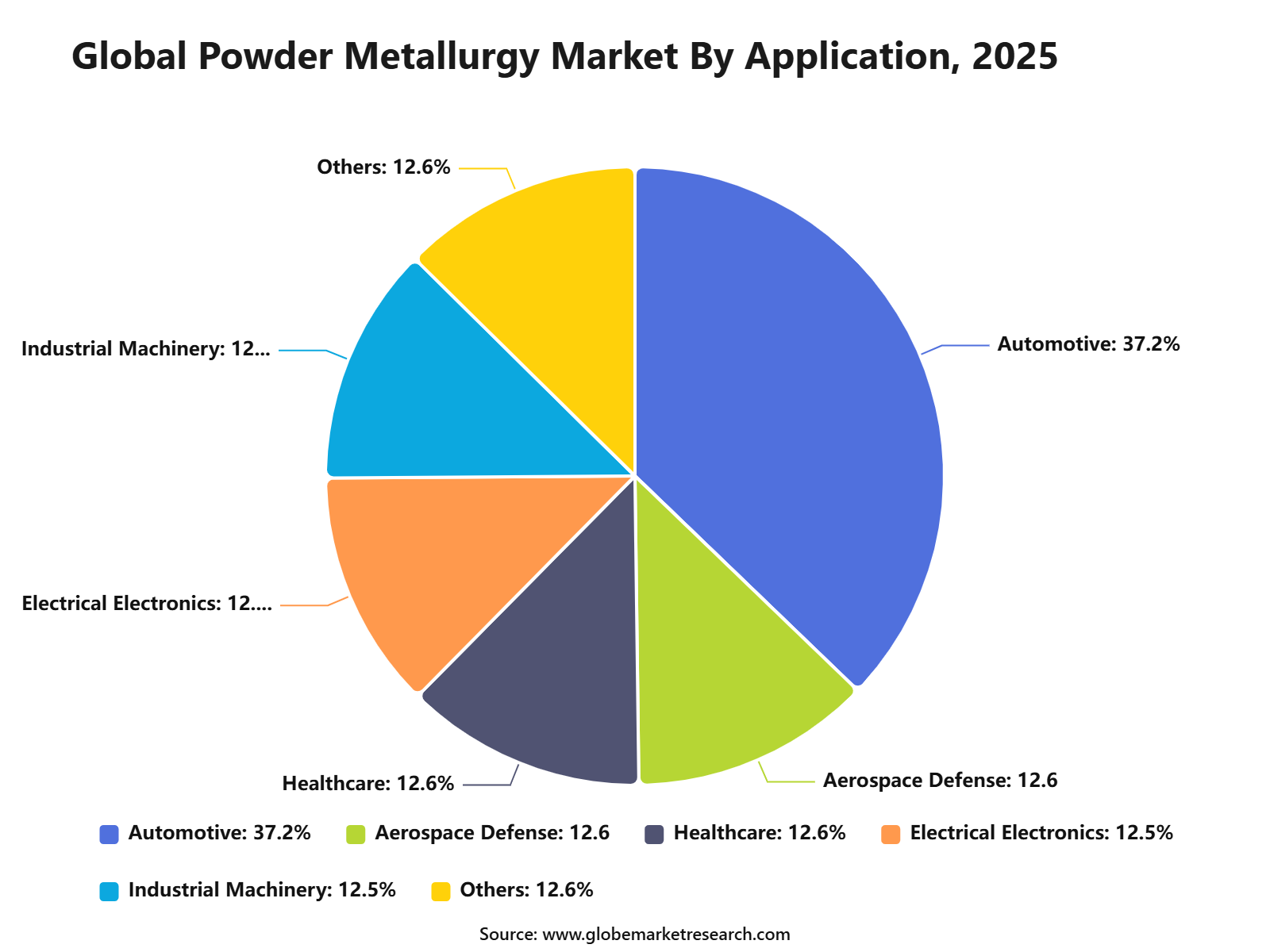 iThe graph shows projected market growth until 2035 based on CAGR analysis. Actual outcomes may vary depending on changing demand, competition, and economic factors.To gain greater insights - request a sample report PDF
By Region
North America accounted for 35.5% share of the Powder Metallurgy Market, reaching USD 1.5 billion. The region’s leadership is supported by strong automotive manufacturing, aerospace production, industrial machinery demand, and growing adoption of additive manufacturing technologies.
The United States, Canada, and Mexico are key contributors to regional demand. The region benefits from advanced manufacturing capabilities, established automotive supply chains, high use of precision metal components, and rising investment in metal 3D printing.
North America is expected to maintain a strong position as manufacturers continue to adopt powder-based production for complex and high-performance parts. Demand will remain supported by ferrous metal powders, automotive applications, additive manufacturing, and the need for efficient material processing.
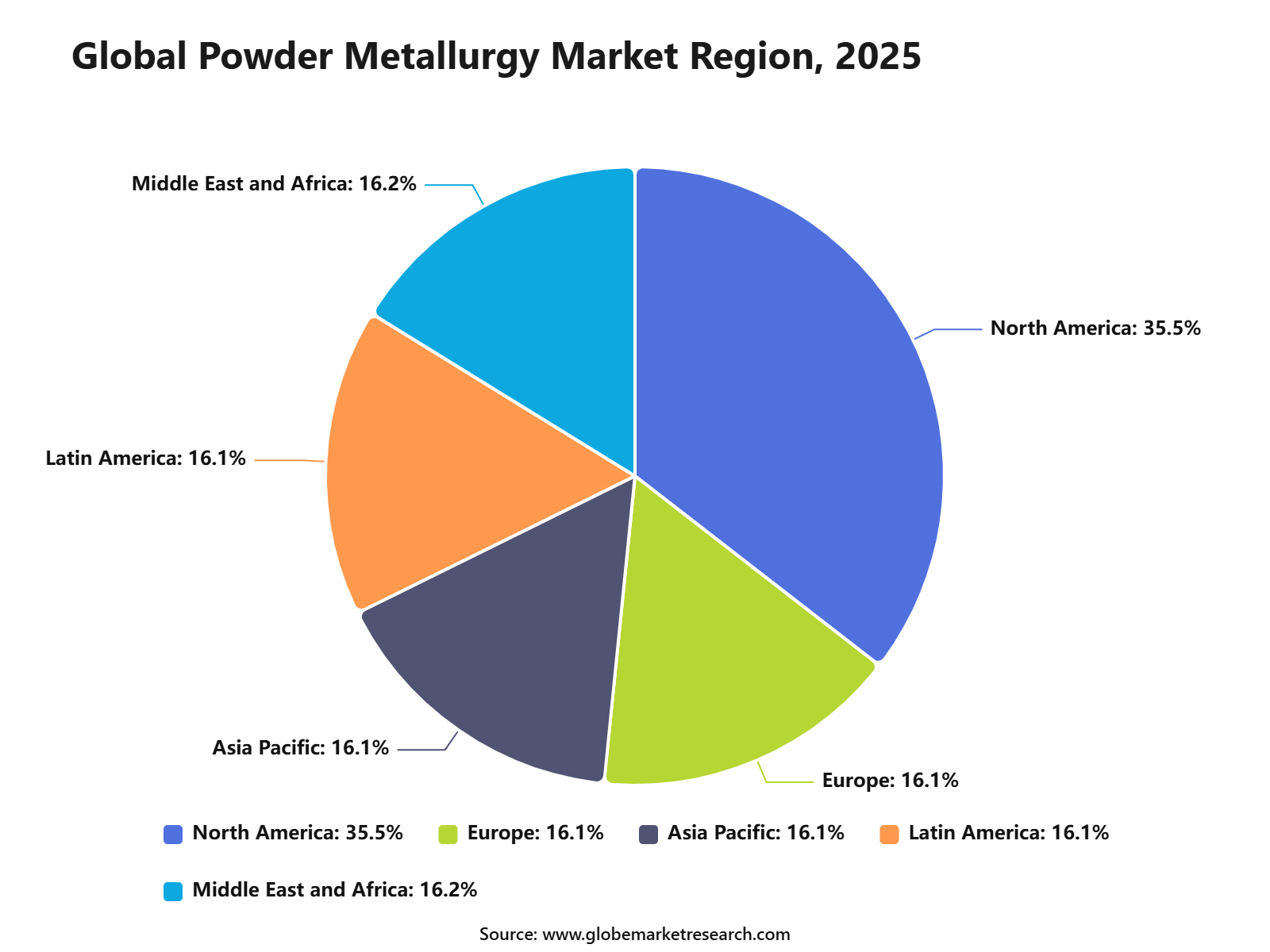 iThe graph shows projected market growth until 2035 based on CAGR analysis. Actual outcomes may vary depending on changing demand, competition, and economic factors.To gain greater insights - request a sample report PDF
Regional Impact Analysis
North America leads the Powder Metallurgy Market with 35.5% share in 2026, valued at around USD 1.6 billion, supported by aerospace, defense, automotive, medical devices, additive manufacturing, and industrial machinery demand. The U.S. remains the main contributor because of its strong advanced manufacturing base and high adoption of metal powder technologies.
Europe remains important due to automotive engineering, industrial tooling, aerospace components, and precision manufacturing. Asia Pacific supports future growth through EV manufacturing, electronics, machinery production, metal powder capacity, and rising adoption of additive manufacturing in China, Japan, South Korea, and India.
Impact Factor | Estimated CAGR Impact | Regional Relevance | Market Impact |
|---|---|---|---|
North America market leadership | +4.7% | North America, 35.5% share in 2026 | Leads global value demand. |
U.S. aerospace and defense demand | +3.8% | U.S. | Drives high-performance powder metallurgy use. |
Canada advanced manufacturing growth | +2.6% | Canada | Supports regional technology adoption. |
Europe automotive and industrial base | +2.4% | Germany, France, UK, Italy | Adds precision component demand. |
Asia Pacific EV and electronics growth | +2.2% | China, Japan, South Korea, India | Builds future market expansion. |
Automotive Demand Accelerates Powder Metallurgy
Automotive and durable-goods production is the most important factor influencing the Powder Metallurgy Market because powder-forged gears, bearings, structural parts, magnetic components and engine systems are widely used in transportation equipment. U.S. durable-goods shipments reached USD 327.9 billion in May 2026, increasing 1.0% from April and 7.6% on a year-to-date basis. Total manufacturing shipments reached USD 653.2 billion, up 1.6% monthly and 5.8% from the comparable 2025 period. These figures are broad manufacturing indicators rather than direct powder-metallurgy sales, but they transparently demonstrate strong downstream component demand.
Advanced metal manufacturing is another important factor because powder metallurgy supports near-net-shape production, lower material waste and geometrically complex parts. The Department of Energy’s 110,000-square-foot Manufacturing Demonstration Facility has generated more than USD 1 billion in follow-on economic activity. DOE-supported research also demonstrated real-time detection of additive-manufacturing pores in less than one millisecond, addressing a major quality barrier for powder-bed processes used in aerospace, automotive and medical components.
Go-To-Market and Sales Economics
Powder metallurgy suppliers should prioritise automotive OEMs, Tier 1 component makers, and transmission or motor-system manufacturers through design-in selling. More than 70% of North American iron powder shipments serve passenger vehicles, while each vehicle contained about 14.3 kilograms of PM components in 2025. Material trials, tooling support, and multi-year nominations can strengthen order visibility.
Aerospace sales should be developed through qualified alloy producers, additive-manufacturing bureaus, engine suppliers, and aircraft programme teams. Airbus delivered 351 commercial aircraft to 77 customers during the first half of 2026. Suppliers offering titanium, nickel, cobalt, and refractory powders should support powder traceability, reuse controls, process validation, and long-term quality documentation before production approval.
Commercial expansion should combine press-and-sinter, metal injection moulding, and additive-manufacturing solutions instead of selling powder alone. The 2026 MPIF assessment estimated that combined North American MIM and AM powder shipments increased about 5% in 2025, with stronger growth expected during 2026. Application engineering, prototyping, and sintering optimisation can improve conversion and customer retention.
Risk Factors & Market Barriers
Automotive concentration remains the principal demand risk because vehicle production, powertrain mix, and model cancellations directly affect component volumes. Battery-electric cars represented 20% of EU registrations through May 2026, totalling 950,521 units. Powder producers should diversify across hybrids, industrial machinery, aerospace, medical devices, energy storage, and defence to reduce dependence on one drivetrain transition.
Trade restrictions and critical-material concentration can disrupt powder availability and contract pricing. MPIF reported in June 2026 that China controlled 80% to 90% of rare-earth refining and 85% to 90% of permanent-magnet production. Dual sourcing, recycled feedstock, strategic inventory, and tariff-adjustment clauses are needed for magnetic powders, tungsten products, and specialised alloy systems.
Metal additive manufacturing still faces high equipment costs, expensive raw materials, and process-control challenges involving density, green strength, binder chemistry, and sintering distortion. MPIF reported that tungsten input prices rose from about USD 325 to nearly USD 3,100 per metric-ton unit, pushing tungsten and carbide powder prices roughly eight to ten times higher and weakening project economics.
Revenue Potential Analysis
Revenue Landscape Across
Automotive applications provide recurring revenue through gears, bearings, synchroniser hubs, sprockets, structural parts, soft-magnetic components, and thermal-management systems. EU battery-electric registrations rose strongly in major markets through May 2026, including 75.7% growth in Italy, 55.4% in France, and 40.9% in Germany. Suppliers can capture value through lightweight, high-density, and magnetic-material solutions.
Aerospace and defence offer higher-value revenue because complex components require certified powders, controlled microstructures, and detailed production records. Airbus completed 89 aircraft deliveries to 49 customers in June 2026 alone. Opportunities extend across fuel nozzles, engine hardware, structural brackets, heat-resistant components, and repair applications produced through powder-bed fusion, directed-energy deposition, and hot isostatic pressing.
Industrial, tooling, and energy applications broaden revenue beyond transportation. World crude steel production reached 157.9 million tonnes in May 2026, supporting demand for wear parts, cutting tools, welding powders, and refractory components. MPIF also reported 2025 shipment increases of 33.6% for molybdenum and 19.2% for tungsten, indicating stronger specialised-material opportunities entering 2026.
Financial Impact
Premium alloys and disciplined product mix can produce strong margins. Carpenter Technology reported fiscal third-quarter 2026 net sales of USD 811.5 million and operating income of USD 186.5 million. Its Specialty Alloys Operations segment achieved a 35.6% adjusted operating margin, demonstrating the earnings potential of technically qualified materials serving aerospace, defence, medical, energy, and industrial applications.
Cash generation improves when pricing, productivity, and working capital are managed together. Carpenter Technology generated USD 193.5 million of operating cash flow and USD 124.8 million of adjusted free cash flow during fiscal third-quarter 2026. Powder metallurgy producers should use customer deposits, indexed metal surcharges, controlled inventory, and milestone billing to finance high-value alloy and additive programmes.
Capacity expansion should be linked to qualified demand because atomisation, compaction, sintering, and additive production require specialised equipment and long validation periods. Carpenter Technology invested USD 68.7 million during fiscal third-quarter 2026 and raised full-year operating-income guidance to USD 700 million to USD 705 million. Returns depend on utilisation, yield, energy efficiency, pricing, and customer-backed volumes.
Drivers Impact Analysis
The Powder Metallurgy Market is driven by rising demand for lightweight components, high-strength metal parts, additive manufacturing, automotive electrification, aerospace components, medical implants, and industrial machinery applications. Powder metallurgy supports near-net-shape production, material efficiency, design flexibility, and lower machining waste.
North America leads the market due to strong adoption in automotive, aerospace, defense, medical devices, industrial equipment, and advanced manufacturing. The U.S. remains the key regional contributor because of its established metal powder supply chain, additive manufacturing ecosystem, and high demand for precision-engineered components.
Impact Factor | Estimated CAGR Impact | Regional Relevance | Market Impact |
|---|---|---|---|
Growth in lightweight metal components | +4.6% | North America, Europe, Asia Pacific | Drives core powder metallurgy demand. |
Rising additive manufacturing adoption | +4.1% | U.S., Germany, Japan, China | Expands advanced metal part production. |
Automotive electrification growth | +3.5% | North America, Europe, Asia Pacific | Supports gears, magnets, and structural parts. |
Aerospace and defense component demand | +3.0% | U.S., Canada, Europe | Adds high-value precision applications. |
Demand for material-efficient manufacturing | +2.4% | Global manufacturing sectors | Reduces waste and improves cost efficiency. |
Restraints Impact Analysis
The market faces restraints from high metal powder cost, powder handling complexity, strict quality control needs, energy-intensive sintering, and qualification barriers in aerospace, medical, and automotive applications. Powder metallurgy requires controlled particle size, purity, flowability, density, and consistent material behavior.
Another restraint is process limitation for large or highly complex parts. While powder metallurgy is efficient for many precision components, some applications still require casting, forging, machining, or hybrid production depending on load performance and scale requirements.
Impact Factor | Estimated CAGR Impact | Regional Relevance | Market Impact |
|---|---|---|---|
High metal powder cost | -2.1% | Global powder metallurgy producers | Pressures part economics. |
Strict quality control requirements | -1.8% | Aerospace, medical, automotive | Slows customer qualification. |
Powder storage and handling risks | -1.4% | Manufacturing facilities | Adds safety and compliance cost. |
Energy-intensive sintering processes | -1.2% | Production-heavy regions | Raises operating cost. |
Competition from casting and forging | -0.9% | Industrial component markets | Limits selected applications. |
Opportunities Impact Analysis
Opportunities are strong in metal additive manufacturing, soft magnetic components, electric vehicle parts, aerospace turbine components, medical implants, industrial tooling, and high-performance alloys. These applications benefit from powder metallurgy’s ability to produce complex shapes and advanced material properties.
Higher-value opportunities are emerging in titanium powders, nickel-based superalloys, stainless steel powders, aluminum powders, binder jetting, metal injection molding, and hot isostatic pressing. Producers that offer consistent powder quality, technical support, and application-specific materials can capture stronger value.
Impact Factor | Estimated CAGR Impact | Regional Relevance | Market Impact |
|---|---|---|---|
Metal additive manufacturing expansion | +4.8% | North America, Europe, Asia Pacific | Builds high-growth market opportunity. |
Electric vehicle component demand | +3.9% | U.S., Europe, China, Japan | Supports advanced metal part production. |
Medical implant and device applications | +3.2% | North America and Europe | Adds premium precision demand. |
Aerospace-grade metal powders | +2.8% | U.S., Canada, Germany, France | Supports high-value alloy demand. |
Binder jetting and MIM adoption | +2.2% | Industrial manufacturing hubs | Expands part production flexibility. |
Challenges Impact Analysis
The main challenge is ensuring consistent powder quality and finished-part performance. Powder metallurgy users need predictable mechanical strength, density, surface finish, fatigue resistance, and dimensional accuracy across production batches.
Another challenge is scaling from prototype to production. Many additive and powder-based processes perform well in small batches, but high-volume production requires stable powder supply, repeatable equipment performance, quality documentation, and cost control.
Impact Factor | Estimated CAGR Impact | Regional Relevance | Market Impact |
|---|---|---|---|
Powder quality consistency | -2.0% | Metal powder producers | Affects part performance. |
Production scale-up difficulty | -1.6% | Additive manufacturing users | Slows commercial adoption. |
Certification and testing burden | -1.3% | Aerospace, medical, automotive | Adds time and cost. |
Equipment and tooling investment | -1.1% | Manufacturers and service bureaus | Raises entry barriers. |
Skilled workforce shortage | -0.9% | Advanced manufacturing markets | Limits process optimization. |
Segment Covered in the Report
By Material
Ferrous Metals
Non-Ferrous Metals
Others
By Process
Additive Manufacturing
Powder Metal Hot Isostatic Pressing
Conventional Powder Metallurgy
By Application
Electrical and Electronics
Industrial Machinery
Others
By Region
North America
Europe
Asia Pacific
Latin America
Middle East and Africa
Market Trend Analysis
The market trend is moving toward additive manufacturing powders, high-performance alloys, electric vehicle components, medical-grade materials, and lightweight aerospace parts. Buyers are shifting from conventional production toward powder-based methods where precision, design flexibility, and material efficiency are important.
North America remains the largest value region because of its strong aerospace, defense, medical device, automotive, and advanced manufacturing base. Europe supports premium demand through automotive and industrial engineering, while Asia Pacific is expanding through electronics, EV production, machinery, and metal powder capacity.
Impact Factor | Estimated CAGR Impact | Regional Relevance | Market Impact |
|---|---|---|---|
Additive manufacturing powder demand rises | +4.5% | North America, Europe, Asia Pacific | Supports high-growth applications. |
High-performance alloy use expands | +3.6% | Aerospace and medical markets | Adds premium material value. |
EV and electrification parts increase | +3.1% | U.S., China, Europe, Japan | Builds future component demand. |
Near-net-shape manufacturing grows | +2.5% | Industrial component producers | Reduces machining waste. |
Medical-grade powder metallurgy expands | +2.0% | U.S. and Europe | Supports regulated precision applications. |
Investor Type Impact Matrix
Investors should focus on companies with strong powder atomization capability, quality control systems, alloy development expertise, additive manufacturing partnerships, and access to aerospace, automotive, medical, and industrial customers. Material consistency, certification, process reliability, and application support are key success factors.
Strategic investors can also target metal powder producers, additive manufacturing material suppliers, MIM companies, binder jetting technology firms, hot isostatic pressing providers, and advanced component manufacturers. Companies that combine material science with scalable production are better positioned for long-term growth.
Investor Type | Estimated CAGR Impact | Regional Relevance | Market Impact |
|---|---|---|---|
Metal Powder Manufacturers | +3.6% | North America, Europe, Asia Pacific | Expands core material supply. |
Additive Manufacturing Material Providers | +3.0% | Aerospace, medical, industrial markets | Supports premium growth. |
Metal Injection Molding Companies | +2.4% | Automotive and precision components | Builds production-scale demand. |
Post-Processing and HIP Providers | +2.0% | Aerospace, medical, defense | Improves certified part performance. |
Strategic Advanced Manufacturing Investors | +1.6% | Global metal component markets | Funds capacity and technology expansion. |
Recent Developments
June 2026: Sandvik launched Osprey GRCop-42, a gas-atomised copper-chromium-niobium powder developed for additive manufacturing of rocket-engine components exposed to extreme thermal and mechanical loads, expanding its specialised commercial aerospace-material portfolio.
April 2026: Miba reported EUR 120 million invested during fiscal 2025/26, including EUR 54 million for research and development and EUR 63 million for buildings and machinery supporting powder-metal and energy-technology operations.
February 2025: Allegheny Technologies, now ATI, commissioned a 132,000-square-foot Florida facility integrating design, laser powder-bed fusion, heat treatment, machining and inspection for complex aerospace, defence, space and naval nuclear components.
Competitive Landscape
The market is characterized by intense competition among established players and emerging companies. Strategic partnerships, mergers and acquisitions, and product innovation are key strategies employed by market participants.
Key Market Players
GKN Powder Metallurgy
Höganäs AB
Sandvik AB
Carpenter Technology Corporation
Rio Tinto Metal Powders
Allegheny Technologies Incorporated
Sumitomo Electric Industries
Miba AG
Hitachi Chemical
Pometon S.p.A.
BASF SE
American Axle & Manufacturing
Fine Sinter Co., Ltd.
PMG Holding GmbH
Melrose IndustriesOther Key Players
Research Methodology
This market study is prepared using a combination of primary and secondary research. Primary research includes discussions with manufacturers, suppliers, distributors, consultants, industry experts, and end users. Secondary research covers company reports, government databases, trade associations, technical publications, regulatory sources, and trusted industry documents. The collected information is used to assess market demand, pricing trends, technology adoption, competitive activity, and regional performance.
AI language models are not used as primary data sources, and publicly available AI-generated content is not treated as market evidence. Computational tools may be used to support data processing, translation, data classification, and pattern identification. However, every published assessment is supported by verified sources, human review, and primary market discussions.
Market estimates are developed through top-down and bottom-up approaches and validated using data triangulation. Revenue, production, shipment, pricing, and application-level data are compared across multiple sources. Forecasts consider economic conditions, regulatory changes, investment activity, innovation, supply chain developments, and industry risks. All findings are reviewed through source verification and internal quality checks before publication.
Part I
Source Management & Input Data Standards
Who provides data, how sources are qualified, and what types of evidence are admissible.
Part II
Research Scope & Market Coverage
How we define the markets we assess and the parameters that govern each product.
Part III
Data Collection, Verification & Submission
The mechanics of gathering, cross-checking, and hierarchically ranking evidence.
Part IV
Assessment Determination & Quality Controls
How raw data becomes a published assessment — normalisation, expert judgement, and outlier exclusion.
Part V
Publication, Corrections & Revision
Our publication schedule, corrections policy, and methodology review cycle.
Part VI
Independence, Ethics & Complaints
Conflict-of-interest policies, editorial independence, and how clients raise concerns.
Google · Preferred Sources
Don't miss the latest market research insights and industry updates on Google.
Add Globe Market Research as a preferred source in the Google app to see our reports, analysis, and market stories in your news suggestions.
Meet the Team
This report was prepared by our expert analysts with deep industry knowledge and research experience.
Pratiksha K. is a Senior Research Analyst with more than five years of experience in market research, industry analysis, competitive intelligence, and business strategy. She has contributed to detailed market reports, customized research studies, company profiling, market sizing, trend analysis, and strategic consulting projects for clients across different regions. Her industry expertise covers Chemical and Material, Consumer Goods, Food & Beverages and Energy & Power. She closely evaluates changing customer requirements, technology developments, regulatory conditions, supply chain structures, investment activity, and competitive strategies to provide clear and practical market insights.
Sayali brings more than 7 years of experience to Globe Market Research, supporting the accuracy, clarity, and relevance of research content across multiple industries. She reviews market data, segment analysis, competitive insights, and industry trends to ensure each report meets strong quality standards and provides practical value to business decision-makers. Her expertise spans healthcare, information technology, consumer goods, and diverse cross-industry domains. With a strong focus on data reliability, structured analysis, and clear presentation, Sayali helps ensure that each research output delivers well-reviewed insights for clients, investors, consultants, and industry stakeholders.
Frequently Asked Questions
Related Reports
More in Chemical and Material
Sulfuric Acid Market to Hit USD 61.5 Billion by 2035
Sulfuric Acid Market Size, Share, Analysis By Raw Material (Elemental Sulfur, Base Metal Smelters, Pyrite Ore, Others), By Application (Fertilizers, Chemical Manufacturing, Metal Processing, Petroleum Refining, Textile, Automotive, Pulp and Paper, Others), By Distribution Channel (Direct Sales, Distributors), By Regional Insights, Business plan and Project Report, Investment Opportunities, Profitability, Industry Trends, Leading Companies and Growth Forecasts by 2026-2035
Bromine Market to Hit USD 1.5 Billion by 2035
Bromine Market Size, Share, Analysis By Derivative (Organobromine, Clear Brine Fluids, Hydrogen Bromide, Others), By Application (Flame Retardants, Oil and Gas Drilling, Biocides, PTA Synthesis, Plasma Etching, Pharmaceuticals, Energy Storage, Others), By End-Use Industry (Chemicals, Oil and Gas, Pharmaceuticals, Electrical and Electronics, Automotive, Agriculture, Others), By Regional Insights, Business plan and Project Report, Investment Opportunities, Profitability, Industry Trends, Leading Companies and Growth Forecasts by 2026-2035
Hydrogen Cyanide Market to Hit USD 5.95 Billion by 2035
Hydrogen Cyanide Market Size, Share, Analysis By Product Form (Hydrogen Cyanide Liquid, Hydrogen Cyanide Gas), By Application (Adiponitrile, Acetone Cyanohydrin, Sodium Cyanide and Potassium Cyanide, Methionine, Cyanuric Chloride, Others), By End-Use Industry (Chemicals, Mining and Metallurgy, Pharmaceuticals, Agriculture, Textiles, Others), By Regional Insights, Business plan and Project Report, Investment Opportunities, Profitability, Industry Trends, Leading Companies and Growth Forecasts by 2026-2035
Ferroalloys Market to Hit USD 280.3 Billion by 2035
Ferroalloys Market Size, Share, Analysis By Type (Ferro-Manganese, Silico-Manganese, Ferro-Silicon, Ferro-Chrome, Ferro-Molybdenum, Ferro-Vanadium, Ferro-Tungsten, Magnesium Ferro-Silicon, Ferro-Silicon-Zirconium, Ferro-Titanium, Ferro-Boron, Ferro-Niobium), By Production (Blast Furnace, Electric Arc Furnace), By End Users (Steel, Construction, Electronics, Automotive & Transportation, Others), By Regional Insights, Business plan and Project Report, Investment Opportunities, Profitability, Industry Trends, Leading Companies and Growth Forecasts by 2026-2035