

Revenue, 2026
USD 3.6 Bn
Forecast, 2035
USD 6.4 Bn
CAGR, 2026-2035
6.6%
Report Coverage
Global
Market Size and Forecast
The Global Black Masterbatch Market was worth USD 3.6 billion in 2026 and is expected to reach USD 6.4 billion by 2035, growing at a CAGR of 6.6% from 2026 to 2035. Asia Pacific held the largest regional share of 48.8% in 2026, valued at around USD 1.7 billion, supported by strong plastic processing activity, packaging production, automotive manufacturing, consumer goods demand, and industrial material usage.
The Black Masterbatch Market includes concentrated mixtures of carbon black, carrier resins, additives, and performance enhancers used to color and improve plastic products. It is widely used in films, pipes, sheets, cables, automotive parts, packaging materials, agricultural films, household products, and industrial components. Black masterbatch is preferred because it provides deep black color, UV protection, opacity, durability, and improved processing performance.
Market growth is being supported by rising demand for high-performance plastics across packaging, construction, automotive, electronics, agriculture, and consumer products. Manufacturers are using black masterbatch to improve product appearance, weather resistance, heat stability, and long-term material strength. Demand is also increasing for recyclable plastics, lightweight materials, and cost-effective coloring solutions across large-scale production lines.
Key Parameter | Report Details |
|---|---|
Market Revenue, 2026 | USD 3.6 Billion |
Projected Revenue, 2035 | USD 6.4 Billion |
CAGR (2026-2035) | 6.6% |
Largest Region | Asia Pacific (48.8%, USD 1.7 Bn) |
Market Concentration | Medium |
Base Year | 2025 |
Forecast Period | 2026-2035 |
Asia Pacific is expected to remain the leading region due to its large plastics manufacturing base, expanding industrial output, and strong demand from China, India, Japan, South Korea, and Southeast Asian markets. Regional growth is supported by packaging expansion, infrastructure development, automotive production, and export-oriented plastic goods manufacturing. Long-term market growth will depend on raw material price stability, carbon black quality, sustainable formulations, regulatory compliance, and stronger demand for durable plastic products.
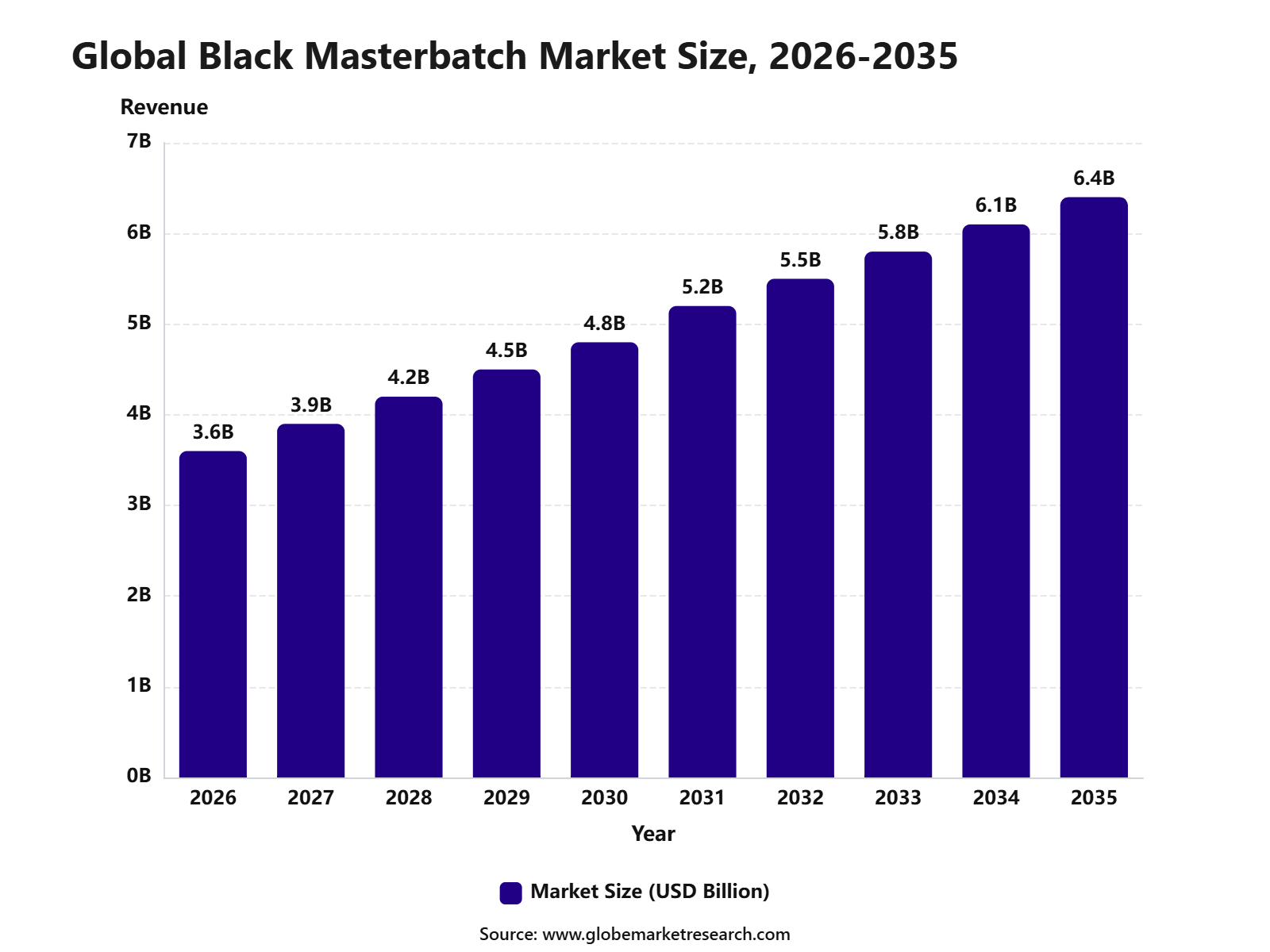 iThe graph shows projected market growth until 2035 based on CAGR analysis. Actual outcomes may vary depending on changing demand, competition, and economic factors.To gain greater insights - request a sample report PDF
Key Market Insights
Standard black masterbatch led the type segment with 65.4% share, supported by its wide use in coloring, UV protection, opacity improvement, and cost-effective plastic product manufacturing.
Packaging accounted for 35.6% share by application, driven by strong demand for black films, bags, containers, caps, closures, and flexible packaging materials.
Polyethylene held 49.2% share by carrier resin, supported by its strong compatibility with packaging films, molded products, pipes, sheets, and other plastic applications.
Plastics captured 70.2% share by end-user industry, driven by high consumption of black masterbatch across packaging, automotive, construction, consumer goods, and industrial plastic products.
Asia Pacific led the black masterbatch market with 48.8% share, valued at USD 1.7 billion, supported by strong plastics manufacturing, expanding packaging demand, and high industrial production across China, India, Japan, and Southeast Asia.
Top Funding and Investment
Top Investments
In October 2025, Gabriel-Chemie completed a EUR 6.5 million investment in its masterbatch production facility in Nyíregyháza, Hungary. The project expanded production, warehouse, laboratory and office areas and included a planned 250 kWp photovoltaic system. The facility produces colour, black and additive masterbatches for plastics processors across European markets.
During 2025 and 2026, Tokai Carbon progressed a JPY 57 billion investment program for its carbon black operations. The expenditure covers capacity expansion, production improvements and development of higher-value carbon black grades. Carbon black is the principal pigment and functional additive used in black masterbatch formulations.
In 2025, Bolder Industries advanced its NextGen Thermal Tire Re-use project in Antwerp, Belgium, supported by a EUR 32 million EU Innovation Fund grant. The facility is being developed to process end-of-life tyres and produce recovered carbon black that can be incorporated into compounds, masterbatches, rubber products and selected plastic applications.
In 2026, Cabot expanded its carbon black manufacturing platform through the acquisition and integration of Mexico Carbon Manufacturing. The operation adds an established Mexican production site and reinforcing-carbon capacity, strengthening Cabot’s regional supply of carbon materials used across rubber and polymer formulations.
In February 2025, Techmer PM expanded its polymer-modification and masterbatch platform by investing in the integration of Colors for Plastics. The transaction added custom colour-concentrate production, formulation expertise and additional customer-serving capacity for plastics applications.
Top Funding Developments
In May 2025, Bolder Industries secured a EUR 32 million grant from the EU Innovation Fund for its Antwerp recovered-carbon-black project. The funding supports engineering, construction and commercial-scale processing of waste tyres into recovered carbon black and other circular raw materials.
Top Acquisitions
In February 2025, Techmer PM acquired Colors for Plastics, a U.S.-based producer of custom colour concentrates. Techmer PM acquired the company’s concentrate formulations, colour-matching capabilities, manufacturing operations, technical expertise and customer relationships.
In 2026, Cabot acquired Mexico Carbon Manufacturing S.A. de C.V. from Bridgestone Corporation. Cabot acquired the Mexican manufacturing operation, production assets, workforce and reinforcing-carbon capacity, strengthening its carbon-material supply network.
By Type
Standard black masterbatch accounted for 65.4% share of the Black Masterbatch Market. This leading position is supported by its wide use in plastic products that require strong black coloration, UV protection, opacity, and improved surface finish.
The segment is widely preferred because standard black masterbatch offers cost efficiency, easy processing, and consistent dispersion across different plastic manufacturing methods. It is commonly used in films, pipes, molded parts, sheets, containers, automotive components, and consumer goods.
Demand is expected to remain strong as plastic processors continue to require reliable and affordable black pigment solutions. Its broad compatibility with packaging, construction, agriculture, automotive, and industrial plastic applications will continue to support segment leadership.
By Application
Packaging accounted for 35.6% share of the Black Masterbatch Market. This dominance is driven by high use in flexible packaging, rigid packaging, films, bags, containers, caps, closures, and industrial packaging products.
Black masterbatch is used in packaging to improve color strength, light blocking, UV resistance, and product appearance. It also helps protect packaged goods from light exposure and supports better brand presentation in consumer and industrial packaging formats.
The segment is expected to remain the largest application area as demand increases from food packaging, consumer goods, e-commerce, personal care, and industrial packaging. Growth will be supported by durable films, lightweight packaging, and wider use of polyethylene-based packaging materials.
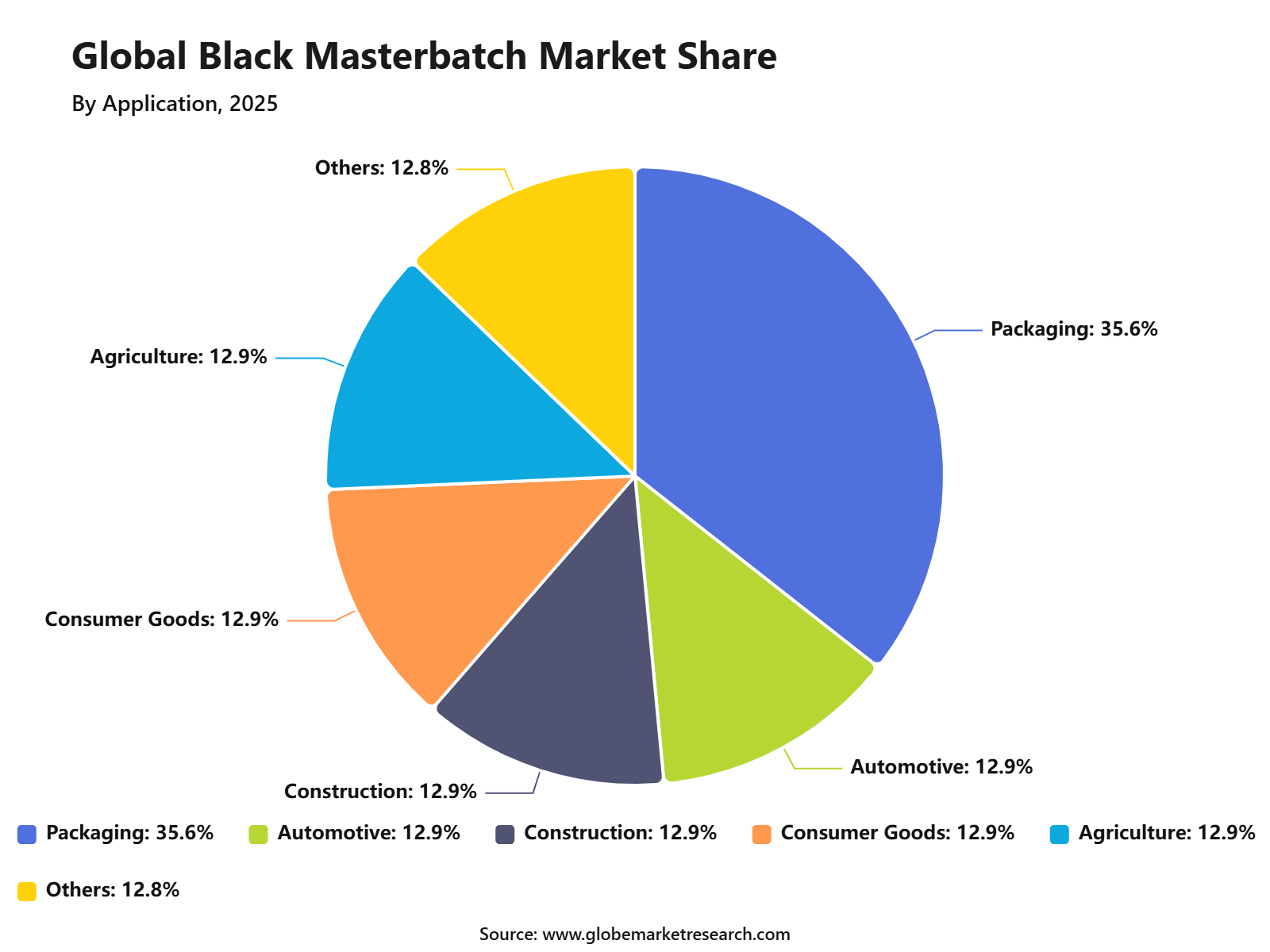 iThe graph shows projected market growth until 2035 based on CAGR analysis. Actual outcomes may vary depending on changing demand, competition, and economic factors.To gain greater insights - request a sample report PDF
By Carrier Resin
Polyethylene accounted for 49.2% share of the Black Masterbatch Market by carrier resin. This leading share is supported by its strong compatibility with flexible films, bags, pipes, sheets, containers, and molded plastic products.
The segment is widely preferred because polyethylene-based masterbatch offers easy processing, good dispersion, and stable performance in high-volume plastic production. It is suitable for blown film, extrusion, injection molding, and rotational molding applications.
Demand for polyethylene carrier resin is expected to remain strong due to its high use in packaging and plastic processing. Its cost efficiency, flexibility, and broad availability will continue to support its role as the leading carrier resin in black masterbatch formulations.
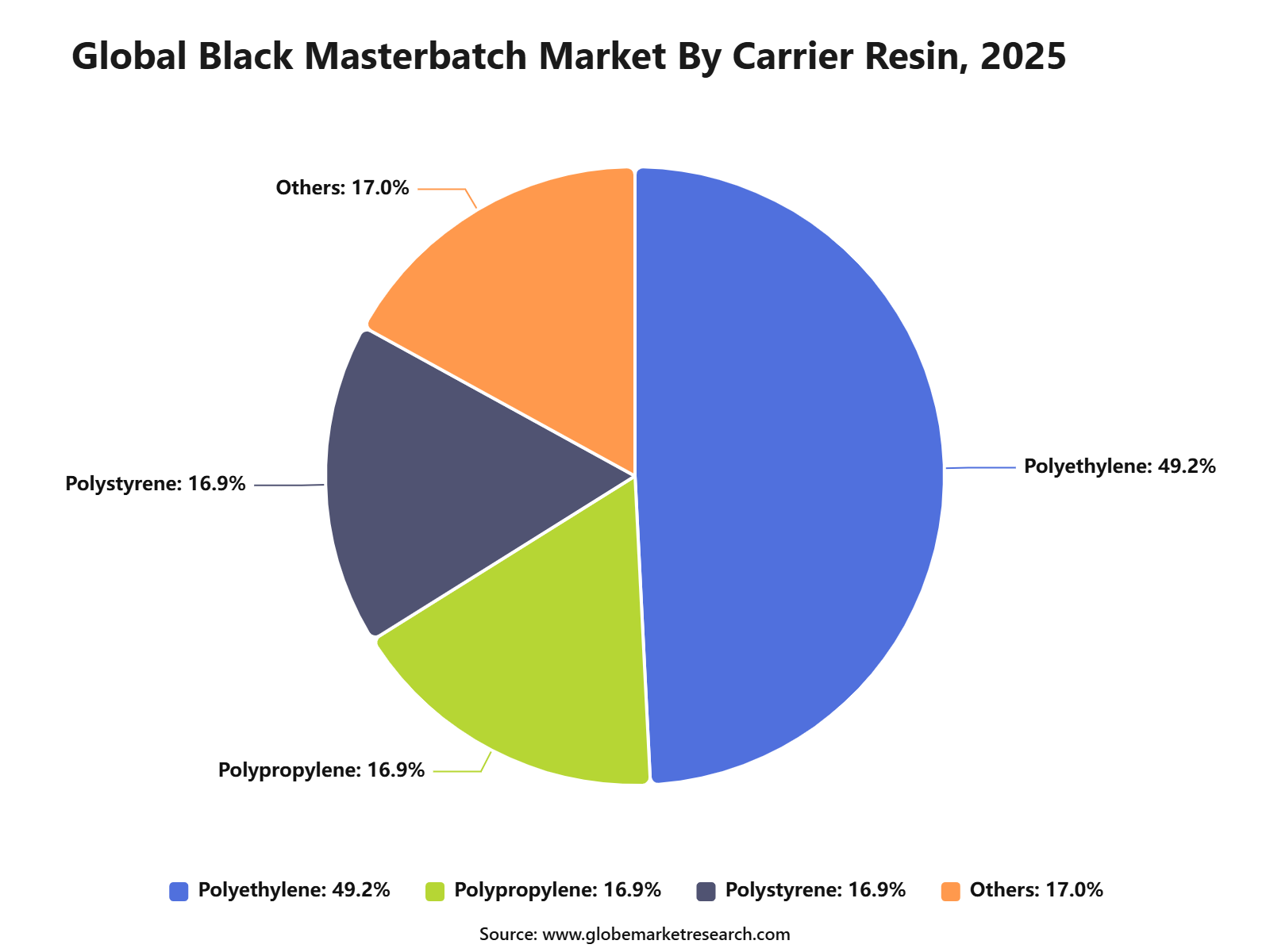 iThe graph shows projected market growth until 2035 based on CAGR analysis. Actual outcomes may vary depending on changing demand, competition, and economic factors.To gain greater insights - request a sample report PDF
By End-User Industry
The plastics industry accounted for 70.2% share of the Black Masterbatch Market. This leading position is supported by the extensive use of black masterbatch in plastic manufacturing, compounding, molding, extrusion, and film production.
Plastic manufacturers use black masterbatch to achieve uniform color, improved opacity, UV stability, and better product appearance. It is widely used across packaging, automotive, construction, agriculture, electrical, consumer goods, and industrial plastic products.
Demand from the plastics industry is expected to remain strong as black-colored plastic components continue to be used across mass-market and industrial applications. Growth will be supported by rising plastic conversion activity and the need for consistent, high-performance color solutions.
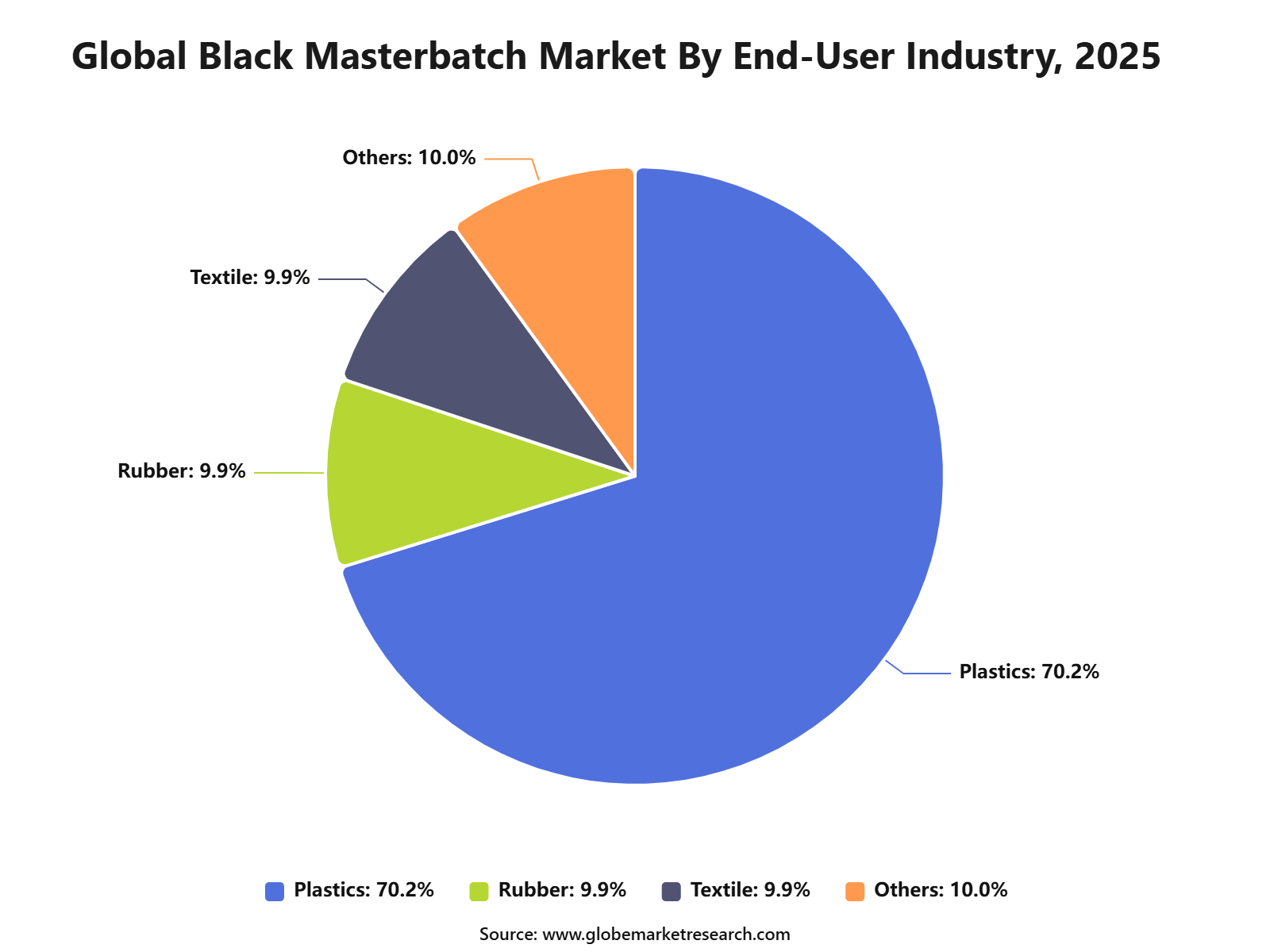 iThe graph shows projected market growth until 2035 based on CAGR analysis. Actual outcomes may vary depending on changing demand, competition, and economic factors.To gain greater insights - request a sample report PDF
By Region
Asia Pacific accounted for 48.8% share of the Black Masterbatch Market, reaching USD 1.7 billion. The region’s leadership is supported by strong plastic processing capacity, large packaging production, growing automotive output, and rising demand from construction and consumer goods industries.
China, India, Japan, South Korea, Indonesia, Vietnam, and Thailand are key contributors to regional demand. The region benefits from cost-efficient manufacturing, strong polymer consumption, and expanding end-use industries that require black masterbatch for coloration and performance enhancement.
Asia Pacific is expected to maintain its leading position as packaging, plastics, automotive, agriculture, and infrastructure-related applications continue to expand. Demand will remain supported by standard black masterbatch, polyethylene carrier resins, and high-volume plastic manufacturing across the region.
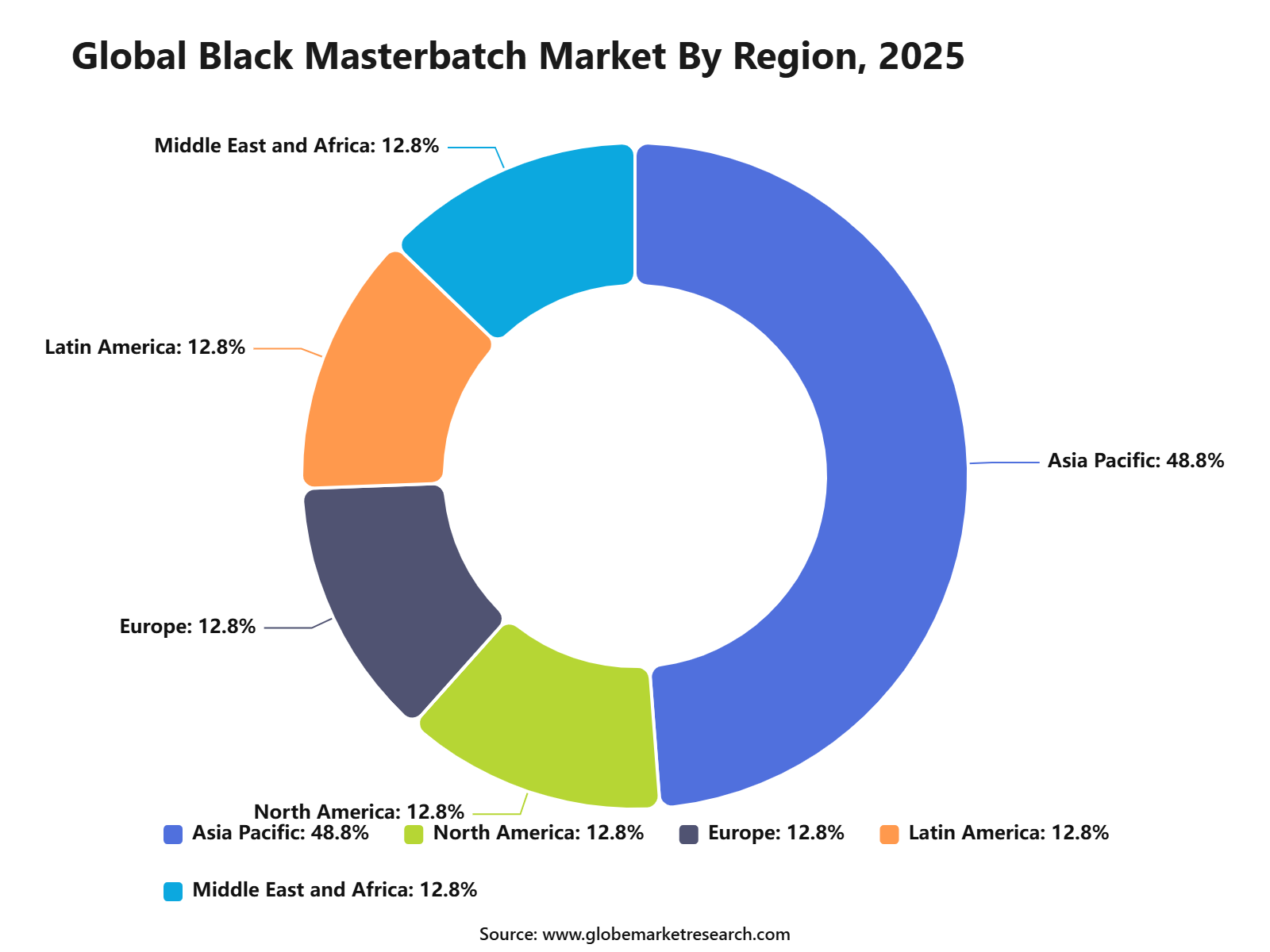 iThe graph shows projected market growth until 2035 based on CAGR analysis. Actual outcomes may vary depending on changing demand, competition, and economic factors.To gain greater insights - request a sample report PDF
Regional Impact Analysis
Asia Pacific leads the Black Masterbatch Market with 48.8% share in 2026, valued at around USD 1.8 billion, supported by strong packaging production, polymer processing, automotive parts manufacturing, agriculture film demand, and infrastructure-related plastics consumption. China, India, Japan, South Korea, Vietnam, Indonesia, and Thailand remain major regional markets.
North America remains important due to demand from packaging, automotive plastics, pipes, cables, and recycled plastic products. Europe supports value growth through strict plastic recycling rules, sustainable packaging demand, and higher adoption of premium and specialty masterbatch grades.
Impact Factor | Estimated CAGR Impact | Regional Relevance | Market Impact |
|---|---|---|---|
Asia Pacific market leadership | +2.0% | Asia Pacific, 48.8% share in 2026 | Leads global value demand. |
China plastics manufacturing scale | +1.5% | China | Drives high-volume masterbatch use. |
India packaging and polymer growth | +1.2% | India | Supports future demand expansion. |
Southeast Asia export manufacturing | +0.9% | Vietnam, Indonesia, Thailand | Adds regional consumption. |
Europe and North America premium demand | +0.7% | U.S., Canada, Germany, France, UK | Supports specialty and recycled grades. |
Go-To-Market and Sales Economics
Black masterbatch suppliers should target packaging converters, film producers, injection moulders, and brand owners through direct technical selling. The EU Packaging and Packaging Waste Regulation will generally apply from 12 August 2026 and requires all packaging to become economically recyclable by 2030. Grade selection, dispersion trials, and recycled-resin compatibility can improve customer qualification.
Automotive sales should begin during component design with compounders, Tier 1 suppliers, and vehicle manufacturers. In the first five months of 2026, 950,521 battery-electric cars were registered in the EU, representing 20% of registrations. Low-odour formulations, ultraviolet protection, conductivity, and batch consistency can support approval for interiors, underbody parts, and charging components.
Construction and infrastructure accounts should be developed through pipe, cable, geomembrane, sheet, and profile manufacturers. U.S. construction spending reached an annualised USD 2.21 trillion in May 2026, including USD 930.2 billion in residential work. Regional warehousing, application support, and volume-based contracts can improve availability while reducing delivery costs for converters.
Risk Factors & Market Barriers
Carbon-black and compound inflation can quickly reduce margins under fixed-price agreements. Cabot announced global price increases of up to 20% for specialty compounds in March 2026, together with ongoing surcharges. Black masterbatch producers should use indexed pricing, shorter quotation periods, multiple carbon-black sources, and disciplined inventory coverage to protect contribution margins.
Regulatory changes create reformulation and documentation costs, particularly for packaging containing recycled polymers. EU packaging rules applying from August 2026 cover every material and origin while setting manufacturing, composition, and recoverability requirements. Suppliers must verify carrier-resin compatibility, migration performance, recyclability, and colour consistency without increasing dosage or weakening final-product properties.
Weak industrial demand and regional competition can reduce plant utilisation and pricing power. Cabot reported that second-quarter 2026 Reinforcement Materials EBIT fell 29%, although volumes increased 3%, because lower gross profit per tonne and stronger Asia-Pacific competition outweighed demand. Producers should diversify applications, customers, carrier resins, and manufacturing locations to stabilise operating performance.
Revenue Potential Analysis
Revenue Landscape Across
Packaging provides recurring revenue across films, containers, caps, crates, and protective products. EU rules aim to make all packaging economically recyclable by 2030 and safely increase recycled-plastic use. Suppliers can expand sales through high-jetness grades, food-contact compliant solutions, reduced dosing, ultraviolet protection, and formulations designed to preserve colour when post-consumer resin content rises.
Automotive and electrical applications provide higher-value demand for black appearance, conductivity, weather resistance, and ultraviolet stability. Battery-electric cars captured 20% of EU registrations through May 2026, while plug-in hybrids reached 460,217 units. Revenue opportunities include interiors, exterior trims, battery housings, connectors, cables, charging equipment, and thermal-management components requiring controlled performance.
Construction offers revenue across pressure pipes, drainage systems, cable ducts, roofing membranes, flooring, profiles, and geosynthetics. U.S. private non-residential construction spending reached an annualised USD 738.7 billion in May 2026, while public spending reached USD 541.2 billion. Durable formulations and regional converter partnerships can support long production runs and repeat orders.
Financial Impact
Scale, product mix, and cost control directly influence masterbatch profitability. Avient reported first-quarter 2026 sales of USD 847 million and expanded adjusted EBITDA margin by 20 basis points to 17.7%. Black masterbatch suppliers can improve returns through specialised grades, efficient dispersion, lower scrap, automated dosing, regional production, and disciplined pricing rather than volume growth alone.
Upstream carbon-black economics affect selling prices and working capital. Cabot’s second-quarter 2026 Performance Chemicals EBIT increased 18% year over year to USD 59 million, supported by product mix and higher specialty-carbon volumes. The company generated USD 77 million of operating cash flow, demonstrating the value of pricing discipline, optimisation, and inventory management.
Cash conversion can remain difficult when oil-linked inputs rise or customers build safety stocks. Orion reported first-quarter 2026 specialty carbon-black sales of USD 169.7 million and adjusted EBITDA of USD 27.1 million, but consolidated free cash outflow reached USD 48 million. Suppliers should use milestone collections, credit limits, and feedstock pass-through clauses.
Drivers Impact Analysis
The Black Masterbatch Market is driven by rising demand from packaging, automotive plastics, consumer goods, agriculture films, pipes, cables, textiles, and construction materials. Black masterbatch is widely used to provide color strength, UV protection, opacity, conductivity, and improved processing performance in plastic products.
Asia Pacific leads the market due to strong plastics manufacturing, packaging production, polymer processing, automotive component output, and consumer goods exports. China, India, Japan, South Korea, Vietnam, Indonesia, and Thailand remain key contributors because of large-scale plastic conversion and growing industrial demand.
Impact Factor | Estimated CAGR Impact | Regional Relevance | Market Impact |
|---|---|---|---|
Rising plastic packaging demand | +1.9% | Asia Pacific, Europe, North America | Drives high-volume black masterbatch use. |
Growth in automotive plastic components | +1.5% | China, India, Japan, South Korea | Supports demand for durable black plastics. |
Expansion of pipe and cable applications | +1.2% | Construction and infrastructure markets | Adds UV-stable material demand. |
Consumer goods manufacturing growth | +0.9% | Asia Pacific and global markets | Supports molded plastic product demand. |
Demand for UV protection and opacity | +0.8% | Packaging, agriculture, outdoor products | Improves functional value. |
Restraints Impact Analysis
The market faces restraints from carbon black price volatility, polymer price fluctuations, environmental concerns, recycled plastic quality issues, and regulatory pressure on plastic waste. Masterbatch producers depend on pigment quality, carrier resin availability, additives, and processing efficiency.
Another restraint is intense price competition, especially in commodity-grade black masterbatch. Buyers often compare suppliers based on price, dispersion quality, blackness level, compatibility, and processing stability, which can pressure margins.
Impact Factor | Estimated CAGR Impact | Regional Relevance | Market Impact |
|---|---|---|---|
Carbon black price volatility | -0.9% | Global masterbatch producers | Pressures production cost. |
Polymer resin price fluctuation | -0.7% | PE, PP, PS, PVC supply chains | Affects pricing stability. |
Plastic waste regulation pressure | -0.6% | Europe, North America, Asia Pacific | Pushes reformulation and recycling needs. |
Commodity-grade price competition | -0.5% | Asia Pacific suppliers | Limits profit margins. |
Recycled plastic compatibility issues | -0.4% | Recycling and packaging markets | Affects product consistency. |
Opportunities Impact Analysis
Opportunities are strong in packaging films, black PE masterbatch, recycled-content plastics, automotive interiors, agriculture mulch films, infrastructure pipes, cables, and durable outdoor plastic products. These applications benefit from color uniformity, UV stability, and cost-efficient plastic processing.
Higher-value opportunities are emerging in food-grade packaging, conductive masterbatch, high-dispersion carbon black systems, sustainable carrier resins, and masterbatch for recycled polymers. Producers that deliver stronger dispersion, lower dosing, and consistent color performance can capture better value.
Impact Factor | Estimated CAGR Impact | Regional Relevance | Market Impact |
|---|---|---|---|
Packaging film applications | +1.8% | Asia Pacific and global packaging markets | Builds core market opportunity. |
Recycled polymer masterbatch | +1.4% | Europe, North America, Asia Pacific | Supports circular plastic demand. |
Automotive-grade black masterbatch | +1.1% | China, Japan, South Korea, India | Adds higher-value applications. |
Agriculture film demand | +0.9% | India, China, Southeast Asia | Supports UV-stable film use. |
Conductive and specialty masterbatch | +0.7% | Electronics, industrial packaging | Adds premium product value. |
Challenges Impact Analysis
The main challenge is maintaining consistent pigment dispersion, color strength, and processing stability across different polymers. Poor dispersion can cause streaks, weak blackness, surface defects, and inconsistent product quality.
Another challenge is meeting sustainability and recycling requirements. As brands and regulators push recycled plastics, masterbatch producers must ensure compatibility with PCR materials, lower carbon footprint, and stable performance in mixed polymer streams.
Impact Factor | Estimated CAGR Impact | Regional Relevance | Market Impact |
|---|---|---|---|
Pigment dispersion consistency | -0.8% | Masterbatch manufacturers | Affects product quality. |
Compatibility across polymers | -0.7% | PE, PP, PVC, PS applications | Raises formulation complexity. |
Sustainability compliance needs | -0.6% | Packaging and consumer goods markets | Adds reformulation pressure. |
Quality variation in recycled plastics | -0.5% | Recycling-based applications | Affects processing stability. |
Low-cost supplier competition | -0.4% | Asia Pacific markets | Pressures pricing and margins. |
Packaging Demand Drives Black Masterbatch
Packaging and plastics manufacturing demand is the most important factor influencing the Black Masterbatch Market. Black masterbatch provides deep coloration, ultraviolet protection, opacity and processing consistency in films, containers, caps and industrial packaging. U.S. manufacturing shipments reached USD 653.2 billion in May 2026, increasing 1.6%, while manufacturing orders stood at USD 657.4 billion. These figures indicate continued downstream production activity that supports demand for polymer additives and color concentrates.
Raw-material and energy costs remain equally important because black masterbatch commonly uses carbon black, polymer carrier resins and energy-intensive compounding processes. The U.S. Henry Hub natural gas price averaged USD 3.52 per MMBtu in 2025, representing a 56% annual increase. Meanwhile, U.S. plastics and rubber products manufacturing employed approximately 718,300 workers at the beginning of 2025. These indicators show that producers must balance packaging demand with energy costs, resin pricing, production efficiency and recycled-plastic compatibility.
Segment Covered in the Report
By Type
Standard Black Masterbatch
Specialty Black Masterbatch
By Application
By Carrier Resin
Polyethylene
Polystyrene
Others
By End-User Industry
Plastics
Rubber
Textile
Others
By Region
North America
Europe
Asia Pacific
Latin America
Middle East and Africa
Market Trend Analysis
The market trend is moving toward high-performance black masterbatch, recycled polymer compatibility, low-dosing formulations, UV-stable grades, and application-specific masterbatch for packaging, automotive, agriculture, and infrastructure. Buyers are looking for better color strength and lower processing issues.
Asia Pacific remains the largest value region because of its strong plastics conversion base, export manufacturing, packaging growth, and rising infrastructure activity. Europe and North America support premium demand through recycled plastics, regulatory compliance, automotive quality standards, and specialty applications.
Impact Factor | Estimated CAGR Impact | Regional Relevance | Market Impact |
|---|---|---|---|
High-dispersion masterbatch demand rises | +1.6% | Asia Pacific, Europe, North America | Improves product quality and efficiency. |
Recycled-content plastic use grows | +1.3% | Packaging and consumer goods markets | Supports sustainable formulation demand. |
UV-stable outdoor grades expand | +1.0% | Agriculture, pipe, cable applications | Adds functional value. |
Low-dosing formulations gain adoption | +0.8% | Cost-sensitive processors | Improves processing economics. |
Specialty black masterbatch increases | +0.6% | Automotive and electronics sectors | Supports higher-margin growth. |
Investor Type Impact Matrix
Investors should focus on companies with strong dispersion technology, consistent carbon black sourcing, polymer compatibility expertise, application-specific formulations, and access to packaging, automotive, pipe, cable, and film customers. Product consistency, cost control, technical support, and sustainable formulation capability are key success factors.
Strategic investors can also target black masterbatch producers, carbon black suppliers, polymer compounders, packaging material suppliers, recycled plastic processors, and specialty additive firms. Companies that combine scale with quality and recycled-polymer compatibility are better positioned for long-term growth.
Investor Type | Estimated CAGR Impact | Regional Relevance | Market Impact |
|---|---|---|---|
Black Masterbatch Manufacturers | +1.4% | Asia Pacific and global markets | Expands core material supply. |
Carbon Black and Additive Suppliers | +1.1% | Polymer processing supply chains | Supports performance and cost control. |
Polymer Compounders | +0.9% | Packaging, automotive, pipe sectors | Adds application-linked value. |
Recycled Plastic Processing Firms | +0.7% | Circular plastics markets | Supports sustainable product demand. |
Strategic Specialty Chemical Investors | +0.5% | Global plastics additives market | Funds capacity and premium grades. |
Recent Developments
In May 2026, LyondellBasell appointed Interpolimeri to distribute its masterbatches and custom performance colours across Germany and Austria, expanding regional access to colour concentrates, functional additives, and polymer-performance solutions.
In February 2026, RTP Company presented customised engineered thermoplastic compounds at Plastindia, including coloured, conductive, flame-retardant, reinforced, and wear-resistant formulations developed through its global compounding and colour-matching manufacturing network.
In June 2025, Clariant launched AddWorks PPA 101 FG and PPA 122 G, including a masterbatch-format processing aid that eliminates intentionally added PFAS while improving polyolefin extrusion, film quality, and production efficiency.
Competitive Landscape
The market is characterized by intense competition among established players and emerging companies. Strategic partnerships, mergers and acquisitions, and product innovation are key strategies employed by market participants.
Key Market Players
Cabot Corporation
LyondellBasell
Avient Corporation
Plastika Kritis S.A.
Plastiblends India Ltd.
Dow
Polyplast Muller GmbH
RTP Company
Ampacet Corporation
Tosaf
Capital Colours
Universal Masterbatch LLP
JJ Plastalloy
BASF SE
Clariant AG
Other Key Players
Research Methodology
This market study is prepared using a combination of primary and secondary research. Primary research includes discussions with manufacturers, suppliers, distributors, consultants, industry experts, and end users. Secondary research covers company reports, government databases, trade associations, technical publications, regulatory sources, and trusted industry documents. The collected information is used to assess market demand, pricing trends, technology adoption, competitive activity, and regional performance.
AI language models are not used as primary data sources, and publicly available AI-generated content is not treated as market evidence. Computational tools may be used to support data processing, translation, data classification, and pattern identification. However, every published assessment is supported by verified sources, human review, and primary market discussions.
Market estimates are developed through top-down and bottom-up approaches and validated using data triangulation. Revenue, production, shipment, pricing, and application-level data are compared across multiple sources. Forecasts consider economic conditions, regulatory changes, investment activity, innovation, supply chain developments, and industry risks. All findings are reviewed through source verification and internal quality checks before publication.
Part I
Source Management & Input Data Standards
Who provides data, how sources are qualified, and what types of evidence are admissible.
Part II
Research Scope & Market Coverage
How we define the markets we assess and the parameters that govern each product.
Part III
Data Collection, Verification & Submission
The mechanics of gathering, cross-checking, and hierarchically ranking evidence.
Part IV
Assessment Determination & Quality Controls
How raw data becomes a published assessment — normalisation, expert judgement, and outlier exclusion.
Part V
Publication, Corrections & Revision
Our publication schedule, corrections policy, and methodology review cycle.
Part VI
Independence, Ethics & Complaints
Conflict-of-interest policies, editorial independence, and how clients raise concerns.
Google · Preferred Sources
Don't miss the latest market research insights and industry updates on Google.
Add Globe Market Research as a preferred source in the Google app to see our reports, analysis, and market stories in your news suggestions.
Meet the Team
This report was prepared by our expert analysts with deep industry knowledge and research experience.
Pratiksha K. is a Senior Research Analyst with more than five years of experience in market research, industry analysis, competitive intelligence, and business strategy. She has contributed to detailed market reports, customized research studies, company profiling, market sizing, trend analysis, and strategic consulting projects for clients across different regions. Her industry expertise covers Chemical and Material, Consumer Goods, Food & Beverages and Energy & Power. She closely evaluates changing customer requirements, technology developments, regulatory conditions, supply chain structures, investment activity, and competitive strategies to provide clear and practical market insights.
Sayali brings more than 7 years of experience to Globe Market Research, supporting the accuracy, clarity, and relevance of research content across multiple industries. She reviews market data, segment analysis, competitive insights, and industry trends to ensure each report meets strong quality standards and provides practical value to business decision-makers. Her expertise spans healthcare, information technology, consumer goods, and diverse cross-industry domains. With a strong focus on data reliability, structured analysis, and clear presentation, Sayali helps ensure that each research output delivers well-reviewed insights for clients, investors, consultants, and industry stakeholders.
Frequently Asked Questions
Related Reports
More in Chemical and Material
Sulfuric Acid Market to Hit USD 61.5 Billion by 2035
Sulfuric Acid Market Size, Share, Analysis By Raw Material (Elemental Sulfur, Base Metal Smelters, Pyrite Ore, Others), By Application (Fertilizers, Chemical Manufacturing, Metal Processing, Petroleum Refining, Textile, Automotive, Pulp and Paper, Others), By Distribution Channel (Direct Sales, Distributors), By Regional Insights, Business plan and Project Report, Investment Opportunities, Profitability, Industry Trends, Leading Companies and Growth Forecasts by 2026-2035
Powder Metallurgy Market to Hit USD 17.0 Billion by 2035
Powder Metallurgy Market Size, Share, Analysis By Material (Ferrous Metals, Non-Ferrous Metals, Others), By Process (Additive Manufacturing, Powder Metal Hot Isostatic Pressing, Conventional Powder Metallurgy), By Application (Automotive, Aerospace and Defense, Healthcare, Electrical and Electronics, Industrial Machinery, Others) , By Regional Insights, Business plan and Project Report, Investment Opportunities, Profitability, Industry Trends, Leading Companies and Growth Forecasts by 2026-2035
Bromine Market to Hit USD 1.5 Billion by 2035
Bromine Market Size, Share, Analysis By Derivative (Organobromine, Clear Brine Fluids, Hydrogen Bromide, Others), By Application (Flame Retardants, Oil and Gas Drilling, Biocides, PTA Synthesis, Plasma Etching, Pharmaceuticals, Energy Storage, Others), By End-Use Industry (Chemicals, Oil and Gas, Pharmaceuticals, Electrical and Electronics, Automotive, Agriculture, Others), By Regional Insights, Business plan and Project Report, Investment Opportunities, Profitability, Industry Trends, Leading Companies and Growth Forecasts by 2026-2035
Hydrogen Cyanide Market to Hit USD 5.95 Billion by 2035
Hydrogen Cyanide Market Size, Share, Analysis By Product Form (Hydrogen Cyanide Liquid, Hydrogen Cyanide Gas), By Application (Adiponitrile, Acetone Cyanohydrin, Sodium Cyanide and Potassium Cyanide, Methionine, Cyanuric Chloride, Others), By End-Use Industry (Chemicals, Mining and Metallurgy, Pharmaceuticals, Agriculture, Textiles, Others), By Regional Insights, Business plan and Project Report, Investment Opportunities, Profitability, Industry Trends, Leading Companies and Growth Forecasts by 2026-2035