

Revenue, 2025
$3.1 Bn
Forecast, 2035
$6.2 Bn
CAGR, 2025-2035
7.2%
Report Coverage
Global
Market Size and Forecast
The Global Castor Oil Market reached USD 3.1 billion in 2025 and is expected to grow to USD 6.2 billion by 2035, registering a CAGR of 7.2% from 2025 to 2035. The growth of the market can be attributed to rising demand for bio-based oils, specialty chemicals, lubricants, cosmetics, pharmaceuticals, coatings, plastics, and industrial applications. Castor oil is widely used due to its high ricinoleic acid content, strong lubricating properties, biodegradability, and suitability for natural and sustainable product formulations.
Asia Pacific held the largest regional share of 60.8% in 2025, supported by strong castor seed production, large processing capacity, and high export activity from India. The region benefits from established supply chains, low-cost raw material availability, and growing demand from personal care, pharmaceutical, chemical, and industrial sectors. Market opportunities are expected to remain strong in hydrogenated castor oil, cold pressed castor oil, sebacic acid, bio-lubricants, cosmetics, and renewable chemical intermediates as industries shift toward plant-based and sustainable raw materials.
The growth of the castor oil market is being driven by the shift toward renewable and plant-based industrial feedstocks. Castor oil is used in lubricants, coatings, adhesives, cosmetics, pharmaceuticals, surfactants, and bio-based chemicals because it offers strong viscosity, hydroxyl functionality, and chemical flexibility. Arkema notes that castor oil is used to produce amino 11 for polyamide 11, while related bio-based products are used in lubricants, cosmetics, pharmaceuticals, and adhesives.
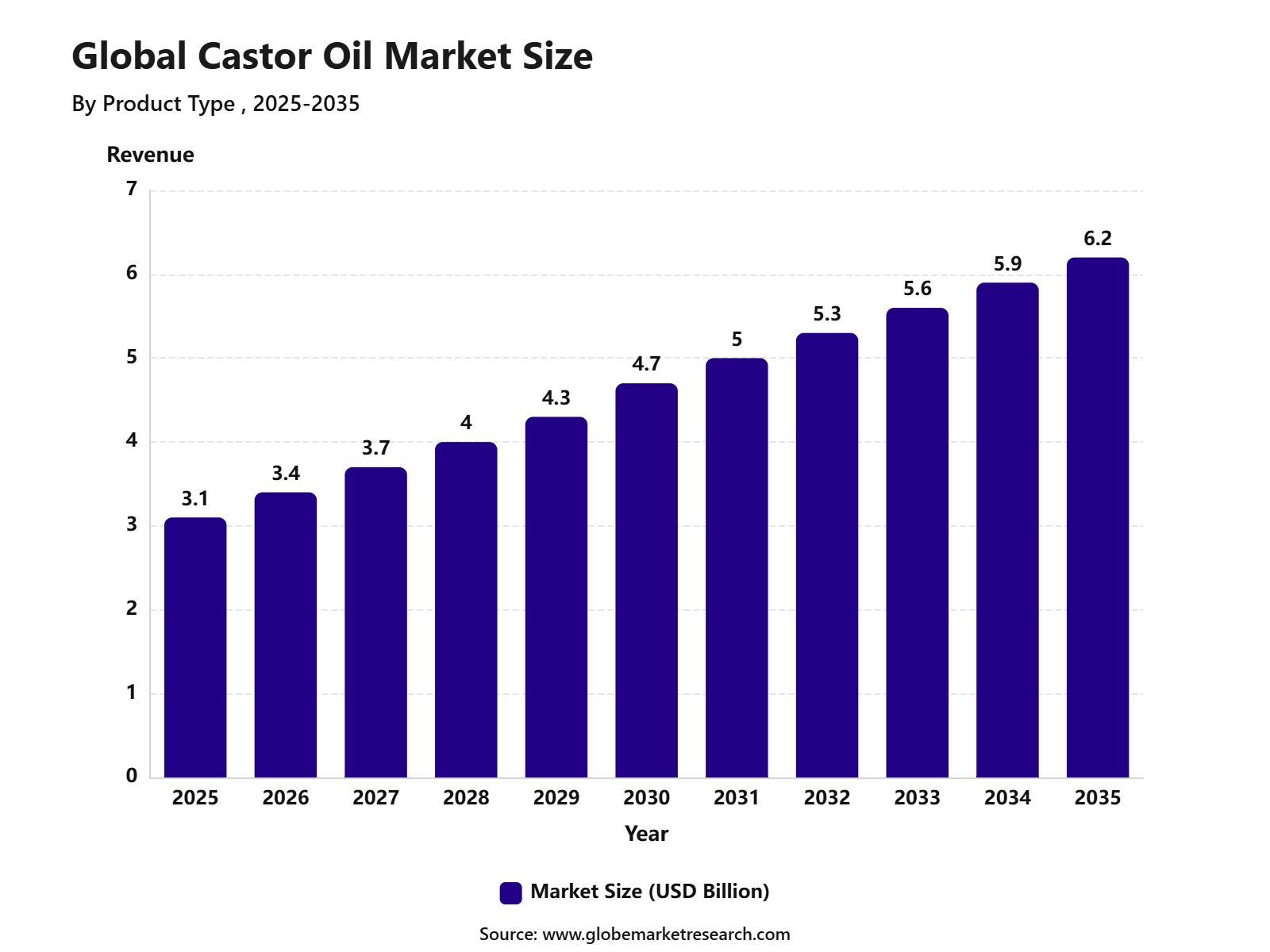 iThe graph shows projected market growth until 2035 based on CAGR analysis. Actual outcomes may vary depending on changing demand, competition, and economic factors.To gain greater insights - request a sample report PDF
Key Market Insights
Cold pressed castor oil led the product type segment with 39.4% share, supported by rising demand for natural, minimally processed oils in personal care, pharmaceuticals, and industrial applications.
Paints and varnishes accounted for 45.0% share by end user, driven by castor oil’s strong use in coatings, resins, binders, and surface protection formulations.
Direct distribution held 67.8% share, supported by bulk purchasing from industrial buyers, long-term supplier agreements, and direct procurement by manufacturers.
Asia Pacific led the castor oil market with 60.8% share, valued at around USD 1.88 billion, supported by strong castor seed production, established processing capacity, and high demand from industrial and specialty chemical sectors.
Castor Oil Market Overview
The Castor Oil Market is supported by steady demand from personal care, pharmaceuticals, lubricants, coatings, plastics, bio-based chemicals, and industrial formulations. Castor oil is valued because it is a renewable vegetable oil with a high ricinoleic acid content, which gives it strong lubricity, viscosity, moisture-retention, and chemical conversion properties. A 2024 cosmetic ingredient safety assessment reported that ricinoleic acid accounts for 87% to 90% of the fatty acyl groups in castor seed oil, making it suitable for products that need specialty fatty acid performance.
The supply landscape is highly linked to India, which remains the main global production and export hub for castor oil and derivatives. World Bank WITS data shows that India exported 629,846,000 kg of castor oil and its fractions in 2023, valued at about USD 1.01 billion, with China, the Netherlands, the United States, France, and Japan among key destinations. OEC data shows India remained the leading exporter in 2024, with castor oil exports valued at USD 1.15 billion, far ahead of the Netherlands at USD 29.6 million and Germany at USD 24.2 million. This export concentration makes India’s crop output, Gujarat’s castor seed production, weather patterns, and processing capacity important factors for global pricing and supply stability
Customer Acquisition Strategy
The Castor Oil Market needs a value-added go-to-market strategy because castor oil is used across lubricants, coatings, cosmetics, pharmaceuticals, polymers, adhesives, bio-based chemicals, and specialty industrial fluids. Suppliers should not sell only on crude oil volume, but on grade consistency, ricinoleic acid quality, moisture control, color, acidity, packaging, and reliable delivery. India remains central to global supply, as India exported about 701.6 million kg of castor oil and fractions worth about USD 1.04 billion in 2024. China, the Netherlands, the United States, France, and Thailand were among the major buyers of Indian castor oil in 2024.
Sales economics are stronger in derivatives than in basic oil because higher-value products can be sold into technical applications. Castor oil is used to make bio-based polyamide 11, specialty acids, lubricants, cosmetics ingredients, pharmaceutical inputs, and adhesives. Arkema states that it sources most of its castor oil from India, mainly from Gujarat, and uses castor oil chemistry to produce bio-based materials for lubricants, cosmetics, pharmaceuticals, and adhesives. This supports a go-to-market model focused on industrial partnerships, long-term contracts, and technical-grade supply.
Product Type Analysis
Cold pressed castor oil led the Castor Oil Market with 39.4% share, supported by growing demand from personal care, cosmetics, pharmaceuticals, and specialty industrial uses. This product type is preferred because it is processed without high heat, which helps retain its natural composition and makes it suitable for applications where purity and quality are important.
The segment is gaining demand as consumers and manufacturers look for natural, plant-based, and minimally processed ingredients. Cold pressed castor oil is widely used in hair care, skin care, massage oils, wellness products, and premium formulations, which supports its leading position in the product type segment.
End User Analysis
Paints and varnishes accounted for 45.0% share, making them the leading end-user segment in the Castor Oil Market. Castor oil is valued in coatings because of its fatty acid structure, film-forming ability, flexibility, gloss support, and usefulness in resins, alkyds, polyols, and specialty coating formulations.
The growth of this segment can be attributed to rising use of bio-based raw materials in coatings and industrial formulations. Paint and varnish manufacturers are using castor oil derivatives to improve product performance while supporting demand for renewable and plant-based chemical inputs.
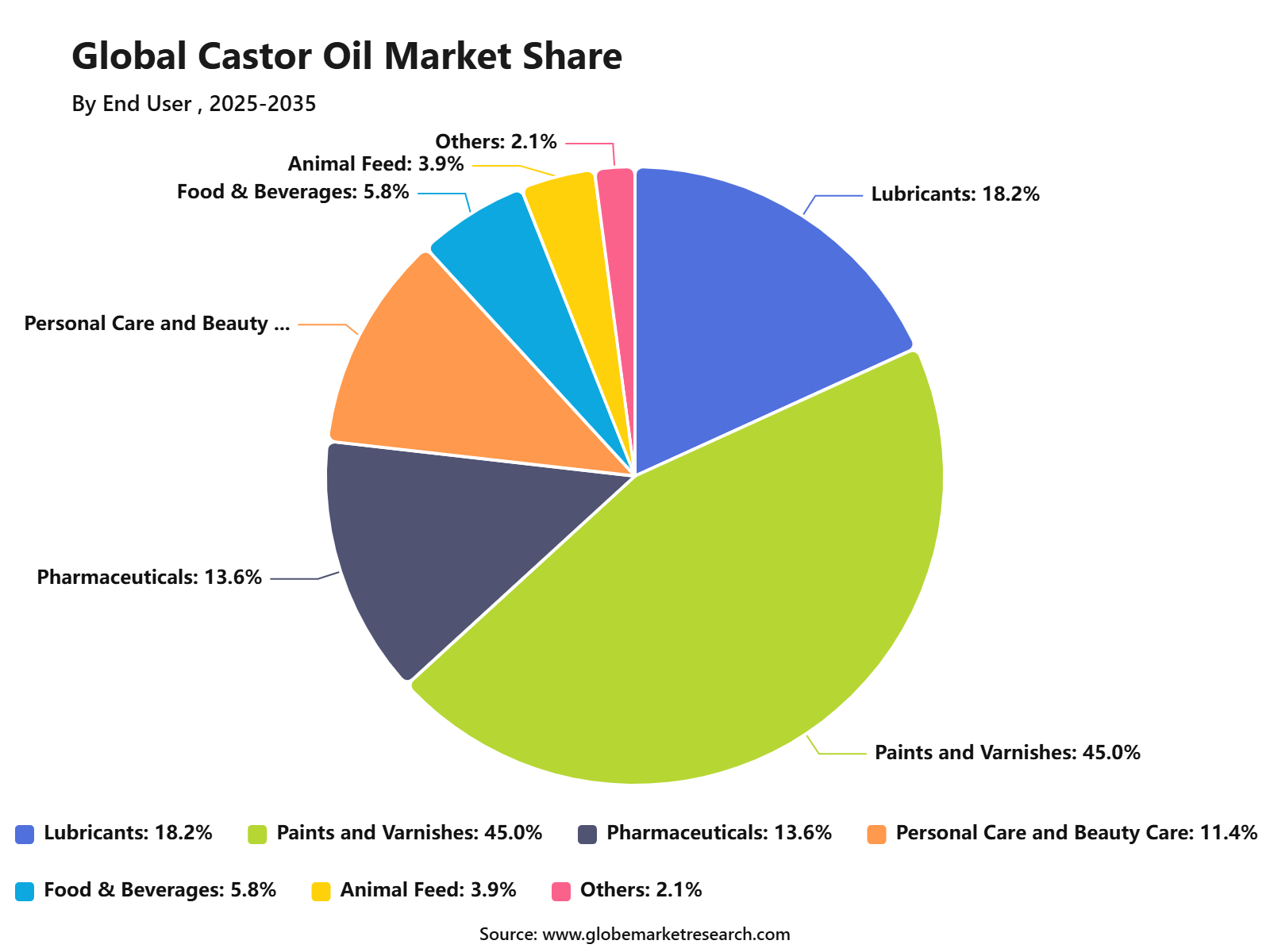 iThe graph shows projected market growth until 2035 based on CAGR analysis. Actual outcomes may vary depending on changing demand, competition, and economic factors.To gain greater insights - request a sample report PDF
Distribution Channel Analysis
Direct distribution led the Castor Oil Market with 67.8% share, supported by large-volume sales between producers, processors, industrial buyers, cosmetic manufacturers, pharmaceutical companies, and chemical formulators. This channel is preferred because castor oil is often purchased in bulk for manufacturing and industrial processing.
The segment is supported by the need for stable supply, quality consistency, price negotiation, and long-term buyer-supplier relationships. Direct distribution also helps manufacturers secure specific grades of castor oil and derivatives for personal care, coatings, lubricants, pharmaceuticals, and chemical applications.
Regional Analysis
Asia Pacific led the Castor Oil Market with 60.8% share, contributing around USD 1.88 billion in 2025. The region’s dominance is supported by strong castor seed cultivation, large processing capacity, established export networks, and high demand from industrial and personal care applications. India remains the key supply base within Asia Pacific due to its strong castor seed production and castor oil export position. The region is expected to maintain its lead as demand grows for cold pressed castor oil, castor oil derivatives, bio-based chemicals, coatings, cosmetics, and pharmaceutical-grade oils.
Region | Market Share (%) |
|---|---|
Asia Pacific | 60.8% |
North America | 16.2% |
Europe | 13.5% |
Middle East & Africa | 5.1% |
Latin America | 4.4% |
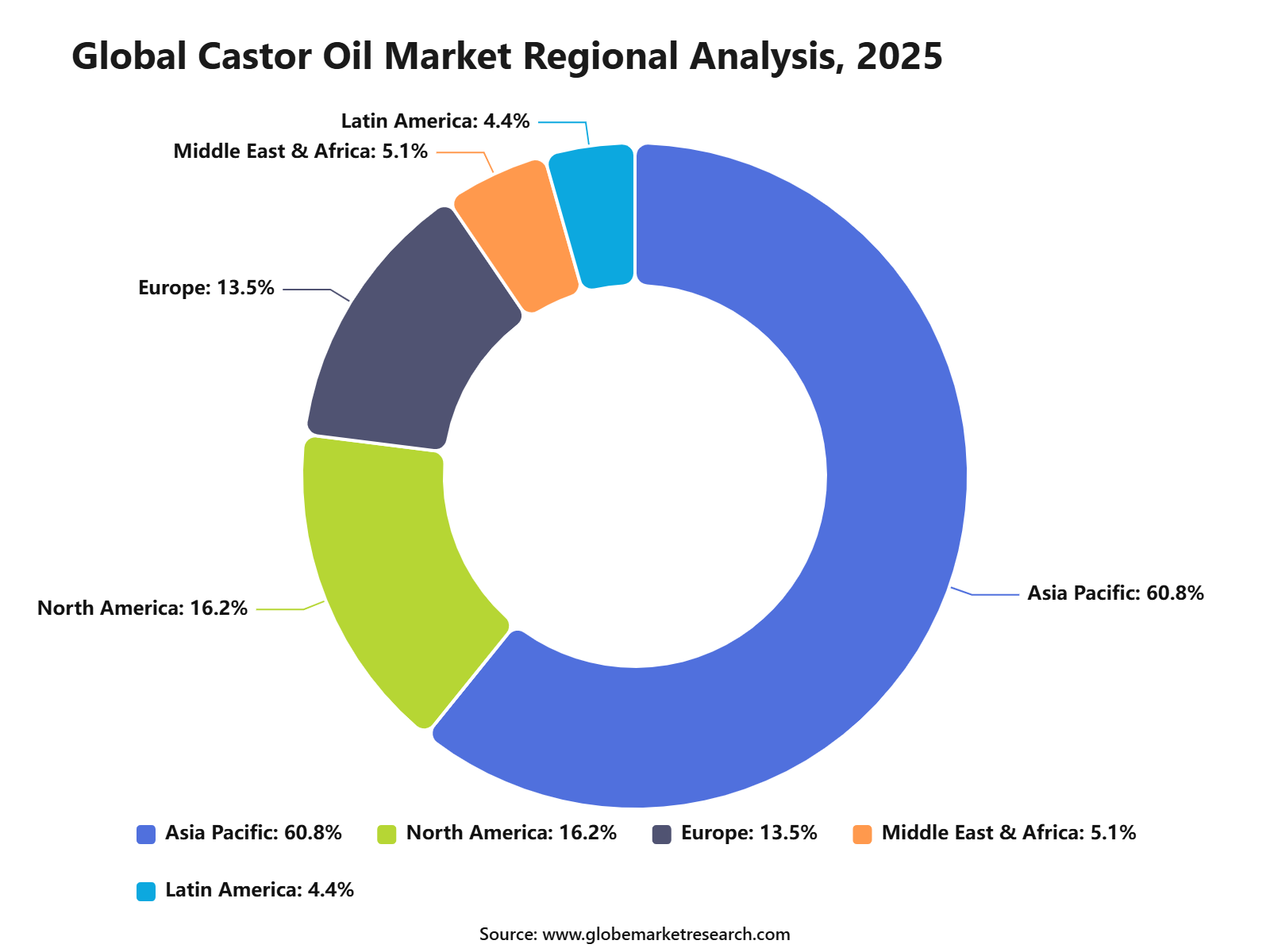 iThe graph shows projected market growth until 2035 based on CAGR analysis. Actual outcomes may vary depending on changing demand, competition, and economic factors.To gain greater insights - request a sample report PDF
Revenue Potential Analysis
Revenue Landscape Across
The revenue landscape across the castor oil market is strongly supported by industrial demand from coatings, lubricants, cosmetics, pharmaceuticals, adhesives, bio-based polymers, and specialty chemicals. India remains the main global supply center, with 2025 calendar-year castor oil exports reaching 675,168 tons, compared with 649,510 tons in 2024 and 629,418 tons in 2023. This shows steady export-linked revenue potential, especially from buyers in China, the U.S., Europe, Japan, and other industrial markets.
Revenue opportunities are also supported by stronger crop availability in 2026. India’s castor seed production for the 2025 to 2026 season reached 17.6 lakh tonnes, up 11%, supported by a 3% rise in acreage and an 8% increase in average yield. Gujarat remained the key production base with 13.65 lakh tonnes, while Rajasthan production rose 18% to 3.22 lakh tonnes, supporting better raw material availability for crushers, refiners, exporters, and derivative manufacturers.
Financial Impact
The financial impact of castor oil is mainly seen through export earnings, raw material cost control, and value addition in derivatives. India exported 3,09,376 tonnes of castor oil during January to May 2025, up 15.76% from 2,67,234 tonnes in the same period of 2024. May 2025 exports alone reached 63,873 tonnes, up 20.6% year over year, showing strong short-term revenue momentum for exporters and processors.
However, 2026 export flow shows some margin risk due to lower early-year shipments. India exported 87,686 tons of castor oil in January to February 2026, lower than 111,018 tons in the same period of 2025, while February 2026 exports stood at 44,448 tons. This can affect cash flow for exporters, freight planning, and processing margins, but higher 2025 to 2026 seed output may help stabilize supply costs and support revenue recovery in downstream products such as sebacic acid, hydrogenated castor oil, dehydrated castor oil, and bio-based polymers.
Technology Adoption Analysis
Impact Factor | Estimated CAGR Impact | Regional Relevance | Market Impact |
|---|---|---|---|
Advanced oil extraction methods | +1.4% | Asia Pacific, Europe, North America | Improves yield quality. |
Cold pressing technology | +1.2% | Personal care and wellness markets | Supports premium oils. |
Refining and purification systems | +1.1% | Global processors | Improves product consistency. |
Bio-based chemical processing | +1.0% | Europe, U.S., Asia Pacific | Expands industrial use. |
Quality testing and traceability tools | +0.8% | Export-focused producers | Builds buyer confidence. |
Investment Opportunity Analysis
Impact Factor | Estimated CAGR Impact | Regional Relevance | Market Impact |
|---|---|---|---|
Cold pressed castor oil production | +1.5% | Asia Pacific, Europe, North America | Offers premium growth. |
Castor oil derivatives manufacturing | +1.4% | India, China, Europe, U.S. | Builds value-added demand. |
Bio-based lubricant applications | +1.2% | Europe, North America, Asia Pacific | Supports sustainable industry. |
Personal care ingredient supply | +1.1% | Global beauty markets | Expands formulation demand. |
Export-oriented processing facilities | +1.0% | Asia Pacific | Strengthens trade potential. |
Segment covered in the Report
By Product Type
Cold Pressed Castor Oil
Hydrogenated Castor Oil
Jamaican Black Castor Oil
Dehydrated Castor Oil
Others
By End User
Lubricants
Paints and Varnishes
Pharmaceuticals
Personal Care and Beauty Care
Food & Beverages
Animal feed
Others
By Distribution Channel
Direct Distribution
Hypermarket/Supermarket
Convenience Stores
Traditional Grocery Stores
Pharmacies & Drug Stores
Discount Stores
Specialty Stores
Online Retail
By Region
Asia Pacific
North America
Europe
Middle East & Africa
Latin America
Drivers Impact Analysis
Impact Factor | Estimated CAGR Impact | Regional Relevance | Market Impact |
|---|---|---|---|
Rising demand from personal care and cosmetics | +1.9% | Asia Pacific, North America, Europe | Drives product usage. |
Growth in bio-based lubricants | +1.6% | Europe, North America, Asia Pacific | Supports industrial demand. |
Increasing use in pharmaceuticals | +1.3% | U.S., Europe, India, Japan | Expands high-value applications. |
Demand from paints and varnishes | +1.2% | Asia Pacific, Europe, Middle East | Supports chemical usage. |
Rising preference for natural ingredients | +1.0% | Global | Improves consumer acceptance. |
Restraints Impact Analysis
Impact Factor | Estimated CAGR Impact | Regional Relevance | Market Impact |
|---|---|---|---|
Volatility in castor seed supply | -1.0% | India, China, Brazil | Affects price stability. |
Dependence on climatic conditions | -0.8% | Asia Pacific, Latin America, Africa | Impacts crop yield. |
Price fluctuations in raw materials | -0.7% | Global | Pressures margins. |
Limited large-scale cultivation regions | -0.6% | Global | Restricts supply expansion. |
Competition from synthetic alternatives | -0.5% | Industrial applications | Limits substitution growth. |
Opportunities Impact Analysis
Impact Factor | Estimated CAGR Impact | Regional Relevance | Market Impact |
|---|---|---|---|
Expansion in bio-based polymers | +1.7% | Europe, North America, Asia Pacific | Creates specialty demand. |
Growth in cold pressed castor oil | +1.4% | Asia Pacific, Europe, North America | Supports premium products. |
Rising demand in personal care formulations | +1.3% | U.S., India, China, Europe | Expands consumer applications. |
Increasing use in specialty chemicals | +1.2% | Asia Pacific, Europe, U.S. | Builds industrial demand. |
Export growth from Asia Pacific | +1.0% | India, China, Southeast Asia | Strengthens regional leadership. |
Recent Developments
May 2026: India’s castor oil exports reached 238,049 MT during January to April 2026, with export value of Rs. 2,751.55 crore. April 2026 exports stood at 74,542 MT, showing strong shipment momentum from India’s castor oil supply chain.
March 2026: India’s castor seed production for the 2025-26 season was reported at 17.6 lakh tonnes, up 11%. The increase was supported by 3% higher acreage and an 8% improvement in average yield, strengthening raw material availability for castor oil processors and exporters.
Report Scope
Report Highlights | Details |
|---|---|
Market Revenue (2025) | USD 3.1 Billion |
Forecast Revenue (2035) | USD 6.2 Billion |
CAGR (2025-2035) | 7.2% |
Base Year for Estimation | 2025 |
Historic Data | 2020-2024 |
Forecast Period | 2025-2035 |
Report Coverage | AI market impact analysis, market surveys, trade analysis, Industry & competitive intelligence, Revenue projections, company positioning, competitive analysis, growth drivers, and emerging market trends, Strategic Consultation & Advisory Services |
Segments Covered | By Product Type (Cold Pressed Castor Oil, Hydrogenated Castor Oil, Jamaican Black Castor Oil, Dehydrated Castor Oil and Others), By End User (Lubricants, Paints and Varnishes, Pharmaceuticals, Personal Care and Beauty Care, Food & Beverages, Animal feed and Others), By Distribution Channel (Direct Distribution, Hypermarket/Supermarket, Convenience Stores, Traditional Grocery Stores, Pharmacies & Drug Stores, Discount Stores, Specialty Stores, Online Retail) |
Regional Analysis | North America - US, Canada; Europe - Germany, France, The UK, Spain, Italy, Russia, Netherlands, Rest of Europe; Asia Pacific - China, Japan, South Korea, India, New Zealand, Singapore, Thailand, Vietnam, Rest of Latin America; Latin America - Brazil, Mexico, Rest of Latin America; Middle East & Africa - South Africa, Saudi Arabia, UAE, Rest of MEA |
Key companies profiled | Hokoku Corporation, Kanak castor Products, Girnar Industries, Jayan Agro Organics Ltd., Gokul Agri International, Vertellus, Xingtai Lantian Fine Chemicals Ltd., Kokura Gosei Kogyo Ltd., ITOH Oil Chemical Ltd., Adani Wilmar, Krishna Antioxidants Pvt. Ltd., Thai Castor Oil Industries Ltd., Arvalli Castor Derivatives Pvt. Ltd., Sebacic India Pvt. Ltd., Hengshui Jinghua Chemical Co., Ltd., Jayant Agro-organics Limited, Ambuja Solvex Pvt LTD., Adya Oils & Chemicals Ltd.,, Taj Agro Products, Girnar Industries, Kisan Agro, Itoh Oil Chemicals Co., Ltd. |
Customization Scope | Tailored insights for specific regions, countries, and market segments can be provided. Additional report customization is available upon request. |
Competitive Landscape
The market is characterized by intense competition among established players and emerging companies. Strategic partnerships, mergers and acquisitions, and product innovation are key strategies employed by market participants.
Research Methodology
This market study is prepared using a combination of primary and secondary research. Primary research includes discussions with manufacturers, suppliers, distributors, consultants, industry experts, and end users. Secondary research covers company reports, government databases, trade associations, technical publications, regulatory sources, and trusted industry documents. The collected information is used to assess market demand, pricing trends, technology adoption, competitive activity, and regional performance.
AI language models are not used as primary data sources, and publicly available AI-generated content is not treated as market evidence. Computational tools may be used to support data processing, translation, data classification, and pattern identification. However, every published assessment is supported by verified sources, human review, and primary market discussions.
Market estimates are developed through top-down and bottom-up approaches and validated using data triangulation. Revenue, production, shipment, pricing, and application-level data are compared across multiple sources. Forecasts consider economic conditions, regulatory changes, investment activity, innovation, supply chain developments, and industry risks. All findings are reviewed through source verification and internal quality checks before publication.
Part I
Source Management & Input Data Standards
Who provides data, how sources are qualified, and what types of evidence are admissible.
Part II
Research Scope & Market Coverage
How we define the markets we assess and the parameters that govern each product.
Part III
Data Collection, Verification & Submission
The mechanics of gathering, cross-checking, and hierarchically ranking evidence.
Part IV
Assessment Determination & Quality Controls
How raw data becomes a published assessment — normalisation, expert judgement, and outlier exclusion.
Part V
Publication, Corrections & Revision
Our publication schedule, corrections policy, and methodology review cycle.
Part VI
Independence, Ethics & Complaints
Conflict-of-interest policies, editorial independence, and how clients raise concerns.
Google · Preferred Sources
Don't miss the latest market research insights and industry updates on Google.
Add Globe Market Research as a preferred source in the Google app to see our reports, analysis, and market stories in your news suggestions.
Meet the Team
This report was prepared by our expert analysts with deep industry knowledge and research experience.
Kimaya brings more than five years of experience in market research, content review, and industry analysis to Globe Market Research. She plays an important role in maintaining the accuracy, clarity, consistency, and relevance of research content across a wide range of industries. Her responsibilities include reviewing market data, segment analysis, competitive landscapes, industry trends, company developments, and strategic insights. Each report is carefully assessed to ensure that the findings are supported by reliable data, presented in a structured format, and aligned with the information needs of business decision-makers. Kimaya has research experience across healthcare, information technology, consumer goods, and several cross-industry domains.
Pratiksha K. is a Senior Research Analyst with more than five years of experience in market research, industry analysis, competitive intelligence, and business strategy. She has contributed to detailed market reports, customized research studies, company profiling, market sizing, trend analysis, and strategic consulting projects for clients across different regions. Her industry expertise covers Chemical and Material, Consumer Goods, Food & Beverages and Energy & Power. She closely evaluates changing customer requirements, technology developments, regulatory conditions, supply chain structures, investment activity, and competitive strategies to provide clear and practical market insights.
Frequently Asked Questions
Related Reports
More in Chemical and Material
Sulfuric Acid Market to Hit USD 61.5 Billion by 2035
Sulfuric Acid Market Size, Share, Analysis By Raw Material (Elemental Sulfur, Base Metal Smelters, Pyrite Ore, Others), By Application (Fertilizers, Chemical Manufacturing, Metal Processing, Petroleum Refining, Textile, Automotive, Pulp and Paper, Others), By Distribution Channel (Direct Sales, Distributors), By Regional Insights, Business plan and Project Report, Investment Opportunities, Profitability, Industry Trends, Leading Companies and Growth Forecasts by 2026-2035
Powder Metallurgy Market to Hit USD 17.0 Billion by 2035
Powder Metallurgy Market Size, Share, Analysis By Material (Ferrous Metals, Non-Ferrous Metals, Others), By Process (Additive Manufacturing, Powder Metal Hot Isostatic Pressing, Conventional Powder Metallurgy), By Application (Automotive, Aerospace and Defense, Healthcare, Electrical and Electronics, Industrial Machinery, Others) , By Regional Insights, Business plan and Project Report, Investment Opportunities, Profitability, Industry Trends, Leading Companies and Growth Forecasts by 2026-2035
Bromine Market to Hit USD 1.5 Billion by 2035
Bromine Market Size, Share, Analysis By Derivative (Organobromine, Clear Brine Fluids, Hydrogen Bromide, Others), By Application (Flame Retardants, Oil and Gas Drilling, Biocides, PTA Synthesis, Plasma Etching, Pharmaceuticals, Energy Storage, Others), By End-Use Industry (Chemicals, Oil and Gas, Pharmaceuticals, Electrical and Electronics, Automotive, Agriculture, Others), By Regional Insights, Business plan and Project Report, Investment Opportunities, Profitability, Industry Trends, Leading Companies and Growth Forecasts by 2026-2035
Hydrogen Cyanide Market to Hit USD 5.95 Billion by 2035
Hydrogen Cyanide Market Size, Share, Analysis By Product Form (Hydrogen Cyanide Liquid, Hydrogen Cyanide Gas), By Application (Adiponitrile, Acetone Cyanohydrin, Sodium Cyanide and Potassium Cyanide, Methionine, Cyanuric Chloride, Others), By End-Use Industry (Chemicals, Mining and Metallurgy, Pharmaceuticals, Agriculture, Textiles, Others), By Regional Insights, Business plan and Project Report, Investment Opportunities, Profitability, Industry Trends, Leading Companies and Growth Forecasts by 2026-2035