

Revenue, 2025
$265.1 Bn
Forecast, 2035
$561.8 Bn
CAGR, 2025-2035
7.8%
Report Coverage
Global
Market Size and Forecast
The global Direct Selling Market was valued at USD 265.1 bn in 2025 and is projected to reach USD 561.8 bn by 2035, growing at a CAGR of 7.8% during the forecast period. APAC held a leading position in the Direct Selling market, accounting for 39.4% share in 2025. The china market was valued at USD 18.5 bn in 2025 and is expected to grow at a CAGR of 23.1% , supported by rising demand for wellness, beauty, and household products, along with wider use of digital selling platforms and strong participation from independent sellers.
The direct selling market refers to the sale of products and services directly to consumers through independent sellers, consultants, distributors, or representatives, instead of fixed retail stores. This model is widely used in wellness, cosmetics, personal care, home care, household goods, and financial or service-based products. The market is supported by personal selling, product demonstrations, social commerce, referrals, and community-based selling.
WFDSA reports direct selling retail sales, while broader market estimates may include associated service revenues, distributor-led sales systems, digital selling platforms, and extended channel revenue. In WFDSA’s 2024 data, 21 markets recorded sales of USD 1.0 billion or more, and these markets represented 92% of global direct selling sales, showing strong concentration in major economies.
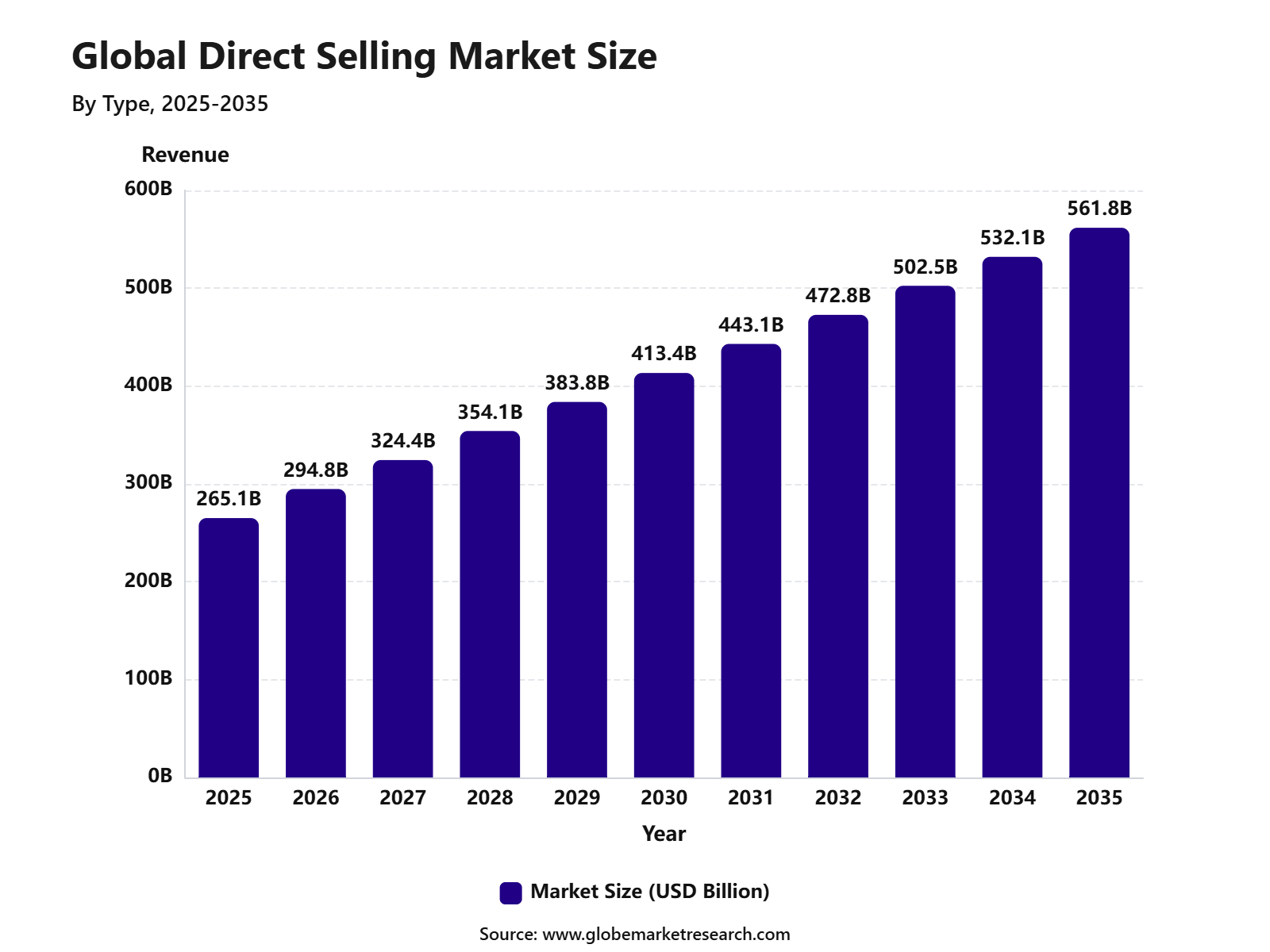 iThe graph shows projected market growth until 2035 based on CAGR analysis. Actual outcomes may vary depending on changing demand, competition, and economic factors.To gain greater insights - request a sample report PDF
Key Insight Summary
Multi-level marketing captured 71.5% share in the direct selling market, supported by strong distributor networks, personal selling models, and commission-based income opportunities.
Wellness accounted for 35.9% share, driven by rising consumer demand for health products, nutrition supplements, personal care, and preventive wellness solutions.
Asia Pacific held 39.3% share in the direct selling market, supported by a large consumer base, expanding middle-class income, and strong adoption of relationship-based selling.
The China direct selling market was valued at USD 18.5 billion and is projected to grow at a CAGR of 23.1% .
The global direct selling workforce reached 104.3 million independent representatives in 2024, showing a slight increase of 0.1% from the previous year.
The leading age groups in the global direct selling workforce were 35 to 44 years and 45 to 54 years, each accounting for 24.1% of representatives.
Younger adults aged 25 to 34 years represented 16.4% of the direct selling workforce, showing continued interest from digitally active income-seeking groups.
India’s direct selling sector reportedly crossed INR 30,000 crore in 2025-26, rising from about INR 3,000 crore in 2015, which indicates nearly 10 times growth in a decade.
By Type: Multi-Level Marketing
Multi-level marketing led the Direct Selling Market with 71.5% share, supported by its wide distributor network, person-to-person selling model, and commission-based earning structure. This model is commonly used for products that benefit from personal explanation, product trials, referrals, and community-based selling. It allows companies to expand consumer reach without depending fully on physical retail stores.
The segment remains strong because independent sellers can build repeat customers through trust, product knowledge, and regular engagement. The growth of multi-level marketing is also supported by digital tools that help sellers manage leads, payments, product information, and customer follow-ups. Social media, messaging apps, and online communities have made distributor-led selling more scalable and easier to manage.
However, compliance and transparency remain important, especially in markets where regulators closely monitor compensation models and recruitment practices. In China, direct selling is permitted under a regulated licensing framework, while pyramid-style selling remains prohibited, making governance a key factor for market participation.
By Application: Wellness
Wellness accounted for 35.9% share of the Direct Selling Market, supported by rising consumer demand for nutrition products, supplements, weight management products, personal care, and preventive health solutions. Direct selling works well in wellness because consumers often prefer product guidance, demonstrations, and personal recommendations before purchase.
Sellers can explain usage, benefits, routines, and product combinations in a more personalised way than standard retail. This has helped wellness remain one of the strongest application areas in direct selling. The segment is also gaining from higher awareness of healthy lifestyles, immunity, fitness, and self-care. Wellness products often support repeat purchases, which helps distributors build long-term customer relationships.
The model is especially effective when products require trust, education, and regular use. Public industry data also shows that Asia Pacific remains a major direct selling region, which supports wellness demand across markets with large consumer bases and growing health awareness.
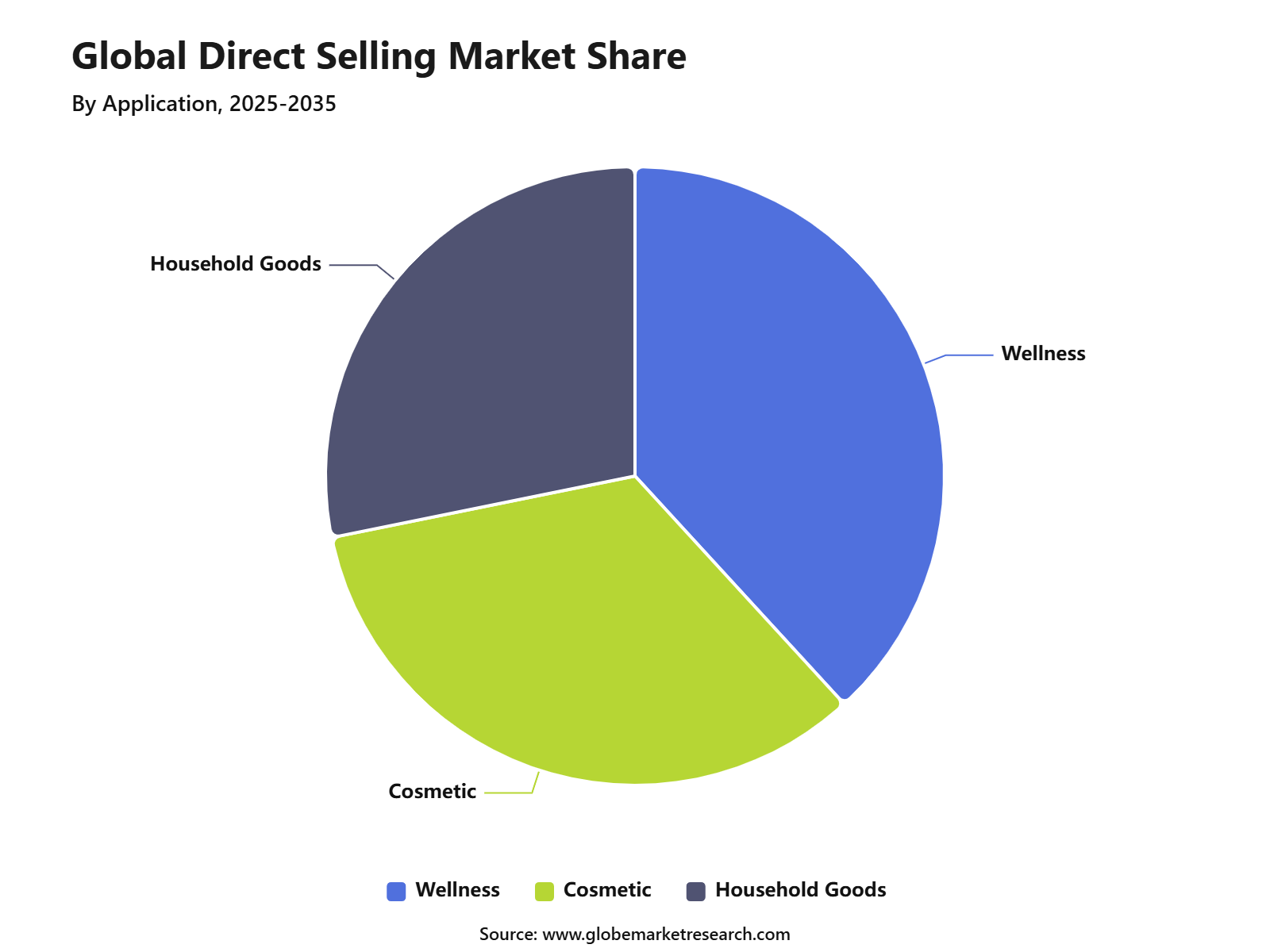 iThe graph shows projected market growth until 2035 based on CAGR analysis. Actual outcomes may vary depending on changing demand, competition, and economic factors.To gain greater insights - request a sample report PDF
Regional Insights
Asia Pacific held 39.3% share of the Direct Selling Market, supported by a large consumer base, strong community-led selling culture, rising wellness demand, and growing use of digital selling tools. The region includes several major direct selling markets, including China, Japan, South Korea, India, Indonesia, Thailand, and Malaysia.
Direct selling has remained relevant in the region because many consumers value personal product recommendations and relationship-based purchasing. WFDSA data cited in public industry coverage shows that Asia Pacific accounted for about 40.3% of global direct selling retail sales in 2024, which supports the region’s leading role.
Region | Market Share (%) |
|---|---|
Asia Pacific | 39.3% |
North America | 27.4% |
Europe | 20.8% |
Latin America | 7.1% |
Middle East & Africa | 5.4% |
The region’s growth is also supported by increasing smartphone use and social commerce adoption. Distributors are using online platforms to share product information, manage orders, and engage customers more efficiently. This has helped direct selling move beyond traditional in-person meetings and home demonstrations. As consumers continue to buy wellness, beauty, personal care, and household products through trusted seller networks, Asia Pacific is expected to remain a key regional market.
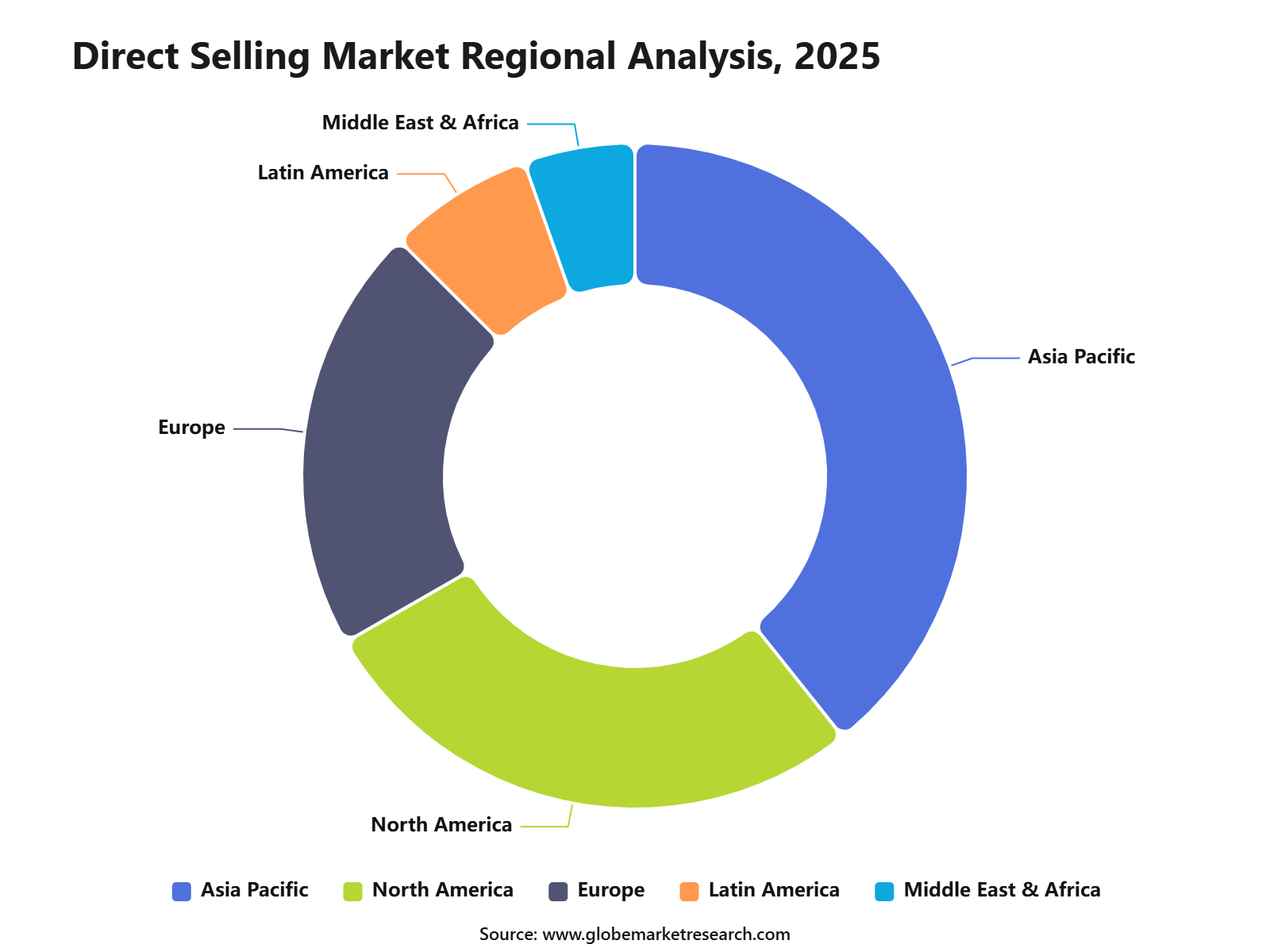 iThe graph shows projected market growth until 2035 based on CAGR analysis. Actual outcomes may vary depending on changing demand, competition, and economic factors.To gain greater insights - request a sample report PDF
China Direct Selling Market
China is a key market within Asia Pacific, with the Direct Selling Market valued at USD 18.5 billion and expected to grow at a CAGR of 23.1% . Growth is supported by rising consumer interest in wellness, nutrition, personal care, and health-related products. China also has a large urban consumer base and strong digital commerce infrastructure, which can support product discovery and distributor engagement.
China’s direct selling environment is shaped by strict oversight, licensing requirements, and clear separation between legal direct selling and illegal pyramid selling. This makes compliance, product quality, consumer protection, and transparent compensation practices essential for long-term growth.
Public WFDSA data shows that China remained one of the largest Asia Pacific direct selling markets, with USD 15.55 billion in retail sales in 2024. This confirms China’s important position in the regional direct selling industry, even as companies continue to adjust to changing regulations and consumer expectations.
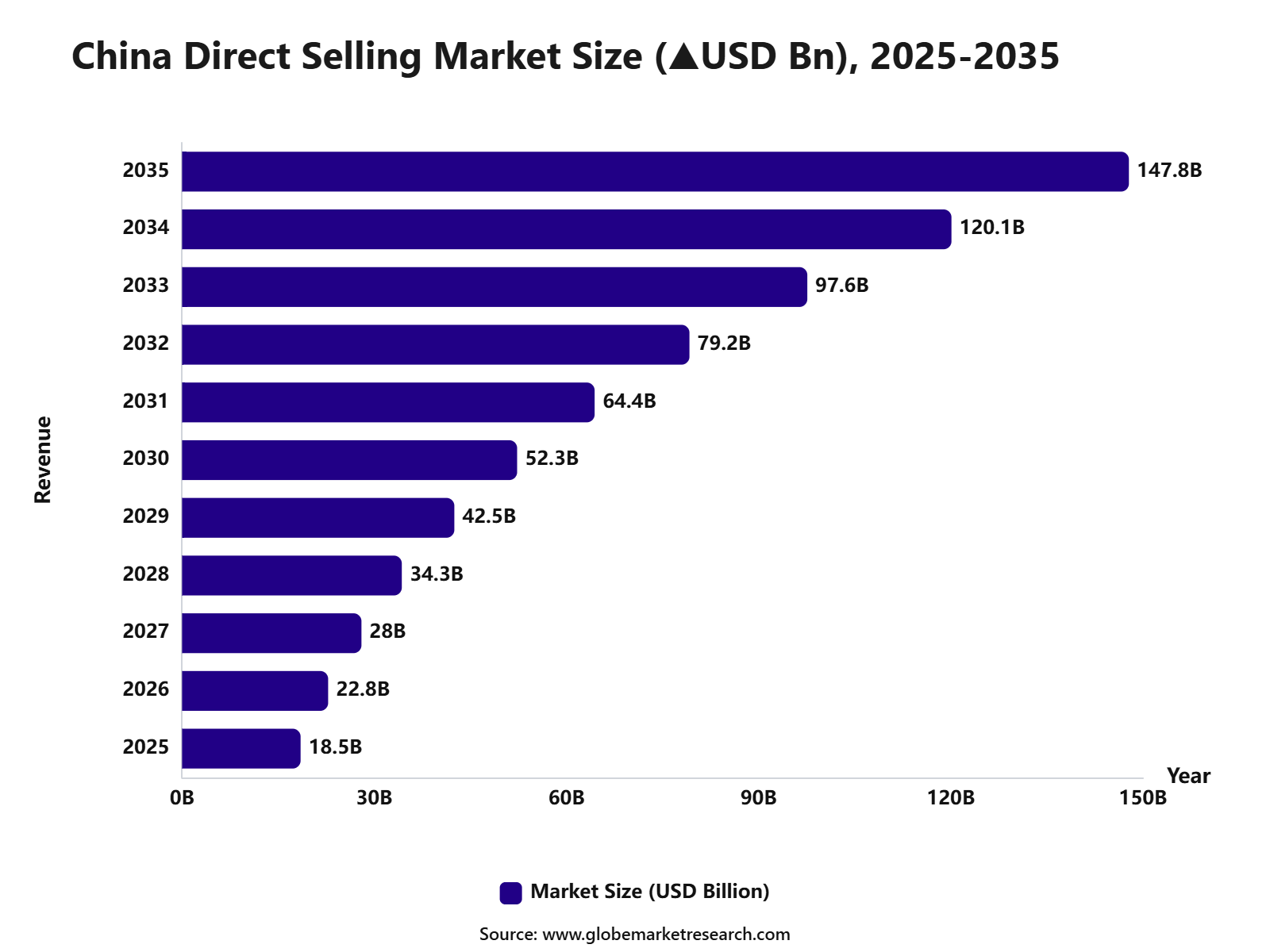 iThe graph shows projected market growth until 2035 based on CAGR analysis. Actual outcomes may vary depending on changing demand, competition, and economic factors.To gain greater insights - request a sample report PDF
Top 10 Direct Selling Markets, 2026 (USD Mn)
Rank | Direct Selling Market | Estimated 2026 Market Size (USD Mn) | Estimated Global Share |
|---|---|---|---|
1 | United States | 62,872 | 22.0% |
2 | Germany | 34,293 | 12.0% |
3 | China | 20,005 | 7.0% |
4 | South Korea | 28,578 | 10.0% |
5 | Malaysia | 17,147 | 6.0% |
6 | Japan | 17,147 | 6.0% |
7 | Brazil | 14,289 | 5.0% |
8 | Mexico | 11,431 | 4.0% |
9 | France | 8,573 | 3.0% |
10 | Taiwan | 8,573 | 3.0% |
Drivers Impact Analysis
Impact Factor | Estimated CAGR Impact | Regional Relevance | Market Impact |
|---|---|---|---|
Rising demand for personalized selling | +2.1% | Global, Asia Pacific, North America | Strengthens customer engagement. |
Growth of wellness and beauty products | +2.4% | Asia Pacific, North America, Europe | Drives product-based sales. |
Expansion of digital selling channels | +1.9% | Global | Improves distributor reach. |
Increasing women entrepreneurship | +1.7% | India, China, Southeast Asia, Latin America | Expands seller participation. |
Growth of social commerce | +1.8% | Asia Pacific, U.S., Brazil, Mexico | Supports online direct selling. |
Restraints Impact Analysis
Impact Factor | Estimated CAGR Impact | Regional Relevance | Market Impact |
|---|---|---|---|
Regulatory scrutiny on MLM models | -1.4% | U.S., Europe, China, India | Increases compliance pressure. |
Consumer trust concerns | -1.2% | Global | Slows new customer acquisition. |
High distributor attrition | -1.1% | Global | Reduces salesforce stability. |
Competition from e-commerce platforms | -1.3% | Global | Limits product differentiation. |
Income uncertainty for sellers | -0.9% | Emerging markets | Affects distributor retention. |
Opportunities Impact Analysis
Impact Factor | Estimated CAGR Impact | Regional Relevance | Market Impact |
|---|---|---|---|
Growth in health and nutrition products | +2.3% | U.S., China, India, Japan, Brazil | Creates strong category demand. |
Expansion of beauty and personal care | +2.0% | Asia Pacific, Europe, Latin America | Supports repeat purchases. |
Adoption of social selling tools | +1.8% | Global | Improves seller productivity. |
Rising demand in emerging markets | +1.9% | India, Indonesia, Vietnam, Brazil, Africa | Opens new growth areas. |
Direct-to-consumer brand partnerships | +1.6% | North America, Europe, Asia Pacific | Expands product distribution. |
Challenges Impact Analysis
Impact Factor | Estimated CAGR Impact | Regional Relevance | Market Impact |
|---|---|---|---|
Mis-selling and compliance risks | -1.2% | Global | Affects brand reputation. |
Distributor training gaps | -0.9% | Emerging markets | Reduces sales quality. |
Market saturation in mature regions | -1.0% | U.S., Europe, Japan | Limits new growth. |
Product quality concerns | -0.8% | Global | Weakens customer loyalty. |
Digital transition barriers | -0.7% | Traditional seller networks | Slows online adoption. |
Key Market Segments
By Type
Single-level Marketing
Multi-level Marketing
By Application
Wellness
Cosmetics
Household Goods
Key Regions and Countries
North America
US
Canada
Europe
Germany
France
The UK
Spain
Italy
Rest of Europe
Asia Pacific
China
Japan
South Korea
India
Australia
Singapore
Rest of Asia Pacific
Latin America
Brazil
Mexico
Rest of Latin America
Middle East & Africa
South Africa
Saudi Arabia
UAE
Rest of MEA
Recent Developments
February 2026: Herbalife reported USD 1.3 billion in Q4 2025 net sales, up 6.3% year over year. Full-year 2025 net sales reached USD 5.0 billion , supported by nutrition product demand and market recovery.
November 2025: Zinzino acquired a 35% stake in Xion International Group. The deal was aimed at strengthening omega-3 oil and spirulina production capacity.
October 2025: Amway announced a USD 12 million investment in India. The funding is planned for store expansion, distributor capability building, and stronger local market presence.
Report Scope
Report Highlights | Details |
|---|---|
Market Revenue (2025) | USD 265.1 Bn |
Forecast Revenue (2035) | USD 561.8 Bn |
CAGR (2025-2035) | 7.8% |
Base Year for Estimation | 2025 |
Historic Data | 2020-2024 |
Forecast Period | 2025-2035 |
Report Coverage | AI impact analysis, Revenue projections, company positioning, competitive analysis, growth drivers, and emerging market trends |
Segments Covered | By Type (Single-level Marketing and Multi-level Marketing), By Application (Wellness, Cosmetics and Household Goods) |
Regional Analysis | Europe – Germany, France, The UK, Spain, Italy, Russia, Netherlands, Rest of Europe; North America – US, Canada; Asia Pacific – China, Japan, South Korea, India, New Zealand, Singapore, Thailand, Vietnam, Rest of Latin America; Latin America – Brazil, Mexico, Rest of Latin America; Middle East & Africa – South Africa, Saudi Arabia, UAE, Rest of MEA |
Key companies profiled | Amway Enterprises Pvt. Ltd.; Herbalife Nutrition Ltd.; Natura & Co.; Vorwerk; Nu Skin Enterprises; Tupperware Brands Corporation; Oriflame Holding AG; Belcorp Corporation; and Mary Kay Inc. |
Customization Scope | Tailored insights for specific regions, countries, and market segments can be provided. Additional report customization is available upon request. |
Competitive Landscape
The market is characterized by intense competition among established players and emerging companies. Strategic partnerships, mergers and acquisitions, and product innovation are key strategies employed by market participants.
Key Market Players
Amway Enterprises Pvt. Ltd.
Herbalife Nutrition Ltd.
Natura & Co.
Nu Skin Enterprises
Tupperware Brands Corporation
Oriflame Holding AG
Belcorp Corporation
Torrent Pharmaceuticals Ltd.
Mary Kay Inc.
Vorwerk
Others
Meet the Team
This report was prepared by our expert analysts with deep industry knowledge and research experience.
Pratiksha is market research analyst with strong experience in industry research, market forecasting, and competitive analysis. She specializes in identifying market trends, evaluating growth opportunities, and preparing data-driven insights across global industries. Her work supports businesses in understanding market dynamics, customer demand, regional opportunities, and strategic investment areas.
Suraj is a Senior Management Consultant with over 7 years of experience in market research, business strategy, and consulting. He has worked with Fortune 500 companies and growing startups, helping them with market entry, cross-border expansion, demand analysis, competitive assessment, and growth planning. His analytical thinking and strong industry knowledge help clients make clear, confident, and informed business decisions.
Frequently Asked Questions
Related Reports
More in Consumer Goods
Pet Toys Market to hit USD 35.6 billion by 2035
Global Pet Toys Market Size, Share Analysis By Product Type (Plush, Rope, Balls, Others), By Pet Type (Dogs, Cats, Others), By Distribution Channel (Offline, Online), By Regional Insights, Business plan and Project Report, Investment Opportunities, Profitability, Industry Trends, Leading Companies and Growth Forecasts By 2025-2035
Black Hair Care Market to hit 17.1 Bn by 2035
Global Black Hair Care Market By Product Type (Shampoo, Conditioner, Hair Dye, Hair Oils, Hair Serums, Others.), By Application (Household, Commercial Use, Salons, Beauty Parlors, Professional Hair Care Services), By Distribution Channel (Offline Stores, Online Platforms, Supermarkets and Hypermarkets, Specialty Beauty Stores, Retail Stores, Pharmacies, Direct-to-Consumer Channels), By End User (Women, Men, Kids, Professional Stylists, Salons), By Hair Concern (Dryness and Moisture Retention, Scalp Health, Breakage Repair, Curl Definition, Frizz Control, Protective Styling, Hair Growth Support, Chemical-Free Hair Care), By Regional Insights, Business plan and Project Report, Investment Opportunities, Profitability, Industry Trends, Leading Companies and Growth Forecasts by 2025-2035
Halloween Costumes Market to hit 12.2 Bn by 2035
Global Halloween Costumes Market By Product Type (Adult Costumes, Kids Costumes, Pet Costumes, Accessories), By Theme (Superheroes, Movies and TV Characters, Horror, Fantasy, Historical, Others), By Distribution Channel (Online Stores, Specialty Stores, Supermarkets and Hypermarkets, Others), By Regional Insights, Business plan and Project Report, Investment Opportunities, Profitability, Industry Trends, Leading Companies and Growth Forecasts by 2025-2035
Residential Air Purifier Market to Surpass USD 42.1 Billion by 2035
Global Residential Air Purifier Market Size, Share Analysis Report By Product Type (Portable Air Purifiers, Whole-House Air Purifiers, Desktop Air Purifiers), By Technology (HEPA Filtration, Activated Carbon Filtration, UV-C Purification, Ionic Filtration, Hybrid Filtration), By Application (Dust and Allergen Removal, Smoke and Odor Control, Pet Dander Removal, Mold and Bacteria Reduction), By Regional Insights, Business plan and Project Report, Investment Opportunities, Profitability, Industry Trends, Leading Companies and Growth Forecasts by 2025-2035