

Revenue, 2026
USD 167.3 Bn
Forecast, 2035
USD 280.3 Bn
CAGR, 2026-2035
5.9%
Report Coverage
Global
Market Size and Forecast
The Global Ferroalloys Market was worth USD 167.3 billion in 2026 and is expected to reach USD 280.3 billion by 2035, growing at a CAGR of 5.9% from 2026 to 2035. Asia Pacific held the largest regional share of 53.8% in 2026, valued at around USD 90.0 billion, supported by strong steel production, infrastructure development, automotive manufacturing, construction activity, and industrial metal demand.
The Ferroalloys Market includes ferrochrome, ferromanganese, ferrosilicon, silicomanganese, ferronickel, and other alloying materials used mainly in steel and stainless-steel production. These materials help improve hardness, corrosion resistance, strength, heat resistance, and overall metal performance. Ferroalloys are widely used across construction, transportation, machinery, energy, shipbuilding, railways, and heavy industrial applications.
Market growth is being supported by rising demand for high-quality steel in infrastructure, automobiles, power projects, and manufacturing. Steel producers use ferroalloys to improve product durability, performance, and chemical composition during production. Demand is also increasing as stainless steel, specialty steel, and low-alloy steel remain important for buildings, equipment, pipelines, industrial tools, and renewable energy infrastructure.
Key Parameter | Report Details |
|---|---|
Market Revenue, 2026 | USD 167.3 Billion |
Projected Revenue, 2035 | USD 280.3 Billion |
CAGR (2026-2035) | 5.9% |
Largest Region | Asia Pacific (53.8%, USD 90.0 Bn) |
Fastest Growing Region | North America |
Market Concentration | Medium |
Base Year | 2025 |
Forecast Period | 2026-2035 |
Asia Pacific is expected to remain the leading region due to its large steel manufacturing base and strong consumption from China, India, Japan, South Korea, and Southeast Asian markets. Regional growth is supported by urbanization, industrial expansion, public infrastructure spending, and export-oriented manufacturing. Long-term market growth will depend on raw material availability, energy costs, environmental regulations, stable steel demand, and cleaner ferroalloy production technologies.
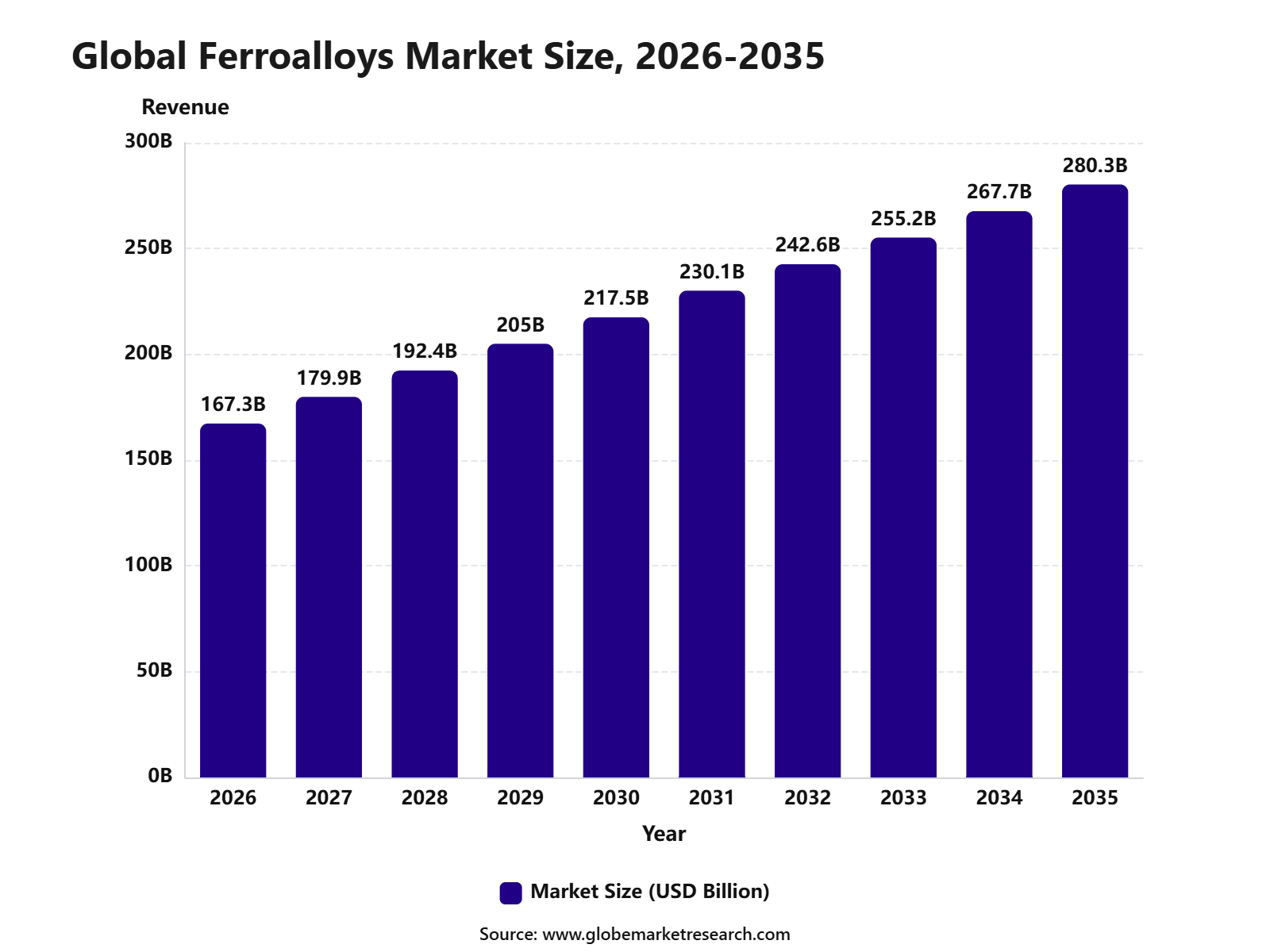 iThe graph shows projected market growth until 2035 based on CAGR analysis. Actual outcomes may vary depending on changing demand, competition, and economic factors.To gain greater insights - request a sample report PDF
Key Market Insights
Ferro silico manganese led the type segment with 47.2% share, supported by its strong use in steelmaking for improving strength, hardness, deoxidation, and alloy performance.
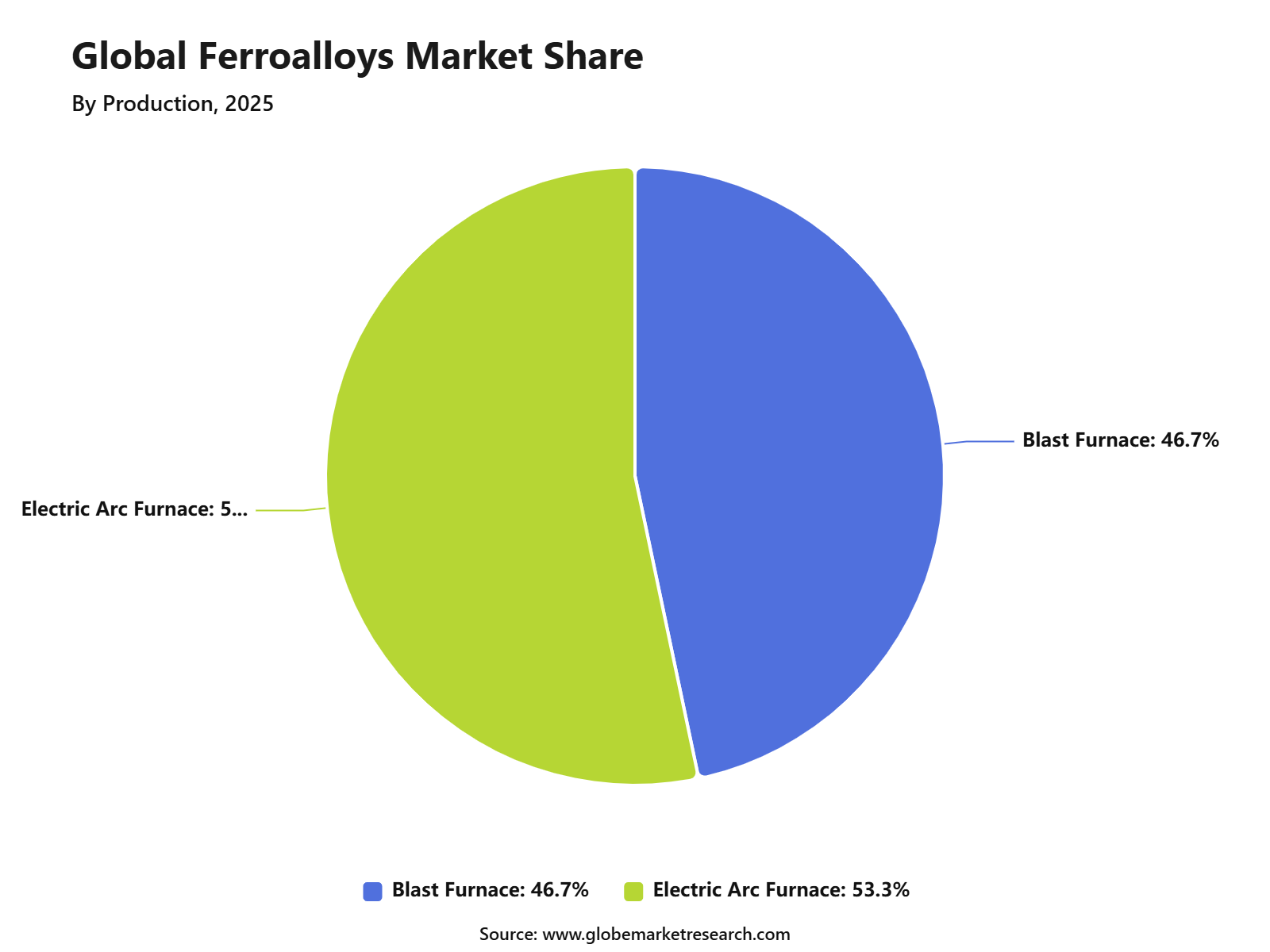
Electric arc furnace production accounted for 53.3% share, driven by energy-efficient steel production, scrap recycling, flexible operations, and strong use in ferroalloy manufacturing.
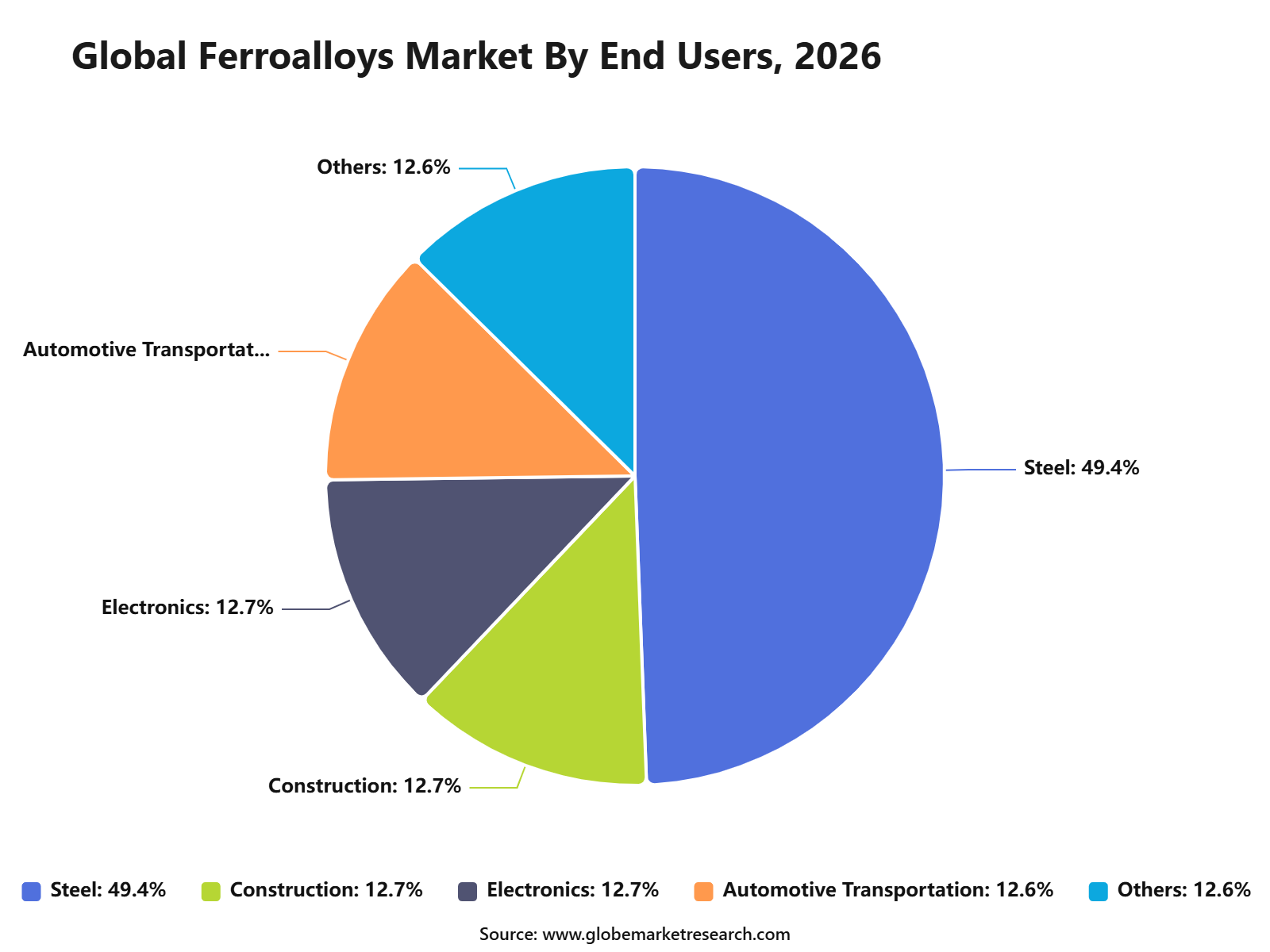
Steel end users held 49.4% share, supported by high ferroalloy consumption in carbon steel, stainless steel, construction steel, automotive steel, and industrial metal production.
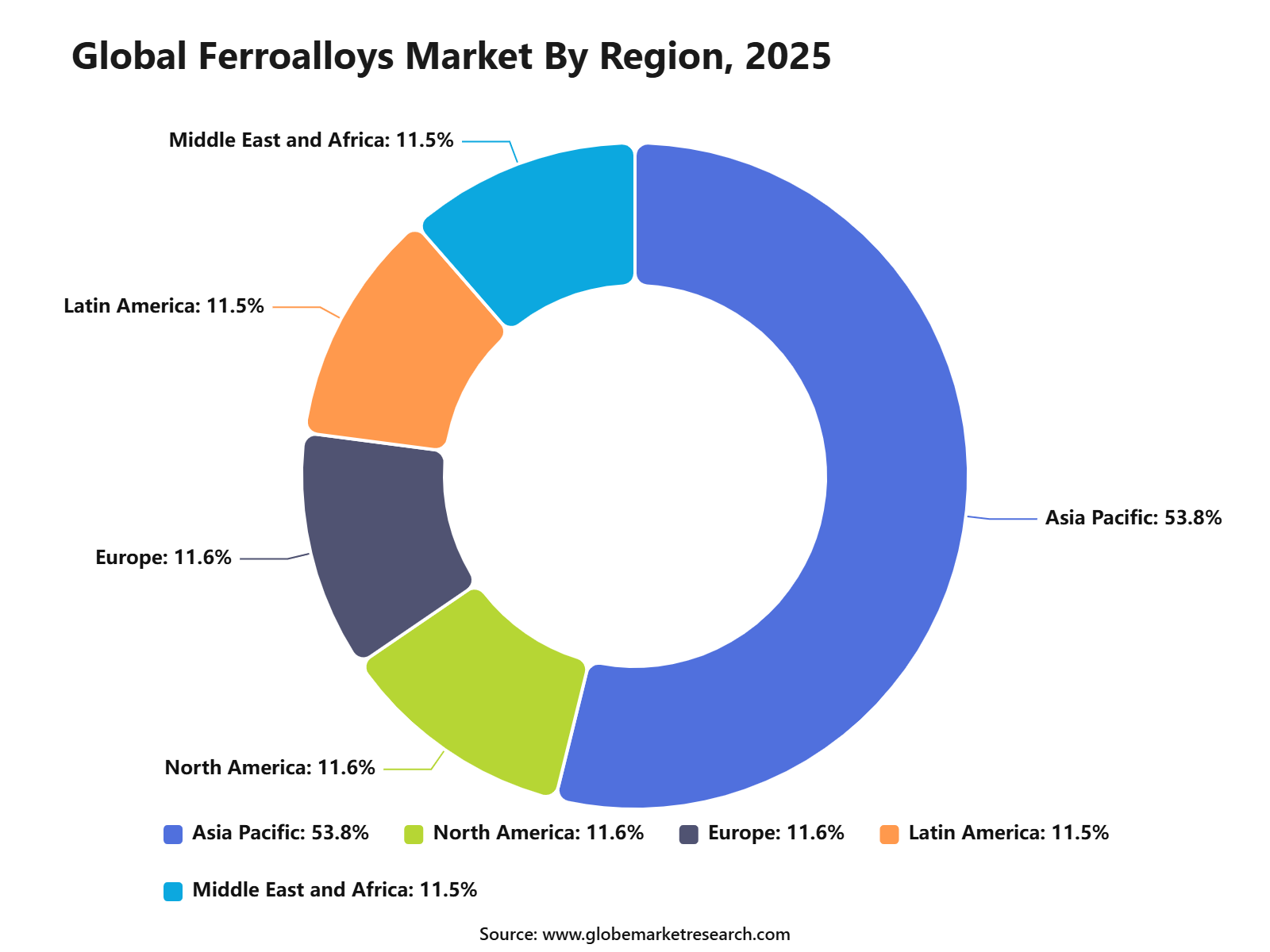
Asia Pacific led the ferroalloys market with 53.8% share, valued at USD 90.0 billion, supported by large steel production capacity, strong construction demand, expanding manufacturing activity, and high consumption across China, India, Japan, and Southeast Asia.
Top Funding and Investment
Top Investments
In October 2025, Outokumpu approved an approximately USD 45 million investment in a New Hampshire, U.S., pilot plant for enriched ferrochrome and chromium metal. The facility will scale production from one kilogram to approximately one tonne per day and is scheduled to begin operations during the first half of 2027. A successful pilot could support a future commercial plant with around 10,000 tonnes of annual capacity.
In April 2025, AMG Critical Materials approved a USD 15 million investment in an aluminothermic chrome-metal production facility in New Castle, Pennsylvania. The plant will have annual capacity of up to 6,500 tonnes and was scheduled to become operational during the first quarter of 2026, establishing domestic U.S. production of chrome metal used in specialised industrial alloys.
In 2025, Eramet completed the full rebuild of the furnace at its Comilog Dunkerque silicomanganese plant in France. The modernised furnace provides annual production capacity of approximately 78,000 tonnes, making it Eramet’s largest silicomanganese furnace. The equipment can also use biocarbon alongside conventional reductants to reduce production-related carbon emissions.
In 2025, OM Holdings completed the conversion of two silicon-metal furnaces for ferrosilicon production and finished major maintenance across all 16 furnaces at its Sarawak smelting complex in Malaysia. The plant produced 191,087 tonnes of ferrosilicon and 311,791 tonnes of manganese alloys during 2025, while ferrosilicon and manganese-alloy furnace operating rates reached 98.5% and 96.4%, respectively.
In December 2025, Samancor Chrome and the Glencore-Merafe Chrome Venture committed to restoring approximately 40% of idled ferrochrome furnace capacity after reaching an electricity-support agreement with Eskom and the South African government. The companies also agreed to suspend planned workforce reductions once an interim electricity tariff was implemented.
Top Funding Developments
In October 2025, the Tasmanian government provided a AUD 20 million loan to finance manganese-ore purchases for the Liberty Bell Bay manganese alloy smelter. The funding paid for a new ore shipment intended to maintain operations at Australia’s only commercial ferromanganese and silicomanganese production facility, which employed approximately 250 workers.
During 2026, Australia’s federal and Tasmanian governments provided a combined AUD 9.6 million to support wages and maintain the Liberty Bell Bay smelter while administrators searched for a buyer. The package included emergency support designed to retain the workforce and preserve the ferroalloy facility during its voluntary administration process.
In March 2026, the Liberty Bell Bay manganese smelter received a separate AUD 3 million emergency wage loan after entering voluntary administration. The financing was used to prevent immediate workforce reductions and maintain the facility while restructuring and buyer discussions continued.
Top Acquisitions
In June 2025, Khwelamet, owned by Menar Capital and Ntiso Investment Holdings, completed the acquisition of the Metalloys manganese alloy smelter complex in Gauteng, South Africa. Khwelamet acquired full ownership of the smelting site, furnaces, land, processing infrastructure and associated manganese-alloy production assets previously held through South32’s Samancor Manganese business.
In February 2026, OM Holdings completed the sale of its 26% interest in Ntsimbintle Mining for approximately ZAR 1.95 billion, equivalent to nearly USD 120 million. Exxaro obtained OM Holdings’ stake in the South African manganese business, providing upstream exposure to manganese ore assets that supply the ferroalloy and steelmaking value chains.
By Type
Ferro silico manganese accounted for 47.2% share of the Ferroalloys Market. This leading position is supported by its wide use in steelmaking, where it works as both a deoxidizer and alloying agent to improve steel strength, hardness, and durability.
The segment is widely preferred because ferro silico manganese helps remove oxygen and sulfur from molten steel while adding manganese and silicon content. It is used in carbon steel, stainless steel, alloy steel, construction steel, and automotive-grade steel production.
Demand is expected to remain strong as steel producers continue to require cost-effective alloying materials for high-volume production. Growth will be supported by infrastructure development, automotive manufacturing, machinery production, and rising demand for stronger and more durable steel products.
By Production
Electric arc furnace production accounted for 53.3% share of the Ferroalloys Market. This dominance is driven by its high suitability for producing ferroalloys using controlled heat, recycled inputs, and precise metallurgical processing.
Electric arc furnaces are widely used because they can reach very high temperatures and support efficient melting of ores, coke, scrap, and alloying materials. This method is important for producing ferro manganese, ferro silicon, ferro chrome, and ferro silico manganese.
The segment is expected to maintain its leading position as producers focus on efficiency, quality control, and flexible production. Demand will remain supported by steel industry requirements, furnace modernization, and the need for reliable ferroalloy output across global manufacturing markets.
 iThe graph shows projected market growth until 2035 based on CAGR analysis. Actual outcomes may vary depending on changing demand, competition, and economic factors.To gain greater insights - request a sample report PDF
By End Users
The steel industry accounted for 49.4% share of the Ferroalloys Market. This leading position is supported by the essential use of ferroalloys in improving steel quality, strength, corrosion resistance, heat resistance, and wear performance.
Ferroalloys are used in the production of construction steel, automotive steel, tool steel, stainless steel, electrical steel, and specialty alloy steel. They help manufacturers achieve the required chemical composition and mechanical properties for different end-use applications.
Demand from the steel sector is expected to remain strong as construction, transport, machinery, energy, and infrastructure industries continue to expand. Ferroalloys will remain critical in steelmaking because they directly influence product performance and manufacturing consistency.
 iThe graph shows projected market growth until 2035 based on CAGR analysis. Actual outcomes may vary depending on changing demand, competition, and economic factors.To gain greater insights - request a sample report PDF
By Region
Asia Pacific accounted for 53.8% share of the Ferroalloys Market, reaching USD 90.0 billion. The region’s leadership is supported by large steel production capacity, strong construction activity, rising infrastructure investment, and high demand from automotive, machinery, and industrial manufacturing.
China, India, Japan, South Korea, Indonesia, Vietnam, and other regional economies are key contributors to ferroalloy consumption. The region benefits from strong availability of raw materials, large electric arc furnace operations, and expanding demand for ferro silico manganese and other alloying products.
Asia Pacific is expected to maintain its leading position as steel production, urban development, and industrial output continue to grow. Demand will remain supported by ferro silico manganese, electric arc furnace production, and the strong role of steel as the primary end-use industry.
 iThe graph shows projected market growth until 2035 based on CAGR analysis. Actual outcomes may vary depending on changing demand, competition, and economic factors.To gain greater insights - request a sample report PDF
Regional Impact Analysis
Asia Pacific leads the Ferroalloys Market with 53.8% share in 2026, valued at around USD 90.0 billion, supported by large steel production, infrastructure development, construction activity, stainless steel demand, and industrial manufacturing. China, India, Japan, South Korea, and Southeast Asia remain major regional markets.
Europe remains important because of stainless steel, automotive-grade steel, machinery, and low-carbon production requirements. North America supports steady demand from infrastructure renewal, automotive manufacturing, energy equipment, and specialty steel applications.
Impact Factor | Estimated CAGR Impact | Regional Relevance | Market Impact |
|---|---|---|---|
Asia Pacific market leadership | +1.9% | Asia Pacific, 53.8% share in 2026 | Leads global value demand. |
China steel production scale | +1.5% | China | Drives high-volume ferroalloy use. |
India infrastructure and steel growth | +1.2% | India | Supports future demand expansion. |
Japan and South Korea specialty steel demand | +0.9% | Japan, South Korea | Adds premium alloy use. |
Europe and North America specialty demand | +0.7% | Germany, U.S., Canada, France | Supports high-quality alloy applications. |
Steel Production Drives Ferroalloy Demand
Steel production is the most important factor influencing the Ferroalloys Market because ferrochrome, ferromanganese, ferrosilicon and other alloys improve steel strength, hardness, corrosion resistance and manufacturing performance. Global crude steel production reached 1,849.4 million tonnes in 2025. In May 2026, steelmakers produced 157.9 million tonnes, while India’s March output rose 9.4% to 15.3 million tonnes and U.S. production increased 5.2% to 7.2 million tonnes. These volumes maintain strong requirements for alloying materials across construction, automotive, machinery and infrastructure applications.
Electricity cost is another important factor because ferroalloy smelting depends on power-intensive electric furnaces. The U.S. industrial electricity price averaged 8.62 cents per kilowatt-hour in 2025 and reached 8.66 cents per kilowatt-hour in April 2026, increasing 5.5% from the previous April. Higher power costs can raise ferroalloy production expenses, especially for energy-intensive ferrochrome and ferrosilicon plants. Producers therefore need efficient furnaces, reliable ore supply and lower-cost electricity to protect margins while serving steel demand.
Go-To-Market and Sales Economics
Ferroalloy suppliers should sell directly to steel mills, foundries, stainless-steel producers, and engineering groups through specification-based contracts. World crude steel production reached 157.9 million tonnes in May 2026, including 84.4 million tonnes in China and 14.1 million tonnes in India. Regional account teams, technical trials, and indexed pricing can improve conversion and order visibility.
Sales portfolios should combine standard ferromanganese, silicomanganese, ferrosilicon, ferrochrome, and specialised low-carbon grades. Ferroglobe shipped 85,743 tonnes of manganese-based alloys and 60,674 tonnes of silicon-based alloys in the first quarter of 2026. Offering multiple chemistries, smaller trial lots, and reliable delivery schedules can increase customer share across steel and foundry applications.
Long-term agreements should link alloy prices to ore, electricity, freight, and currency movements because conversion costs can change quickly. Ferroglobe’s manganese-alloy selling price increased 9.0% quarter over quarter in early 2026, while shipments rose 6.1%. Price-adjustment formulas, customer forecasts, and local inventories can protect margins while reducing supply interruptions for steelmakers.
Risk Factors & Market Barriers
Weak steel demand and global overcapacity can reduce alloy prices and furnace utilisation. The OECD expects steel excess capacity to reach 745 million tonnes by 2028, while demand growth remains near 0.9% annually. Producers should avoid unsupported expansion, diversify customers, and use flexible furnace scheduling to limit fixed-cost pressure during periods of oversupply and aggressive export competition.
Electricity availability is a major barrier because submerged-arc furnaces require continuous, high-volume power. Glencore produced only 13,000 tonnes of ferrochrome in the first quarter of 2026, down 95% year over year, as smelting operations remained largely under care and maintenance. Secure power contracts, efficient furnaces, and backup planning are therefore essential for reliable production.
Raw-material supply is highly concentrated across manganese and chromium. The 2026 USGS summaries estimated that South Africa produced 7.6 million tonnes of manganese content and 23 million tonnes of chromite ore in 2025. They also estimated that 95% of chromium resources are located in Kazakhstan and southern Africa. Multi-origin sourcing can reduce disruption exposure.
Revenue Potential Analysis
Revenue Landscape Across
Asia provides the largest volume opportunity because steel production is concentrated in China and India. In May 2026, Asia and Oceania produced 116.2 million tonnes of crude steel, representing nearly three-quarters of reported global output. Suppliers can develop revenue through local alloy plants, bonded inventory, mill-specific grades, and contracts serving construction, automotive, machinery, and infrastructure steel.
North America offers higher-value opportunities in domestic alloys, stainless steel, foundries, and secure supply chains. Regional crude steel production increased 15.6% year over year to 10.1 million tonnes in May 2026. Suppliers can target premium low-carbon alloys, traceable material, technical service, and shorter lead times where buyers are reducing dependence on distant import sources.
Specialised alloying creates revenue beyond bulk carbon steel. The 2026 USGS summaries reported that more than 90% of U.S. vanadium consumption was metallurgical, while stainless and heat-resistant steel producers were the leading ferrochrome users. High-purity ferrovanadium, low-carbon ferrochrome, and customised silicon alloys can earn stronger margins in automotive, aerospace, energy, and tooling applications.
Financial Impact
Product mix can materially change earnings even when total volumes rise. Ferroglobe’s first-quarter 2026 manganese-alloy revenue increased 15.7% to USD 107.2 million, with adjusted EBITDA of USD 10.0 million and a 9.3% margin. Producers should prioritise grades with firm demand, pass-through pricing, and lower conversion intensity rather than pursuing tonnage without acceptable contribution.
Energy, ore, and logistics costs remain the central financial variables. Ferroglobe reported that raw materials and energy represented 65.9% of revenue in the first quarter of 2026 when power-contract valuation effects were excluded. Furnace efficiency, ore blending, yield improvement, freight optimisation, and disciplined maintenance can therefore produce substantial changes in operating margin and cash generation.
Working-capital demands can remain high because producers must finance ore, reductants, finished alloy inventories, and customer credit. Ferroglobe ended March 2026 with USD 431.2 million of working capital and USD 54.6 million of net debt. Advance payments, inventory limits, credit controls, and shorter cash cycles are required to support growth without weakening balance-sheet resilience.
Drivers Impact Analysis
The Ferroalloys Market is driven by rising steel production, stainless steel demand, infrastructure development, automotive manufacturing, construction activity, and industrial machinery output. Ferroalloys are essential in steelmaking because they improve strength, hardness, corrosion resistance, wear resistance, and heat tolerance.
Asia Pacific leads the market due to large steel production capacity, strong construction activity, automotive manufacturing, shipbuilding, infrastructure projects, and industrial metal demand. China, India, Japan, South Korea, and Southeast Asia remain key contributors because of strong steel consumption and ferroalloy processing capacity.
Impact Factor | Estimated CAGR Impact | Regional Relevance | Market Impact |
|---|---|---|---|
Rising steel production | +1.7% | Asia Pacific, Europe, North America | Drives core ferroalloy consumption. |
Growth in stainless steel demand | +1.4% | China, India, Japan, South Korea | Supports chromium and manganese alloy use. |
Infrastructure and construction growth | +1.2% | Asia Pacific and emerging markets | Adds long-term steel demand. |
Automotive and machinery manufacturing | +0.9% | Asia Pacific, Europe, North America | Supports specialty steel applications. |
Demand for high-strength steel | +0.7% | Industrial and engineering sectors | Improves ferroalloy value demand. |
Restraints Impact Analysis
The market faces restraints from volatile ore prices, high energy consumption, carbon emission pressure, logistics cost, and dependence on mining supply chains. Ferroalloy production requires manganese ore, chromite, silicon, coke, electricity, and smelting capacity, making the market sensitive to input cost movement.
Another restraint is environmental regulation. Ferroalloy smelting is energy-intensive, and producers must manage emissions, slag, dust, wastewater, and carbon reduction requirements. These factors can raise production cost and affect margins.
Impact Factor | Estimated CAGR Impact | Regional Relevance | Market Impact |
|---|---|---|---|
Raw material price volatility | -0.8% | Global ferroalloy producers | Pressures production cost. |
High electricity consumption | -0.7% | Smelting-heavy regions | Affects operating margins. |
Carbon emission regulations | -0.6% | China, Europe, India | Raises compliance cost. |
Ore supply concentration risk | -0.5% | Manganese and chromite supply chains | Creates sourcing pressure. |
Freight and logistics cost variation | -0.4% | Export and import markets | Impacts delivered prices. |
Opportunities Impact Analysis
Opportunities are strong in ferro manganese, silico manganese, ferro chrome, ferro silicon, stainless steel alloys, specialty steel applications, and low-carbon ferroalloy production. These segments benefit from rising demand for stronger, lighter, and more corrosion-resistant steels.
Higher-value opportunities are emerging in green steel supply chains, renewable-powered smelting, alloy optimization, recycling-linked metal recovery, and long-term supply contracts with steelmakers. Producers with cost-efficient smelting, reliable ore access, and cleaner production can capture stronger value.
Impact Factor | Estimated CAGR Impact | Regional Relevance | Market Impact |
|---|---|---|---|
Silico manganese demand growth | +1.6% | Asia Pacific steel mills | Builds core market opportunity. |
Ferro chrome use in stainless steel | +1.3% | China, India, Japan, Europe | Supports corrosion-resistant steel demand. |
Low-carbon ferroalloy production | +1.0% | Europe, Japan, South Korea | Adds premium sustainability value. |
Long-term steelmaker supply contracts | +0.8% | Large steel-producing regions | Improves revenue visibility. |
Metal recovery and recycling routes | +0.6% | Circular steel supply chains | Supports resource efficiency. |
Challenges Impact Analysis
The main challenge is balancing production cost with quality consistency. Ferroalloy producers must control alloy composition, impurity levels, smelting efficiency, and energy use while meeting strict steelmaker specifications.
Another challenge is managing demand cyclicality. Ferroalloy demand is closely linked to steel, construction, automotive, and industrial production cycles, so slowdowns in these sectors can reduce short-term consumption.
Impact Factor | Estimated CAGR Impact | Regional Relevance | Market Impact |
|---|---|---|---|
Maintaining alloy quality consistency | -0.7% | Ferroalloy producers | Affects customer acceptance. |
Steel industry cyclicality | -0.6% | Global steel markets | Impacts demand stability. |
Energy price uncertainty | -0.5% | Smelting operations | Raises cost risk. |
Environmental compliance complexity | -0.4% | Regulated production markets | Adds operational burden. |
Competition from low-cost suppliers | -0.3% | Asia Pacific and export markets | Pressures pricing. |
Segment Covered in the Report
By Type
Ferro-Manganese
Silico-Manganese
Ferro-Silicon
Ferro-Chrome
Ferro-Molybdenum
Ferro-Vanadium
Ferro-Tungsten
Magnesium Ferro-Silicon
Ferro-Silicon-Zirconim
Ferro-Titanium
Ferro-Boron
Ferro-Niobiumu
By Production
Blast Furnace
Electric Arc Furnace
By End Users
By Region
North America
Europe
Asia Pacific
Latin America
Middle East and Africa
Market Trend Analysis
The market trend is moving toward silico manganese, ferro chrome, low-carbon alloys, cleaner smelting processes, and integrated supply chains. Steelmakers are demanding better alloy consistency, lower impurities, and more reliable supply to support high-quality steel production.
Asia Pacific remains the largest value region because of its dominant steel production base, infrastructure demand, and industrial manufacturing scale. Europe and North America support value growth through specialty steel, stainless steel, automotive-grade steel, and low-carbon production requirements.
Impact Factor | Estimated CAGR Impact | Regional Relevance | Market Impact |
|---|---|---|---|
Silico manganese remains dominant | +1.5% | Asia Pacific steelmaking hubs | Supports high-volume consumption. |
Stainless steel production expands | +1.2% | China, India, Japan, Europe | Drives ferro chrome demand. |
Cleaner smelting gains focus | +0.9% | Europe, Japan, South Korea | Supports sustainability positioning. |
Specialty steel applications grow | +0.8% | Automotive and machinery sectors | Adds higher-value demand. |
Supply chain integration increases | +0.6% | Ore-to-alloy producers | Improves cost and supply control. |
Investor Type Impact Matrix
Investors should focus on companies with stable ore access, efficient smelting operations, strong steelmaker relationships, energy cost control, environmental compliance, and consistent alloy quality. Cost efficiency, supply reliability, and product specification control are key success factors.
Strategic investors can also target ferroalloy producers, manganese and chromite miners, smelting technology providers, emission control firms, ore beneficiation companies, and specialty steel supply chain partners. Companies that combine scale with cleaner production are better positioned for long-term growth.
Investor Type | Estimated CAGR Impact | Regional Relevance | Market Impact |
|---|---|---|---|
Ferroalloy Manufacturers | +1.3% | Asia Pacific and global markets | Expands core alloy supply. |
Manganese and Chromite Mining Firms | +1.0% | Ore-producing regions | Supports raw material security. |
Steelmaking Supply Chain Investors | +0.8% | Global steel markets | Builds integrated value. |
Energy-Efficient Smelting Technology Firms | +0.7% | Ferroalloy production hubs | Improves cost and emissions performance. |
Strategic Metals Investors | +0.5% | Global industrial metals market | Funds capacity and modernization. |
Recent Developments
November 2025: Tata Steel agreed to sell its Jajpur ferroalloy plant in Odisha to Indian Metals & Ferro Alloys for ₹610 crore. The transaction supports portfolio optimisation while transferring an operating ferrochrome asset.
March 2026: China Minmetals reported winning the Liaoning Huahonggou iron-mine project during 2025. The investment added approximately 1.895 billion tonnes of iron-ore resources and strengthened its long-term ferrous-material supply portfolio.
January 2026: Glencore reported 2025 attributable ferrochrome production of 436,000 tonnes, down 63%, after suspending Boshoek and Wonderkop smelters during May and June 2025 amid difficult operating economics and market conditions.
Competitive Landscape
The market is characterized by intense competition among established players and emerging companies. Strategic partnerships, mergers and acquisitions, and product innovation are key strategies employed by market participants.
Key Market Players
Eramet
Tata Steel
Glencore
China Minmetals Corporation
South32
Ferroglobe
Mitsubishi Corporation
OM Holdings
Manganese Metal Company
Ferro Alloys Corporation
Jindal Stainless
Sakura Ferroalloys
Gulf Ferroalloys Company
ArcelorMittal
Vale S.A.
Other Key Players
Research Methodology
This market study is prepared using a combination of primary and secondary research. Primary research includes discussions with manufacturers, suppliers, distributors, consultants, industry experts, and end users. Secondary research covers company reports, government databases, trade associations, technical publications, regulatory sources, and trusted industry documents. The collected information is used to assess market demand, pricing trends, technology adoption, competitive activity, and regional performance.
AI language models are not used as primary data sources, and publicly available AI-generated content is not treated as market evidence. Computational tools may be used to support data processing, translation, data classification, and pattern identification. However, every published assessment is supported by verified sources, human review, and primary market discussions.
Market estimates are developed through top-down and bottom-up approaches and validated using data triangulation. Revenue, production, shipment, pricing, and application-level data are compared across multiple sources. Forecasts consider economic conditions, regulatory changes, investment activity, innovation, supply chain developments, and industry risks. All findings are reviewed through source verification and internal quality checks before publication.
Part I
Source Management & Input Data Standards
Who provides data, how sources are qualified, and what types of evidence are admissible.
Part II
Research Scope & Market Coverage
How we define the markets we assess and the parameters that govern each product.
Part III
Data Collection, Verification & Submission
The mechanics of gathering, cross-checking, and hierarchically ranking evidence.
Part IV
Assessment Determination & Quality Controls
How raw data becomes a published assessment — normalisation, expert judgement, and outlier exclusion.
Part V
Publication, Corrections & Revision
Our publication schedule, corrections policy, and methodology review cycle.
Part VI
Independence, Ethics & Complaints
Conflict-of-interest policies, editorial independence, and how clients raise concerns.
Google · Preferred Sources
Don't miss the latest market research insights and industry updates on Google.
Add Globe Market Research as a preferred source in the Google app to see our reports, analysis, and market stories in your news suggestions.
Meet the Team
This report was prepared by our expert analysts with deep industry knowledge and research experience.
Pratiksha K. is a Senior Research Analyst with more than five years of experience in market research, industry analysis, competitive intelligence, and business strategy. She has contributed to detailed market reports, customized research studies, company profiling, market sizing, trend analysis, and strategic consulting projects for clients across different regions. Her industry expertise covers Chemical and Material, Consumer Goods, Food & Beverages and Energy & Power. She closely evaluates changing customer requirements, technology developments, regulatory conditions, supply chain structures, investment activity, and competitive strategies to provide clear and practical market insights.
Sayali brings more than 7 years of experience to Globe Market Research, supporting the accuracy, clarity, and relevance of research content across multiple industries. She reviews market data, segment analysis, competitive insights, and industry trends to ensure each report meets strong quality standards and provides practical value to business decision-makers. Her expertise spans healthcare, information technology, consumer goods, and diverse cross-industry domains. With a strong focus on data reliability, structured analysis, and clear presentation, Sayali helps ensure that each research output delivers well-reviewed insights for clients, investors, consultants, and industry stakeholders.
Frequently Asked Questions
Related Reports
More in Chemical and Material
Sulfuric Acid Market to Hit USD 61.5 Billion by 2035
Sulfuric Acid Market Size, Share, Analysis By Raw Material (Elemental Sulfur, Base Metal Smelters, Pyrite Ore, Others), By Application (Fertilizers, Chemical Manufacturing, Metal Processing, Petroleum Refining, Textile, Automotive, Pulp and Paper, Others), By Distribution Channel (Direct Sales, Distributors), By Regional Insights, Business plan and Project Report, Investment Opportunities, Profitability, Industry Trends, Leading Companies and Growth Forecasts by 2026-2035
Powder Metallurgy Market to Hit USD 17.0 Billion by 2035
Powder Metallurgy Market Size, Share, Analysis By Material (Ferrous Metals, Non-Ferrous Metals, Others), By Process (Additive Manufacturing, Powder Metal Hot Isostatic Pressing, Conventional Powder Metallurgy), By Application (Automotive, Aerospace and Defense, Healthcare, Electrical and Electronics, Industrial Machinery, Others) , By Regional Insights, Business plan and Project Report, Investment Opportunities, Profitability, Industry Trends, Leading Companies and Growth Forecasts by 2026-2035
Bromine Market to Hit USD 1.5 Billion by 2035
Bromine Market Size, Share, Analysis By Derivative (Organobromine, Clear Brine Fluids, Hydrogen Bromide, Others), By Application (Flame Retardants, Oil and Gas Drilling, Biocides, PTA Synthesis, Plasma Etching, Pharmaceuticals, Energy Storage, Others), By End-Use Industry (Chemicals, Oil and Gas, Pharmaceuticals, Electrical and Electronics, Automotive, Agriculture, Others), By Regional Insights, Business plan and Project Report, Investment Opportunities, Profitability, Industry Trends, Leading Companies and Growth Forecasts by 2026-2035
Hydrogen Cyanide Market to Hit USD 5.95 Billion by 2035
Hydrogen Cyanide Market Size, Share, Analysis By Product Form (Hydrogen Cyanide Liquid, Hydrogen Cyanide Gas), By Application (Adiponitrile, Acetone Cyanohydrin, Sodium Cyanide and Potassium Cyanide, Methionine, Cyanuric Chloride, Others), By End-Use Industry (Chemicals, Mining and Metallurgy, Pharmaceuticals, Agriculture, Textiles, Others), By Regional Insights, Business plan and Project Report, Investment Opportunities, Profitability, Industry Trends, Leading Companies and Growth Forecasts by 2026-2035