

Revenue, 2025
$8.0 Bn
Forecast, 2035
$15.7 Bn
CAGR, 2025-2035
7.0%
Report Coverage
Global
Market Size and Forecast
2025
$8.0 Bn
2035
$15.7 Bn
CAGR
7.0%
The Global Marine Composites Market was valued at USD 8.0 billion in 2025 and is projected to reach USD 15.7 billion by 2035, growing at a CAGR of 7.0% during 2025 to 2035. Market growth can be attributed to the rising use of lightweight, corrosion-resistant, and high-strength composite materials in boats, yachts, commercial vessels, naval platforms, and offshore marine structures. These materials are increasingly preferred over conventional metals because they help reduce vessel weight, improve fuel efficiency, lower maintenance costs, and extend service life in harsh marine environments.
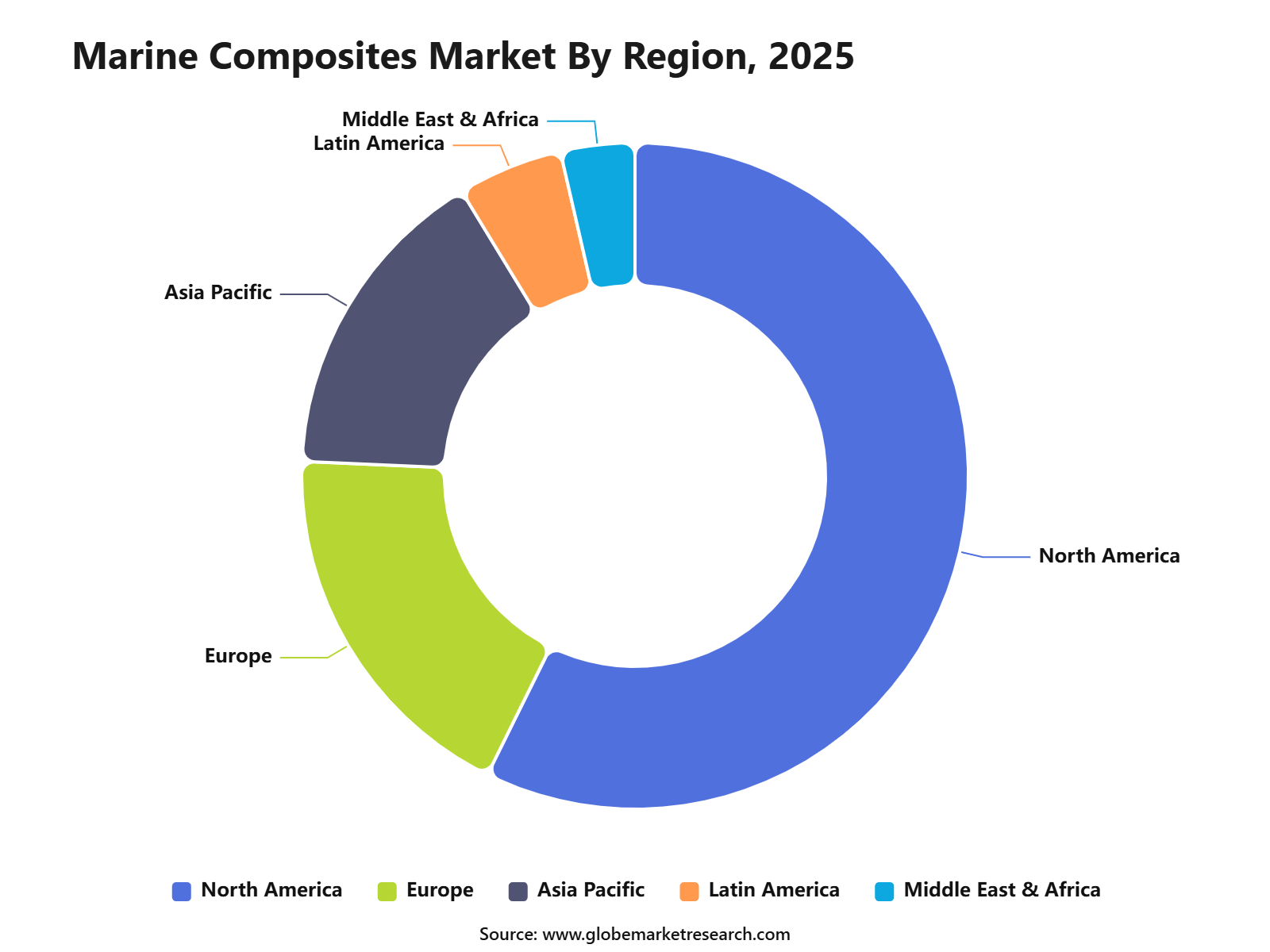
North America held the largest share of 57.3% in 2025, supported by strong demand from recreational boating, defense marine applications, advanced shipbuilding, and offshore infrastructure. The region benefits from established boat manufacturing capabilities, higher adoption of carbon fiber and glass fiber composites, and growing investment in fuel-efficient marine designs. Over the forecast period, demand is expected to remain positive as marine operators focus on durable, lightweight, and sustainable materials to improve performance, safety, and lifecycle efficiency.
Key Market Insights
Polymer-matrix composites led the market with 73.6% share, supported by their lightweight structure, corrosion resistance, high strength, and wide use in marine vessel manufacturing.
Epoxy accounted for 34.2% share by resin type, driven by strong bonding performance, durability, water resistance, and suitability for advanced marine composite applications.
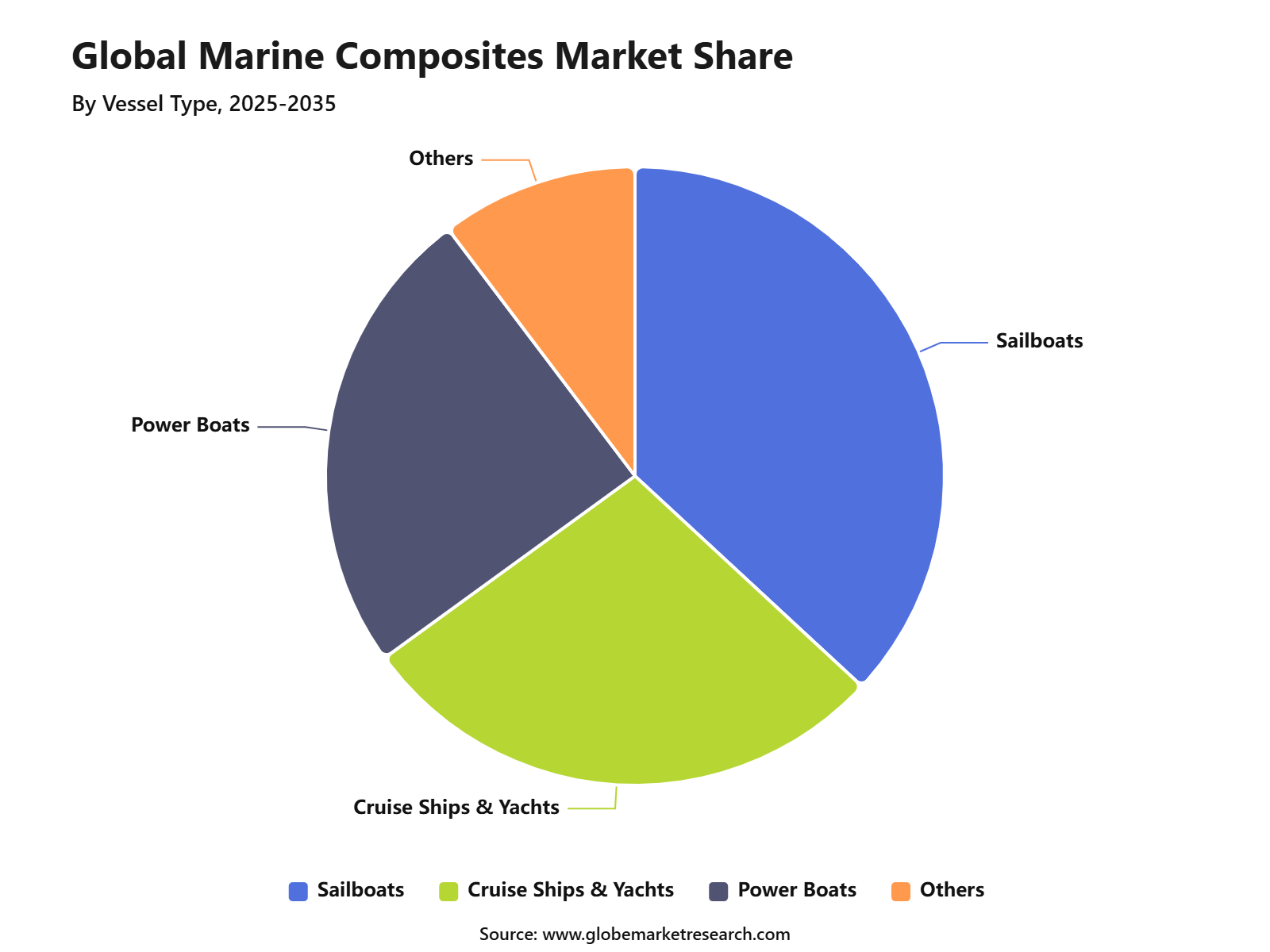
Sailboats captured 36.9% share by vessel type, supported by increasing use of composite materials to reduce weight, improve fuel efficiency, and enhance vessel performance.
North America held 57.3% share of the marine composites market, supported by strong boat manufacturing activity, advanced marine infrastructure, and rising demand for lightweight, durable marine materials.
Go-to-Market and Sales Economics
The marine composites market is strongly linked to boatbuilding, yacht manufacturing, commercial vessels, offshore structures, naval applications, and marine repair services. Marine composites are used in hulls, decks, masts, bulkheads, gratings, piping, shafts, radomes, sonar domes, and other structural parts because they offer low weight, corrosion resistance, design flexibility, and lower maintenance needs compared to many traditional materials.
Sales growth is supported by the need for lighter vessels, better fuel efficiency, longer service life, and reduced corrosion-related repair costs. In marine environments, saltwater, moisture, waves, vibration, and UV exposure create severe operating conditions. This makes glass fiber composites, carbon fiber composites, aramid fiber composites, epoxy systems, polyester resins, and vinyl ester resins important materials for vessel builders and marine component suppliers.
The commercial sales model is usually project-based and qualification-led. Boatbuilders, shipyards, naval contractors, offshore operators, and marine equipment manufacturers require materials that meet performance, safety, durability, and lifecycle cost expectations. Suppliers must provide technical data sheets, test evidence, design support, resin compatibility information, lamination guidance, and after-sales engineering support to win long-term supply contracts.
The recreational boating industry provides a strong demand base for marine composites. In the U.S., recreational boating supports USD 230 billion in annual economic impact, USD 56.7 billion in annual sales of boats, marine products and services, and more than 812,000 jobs. This creates a large downstream ecosystem for composite hulls, decks, interiors, panels, and molded parts. Since 95% of boats sold in the U.S. are made domestically, regional supply partnerships with boat manufacturers remain important for material suppliers.
Composite Type Analysis
Polymer-matrix composites led the Marine Composites Market with 73.6% share, supported by their strong use in hulls, decks, masts, interiors, superstructures, and other vessel components. These composites are preferred because they offer high strength-to-weight ratio, corrosion resistance, design flexibility, and lower maintenance needs in harsh marine environments.
The growth of this segment can be attributed to rising demand for lightweight and durable marine materials. Polymer-matrix composites help improve vessel performance, reduce structural weight, support better fuel efficiency, and extend service life compared with many traditional materials.
Resin Type Analysis
Epoxy accounted for 34.2% share in the Marine Composites Market, supported by its strong bonding strength, mechanical performance, water resistance, and durability. It is widely used in high-performance marine applications where strength, stiffness, fatigue resistance, and long-term reliability are important.
The segment is gaining demand in sailboats, yachts, racing boats, naval vessels, and premium marine structures. Epoxy-based composites are preferred where high-quality laminate performance, better adhesion, and resistance to moisture and chemicals are required.
Vessel Type Analysis
Sailboats held 36.9% share, making them the leading vessel type in the Marine Composites Market. Composite materials are widely used in sailboats because they help reduce vessel weight, improve speed, increase stiffness, and support better handling under different wind and water conditions.
The segment is supported by demand from recreational sailing, yacht racing, leisure boating, and premium boat manufacturing. Sailboat builders continue to use composite materials for hulls, decks, masts, and structural parts because these materials improve performance while reducing maintenance needs.
 iThe graph shows projected market growth until 2035 based on CAGR analysis. Actual outcomes may vary depending on changing demand, competition, and economic factors.To gain greater insights - request a sample report PDF
Regional Analysis
North America led the Marine Composites Market with 57.3% share, supported by strong recreational boating activity, advanced boatbuilding capabilities, high demand for yachts and sailboats, and wide use of lightweight marine materials. The region has a mature marine manufacturing base and strong adoption of performance-focused composite structures.
The growth of North America is also supported by demand for durable, corrosion-resistant, and low-maintenance vessels across leisure boating, marine tourism, defense, and commercial applications. Continued investment in advanced materials, premium boat design, and efficient vessel construction is expected to support regional demand.
 iThe graph shows projected market growth until 2035 based on CAGR analysis. Actual outcomes may vary depending on changing demand, competition, and economic factors.To gain greater insights - request a sample report PDF
Drivers Impact Analysis
Impact Factor | Estimated CAGR Impact | Regional Relevance | Market Impact |
|---|---|---|---|
Rising demand for lightweight marine structures | +1.9% | North America, Europe, Asia Pacific | Reduces vessel weight. |
Growth in recreational boating and yachts | +1.6% | U.S., Europe, Australia, Middle East | Supports composite adoption. |
Increasing use in sailboats and high-performance vessels | +1.4% | North America, Europe | Improves speed and durability. |
Demand for corrosion-resistant materials | +1.2% | Global coastal markets | Extends vessel life. |
Fuel efficiency and emission reduction needs | +1.0% | Europe, North America, Asia Pacific | Supports lightweight design. |
Restraints Impact Analysis
Impact Factor | Estimated CAGR Impact | Regional Relevance | Market Impact |
|---|---|---|---|
High raw material cost | -1.0% | Global | Limits price-sensitive adoption. |
Complex repair and maintenance process | -0.8% | Commercial and leisure vessels | Raises service cost. |
Recycling challenges for composites | -0.7% | Europe, North America | Creates sustainability pressure. |
Limited skilled labor availability | -0.6% | Emerging markets | Slows production scale. |
Competition from aluminum and steel | -0.5% | Commercial marine sector | Limits replacement demand. |
Segment covered in the Report
By Composite Type
Polymer-Matrix Composites
Metal-Matrix Composites
Ceramic-Matrix Composites
By Resin Type
Epoxy
Polyester
Others
By Vessel Type
Sailboats,
Cruise Ships & Yachts
Power Boats
Others
By Region
North America
Europe
Asia Pacific
Latin America
Middle East & Africa
Technology Adoption Analysis
Impact Factor | Estimated CAGR Impact | Regional Relevance | Market Impact |
|---|---|---|---|
Vacuum infusion manufacturing | +1.5% | North America, Europe, Asia Pacific | Improves part quality. |
Resin transfer molding | +1.2% | Commercial and recreational vessels | Supports repeat production. |
Carbon fiber reinforcement | +1.1% | Premium yachts and defense vessels | Enhances strength ratio. |
Advanced epoxy formulations | +1.0% | Global boatbuilders | Improves fatigue resistance. |
Digital design and simulation tools | +0.8% | Developed marine hubs | Reduces development risk. |
Demand Analysis
Impact Factor | Estimated CAGR Impact | Regional Relevance | Market Impact |
|---|---|---|---|
Demand from sailboats | +1.6% | North America, Europe, Australia | Leads vessel adoption. |
Demand from yachts and leisure boats | +1.5% | U.S., Europe, Middle East | Supports premium sales. |
Demand from commercial workboats | +1.1% | Asia Pacific, Europe, North America | Expands industrial usage. |
Demand for corrosion-resistant hulls | +1.0% | Global coastal regions | Improves lifecycle value. |
Demand from offshore marine structures | +0.9% | Gulf regions, North Sea, Asia Pacific | Supports structural applications. |
Investment Opportunity Analysis
Impact Factor | Estimated CAGR Impact | Regional Relevance | Market Impact |
|---|---|---|---|
Polymer-matrix composite production | +1.6% | Global | Offers high-volume growth. |
Epoxy resin marine applications | +1.3% | North America, Europe, Asia Pacific | Supports premium products. |
Carbon fiber marine components | +1.1% | Yachts, racing boats, defense | Builds high-value demand. |
Composite repair and maintenance services | +0.9% | North America, Europe, Australia | Expands aftermarket revenue. |
Sustainable composite recycling solutions | +0.8% | Europe, U.S., Japan | Supports circular materials. |
Recent Developments
June 2026: Computed Wing Sail completed a full-scale test campaign for its Airfin350 rigid wing sail, a 40-meter composite wing designed for wind-assisted propulsion in commercial shipping. The system is reported to reduce fuel consumption by 20% to 60%, depending on sailing conditions, and is suitable for both newbuild and retrofit vessels.
May 2026: A two-year Australian research project titled Sustainable Composites for Next Gen Boat Hulls was launched by ACM CRC, UNSW Sydney, Steber International, and explorer Lisa Blair. The project carries a value of A$1.9 million and will test basalt fiber and bio-resins as a recyclable alternative to traditional fiberglass hulls.
Report Scope
Report Highlights | Details |
|---|---|
Market Revenue (2025) | USD 8.0 Billion |
Forecast Revenue (2035) | USD 15.7 Billion |
CAGR (2025-2035) | 7.0% |
Base Year for Estimation | 2025 |
Historic Data | 2020-2024 |
Forecast Period | 2025-2035 |
Report Coverage | AI market impact analysis, market surveys, trade analysis, Industry & competitive intelligence, Revenue projections, company positioning, competitive analysis, growth drivers, and emerging market trends, Strategic Consultation & Advisory Services |
Segments Covered | By Composite Type (Polymer-Matrix Composites, Metal-Matrix Composites, Ceramic-Matrix Composites), By Resin Type (Epoxy, Polyester, Others), By Vessel Type (Sailboats, Cruise Ships & Yachts, Power Boats, Others) |
Regional Analysis | North America - US, Canada; Europe - Germany, France, The UK, Spain, Italy, Russia, Netherlands, Rest of Europe; Asia Pacific - China, Japan, South Korea, India, New Zealand, Singapore, Thailand, Vietnam, Rest of Latin America; Latin America - Brazil, Mexico, Rest of Latin America; Middle East & Africa - South Africa, Saudi Arabia, UAE, Rest of MEA |
Key companies profiled | DuPont, Hexcel Corporation, Toray Industries, Inc., Gurit Services AG, Owens Corning, SGL Carbon, Teijin Limited, Mitsubishi Chemical Group Corporation, Solvay, Huntsman Corporation |
Customization Scope | Tailored insights for specific regions, countries, and market segments can be provided. Additional report customization is available upon request. |
Competitive Landscape
The market is characterized by intense competition among established players and emerging companies. Strategic partnerships, mergers and acquisitions, and product innovation are key strategies employed by market participants.
Key Market Players
DuPont
Hexcel Corporation
Toray Industries, Inc.
Gurit Services AG
Owens Corning
SGL Carbon
Teijin Limited
Mitsubishi Chemical Group Corporation
Solvay
Huntsman Corporation
Meet the Team
This report was prepared by our expert analysts with deep industry knowledge and research experience.
Pratiksha is market research analyst with strong experience in industry research, market forecasting, and competitive analysis. She specializes in identifying market trends, evaluating growth opportunities, and preparing data-driven insights across global industries. Her work supports businesses in understanding market dynamics, customer demand, regional opportunities, and strategic investment areas.
Suraj is a Senior Management Consultant with over 7 years of experience in market research, business strategy, and consulting. He has worked with Fortune 500 companies and growing startups, helping them with market entry, cross-border expansion, demand analysis, competitive assessment, and growth planning. His analytical thinking and strong industry knowledge help clients make clear, confident, and informed business decisions.
Frequently Asked Questions
Related Reports
More in Chemical and Material
Water and Wastewater Treatment Equipment Market to Exceed USD 136.6 Billion by 2035
Global Water and Wastewater Treatment Equipment Market Size By Application (Municipal, Industrial), By Process (Primary Treatment, Secondary Treatment, Tertiary Treatment), By Regional Insights, Business plan and Project Report, Investment Opportunities, Profitability, Industry Trends, Leading Companies and Growth Forecasts by 2025-2035
Black Pellets Market Revenue to Hit USD 722.1 Bn by 2035
Global Black Pellets Market Size, Share and Trends Analysis Report By Type (Torrefied Black Pellets, Hydrothermal Carbonized Pellets, Steam-Exploded Pellets), By Application (Heat Generation, Power Generation, Industrial Heating, Residential / Commercial Heating and Others), By Raw Material (Wood Biomass / Forest Residues, Agricultural Residues, Energy Crops and Others), By End-User (Utilities / Power Plants, Industrial Users, Commercial Heating Users, Residential Users), By Regional Insights, Adoption Trends, Leading Companies and Growth Forecasts By 2025-2035
Caprolactone Market Size to Reach USD 638 Mn by 2035
Global Caprolactone Market Size and Trade Analysis Report By Type (99.5% Purity, 99.9% Purity), By Application (Polycaprolactone (PCL), Acrylic Resin Modified, Polyesters Modified, Epoxy Resin Modified, Others), By End-Use Industry (Industrial Applications, Packaging, Healthcare, Automotive, Construction), By Regional Insights, Leading Companies and Growth Forecasts by 2025-2035