
Revenue, 2025
$76.3 Bn
Forecast, 2035
$136.6Bn
CAGR, 2025-2035
6.0%
Report Coverage
Global
Market Size and Forecast
2025
$76.3 Bn
2035
$136.6Bn
CAGR
6.0%
The Global Water and Wastewater Treatment Equipment Market was valued at USD 76.3 billion in 2025 and is projected to reach USD 136.6 billion by 2035, growing at a CAGR of 6.0% from 2025 to 2035. The growth of the market can be attributed to rising water scarcity, stricter wastewater discharge regulations, rapid urbanization, and growing demand for clean water across municipal, industrial, and commercial sectors. Increasing investments in sewage treatment plants, desalination systems, filtration units, membrane technologies, and sludge treatment equipment are also supporting steady market expansion.
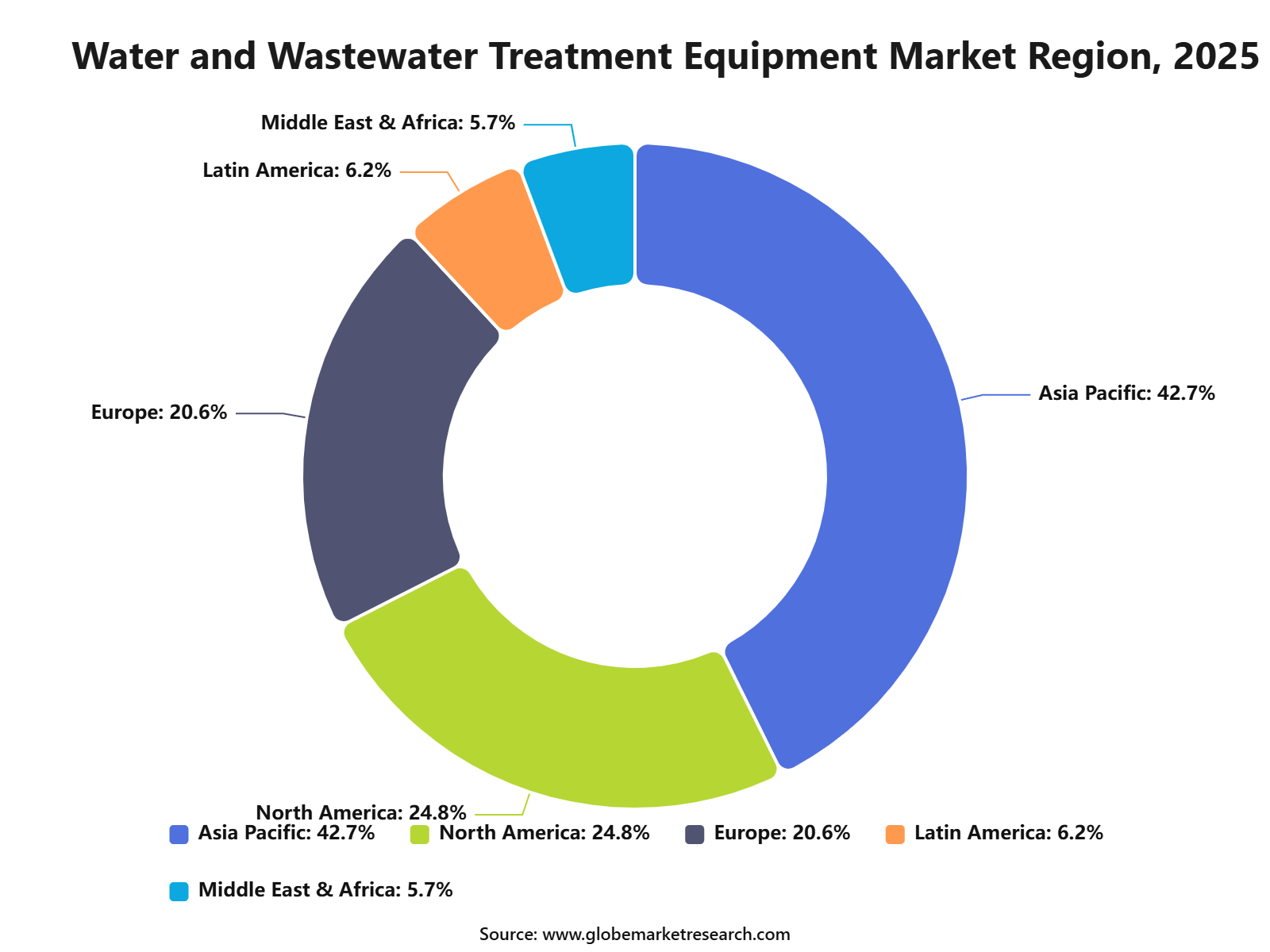
Asia Pacific held the largest regional share of 42.7% in 2025, supported by strong infrastructure development, high population density, industrial expansion, and rising government spending on water treatment projects. Countries such as China, India, Japan, South Korea, and Southeast Asian economies are witnessing higher demand for advanced treatment systems due to increasing municipal wastewater generation and industrial water reuse needs. The region is expected to remain a key growth hub as public and private investments continue to improve water supply reliability, pollution control, and sustainable wastewater management.
Key Market Insights
Municipal applications led the market with 68.4% share, supported by rising demand for clean water supply, sewage treatment, urban sanitation, and public wastewater management.
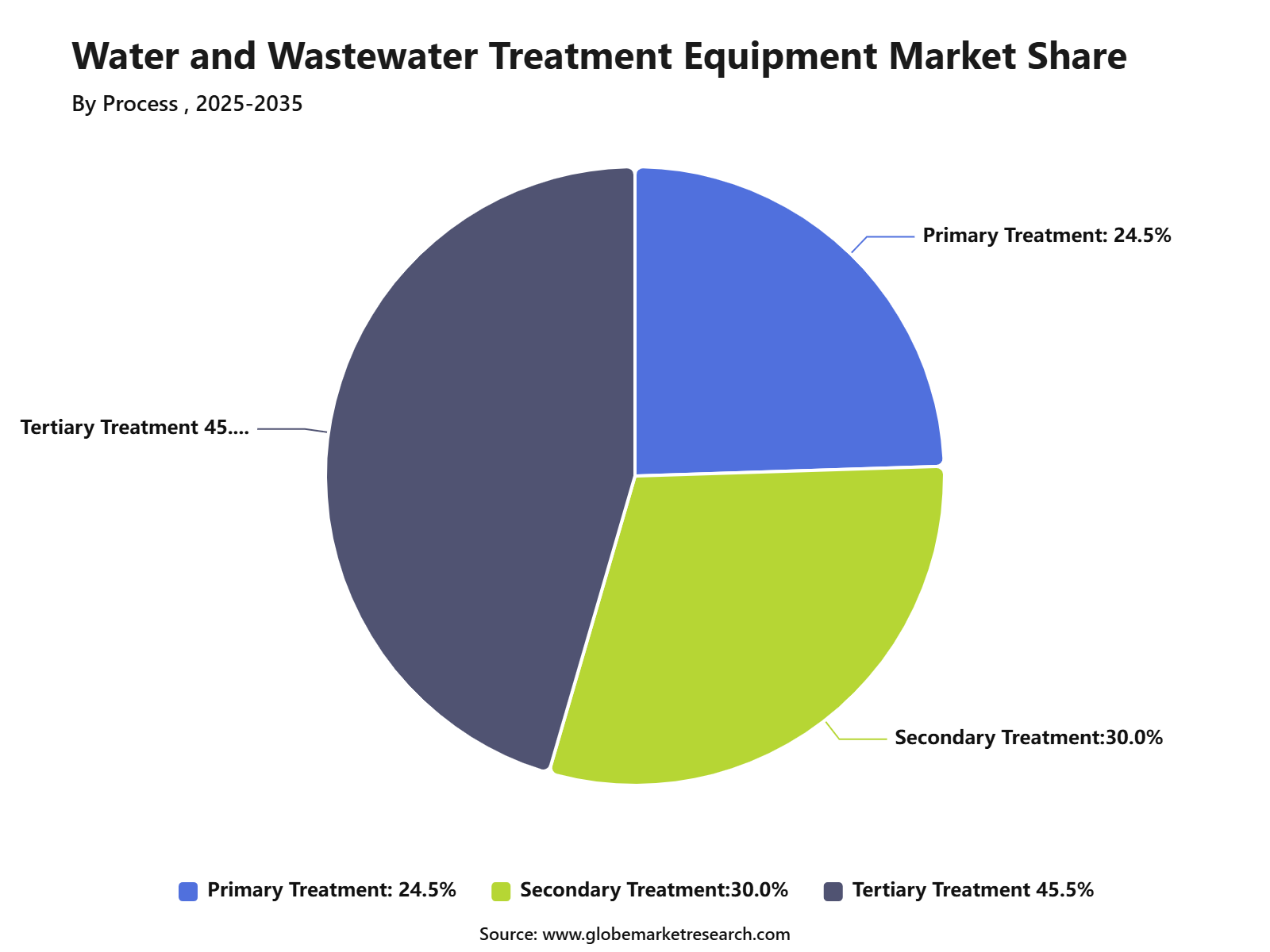
Tertiary treatment accounted for 45.5% share by process, driven by its role in advanced contaminant removal, water reuse, nutrient reduction, and improved discharge quality.
Asia Pacific held 42.7% share of the water and wastewater treatment equipment market, supported by rapid urbanization, industrial growth, rising water demand, and increasing investment in treatment infrastructure.
Market Overview
The Water and Wastewater Treatment Equipment Market covers systems used to remove physical, chemical, and biological contaminants from drinking water, municipal wastewater, and industrial effluent. These systems include filtration units, membranes, clarifiers, disinfection equipment, pumps, sludge treatment units, chemical dosing systems, and monitoring solutions. Demand is rising as cities, industries, and utilities work to improve water quality, reduce pollution, and expand access to safe water services.
The need for treatment equipment remains strong because WHO and UNICEF reported that 2.1 billion people still lacked safely managed drinking water in 2024, while 3.4 billion people lacked safely managed sanitation. The market is also being supported by stricter discharge rules, water reuse programs, industrial expansion, and growing concern over untreated wastewater entering rivers, lakes, and coastal areas.
UN-Water reported that 42% of household wastewater was not safely treated before discharge in 2022, releasing an estimated 113 billion cubic meters of inadequately treated wastewater into the environment. Industrial wastewater treatment also remains a major gap, as reported data from 22 countries showed that only 38% of industrial wastewater was treated and only 27% was safely treated.
Go-to-Market and Sales Economics
The water and wastewater treatment equipment market is driven by public infrastructure spending, industrial compliance, water scarcity, urban growth, and stricter water quality standards. Key buyers include municipal utilities, industrial plants, commercial facilities, engineering contractors, government agencies, and project developers. The market includes filtration systems, membrane systems, disinfection units, pumps, valves, aeration systems, sludge handling equipment, tertiary treatment units, PFAS treatment systems, sensors, and digital monitoring platforms.
Municipal utilities remain a major customer group because drinking water and wastewater plants need regular upgrades, replacement parts, and long-term service support. Aging pipelines, old treatment plants, stormwater pressure, and emerging contaminants are increasing demand for treatment equipment. In the U.S., EPA estimates USD 625 billio n in drinking water infrastructure needs and at least USD 630 billio n in wastewater, stormwater, and clean water infrastructure needs over the next 20 years .
Industrial customers also create strong demand for water and wastewater treatment equipment. Food and beverage, pharmaceuticals, chemicals, semiconductors, mining, oil and gas, textiles, and power generation facilities use these systems to meet discharge rules, reduce freshwater use, recover process water, and avoid penalties. Buying decisions are mainly based on compliance, operating cost savings, production continuity, and sustainability targets.
Investment Opportunity Analysis
Impact Factor | Estimated CAGR Impact | Regional Relevance | Market Impact |
|---|---|---|---|
Municipal treatment plant upgrades | +1.6% | Asia Pacific, North America, Europe | Offers steady demand. |
Membrane and filtration equipment | +1.3% | Global | Supports advanced treatment. |
Industrial wastewater treatment systems | +1.1% | Manufacturing and process industries | Builds compliance revenue. |
Digital monitoring and automation | +0.9% | Developed and urban markets | Improves service value. |
Water reuse infrastructure | +1.0% | Middle East, Asia Pacific, Europe | Supports long-term growth. |
Application Analysis
Municipal applications led the Water and Wastewater Treatment Equipment Market with 68.4% share , supported by rising investment in drinking water systems, sewage treatment plants, stormwater management, and public utility upgrades. The demand for municipal equipment is being driven by aging treatment plants, growing urban populations, stricter discharge standards, and the need to provide safe and reliable water services. Municipal utilities require filtration systems, pumps, membranes, disinfection units, aeration systems, sludge treatment equipment, and monitoring platforms to maintain daily operations and meet regulatory requirements.
Process Analysis
Tertiary treatment accounted for 45.5% share, driven by the growing need for advanced water purification after primary and secondary treatment stages. This process is used to remove remaining contaminants, nutrients, suspended solids, pathogens, and trace pollutants before treated water is discharged or reused. Demand is increasing as utilities and industries focus on water reuse, nutrient control, stricter wastewater limits, and protection of rivers, lakes, and groundwater resources
 iThe graph shows projected market growth until 2035 based on CAGR analysis. Actual outcomes may vary depending on changing demand, competition, and economic factors.To gain greater insights - request a sample report PDF
Regional Analysis
Asia Pacific led the Water and Wastewater Treatment Equipment Market with 42.7% share , supported by rapid urbanization, industrial expansion, rising water demand, and growing investment in municipal water infrastructure. Countries such as China, India, Japan, South Korea, Indonesia, Vietnam, and Australia are increasing focus on safe drinking water, wastewater reuse, sewage treatment, and pollution control. The demand for equipment such as filtration systems, membrane systems, pumps, disinfection units, sludge treatment systems, and monitoring platforms continues to rise as cities expand and water quality standards become stricter.
Region | Market Share (%) |
|---|---|
Asia Pacific | 42.7% |
North America | 24.8% |
Europe | 20.6% |
Latin America | 6.2% |
Middle East & Africa | 5.7% |
The growth of the Asia Pacific market can also be attributed to increasing pressure on freshwater resources and the need to treat wastewater before discharge or reuse. Industrial facilities, municipal utilities, and public agencies are investing in advanced treatment technologies to meet environmental rules, reduce water loss, and improve long-term water security. The region is expected to remain a major demand center as governments and industries continue to modernize water networks, upgrade aging treatment plants, and expand wastewater treatment capacity across urban and semi-urban areas.
 iThe graph shows projected market growth until 2035 based on CAGR analysis. Actual outcomes may vary depending on changing demand, competition, and economic factors.To gain greater insights - request a sample report PDF
Segment covered in the Report
By Application
Municipal
Industrial
By Process
Primary Treatment
Secondary Treatment
Tertiary Treatment
By Region
Asia Pacific
North America
Europe
Middle East & Africa
Latin America
Drivers Impact Analysis
Impact Factor | Estimated CAGR Impact | Regional Relevance | Market Impact |
|---|---|---|---|
Rising demand for clean water supply | +1.6% | Asia Pacific, North America, Middle East | Drives treatment equipment use. |
Growing municipal wastewater treatment needs | +1.4% | Global urban markets | Supports public infrastructure demand. |
Stricter water quality regulations | +1.2% | U.S., Europe, China, India | Increases equipment upgrades. |
Industrial water reuse adoption | +1.0% | Manufacturing, chemicals, power, food processing | Reduces freshwater dependency. |
Aging water infrastructure replacement | +0.9% | North America, Europe | Drives retrofit demand. |
Restraints Impact Analysis
Impact Factor | Estimated CAGR Impact | Regional Relevance | Market Impact |
|---|---|---|---|
High capital investment cost | -0.9% | Emerging markets, small municipalities | Slows project execution. |
Complex installation and maintenance needs | -0.7% | Global | Raises operating burden. |
Budget limitations in public utilities | -0.6% | Developing regions | Delays procurement cycles. |
Energy-intensive treatment processes | -0.5% | Global | Increases operating cost. |
Slow approval process for infrastructure projects | -0.5% | Public sector markets | Extends project timelines. |
Opportunities Impact Analysis
Impact Factor | Estimated CAGR Impact | Regional Relevance | Market Impact |
|---|---|---|---|
Expansion of tertiary treatment systems | +1.5% | Asia Pacific, Europe, North America | Improves water reuse. |
Growth in membrane filtration technologies | +1.3% | Global | Supports advanced treatment. |
Rising demand for sludge treatment equipment | +1.0% | Municipal and industrial users | Expands equipment scope. |
PFAS and emerging contaminant treatment | +0.9% | U.S., Europe, developed Asia | Creates upgrade demand. |
Smart water monitoring integration | +0.8% | Developed and urban markets | Improves system control. |
Recent Developments
May 2026: VA Tech WABAG was awarded a Delhi Jal Board contract to build and operate a 17 MGD wastewater treatment plant at Mitraon, including sludge dewatering, pumping stations, and related piping. The order was classified in the range of ₹100 crore to ₹250 crore , or about USD 12 million to USD 29 million.
April 2026: VINCI won a €192 million contract to upgrade Prague’s main wastewater treatment plant. The project includes rebuilding and refurbishing settling tanks and refitting facilities with new water treatment technologies, with work expected to start in October 2026 and continue for 43 months .
Report Scope
Report Highlights | Details |
|---|---|
Market Revenue (2025) | USD 76.3 Billion |
Forecast Revenue (2035) | USD 136.6 Billion |
CAGR (2025-2035) | 6.0% |
Base Year for Estimation | 2025 |
Historic Data | 2020-2024 |
Forecast Period | 2025-2035 |
Report Coverage | AI market impact analysis, market surveys, trade analysis, Industry & competitive intelligence, Revenue projections, company positioning, competitive analysis, growth drivers, and emerging market trends, Strategic Consultation & Advisory Services |
Segments Covered | By Application (Municipal, Industrial), By Process (Primary Treatment, Secondary Treatment, Tertiary Treatment) |
Regional Analysis | North America - US, Canada; Europe - Germany, France, The UK, Spain, Italy, Russia, Netherlands, Rest of Europe; Asia Pacific - China, Japan, South Korea, India, New Zealand, Singapore, Thailand, Vietnam, Rest of Latin America; Latin America - Brazil, Mexico, Rest of Latin America; Middle East & Africa - South Africa, Saudi Arabia, UAE, Rest of MEA |
Key companies profiled | Veolia, SUEZ Worldwide, Xylem Inc., Ecolab Inc., DuPont, 3M, Pentair plc, Evoqua Water Technologies LLC, Kemira Oyj, Kurita Water Industries Ltd., Aquatech International LLC, Acciona, American Water, Hydro International, Thermax Limited, Trojan Technologies, BioMicrobics, Voltas Limited, WOG Technologies, Golder Associates, SWA Water Treatment, Calgon Carbon Corporation, Toshiba Water Solutions, and Ecologix Environmental Systems. |
Customization Scope | Tailored insights for specific regions, countries, and market segments can be provided. Additional report customization is available upon request. |
Competitive Landscape
The market is characterized by intense competition among established players and emerging companies. Strategic partnerships, mergers and acquisitions, and product innovation are key strategies employed by market participants.
Key Market Players
Veolia
SUEZ Worldwide
Xylem Inc.
Ecolab Inc.
DuPont
3M
Pentair plc
Evoqua Water Technologies LLC
Kemira Oyj
Kurita Water Industries Ltd.
Aquatech International LLC
Acciona
American Water
Hydro International
Thermax Limited
Trojan Technologies
BioMicrobics
Voltas Limited
WOG Technologies
Golder Associates
SWA Water Treatment
Calgon Carbon Corporation
Toshiba Water Solutions
Ecologix Environmental Systems
Meet the Team
This report was prepared by our expert analysts with deep industry knowledge and research experience.
Pratiksha is market research analyst with strong experience in industry research, market forecasting, and competitive analysis. She specializes in identifying market trends, evaluating growth opportunities, and preparing data-driven insights across global industries. Her work supports businesses in understanding market dynamics, customer demand, regional opportunities, and strategic investment areas.
Suraj is a Senior Management Consultant with over 7 years of experience in market research, business strategy, and consulting. He has worked with Fortune 500 companies and growing startups, helping them with market entry, cross-border expansion, demand analysis, competitive assessment, and growth planning. His analytical thinking and strong industry knowledge help clients make clear, confident, and informed business decisions.
Frequently Asked Questions
Related Reports
More in Chemical and Material
Marine Composites Market to hit USD 15.7 Bn By 2035
Global Marine Composites Market Size By Composite Type (Polymer-Matrix Composites, Metal-Matrix Composites, Ceramic-Matrix Composites), By Resin Type (Epoxy, Polyester, Others), By Vessel Type (Sailboats, Cruise Ships & Yachts, Power Boats, Others), By Regional Insights, Business plan and Project Report, Investment Opportunities, Profitability, Industry Trends, Leading Companies and Growth Forecasts by 2025-2035
Black Pellets Market Revenue to Hit USD 722.1 Bn by 2035
Global Black Pellets Market Size, Share and Trends Analysis Report By Type (Torrefied Black Pellets, Hydrothermal Carbonized Pellets, Steam-Exploded Pellets), By Application (Heat Generation, Power Generation, Industrial Heating, Residential / Commercial Heating and Others), By Raw Material (Wood Biomass / Forest Residues, Agricultural Residues, Energy Crops and Others), By End-User (Utilities / Power Plants, Industrial Users, Commercial Heating Users, Residential Users), By Regional Insights, Adoption Trends, Leading Companies and Growth Forecasts By 2025-2035
Caprolactone Market Size to Reach USD 638 Mn by 2035
Global Caprolactone Market Size and Trade Analysis Report By Type (99.5% Purity, 99.9% Purity), By Application (Polycaprolactone (PCL), Acrylic Resin Modified, Polyesters Modified, Epoxy Resin Modified, Others), By End-Use Industry (Industrial Applications, Packaging, Healthcare, Automotive, Construction), By Regional Insights, Leading Companies and Growth Forecasts by 2025-2035