

Revenue, 2025
$5.4 Bn
Forecast, 2035
$10.3 Bn
CAGR, 2025-2035
13.5%
Report Coverage
Global
Market Size and Forecast
2025
$5.4 Bn
2035
$10.3 Bn
CAGR
13.5%
What is the Operating Room Integration Market Size?
The global operating room integration market size was valued at USD 5.4 billion in 2025 and is projected to grow from USD 7.2 billion in 2026 to USD 10.3 billion by 2035, growing at a CAGR of 13.5% from 2025 to 2035. The market in North America dominated with a revenue share of 39% in 2025. The market growth is supported by the rising adoption of digital operating rooms, increasing demand for minimally invasive surgeries, growing use of advanced imaging systems, and higher hospital investments in connected surgical infrastructure.
North America held the largest regional share of 39.0% in 2025, supported by advanced hospital infrastructure, higher adoption of digital operating rooms, and strong investment in surgical workflow automation. The U.S. Operating Room Integration Market was valued at USD 3.4 billion in 2025 and is projected to expand at a CAGR of 14.8%, supported by rising demand for hybrid operating rooms, robotic surgery support, real-time imaging integration, and connected surgical data platforms.
Investment activity remains strong across the global operating room integration ecosystem as hospitals focus on improving surgical precision, reducing procedure delays, and enhancing team coordination. The market is supported by rising demand for hybrid operating rooms, minimally invasive procedures, robotic surgery support, and AI-enabled surgical data management. Increasing healthcare digitization, growing surgical volumes, and the need for centralized control of operating room equipment are expected to create steady opportunities for technology providers, healthcare IT vendors, and surgical infrastructure companies.
Key Insights
Software led the component segment with 55.6% share. The segment was supported by rising demand for centralized control platforms, surgical workflow management, real-time data access, and seamless integration of imaging, audio, video, and documentation systems.
Documentation management systems accounted for 36.7% share by device type. Adoption was driven by the need to record surgical data, reduce manual documentation errors, improve compliance, and support faster post-surgery reporting.
General surgery held 41.0% share by application. The segment remained dominant due to the high volume of general surgical procedures and the growing need for connected operating rooms that support better visibility, coordination, and decision-making.
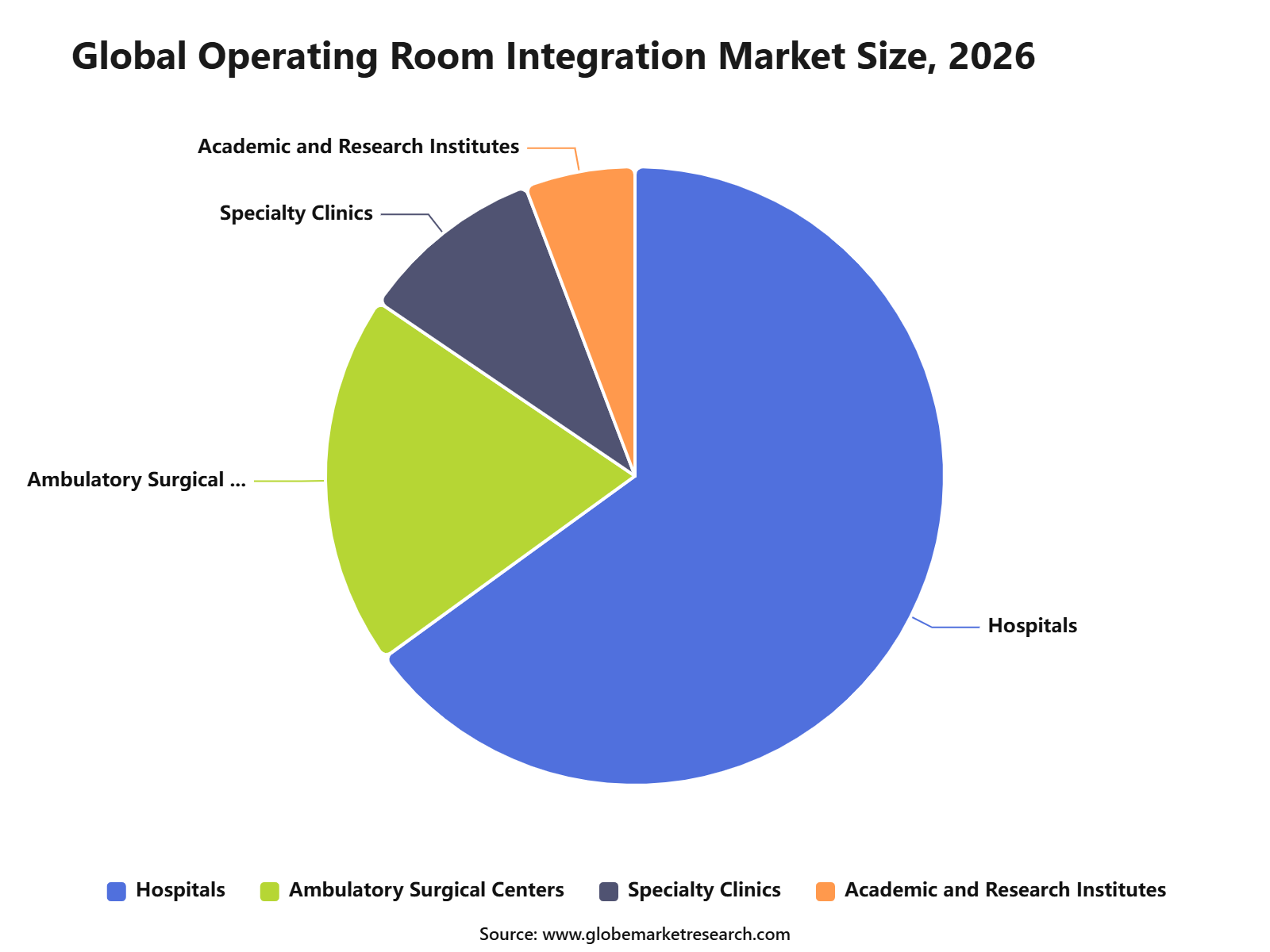
Hospitals captured 65.4% share by end user. Strong adoption was supported by higher surgical volumes, larger budgets for digital infrastructure, and the increasing need to improve operating room efficiency and patient safety.
On-premise deployment held 59.6% share. Hospitals continued to prefer on-premise systems due to stronger data control, secure internal networks, regulatory compliance needs, and direct integration with existing hospital infrastructure.
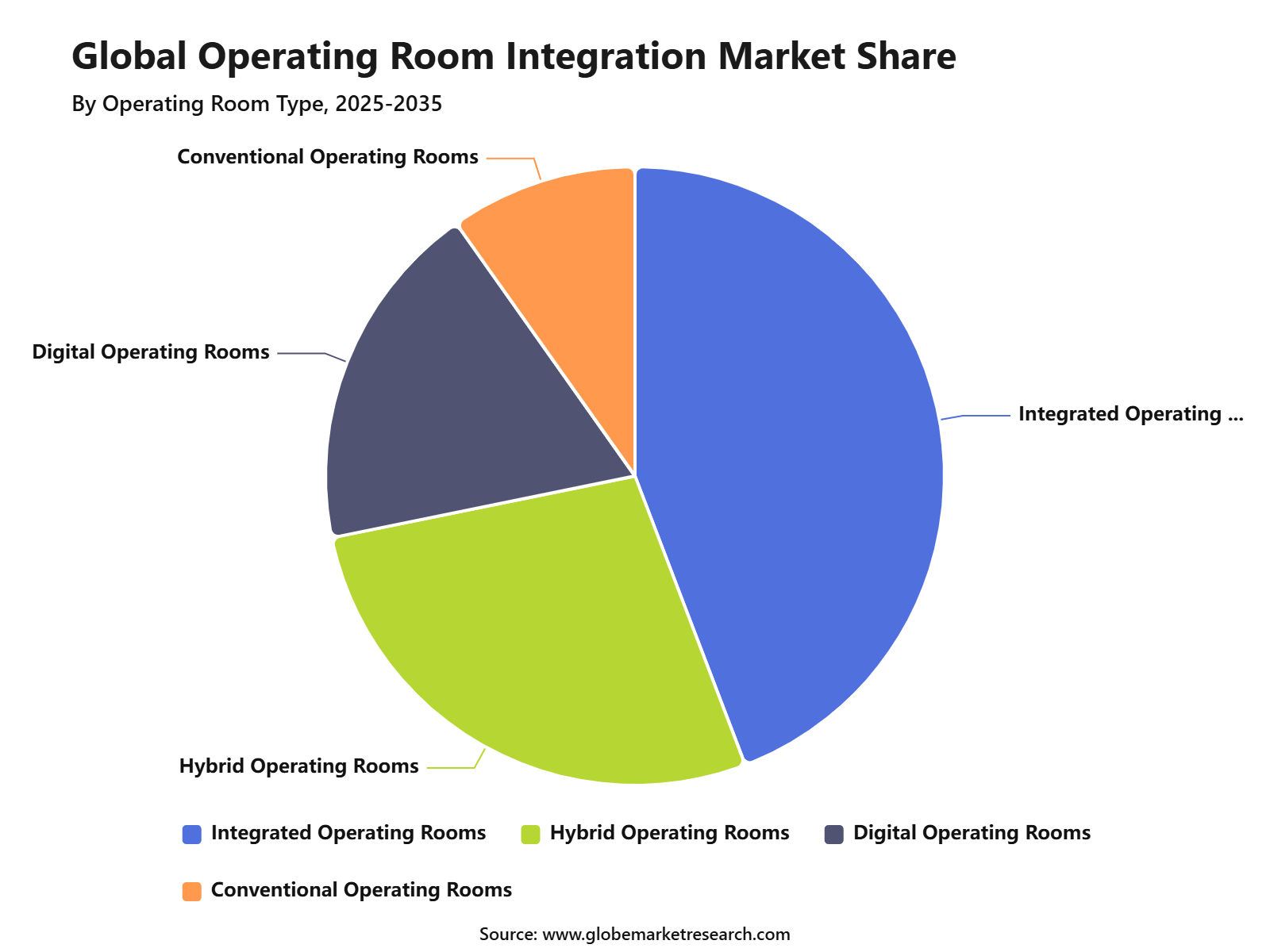
Integrated operating rooms accounted for 44.2% share by operating room type. Growth was supported by the rising use of connected surgical equipment, centralized displays, advanced imaging systems, and real-time communication tools.
Image and video integration led the technology segment with 36.7% share. Demand increased as surgeons required high-quality visualization, multi-source video routing, procedure recording, and better access to diagnostic images during surgery.
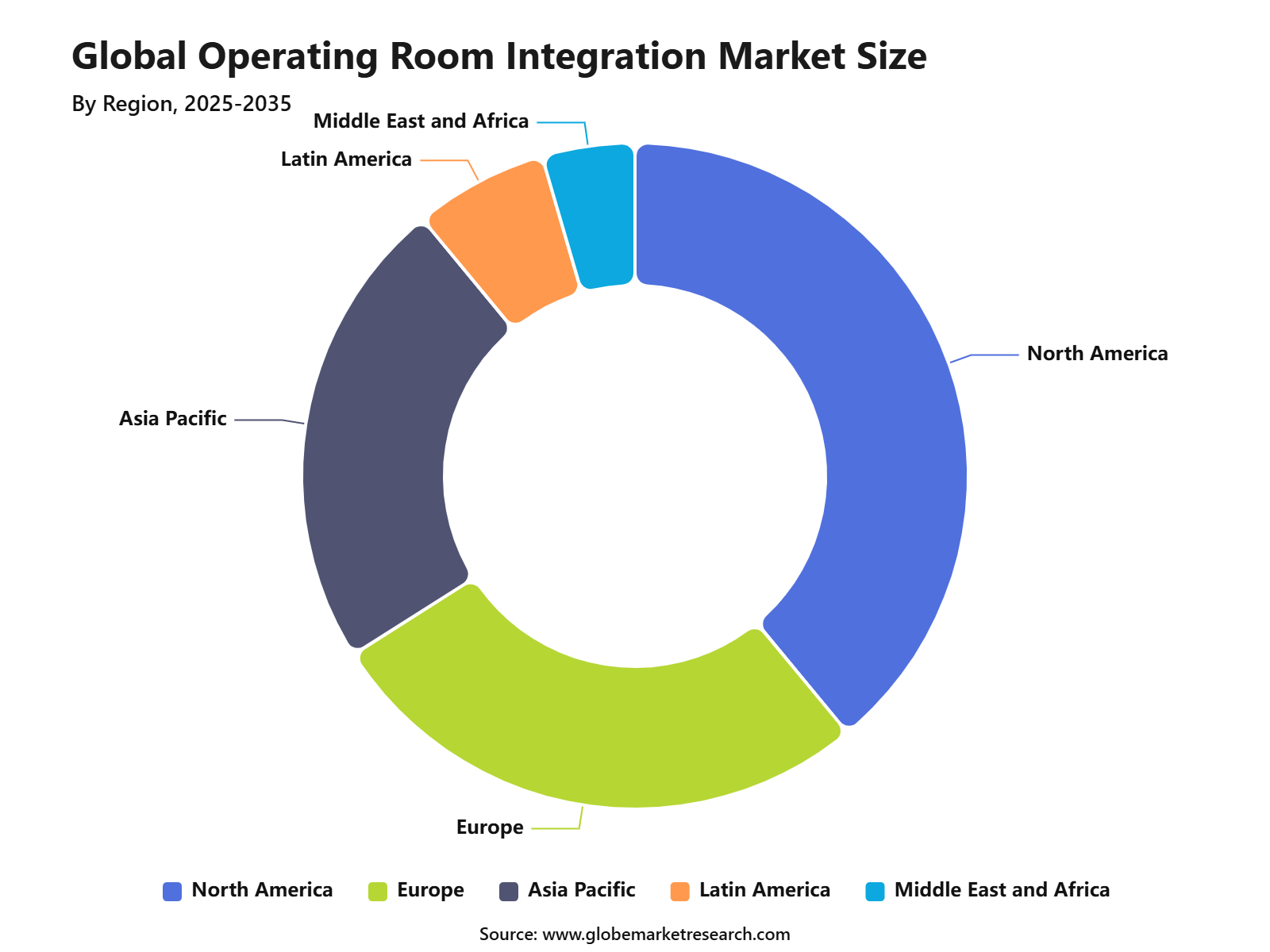
North America held 39% share by region. The region led the market due to advanced hospital infrastructure, high adoption of digital surgery platforms, strong healthcare spending, and wider use of minimally invasive and robotic-assisted procedures.
Market Overview
The operating room integration market consists of systems, technologies, and services designed to unify medical devices, imaging equipment, audiovisual systems, documentation tools, and workflow software in surgical environments. These integration solutions enable consolidated control and monitoring of surgical data, imaging, video feeds, device communication, and peri‑operative processes from a single platform. Integration simplifies complex operating room procedures, improves coordination among surgical teams, and supports decision‑making during operations.
One of the strongest drivers of the market is the increasing number of surgical procedures worldwide, including minimally invasive and image-guided surgeries. The rising prevalence of chronic diseases and complex interventions has created a need for real-time coordination and consolidated OR workflows, prompting healthcare facilities to invest in integrated systems. During 2025, hospital investment in integrated OR solutions grew by approximately 14% year-over-year, particularly in hybrid operating rooms that combine traditional surgery with advanced imaging technologies.
Urban hospitals and large surgical centers are upgrading existing facilities, with over 40% of newly built ORs in developed regions adopting integrated platforms to improve patient safety and procedural efficiency. The integration of AI and machine learning for predictive surgical analytics, cloud-enabled platforms for remote monitoring, and IoT-connected sensors for real-time performance feedback. Adoption of these technologies is expected to grow by 15% per year in advanced healthcare markets as hospitals focus on efficiency, safety, and operational cost reduction.
Go-to-Market and Sales Economics
The go-to-market strategy for the Operating Room Integration market is mainly focused on hospitals, ambulatory surgery centers, specialty surgical centers, and academic medical institutions. The buyer group usually includes hospital administrators, operating room directors, surgeons, IT teams, biomedical engineering teams, and procurement teams. In the U.S., there are around 6,100 hospitals and more than 907,000 staffed hospital beds, which shows a large base of healthcare facilities that may require surgical infrastructure upgrades. This creates strong demand potential for integrated operating room systems that improve device control, audio-video routing, documentation, imaging access, and surgical workflow.
 iThe graph shows projected market growth until 2035 based on CAGR analysis. Actual outcomes may vary depending on changing demand, competition, and economic factors.To gain greater insights - request a sample report PDF
Sales economics in this market are strongly linked to return on investment because operating rooms are among the most expensive areas inside a hospital. Public surgical cost data show that one minute of operating room time costs about USD 36 Bn to USD 37 Bn, which means even small delays can create measurable financial pressure. Integrated operating rooms can support better room utilization by reducing manual coordination, improving visibility, supporting faster documentation, and helping surgical teams access devices and images from a central platform. This makes the sales pitch stronger when vendors can prove savings from shorter delays, better case turnover, and smoother surgical communication.
Hospital spending also supports the commercial case for operating room integration. Public hospital cost data shows that hospitals spent more than USD 10 billion on surgical and medical instruments in 2024, up 7% from 2023. They also spent nearly USD 4.5 billion on computing infrastructure and data processing, up 15%, and nearly USD 1.4 billion on diagnostic imaging equipment, up 8%. These figures show that hospitals are already investing in surgical tools, imaging systems, and digital infrastructure, which makes operating room integration a natural part of hospital modernization planning.
By Component
Software led the component segment of the Operating Room Integration Market with 55.6% share. The segment was supported by rising demand for centralized control platforms, surgical workflow management, real-time data access, and seamless integration of imaging, audio, video, and documentation systems.
Hospitals are using software platforms to connect multiple operating room systems into one coordinated environment. These platforms help surgical teams manage equipment, view patient data, route video feeds, record procedures, and improve communication during surgery.
The growth of software adoption can be attributed to the need for better operating room efficiency and patient safety. As hospitals continue to modernize surgical suites, demand is expected to remain strong for platforms that support interoperability, secure data access, and smooth coordination between surgical teams.
 iThe graph shows projected market growth until 2035 based on CAGR analysis. Actual outcomes may vary depending on changing demand, competition, and economic factors.To gain greater insights - request a sample report PDF
By Device Type
Documentation management systems accounted for 36.7% share by device type. Adoption was driven by the need to record surgical data, reduce manual documentation errors, improve compliance, and support faster post-surgery reporting. These systems help hospitals capture procedure notes, images, videos, timestamps, patient records, and surgical details in a structured format.
This improves traceability and allows care teams to access accurate surgical information after the procedure. Demand is expected to grow as hospitals place greater focus on audit readiness, clinical quality, reimbursement support, and medico-legal documentation. Integrated documentation systems are becoming important because they reduce paperwork and help surgical teams spend more time on clinical care.
By Application
General surgery held the largest application share at 41.0%, driven by the high volume of routine and complex procedures performed across hospitals and surgical centers. Operating room integration is widely used in general surgery because these procedures often require coordinated access to imaging, patient data, surgical tools, video systems, and clinical communication platforms.
The demand in this segment is also supported by the need to improve operating room efficiency, reduce procedure delays, and support safer surgical workflows. Integrated systems help surgical teams manage information more effectively, especially during laparoscopic, abdominal, gastrointestinal, and other common general surgery procedures.
By End User
Hospitals dominated the market with a 65.4% share, as they perform a large number of surgeries and require advanced infrastructure to manage complex operating room environments. Large hospitals and multi-specialty facilities are investing in integrated operating rooms to improve surgical productivity, patient safety, resource use, and clinical coordination.
The growth of this segment is further supported by rising investment in digital healthcare infrastructure, smart operating rooms, and advanced surgical equipment. Hospitals prefer integrated systems because they help centralize device control, improve communication between surgical teams, and support better use of imaging and documentation tools during procedures.
By Deployment Mode
On-premise deployment held the leading position with a 59.6% share, mainly due to the high importance of data security, system control, and reliable access within hospital environments. Many healthcare facilities prefer on-premise systems because operating room data is highly sensitive and must be managed under strict privacy, safety, and compliance requirements.
This deployment model is also preferred by hospitals that require direct control over hardware, software updates, device connectivity, and internal IT systems. On-premise solutions provide strong reliability for critical surgical environments, where uninterrupted access to images, videos, patient records, and device controls is essential.
By Operating Room Type
Integrated operating rooms led the market with a 44.2% share, supported by the growing need to connect surgical devices, imaging systems, displays, lighting, cameras, and documentation tools into one coordinated setup. These rooms are designed to improve visibility, reduce clutter, and allow surgical teams to control multiple systems from a central platform.
The segment is gaining traction as hospitals aim to improve surgical accuracy, reduce operating room turnaround time, and support advanced procedures. Integrated operating rooms are especially useful in facilities handling minimally invasive surgery, image-guided surgery, robotic-assisted procedures, and multi-specialty surgical workflows.
 iThe graph shows projected market growth until 2035 based on CAGR analysis. Actual outcomes may vary depending on changing demand, competition, and economic factors.To gain greater insights - request a sample report PDF
By Technology
Image and video integration led the technology segment with 36.7% share. Demand increased as surgeons required high-quality visualization, multi-source video routing, procedure recording, and better access to diagnostic images during surgery. This technology helps surgical teams display live surgical video, endoscopic images, radiology scans, patient data, and procedural content on centralized screens.
It improves situational awareness and supports better coordination between the surgical team and supporting specialists. The segment is expected to grow as hospitals invest in high-definition displays, 4K imaging, robotic surgery systems, telemedicine-enabled operating rooms, and surgical training platforms. Image and video integration will remain a core technology because visualization is critical to modern surgical decision-making.
By Region
North America held the largest regional share at 39%, supported by advanced hospital infrastructure, high adoption of digital operating rooms, and strong investment in surgical technology. The region has a well-developed healthcare system where hospitals are actively upgrading operating rooms with integrated imaging, video, documentation, and communication platforms.
Market growth in North America is also supported by rising surgical volumes, increasing adoption of minimally invasive procedures, and growing focus on patient safety and hospital workflow efficiency. Technologically advanced healthcare facilities and strong demand for connected surgical environments keep the region at the forefront.
 iThe graph shows projected market growth until 2035 based on CAGR analysis. Actual outcomes may vary depending on changing demand, competition, and economic factors.To gain greater insights - request a sample report PDF
Risk Factors & Market Barriers
Regulatory & Compliance Risks
Regulatory and compliance risks are high because integrated operating rooms connect medical devices, imaging systems, software platforms, hospital networks, and patient information. These systems must protect electronic health information, support safe device interoperability, and reduce cybersecurity exposure. As operating rooms become more connected, hospitals must ensure that every connected platform follows privacy, security, access control, and system update requirements. Weak cybersecurity or poor integration can create patient safety risk, data exposure, and compliance failures.
Patient safety remains a major compliance issue in surgical environments. CDC data estimated 110,800 surgical site infections linked to inpatient surgeries in 2015, and surgical site infections remain one of the most costly healthcare-associated infections. CDC also notes that surgical site infections can add more than USD 20,000 in hospitalization costs per admission and extend hospital stay by about 9.7 days. This makes operating room integration important because better documentation, imaging access, workflow control, and communication can support safer surgical processes.
Market Adoption Barriers
High upfront investment is one of the biggest barriers in the Operating Room Integration market. Hospitals must purchase displays, control systems, audio-video routers, cameras, integration software, cabling, networking tools, documentation systems, cybersecurity layers, and device interfaces. The cost is even higher in hybrid operating rooms because these rooms often require advanced imaging systems, robotic support, high-resolution displays, and stronger data infrastructure. This can delay adoption in small hospitals, rural hospitals, and facilities with limited capital budgets.
Legacy infrastructure also slows adoption. Many hospitals still use older medical devices, separate documentation platforms, fragmented imaging systems, and isolated operating room equipment. Integration becomes difficult when systems must connect with electronic health records, picture archiving and communication systems, anesthesia systems, endoscopy platforms, surgical cameras, and hospital IT networks. If compatibility is weak, implementation time increases, and the expected return on investment becomes harder to achieve.
Overall, the market outlook remains positive because hospitals are under pressure to improve surgical efficiency, patient safety, room utilization, and digital documentation. The commercial opportunity is supported by large hospital infrastructure, rising spending on surgical instruments and computing systems, and the high cost of operating room delays. However, adoption depends on cybersecurity readiness, interoperability, capital availability, and clinical acceptance. Companies that show measurable savings, safe integration, and smooth implementation are expected to gain stronger buyer confidence.
Segments Covered in Report
By Component
Software
Hardware
Services
By Device Type
Audio and video management systems
Display systems
Documentation management systems
Recording and streaming systems
OR communication systems
Surgical lighting systems
Operating tables
Integration control systems
By Application
General surgery
Orthopedic surgery
Cardiovascular surgery
Neurosurgery
Gynecology surgery
Urology surgery
ENT surgery
Robotic surgery
Minimally invasive surgery
By End User
Hospitals
Ambulatory surgical centers
Specialty clinics
Academic and research institutes
By Deployment Mode
On-premise
Cloud-based
Hybrid
By Operating Room Type
Hybrid operating rooms
Integrated operating rooms
Digital operating rooms
Conventional operating rooms
By Technology
Surgical workflow integration
Image and video integration
Data and documentation integration
AI-enabled OR integration
Robotic surgery integration
IoT-enabled operating room systems
By Region
North America
Europe
Asia Pacific
Latin America
Middle East and Africa
Drivers Impact Analysis
Impact Factor | Estimated CAGR Impact | Regional Relevance | Market Impact |
|---|---|---|---|
Rising surgical procedure volume | +2.7% | High in North America, Europe, China, India, and Japan | Increases demand for integrated operating rooms that improve surgical coordination, workflow speed, and procedure visibility. |
Growing need for surgical workflow efficiency | +2.4% | Strong in developed hospital systems and large private hospitals | Supports adoption of centralized control systems, real-time data access, and connected surgical displays. |
Increasing adoption of minimally invasive surgery | +2.1% | High in North America, Europe, South Korea, Japan, and urban Asia Pacific | Drives demand for video routing, imaging integration, device connectivity, and high-definition visualization tools. |
Expansion of digital hospitals and smart operating rooms | +1.9% | Strong in North America, Europe, GCC countries, China, and India | Encourages hospitals to invest in integrated platforms that connect imaging, documentation, communication, and surgical equipment. |
Demand for better clinical documentation and compliance | +1.6% | High in regulated healthcare markets | Increases use of documentation management systems, audit trails, and automated surgical records. |
Restraints Impact Analysis
Impact Factor | Estimated CAGR Impact | Regional Relevance | Market Impact |
|---|---|---|---|
High installation and infrastructure cost | -2.0% | High impact in emerging markets and small hospitals | Limits adoption among budget-constrained hospitals due to high upfront spending on hardware, software, displays, cabling, and integration services. |
Complex integration with legacy hospital systems | -1.7% | Common in public hospitals and older healthcare facilities | Slows deployment because existing imaging, EMR, PACS, and surgical devices may not connect easily. |
Data privacy and cybersecurity concerns | -1.5% | High in North America, Europe, and regulated Asian markets | Creates stronger requirements for secure access, device authentication, encryption, and compliance controls. |
Long procurement and approval cycles | -1.3% | Common in public healthcare systems and large hospital groups | Delays purchasing decisions because operating room upgrades require technical, clinical, financial, and regulatory review. |
Shortage of trained technical staff | -1.1% | Higher impact in developing healthcare markets | Reduces effective system use when hospitals lack trained biomedical engineers, IT teams, and clinical users. |
Opportunities Impact Analysis
Impact Factor | Estimated CAGR Impact | Regional Relevance | Market Impact |
|---|---|---|---|
AI-enabled surgical decision support | +2.3% | High in North America, Europe, Japan, South Korea, and advanced hospitals in Asia Pacific | Creates opportunities for real-time risk alerts, workflow optimization, predictive analytics, and surgical performance improvement. |
Growth of hybrid operating rooms | +2.0% | Strong in cardiac, vascular, neuro, and trauma care centers | Increases demand for integrated imaging, surgical displays, device control, and multidisciplinary procedure support. |
Hospital modernization in emerging economies | +1.8% | Strong in India, China, Southeast Asia, Middle East, and Latin America | Supports new installations as private hospitals and government systems upgrade surgical infrastructure. |
Remote collaboration and surgical education | +1.5% | High in teaching hospitals and multi-site healthcare networks | Expands use of live video streaming, recording, teleconsultation, and training support from operating rooms. |
Cloud-based data management and analytics | +1.3% | Growing in digitally mature healthcare markets | Supports centralized storage, case review, procedure documentation, and operating room performance analysis. |
Challenges Impact Analysis
Impact Factor | Estimated CAGR Impact | Regional Relevance | Market Impact |
|---|---|---|---|
Interoperability between multiple device brands | -1.8% | High across all major regions | Creates technical difficulty when hospitals use surgical devices, imaging systems, displays, and software from different vendors. |
Maintaining system uptime during surgery | -1.6% | High in advanced surgical centers and tertiary hospitals | Requires reliable networks, backup systems, and fast technical support because downtime can affect surgical workflow. |
Managing large surgical video and imaging data | -1.4% | Strong in hospitals with high procedure volume | Increases storage, bandwidth, security, and retrieval challenges for high-resolution surgical content. |
User training and change management | -1.2% | Common across public and private hospitals | Slows adoption when surgeons, nurses, and operating room teams need time to adjust to new digital workflows. |
Balancing innovation with regulatory compliance | -1.0% | High in North America, Europe, Japan, and Australia | Increases validation needs for connected devices, cybersecurity controls, software updates, and patient data handling. |
Recent Development
Getinge AB, April 2026 - Getinge highlighted integrated operating room systems that bring devices, data, and workflows into one connected structure, reducing manual coordination and supporting more efficient surgical teams.
Stryker, August 2025 - Stryker advanced its operating room integration platform with a focus on connecting surgical imaging, room cameras, displays, and compatible surgical devices through a simplified interface for better workflow control.
ALVO Medical, April 2026 - ALVO Medical continued to promote intelligent operating room integration, with focus on modular OR design, integrated displays, telemedicine support, and surgical robotics readiness.
Richard Wolf GmbH, February 2026 - Richard Wolf promoted smart networking solutions for operating rooms, supporting seamless communication between surgical systems and clinical teams through its digitization-focused RIWOlink approach.
Ditec Medical, June 2026 - Ditec Medical advanced its ORisTIC digital operating room roadmap, focusing on intelligent operating rooms, AI, virtual reality, international expansion, and stronger digital surgical theatre capabilities.
Report Scope
Report Highlights | Details |
|---|---|
Market Revenue (2025) | USD 5.4 Bn |
Forecast Revenue (2035) | USD 10.3 Bn |
CAGR (2025-2035) | 13.5% |
Base Year for Estimation | 2025 |
Historic Data | 2020-2024 |
Forecast Period | 2025-2035 |
Report Coverage | AI market impact analysis, market surveys, trade analysis, Industry & competitive intelligence, Revenue projections, company positioning, competitive analysis, growth drivers, and emerging market trends, Strategic Consultation & Advisory Services |
Segments Covered | By Component (Software, Hardware, Services), By Device Type (Audio and Video Management Systems, Display Systems, Others), By Application (General Surgery, Orthopedic Surgery, Others), By End User (Hospitals, Ambulatory Surgical Centers, Specialty Clinics), By Deployment Mode On-premise, Cloud-based, Hybrid), By Operating Room Type (Hybrid Operating Rooms, Integrated Operating Rooms), By Technology (Surgical Workflow Integration, Image and Video Integration, Others), By Regional |
Regional Analysis | North America - US, Canada; Europe - Germany, France, The UK, Spain, Italy, Russia, Netherlands, Rest of Europe; Asia Pacific - China, Japan, South Korea, India, New Zealand, Singapore, Thailand, Vietnam, Rest of Latin America; Latin America - Brazil, Mexico, Rest of Latin America; Middle East & Africa - South Africa, Saudi Arabia, UAE, Rest of MEA |
Key companies profiled | Stryker, Getinge AB, Brainlab AG, Barco, Drägerwerk AG & Co. KGaA, Steris Plc., KARL STORZ SE & CO. KG, Olympus, Caresyntax, Arthrex, Inc., ALVO Medical, Skytron, LLC, Merivaara, Richard Wolf GmbH, Ditec Medical. |
Customization Scope | Tailored insights for specific regions, countries, and market segments can be provided. Additional report customization is available upon request. |
Competitive Landscape
The market is characterized by intense competition among established players and emerging companies. Strategic partnerships, mergers and acquisitions, and product innovation are key strategies employed by market participants.
Key Market Players
Stryker
Getinge AB
Brainlab AG
Barco
Drägerwerk AG & Co. KGaA
Steris Plc.
KARL STORZ SE & CO. KG
Olympus
Caresyntax
Arthrex, Inc.
ALVO Medical
Skytron, LLC
Merivaara
Caresyntax
Richard Wolf GmbH
Ditec Medical
Meet the Team
This report was prepared by our expert analysts with deep industry knowledge and research experience.
Pratiksha is market research analyst with strong experience in industry research, market forecasting, and competitive analysis. She specializes in identifying market trends, evaluating growth opportunities, and preparing data-driven insights across global industries. Her work supports businesses in understanding market dynamics, customer demand, regional opportunities, and strategic investment areas.
Suraj is a Senior Management Consultant with over 7 years of experience in market research, business strategy, and consulting. He has worked with Fortune 500 companies and growing startups, helping them with market entry, cross-border expansion, demand analysis, competitive assessment, and growth planning. His analytical thinking and strong industry knowledge help clients make clear, confident, and informed business decisions.
Frequently Asked Questions
Related Reports
More in Information and Technology
Sharing Economy Apps Market to hit 1,411.2 Bn by 2035
Global Sharing Economy Apps Market By Product / Service Type (Shared Transportation, Shared Space, Sharing Financial, Sharing Food, Shared Healthcare, Shared Knowledge & Education, Shared Task Services, Shared Items, Others), By Distribution Channel (Online, Offline), By End User (Generation Z, Millennials, Generation X, Boomers), By Regional Insights, Business plan and Project Report, Investment Opportunities, Profitability, Industry Trends, Leading Companies and Growth Forecasts by 2025-2035
AI Receptionist Market to hit USD 23.8 Bn by 2035
Global AI Receptionist Market Size, Share Analysis Report By Component (Solutions, Services), By Deployment (Cloud-based, On-premises), By Service Type (Voice Reception Services, Chat Reception Services, Appointment Scheduling, Call Routing, Lead Qualification, Customer Support), By Service Model (24/7 Receptionist Solutions, Business Hours Receptionist Solutions, Hybrid Receptionist Solutions), By Technology (Voice AI Integration, Conversational AI, Natural Language Processing, Speech Recognition and Others), By Enterprise Size (Small and Medium Enterprises, Large Enterprises), By End-use (Healthcare, Legal Services, Real Estate, Retail and E-commerce, BFSI, Hospitality, Automotive, Home Services, IT and Telecom, Others), By Regional Insights, Business plan and Project Report, Investment Opportunities, Profitability, Industry Trends, Leading Companies and Growth Forecasts by 2025-2035
Voice AI Agents Market to Hit USD 113.7 Billion by 2035
Global Voice AI Agents Market Size, Share Analysis Report By Solution (Voice AI Platform, Services (Professional Services(Implementation & Integration, Consulting & Training Services, Support and Maintenance Services), Managed Services)), By Deployment (Cloud Based, On Premises), By Enterprise Size (Small & Medium Enterprise Size, Large Enterprises), By Industry (BFSI, Automotive, Healthcare, Retail & E-commerce, IT & Telecom, Aerospace & Defence, Others (Utilities, Media & Entertainment)), By Regional Insights, Business plan and Project Report, Investment Opportunities, Profitability, Industry Trends, Leading Companies and Growth Forecasts by 2025-2035
AI Trust, Risk and Security Management (AI TRiSM) Market to hit USD 39.8 Bn by 2026
Global AI Trust, Risk and Security Management (AI TRiSM) Market Size, Share Analysis Report By Component (Solutions, Services), By Technology (ML based TRiSM, Natural Language Processing based TRiSM, Explainable AI (XAI), Federated Learning/Privacy-Preserving ML), By Application (Model Governance & Compliance, Model Monitoring & Observability, Data Privacy & Security, Bias Detection & Mitigation, Identity & Access Security for AI), By Deployment (On-premises, Cloud), By Organization Size (Large Enterprises, Small & Medium Enterprises), By Industry Vertical (BFSI, Healthcare, Retail & E-commerce, IT & Telecom, Government & Defense, Manufacturing, Transportation & Logistics), By Regional Insights, Business plan and Project Report, Investment Opportunities, Profitability, Industry Trends, Leading Companies and Growth Forecasts by 2025-2035