
Revenue, 2025
$2.3Bn
Forecast, 2035
$23.8Bn
CAGR, 2025-2035
26.3%
Report Coverage
Global
Market Size and Forecast
2025
$2.3Bn
2035
$23.8Bn
CAGR
26.3%
The Global AI Receptionist Market was valued at USD 2.3 billion in 2025 and is projected to reach USD 23.8 billion by 2035, growing at a CAGR of 26.3% during the forecast period. The growth of the market can be attributed to rising demand for 24/7 call answering, automated appointment scheduling, lead capture, multilingual customer support, and faster response handling across small businesses, healthcare clinics, legal firms, real estate companies, financial service providers, and service-based enterprises.
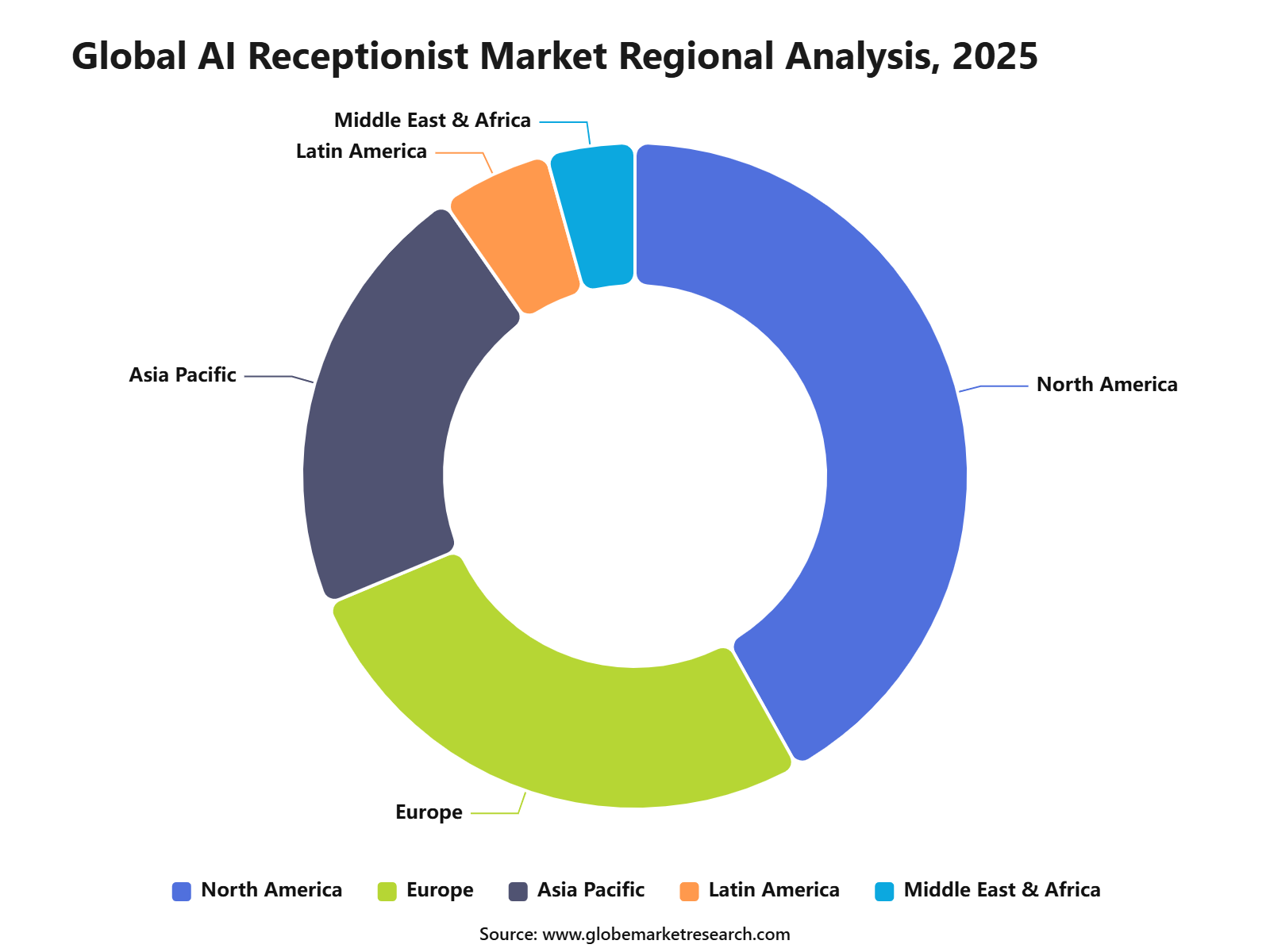
AI receptionists are increasingly being used to reduce missed calls, lower front-desk workload, route customers to the right team, and maintain consistent service during peak hours, after office hours, weekends, and holidays. North America held the largest regional share of 41.9% in 2025, supported by strong adoption of cloud communication tools, advanced CRM integration, high labor cost pressures, and early enterprise use of AI agents in customer service operations.
Key Insights
Solutions and software platforms led the market with 75.9% share, supported by rising use of automated call handling, appointment scheduling, lead capture, and customer support tools.
Cloud-based deployment accounted for 69.1% share, driven by easier setup, remote access, lower infrastructure needs, and flexible scaling for businesses.
Voice reception services held 55.5% share, supported by growing demand for AI-powered call answering, call routing, message taking, and customer query handling.
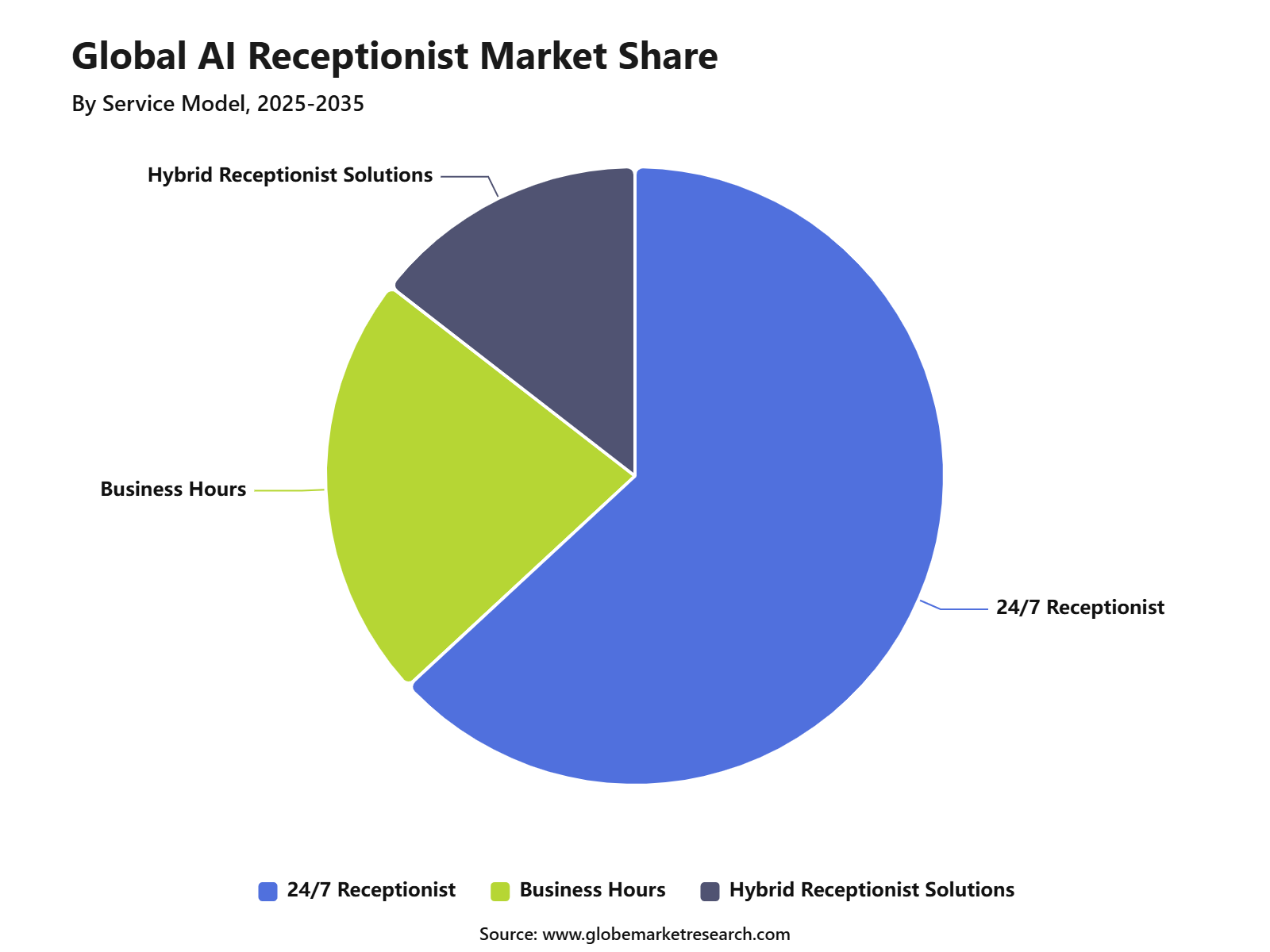
24/7 receptionist solutions captured 63.1% share, driven by business demand for round-the-clock customer support and reduced missed calls.
Voice AI integration accounted for 55.6% share, supported by improvements in speech recognition, natural language understanding, and real-time voice response systems.
North America held 41.9% share of the AI receptionist market, supported by strong adoption among small businesses, healthcare providers, service firms, and customer-facing enterprises.
Market Overview
The strongest growth driver is the rising need for quick, accurate, and personal customer service. Public customer service data shows that 88% of customers say good service makes them more likely to buy again from the same company. It also shows that 86% of agents and 74% of mobile workers say customer expectations are getting higher. This creates a clear need for AI receptionists that can answer routine questions, reduce waiting time, and move complex issues to staff when needed.
Demand is increasing because customer contact volumes are rising while service teams remain under pressure. Public service data shows that 76% of service organizations expect higher case volumes in the coming year. It also shows that 77% of agents say their workload has increased, while 65% say cases are more complex than a year ago. AI receptionists help reduce this pressure by handling first-level calls, appointment requests, FAQs, reminders, and simple customer routing.
Investment potential is also supported by growing enterprise use of AI agents. In FY25, customers created over 3 million AI agents using Microsoft tools, including more than 1 million custom agents in one quarter, with 130% quarter-over-quarter growth. More than 230,000 organizations were actively using Copilot Studio to build and deploy custom agents. This shows that businesses are moving from general AI use toward task-specific agents, creating a strong opening for AI receptionist solutions built around customer communication, scheduling, and front-office automation.
 iThe graph shows projected market growth until 2035 based on CAGR analysis. Actual outcomes may vary depending on changing demand, competition, and economic factors.To gain greater insights - request a sample report PDF
AI Receptionist Statistics
According to census, AI receptionist adoption is being supported by wider business AI use. U.S. business AI usage stayed between 17% and 20% from December 2025 to May 2026, while 20% to 23% of businesses expected to use AI in the next six months.
Larger firms are adopting AI faster than smaller firms. In May 2026, 37% of U.S. firms with at least 250 employees used AI, while 32% of firms with 100 to 249 employees reported AI use in business operations.
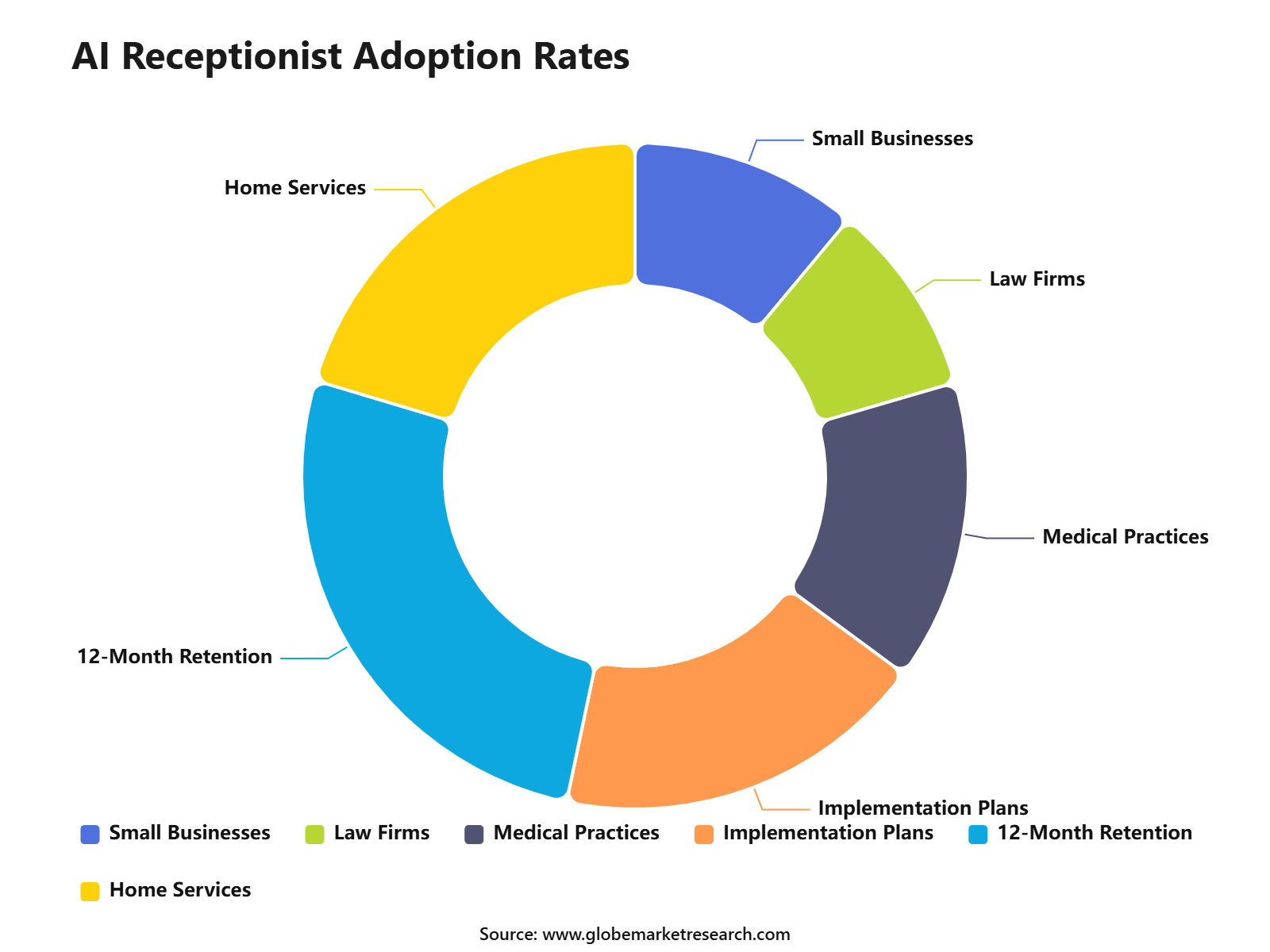
Small businesses are becoming a major demand base for AI receptionists. Almost 60% of small businesses said they use AI for business operations, and 58% reported using generative AI.
Based on data from salesforce, Customer service is one of the clearest use cases for AI reception technology. In 2025, AI resolved 30% of service cases, and this share is expected to reach 50% by 2027. AI receptionists benefit from the same shift because they handle first-contact tasks such as FAQs, order inquiries, call routing, and basic service requests.
Service teams using AI agents expect service costs and case resolution times to fall by an average of 20%. This cost and time benefit is one of the strongest reasons businesses are adopting AI receptionists for front-desk automation, overflow call handling, and repetitive inquiry management.
Conversational AI is becoming more important in phone-based service. Around 88% of service professionals say conversational AI accelerates resolution times, 85% say voice AI to human handoffs are seamless, and 87% say AI frees human representatives to handle more complex issues.
Around 74% of consumers now expect customer service to be available 24/7 due to AI.
Around 88% of customers expect faster response times than they did one year earlier.
 iThe graph shows projected market growth until 2035 based on CAGR analysis. Actual outcomes may vary depending on changing demand, competition, and economic factors.To gain greater insights - request a sample report PDF
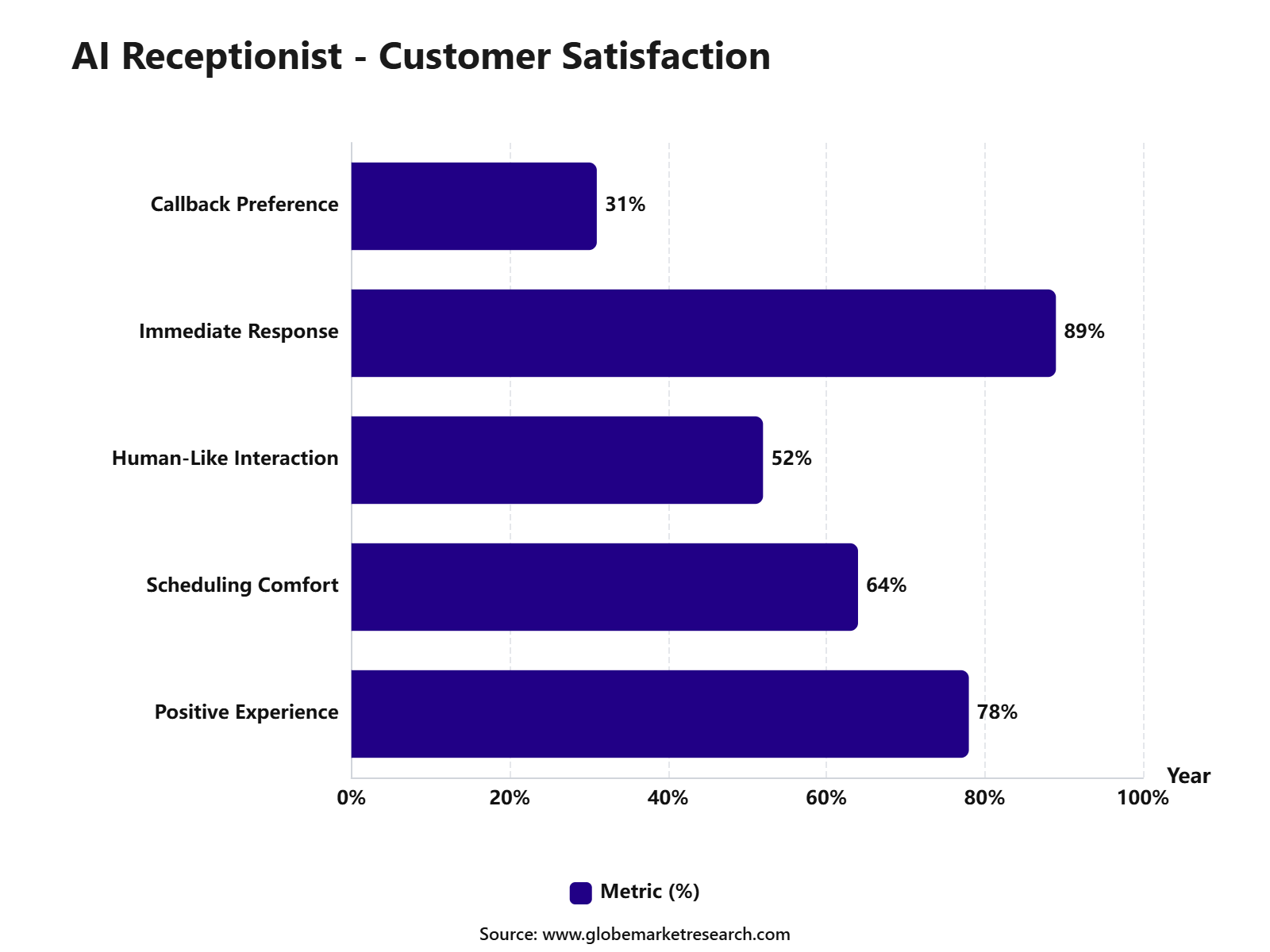
According to SchedulingKit, AI-powered scheduling tools help businesses automate bookings, payments, and follow-ups with less manual work. This supports higher customer satisfaction because callers can get faster responses, easier appointment handling, and round-the-clock support.
 iThe graph shows projected market growth until 2035 based on CAGR analysis. Actual outcomes may vary depending on changing demand, competition, and economic factors.To gain greater insights - request a sample report PDF
Component Insights
Solutions and software platforms dominated the AI receptionist market with a 75.9% share in 2025. The segment is gaining strong demand because businesses need one system to manage call answering, appointment scheduling, lead capture, caller routing, and customer follow-ups. Adoption is also supported by the shift in customer service, where AI is already estimated to handle around 30% of service cases and is expected to handle nearly 50% by 2027.
The growth of this segment can be attributed to rising demand for automated front-desk workflows across small businesses, clinics, legal offices, real estate firms, salons, and service-based companies. AI-enabled software helps reduce repetitive reception tasks, as service professionals using AI report around 20% less time spent on routine cases and nearly 4 hours saved per week. This makes software platforms the core revenue segment because they combine voice, workflow automation, CRM integration, and analytics in one scalable system.
Deployment Insights
Cloud-based deployment accounted for 69.1% share of the AI receptionist market in 2025. Businesses prefer cloud-based systems because they can be deployed faster, updated remotely, and scaled across multiple locations without large on-site infrastructure. This trend is supported by wider enterprise cloud adoption, as 73% of organizations now operate hybrid cloud environments and multi-cloud adoption continues to rise.
Cloud-based AI receptionists are especially useful for businesses that receive calls outside office hours, manage distributed teams, or operate across several branches. Cloud platforms also support integration with phone systems, calendars, CRM tools, payment links, and customer records. As cloud cost control becomes more important, 63% of organizations now use FinOps teams and 71% use cloud centers of excellence, showing that cloud management is becoming more structured.
Service Type Insights
Voice reception services held a 55.5% share of the AI receptionist market in 2025. This segment is important because phone calls remain a high-intent customer channel for appointment booking, service inquiries, emergency requests, and lead generation. In the U.S., customer service representatives held about 2.8 million jobs in 2024, which shows the large operational base where voice automation can support front-office and contact-handling work.
The segment is also supported by rising customer expectations for faster response and reduced waiting time. AI voice systems can answer common questions, qualify callers, transfer calls, record call notes, and support multiple languages. In voice and chatbot deployments, public case examples show up to 80% IVR containment, a 65% increase in self-service rate, and a 30% reduction in agent call volume.
Service Model Insights
24/7 receptionist solutions accounted for 63.1% share in 2025. The segment is expanding because customers increasingly expect support outside standard working hours, especially in healthcare, home services, travel, legal, financial services, and real estate. Recent customer experience data shows that 74% of consumers expect customer service to be available 24/7, while 88% expect faster response times than they did one year earlier.
The adoption of 24/7 AI receptionists is also supported by labor and operating cost pressures. Many customer service roles require evening, weekend, or holiday coverage, while call centers may operate 24 hours a day. Automated receptionist systems help businesses reduce missed calls, capture after-hours leads, and maintain service continuity without adding a full night-shift reception team.
 iThe graph shows projected market growth until 2035 based on CAGR analysis. Actual outcomes may vary depending on changing demand, competition, and economic factors.To gain greater insights - request a sample report PDF
By Technology Use Insights
Voice AI integration represented 55.6% share of the AI receptionist market in 2025. The segment is gaining traction as businesses move from basic call answering to natural voice conversations, speech recognition, intent detection, call summarization, and smart routing. Voice AI adoption is supported by wider customer service automation, with 42% of CX leaders expecting generative AI to influence voice-based interactions over the next two years.
Voice AI is also becoming more useful because it can support both structured and open-ended conversations. Modern systems can manage booking requests, collect caller details, answer FAQs, detect urgency, and send summaries to staff after the call. In real-world conversational AI deployments, automated systems have shown 35% fully automated end-to-end calls and a 30% reduction in agent call volume, which strengthens the business case for voice AI integration.
Regional Insights
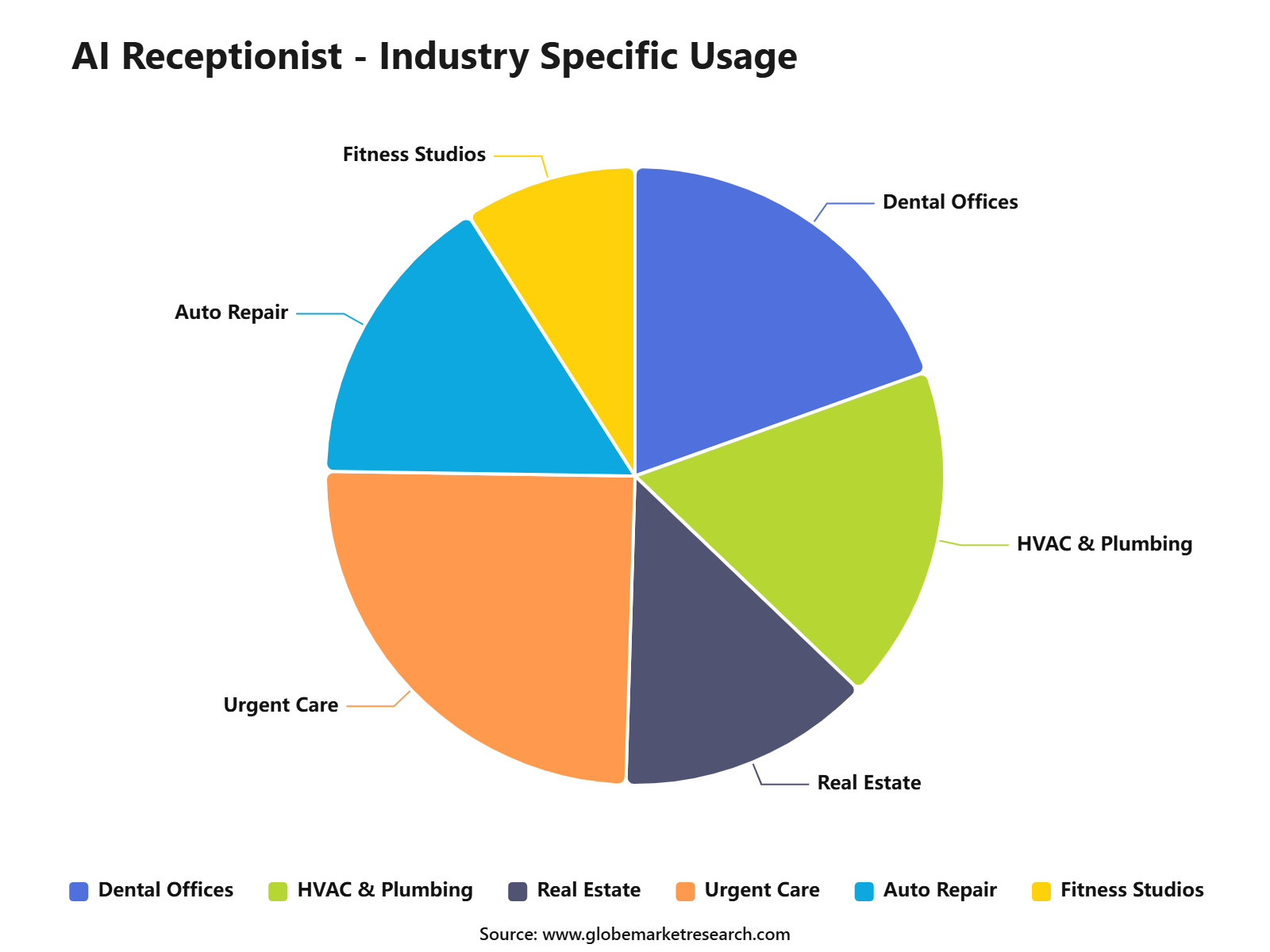
North America dominated the AI receptionist market with a 41.9% share in 2025. The region benefits from strong cloud adoption, high service automation demand, and a large base of small and medium businesses that depend on fast customer response. In the U.S., there were 5.58 million employer firms with fewer than 500 employees in 2023, along with more than 30.4 million nonemployer establishments, creating a broad addressable base for AI receptionist tools.
The regional lead is also supported by high labor costs and strong demand for operational efficiency in customer-facing sectors. Receptionists held about 1.0 million jobs in the U.S. in 2024, with healthcare and social assistance accounting for 45% of receptionist employment. This creates strong adoption potential for AI receptionists in clinics, dental offices, senior care, professional services, and other appointment-driven businesses.
 iThe graph shows projected market growth until 2035 based on CAGR analysis. Actual outcomes may vary depending on changing demand, competition, and economic factors.To gain greater insights - request a sample report PDF
Drivers Impact Analysis
Impact Factor | Estimated CAGR Impact | Regional Relevance | Market Impact |
|---|---|---|---|
Rising demand for automated front-desk operations | +6.8% | North America, Europe, Asia Pacific | Reduces manual workload. |
Growth in AI-based customer interaction tools | +6.2% | U.S., China, India, UK, Germany | Improves service handling. |
Increasing adoption by SMEs | +5.5% | U.S., Europe, India, Southeast Asia | Expands user base. |
Need for 24/7 customer response | +5.2% | Global | Improves availability. |
Rising labor cost in service industries | +4.8% | North America, Europe, Japan, Australia | Supports automation demand. |
Restraints Impact Analysis
Impact Factor | Estimated CAGR Impact | Regional Relevance | Market Impact |
|---|---|---|---|
Data privacy and call recording concerns | -3.2% | North America, Europe, developed Asia | Slows trust building. |
High setup and integration cost | -2.8% | SMEs and emerging markets | Limits early adoption. |
Limited accuracy with accents and languages | -2.5% | Asia Pacific, Latin America, MEA | Affects user experience. |
Customer preference for human receptionists | -2.1% | Healthcare, hospitality, professional services | Restricts full automation. |
Dependence on internet and cloud systems | -1.8% | Emerging markets | Impacts service reliability. |
Opportunities Impact Analysis
Impact Factor | Estimated CAGR Impact | Regional Relevance | Market Impact |
|---|---|---|---|
Expansion in healthcare clinics | +6.4% | U.S., Europe, India, GCC | Supports appointment automation. |
Growth in hospitality and travel services | +5.8% | North America, Europe, Asia Pacific | Improves guest support. |
Adoption by legal and professional firms | +5.1% | U.S., UK, Canada, Australia | Enhances call handling. |
Integration with CRM and booking systems | +4.9% | Global | Streamlines workflows. |
Multilingual AI receptionist solutions | +4.6% | Europe, Asia Pacific, Latin America | Broadens market reach. |
Challenges Impact Analysis
Impact Factor | Estimated CAGR Impact | Regional Relevance | Market Impact |
|---|---|---|---|
Voice recognition errors | -3.0% | Global | Reduces service quality. |
Integration with legacy phone systems | -2.6% | SMEs and traditional businesses | Delays deployment. |
Regulatory compliance for customer data | -2.3% | U.S., Europe, India, Australia | Raises compliance burden. |
Limited personalization in complex cases | -2.0% | Healthcare, legal, hospitality | Requires human support. |
Vendor lock-in risk | -1.7% | Global | Limits platform flexibility. |
Segments Covered in the Report
By Component
Solutions
Services
By Deployment
Cloud-based
On-premises
By Service Type
Voice Reception Services
Chat Reception Services
Appointment Scheduling
Call Routing
Lead Qualification
Customer Support
By Service Model
24/7 Receptionist Solutions
Business Hours Receptionist Solutions
Hybrid Receptionist Solutions
By Technology
Voice AI Integration
Conversational AI
Natural Language Processing
Speech Recognition
Others
By Enterprise Size
Small and Medium Enterprises
Large Enterprises
By End-use
Healthcare
Legal Services
Real Estate
Retail and E-commerce
BFSI
Hospitality
Automotive
Home Services
IT and Telecom
Others
By Region
North America
Europe
Asia-Pacific
Latin America
Middle East and Africa
Market Trend Analysis
Impact Factor | Estimated CAGR Impact | Regional Relevance | Market Impact |
|---|---|---|---|
Voice-first AI receptionist adoption | +6.3% | North America, Europe, Asia Pacific | Improves customer access. |
AI receptionist for appointment scheduling | +5.7% | Healthcare, salons, clinics, services | Reduces missed calls. |
Human-like conversational AI | +5.3% | U.S., Europe, China, India | Enhances caller experience. |
Omnichannel receptionist platforms | +4.8% | Global | Connects calls, chat, and email. |
Subscription-based AI receptionist services | +4.5% | SMEs and service businesses | Supports recurring revenue. |
Demand Analysis
Impact Factor | Estimated CAGR Impact | Regional Relevance | Market Impact |
|---|---|---|---|
Demand from small businesses | +6.2% | U.S., Europe, India, Southeast Asia | Drives volume adoption. |
Demand from healthcare providers | +5.8% | U.S., Europe, India, GCC | Supports patient scheduling. |
Demand from hospitality businesses | +5.1% | Global travel hubs | Improves guest communication. |
Demand for 24/7 call answering | +5.5% | Global | Reduces missed inquiries. |
Demand for cost-efficient customer support | +5.0% | SMEs and service firms | Lowers operating cost. |
Investor Type Impact Matrix
Investor Type | Estimated CAGR Impact | Regional Relevance | Market Impact |
|---|---|---|---|
Venture Capital Firms | +6.0% | U.S., India, Europe, Southeast Asia | Supports AI startups. |
Strategic Technology Investors | +5.6% | U.S., China, Japan, South Korea | Expands platform capability. |
Contact Center Technology Investors | +5.1% | North America, Europe, Asia Pacific | Drives service automation. |
Private Equity Firms | +4.5% | North America, Europe, Asia Pacific | Supports scaling. |
Telecom and Cloud Investors | +4.8% | Global | Strengthens deployment infrastructure. |
Recent Developments
May 2026 - OpenAI launched new real-time audio models for voice-based software agents. The models include GPT-Realtime-2, GPT-Realtime-Translate, and GPT-Realtime-Whisper. Pricing started at USD 32 per million audio input tokens, USD 0.034 per minute for real-time translation, and USD 0.017 per minute for live transcription. This supports wider use of AI receptionists in customer service, booking, and call handling.
February 2026 - Newo raised USD 25 million to scale production-ready AI receptionists for small businesses. The funding is being used for product development, partner ecosystem growth, go-to-market expansion, and broader voice AI use cases across service-led industries.
February 2026 - Slang AI raised USD 36 million in Series B funding, bringing total funding to USD 68 million . The company’s AI “Superhost” platform automates restaurant guest calls, reservations, FAQs, and front-desk workflows.
January 2026 - Parloa raised USD 350 million in Series D funding at a USD 3 billion valuation. The company’s total funding reached more than USD 560 million. Parloa supports enterprise AI agents for calls, chats, and customer service workflows, making it highly relevant to AI receptionist adoption.
Report Scope
Report Highlights | Details |
|---|---|
Market Revenue (2025) | USD 2.3 Bn |
Forecast Revenue (2035) | USD 23.8 Bn |
CAGR (2025-2035) | 26.3% |
Base Year for Estimation | 2025 |
Historic Data | 2020-2024 |
Forecast Period | 2025-2035 |
Report Coverage | AI market impact analysis, Market surveys, trade analysis, Industry & competitive intelligence, Revenue projections, company positioning, competitive analysis, growth drivers, and emerging market trends, Strategic Consultation & Advisory Services |
Segments Covered | By Component (Solutions, Services), By Deployment (Cloud-based, On-premises), By Service Type (Voice Reception Services, Chat Reception Services, Appointment Scheduling, Call Routing, Lead Qualification, Customer Support), By Service Model (24/7 Receptionist Solutions, Business Hours Receptionist Solutions, Hybrid Receptionist Solutions), By Technology (Voice AI Integration, Conversational AI, Natural Language Processing, Speech Recognition and Others), By Enterprise Size (Small and Medium Enterprises, Large Enterprises), By End-use (Healthcare, Legal Services, Real Estate, Retail and E-commerce, BFSI, Hospitality, Automotive, Home Services, IT and Telecom, Others), By Regional Insights |
Regional Analysis | North America - US, Canada; Europe - Germany, France, The UK, Spain, Italy, Russia, Netherlands, Rest of Europe; Asia Pacific - China, Japan, South Korea, India, New Zealand, Singapore, Thailand, Vietnam, Rest of Latin America; Latin America - Brazil, Mexico, Rest of Latin America; Middle East & Africa - South Africa, Saudi Arabia, UAE, Rest of MEA |
Key companies profiled | RingCentral, Aircall, Smith.ai , Ruby, AnswerConnect, AIRA, Dialzara, Rosie, Goodcall, Retell AI, Zoom, Quo, Nextiva, Moneypenny, PATLive, Abby Connect, Nexa, PolyAI, Cognigy, Five9. |
Customization Scope | Tailored insights for specific regions, countries, and market segments can be provided. Additional report customization is available upon request. |
Competitive Landscape
The market is characterized by intense competition among established players and emerging companies. Strategic partnerships, mergers and acquisitions, and product innovation are key strategies employed by market participants.
Key Market Players
RingCentral
Aircall
Smith.ai
Ruby
AnswerConnect
AIRA
Dialzara
Rosie
Goodcall
Retell AI
Zoom
Quo
Nextiva
Moneypenny
PATLive
Abby Connect
Nexa
Other Key Players
Meet the Team
This report was prepared by our expert analysts with deep industry knowledge and research experience.
Pratiksha is market research analyst with strong experience in industry research, market forecasting, and competitive analysis. She specializes in identifying market trends, evaluating growth opportunities, and preparing data-driven insights across global industries. Her work supports businesses in understanding market dynamics, customer demand, regional opportunities, and strategic investment areas.
Suraj is a Senior Management Consultant with over 7 years of experience in market research, business strategy, and consulting. He has worked with Fortune 500 companies and growing startups, helping them with market entry, cross-border expansion, demand analysis, competitive assessment, and growth planning. His analytical thinking and strong industry knowledge help clients make clear, confident, and informed business decisions.
Frequently Asked Questions
Related Reports
More in Information and Technology
Operating Room Integration Market to hit USD 10.3 Bn by 2035
Global Operating Room Integration Market Size, Share Report By Component (Software, Hardware, Services), By Device Type (Audio and Video Management Systems, Display Systems, Others), By Application (General Surgery, Orthopedic Surgery, Others), By End User (Hospitals, Ambulatory Surgical Centers, Specialty Clinics), By Deployment Mode On-premise, Cloud-based, Hybrid), By Operating Room Type (Hybrid Operating Rooms, Integrated Operating Rooms), By Technology (Surgical Workflow Integration, Image and Video Integration, Others), By Regional (North America, Europe, Asia Pacific, Others), By Regional Insights, Business plan and Project Report, Investment Opportunities, Profitability, Industry Trends, Leading Companies and Growth Forecasts by 2025-2035
Sharing Economy Apps Market to hit 1,411.2 Bn by 2035
Global Sharing Economy Apps Market By Product / Service Type (Shared Transportation, Shared Space, Sharing Financial, Sharing Food, Shared Healthcare, Shared Knowledge & Education, Shared Task Services, Shared Items, Others), By Distribution Channel (Online, Offline), By End User (Generation Z, Millennials, Generation X, Boomers), By Regional Insights, Business plan and Project Report, Investment Opportunities, Profitability, Industry Trends, Leading Companies and Growth Forecasts by 2025-2035
Voice AI Agents Market to Hit USD 113.7 Billion by 2035
Global Voice AI Agents Market Size, Share Analysis Report By Solution (Voice AI Platform, Services (Professional Services(Implementation & Integration, Consulting & Training Services, Support and Maintenance Services), Managed Services)), By Deployment (Cloud Based, On Premises), By Enterprise Size (Small & Medium Enterprise Size, Large Enterprises), By Industry (BFSI, Automotive, Healthcare, Retail & E-commerce, IT & Telecom, Aerospace & Defence, Others (Utilities, Media & Entertainment)), By Regional Insights, Business plan and Project Report, Investment Opportunities, Profitability, Industry Trends, Leading Companies and Growth Forecasts by 2025-2035
AI Trust, Risk and Security Management (AI TRiSM) Market to hit USD 39.8 Bn by 2026
Global AI Trust, Risk and Security Management (AI TRiSM) Market Size, Share Analysis Report By Component (Solutions, Services), By Technology (ML based TRiSM, Natural Language Processing based TRiSM, Explainable AI (XAI), Federated Learning/Privacy-Preserving ML), By Application (Model Governance & Compliance, Model Monitoring & Observability, Data Privacy & Security, Bias Detection & Mitigation, Identity & Access Security for AI), By Deployment (On-premises, Cloud), By Organization Size (Large Enterprises, Small & Medium Enterprises), By Industry Vertical (BFSI, Healthcare, Retail & E-commerce, IT & Telecom, Government & Defense, Manufacturing, Transportation & Logistics), By Regional Insights, Business plan and Project Report, Investment Opportunities, Profitability, Industry Trends, Leading Companies and Growth Forecasts by 2025-2035