

Revenue, 2025
$ 10.3 Bn
Forecast, 2035
$ 16.9 Bn
CAGR, 2025-2035
5.1%
Report Coverage
Global
Market Size and Forecast
The Global Styrenic Block Copolymer Market was worth USD 10.3 billion in 2025 and is expected to reach USD 16.9 billion by 2035, growing at a CAGR of 5.1% from 2025 to 2035. Asia Pacific held the largest regional share of 47.9% in 2025, supported by strong polymer production, rising demand from packaging, footwear, adhesives, healthcare, and automotive applications, and expanding manufacturing activity across China, India, Japan, South Korea, and Southeast Asia.
The Styrenic Block Copolymer Market includes thermoplastic elastomers that offer rubber-like flexibility with plastic-like processing benefits. These materials are widely used in adhesives, sealants, footwear soles, roofing, paving, medical tubing, hygiene products, packaging films, toys, and automotive components. The market is closely linked with plastics processing, synthetic rubber demand, flexible packaging, consumer goods manufacturing, and high-performance material development.
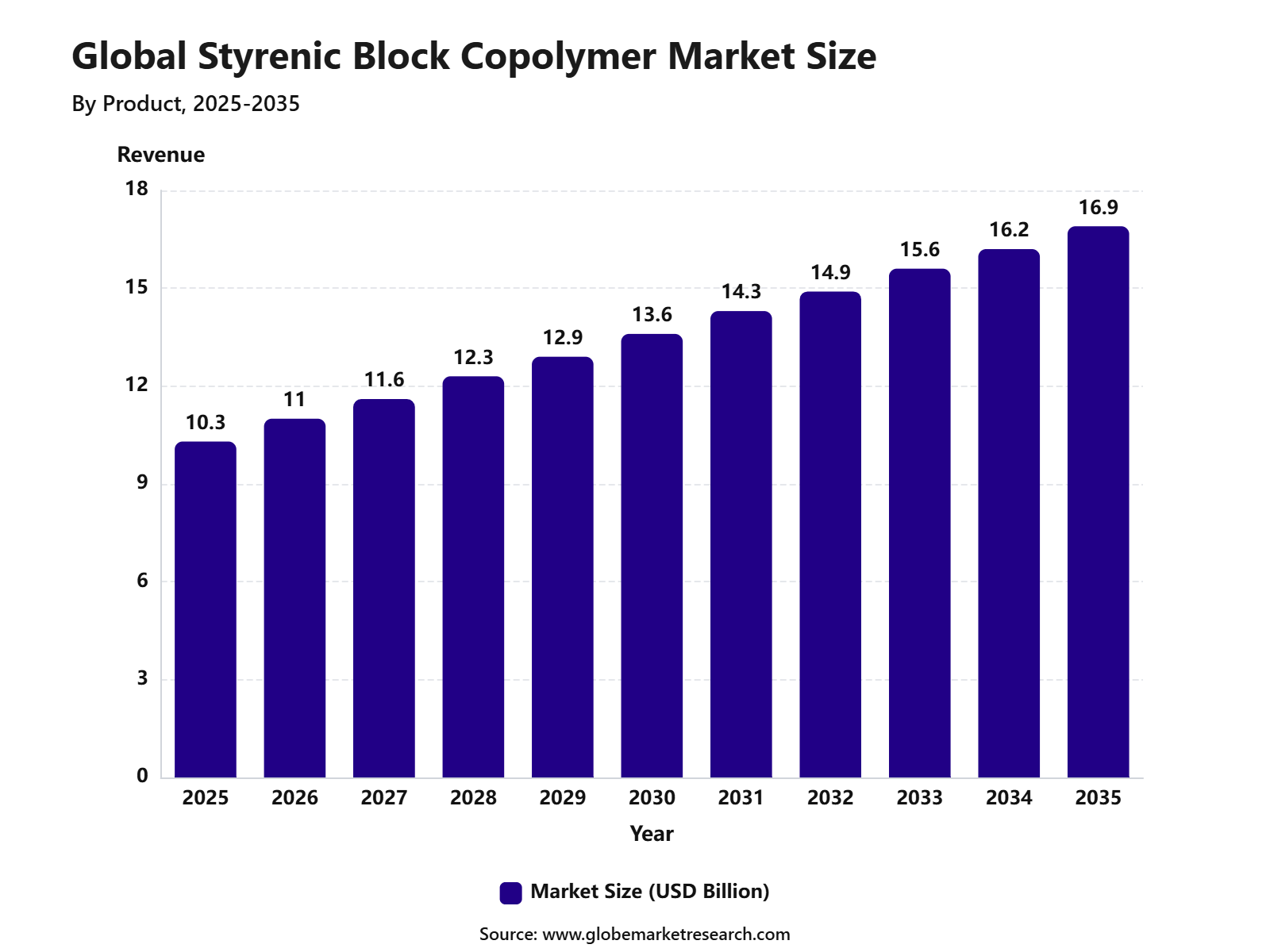 iThe graph shows projected market growth until 2035 based on CAGR analysis. Actual outcomes may vary depending on changing demand, competition, and economic factors.To gain greater insights - request a sample report PDF
The market outlook remains steady as industries continue to prefer lightweight, flexible, durable, and easy-to-process materials. Growth can be attributed to increasing use of styrenic block copolymers in pressure-sensitive adhesives, soft-touch consumer products, medical devices, and modified asphalt applications. The expansion of bio-based elastomers, recyclable polymer solutions, and advanced material formulations is expected to support long-term market demand.
Report Highlights | Details |
|---|---|
Market Revenue (2025) | USD 10.3 Billion |
Forecast Revenue (2035) | USD 16.9 Billion |
CAGR (2025-2035) | 5.1% |
Base Year for Estimation | 2025 |
Historic Data | 2020-2024 |
Forecast Period | 2025-2035 |
Key Market Insights
Styrene-butadiene-styrene led the product segment with 65.9% share, supported by its strong elasticity, durability, processing flexibility, and wide use in adhesives, sealants, footwear, paving, and roofing materials.
Paving and roofing accounted for 38.1% share by application, driven by rising use of styrenic block copolymers in asphalt modification, waterproofing membranes, road durability improvement, and construction materials.
Asia Pacific led the styrenic block copolymer market with 47.9% share, supported by strong construction activity, expanding infrastructure projects, high polymer consumption, and growing manufacturing demand across China, India, and Southeast Asia.
Product Analysis
Styrene-butadiene-styrene led the Styrenic Block Copolymer Market with 65.9% share, supported by its strong elasticity, flexibility, tensile strength, and easy processing. SBS is widely used where rubber-like performance is needed along with the processing advantages of thermoplastics.
The growth of this segment can be attributed to strong use in asphalt modification, footwear, adhesives, sealants, polymer modification, and flexible molded products. SBS improves toughness, impact resistance, and low-temperature flexibility, making it suitable for both industrial and consumer applications.
SBS is expected to remain the leading product because it offers a strong balance between performance and cost. Demand will continue to be supported by infrastructure activity, roofing materials, pressure-sensitive adhesives, footwear soles, packaging materials, and polymer blending applications.
Application Analysis
Paving and roofing accounted for 38.1% share, making it the leading application segment in the Styrenic Block Copolymer Market. SBS is commonly used to modify bitumen and asphalt because it improves flexibility, crack resistance, durability, and performance under temperature variation.
The growth of this segment can be linked to road construction, highway maintenance, waterproofing membranes, bridge decks, and roofing systems. Modified asphalt and roofing materials benefit from SBS because it helps improve resistance to deformation, weathering, and long-term wear.
Paving and roofing are expected to remain key application areas as infrastructure spending and maintenance needs continue across developed and emerging economies. Demand will remain strong for polymer-modified bitumen, roofing membranes, road resurfacing materials, waterproofing systems, and high-performance pavement solutions.
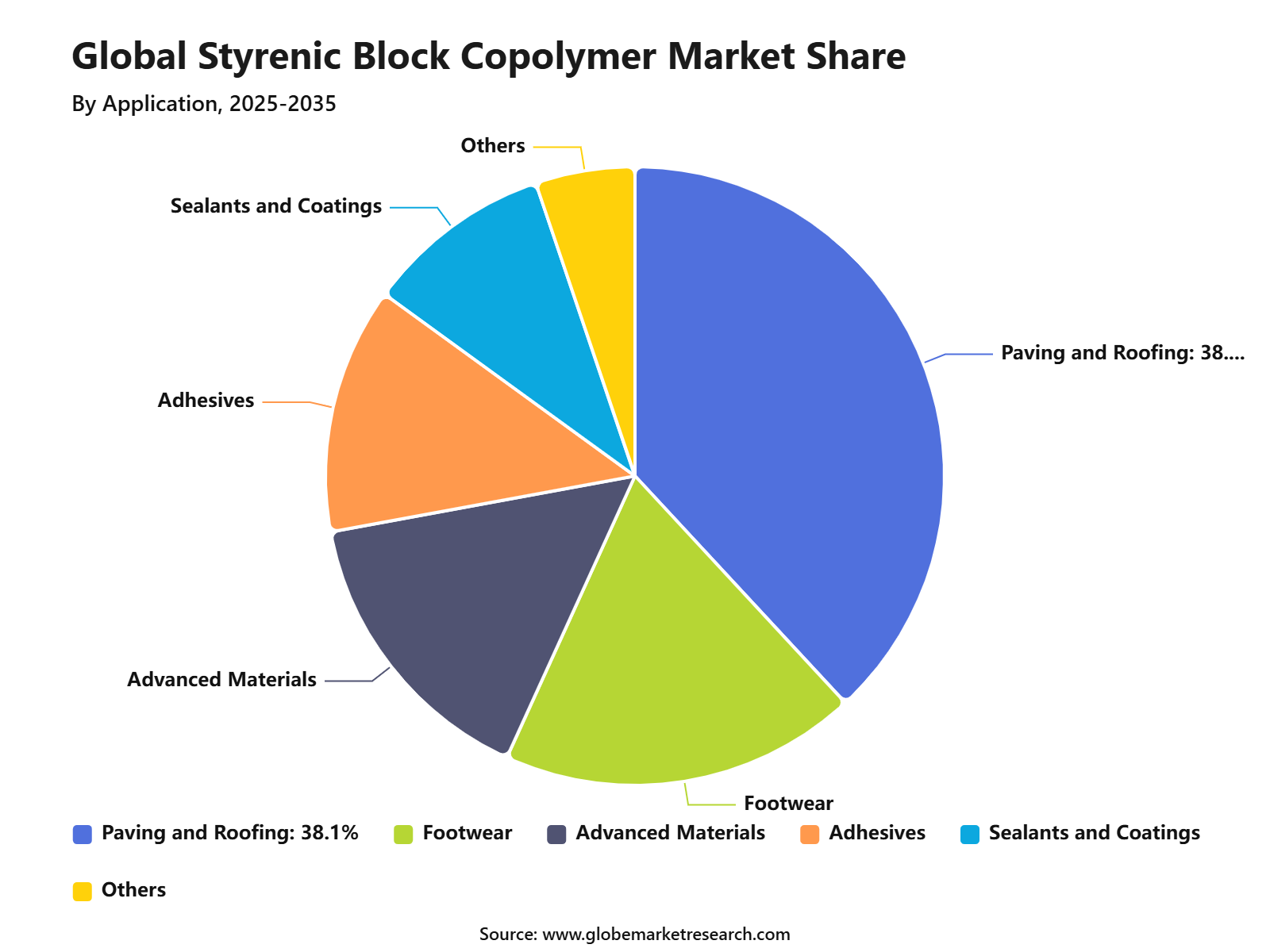 iThe graph shows projected market growth until 2035 based on CAGR analysis. Actual outcomes may vary depending on changing demand, competition, and economic factors.To gain greater insights - request a sample report PDF
Regional Analysis
Asia Pacific led the Styrenic Block Copolymer Market with 47.9% share, supported by strong demand from construction, road infrastructure, adhesives, footwear, packaging, automotive, and consumer goods manufacturing. China, India, Japan, South Korea, and Southeast Asia remain major contributors to regional consumption.
The region’s dominance can be attributed to large-scale infrastructure development and strong downstream manufacturing capacity. SBS demand is especially supported by paving and roofing applications, along with footwear and adhesive production in high-volume manufacturing hubs.
Asia Pacific is expected to remain the leading region as construction activity, urban development, and industrial production continue to support demand. Opportunities are likely to remain strong in SBS-based asphalt modification, roofing membranes, footwear materials, adhesives, sealants, and flexible polymer applications.
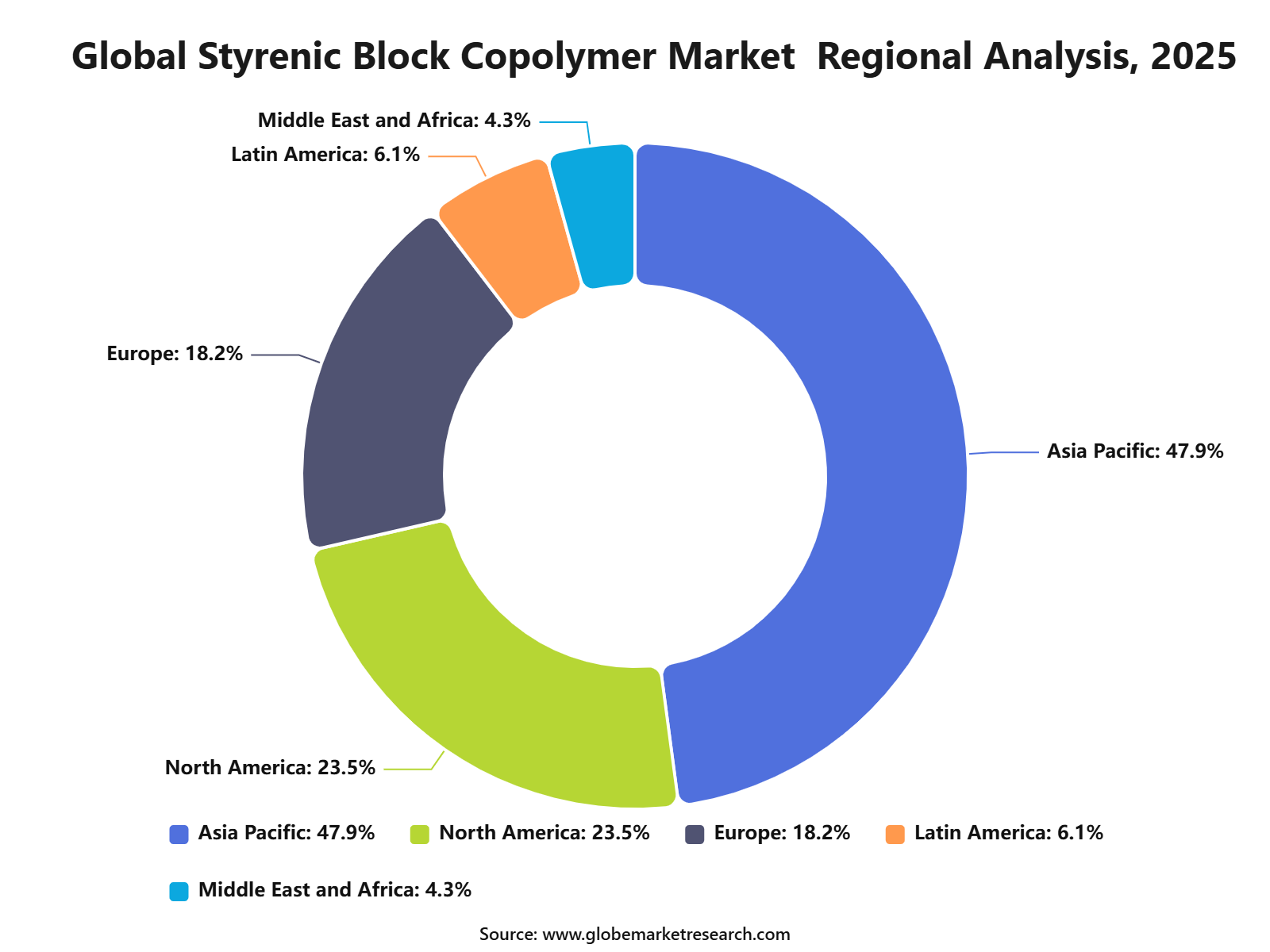 iThe graph shows projected market growth until 2035 based on CAGR analysis. Actual outcomes may vary depending on changing demand, competition, and economic factors.To gain greater insights - request a sample report PDF
Regional Impact Analysis
Asia Pacific leads the Styrenic Block Copolymer Market with 47.9% share in 2025, supported by construction, footwear manufacturing, packaging demand, and industrial polymer processing. China, India, Japan, South Korea, and Southeast Asia remain important growth contributors.
North America and Europe are important markets for paving, roofing, medical materials, adhesives, and specialty compounds. These regions also show stronger interest in sustainable polymer grades and performance-driven formulations.
Impact Factor | Estimated CAGR Impact | Regional Relevance | Market Impact |
|---|---|---|---|
Asia Pacific market leadership | +1.7% | Asia Pacific, 47.9% share in 2025 | Leads volume demand. |
China construction and polymer demand | +1.1% | China | Drives regional growth. |
India infrastructure and footwear demand | +0.9% | India | Supports future consumption. |
North America asphalt and roofing use | +0.8% | U.S. and Canada | Builds stable demand. |
Europe specialty and sustainable grades | +0.6% | Germany, France, UK, Italy | Supports premium adoption. |
Go-To-Market-Startagy
The go-to-market approach for the Styrenic Block Copolymer Market should be built around application-specific selling, not bulk polymer selling. Demand is mainly driven by SBS, SIS and hydrogenated SBC grades used in adhesives, sealants, coatings, packaging, automotive, medical, paving and roofing products. In February 2026, Kraton announced a global price increase of USD 330 per metric ton for SBS, SIS and HSBC product lines, showing that pricing power is being shaped by raw material, handling and logistics costs.
Sales economics are becoming more technical because buyers are looking for materials that improve flexibility, elasticity, bonding strength and weather resistance. The strongest customer targets include adhesive formulators, asphalt modifier producers, compounders, footwear manufacturers, hygiene product suppliers and automotive component makers. In June 2026, styrene prices were reported at USD 0.88/kg in North America, USD 1.39/kg in Europe and USD 1.29/kg in Northeast Asia, making regional sourcing strategy important for margin protection.
Automotive and transport applications are a major route for SBC-based thermoplastic elastomers because these materials support soft-touch parts, seals, interior components, vibration control and lightweight design. Global vehicle production increased to 96.4 million units in 2025, while global vehicle sales reached 99.8 million units, creating stable downstream pull for elastomeric materials used in automotive compounds and adhesive systems.
Revenue Potential Analysis
Revenue Landscape Across
Revenue potential is spread across hot-melt adhesives, pressure-sensitive adhesives, polymer modification, bitumen modification, roofing membranes, medical elastomers, footwear soles, packaging adhesives and personal care products. Adhesives and sealants remain one of the strongest revenue areas because SBC grades help improve tack, peel strength and flexibility. FEICA’s latest European adhesives and sealants market report covers the 2025 to 2030 period, showing that adhesive producers are actively tracking new demand cycles and regulatory needs.
Paving and roofing applications create another important revenue pool for SBS-based products. In the U.S., highway construction spending reached a seasonally adjusted annual rate of USD 149.6 billion in April 2026, while total public construction spending stood at USD 532.7 billion. This supports demand for modified asphalt binders, waterproofing membranes and roofing systems where SBCs are used to improve elasticity and temperature performance.
Asia remains important for downstream conversion because automotive, construction, packaging and electronics supply chains are concentrated in the region. Global car production grew by 4.2% in 2025 to 78.7 million passenger cars, with Asia accounting for 62.1% of total output. This supports SBC suppliers serving compounders, part makers and adhesive producers located near large manufacturing hubs.
Financial Impact
The financial impact of SBC is being shaped by feedstock volatility and producer price actions. Butadiene, a key input for SBS and related elastomer chains, showed regional price pressure in June 2026, with Europe at USD 1.07/kg and Northeast Asia at USD 1.71/kg. This makes pass-through contracts, indexed pricing and diversified sourcing important for producers and large buyers.
For manufacturers, the strongest margin improvement comes from specialty grades rather than commodity sales. Hydrogenated SBCs and customized grades can command better value in medical, personal care, packaging and automotive applications because buyers pay for purity, durability, softness, heat resistance and regulatory suitability. Kraton’s 2026 communication also confirms that SBC products are sold into more than 70 countries, which reflects the global nature of the customer base and export opportunity.
Drivers Impact Analysis
The Styrenic Block Copolymer Market is driven by rising demand for flexible, durable, and lightweight polymer materials across paving, roofing, footwear, adhesives, packaging, and medical products. Its rubber-like flexibility and thermoplastic processability make it suitable for applications that need strength, elasticity, and easy molding.
Asia Pacific supports strong demand because of large construction activity, footwear production, packaging growth, and expanding polymer processing capacity. China, India, Japan, and Southeast Asia remain important demand centers due to industrial manufacturing and infrastructure-linked consumption.
Impact Factor | Estimated CAGR Impact | Regional Relevance | Market Impact |
|---|---|---|---|
Rising demand for SBS polymers | +1.3% | Asia Pacific, North America, Europe | Drives core consumption. |
Growth in paving and roofing applications | +1.1% | China, India, U.S., Europe | Supports asphalt modification. |
Expansion of footwear manufacturing | +0.9% | Asia Pacific | Builds flexible material demand. |
Increasing use in adhesives and sealants | +0.8% | Global manufacturing markets | Expands industrial usage. |
Demand for lightweight polymer materials | +0.7% | Automotive, packaging, consumer goods | Supports material substitution. |
Restraints Impact Analysis
The market faces restraints from raw material price volatility, especially styrene and butadiene, which are linked to petrochemical feedstock movements. Cost swings can affect margins and create pricing pressure for compounders and end users.
Environmental pressure on plastic materials also affects market growth. Although styrenic block copolymers are useful in many performance applications, waste management concerns and recycling limitations can increase scrutiny in packaging and consumer product segments.
Impact Factor | Estimated CAGR Impact | Regional Relevance | Market Impact |
|---|---|---|---|
Styrene and butadiene price volatility | -0.8% | Global producers | Pressures margins. |
Environmental concerns over polymers | -0.7% | Europe, North America, developed Asia | Raises compliance burden. |
Competition from alternative elastomers | -0.6% | Global industrial markets | Limits substitution potential. |
Recycling and disposal challenges | -0.5% | Packaging and consumer goods sectors | Affects sustainability claims. |
Energy-intensive production processes | -0.4% | Petrochemical production hubs | Increases cost exposure. |
Opportunities Impact Analysis
Opportunities are strong in asphalt modification, medical-grade elastomers, footwear soles, hygiene products, adhesives, and specialty compounds. Producers that offer high-performance grades with better durability, processability, and softness can capture higher-value demand.
Sustainability-focused innovation also creates future growth potential. SBC suppliers can benefit from recyclable formulations, bio-based feedstock development, and lower-emission production routes as customers seek improved material performance with reduced environmental impact.
Impact Factor | Estimated CAGR Impact | Regional Relevance | Market Impact |
|---|---|---|---|
Asphalt modification growth | +1.2% | Asia Pacific, U.S., Europe | Supports infrastructure demand. |
Medical-grade SBC applications | +1.0% | North America, Europe, Japan, China | Builds premium value. |
Expansion in footwear soles | +0.9% | China, India, Vietnam, Indonesia | Drives flexible material use. |
Growth in hygiene and packaging films | +0.8% | Global consumer markets | Supports soft-touch demand. |
Recyclable and specialty SBC grades | +0.7% | Europe, North America, Asia Pacific | Improves sustainability value. |
Challenges Impact Analysis
The main challenge is balancing performance, cost, and sustainability in end-use applications. Customers need materials that meet flexibility, durability, and safety requirements while keeping product costs manageable.
Another challenge is maintaining reliable supply during petrochemical market fluctuations. Since SBC production depends on key monomers, suppliers must manage feedstock access, quality consistency, and long-term customer contracts carefully.
Impact Factor | Estimated CAGR Impact | Regional Relevance | Market Impact |
|---|---|---|---|
Maintaining cost-performance balance | -0.7% | Global manufacturers | Affects buyer decisions. |
Feedstock supply uncertainty | -0.6% | Asia Pacific, Europe, North America | Impacts production planning. |
Meeting medical and food-contact standards | -0.5% | U.S., Europe, Japan | Raises qualification needs. |
Technical limits in recycling | -0.5% | Polymer recycling markets | Slows circular adoption. |
Strong competition in commodity grades | -0.4% | Asia Pacific and global suppliers | Reduces margin strength. |
Segment Covered in the Report
By Product
Styrene-Butadiene-Styrene (SBS)
Styrene-Isoprene-Styrene (SIS)
Styrene-Isoprene Butadiene Block Copolymer (SIBS)
Hydrogenated Styrenic Block Copolymers (HSBC)
By Application
Paving and Roofing
Footwear
Advanced Materials
Adhesives
Sealants and Coatings
Others
By Region
North America
Europe
Asia Pacific
Latin America
Middle East and Africa
Market Trend Analysis
The market trend is moving toward SBS dominance, especially in paving and roofing applications, where it improves asphalt elasticity, crack resistance, and weather durability. This makes SBS important for infrastructure maintenance and road construction.
At the same time, demand is growing for higher-value SBC grades used in medical devices, adhesives, footwear, packaging, and personal hygiene products. These applications support better margins compared with lower-value commodity polymer uses.
Impact Factor | Estimated CAGR Impact | Regional Relevance | Market Impact |
|---|---|---|---|
SBS remains leading product type | +1.3% | Global | Leads market revenue. |
Paving and roofing remain key applications | +1.1% | Asia Pacific, North America, Europe | Drives asphalt demand. |
Medical and hygiene applications expand | +0.9% | Developed and urban markets | Supports premium growth. |
Footwear compound demand increases | +0.8% | Asia Pacific | Builds volume use. |
Specialty adhesive formulations rise | +0.7% | Global industrial markets | Adds value demand. |
Investor Type Impact Matrix
Investors should focus on producers with strong SBS capacity, reliable feedstock access, technical compounding capability, and exposure to infrastructure-linked applications. Companies serving paving, roofing, footwear, and adhesives can benefit from steady demand.
Strategic investors can also target medical-grade SBC, sustainable polymer innovation, and regional compounding facilities. These areas offer better value creation than commodity-grade supply alone because they require performance, consistency, and customer-specific formulation support.
Investor Type | Estimated CAGR Impact | Regional Relevance | Market Impact |
|---|---|---|---|
SBC Manufacturers | +1.2% | Global | Expands production capacity. |
Petrochemical and Polymer Producers | +1.0% | Asia Pacific, North America, Europe | Secures raw material flow. |
Asphalt Modifier Companies | +0.9% | Infrastructure-heavy regions | Drives paving demand. |
Footwear and Adhesive Material Suppliers | +0.8% | Asia Pacific, Europe, North America | Builds downstream use. |
Private Equity and Strategic Investors | +0.6% | Global specialty polymer markets | Supports capacity scaling. |
Recent Developments
In February 2026, Kraton announced a global price increase of USD 330 per metric ton, or USD 0.15 per pound, for all Kraton Polymers products covering SBS, SIS, and HSBC product lines. The increase became effective on March, 2026, and was linked to higher raw material, storage, handling, and logistics costs. This shows that the Styrenic Block Copolymer Market is still facing cost pressure across feedstock and supply-chain operations.
In March 2026, Kraton announced another global price increase for all polymer products, ranging from USD 440 per metric ton to USD 700 per metric ton, depending on polymer type and production location. The increase became effective on April, 2026, and was attributed to higher raw material, energy, and freight costs. This development indicates that buyers in adhesives, sealants, paving, roofing, medical, packaging, and automotive applications may continue to face higher procurement costs in 2026.
Competitive Landscape
The market is characterized by intense competition among established players and emerging companies. Strategic partnerships, mergers and acquisitions, and product innovation are key strategies employed by market participants.
Key Market Players
Versalis S.p.A.
Kraton Corporation
Eastman Chemical Company
TSRC
Cray Valley
RTP Company
Avient Corporation
HEXPOL AB
Asahi Kasei Corporation
BASF SE
ZEON Corporation
INEOS Styrolution Group GmbH
Denka Company Limited
Denka Company Limited
China Petrochemical Corporation
Other Key Players
Research Methodology
This market study is prepared using a combination of primary and secondary research. Primary research includes discussions with manufacturers, suppliers, distributors, consultants, industry experts, and end users. Secondary research covers company reports, government databases, trade associations, technical publications, regulatory sources, and trusted industry documents. The collected information is used to assess market demand, pricing trends, technology adoption, competitive activity, and regional performance.
AI language models are not used as primary data sources, and publicly available AI-generated content is not treated as market evidence. Computational tools may be used to support data processing, translation, data classification, and pattern identification. However, every published assessment is supported by verified sources, human review, and primary market discussions.
Market estimates are developed through top-down and bottom-up approaches and validated using data triangulation. Revenue, production, shipment, pricing, and application-level data are compared across multiple sources. Forecasts consider economic conditions, regulatory changes, investment activity, innovation, supply chain developments, and industry risks. All findings are reviewed through source verification and internal quality checks before publication.
Part I
Source Management & Input Data Standards
Who provides data, how sources are qualified, and what types of evidence are admissible.
Part II
Research Scope & Market Coverage
How we define the markets we assess and the parameters that govern each product.
Part III
Data Collection, Verification & Submission
The mechanics of gathering, cross-checking, and hierarchically ranking evidence.
Part IV
Assessment Determination & Quality Controls
How raw data becomes a published assessment — normalisation, expert judgement, and outlier exclusion.
Part V
Publication, Corrections & Revision
Our publication schedule, corrections policy, and methodology review cycle.
Part VI
Independence, Ethics & Complaints
Conflict-of-interest policies, editorial independence, and how clients raise concerns.
Google · Preferred Sources
Don't miss the latest market research insights and industry updates on Google.
Add Globe Market Research as a preferred source in the Google app to see our reports, analysis, and market stories in your news suggestions.
Meet the Team
This report was prepared by our expert analysts with deep industry knowledge and research experience.
Pratiksha K. is a Senior Research Analyst with more than five years of experience in market research, industry analysis, competitive intelligence, and business strategy. She has contributed to detailed market reports, customized research studies, company profiling, market sizing, trend analysis, and strategic consulting projects for clients across different regions. Her industry expertise covers Chemical and Material, Consumer Goods, Food & Beverages and Energy & Power. She closely evaluates changing customer requirements, technology developments, regulatory conditions, supply chain structures, investment activity, and competitive strategies to provide clear and practical market insights.
Sayali brings more than 7 years of experience to Globe Market Research, supporting the accuracy, clarity, and relevance of research content across multiple industries. She reviews market data, segment analysis, competitive insights, and industry trends to ensure each report meets strong quality standards and provides practical value to business decision-makers. Her expertise spans healthcare, information technology, consumer goods, and diverse cross-industry domains. With a strong focus on data reliability, structured analysis, and clear presentation, Sayali helps ensure that each research output delivers well-reviewed insights for clients, investors, consultants, and industry stakeholders.
Frequently Asked Questions
Related Reports
More in Chemical and Material
Sulfuric Acid Market to Hit USD 61.5 Billion by 2035
Sulfuric Acid Market Size, Share, Analysis By Raw Material (Elemental Sulfur, Base Metal Smelters, Pyrite Ore, Others), By Application (Fertilizers, Chemical Manufacturing, Metal Processing, Petroleum Refining, Textile, Automotive, Pulp and Paper, Others), By Distribution Channel (Direct Sales, Distributors), By Regional Insights, Business plan and Project Report, Investment Opportunities, Profitability, Industry Trends, Leading Companies and Growth Forecasts by 2026-2035
Powder Metallurgy Market to Hit USD 17.0 Billion by 2035
Powder Metallurgy Market Size, Share, Analysis By Material (Ferrous Metals, Non-Ferrous Metals, Others), By Process (Additive Manufacturing, Powder Metal Hot Isostatic Pressing, Conventional Powder Metallurgy), By Application (Automotive, Aerospace and Defense, Healthcare, Electrical and Electronics, Industrial Machinery, Others) , By Regional Insights, Business plan and Project Report, Investment Opportunities, Profitability, Industry Trends, Leading Companies and Growth Forecasts by 2026-2035
Bromine Market to Hit USD 1.5 Billion by 2035
Bromine Market Size, Share, Analysis By Derivative (Organobromine, Clear Brine Fluids, Hydrogen Bromide, Others), By Application (Flame Retardants, Oil and Gas Drilling, Biocides, PTA Synthesis, Plasma Etching, Pharmaceuticals, Energy Storage, Others), By End-Use Industry (Chemicals, Oil and Gas, Pharmaceuticals, Electrical and Electronics, Automotive, Agriculture, Others), By Regional Insights, Business plan and Project Report, Investment Opportunities, Profitability, Industry Trends, Leading Companies and Growth Forecasts by 2026-2035
Hydrogen Cyanide Market to Hit USD 5.95 Billion by 2035
Hydrogen Cyanide Market Size, Share, Analysis By Product Form (Hydrogen Cyanide Liquid, Hydrogen Cyanide Gas), By Application (Adiponitrile, Acetone Cyanohydrin, Sodium Cyanide and Potassium Cyanide, Methionine, Cyanuric Chloride, Others), By End-Use Industry (Chemicals, Mining and Metallurgy, Pharmaceuticals, Agriculture, Textiles, Others), By Regional Insights, Business plan and Project Report, Investment Opportunities, Profitability, Industry Trends, Leading Companies and Growth Forecasts by 2026-2035