Introduction
AI Receptionist Statistics: AI receptionist statistics show that automated customer service is moving from basic chat support to voice-based, appointment-focused, and task-handling systems. In 2025, service teams estimated that 30% of customer service cases were handled by AI, and this share is expected to reach 50% by 2027, showing faster acceptance of AI for routine service work. Customer comfort is also improving, as 39% of consumers are already comfortable with AI agents scheduling appointments, while 54% do not mind how they interact with a company as long as their problem is solved quickly (by salesforce).
According to zendesk, Voice AI is becoming especially important because customers still prefer fast, natural, and clear phone support when they contact a business. Recent customer service data shows that nearly 7 in 10 consumers believe more natural-sounding AI over the phone would improve their experience, while 60% want companies to adopt advanced Voice AI technologies. Adoption among customer service organizations also increased from 39% in 2025 to 66% in 2026, and 70% of organizations using AI agents reported measurable value within 60 days.
Editor’s Choices
85% of people do not call back if their first call attempt goes unanswered, making first-response availability critical for service-based businesses.
74% of small business calls go unanswered during busy periods, showing a clear gap in front-desk capacity and call handling.
Based on data from getnextphone and magicline, 62% of callers do not leave a voicemail when their call is missed, creating a direct risk of lost leads and delayed customer response.
35% to 40% of all calls arrive after business hours, when human staff are usually unavailable to answer or schedule appointments.
An average contractor may lose around USD 189,068 in annual revenue due to unmanaged phones, missed calls, and delayed lead response.
AI receptionist subscriptions typically cost between USD 600 and USD 4,800 per year, making them a lower-cost option for small and mid-sized businesses.
A full-time human receptionist costs around USD 35,000 to USD 65,000 per year, excluding hiring, training, benefits, and management costs.
Businesses can achieve around 93% operational cost savings when replacing or supplementing a full-time receptionist with an AI receptionist.
Capturing after-hours bookings and upselling services can help businesses generate up to 50% more monthly revenue.
AI receptionists can filter 100% of butt-dials and spam calls, reducing unnecessary administrative work and improving staff productivity.
Around 99% of callers express positive or neutral sentiment when handled by an AI receptionist, showing growing acceptance of automated call support.
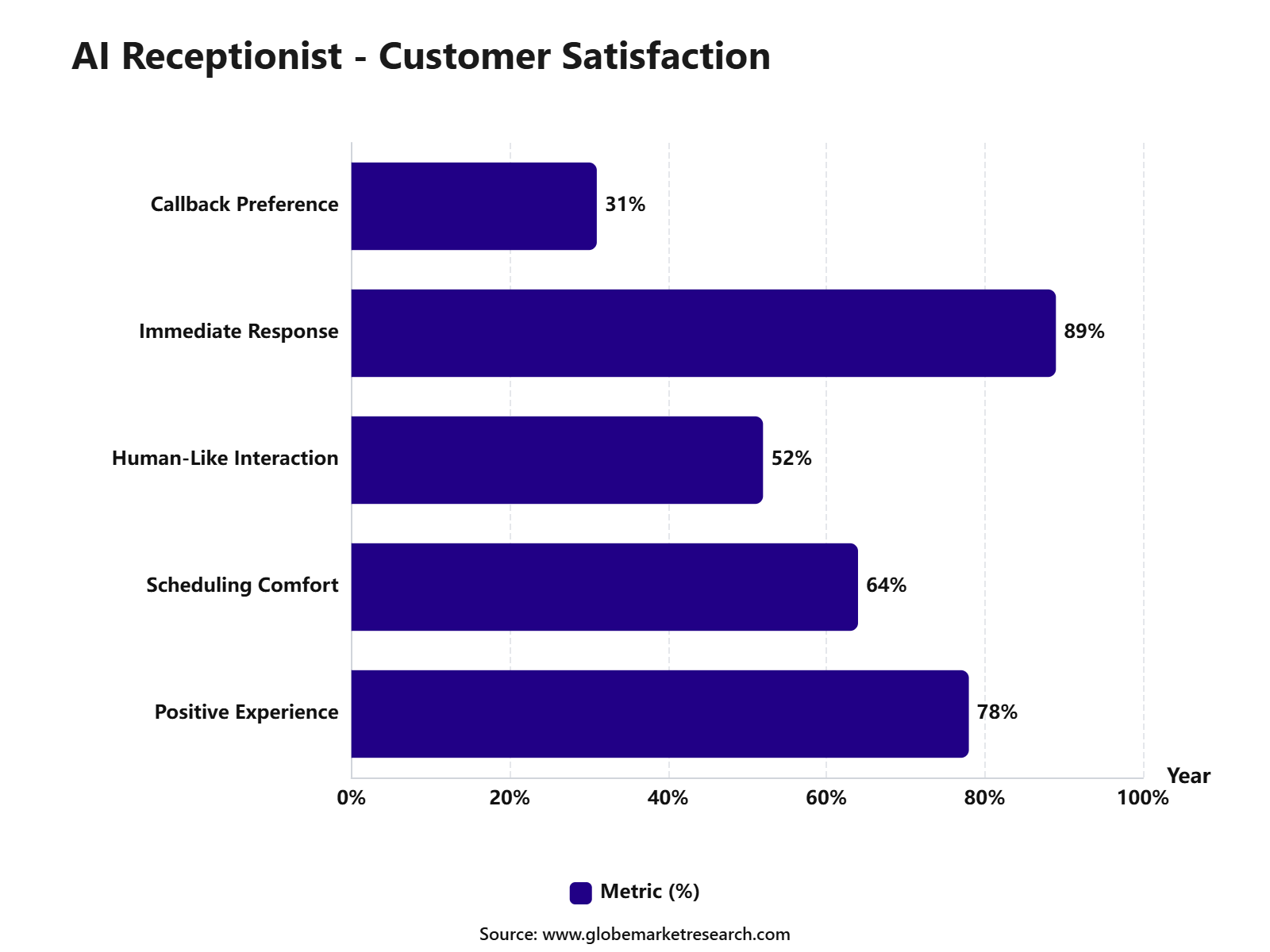
89% of customers prefer an immediate AI response instead of waiting on hold for a human representative.
AI receptionists achieve 85% to 92% satisfaction ratings in post-call surveys, supported by fast response, call routing, and consistent service quality.
Around 73.8% of AI interactions correctly route callers to the requested department or person, improving call handling accuracy and response efficiency.
AI Receptionist Market Size
The growth of the market can be attributed to rising demand for 24/7 call answering, automated appointment scheduling, lead capture, multilingual customer support, and faster response handling across small businesses, healthcare clinics, legal firms, real estate companies, financial service providers, and service-based enterprises. AI receptionist solutions are being adopted to reduce missed calls, improve front-desk efficiency, manage routine customer queries, and provide a consistent first point of contact for businesses. The market is also benefiting from wider use of conversational AI, speech recognition, CRM integration, calendar automation, and AI-powered call routing.
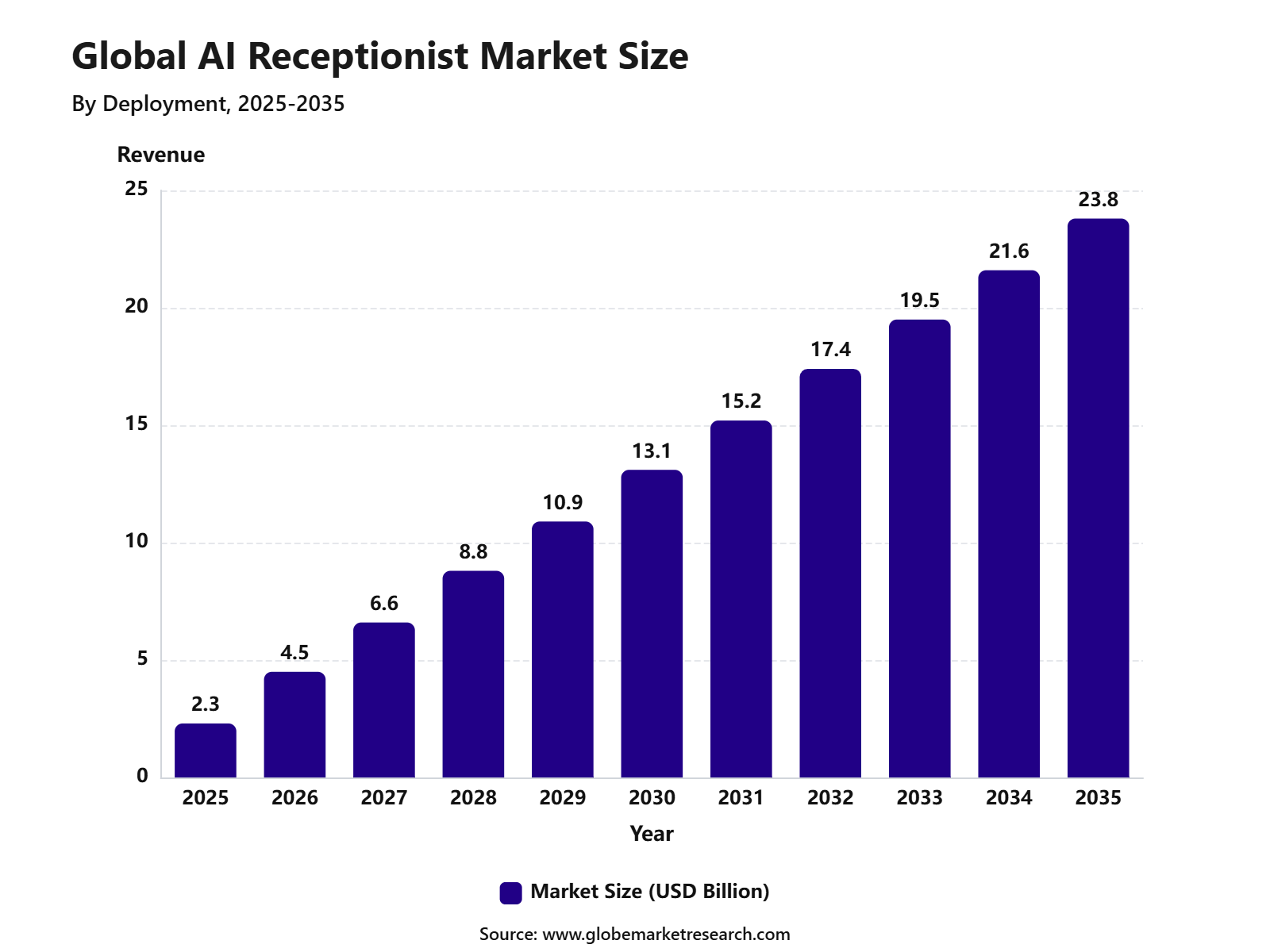
Global AI Receptionist Market Size, 2025 to 2035
Year | Market Size (USD Billion) |
|---|---|
2025 | 2.3 |
2026 | 4.5 |
2027 | 6.6 |
2028 | 8.8 |
2029 | 10.9 |
2030 | 13.1 |
2031 | 15.2 |
2032 | 17.4 |
2033 | 19.5 |
2034 | 21.6 |
2035 | 23.8 |
AI Receptionist Statistics
28% of business calls go unanswered, showing why AI receptionists are being used to reduce missed calls, capture leads, and provide after-hours response.
According to intercom, 82% of senior customer service leaders invested in AI over the last 12 months, and 87% plan to invest in 2026, showing wider adoption of AI in support operations. Source: Intercom, 2026.
Only 10% of support teams have reached mature AI deployment, meaning most businesses are still in early or mid-stage use of AI reception and service automation.
87% of mature AI support teams reported improved metrics, compared with 62% overall, which suggests that deeper AI integration delivers better service results
By twilio, 78% of consumers say it is important to switch from an AI agent to a human agent, but only 15% have experienced a seamless handoff, making human escalation a key feature for AI receptionists.
72% of consumers believe they can identify a voice-based AI agent, but 90% failed to correctly identify AI-generated voice clips, showing that AI voice quality is improving quickly.
69% of consumers still prefer real people, but 72% would choose an AI agent if the issue was guaranteed to be solved faster, showing that speed strongly influences AI acceptance.
Key Market Insights - 2025 Share
Solutions and software platforms led the market with 75.9% share, supported by rising use of automated call handling, appointment scheduling, lead capture, and customer support tools.
Cloud-based deployment accounted for 69.1% share, driven by easier setup, remote access, lower infrastructure needs, and flexible scaling for businesses.
Voice reception services held 55.5% share, supported by growing demand for AI-powered call answering, call routing, message taking, and customer query handling.
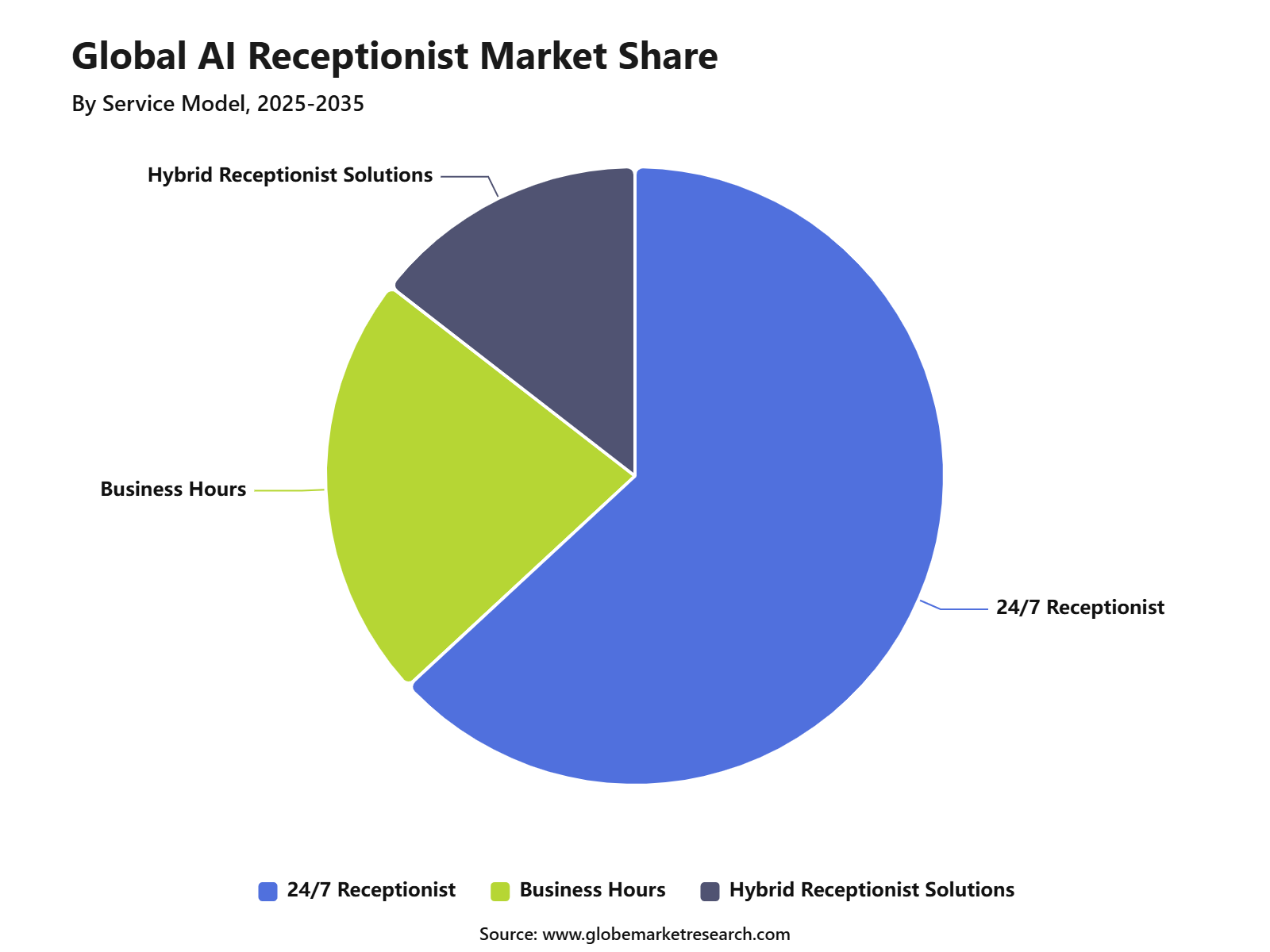
24/7 receptionist solutions captured 63.1% share, driven by business demand for round-the-clock customer support and reduced missed calls.
Voice AI integration accounted for 55.6% share, supported by improvements in speech recognition, natural language understanding, and real-time voice response systems.
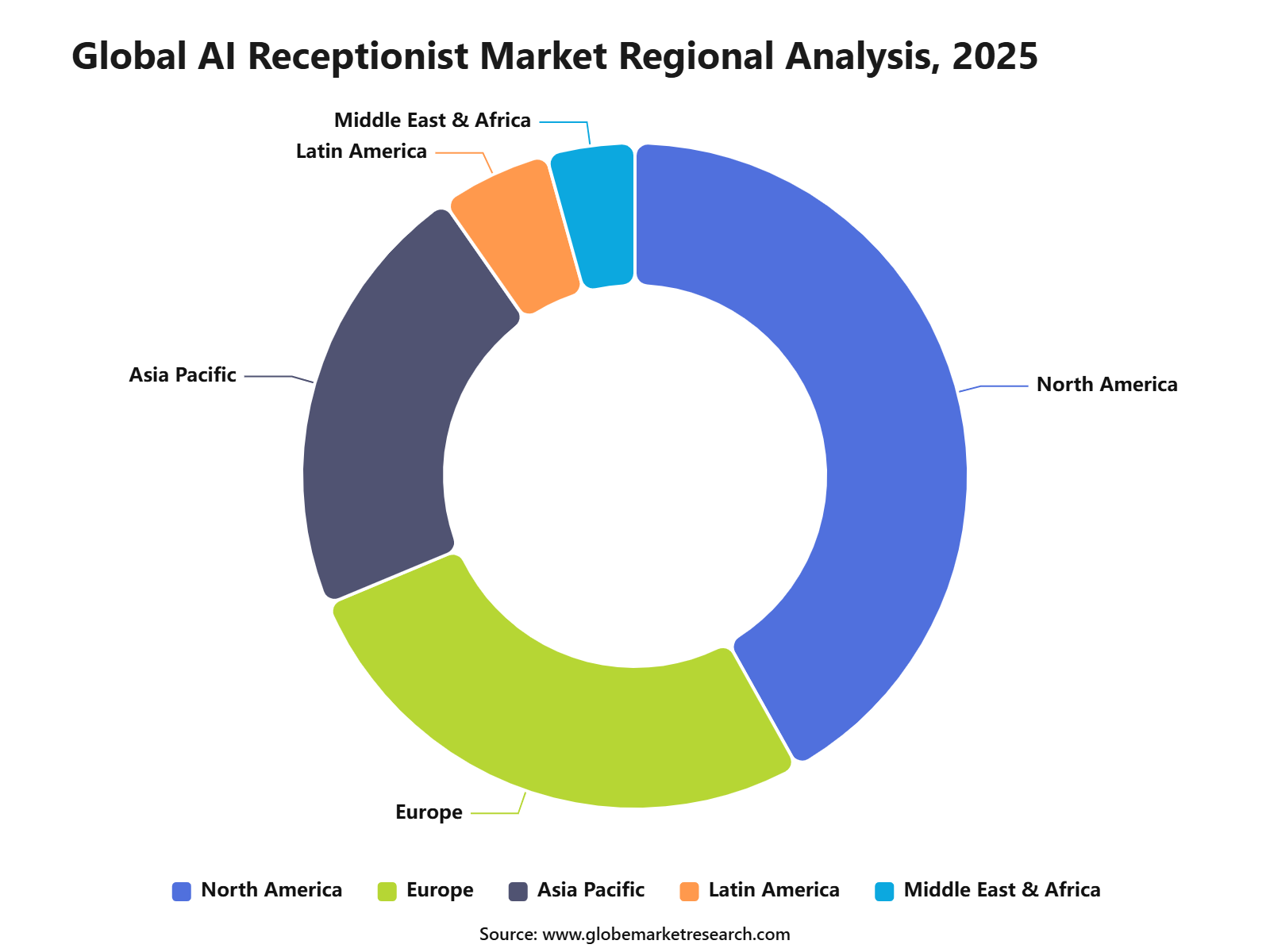
North America held 41.9% share of the AI receptionist market, supported by strong adoption among small businesses, healthcare providers, service firms, and customer-facing enterprises.
Regional Analysis
Missed Calls & Revenue Impact Statistics
28% of all business calls go unanswered, which shows a clear need for AI receptionists in lead capture, appointment booking, and after-hours call handling.
37% of phone leads convert during the call, based on AI analysis of more than 60 million phone conversations. This means unanswered calls can directly affect sales, bookings, and customer acquisition
Based on CallRail’s 28% missed-call rate and Invoca’s 37% phone-lead conversion benchmark, around 10 potential conversions may be at risk for every 100 inbound phone leads if missed calls have similar purchase intent.
97% of consumers read online reviews when browsing for local businesses, and 41% always read reviews. If a caller cannot reach a business, they may quickly compare competitors, making fast call response important for local service providers.
Customer Satisfaction Statistics
According to SchedulingKit, AI-powered scheduling tools help businesses automate bookings, payments, and follow-ups with less manual work. This supports higher customer satisfaction because callers can get faster responses, easier appointment handling, and round-the-clock support.
Risk Factors & Market Barriers
Regulatory & Compliance Risks
AI receptionist systems must follow call-consent and voice communication rules. In the U.S., the FCC clarified that AI-generated voice calls can fall under TCPA rules covering “artificial or prerecorded voice” calls, making unlawful robocalls with AI-generated voices illegal unless proper consent or legal permission applies.
Transparency is a major compliance requirement. The EU AI Act introduces disclosure obligations so users are made aware when they are interacting with an AI system, such as a chatbot or automated assistant.
Misleading AI claims can create legal risk. The FTC stated that there is “no AI exemption” from existing laws and that using AI tools to trick, mislead, or defraud people is illegal.
AI receptionists handle sensitive customer information such as names, phone numbers, appointment details, service needs, and sometimes health or financial context. NIST states that AI risk management should address risks to individuals, organizations, and society, which makes privacy, security, accountability, and monitoring important for deployment.
Market Adoption Barriers
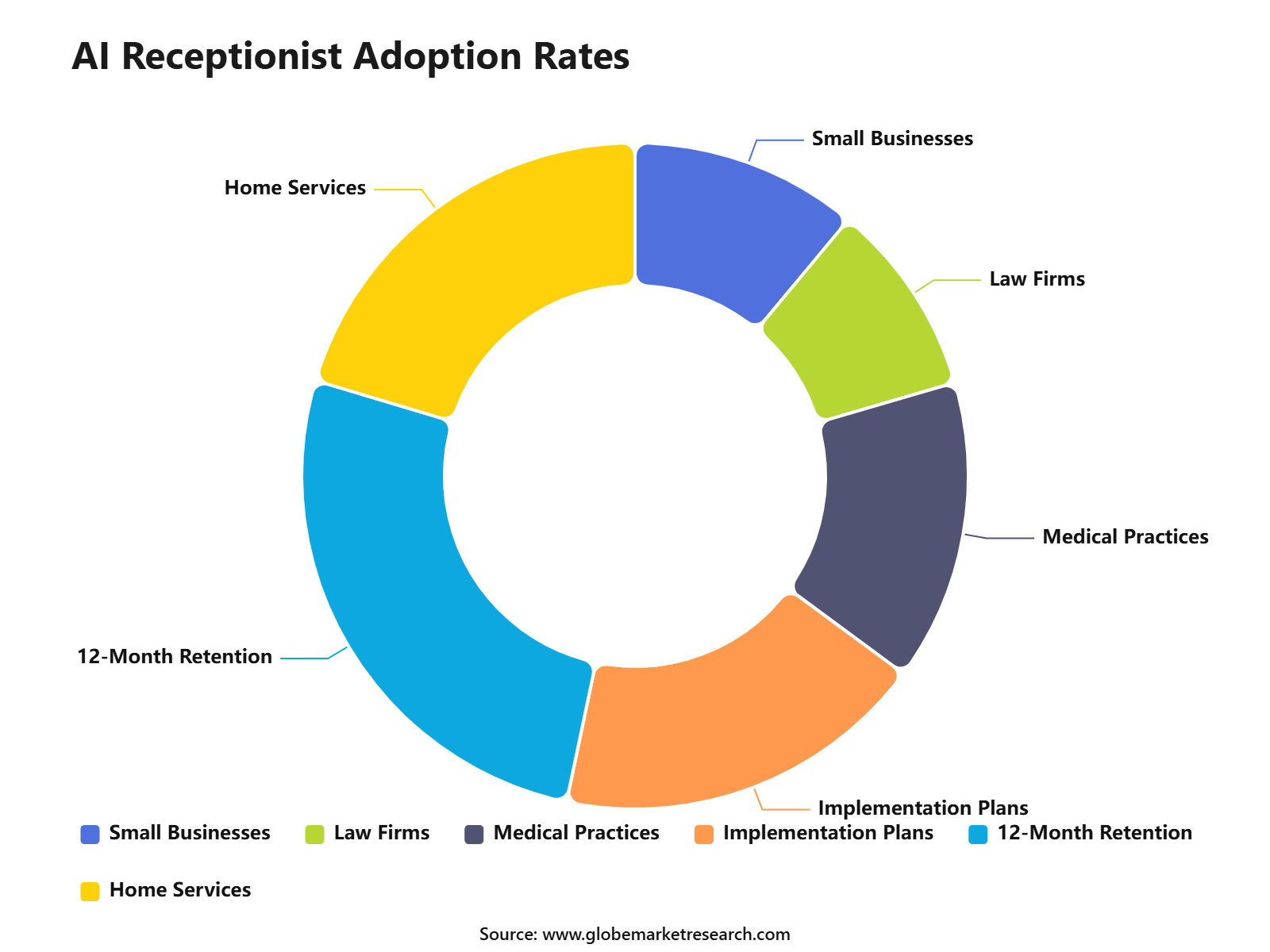
64% of consumers said they are not very confident or not at all confident in how businesses use generative AI when interacting with them, while 53% lacked confidence that organizations use generative AI responsibly.
49.6% of consumers said they would cancel a service over AI-driven customer service, and 41.5% said they would pay extra for access to human representatives.
78% of consumers said it is important to switch from an AI agent to a human agent, but only 15% reported a seamless handoff experience.
74% of enterprises have already rolled back or shut down an AI customer communications agent after deployment due to governance failure, rising to 81% among organizations with fully mature guardrails.
The main causes of AI agent rollback include 31% customer data exposure concerns, 22% hallucinations or brand-risk issues, and 16% lack of auditability.
AI Receptionist Performance Statistics
AI-enabled customer service teams resolved tickets in 32 minutes on average, while less advanced teams took up to 36 hours.
64% of consumers believe AI will improve the quality and speed of customer experience over the next two to three years.
42% of CX leaders said increasing AI use to improve customer experience is a top priority, and around 33% of CX budgets are expected to go to AI-powered technologies.
83% of executives expect AI agents to improve process efficiency and output by 2026, while 71% believe agents will adapt autonomously to changing workflows.
Based on data from CallBird AI, AI receptionists can reach 85% to 95% accuracy for routine calls when trained on business-specific information, including FAQs, services, pricing, booking rules, and customer workflows.
AI systems can answer calls in under 1 second, compared with an average 15 to 45 seconds for many human answering services.
AI receptionists can handle unlimited simultaneous calls, while one human receptionist can manage only one call at a time.
AI implementation can reduce missed calls by 87%, helping businesses capture more leads, bookings, and customer requests.
AI-powered reminders can reduce no-shows by 40% to 60%, especially for appointment-based businesses such as clinics, salons, legal offices, and service providers.
AI call filtering can block around 7% of wasted calls automatically, reducing staff interruptions from spam, wrong numbers, and low-value calls.
Around 25.4% of callers request a follow-up, showing the importance of callback capture, lead tracking, and timely response management.
Top Opportunities
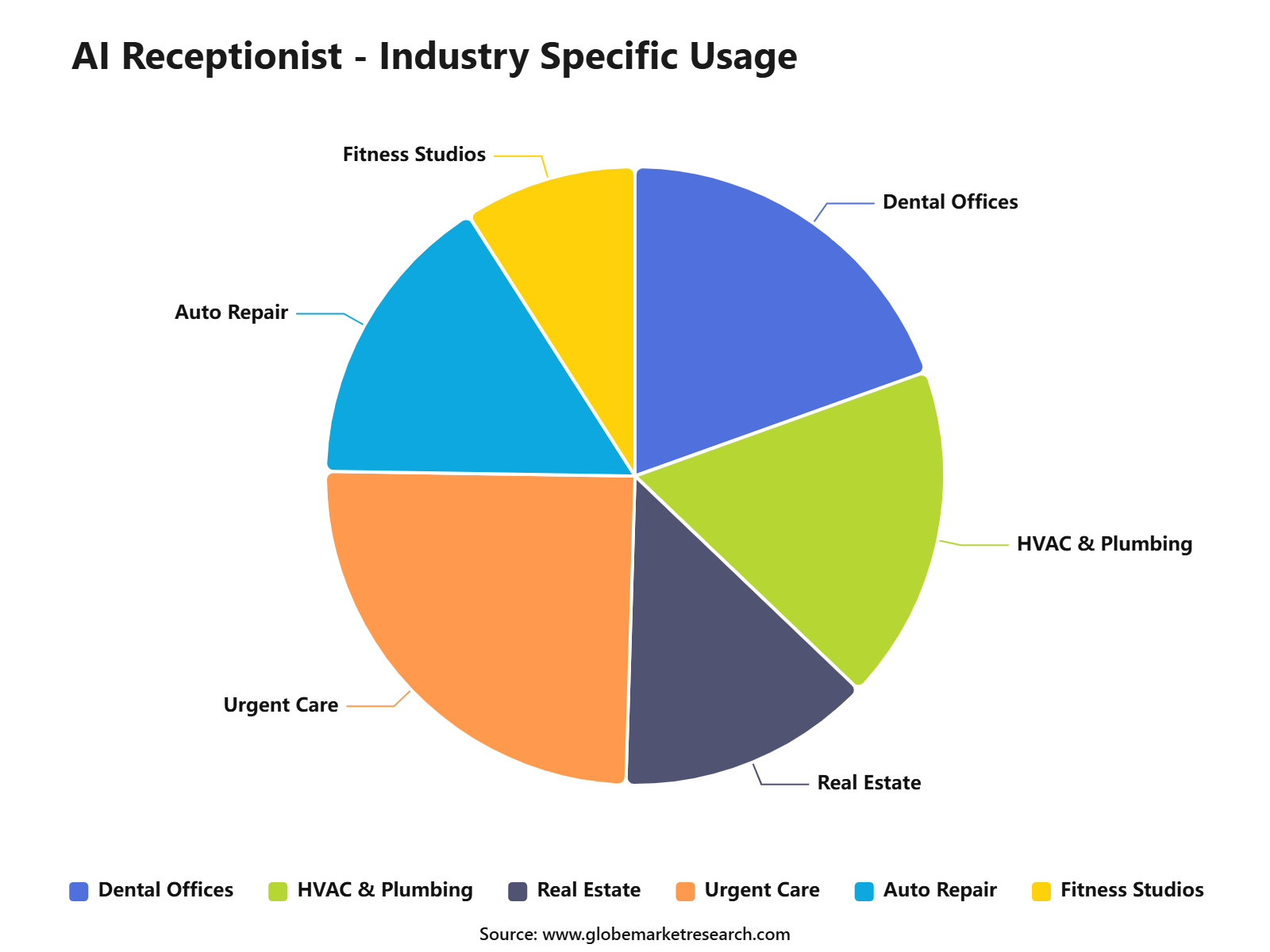
Small and local businesses: The strongest opportunity is in businesses that depend on phone leads, such as home services, clinics, repair shops, law firms, real estate agencies, and salons. Missed-call data shows a clear revenue risk because many customers move to competitors when calls are not answered.
Healthcare and wellness clinics: Clinics can use AI receptionists for appointment booking, reminders, patient intake, insurance questions, and follow-up calls. This opportunity is supported by the need to reduce no-shows, improve scheduling efficiency, and lower pressure on front-desk staff.
Legal, real estate, and financial services intake: These sectors receive high-value inquiries where fast response and proper routing are important. AI receptionists can capture client details, identify urgency, schedule consultations, and send structured summaries to professionals.
Multilingual customer support: AI receptionists can support callers in multiple languages, which is useful for healthcare, hospitality, travel, banking, education, and local services. This can improve access for customers who prefer voice support in their native language.
AI plus human receptionist model: A strong opportunity exists in hybrid models where AI handles routine calls and humans manage sensitive, complex, or high-value conversations. This model is likely to gain adoption because service teams are already seeing faster resolution, better handoff, and more time for complex work.
CRM-integrated AI receptionist platforms: Businesses will increasingly prefer AI receptionists that connect with calendars, CRMs, payment links, ticketing tools, and marketing automation platforms. This creates opportunities for providers offering industry-specific workflows rather than simple call answering.
Top Use Cases
24/7 call answering: AI receptionists answer customer calls outside working hours, during staff shortages, and during peak call periods. This is especially useful for small businesses because 85% of missed callers may not call back once their call is unanswered.
Appointment scheduling and reminders: AI receptionists can book, reschedule, confirm, and cancel appointments across healthcare, salons, repair services, legal consultations, and real estate viewings. Automated reminder systems are valuable because healthcare studies show that reminders can reduce missed appointments and improve attendance.
Lead qualification and intake: AI receptionists can collect customer name, location, service need, urgency, budget range, and preferred time before passing the lead to sales or operations teams. This improves response speed, which matters because almost two-thirds of buyers expect a response within 10 minutes for sales, marketing, or service inquiries.
Call routing and escalation: AI systems can identify caller intent and route calls to the right person, department, branch, or emergency contact. This reduces repeated explanations, which is important because customers often get frustrated when they need to repeat the same issue across multiple agents.
Recent developments
June 2026 - Equal AI raised USD 30 million in Series B funding co-led by Prosus Ventures and Tomales Bay Capital. The company is expanding its AI call assistant platform into broader everyday service automation in India.
January 2026 - RingCentral released new updates for its AI Receptionist platform. The company noted that AIR was first launched in February 2025 and the January release focused on easier setup, smarter conversations, and better follow-up options for businesses.
January 2026 - Deepgram raised USD 130 million in Series C funding at a USD 1.3 billion valuation. The company also acquired OfOne, a voice AI platform for restaurant drive-thru automation. Deepgram supports more than 50 languages and serves over 1,300 clients.
November 2025 - Beside raised USD 32 million to build AI receptionist technology for small businesses. The company’s voice AI system handles millions of calls per month, showing strong demand for automated front-desk and call-answering solutions.