
Market Size and Growth
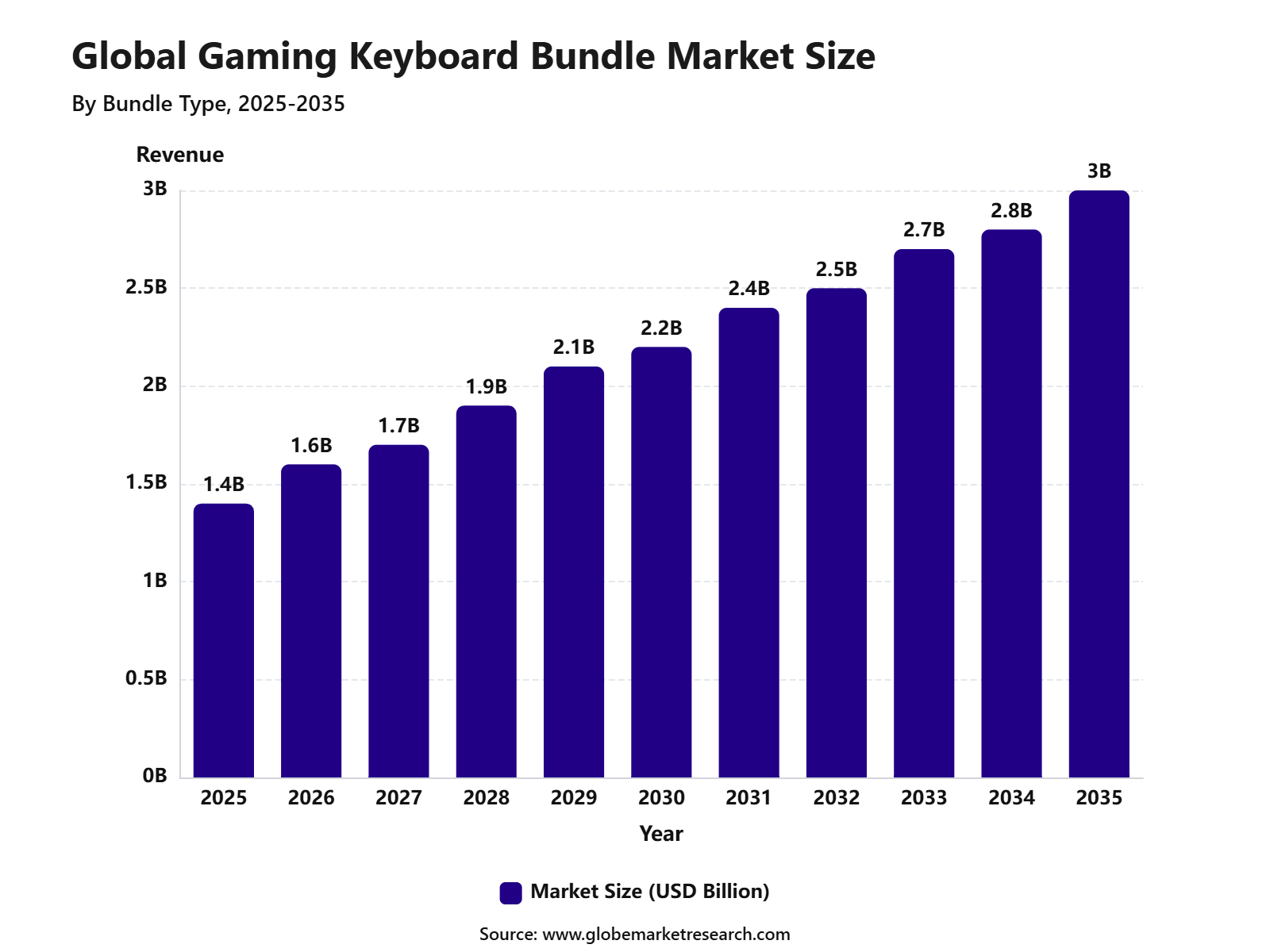
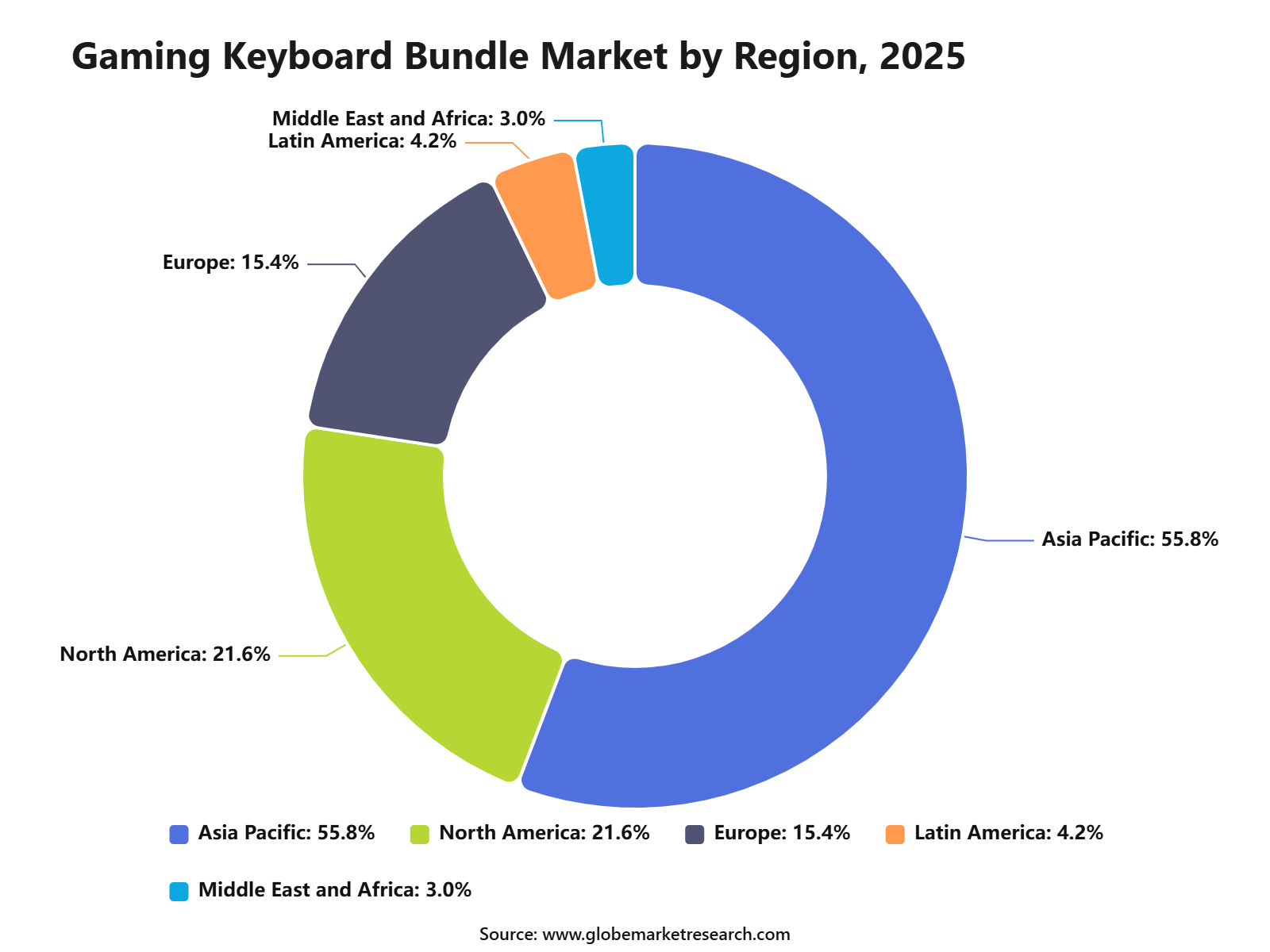
According to Globe Market Research, The Gaming Keyboard Bundle Market is expected to increase from USD 1.4 billion in 2025 to USD 3.0 billion by 2035. Asia Pacific accounted for the largest regional share of 55.8% in 2025, supported by its large gaming population, expanding esports participation, electronics manufacturing base and strong demand for affordable PC accessories across China, India, Japan, South Korea and Southeast Asia.
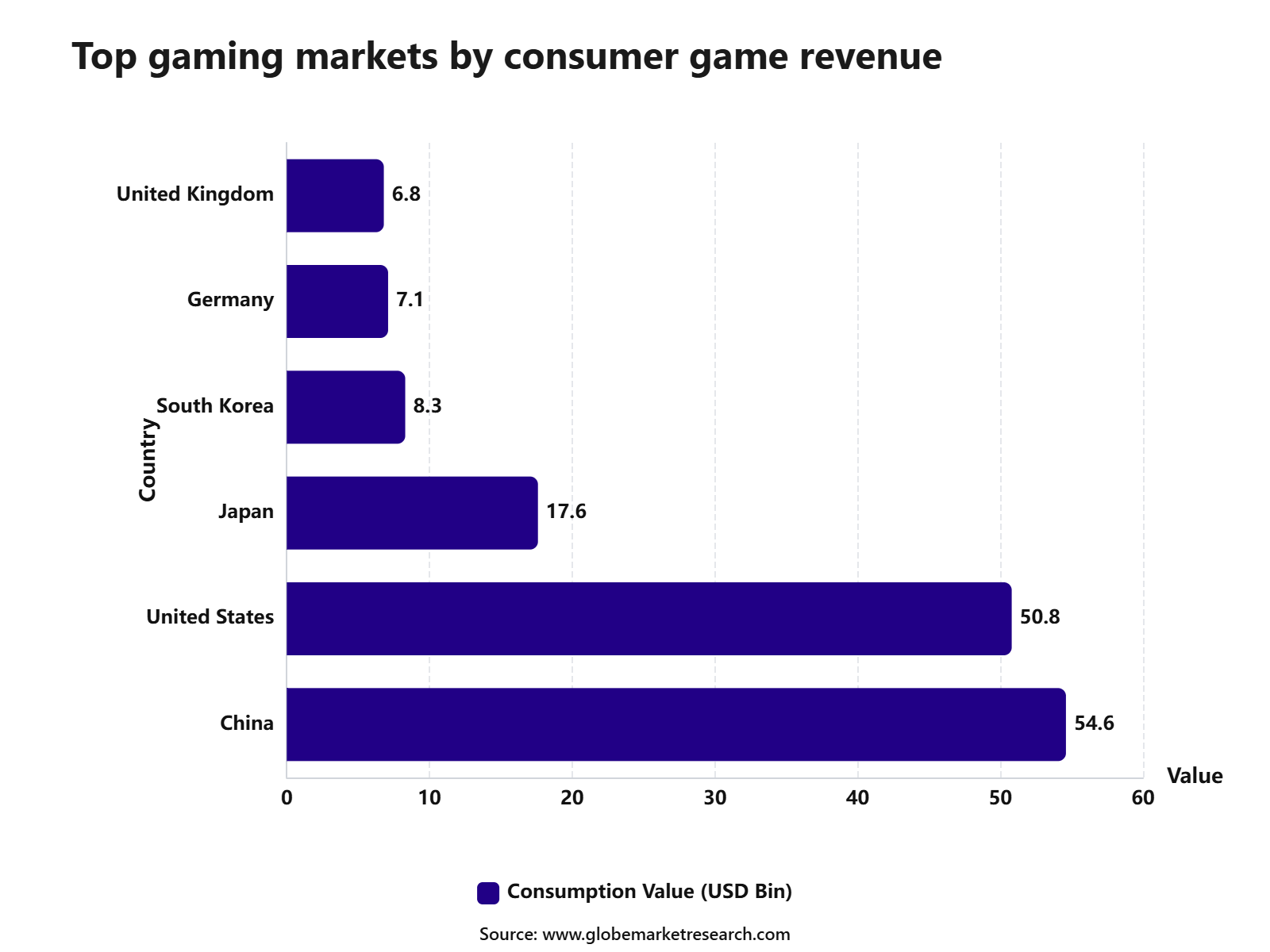
The broader gaming industry provides a strong demand base for peripheral manufacturers. In the United States, 212.3 million people played video games for at least one hour per week in 2025, equal to 67% of the population aged 5 to 90. U.S. spending on video game accessories reached USD 2.95 billion in 2025, while hardware spending reached USD 5.4 billion. These figures indicate continued consumer willingness to invest in gaming equipment and accessory upgrades.
The category is benefiting from the wider gaming economy. The Entertainment Software Association reported that 212.3 million Americans play video games every week, equal to 67% of Americans aged 5 to 90, while Newzoo reported that global games revenue crossed USD 200 billion in 2025. This large gaming base supports demand for keyboards, mice, headsets, mousepads, and affordable gaming setup upgrades.
Why the Gaming Keyboard Bundle Market Is Growing
The market is growing because more gamers want affordable and complete accessory setups. The report identifies rising gaming population as a +2.1% growth impact, growth in PC gaming and esports as +1.8%, demand for mechanical keyboards as +1.5%, and increasing preference for bundled accessories as +1.3%.
PC and console gaming growth is supporting peripheral upgrades. Newzoo’s 2026 PC and console gaming report states that the global PC and console games market is projected to reach USD 103.7 billion by 2028, while PC revenue in 2025 included USD 20.6 billion from microtransactions and USD 12.5 billion from premium game sales. This shows that PC gaming remains a strong ecosystem for keyboard and accessory demand.
Gaming accessories are also benefiting from product refresh cycles. Reuters reported that Logitech’s gaming product sales rose 12% in its latest reported quarter, supported by new product launches. This indicates that gamers continue to upgrade peripherals when brands offer better performance, comfort, design, and software features.
Key Market Drivers
Expansion of the gaming population: The number of Americans playing video games weekly increased by 7.2 million in 2025 to reach 212.3 million. A larger and more diverse gaming population is supporting demand for affordable keyboards, mice, headsets and complete desktop setups.
Demand for cost-effective gaming setups: Bundles allow users to purchase compatible input devices at a lower combined price than many separately purchased products. This purchasing model is particularly attractive to students, first-time PC users, casual gamers and esports beginners.
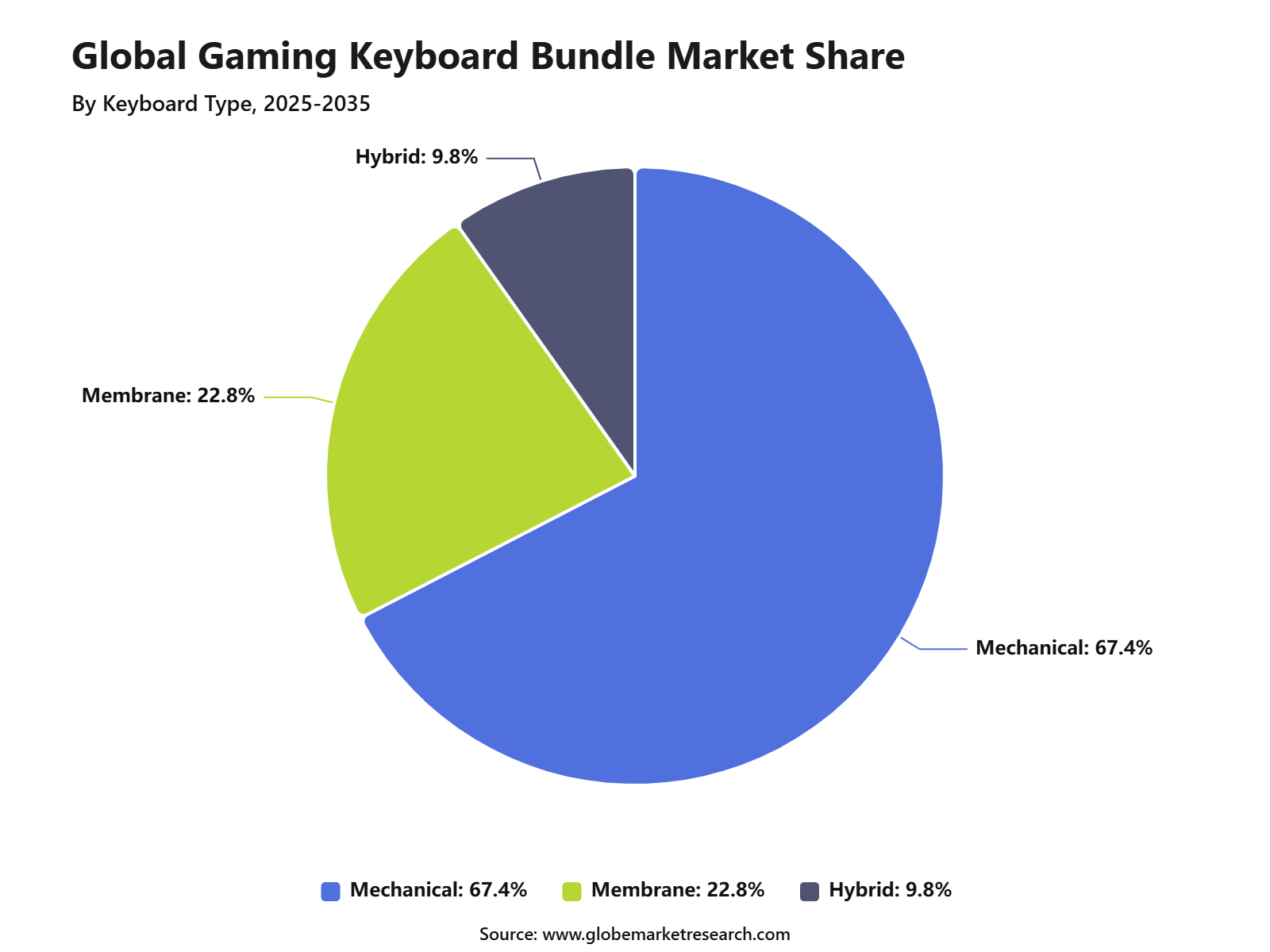
Growth of mechanical keyboards: Mechanical keyboards accounted for 67.4% of the market. Tactile response, switch durability, faster actuation and customization options are making mechanical models more common in both mid-range and premium bundles.
Increasing competitive gaming participation: Esports and multiplayer gaming are increasing interest in low-latency keyboards, lightweight mice, anti-ghosting, programmable keys and high polling rates. Performance-focused players are also influencing product features adopted by casual consumers.
Expansion of online distribution: Online channels held 54.1% of market revenue. Product comparisons, user reviews, discount campaigns, direct-to-consumer websites and wider availability are making e-commerce the leading purchasing channel for gaming bundles.
Market Segmentation
Bundle Type Insights: Keyboard and mouse bundles led the market with a 56.2% share. These products provide the two main PC input devices in one package and are widely selected by entry-level and mid-range gamers seeking compatibility and value.
Keyboard Type Insights: Mechanical keyboards accounted for 67.4% of revenue. The segment is supported by improved durability, tactile feedback, replaceable switches, compact designs and demand for faster gaming response.
Connectivity Insights: Wired bundles held a 78.1% share due to their stable performance, low latency and lack of battery-related interruptions. Wired products also remain more affordable than many comparable wireless combinations.
Price Range Insights: Budget bundles represented 48.8% of market revenue. Products in this category frequently include RGB lighting, anti-ghosting keys, adjustable mouse sensitivity and basic software controls at accessible prices.
Distribution and End-User Insights: Online channels accounted for 54.1%, while individual gamers represented 70.5% of demand. This group includes students, streamers, casual users, home PC players and competitive gamers purchasing equipment for personal use.
Technology and Adoption Trends
Magnetic and adjustable switches: Premium gaming keyboards are adopting magnetic switches that allow users to adjust actuation distance and rapid-trigger settings. GIGABYTE’s AORUS K10 Infinity, for example, supports actuation adjustment down to 0.1 millimetres and multi-stage trigger settings.
Higher polling rates: New gaming keyboards and mice increasingly support polling rates of up to 8,000 Hz. Razer states that its Huntsman V3 Tenkeyless 8KHz can report inputs up to eight times faster than a standard 1,000 Hz gaming keyboard.
Browser-based customization: Manufacturers are reducing dependence on installed desktop applications. Razer Synapse Web and GIGABYTE GiMATE Web Edition allow users to manage key settings, lighting and profiles through supported web browsers.
Tri-mode wireless connectivity: Premium products are increasingly supporting 2.4 GHz wireless, Bluetooth and wired USB connections in one device. Improved battery performance and lower wireless latency are gradually increasing interest in wireless bundles, although wired products continue to lead the overall market.
Integrated productivity and streaming controls: Gaming keyboards are being designed for gaming, streaming and daily work. LCD displays, programmable control keys, media functions, macro support and Stream Deck integration are increasing the functional value of premium products.
Regional Breakdown and Supply Chain
Asia Pacific: The region held 55.8% of market revenue in 2025. Large gaming communities, domestic electronics production, esports growth and broad availability of budget accessories support volume demand across China, India, Japan and South Korea.
North America: The region represents an important market for premium mechanical keyboards, wireless peripherals and creator-focused equipment. U.S. video game accessory spending reached USD 2.95 billion in 2025, demonstrating a substantial commercial base for peripheral manufacturers.
Europe: Demand is being supported by established PC gaming communities in Germany, the United Kingdom, France and Nordic countries. Manufacturers selling rechargeable wireless keyboards and mice in the EU must also comply with common USB-C charging requirements that have applied to these products since December 28, 2024.
Latin America, the Middle East and Africa: Market development is being supported by gaming cafes, esports events, younger populations and wider availability of affordable computer equipment. Brazil, Mexico, Saudi Arabia, the UAE and South Africa are expected to remain important emerging markets.
Supply chain structure: The value chain includes switch manufacturers, sensor suppliers, semiconductor companies, printed circuit board producers, plastics and aluminium suppliers, contract manufacturers, software developers, distributors and online retailers. Product availability can be affected by component shortages, shipping costs, tariffs and rapid inventory ageing.
Regional Impact Analysis
Impact Factor | Estimated CAGR Impact | Regional Relevance | Market Impact |
|---|---|---|---|
Asia Pacific market leadership | +2.4% | China, India, Japan, South Korea, Southeast Asia | Drives volume demand. |
North America premium gaming demand | +1.6% | U.S. and Canada | Supports high-value sales. |
Europe esports and PC gaming growth | +1.3% | Germany, UK, France, Nordics | Builds steady adoption. |
Latin America emerging gaming base | +0.8% | Brazil, Mexico, Chile, Colombia | Supports gradual growth. |
Middle East and Africa gaming cafe expansion | +0.7% | UAE, Saudi Arabia, South Africa | Shows future potential. |
Future Outlook, 2026-2035
The Gaming Keyboard Bundle Market is expected to develop from basic keyboard-and-mouse combinations toward differentiated packages designed for specific user groups. Budget bundles will continue to generate high unit volumes, while premium growth will be supported by mechanical and magnetic switches, hot-swappable boards, aluminium frames, low-latency wireless technology and advanced software controls.
Wireless bundles are expected to gain adoption as battery life, response time and connection stability improve. However, wired connectivity will remain important for esports players and price-sensitive consumers. Compact layouts, low-profile designs and hybrid products suitable for both gaming and productivity are also expected to become more common.
Market growth through 2035 will depend on manufacturers balancing performance with affordability. Brands capable of delivering reliable sensors, genuine mechanical switches, useful software and stronger warranties within clearly defined price categories will be better positioned to compete.
Key Opportunities
Mechanical and magnetic keyboard bundles: Adjustable actuation, rapid-trigger controls and hot-swappable switches can help brands move customers from basic membrane products toward higher-value packages.
Low-latency wireless bundles: Improved wireless performance creates opportunities for coordinated keyboard-and-mouse packages that provide cleaner desktop setups without reducing gaming responsiveness.
Esports-focused products: Bundles developed with professional players can include compact keyboards, lightweight mice, large mousepads and tournament-ready profile controls. ASUS has expanded this approach through collaborations with professional esports teams and players.
Online and direct-to-consumer sales: Brand websites and marketplaces can be used to offer exclusive colour combinations, limited editions, customizable accessories and seasonal discounts while reducing dependence on physical retail space.
Segment-specific bundles: Separate packages can be developed for students, gaming cafes, streamers, content creators, professional esports players and hybrid work-and-gaming users. Each package can be differentiated through layout, connectivity, software and included accessories.
Challenges and Restraints
High price of premium bundles: Magnetic switches, aluminium frames, displays and low-latency wireless technology increase manufacturing costs. High retail prices can restrict adoption among students and consumers in emerging markets.
Competition from standalone accessories: Experienced gamers often prefer to select keyboards, mice and headsets from different manufacturers. This reduces demand for complete bundles where one included component does not meet the user’s requirements.
Rapid product and design cycles: New switch types, polling rates, compact layouts, colour options and software functions can make existing inventory less attractive. Manufacturers and retailers must therefore manage stock levels carefully.
Quality and warranty concerns: Poor switches, weak mouse sensors, unstable wireless connections, key wobble and double-click failures can reduce buyer confidence. Return policies, independent reviews and warranty support strongly influence purchasing decisions.
Supply chain and compliance pressure: Wireless products must comply with radio-frequency, electrical safety and charging regulations. European requirements covering USB-C charging, hazardous substances and electronic waste can increase testing and documentation costs.
Revenue Potential and Financial Impact
Revenue potential is strongest across keyboard and mouse bundles, keyboard-mouse-headset bundles, mechanical keyboard bundles, RGB bundles, wireless bundles, compact keyboard bundles, streamer kits, and budget gaming setups. The report identifies expansion of mechanical keyboard bundles as a +1.8% opportunity and growth in wireless gaming bundles as a +1.5% opportunity.
Bundling can improve average order value because buyers purchase multiple related products at once. It can also reduce customer decision time, simplify merchandising, improve promotional visibility, and help brands move accessories together. Financial risk remains linked to discount pressure, returns, warranty claims, low-quality components, tariff costs, and inventory aging. Gaming peripherals are trend-sensitive, so slow-moving designs, older switch types, or weak software support can reduce sell-through quickly.
Risk Factors and Market Barriers
Price competition is the main market barrier. Gaming keyboard bundles are widely sold across marketplaces, gaming retailers, electronics stores, and brand websites, which makes basic bundles easy to compare. The report identifies price pressure from budget brands as a -0.7% challenge impact.
Premium bundle pricing is another restraint, with an estimated -1.0% impact. Many buyers want mechanical keyboards, wireless mice, headsets, and RGB features, but they may avoid expensive bundles when lower-cost alternatives are available. Counterfeit and low-quality products also affect buyer confidence. The report assigns this factor a -0.6% impact, especially across Asia Pacific and online marketplaces. Poor switches, unstable mouse sensors, weak cables, missed clicks, and short product life can damage repeat purchase behavior.
Regulatory and Compliance Risks
Gaming keyboard bundles are electrical and electronic products, so brands must manage product safety, electromagnetic compatibility, wireless certification, labeling, and environmental compliance. In the U.S., FCC Part 15 covers intentional and unintentional radio-frequency devices and prohibits marketing non-compliant devices unless they meet required authorization rules.
Europe adds further compliance pressure. EU common charger rules apply to keyboards and mice from 28 December 2024, while laptops are covered from 28 April 2026. The EU RoHS Directive also restricts 10 hazardous substances in electrical and electronic equipment, including lead, cadmium, mercury, hexavalent chromium, selected flame retardants, and certain phthalates.
E-waste is also becoming more important. Eurostat reported that 11.6 kg of waste electrical and electronic equipment was officially collected per person in the EU in 2023, compared with 32.2 kg of new electrical and electronic equipment placed on the market per person. This creates pressure for better durability, repairability, packaging, recycling, and take-back programs.
Prominent Global Market Leaders
The Gaming Keyboard Bundle Market appears moderately concentrated because global gaming peripheral brands have strong product portfolios, retail partnerships, esports visibility, and software ecosystems. However, online marketplaces also include many regional, private-label, and budget brands, which keeps price competition high. The Gaming Keyboard Bundle Market is competitive, with gaming peripheral brands, electronics companies, PC hardware vendors, online sellers, and private-label accessory suppliers competing across price, performance, design, bundle value, and software support.
Key companies include:
Logitech International S.A.
Razer Inc.
Corsair Gaming, Inc.
SteelSeries ApS
Kingston Technology Corporation
ASUSTeK Computer Inc.
Cooler Master Technology Inc.
Turtle Beach Corporation
Dell Technologies Inc.
Micro-Star International Co., Ltd.
Strategic Implications
Gaming peripheral companies should organize their product portfolios around clearly defined customer categories. Entry-level packages should focus on affordability, durability and simple installation. Mid-range bundles should add mechanical switches, stronger sensors and software control, while premium packages should provide magnetic switches, wireless connectivity, advanced materials and esports-level performance.
A coordinated product ecosystem can improve bundle value. Keyboards, mice and headsets should use consistent lighting, profile management and configuration software. However, customers should not be forced to install resource-intensive applications for basic adjustments. Browser-based controls and onboard memory can reduce adoption barriers.
Manufacturers should also provide transparent specifications covering switch type, polling rate, sensor performance, connectivity, device compatibility and warranty terms. Clear information can help distinguish genuine performance products from low-cost bundles that rely mainly on RGB styling.
Channel strategies should combine online marketplaces, direct sales, specialty retailers and gaming community partnerships. Direct-to-consumer channels can support higher margins and exclusive configurations, while retail demonstrations remain useful for products where switch feel, comfort and build quality influence the purchasing decision.
Recent Developments
January 2026: Razer launched Synapse Web in beta for selected Huntsman V3 keyboards. The platform enables browser-based customization without requiring users to install the complete desktop application.
March 2026: Corsair introduced the VANGUARD AIR 99 Wireless optical-mechanical gaming keyboard. The product combines tri-mode connectivity, 8,000 Hz polling, an LCD display and Elgato Stream Deck integration.
June 2026: ASUS Republic of Gamers expanded its esports peripheral portfolio at Computex 2026. The company introduced a Lava Red version of the Falchion Ace 75 HE magnetic keyboard and new equipment developed with professional esports players.
June 2026: GIGABYTE unveiled the AORUS K10 Infinity keyboard and M10 Infinity mouse. The keyboard includes adjustable magnetic switches, 8,000 Hz polling and a 3.1-inch OLED touchscreen, while both products support browser-based configuration.
June 2026: Logitech expanded its G3 Series with the G316 X wired mechanical keyboard and G305 X Superlight wireless mouse. The products were positioned as accessible performance equipment for PC gamers.
Conclusion
The Gaming Keyboard Bundle Market is expected to maintain steady growth as PC gaming becomes more widely adopted and consumers seek complete, affordable desktop setups. Mechanical keyboards, wired connectivity and keyboard-and-mouse combinations currently account for the largest market shares, while magnetic switches, high polling rates and low-latency wireless products are creating new premium opportunities.
Asia Pacific will remain important for volume demand, while North America and Europe will support higher-value products and advanced customization. Companies that combine reliable performance, competitive pricing, coordinated software and strong warranty support will be better positioned to benefit from market growth through 2035.
Contact us
Global Business Development Team
Email: [email protected]