AI receptionists combine conversational AI, speech recognition, natural language processing and business-system integrations to manage incoming calls and customer requests. These systems can answer common questions, qualify leads, route callers, schedule appointments, send confirmations and transfer complex enquiries to employees. Integration with calendars, customer relationship management platforms and existing telephone systems is improving their operational value.
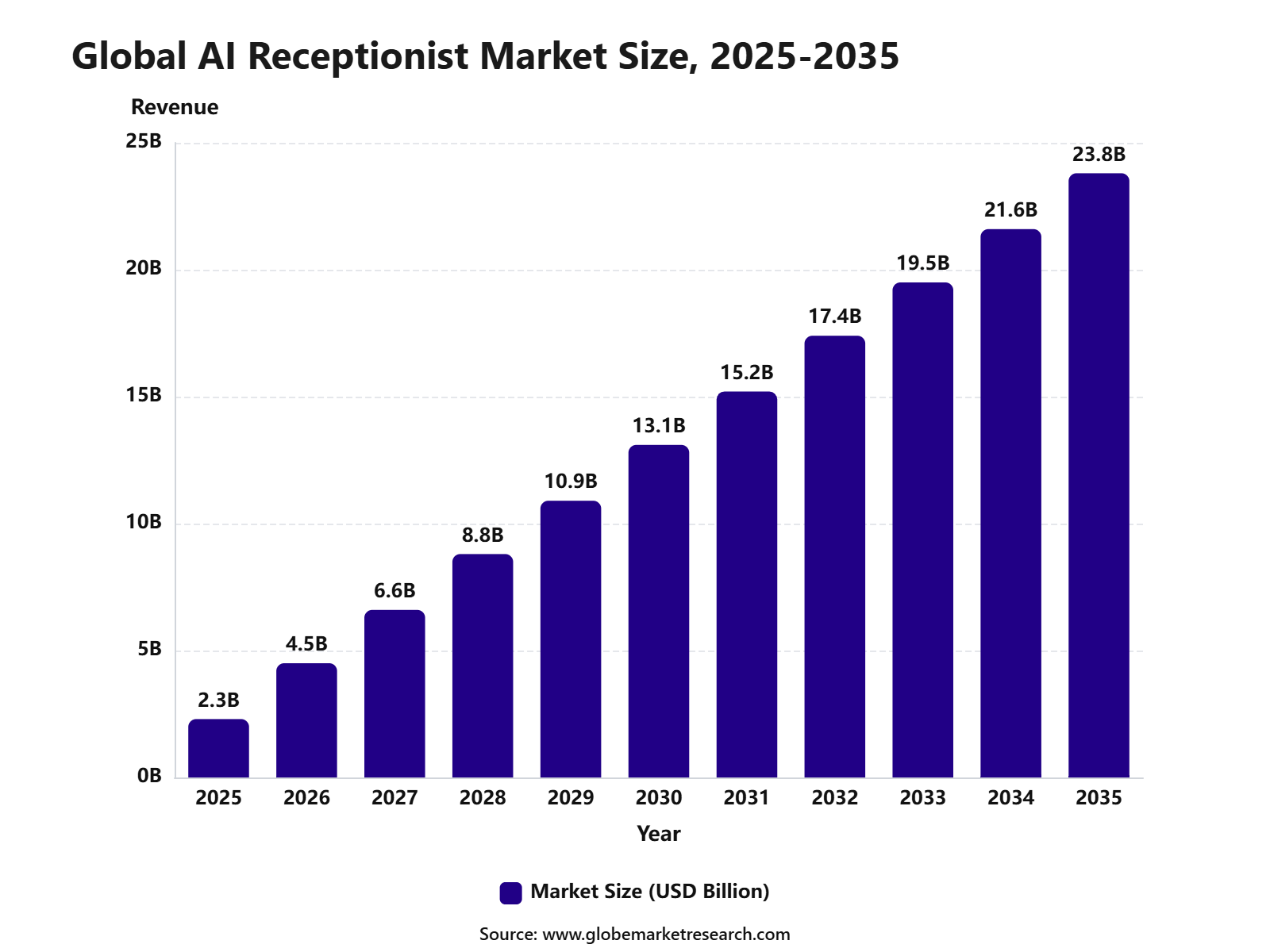
According to Globe Market Research, the global AI Receptionist Market was valued at USD 2.3 billion in 2025 and is projected to reach USD 23.8 billion by 2035, growing at a 26.3% CAGR from 2025 to 2035. North America led the market with 41.9% share in 2025, supported by strong cloud communication adoption, labor cost pressure, CRM integration, and early enterprise use of AI agents in customer service operations.
Key Parameter | Report Details |
|---|---|
Market Revenue, 2025 | USD 2.3 Billion |
Projected Revenue, 2035 | USD 23.8 Billion |
CAGR, 2025-2035 | 26.3% |
Largest Region | North America |
Market Concentration | Medium |
Base Year | 2025 |
Forecast Period | 2025-2035 |
The market is growing because companies need faster customer response without adding full-time front-desk staff. U.S. Census data shows that business AI use stayed between 17% and 20% from December 2025 to May 2026, while 37% of firms with at least 250 employees used AI in business operations by May 2026. This shows that AI receptionist adoption is part of a broader shift toward practical business automation.
Demand is also being influenced by the wider adoption of AI across customer-service operations. Salesforce reported that AI resolved 30% of service cases in 2025, with the share expected to reach 50% by 2027. Intercom’s 2026 customer-service research found that 58% of support teams identified improving customer experience and satisfaction as their leading priority, compared with 28% in the previous year. These trends support investment in AI receptionists that can provide faster responses, continuous availability and consistent call handling.
Why the AI Receptionist Market Is Growing
The growth of the AI Receptionist Market can be attributed to rising demand for automated front-desk operations, which has an estimated positive impact of +6.8%. Growth in AI-based customer interaction tools adds +6.2%, while increasing adoption by SMEs contributes +5.5%. These drivers show that businesses are using AI receptionists to reduce missed calls, improve response speed, and capture more leads.
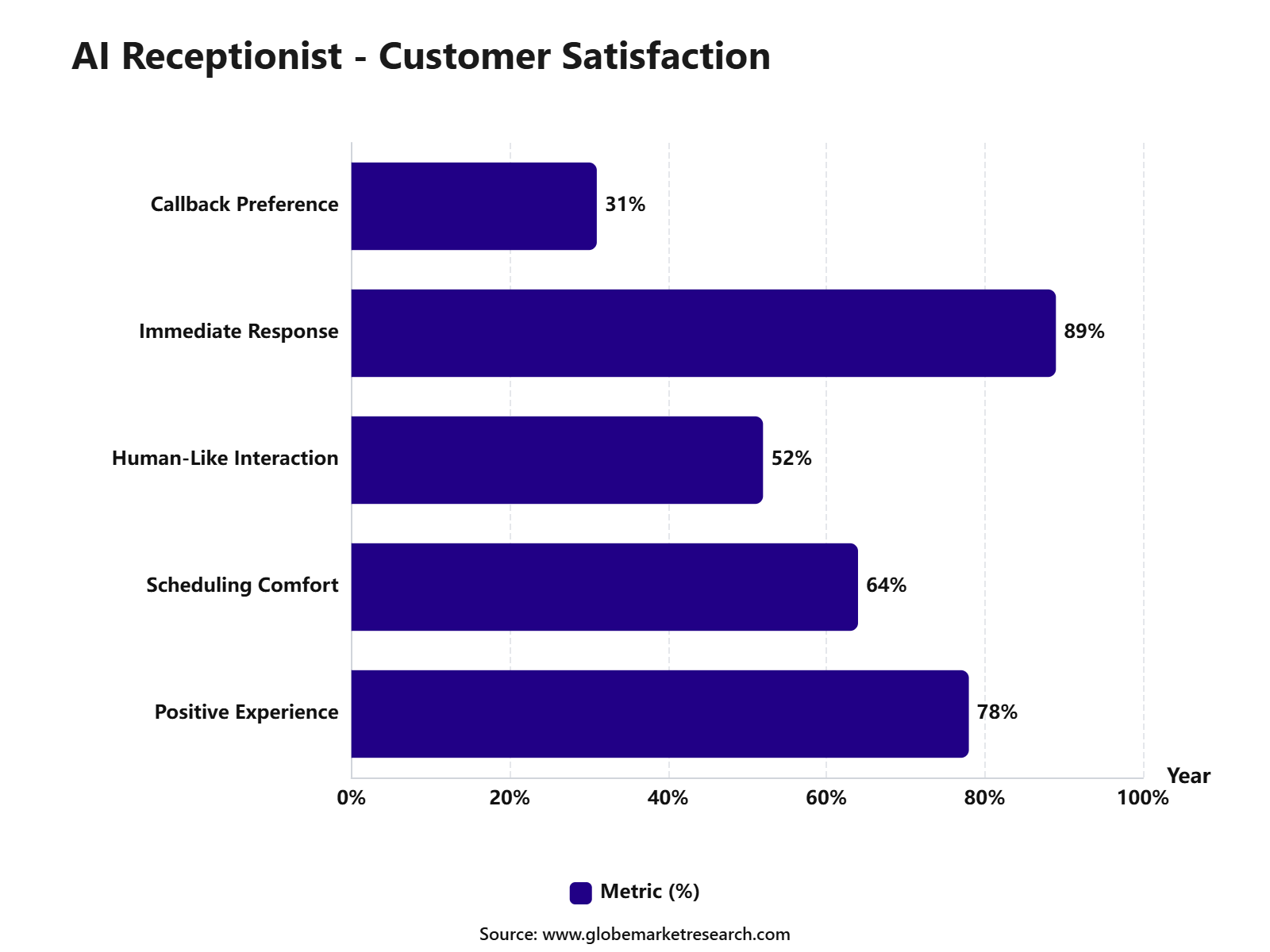
Customer service expectations are rising quickly. Zendesk’s 2026 CX Trends report states that 74% of consumers now expect customer service to be available 24/7 because of AI, while 88% expect faster response times than they did one year earlier. This directly supports demand for AI receptionists that can answer calls and messages outside business hours. Customer service automation is also becoming more measurable. Salesforce reported that 30% of service cases were resolved by AI in 2025, and this is expected to reach 50% by 2027. It also reported that service teams using AI agents expect service costs and case resolution times to fall by an average of 20%.
Solutions and Software Platforms Lead the Component Segment
Solutions and software platforms dominated the component segment with 75.9% share in 2025. This leadership is supported by demand for automated call answering, appointment scheduling, lead capture, customer routing, message taking, CRM updates, and analytics in one platform. Software remains the core revenue segment because AI receptionists are mainly delivered through cloud tools, voice AI platforms, phone system integrations, CRM connectors, calendar tools, and workflow automation modules.
Businesses prefer software-first platforms because they are easier to deploy and update than traditional front-desk systems. The segment is also supported by the rise of custom AI agents. Microsoft reported that customers created more than 1 million custom agents across SharePoint and Copilot Studio in one quarter, up 130% quarter over quarter. This shows that companies are moving from general AI tools toward task-specific agents, including reception, scheduling, and customer handling systems.
Cloud-Based Deployment Leads the Market
Cloud-based deployment accounted for 69.1% share of the AI Receptionist Market in 2025. Businesses prefer cloud deployment because it allows faster setup, remote updates, multi-location access, lower infrastructure needs, and flexible scaling for service teams.
Cloud-based AI receptionists are especially useful for businesses that receive calls outside office hours or operate across several branches. These systems can connect with phone systems, booking calendars, CRM platforms, payment links, help desks, and customer records without requiring large on-site infrastructure.
This deployment model is also attractive for small businesses because it reduces upfront cost. Instead of hiring additional staff or building a call center, businesses can subscribe to AI receptionist software and scale usage based on call volume, locations, and service needs.
Voice Reception Services Hold the Largest Service Type Share
Voice reception services held 55.5% share in 2025. This segment leads because phone calls remain a high-intent customer channel for appointment booking, urgent inquiries, service requests, order questions, legal consultations, home repairs, medical scheduling, and sales leads.
The addressable labor base is large. The U.S. Bureau of Labor Statistics reported that receptionists held about 1.0 million jobs in 2024, with healthcare and social assistance accounting for 45% of receptionist employment. This creates a large workflow base where AI tools can support, not fully replace, front-desk teams.
Customer service representatives also represent a major opportunity for voice automation. BLS reported that customer service representatives held about 2.8 million jobs in 2024, with strong concentration in retail trade, insurance, business support, professional services, and wholesale trade. AI receptionists can reduce repetitive call volume and help staff focus on higher-value customer issues.
24/7 Receptionist Solutions Lead by Service Model
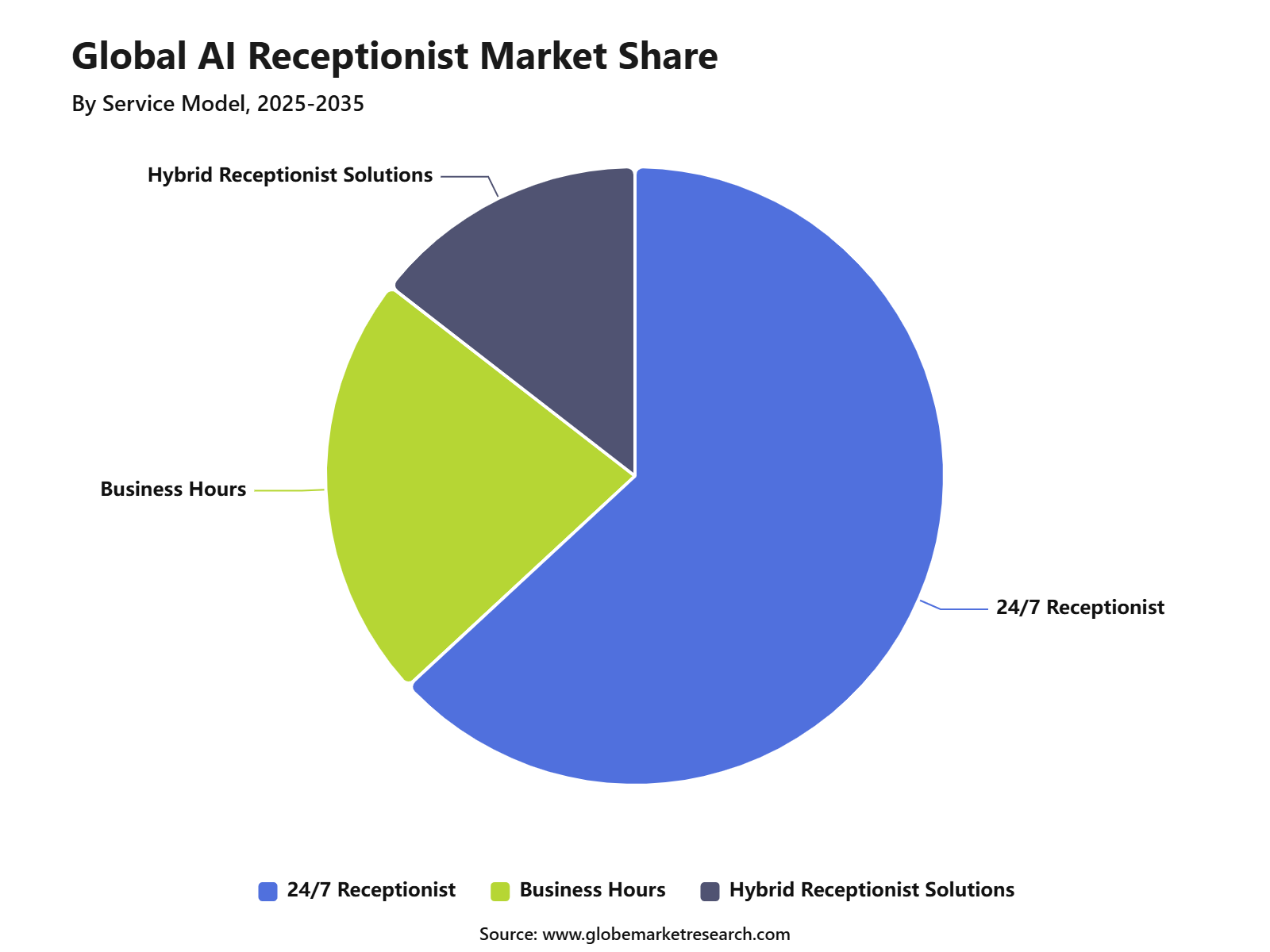
24/7 receptionist solutions accounted for 63.1% share in 2025. The segment is expanding because customers want support during evenings, weekends, holidays, peak hours, and after-hours emergencies.
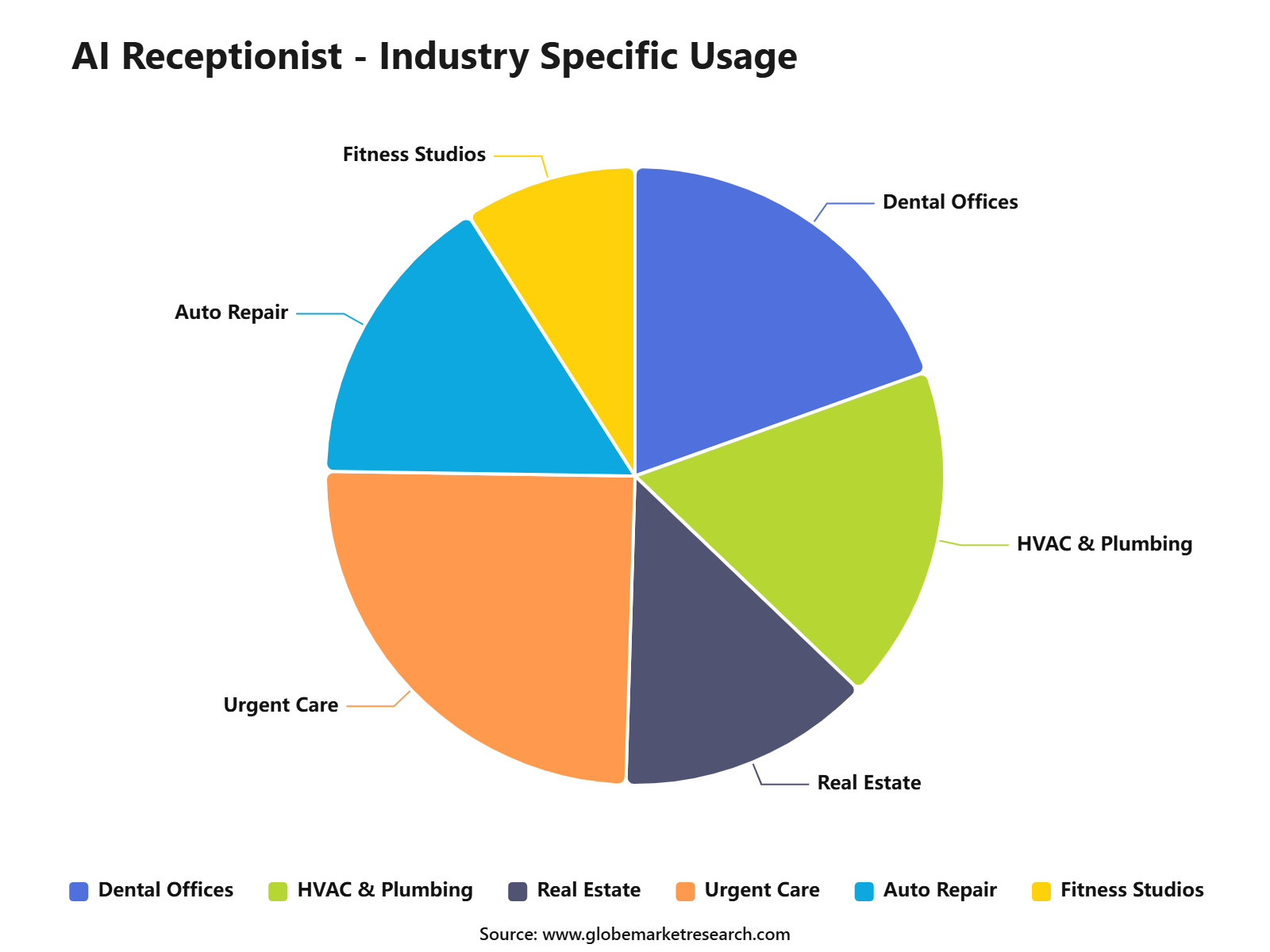
This model is especially useful for healthcare clinics, dental offices, home services, hospitality, real estate, legal firms, travel services, and local service providers. These businesses often lose revenue when callers reach voicemail or cannot book appointments immediately.
The value proposition is simple. A 24/7 AI receptionist can answer routine questions, collect caller details, schedule appointments, route urgent issues, capture leads, and notify staff without requiring overnight or weekend reception teams.
Voice AI Integration Leads by Technology
Voice AI integration represented 55.6% share of the market in 2025. The segment is gaining traction as businesses move from basic recorded menus to natural voice conversations, speech recognition, intent detection, call summarization, multilingual response, and smart handoff.
Voice AI is becoming more useful because it can support both structured and open-ended calls. A caller may ask to book an appointment, reschedule a visit, check service availability, request pricing, or speak to a specific department. AI receptionists can handle these tasks while keeping records for the business.
OpenAI’s May 2026 release of GPT-Realtime-2, GPT-Realtime-Translate, and GPT-Realtime-Whisper also shows how real-time voice infrastructure is becoming more developer-ready. GPT-Realtime-2 was priced at USD 32 per 1 million audio input tokens, while real-time translation was priced at USD 0.034 per minute and live transcription at USD 0.017 per minute.
Small Businesses Are a Major Demand Base
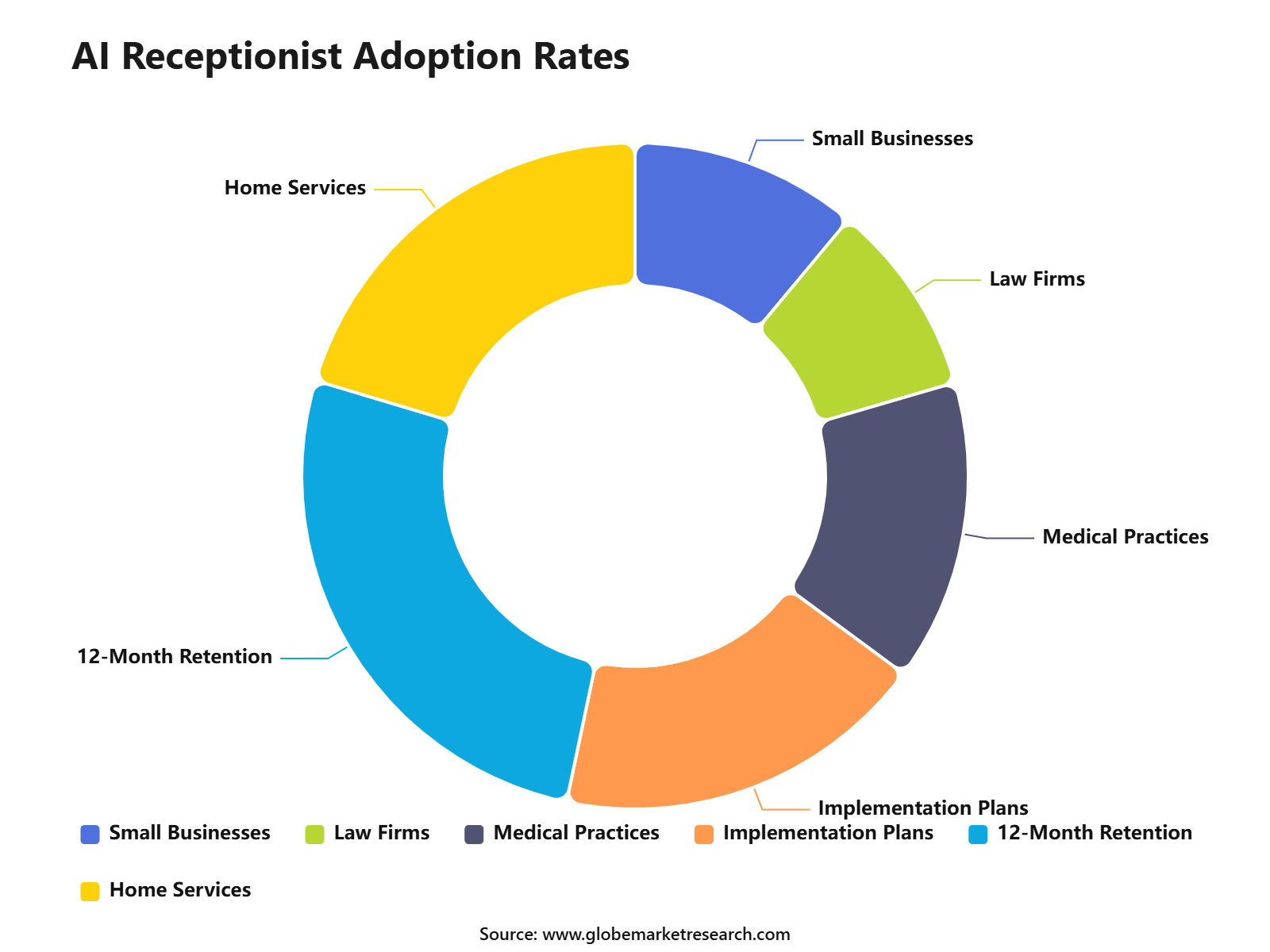
Small businesses are becoming one of the strongest adoption groups for AI receptionists. Globe Market Research identifies demand from small businesses as a key demand factor with an estimated positive impact of +6.2%, especially in the U.S., Europe, India, and Southeast Asia.
The U.S. Chamber of Commerce reported that almost 60% of small businesses said they use AI for business operations in 2025, while 58% said they use generative AI. This supports adoption of AI receptionists among businesses that need better response capacity but cannot expand administrative teams quickly.
Small businesses are practical buyers because the pain point is clear. Missed calls can mean missed appointments, lost leads, poor reviews, delayed service, and weaker customer retention. AI receptionists help these companies answer more inquiries without adding the same level of payroll cost.
North America Leads the AI Receptionist Market
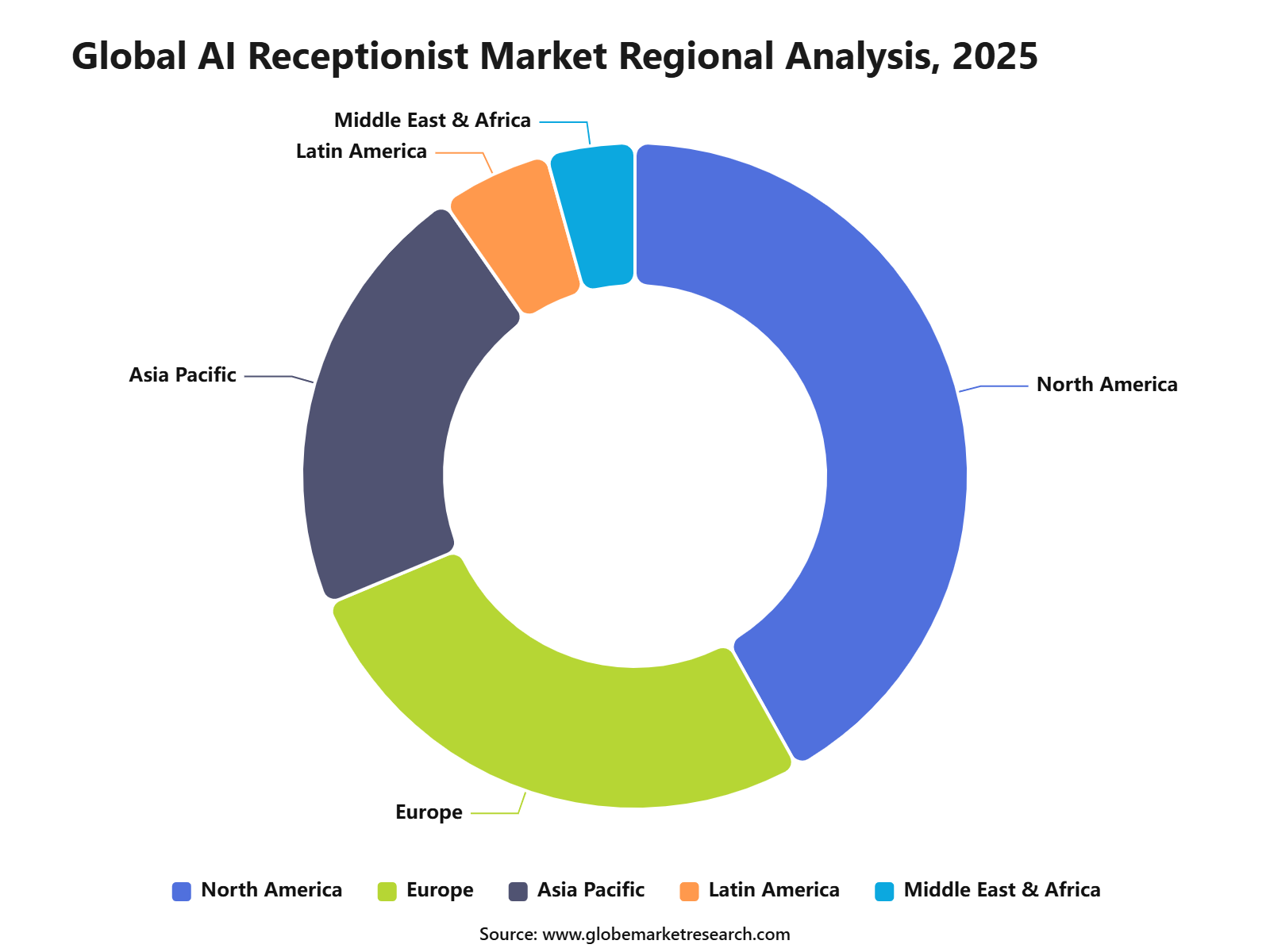
North America dominated the AI Receptionist Market with 41.9% share in 2025. The region benefits from strong cloud adoption, high labor costs, mature customer service software use, a large small-business base, and early adoption of AI agents in customer-facing operations.
The U.S. is the key market because many businesses depend on phone-based customer intake. Healthcare clinics, legal firms, home services, real estate firms, salons, insurance offices, auto service providers, and hospitality operators often rely on inbound calls for revenue generation.
Europe is expected to grow through multilingual AI receptionist demand and customer service automation, while Asia Pacific is gaining momentum through India, China, Southeast Asia, Japan, and Australia. Adoption will depend on language accuracy, accent handling, regulatory compliance, and integration with local business software.
Segments Covered in the Report
By Component
Solutions
Services
By Deployment
Cloud-based
On-premises
By Service Type
Voice Reception Services
Chat Reception Services
Appointment Scheduling
Call Routing
Lead Qualification
Customer Support
By Service Model
24/7 Receptionist Solutions
Business Hours Receptionist Solutions
Hybrid Receptionist Solutions
By Technology
Voice AI Integration
Conversational AI
Natural Language Processing
Speech Recognition
Others
By Enterprise Size
Small and Medium Enterprises
Large Enterprises
By End-use
Healthcare
Legal Services
Real Estate
Retail and E-commerce
BFSI
Hospitality
Automotive
Home Services
IT and Telecom
Others
By Region
North America
Europe
Asia-Pacific
Latin America
Middle East and Africa
Recent Developments
In May 2026, OpenAI launched new real-time audio models for voice-based software agents, including GPT-Realtime-2, GPT-Realtime-Translate, and GPT-Realtime-Whisper. These models support more advanced AI receptionist use cases across live calls, translation, transcription, and customer service automation.
In February 2026, Newo raised USD 25 million in Series A funding to scale AI voice infrastructure for small businesses. The company said the funding would support product development, partner ecosystem growth, and go-to-market expansion for AI reception and customer communication workflows.
In January 2026, Parloa raised USD 350 million in Series D funding at a USD 3 billion valuation, bringing total capital raised to more than USD 560 million. The company said the funding would support U.S. and European expansion and further development of its AI Agent Management Platform.
In February 2026, Slang AI raised USD 36 million in Series B funding, bringing total funding to USD 68 million. The company’s AI platform automates restaurant guest calls, reservations, FAQs, and front-desk workflows, showing strong vertical demand in hospitality.
Market Concentration: Medium
The AI Receptionist Market has medium concentration because established communication software companies, contact center platforms, and customer experience providers already have large customer bases, cloud infrastructure, and integration ecosystems. Companies such as RingCentral, Aircall, Zoom, Nextiva, Five9, PolyAI, Cognigy, and Smith.ai have advantages in distribution, trust, and enterprise readiness.
At the same time, the market remains fragmented because many niche providers focus on specific sectors such as restaurants, clinics, legal intake, home services, real estate, and local businesses. New entrants can still compete by offering better voice quality, faster setup, vertical workflows, multilingual support, and affordable pricing for small businesses.
Competitive Landscape
The AI Receptionist Market is competitive, with communication platforms, voice AI startups, virtual receptionist companies, CRM-integrated tools, contact center providers, and small-business automation vendors competing across accuracy, pricing, integrations, language support, and service quality.
Key companies include:
RingCentral
Aircall
Ruby
AnswerConnect
AIRA
Dialzara
Rosie
Goodcall
Retell AI
Zoom
Quo
Nextiva
Moneypenny
PATLive
Abby Connect
Nexa
PolyAI
Cognigy
Five9
Competition is expected to increase as AI voice systems become easier to build and integrate. Companies with stronger call accuracy, secure data handling, calendar and CRM integration, human handoff, and vertical-specific workflows are likely to gain stronger adoption. The strongest providers will be those that make AI reception feel dependable, not experimental. In this market, businesses are not buying only automation. They are buying fewer missed calls, faster response, more appointments, better lead capture, and a consistent customer experience.
Conclusion
The AI Receptionist Market is entering a strong growth phase as businesses adopt 24/7 call answering, voice AI, appointment scheduling, lead qualification, CRM integration, and automated front-desk support. Growth is being supported by customer expectations for instant service, rising labor costs, small-business AI adoption, and increasing use of task-specific AI agents.
Future growth will be led by cloud-based AI receptionist platforms, voice reception services, healthcare clinic automation, hospitality support, legal intake, multilingual AI, and subscription-based business models. Companies that combine accuracy, compliance, natural voice experience, integration depth, and human fallback will be better positioned in this market.
Curious about the latest AI receptionist market statistics? Explore the key insights here: https://www.globemarketresearch.com/statistic/ai-receptionist-market-statistics