Market Overview & Financials
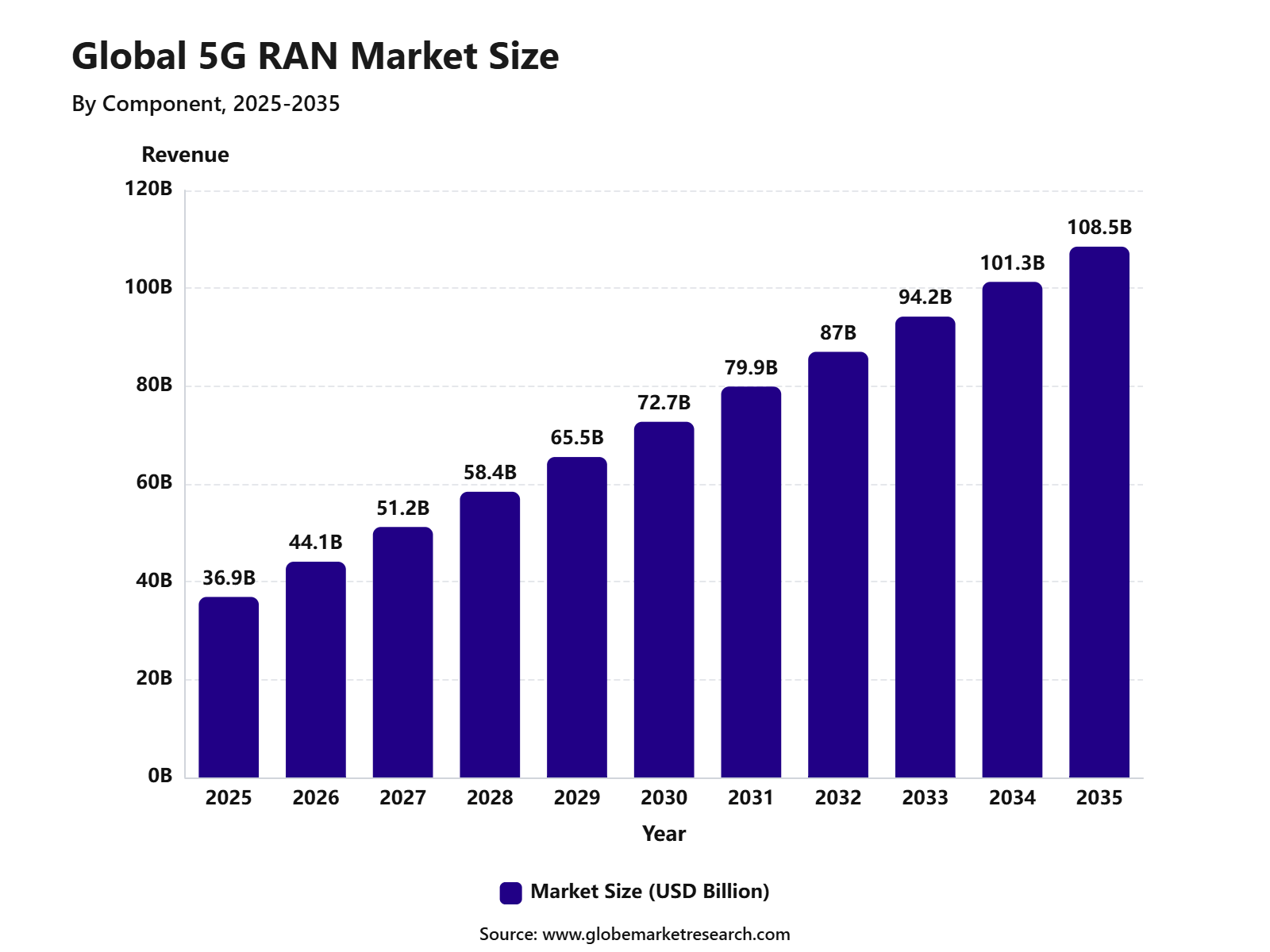
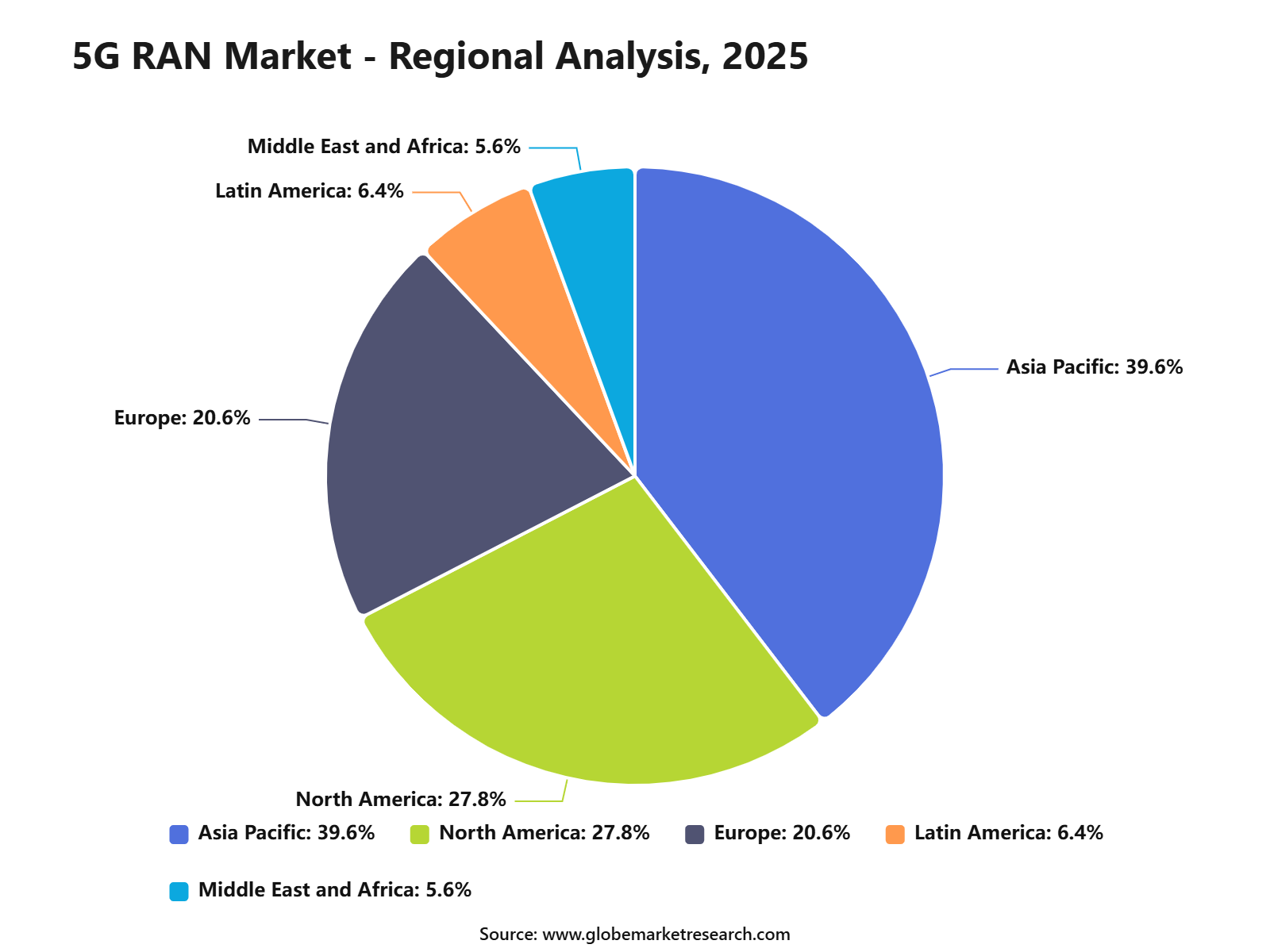
According to Globe Market Research, the global 5G RAN Market was worth USD 36.9 billion in 2025 and is expected to reach USD 44.1 billion in 2026. The market is further projected to reach USD 108.5 billion by 2035, growing at an 11.4% CAGR from 2025 to 2035. Asia Pacific led with 39.6% share in 2025, supported by rapid 5G rollout, telecom infrastructure investment, mobile data growth, and large subscriber bases across China, India, Japan, South Korea, and Southeast Asia.
The 5G RAN market includes radio access network infrastructure used to connect mobile devices, IoT systems, private networks, and enterprise applications to 5G core networks. It covers radios, antennas, baseband units, distributed units, centralized units, small cells, macro cells, massive MIMO systems, software, Open RAN platforms, and related integration services.
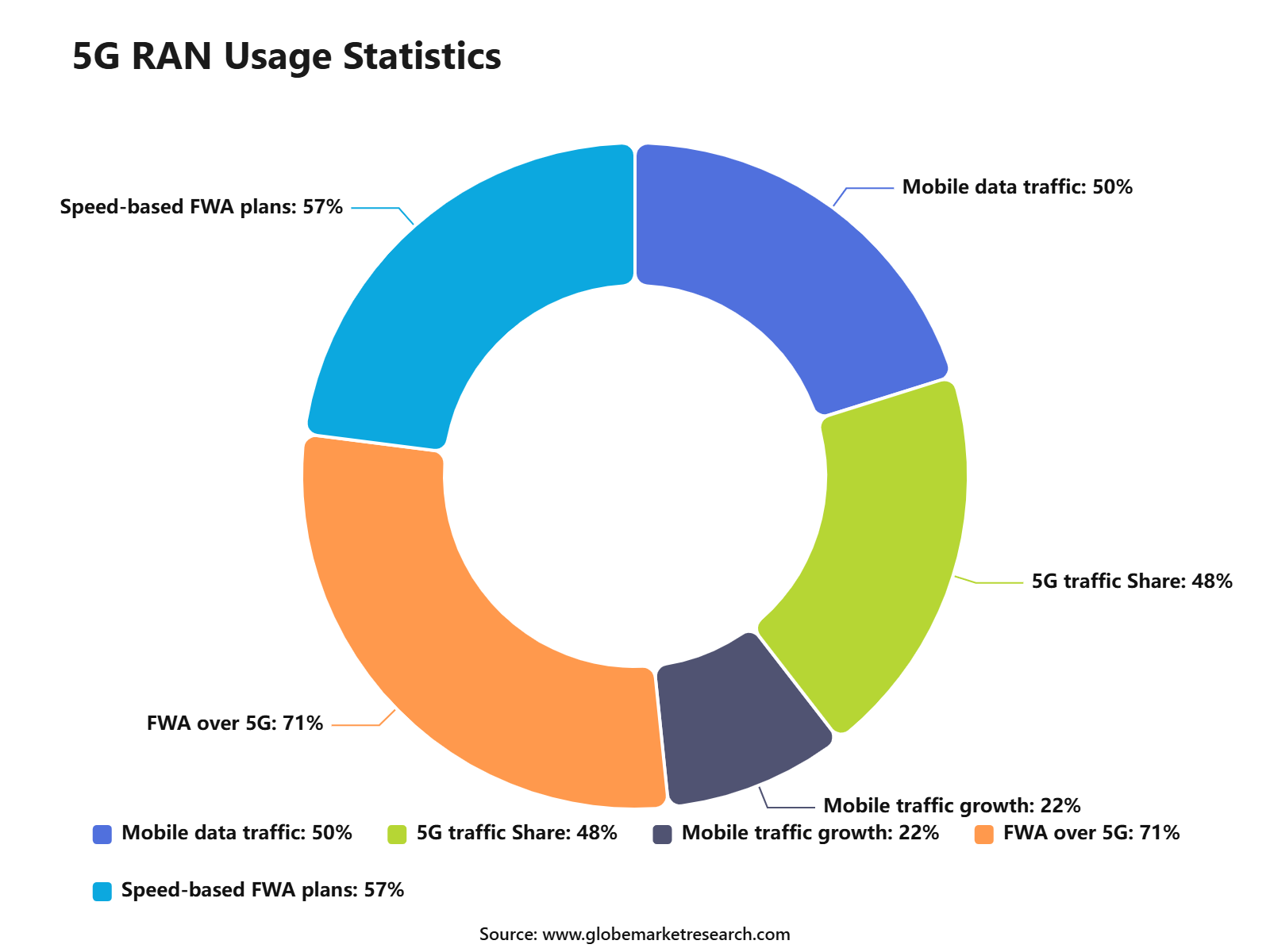
The market is expanding because 5G is moving from basic coverage rollout toward capacity expansion, standalone networks, enterprise private 5G, Open RAN, cloud RAN, and AI-based network optimization. Ericsson reported that global 5G subscriptions passed 3 billion in 2026, while 5G carried 48% of global mobile data traffic at the end of 2025 and is projected to carry 85% by 2031.
Why the 5G RAN Market Is Growing
The market is growing because telecom operators continue to expand 5G coverage, improve mobile broadband speed, densify urban networks, and prepare infrastructure for low-latency enterprise applications. The report identifies rising 5G network rollout as a +3.0% growth impact, mobile data traffic growth as +2.6%, and urban network densification as +2.2%.
Commercial 5G adoption is also becoming broader. GSA reported that 392 operators had launched 5G networks by April 2026, up 14% from March 2025. This shows that 5G RAN investment is moving from initial launches toward broader coverage, standalone upgrades, and capacity improvement.
Private 5G adoption is another important driver. Manufacturing plants, ports, mines, logistics hubs, utilities, hospitals, and smart cities need reliable wireless networks for automation, robotics, remote monitoring, video analytics, and mission-critical communication. The report assigns private 5G adoption a +1.8% growth impact.
Key Market Drivers
Expansion of 5G subscriptions: Global 5G subscriptions reached 3.1 billion in the first quarter of 2026. Higher subscriber density is increasing the need for network capacity, coverage and radio modernization.
Growth in mobile data traffic: The share of mobile data traffic carried over 5G increased from 34% to 48% during 2025. This share is projected to reach 85% by 2031, creating continued demand for high-capacity RAN infrastructure.
5G Standalone deployment: More than 90 service providers had launched commercial 5G Standalone networks by 2026. Standalone architecture supports network slicing, lower latency, differentiated connectivity and advanced enterprise services.
Fixed wireless access adoption: Around 71% of fixed wireless access providers offered services over 5G in 2026, compared with 57% in June 2025. This model allows telecom operators to monetize existing spectrum and network capacity through residential and business broadband services.
Enterprise and industrial connectivity: Manufacturing facilities, ports, warehouses, mines, hospitals and utility sites are deploying private 5G networks for robotics, automation, video analytics, asset tracking and remote monitoring.
Market Segmentation
Component Insights: Hardware led the market with a 59.3% share. Radios, antennas, baseband equipment, small cells, power systems and supporting site infrastructure remain essential for network rollout and capacity expansion.
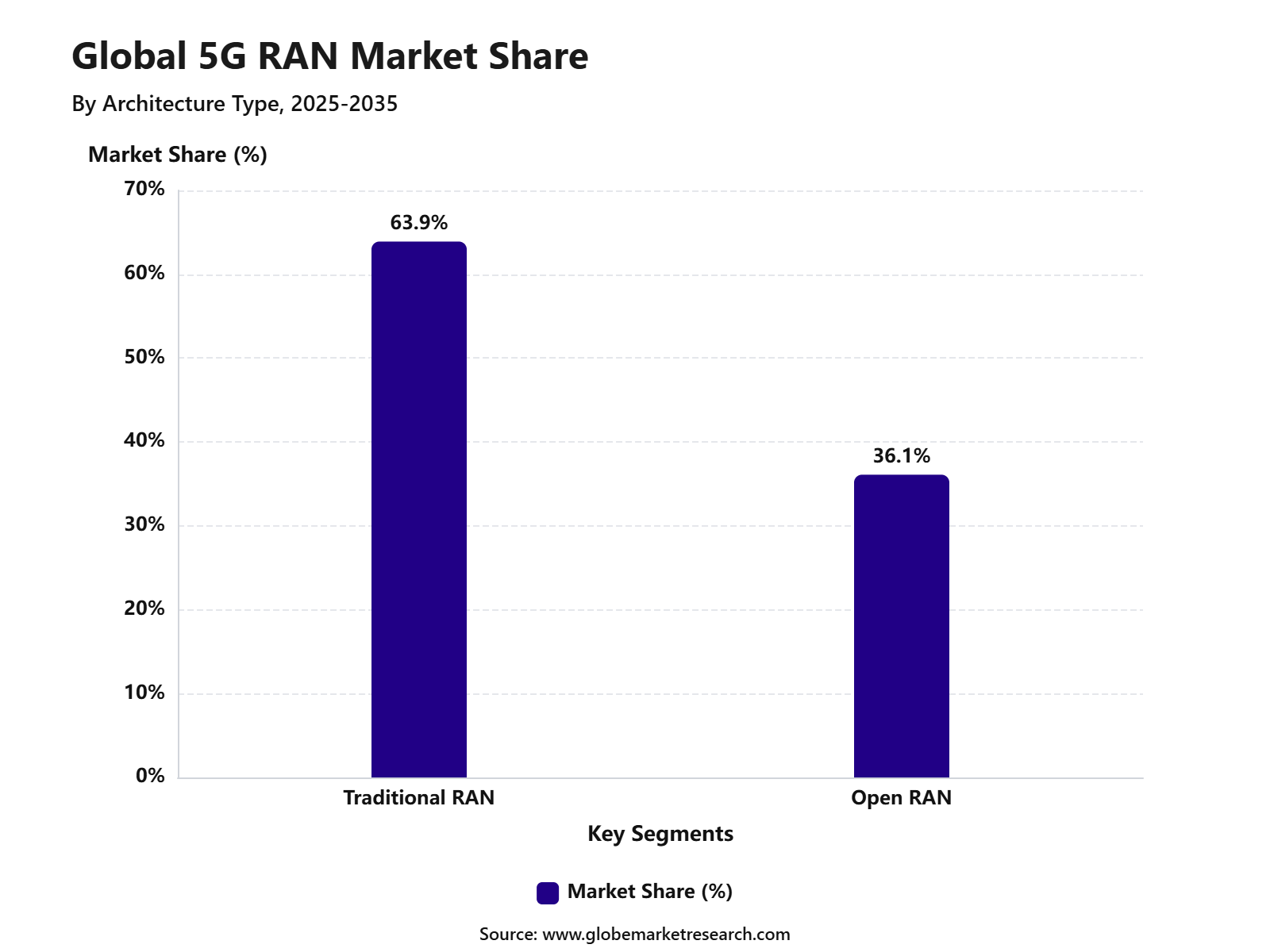
Architecture Type Insights: Traditional RAN accounted for approximately 63.9% of market revenue. Its position is supported by established vendor relationships, proven performance and compatibility with existing telecom infrastructure.
Deployment Insights: Public networks represented around 82.0% of the market. These networks support consumer broadband, enterprise connectivity, fixed wireless access, smart-city applications and nationwide mobile services.
End-Use Insights: Telecom operators held approximately 74.6% of market revenue. Operators remain the principal buyers because they manage spectrum, network planning, infrastructure deployment and long-term technology upgrades.
Regional Insights: Asia Pacific led the market with a 39.6% share in 2025. Strong infrastructure spending, dense cities and high smartphone usage continue to support regional RAN demand.
Technology and Adoption Trends
AI-native radio optimization: AI is being incorporated into radio scheduling, beamforming, positioning and coverage prediction. These systems can improve spectrum usage and network performance without requiring equivalent increases in physical capacity.
AI-ready radio equipment: Ericsson introduced ten AI-ready radios in February 2026, supported by neural network accelerators designed for AI inference in Massive MIMO systems. The portfolio also includes AI-managed beamforming and instant coverage-prediction software.
Open RAN adoption: Operators are adopting open interfaces to increase supplier choice and support multi-vendor infrastructure. Open RAN also creates opportunities for independent radio, software, cloud and integration providers.
Virtualized and cloud RAN: Baseband functions are increasingly being operated as software on commercial computing infrastructure. Samsung and Orange agreed to expand the number of European vRAN and Open RAN sites during 2026 following earlier pilot deployments.
Shared AI and RAN computing: Nokia completed functional tests of its anyRAN software on NVIDIA GPU-accelerated infrastructure with T-Mobile, Indosat and SoftBank. The approach allows radio workloads and external AI applications to operate on shared computing resources.
Regional Breakdown and Supply Chain
Asia Pacific: The region accounted for 39.6% of global market revenue in 2025. China, India, Japan and South Korea are investing in broader coverage, Massive MIMO, 5G Standalone and AI-enabled network infrastructure.
North America: Growth is being supported by mid-band spectrum deployment, fixed wireless access, Open RAN-capable equipment and AI-based network optimization. Operators are also preparing networks for 5G-Advanced services.
Europe: Operators are focusing on network modernization, energy efficiency and supplier diversification. Virtualized RAN and Open RAN deployments are progressing from trials toward wider commercial use.
Middle East, Africa and Latin America: Gulf countries are investing in high-capacity 5G and smart-city infrastructure, while emerging markets are prioritizing affordable coverage and fixed wireless broadband. Deployment continues to depend on spectrum availability, fiber backhaul and capital resources.
Supply chain structure: The market depends on semiconductor designers, radio manufacturers, antenna suppliers, cloud-platform providers, server companies, software developers and systems integrators. Availability of advanced processors, radio components and skilled engineering services directly affects project schedules and costs.
Segment Covered in the Report
By Component
Hardware
Software
Services
By Architecture Type
Traditional RAN
Open RAN
By Deployment
Public Networks
Private Networks
By End Use
Telecom Operators
Enterprise and Industrial Users
By Region
North America
Europe
Asia Pacific
Latin America
Middle East and Africa
Open RAN and Cloud RAN Are Creating New Growth Paths
Open RAN deployment is one of the strongest opportunities in the market, with an estimated +2.8% impact. Open RAN allows operators to use interoperable hardware and software from multiple vendors, supporting vendor diversity and more flexible network architecture.
AT&T’s Open RAN strategy shows how large operators are moving in this direction. AT&T stated in March 2026 that more than 50% of its network traffic was carried on open-capable hardware, and the company had completed an Open RAN call on its commercial network using Ericsson basebands and 1Finity radios.
Cloud RAN and virtualized RAN are also gaining importance. These models help operators centralize processing, improve software upgrade cycles, support automation, and prepare networks for AI-enabled optimization. The report assigns virtualized and cloud RAN adoption a +2.4% opportunity impact.
AI-RAN Is Becoming a Strategic Technology Trend
AI-RAN is emerging as a major technology direction for 5G-Advanced and future 6G networks. It uses AI to improve network optimization, energy efficiency, traffic steering, radio performance, and edge intelligence.
In 2026, Ericsson launched AI-ready radios, antennas, and AI RAN software designed to support future networks, including AI traffic, augmented reality use cases, uplink performance, and automated RAN optimization.
T-Mobile and Ericsson also reported a 5G-Advanced AI-RAN milestone, with Ericsson stating that AI-native RAN innovation delivered up to 15% performance gains. This shows that AI is moving from network analytics into active radio network performance improvement.
Revenue Potential and Financial Impact
Revenue potential is strongest across macro RAN modernization, small cells, massive MIMO radios, millimeter-wave densification, Open RAN, cloud RAN, private 5G, and AI-RAN. These areas support both new infrastructure deployment and long-term software and services revenue.
The financial impact is also linked to traffic growth. Ericsson data shows that 5G’s share of mobile traffic rose from 34% to 48% during 2025, and the share is expected to reach 85% by 2031. This supports ongoing investment in higher-capacity RAN infrastructure and better spectrum efficiency.
Public funding is also improving the investment base. The U.S. Public Wireless Supply Chain Innovation Fund is a USD 1.5 billion program aimed at advancing Open RAN, wireless innovation, competition, and supply-chain resilience. In 2026, NTIA also sought industry feedback on a new direction focused on AI-RAN.
Risk Factors and Market Barriers
High deployment cost remains the largest restraint, with an estimated -1.6% impact. 5G RAN rollout requires spectrum, radios, antennas, towers, fiber backhaul, power systems, energy management, engineering teams, and site maintenance.
Spectrum investment pressure is another key barrier, with an estimated -1.3% impact. Operators must spend heavily on licensed spectrum before or during network deployment, which can reduce available capital for RAN upgrades.
Complex integration with legacy networks also slows adoption. Operators must manage 4G-to-5G transition, standalone upgrades, core integration, transport networks, multi-vendor testing, and cybersecurity controls. The report assigns legacy integration a -1.1% impact and multi-vendor interoperability issues a -1.5% challenge impact.
Key Opportunities
AI-RAN commercialization: AI can optimize traffic scheduling, beam management, spectrum use and energy consumption. Nokia launched a commercial AI-native RAN platform in July 2026 and stated that the system is designed to deliver substantial spectral-efficiency improvements.
Open RAN expansion: Open interfaces create opportunities for new radio suppliers, software developers and systems integrators to participate in telecom networks historically controlled by integrated vendors.
Private industrial networks: Manufacturing, logistics, mining, utilities and healthcare organizations require secure connectivity for automation, robotics and mission-critical communication.
Fixed wireless access: 5G broadband can provide high-speed connectivity where fiber installation is costly or slow. Speed-based plans can also support several customer and pricing categories.
Software and lifecycle services: Network planning, cybersecurity, interoperability testing, performance optimization and maintenance can generate recurring revenue after equipment installation.
Challenges and Restraints
High network deployment cost: Operators must invest in spectrum, towers, radios, antennas, power infrastructure, fiber backhaul and software licenses. These expenses can slow deployment in rural and lower-income markets.
Uncertain investment returns: Consumer willingness to pay more for standard 5G connectivity remains limited in several countries. Operators must develop fixed wireless, enterprise and differentiated service models to improve monetization.
Multi-vendor integration: Open and virtualized systems require extensive testing across radio units, distributed units, centralized units, cloud platforms and network management software.
Energy consumption: Radio access networks account for a substantial share of mobile network electricity use. Dense networks and Massive MIMO equipment can raise operating costs unless energy-saving software and efficient hardware are adopted.
Technical skills and cybersecurity: Software-defined and AI-managed networks require experienced cloud, telecom and cybersecurity professionals. Skills shortages can increase project risk and delay modernization.
Recent Developments
In February 2026, Ericsson launched AI-ready radios, antennas, and AI RAN software to support 5G-Advanced and future network use cases. The portfolio targets AI traffic, augmented reality, uplink performance, and more automated radio access networks.
In May 2026, T-Mobile and Ericsson reported a 5G-Advanced AI-RAN milestone, with Ericsson stating that AI-native network innovation delivered up to 15% performance gains.
In March 2026, Nokia announced progress in its strategic AI-RAN partnership with NVIDIA, including functional tests of Nokia anyRAN software on NVIDIA GPU-accelerated AI-RAN infrastructure with T-Mobile, Indosat, and SoftBank.
In March 2026, Samsung and Orange Group expanded their strategic partnership to bring vRAN and Open RAN into broader field deployment in Europe during 2026.
In March 2026, AT&T said it had completed an Open RAN call on its commercial network and that more than 50% of network traffic was being carried on open-capable hardware.
Market Concentration: High
The 5G RAN Market has high concentration because a limited number of large telecom equipment vendors control major RAN portfolios, global operator relationships, patent positions, radio technology, and large-scale deployment experience. The report identifies the market concentration as High.
At the same time, Open RAN is creating room for new vendors, software providers, system integrators, cloud companies, and chip suppliers. This may gradually reduce vendor concentration, but large-scale public network deployments still require proven reliability and strong field support.
Competitive Landscape
The 5G RAN Market is competitive, with telecom equipment vendors, Open RAN specialists, semiconductor companies, software firms, cloud infrastructure providers, and telecom operators competing across performance, interoperability, cost, software roadmap, energy efficiency, and deployment scale.
Key companies include:
Huawei Technologies Co., Ltd.
Telefonaktiebolaget LM Ericsson
Nokia
Qualcomm Technologies, Inc.
Intel Corporation
Samsung
Cisco Systems, Inc.
Verizon
Rakuten Symphony Singapore Pte. Ltd.
ZTE Corporation
VMware, Inc.
Fujitsu
Mavenir
Other Key Players
Competition is expected to increase as Open RAN, cloud RAN, private 5G, and AI-RAN become more commercially relevant. Companies with strong radio performance, software capability, AI optimization, interoperability testing, and operator trust are likely to perform better.
The strongest providers will be those that can balance performance with flexibility. In this market, operators are not buying only equipment. They are buying coverage, capacity, software evolution, lower operating cost, and long-term network readiness.
Conclusion
The 5G RAN Market is entering a new phase supported by public network expansion, hardware upgrades, traditional RAN modernization, Open RAN, cloud RAN, private 5G, AI-RAN, and 5G standalone deployment. The market is projected to grow from USD 36.9 billion in 2025 to USD 108.5 billion by 2035, supported by an 11.4% CAGR.
Future growth will be led by hardware, public networks, telecom operators, Asia Pacific infrastructure investment, Open RAN, massive MIMO, small cells, and AI-enabled RAN optimization. Companies that manage deployment cost, interoperability, energy efficiency, cybersecurity, and operator monetization needs will be better positioned in this market.
Contact us
Global Business Development Team
Email: [email protected]