
Market Size and Growth
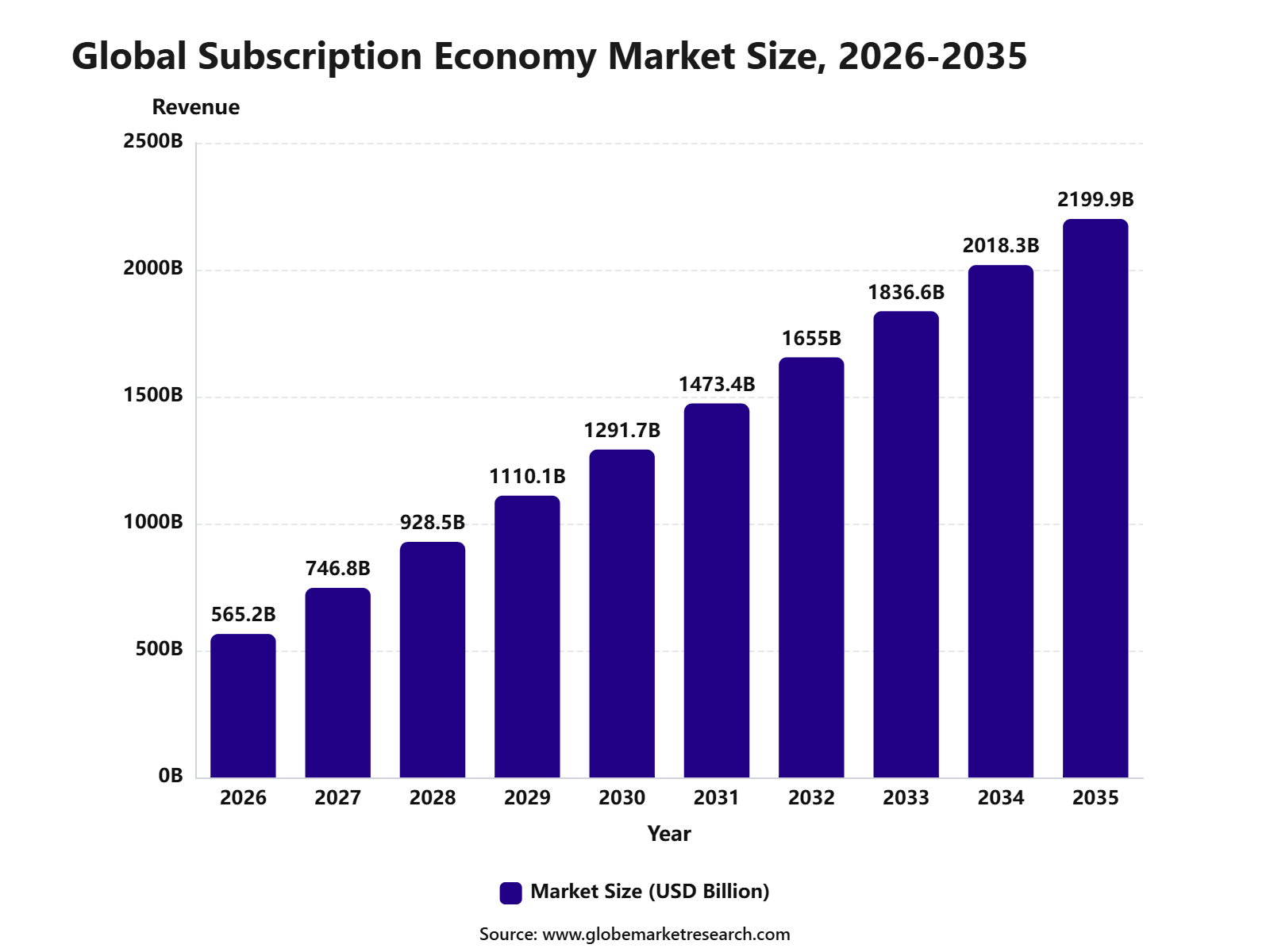
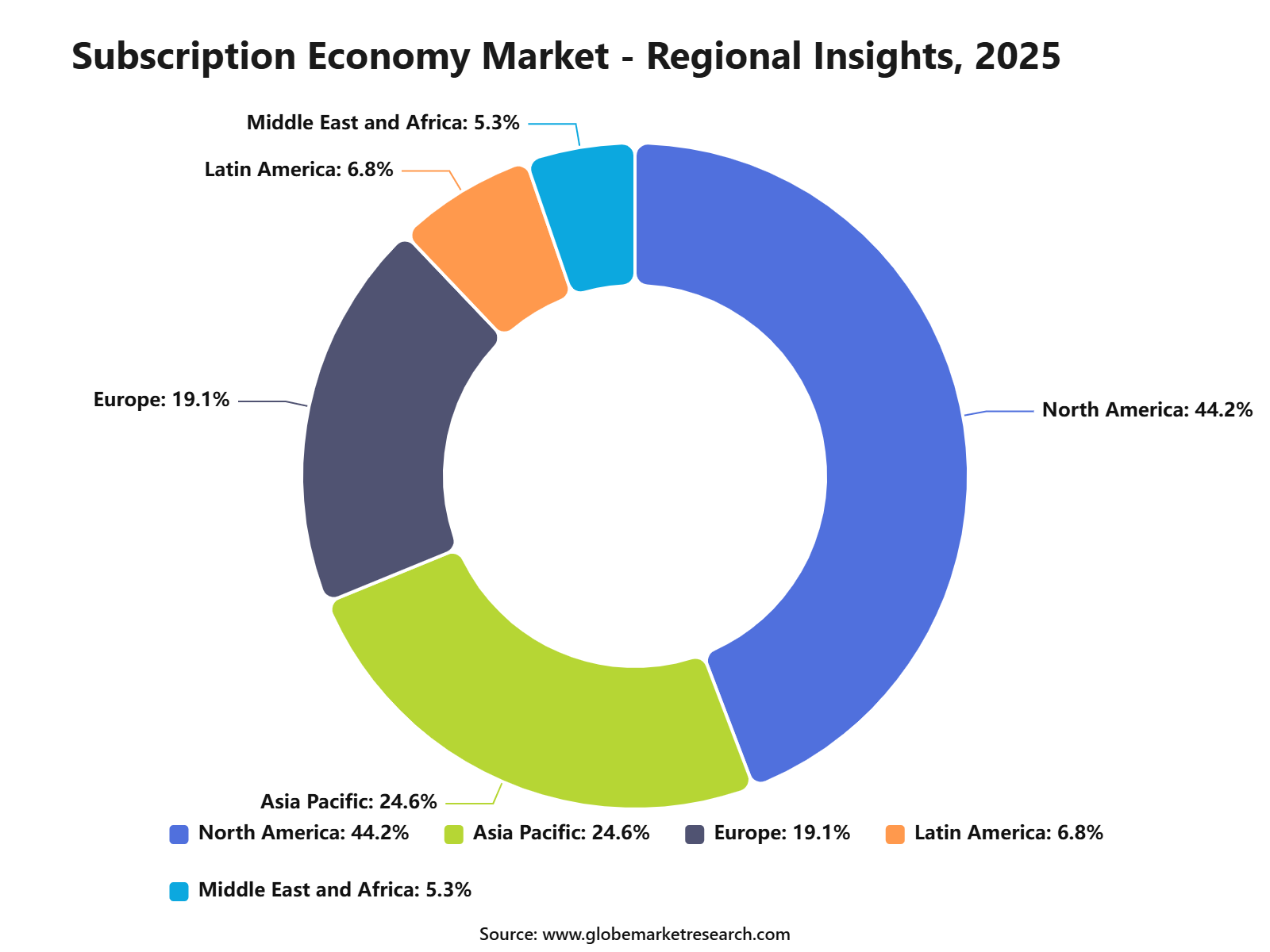
According to Globe Market Research, the global Subscription Economy Market was valued at USD 565.2 billion in 2026 and is projected to reach USD 2,199.9 billion by 2035, growing at a 16.3% CAGR from 2026 to 2035. North America accounted for around 44.2% share in 2025, while the U.S. market reached approximately USD 201.8 billion in 2026 and is expected to expand at a 15.6% CAGR.
The subscription economy covers business models where customers make recurring payments for continued access to products, software, services, memberships, or digital content. It includes SaaS, cloud platforms, streaming media, gaming, e-commerce memberships, telecom plans, wellness apps, online education, mobility services, and subscription-based consumer goods.
The market is expanding because companies want predictable recurring revenue, while customers want flexible access without full ownership. Growth is also being supported by digital payments, cloud billing systems, mobile commerce, AI-powered retention, personalized plans, and bundled services.
Why the Subscription Economy Market Is Growing
The market is growing because recurring digital services are becoming part of daily consumer and enterprise spending. SaaS and cloud subscription adoption has an estimated growth impact of +4.8%, streaming and digital media subscriptions add +3.9%, and e-commerce memberships contribute +3.2%.
Cloud adoption is a major growth base for business subscriptions. Eurostat reported that 52.7% of EU enterprises used paid cloud computing services in 2025, including software, computing power, storage, CRM, and application development platforms. This supports subscription demand across enterprise software, cloud security, office tools, analytics, and digital workflow platforms.
Consumer access is also expanding through internet penetration. ITU estimates that 6 billion people, equal to 74% of the global population, were online in 2025, up from 5.8 billion in 2024. This widens the addressable audience for web-based subscriptions, streaming platforms, mobile apps, online education, digital fitness, and e-commerce memberships.
Key Market Drivers
Expansion of digital payment infrastructure: Businesses operating through Stripe generated USD 1.9 trillion in total payment volume during 2025, representing annual growth of 34%. The growing scale of payment platforms is making recurring billing more accessible to companies of different sizes.
Increasing use of cloud software: Recurring contracts are widely used for cloud infrastructure, cybersecurity, collaboration platforms, data analytics and enterprise applications. In 2025, 52.74% of EU enterprises used paid cloud computing services, while adoption among large enterprises reached 84.67%.
Rising internet connectivity: Approximately 6 billion people, equal to 74% of the global population, were using the internet in 2025. The larger online population is increasing the addressable customer base for web-based subscriptions, digital media, education platforms and online services.
Demand for predictable revenue: Subscription models allow companies to estimate future income, improve financial planning and maintain regular contact with customers. They also provide opportunities to increase customer lifetime value through upgrades, add-ons and premium features.
Preference for access over ownership: Consumers and enterprises are increasingly selecting recurring access to software, entertainment, transportation, education and professional services instead of making large upfront purchases.
Market Segmentation
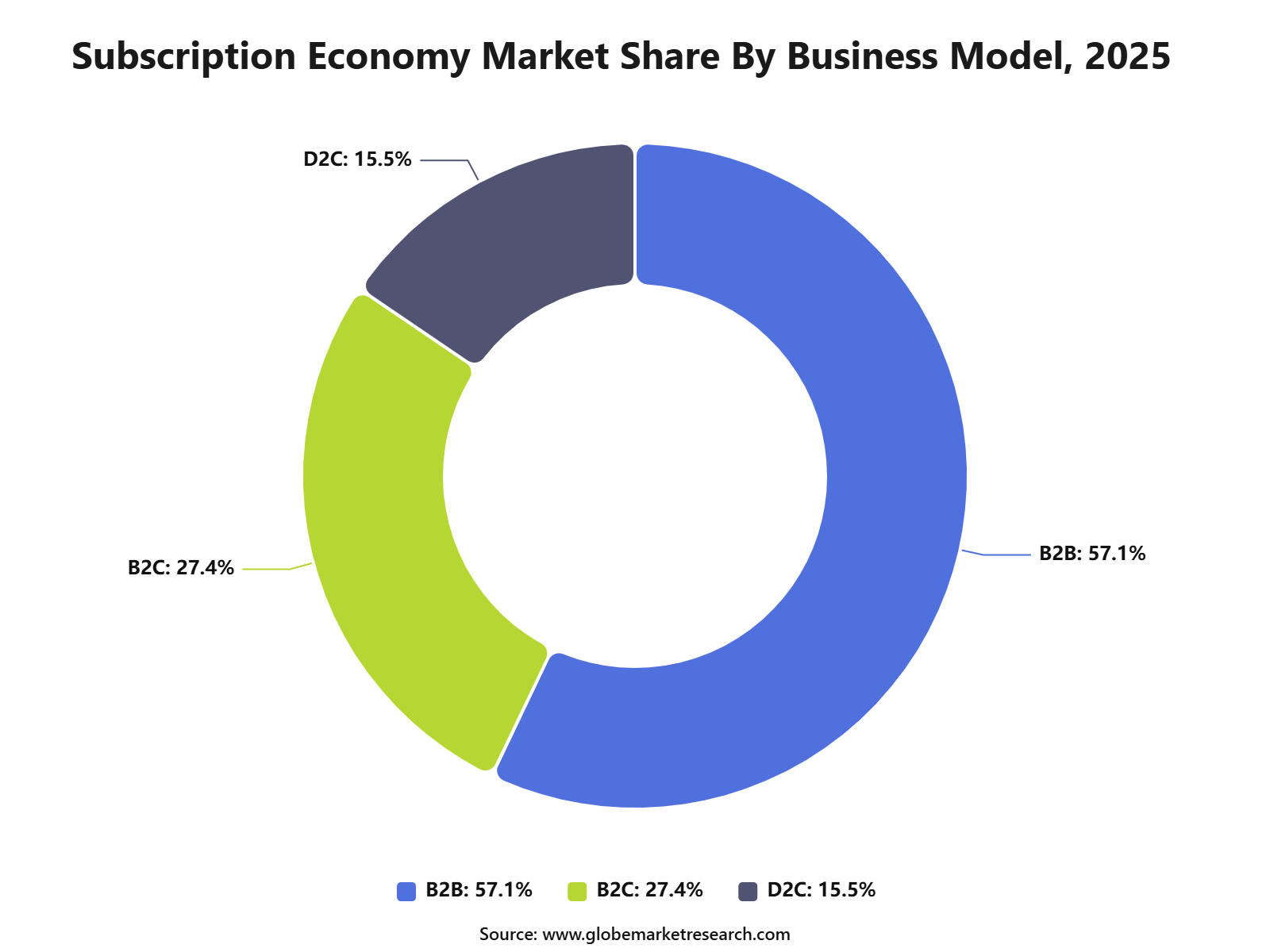
By Business Model: B2B subscriptions represented approximately 57.1% of the market. Growth is being driven by enterprise software, cloud services, cybersecurity, professional platforms and recurring business services.
By Delivery Platform: Web-based platforms accounted for around 55.1% of the market due to browser accessibility, centralized updates, lower installation requirements and compatibility across multiple devices.
By Organization Size: Large enterprises held nearly 63.5% of market revenue, supported by substantial spending on cloud capacity, software licenses, communication systems, security and workforce management tools.
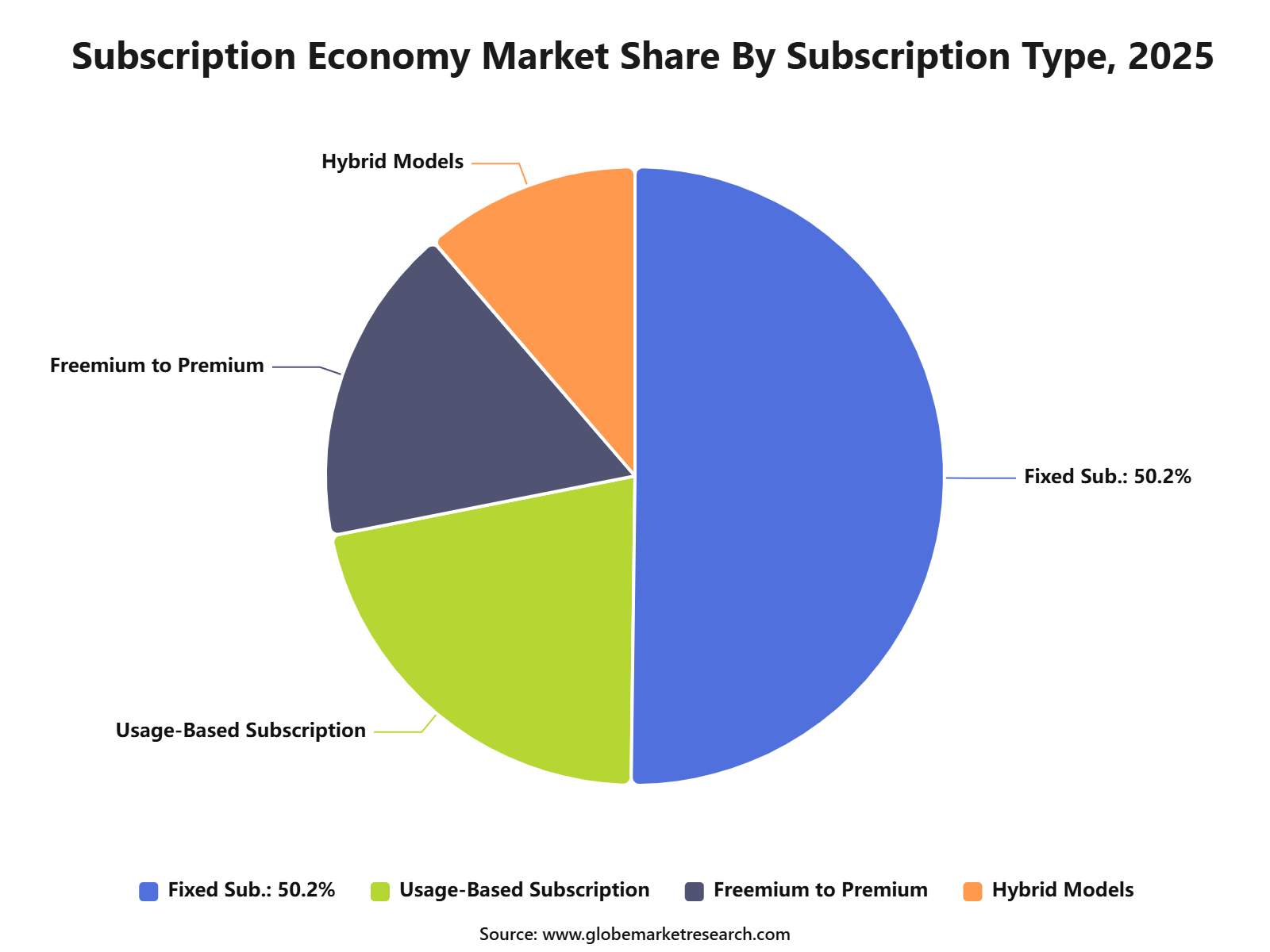
By Subscription Type: Fixed subscriptions captured approximately 50.2% of the market because they provide stable billing amounts and predictable revenue. Usage-based, freemium and hybrid plans are gaining importance where customer consumption varies.
By Industry Vertical: Media and entertainment represented around 20.1% of the market, supported by video streaming, music, gaming, digital publishing, sports content and premium creator platforms.
Technology and Adoption Trends
AI-based subscription management: Artificial intelligence is being used to predict churn, recommend suitable plans, personalize content, identify fraud and recover failed payments. Around 43% of surveyed consumers were comfortable allowing AI to manage their subscriptions.
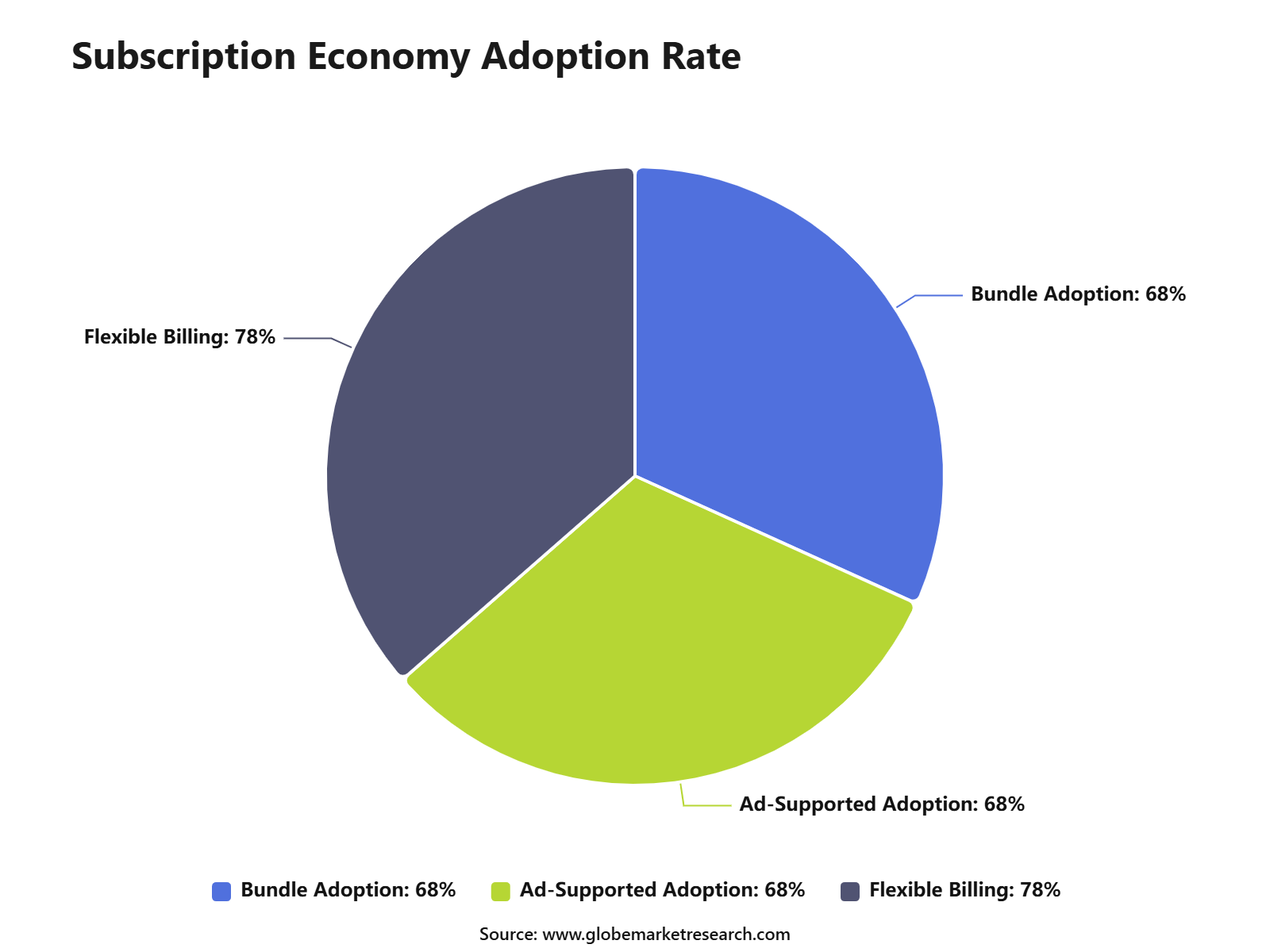
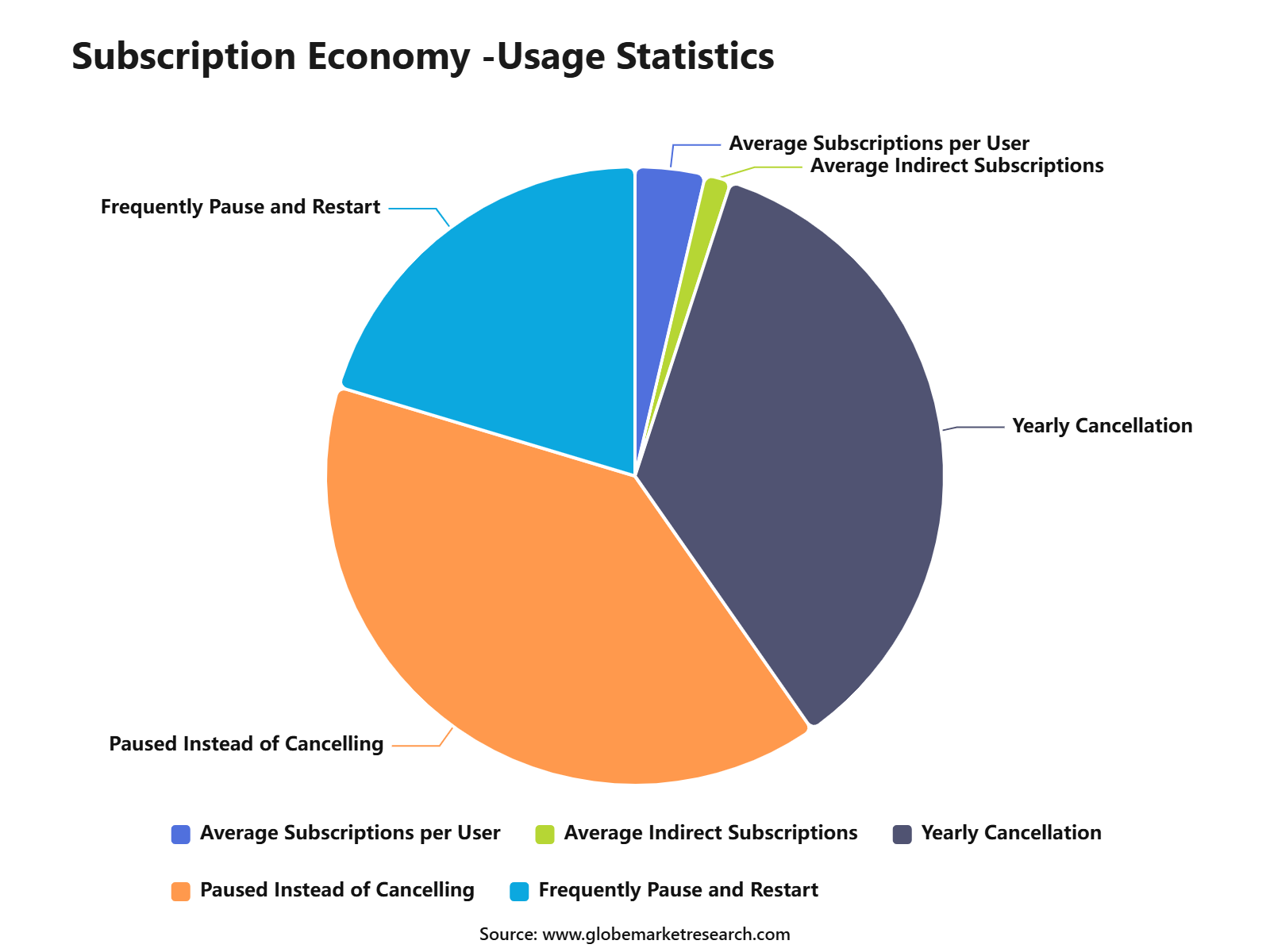
Pause and reactivation features: Companies offering a pause option before cancellation recorded a 337% increase in pause usage. Three out of four subscribers who paused a service eventually returned, showing that flexible controls can protect recurring revenue.
Hybrid monetization models: Fixed subscriptions are increasingly being combined with usage-based charges, advertising, premium features, one-time purchases and consumption pricing. These structures allow businesses to serve both predictable and variable customer needs.
Growth of subscription applications: Subscription app data collected in 2026 covered more than 115,000 applications and over USD 16 billion in revenue. More than 14,000 new subscription apps were entering the ecosystem each month, increasing competition for users and digital visibility.
Subscription controls inside banking apps: Banks and payment providers are allowing users to view renewal dates, change plans, pause services and manage recurring payments through digital banking platforms. Around 67% of consumers indicated that better payment information in banking apps would reduce disputes.
Regional Breakdown and Supply Chain
North America: The region held approximately 44.2% of global market revenue in 2025. Its leading position is supported by high SaaS adoption, established payment infrastructure, mature streaming usage and strong enterprise spending on cloud platforms.
Europe: Subscription growth is being supported by enterprise cloud adoption, digital media and recurring business software. However, providers must prepare for stronger requirements covering renewal reminders, cancellation processes, cooling-off periods and customer refunds.
Asia Pacific: Mobile applications, digital entertainment, online education, telecommunications bundles and cloud software are creating opportunities across the region. Local payment options, multilingual interfaces and affordable pricing tiers remain important for wider adoption.
Latin America, Middle East and Africa: Market development is being supported by improving internet access, digital wallets, telecom-led subscriptions and mobile-first service delivery. Partnerships with local payment providers and telecommunications companies can help reduce customer acquisition and payment-processing barriers.
Subscription supply chain: The operational value chain includes cloud infrastructure providers, app stores, billing engines, payment processors, identity verification services, customer relationship platforms, churn analytics tools and content or product fulfilment partners. Payment visibility and banking integration are becoming more important as companies seek to reduce disputes, failed payments and involuntary cancellations.
AI Is Becoming a Subscription Management Tool
AI is becoming important in subscription management because companies need better churn prediction, failed payment recovery, personalized offers, and usage-based pricing. The report identifies AI tool subscriptions as a +3.8% opportunity and highlights AI-powered personalization as a key growth route. Recurly’s 2026 subscription analysis covered 2,200 subscription businesses and 76 million unique subscribers.
It reported that 52% of consumers cancelled at least one subscription during the previous year because they were not using it enough. AI can help providers identify low-engagement users before they cancel. It can also support personalized plan recommendations, renewal reminders, dunning workflows, payment recovery, churn scoring, and targeted save offers.
Key Market Segments
By Business Model
B2B
B2C
D2C
By Delivery Platform
Web-based Platforms
Mobile Apps
Multi-channel
By Organization Size Analysis
Large Enterprises
Small and Medium-sized Enterprises (SMEs)
By Subscription Type
Fixed Subscription
Usage-Based Subscription
Freemium to Premium
Hybrid Models
By Industry Vertical Outlook
Software & Technology
Media & Entertainment
E-commerce & Retail
Telecommunications
Healthcare & Wellness
Automotive & Mobility
Others
By Region
North America
Europe
Asia Pacific
Latin America
Middle East and Africa
Key Opportunities
AI and automation subscriptions: Demand is emerging for recurring access to AI assistants, content-generation tools, analytics platforms, cybersecurity solutions and automated business applications.
Usage-based billing: Software and cloud companies can expand adoption by allowing customers to pay according to transactions, computing consumption, users, tokens or completed business outcomes.
Bundled subscription services: Telecommunications companies, banks, retailers and digital platforms can combine entertainment, cloud storage, delivery, financial services and loyalty benefits into unified packages.
Flexible retention programs: Pause options, plan downgrades, temporary discounts and loyalty rewards can retain customers who may otherwise cancel. Two-thirds of users surveyed by Mastercard indicated that they could remain subscribed when offered a reduced price.
Vertical B2B subscriptions: Industry-specific platforms for healthcare, finance, manufacturing, logistics, education and professional services can generate long-term contracts by solving specialized workflow and compliance requirements.
Challenges and Restraints
Subscription fatigue: Around 52% of consumers cancelled at least one subscription during the previous year because of insufficient use. Companies must demonstrate clear and continuing value after the initial sign-up.
Price sensitivity: Value for money and price were identified as retention factors by 88% and 86% of subscribers, respectively. Frequent price increases can therefore accelerate plan downgrades and cancellations.
Involuntary churn: Payment failures, expired cards and billing errors can cause cancellations even when customers intend to remain subscribed. Billing errors represented 32.3% of Google Play subscription cancellations in RevenueCat’s 2026 analysis.
Regulatory compliance: The UK estimated that 9.7 million unwanted subscription contracts were active, representing approximately GBP 1.6 billion in annual consumer spending. New rules require clearer information, straightforward cancellation and cooling-off rights.
Uneven competitive performance: The top 25% of subscription apps recorded annual monthly recurring revenue growth of at least 80%, while the bottom 25% experienced a decline of more than 33%. This performance gap highlights the increasing difficulty of competing without strong customer engagement and product differentiation.
Prominent Global Market Leaders
The Subscription Economy Market has medium concentration because large global companies have strong customer bases, payment infrastructure, cloud platforms, content libraries, and brand trust. Leading players across software, media, e-commerce, and cloud services benefit from scale and high customer retention. At the same time, the market remains fragmented because many startups, app developers, SaaS companies, creator platforms, subscription commerce brands, and regional providers continue to enter the space. This keeps competition strong and increases pressure on pricing, customer acquisition, and differentiation.
The Subscription Economy Market is competitive, with software companies, streaming platforms, cloud providers, e-commerce firms, payment companies, subscription billing vendors, media platforms, and app developers competing across pricing, flexibility, retention, content, and customer experience.
Key companies include:
Amazon.com, Inc.
Microsoft Corporation
Apple Inc.
Netflix, Inc.
Salesforce, Inc.
Oracle Corporation
Spotify Technology S.A.
Zuora, Inc.
Atlassian Corporation
Dropbox, Inc.
Strategic Implications
Subscription providers should prioritize customer lifetime value, retention and payment success rather than focusing only on new registrations. Product quality, transparent pricing, flexible contracts and simple cancellation processes will directly influence whether customers maintain long-term relationships. Businesses should also build a diversified monetization structure.
A core fixed plan can be combined with consumption charges, premium capabilities, advertising, professional services or one-time purchases. This reduces dependence on a single revenue stream and allows pricing to reflect customer usage more accurately. Investment in billing integration, churn analytics, customer data management and payment recovery will be required. Companies operating internationally must also support local currencies, payment methods, tax requirements, languages and consumer protection rules.
Future Outlook, 2026-2035
The Subscription Economy Market is expected to move beyond conventional monthly plans toward more flexible and personalized commercial structures. Fixed subscriptions will increasingly be combined with usage-based pricing, micro-subscriptions, advertising-supported tiers, premium add-ons and customer-specific bundles. AI will be applied across acquisition, onboarding, pricing, payment recovery and retention.
Market revenue is projected to increase from USD 565.2 billion in 2026 to USD 2,199.9 billion by 2035. However, growth will increasingly depend on retention rather than subscriber acquisition alone. Overall subscription growth slowed to 12.6% in Recurly’s 2026 dataset, while former customers generated nearly one-fourth of new sign-ups. This indicates that win-back programs, service flexibility and continuing customer value will be central to long-term performance.
Recent Developments
January 2026: Recurly published its 2026 State of Subscriptions analysis covering 76 million subscribers and 2,200 global subscription businesses. The findings showed that retention, pause features and win-back campaigns were becoming major growth priorities.
February 2026: Stripe reported that companies using its platform generated USD 1.9 trillion in payment volume during 2025, an increase of 34%. Its billing, invoicing and tax product group was expected to reach a USD 1 billion annual revenue run rate during 2026.
Early 2026: RevenueCat released subscription application benchmarks based on more than 115,000 apps and USD 16 billion in tracked revenue. The analysis showed widening differences between leading and underperforming subscription applications.
April 2026: Mastercard outlined an expanded model for managing subscriptions through banking applications. The approach gives consumers greater visibility into recurring payments and provides merchants with opportunities to offer discounts, plan changes and loyalty incentives.
May 2026: Costco reported USD 1.37 billion in membership fee revenue for the third quarter of fiscal 2026, compared with USD 1.24 billion in the same period of the previous year. Digitally enabled comparable sales increased by an adjusted 20.8%, demonstrating the continuing strength of membership-led retail models.
Conclusion
The Subscription Economy Market is entering a more mature phase in which customer retention, flexible pricing and transparent service management are becoming as important as subscriber acquisition. Market expansion will continue to be supported by cloud services, digital entertainment, enterprise software, mobile applications, online memberships and AI-based tools.
Companies that provide clear value, reliable service, easy account controls and locally suitable payment options will be better positioned to benefit from the projected growth through 2035. Long-term success will depend on balancing recurring revenue objectives with affordability, consumer trust, regulatory compliance and measurable customer outcomes.
Contact us
Global Business Development Team
Email: [email protected]