
Market Size and Growth
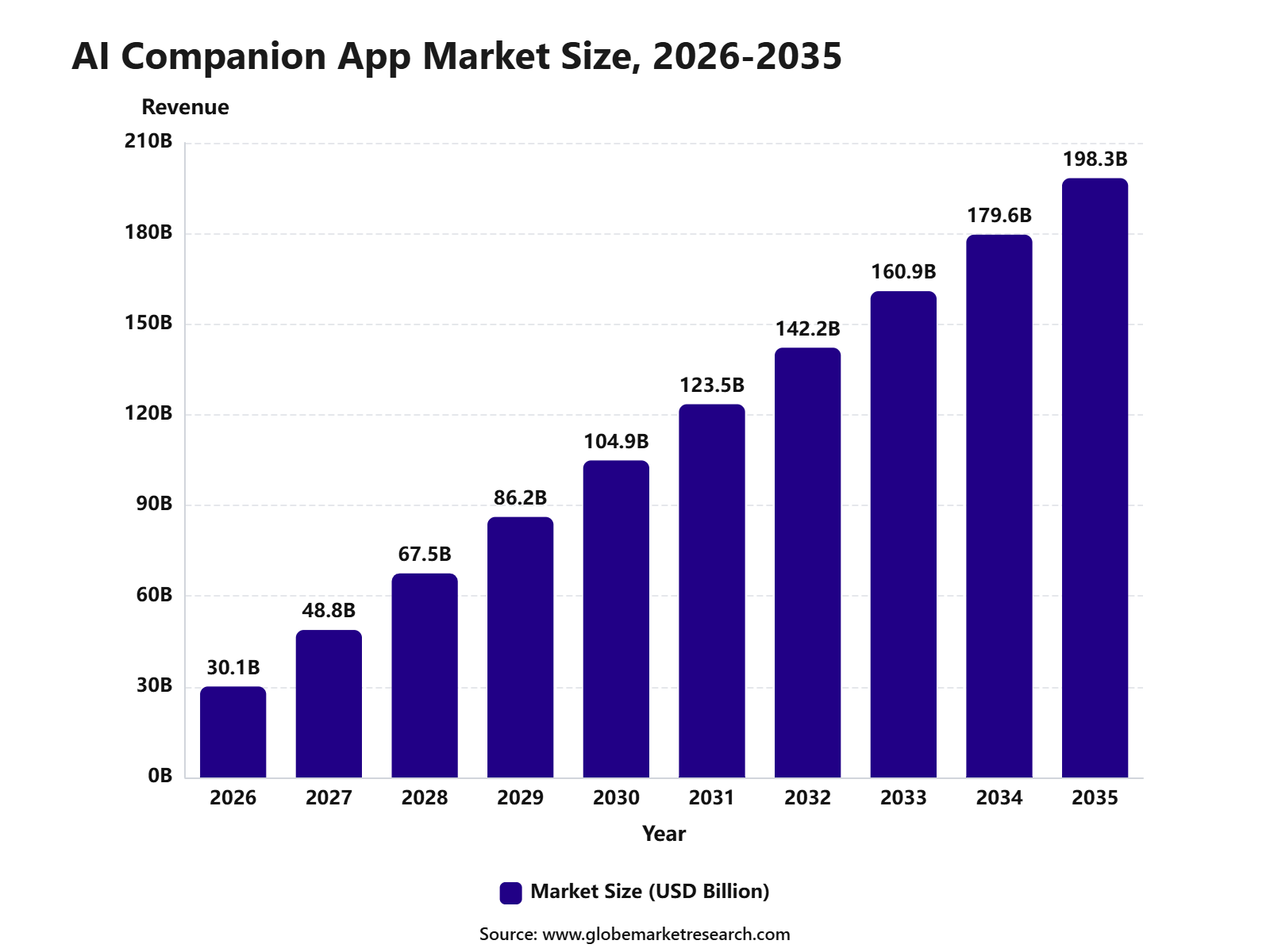
According to Globe Market Research, the global AI Companion App Market was valued at USD 30.1 billion in 2026 and is projected to reach USD 198.3 billion by 2035, growing at a 23.3% CAGR from 2026 to 2035. North America accounted for around 42.6% share in 2025, supported by high smartphone use, strong paid app monetization, early consumer AI adoption, and the presence of major AI application developers.
AI companion apps use large language models, natural language processing, voice technology, memory systems, and user-defined personalities to create responsive digital characters. These apps are used for companionship, entertainment, role-play, journaling, language practice, productivity support, emotional expression, and casual conversation.
The category is gaining visibility because consumers are moving from general AI assistants toward personalized digital companions. Appfigures data reported by TechCrunch showed that AI companion apps reached 220 million cumulative global downloads by July 2025 and generated USD 221 million in worldwide consumer spending, with first-half 2025 downloads rising 88% year over year to 60 million.
Why the AI Companion App Market Is Growing
The market is growing because users want personalized digital interaction, always-available conversation, entertainment, social practice, role-playing, and wellness-oriented support. The report identifies rising demand for personalized AI interaction as a +6.5% growth impact, growth in conversational AI models as +5.8%, and increasing digital wellness usage as +4.7%.
Consumer adoption is strongest where AI companions provide regular engagement rather than one-time utility. Users return to continue previous conversations, interact with created characters, explore fictional scenarios, receive motivation, or use the app as a private space for expression. This supports recurring subscriptions, premium characters, memory features, voice calls, and paid customization.
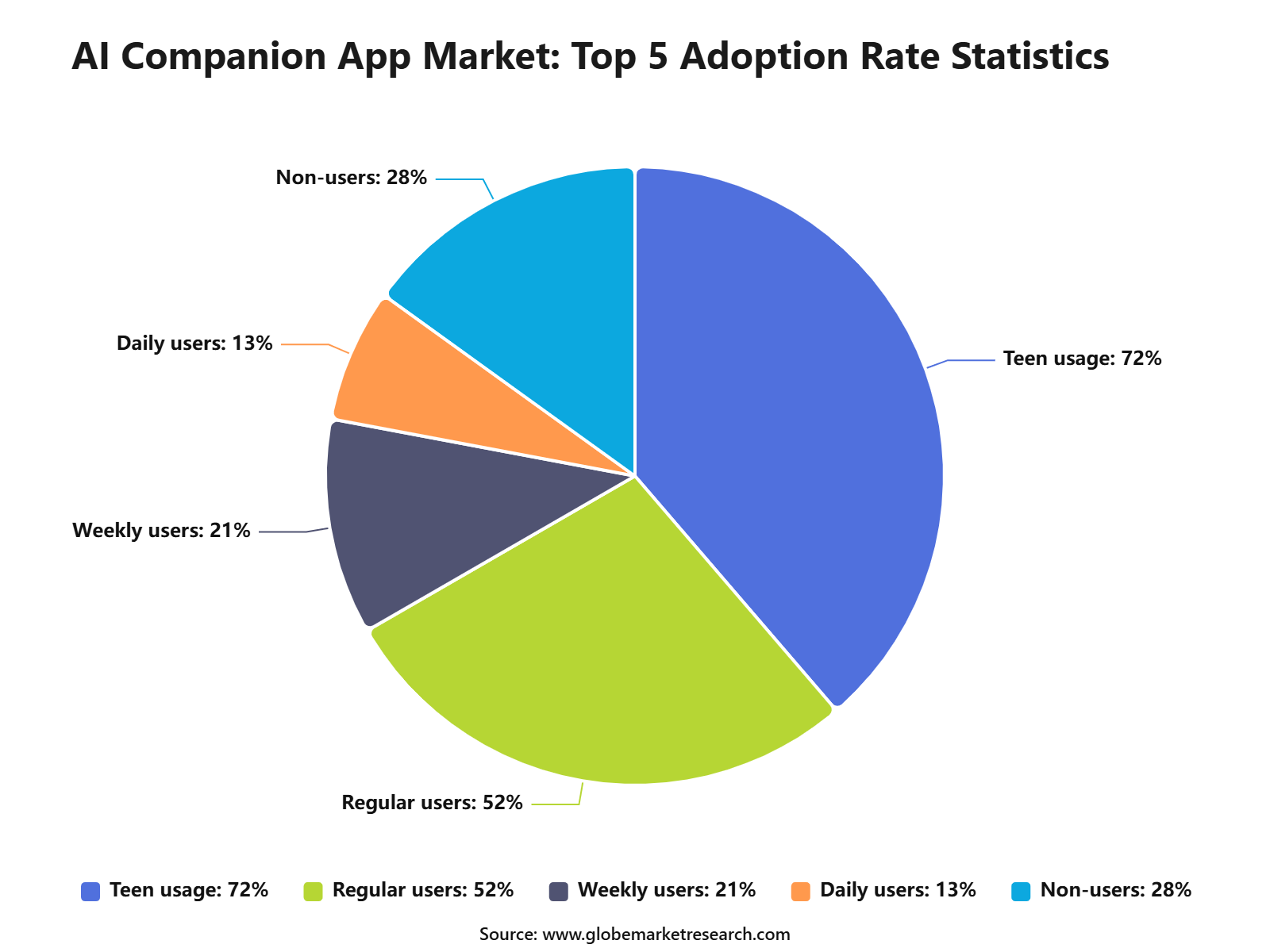
Youth adoption is also shaping the market, but it increases safety responsibility. Common Sense Media reported that nearly three in four U.S. teens had used AI companions, about half used them regularly, one-third had chosen AI companions over humans for serious conversations, and one-quarter had shared personal information with these platforms.
Key Market Drivers
Demand for personalized digital interaction: AI companions can remember preferences, adapt conversational tone and maintain context across multiple sessions. These capabilities make them suitable for casual conversation, storytelling, role-playing, motivation and communication practice.
Rapid consumer adoption of conversational AI: AI companion applications had generated approximately 220 million cumulative mobile downloads by July 2025. Downloads reached around 60 million during the first half of 2025, representing year-over-year growth of 88%.
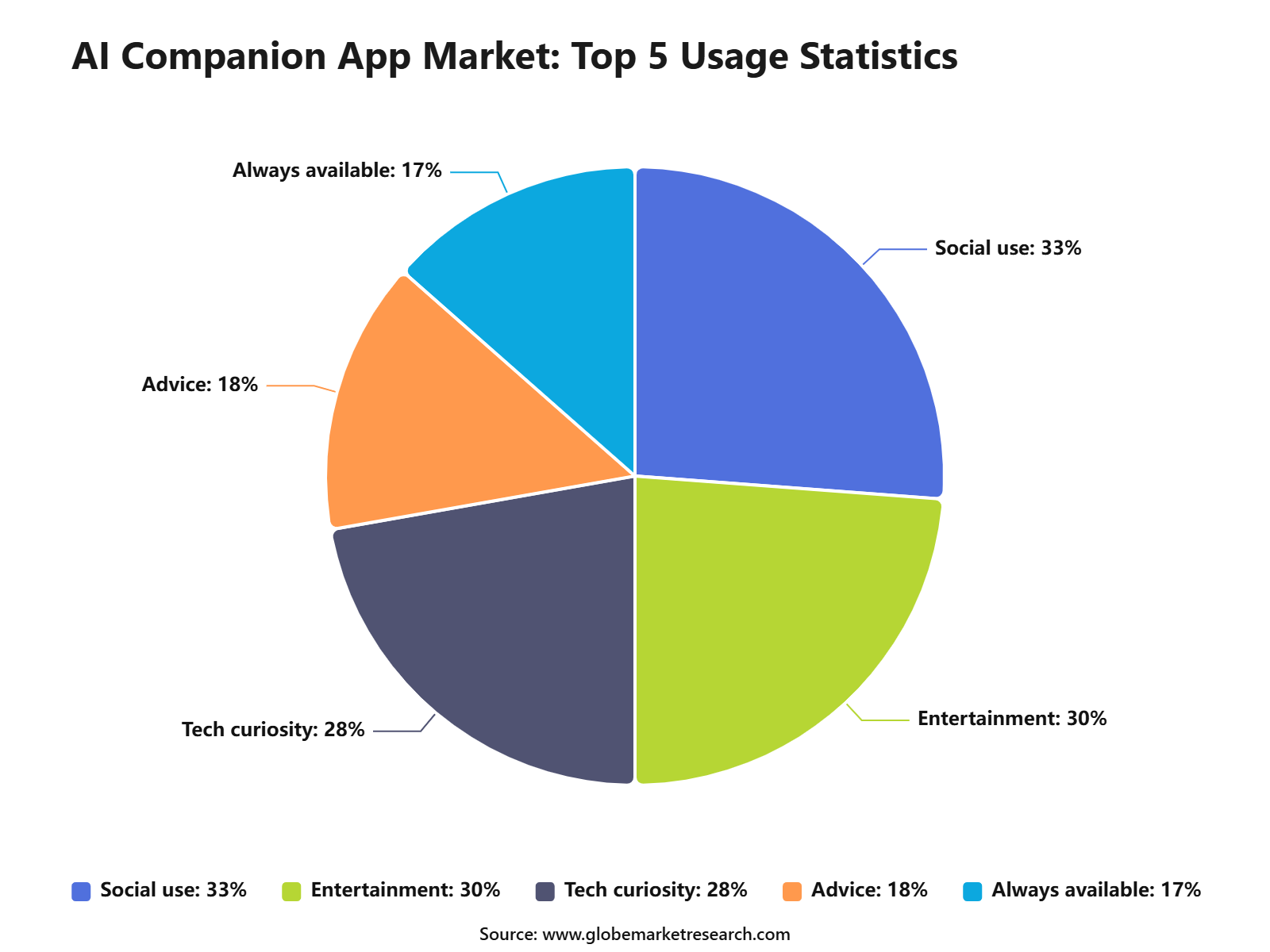
High engagement among younger users: A 2025 U.S. survey found that 72% of teenagers had used an AI companion at least once, while 52% used these services regularly. Social interaction, entertainment, curiosity and advice were among the main reasons for adoption.
Improvement in large language models: Better context management, natural language understanding and response consistency are making AI companions more realistic. Developers are also improving long-term memory so users do not have to repeat personal details or story information.
Expansion of premium features: Paid plans increasingly include advanced memory, voice calling, avatar customization, image generation, exclusive characters and longer conversations. These features are creating recurring subscription and in-app purchase opportunities.
Market Segmentation
By User Purpose: Companionship represented approximately 59.2% of the market. Demand is being supported by users seeking regular conversation, emotional reassurance, role-playing, friendship simulation and nonjudgmental digital interaction.
By Type: Text-based AI companions accounted for around 46.8% of the market. Text interaction remains widely accessible, private and suitable for both short messages and detailed conversations while requiring less bandwidth than continuous voice or video.
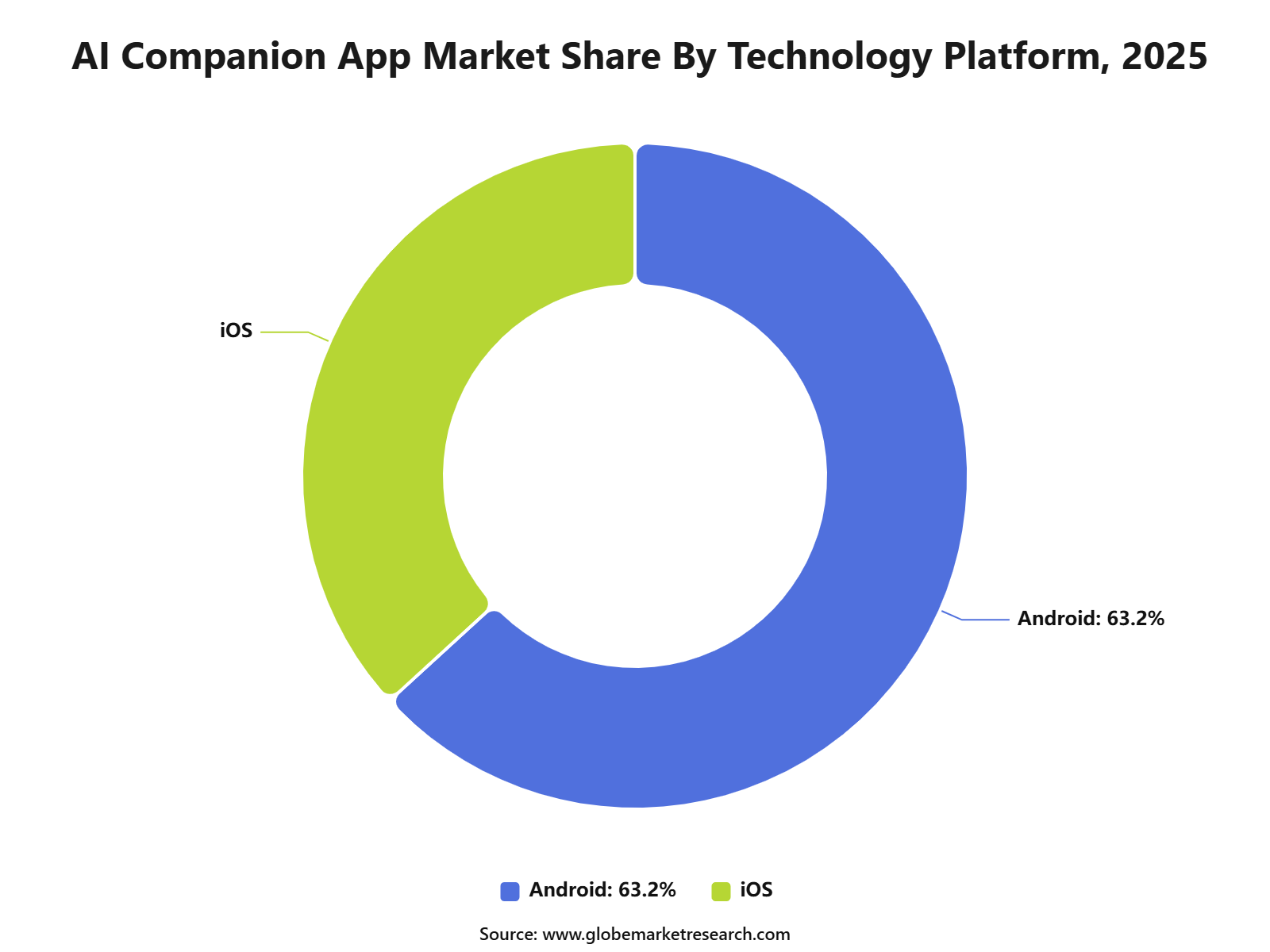
By Technology Platform: Android held nearly 63.2% of the market. Its leading position is supported by broad global device availability, affordable smartphones and flexible application distribution across different hardware categories.
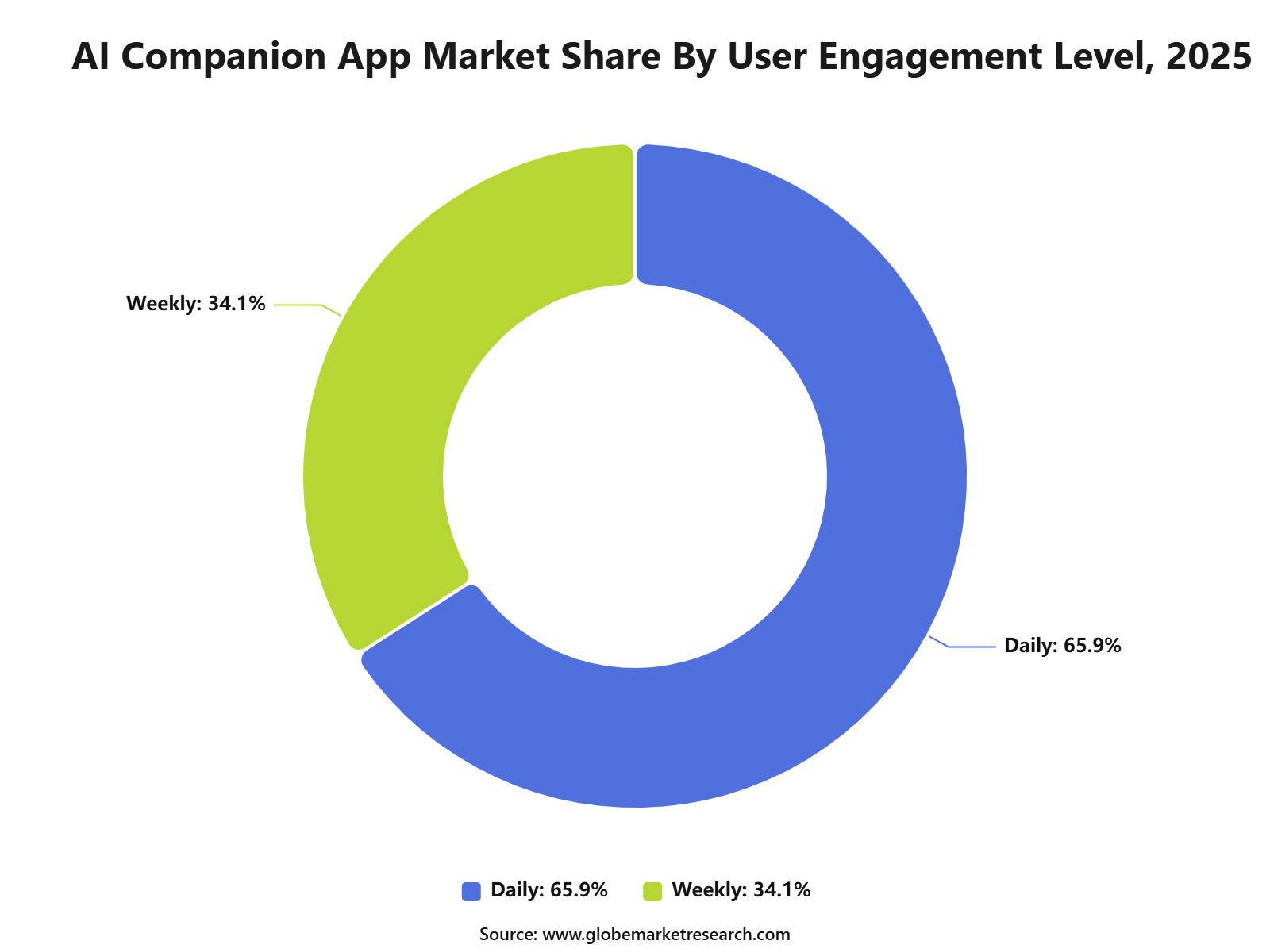
By User Engagement Level: Daily engagement represented approximately 65.9% of the market. Frequent interaction is encouraged by continuous conversations, recurring reminders, persistent storylines and emotionally responsive digital characters.
By Functionality and Demographics: Custom audiovisual character design captured around 47.2% of the functionality segment, while young adults accounted for approximately 44.2% of users. Custom appearances, voices and personalities are becoming important product differentiators.
Technology and Adoption Trends
Persistent memory systems: AI companions are being designed to retain facts about users, characters and storylines across longer conversations. Character.AI introduced expanded memory categories, editable facts and memory-usage indicators during 2026.
Voice and multimodal interaction: Companion apps are moving from text-only interfaces toward voice conversations, animated avatars, images and video-based interaction. Multimodal systems can create more expressive and realistic user experiences.
User-created characters and worlds: Character creation tools allow users to select personality traits, interests, appearance, voice and background information. Lorebook-style features also help creators maintain consistent settings, histories and fictional worlds across conversations.
Rising daily AI use: A June 2026 survey of 1,204 U.S. children aged 9 to 17 found that 86% used AI and nearly one-quarter used it every day. More than one-third of AI users had discussed feelings or personal problems with AI systems.
Safety-by-design adoption: Age assurance, crisis detection, content filters, interaction reminders and parental controls are becoming part of the technology stack. These tools are increasingly required to reduce emotional, privacy and child-safety risks.
Regional Breakdown and Supply Chain
North America: The region held approximately 42.6% of the global market in 2025. Growth is supported by high AI adoption, paid application usage, advanced language-model development and strong consumer familiarity with subscription services.
Europe: Market development is being supported by smartphone access, digital wellness applications and multilingual AI services. Providers must also comply with strict requirements concerning personal data, consent, automated decision-making and services accessed by minors.
Asia Pacific: A large Android user base, mobile-first consumer behavior and demand for multilingual content are supporting adoption. Opportunities are particularly visible in entertainment, language learning, digital characters and localized social interaction.
Latin America, the Middle East and Africa: Future adoption is expected to be led by affordable Android applications, localized language support and freemium pricing. Mobile payment integration and lower data consumption will remain important for wider accessibility.
Digital supply chain: The market depends on foundation-model providers, cloud and GPU infrastructure, voice-synthesis platforms, avatar-generation tools, content moderation systems, app stores, payment processors and consumer application developers. Safety vendors and age-assurance providers are becoming more important as regulation expands.
Key Opportunities
Voice-based AI companions: Natural speech, expressive voices and real-time responses can create more accessible experiences for users who prefer speaking over typing. Voice interaction also creates opportunities across smart speakers, vehicles and wearable devices.
Multilingual and localized applications: Companion apps designed for regional languages, cultural preferences and local communication styles can reach users who are not adequately served by English-first platforms.
Elder companionship: AI companions may support social interaction, routine reminders, storytelling and communication for older adults. Products in this category should be positioned as supplementary tools rather than replacements for human care.
Education and communication practice: Language learning, interview preparation, public-speaking exercises and confidence-building conversations can provide practical value beyond entertainment.
Creator-led companion ecosystems: Users and professional creators can design, publish and monetize original characters, story worlds and interactive experiences. Revenue can be generated through subscriptions, premium character access, virtual goods and licensed intellectual property.
Challenges and Restraints
Privacy and sensitive personal information: AI companion conversations may include emotional concerns, relationship details, health questions and private experiences. In the 2025 teen survey, 24% of teen companion users reported sharing personal or private information with these systems.
Emotional dependency: Persistent and highly personalized interaction can cause some users to become overly dependent on digital companions. One in five children using AI said it would be difficult to go one month without it, according to a 2026 survey.
Unsafe or inappropriate responses: Companion systems may provide harmful, inaccurate or age-inappropriate content when safety controls fail. One in six children who had used AI chatbots reported seeing inappropriate material, and only one-third informed a trusted adult.
High operating costs: Long conversations, voice processing, image generation, memory storage and real-time moderation require substantial computing capacity. These expenses can pressure margins, particularly for applications offering extensive free usage.
Regulatory exposure: California’s SB 243 requires disclosures, self-harm safeguards and protections for minors. It also permits civil damages of at least USD 1,000 per violation when a person suffers an injury because of non-compliance.
Go-to-Market Strategy for AI Companion App Companies
A strong go-to-market strategy should focus on simple onboarding, free trial access, clear character customization, safe personalization, and strong mobile retention. The report notes that developers should initially target entertainment, social interaction, role-playing, wellness support, communication practice, and productivity assistance.
The strongest monetization model will combine free basic conversations with paid subscriptions, advanced memory, premium characters, voice calls, image generation, virtual gifts, creator tools, and specialized companion modes.
Customer acquisition should rely on app store optimization, influencer-led demos, short-form video, community discovery, referral offers, and character-sharing features. However, teen and young-adult audiences require stronger age controls, usage limits, disclosure, and safety messaging.
Revenue Potential and Financial Impact
Revenue opportunities are distributed across monthly subscriptions, annual memberships, message credits, premium characters, voice features, digital gifts, avatar tools, branded experiences, creator subscriptions, and advertising. The report notes that AI companion apps generated approximately USD 150 million in mobile revenue during Q1 2026.
TechCrunch, citing Appfigures, reported that 337 active and revenue-generating AI companion apps were available worldwide in 2025, generating USD 82 million during the first half of the year. The top 10% of apps generated 89% of category revenue, showing that monetization is concentrated among a small group of strong platforms.
Financial performance will depend on user retention, subscription conversion, AI inference cost, content moderation cost, trust and safety investment, app store fees, and customer acquisition cost. Developers must balance richer AI experiences with operating cost control.
Risk Factors and Market Barriers
Privacy and personal data concerns are the largest restraint, with a -3.8% impact. AI companion apps may process sensitive conversations, emotional disclosures, preferences, relationship details, voice inputs, and saved character settings.
Content safety and moderation risks carry a -3.2% impact. Companion apps must prevent harmful outputs, inappropriate interactions, manipulative behavior, unsafe emotional reinforcement, and responses that could increase risk for vulnerable users.
Regulation is becoming a major barrier. California’s SB 243 requires clear disclosure when a user may be misled into thinking a companion chatbot is human, mandates suicide and self-harm safety protocols, requires special protections for minors, and allows damages of the greater of actual damages or USD 1,000 per violation.
Analyst Perspective
What Opportunities Are Emerging?
The biggest opportunity is in personalized character ecosystems. Users want companions that remember context, match preferred personalities, support voice and avatar features, and allow creative role-play or storytelling.
AI wellness, journaling, language practice, and productivity companionship are also emerging. These use cases can create daily utility beyond entertainment and make subscriptions easier to justify.
Group-chat AI companions are also becoming visible. In April 2026, Shapes emerged from stealth with USD 8 million in seed funding for an app where humans and AI characters can participate in shared group conversations.
What Risks Should Companies Be Aware Of?
The main risk is emotional safety. Companion apps can create strong attachment, especially among younger or vulnerable users, so companies must design for disclosure, healthy boundaries, moderation, crisis response, and responsible engagement.
Regulatory risk is increasing quickly. Meta suspended teenagers’ access to its existing AI characters across its apps worldwide in January 2026 while building an updated teen experience with parental controls.
Retention risk is also important. Users may try an AI companion out of curiosity, but paid retention depends on memory quality, response accuracy, emotional tone, customization depth, and trust.
What Decisions Should Clients Make Next?
Clients should first decide which use case they want to own: companionship, role-play, journaling, emotional wellness, study support, productivity, elder companionship, or multilingual interaction. Each use case needs different safety rules, tone design, monetization, and product controls.
Second, developers should build privacy and safety into the product before scaling. Age assurance, AI disclosure, user data controls, crisis escalation, content moderation, and session management should be treated as core infrastructure.
Finally, companies should track both engagement and well-being signals. Daily use is commercially attractive, but safe growth requires monitoring overuse, unhealthy dependency, harmful outputs, and user complaints.
Key Market Segments
By User Purpose
Mental Health Support
Companionship
By Type
Text-based AI Companion
Voice-based AI Companion
Multi-modal AI Companion
By Technology Platform
iOS
Android
By User Engagement Level
Weekly Engagement
Daily Engagement
By Functionality Feature
Behavioral Learning
Custom AV Character Design
By User Demographics
Seniors
Adults
Teenagers
Young Adults
By Region
North America
Europe
Asia Pacific
Latin America
Middle East and Africa
Prominent Global Market Leaders
The AI Companion App Market is competitive, with companion app developers, generative AI companies, conversational AI platforms, avatar technology providers, and large technology firms competing across memory, voice, character design, moderation, user safety, and monetization.
Key companies include:
Replika by Luka, Inc.
Nomi AI
Kindroid AI
Candy AI
Chai Research Corp.
Inflection AI
OpenAI
Google DeepMind
Meta Platforms, Inc.
Soul Machines
Microsoft Corporation
Amazon Alexa AI
IBM watsonx Assistant
Strategic Implications
AI companion developers should compete on memory quality, response consistency, safety and user control rather than relying only on entertaining conversations. Users must be able to understand what information is stored, correct inaccurate memories and remove personal data.
Monetization should be linked to clear improvements in the experience. Premium voice calls, advanced memory, character creation and specialized content can support paid plans, but basic safety tools should not be restricted to subscribers.
Companies targeting younger audiences will face greater compliance and reputational risk. Strong age assurance, parental supervision, crisis-response protocols and independent product testing should be integrated before applications are widely promoted. New York already requires companion systems to provide AI disclosures and self-harm safety protocols, while California has adopted additional requirements for minor users.
Recent Developments
January 2026: Meta temporarily paused teen access to existing AI characters across its applications while developing a revised experience. The company stated that the pause would apply globally to known and suspected teen users.
April 2026: Character.AI introduced its PipSqueak 2 model with improvements in character consistency, memory, context and writing quality. The company also presented Lorebook, a feature designed to preserve fictional histories, locations and character backgrounds.
June 2026: Common Sense Media released its first annual census of AI use among children aged 9 to 17. The study found that 86% used AI, nearly one-quarter used it daily and over four in ten had not discussed AI safety with a parent or guardian.
June 2026: UNICEF published a policy brief examining child-rights risks, regulatory responses and business responsibilities related to AI chatbots and companion systems. The organization called for preventive safeguards, clearer accountability and stronger oversight.
Conclusion
The AI Companion App Market is shifting from experimental chatbot use toward persistent digital relationships supported by memory, personality settings, voice communication and customizable characters. Strong engagement and growing consumer familiarity with AI provide a favorable foundation for expansion through 2035. However, commercial success will depend on more than technical capability. Companies that provide useful functions, transparent data controls, effective age protections and reliable emotional-safety measures will be better positioned to build sustainable user trust and recurring revenue.
Contact us
Global Business Development Team
Email: [email protected]