Strategic Market Snapshot
Key Parameter | Report Details |
|---|---|
Market Revenue, 2025 | USD 5.88 Billion |
Projected Revenue, 2035 | USD 8.03 Billion |
CAGR, 2025-2035 | 5.33% |
Largest Region | North America |
U.S. Halloween Spending, 2025 | USD 13.1 Billion |
U.S. Costume Spending, 2025 | USD 4.3 Billion |
Consumers Planning Costume Purchase | 71% |
Market Concentration | Medium |
Base Year | 2025 |
Forecast Period | 2025-2035 |
Market Overview
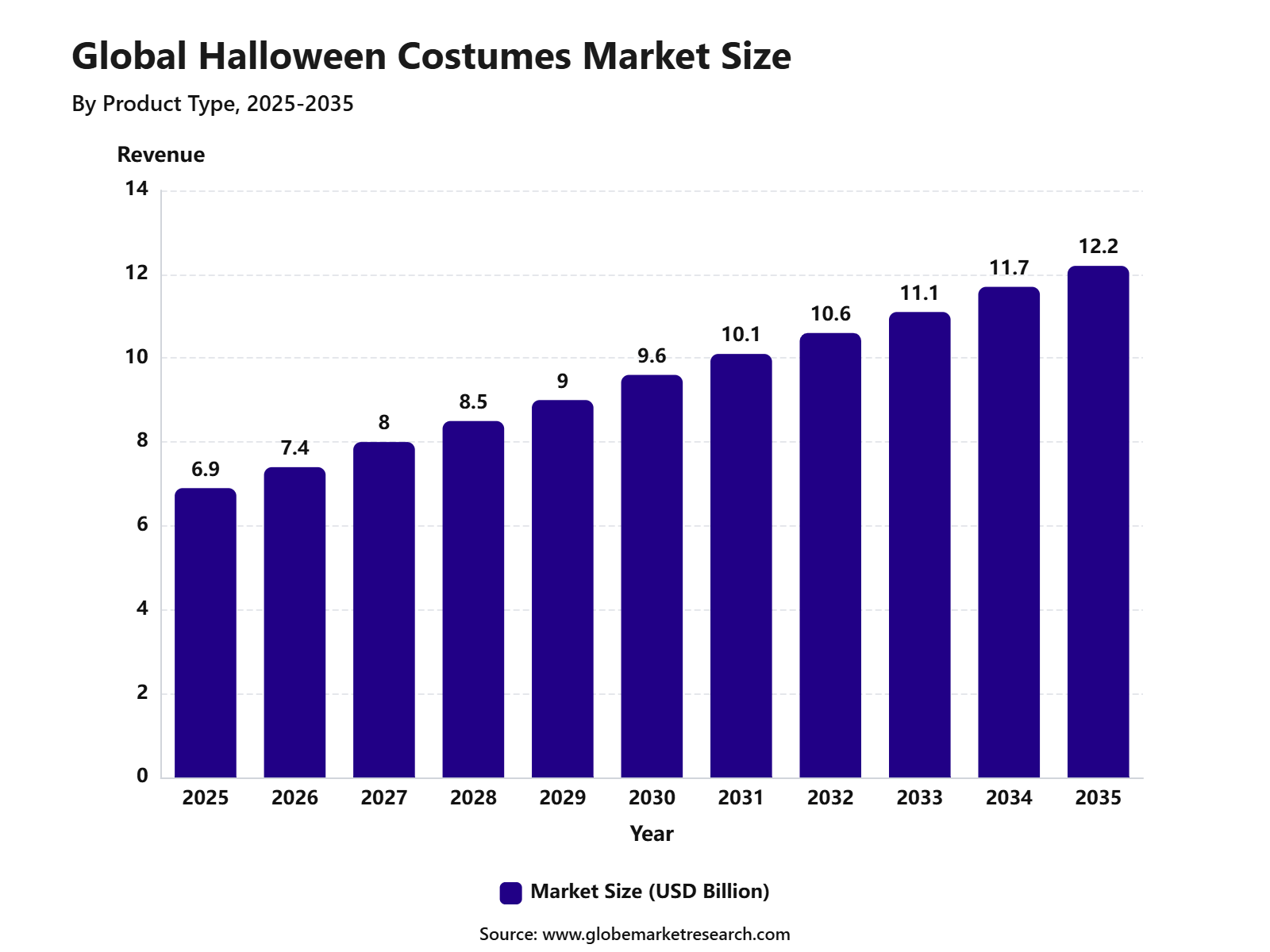
Research published by Globe Market Research shows that, the global Halloween Costumes Market was valued at USD 6.9 billion in 2025 and is projected to reach USD 12.2 billion by 2035, growing at a 5.9% CAGR. North America led the market with 42.2% share in 2025, supported by high Halloween participation, strong seasonal retail culture, early shopping behavior, and mature costume distribution channels.
Halloween costumes include themed apparel, masks, wigs, accessories, makeup items, props, licensed character outfits, pet costumes, and party-wear products used during Halloween celebrations. The market is highly seasonal, but the selling window is expanding as consumers begin shopping earlier and retailers launch costumes, décor, and themed merchandise before October.
The market is also being supported by broader Halloween spending. NRF projected U.S. Halloween spending to reach a record USD 13.1 billion in 2025, up from USD 11.6 billion in 2024, while costume spending was expected to reach USD 4.3 billion. Around 71% of shoppers planned to purchase costumes, confirming the importance of costumes within Halloween retail.
Why the Halloween Costumes Market Is Growing
The growth of the Halloween costumes market can be attributed to higher seasonal celebration spending, wider adult participation, and stronger demand from children, families, schools, workplaces, and community events. Globe Market Research indicates that rising Halloween celebration spending has an estimated positive impact of +1.6%, while growth in themed parties and events adds +1.3%.
Halloween is no longer limited to children’s trick-or-treating. Adults are increasingly buying costumes for parties, office events, nightlife, social media content, family themes, and pop-culture celebrations. In 2025, 51% of U.S. consumers planned to dress up in costume, while nearly 73% planned to celebrate Halloween.
Early shopping is becoming a strong retail trend. The report notes that 49% of consumers began Halloween shopping in September or earlier to avoid missing desired items and reduce last-minute stress. This gives retailers a longer sales window and supports stronger demand for online listings, licensed costumes, accessories, wigs, masks, and makeup kits.
Adult Costumes Lead the Product Type Segment
Adult costumes led the product type segment with 41.5% share in 2025. The segment is supported by themed parties, workplace celebrations, cosplay events, social gatherings, nightlife events, and group costume trends. Halloween has become a social and entertainment-led occasion for adults, which is increasing demand for premium and creative costume options. Adult buyers are spending on horror costumes, pop-culture outfits, couple costumes, movie characters, fantasy looks, and customized apparel.
Social media has also made costume planning more visible, as consumers look for outfits that are recognizable, shareable, and easy to style with makeup and accessories. Kids costumes remained the second-largest product type with 29.7% share, supported by school events, neighborhood activities, family celebrations, and trick-or-treating. Accessories held 14.9% share, while pet costumes accounted for 13.9% share, showing that costume spending is spreading across the full household.
Superhero Costumes Remain the Leading Theme
Superhero costumes accounted for 25.4% share in 2025, making them the leading theme category. Their leadership is supported by popular movie franchises, comic characters, streaming content, gaming culture, and strong appeal across children and adults. Superhero costumes perform well because they are easy to recognize and widely available across budget, mid-range, and premium price points.
Costumes based on Spider-Man, Batman, Superman, Wonder Woman, and other character franchises continue to attract buyers across schools, family events, and themed parties. Movies and TV characters held 20.0% share, followed by horror costumes at 17.9%, fantasy costumes at 15.3%, historical and cultural costumes at 10.3%, and others at 11.1%. This indicates that entertainment-led demand remains one of the strongest drivers of costume sales.
Online Stores Lead Distribution Channels
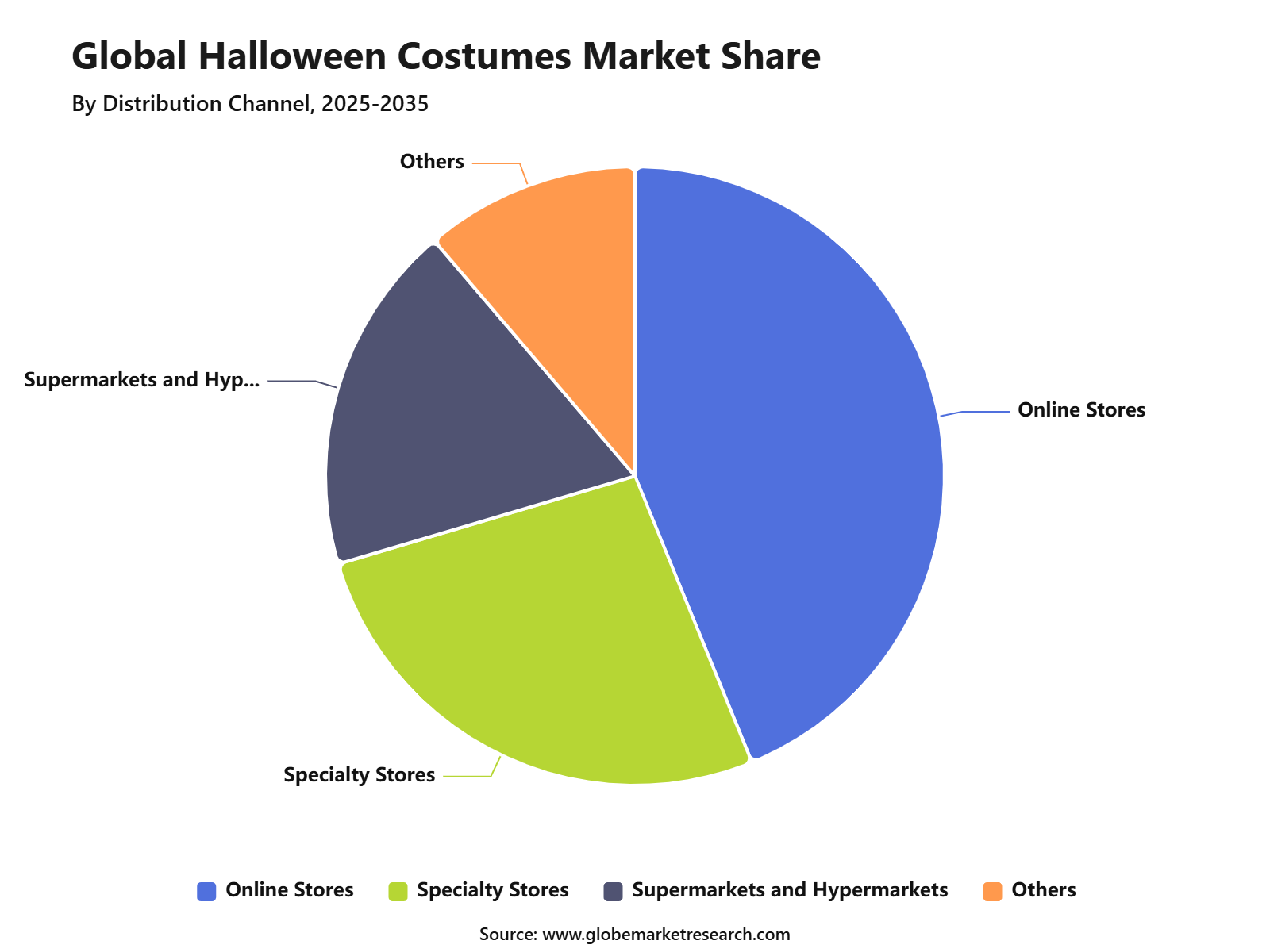
Online stores dominated the distribution channel with 43.7% share in 2025. Online channels are gaining share because they provide wider costume variety, easy price comparison, seasonal discounts, home delivery, customer reviews, and access to niche costume designs. The online channel is especially important for early shoppers. Consumers can compare sizes, themes, characters, accessories, delivery dates, and bundled products before the peak Halloween period.
This reduces last-minute shopping pressure and allows brands to sell costumes before physical stores reach full seasonal display. Specialty stores held 26.5% share, while supermarkets and hypermarkets accounted for 18.3% share. Specialty stores remain important because consumers can try costumes, check product quality, and buy accessories immediately, while supermarkets and hypermarkets benefit from convenience and impulse purchases.
North America Leads the Regional Market
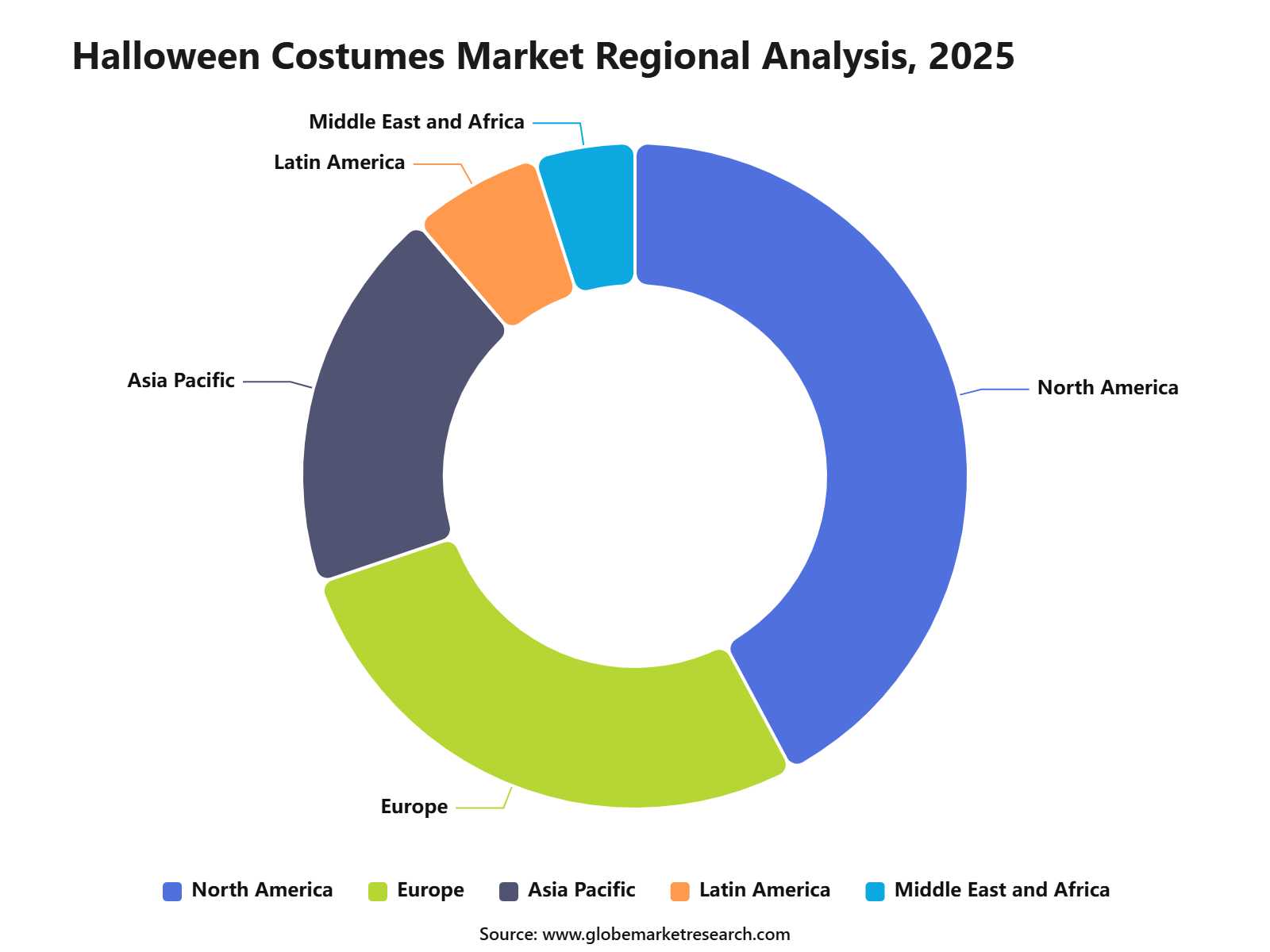
North America held the largest regional share at 42.2% in 2025. The region benefits from strong Halloween spending, high consumer participation, organized trick-or-treating, school events, costume parties, workplace celebrations, and a well-developed seasonal retail ecosystem.
The U.S. remains the most important demand center. NRF projected that Halloween costume spending in the U.S. would reach USD 4.3 billion in 2025, including USD 2.0 billion for adult costumes, USD 1.4 billion for children’s costumes, and USD 860 million for pet costumes.
Europe held 27.6% share, supported by themed events and growing adoption in the UK, Germany, France, and Italy. Asia Pacific accounted for 18.9% share, supported by youth-led Halloween adoption in Japan, South Korea, China, and India. Latin America held 6.4% share, while Middle East and Africa held 4.9% share.
Regional Impact Analysis
Impact Factor | Estimated CAGR Impact | Regional Relevance | Market Impact |
|---|---|---|---|
North America market leadership | +2.0% | U.S. and Canada | Leads Halloween spending. |
Europe themed event adoption | +1.3% | UK, Germany, France, Italy | Supports seasonal growth. |
Asia Pacific emerging demand | +1.0% | Japan, South Korea, China, India | Builds youth-led adoption. |
Latin America event-based demand | +0.7% | Mexico, Brazil, Chile | Shows gradual growth. |
Middle East and Africa niche adoption | +0.5% | UAE, South Africa | Builds early demand. |
Licensed Character Costumes Are Becoming a High-Value Category
Licensed character costumes are one of the strongest commercial opportunities in the Halloween costumes market. Globe Market Research assigns licensed character costume growth an estimated positive impact of +1.4%, supported by demand from movies, gaming, streaming shows, comics, animation, and family entertainment franchises.
In July 2025, Disguise, a JAKKS Pacific company, launched official costume lines based on Wicked: For Good, How to Train Your Dragon, Gabby’s Dollhouse: The Movie, and Jurassic World Rebirth. These releases show how film-linked costume launches can support seasonal demand across kids, families, and adult fans.
Licensed costumes usually support stronger pricing because they connect with recognizable characters and current entertainment releases. Retailers can benefit by aligning inventory with film calendars, streaming trends, gaming characters, and viral social media themes.
Pet Costumes Are Expanding as a Niche Growth Area
Pet costumes are becoming an important niche category as pets are increasingly included in family celebrations. The report shows that pet costumes accounted for 13.9% share in 2025, while pet costume spending in the U.S. reached USD 860 million.
This category is supported by pet humanization, social media sharing, family photos, themed events, and pet-friendly community celebrations. Demand is especially strong for simple, comfortable, lightweight, and safe costumes designed for dogs and cats.
Pet costume expansion has an estimated positive impact of +1.0%, with stronger relevance in the U.S., Canada, and the UK. Brands can improve category performance through size variety, comfort-led design, easy fastening, and matching family costume themes.
Go-to-Market Strategy
A successful go-to-market strategy should focus on early seasonal planning, online visibility, licensed designs, and fast inventory availability. Since many shoppers begin purchasing in September or earlier, brands need product listings, SEO pages, marketplace content, and retail displays ready before peak Halloween demand begins.
Retailers should build product ranges across adult costumes, kids costumes, accessories, makeup, masks, wigs, pet costumes, and family group themes. Adult costumes held 41.5% share, but children’s costumes and accessories remain essential because households often buy multiple items in one shopping cycle.
The strongest sales approach should combine affordability with trend responsiveness. Consumers want recognizable costumes, but they are also sensitive to price. NRF data showed that 79% of shoppers expected Halloween prices to be higher in 2025 because of tariffs, which makes value packs, budget ranges, reusable costumes, and flexible promotions important.
Analyst Perspective
What Opportunities Are Emerging?
The biggest opportunity is in licensed character costumes. Movie releases, streaming content, gaming characters, and viral entertainment trends can create fast seasonal demand when retailers prepare inventory early.
Adult costumes and pet costumes are also strong opportunity areas. Adults are spending more on parties and social events, while pet owners are adding pets to family costume traditions.
Online retail and social commerce should also be prioritized. Consumers are using search, reviews, social media, and marketplaces to compare costumes before buying, which makes digital visibility critical during the short Halloween season.
What Risks Should Companies Be Aware Of?
The main risk is inventory mismatch. Costume trends can change quickly, and unsold seasonal stock can lose value immediately after Halloween. Price pressure is also important. NRF reported that 79% of shoppers expected higher Halloween prices in 2025, which can push consumers toward discount stores, DIY costumes, resale options, or lower-priced accessories. Supply chain timing is another major risk. Delayed imports, late licensing approvals, or missed delivery windows can reduce sales because Halloween demand cannot easily be shifted into later months.
What Decisions Should Clients Make Next?
Clients should first decide which costume category they want to lead: adult costumes, kids costumes, pet costumes, accessories, licensed characters, horror, fantasy, or sustainable costumes. This choice should guide product design, licensing, pricing, and channel strategy. Second, companies should strengthen demand forecasting around pop culture.
Film calendars, streaming releases, gaming trends, social media searches, and retail pre-orders should be monitored before inventory commitments are finalized. Finally, retailers should improve seasonal risk control. Early online listings, limited-run collections, flexible supplier contracts, replenishment planning, and post-Halloween clearance strategies can help reduce stock losses.
Recent Developments
In June 2026, Spirit Halloween announced its largest seasonal hiring plan, with more than 52,000 seasonal associates across over 1,500 communities in the U.S. and Canada. The hiring plan supports expected demand for costumes, masks, accessories, animatronics, and seasonal décor during the 2026 Halloween season.
In September 2025, NRF projected U.S. Halloween spending to reach a record USD 13.1 billion, with costume spending expected to reach USD 4.3 billion. The projection confirmed that costumes remain one of the largest Halloween retail categories.
In July 2025, Disguise launched official costume lines from NBCUniversal’s 2025 films, including Wicked: For Good, How to Train Your Dragon, Gabby’s Dollhouse: The Movie, and Jurassic World Rebirth. This reinforced the role of licensed entertainment content in Halloween costume demand.
Competitive Landscape
The Halloween costumes market is competitive, with costume manufacturers, seasonal retailers, online sellers, party supply companies, licensed merchandise producers, and specialty apparel brands competing across price, design, licensing, distribution, and seasonal availability. Competition is expected to increase as online marketplaces, licensed entertainment brands, and seasonal retail chains expand costume selections. Companies with faster trend response, stronger licensing access, reliable inventory planning, and wide online visibility are likely to perform better. The strongest providers will be those that balance affordability with recognizable designs. Consumers are looking for costumes that are timely, comfortable, easy to buy, and suitable for parties, schools, family events, social media, and pet celebrations.
Top Key companies
Rubie’s Costume Company
Spirit Halloween
Disguise, JAKKS Pacific
Party City Holdco Inc.
Fun World
California Costumes
Leg Avenue
Smiffys
Amscan Inc.
MorphCostumes
Charades Costumes
Forum Novelties
Rasta Imposta
Underwraps Costumes
Elope Inc.
Dreamgirl International
InCharacter Costumes
Costume Culture by Franco
BuySeasons Inc.
Key Market Segments
By Product Type
Adult Costumes
Kids Costumes
Pet Costumes
Accessories
By Theme
Superheroes
Movies and TV Characters
Horror
Fantasy
Historical
Others
By Distribution Channel
Online Stores
Specialty Stores
Supermarkets and Hypermarkets
Others
By Region
North America
Europe
Asia Pacific
Latin America
Middle East and Africa
Conclusion
The Halloween costumes market is entering a steady growth phase supported by adult costume demand, licensed character trends, online retail, pet costumes, early seasonal shopping, and strong North American Halloween spending. The market is seasonal, but the retail window is expanding as consumers shop earlier and brands launch collections around entertainment trends.
Future growth will be led by adult costumes, superhero and movie-based costumes, pet costumes, online stores, sustainable and reusable costumes, and social media-driven costume discovery. Companies that manage inventory timing, pricing, licensing, and digital visibility will be better positioned in this market.