
Introduction
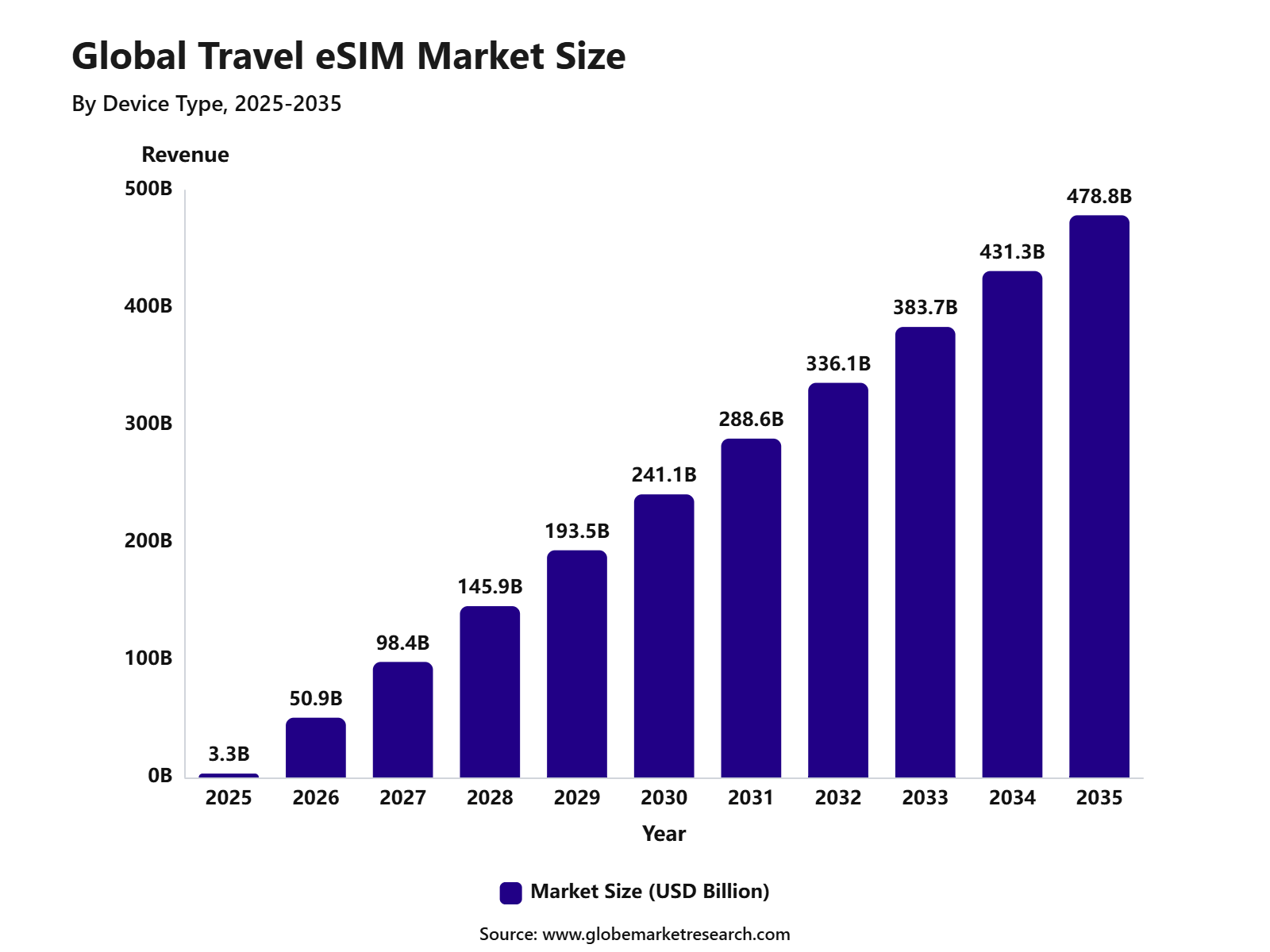
International travel is becoming more digital, and mobile connectivity is now one of the first things travelers plan before leaving home. From maps and hotel bookings to payments, translation apps, ride-hailing, messaging, and work emails, travelers depend on mobile data throughout the journey. According to Globe Market Research, The Travel eSIM Market was valued at USD 3.3 billion in 2025 and is projected to reach USD 478.8 billion by 2035, growing at a CAGR of 64.5% from 2025 to 2035. Asia Pacific led the market with 57.1% share in 2025, supported by strong outbound travel, mobile-first consumers, and rising demand for simple cross-border connectivity.
Key Parameter | Report Details |
|---|---|
Current Revenue, 2025 | USD 3.3 Billion |
Projected Revenue, 2035 | USD 478.8 Billion |
CAGR, 2025 To 2035 | 64.5% |
Largest Region | Asia Pacific |
Largest Region Revenue, 2025 | USD 1.9 Billion |
Fastest Growing Region | Asia Pacific |
Leading Country Market | China |
China Market Revenue, 2025 | USD 1.0 Billion |
China CAGR | 63.8% |
Market Concentration | Medium |
Base Year | 2025 |
Forecast Period | 2025-2035 |
The Travel eSIM Market refers to digital SIM-based mobile connectivity plans designed for international travelers. Instead of buying a physical SIM card after arrival, users can purchase and activate a data plan digitally through a mobile app, telecom website, or travel platform. Travel eSIMs are widely used for international roaming, leisure travel, business travel, airline passenger connectivity, cruise travel, and multi-country trips.
The market includes data-only eSIM plans, regional plans, prepaid plans, unlimited data plans, voice and data plans, and enterprise travel connectivity solutions. The growth of the market can be attributed to the strong recovery of international travel and rising dependence on mobile internet during trips. UN Tourism reported that 1.52 billion international tourist arrivals were recorded globally in 2025, marking a 4% increase from 2024.
Key Market Highlights
Smartphones led the device type segment with 79.8% share in 2025. Growth was supported by high smartphone penetration, wider eSIM compatibility, and strong use of mobile devices for navigation, messaging, bookings, payments, and travel apps.
Individual travelers accounted for 63.9% share by end user. Demand was driven by tourists, students, solo travelers, digital nomads, and short-term visitors looking for flexible and low-cost international mobile data.
Data-only eSIMs captured 71.9% share by connectivity type. The segment benefited from heavy use of app-based communication, maps, social media, search, payment apps, and online travel services.
International roaming held 53.4% share by application. Travelers are increasingly choosing eSIM plans to avoid expensive roaming charges and reduce dependence on physical SIM cards.
Weekly plans accounted for 38.9% share by subscription duration. These plans are preferred for short leisure trips, business visits, and multi-day international travel where users need temporary data access.
Mobile applications captured 48.2% share by distribution channel. Growth was supported by easy plan comparison, instant purchase, digital payment, quick activation, and simple data top-up features.
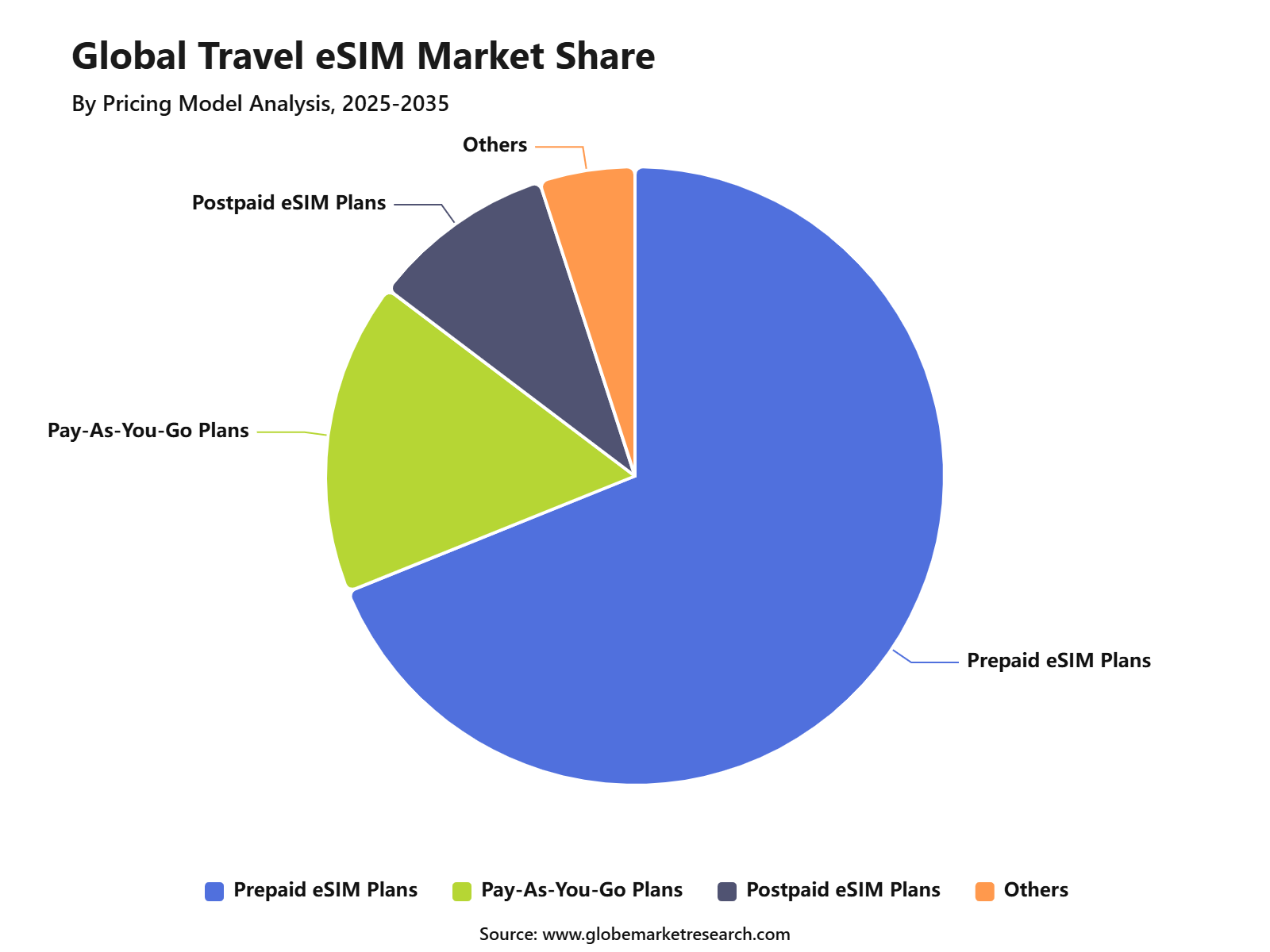
Prepaid eSIM plans accounted for 68.9% share by pricing model. Travelers prefer prepaid plans because they offer clear pricing, cost control, no long-term commitment, and lower risk of unexpected roaming bills.
Top Funding and Investment Trends 2026
The Travel eSIM Market is attracting investment because international travelers want instant mobile data, lower roaming costs, digital activation, and reliable connectivity across countries. Growth is being supported by rising international travel, wider eSIM smartphone adoption, and partnerships between eSIM providers, travel booking platforms, device makers, and telecom infrastructure companies.
International tourist arrivals reached an estimated 1.52 billion in 2025, up 4% from 2024, which created a stronger base for travel connectivity services. At the same time, GSMA reported that global eSIM smartphone penetration reached 5% at the end of 2025 and is expected to reach 10% by the end of 2026, showing that device readiness is improving quickly.
Top Funding and Investment Highlights
Company / Partnership | Latest Signal | Investment Meaning |
|---|---|---|
Airalo | USD 220 million investment round in 2025, valuing the company above USD 1 billion | Confirms travel eSIM has moved from niche travel utility to a large digital connectivity category |
Roamless | USD 12 million Series A round | Shows investor interest in infrastructure-led travel eSIM models beyond data-only resale |
eSIMo | USD 10 million funding round in 2026 | Supports global expansion and wider destination coverage |
eSIM Go | Strategic investment led by TNS Global in 2026 | Strengthens B2B travel eSIM, MVNO, and embedded connectivity growth |
By Device Type
Smartphones led the device type segment with 79.8% share, supported by their central role in travel planning, navigation, payments, ride-hailing, hotel booking, messaging, translation, and social media use. Travel eSIM adoption is strongest on smartphones because users can activate plans digitally before departure or after arrival without visiting a physical store.
The segment is also supported by wider device-level eSIM adoption. GSMA stated that global eSIM smartphone penetration reached 5% at the end of 2025 and is expected to reach 10% by the end of 2026. This shows that eSIM is moving from a premium-device feature to a broader smartphone connectivity option.
By End User
Individual travelers accounted for 63.9% share, driven by strong use among tourists, solo travelers, students, freelancers, and business travelers. These users prefer travel eSIMs because plans can be purchased online, activated quickly, and used across destinations without changing a physical SIM card.
Apple’s travel eSIM guidance states that users can buy prepaid data eSIM plans from worldwide service providers, choose different data amounts and durations, and use them in over 190 countries and regions. This supports strong individual adoption because travelers can manage connectivity directly from their phones.
By Service Type
Data-only eSIM plans held 71.9% share, supported by strong demand for internet access during international travel. Many travelers mainly need mobile data for apps, maps, messaging, email, video calls, online bookings, and payments rather than local voice calling.
This model is popular because app-based calling and messaging reduce the need for a local mobile number. Apple also notes that travelers can use a travel eSIM as a secondary line while keeping their primary line active for services such as iMessage, FaceTime, and app-based communication.
By Connectivity Use
Roaming alternative plans accounted for 53.4% share, as travelers increasingly compare travel eSIM prices against traditional roaming packs. Travel eSIMs are attractive where roaming charges are high or where users want better control over data cost, validity period, and destination coverage.
GSMA Intelligence highlighted travel eSIMs as a clear consumer benefit and noted that they can support wider mobile connectivity use among travelers, including users who may otherwise avoid roaming. This makes travel eSIMs an important route for improving mobile data usage during international trips.
By Plan Duration
Weekly plans held 38.9% share, supported by short leisure trips, business travel, conferences, family holidays, and regional travel. A weekly plan fits the normal travel period for many users because it offers enough validity without forcing customers to pay for a full monthly package.
The segment also benefits from simple pricing and easy plan comparison. Travelers can select plans based on destination, data size, and trip duration, which makes weekly packages suitable for both single-country and multi-country travel.
By Sales Channel
Mobile apps accounted for 48.2% share, supported by instant plan purchase, QR-code activation, in-app top-up, location-based plan selection, and digital customer support. Apps have become important because travelers prefer to compare plans, buy data, and activate service before reaching the destination.
The app channel is also supported by broader smartphone-based travel behavior. Travel eSIM providers are using app-led models to reduce friction in onboarding, payment, activation, and plan renewal. This is important because ease of use remains one of the main factors shaping consumer eSIM adoption.
By Region
Asia Pacific led the Travel eSIM Market with 57.1% share, supported by high outbound travel from China, India, Japan, South Korea, and Southeast Asia. The region also benefits from strong smartphone use, large international student flows, business travel, tourism growth, and heavy use of mobile-first digital services.
The region’s leadership is supported by the wider recovery of international tourism. UN Tourism reported that international tourist arrivals grew 5% in the first six months of 2025 compared with the same period in 2024, placing arrivals around 4% above pre-pandemic levels. Strong travel recovery in Asia Pacific supports higher demand for short-term data connectivity.
Emerging Trends
eSIM-only and dual-eSIM phones are supporting faster adoption: Travel eSIM adoption is being supported by smartphones that allow multiple eSIM profiles and dual active connectivity. Apple states that supported iPhone models can store 8 or more eSIMs and use two active eSIMs at the same time. This is useful for frequent travelers who want to keep their home number active while using a local or travel data plan abroad.
Telecom operators are entering the travel eSIM space: Travel eSIM was earlier driven mainly by digital-first eSIM providers, but telecom operators are now adding travel eSIM products to protect roaming revenue and serve inbound and outbound travelers. GSMA Intelligence noted that more mobile network operators are integrating travel eSIM into their offers, which can improve trust, activation support, and consumer awareness.
Multi-country regional plans are gaining demand: Regional eSIM plans are becoming popular among travelers visiting several countries in one trip. This is especially relevant in Europe, Southeast Asia, the Middle East, and North America, where users often move across borders within a short period. Multi-country plans reduce the need to buy separate local SIMs and improve continuity of mobile data access.
Data control is becoming a purchase driver: Travelers are increasingly choosing eSIMs to control roaming expenses, avoid bill shock, and select data limits before travel. This trend is stronger among cost-conscious tourists, students, and frequent business travelers. Clear pricing, daily data limits, and in-app usage tracking are becoming important buying factors.
Factors Affecting the Market
International travel recovery supports demand: Rising international arrivals are one of the strongest demand drivers for travel eSIMs. As tourism and business travel recover, more users need flexible data connectivity for booking, maps, communication, payment, and local transport. The 2% growth in Q1 2026 international arrivals shows that travel demand remains positive.
Device compatibility remains a key adoption factor: Travel eSIM use depends on whether the traveler owns an eSIM-supported and unlocked smartphone. Apple states that an iPhone XS, iPhone XS Max, iPhone XR, or later is needed for eSIM use, and an unlocked device is required when using another carrier while traveling. This means older phones, locked phones, and markets with limited eSIM device penetration can slow adoption.
Consumer awareness still needs improvement: Many users are aware of eSIM but do not fully understand activation, compatibility, roaming settings, or plan selection. GSMA Intelligence stated that average eSIM awareness was around 50% in major markets, while only 8% of eSIM-aware consumers discovered eSIM through mobile network operators. This shows that clearer education and operator promotion are still needed.
Regulation and identity checks can affect activation: In some countries, travelers may need identification, passport verification, or local registration to buy mobile services. Apple notes that local regulations may require travelers to show identification such as a passport when purchasing an eSIM from a local carrier. These rules can affect onboarding speed and user experience.
Price competition affects margins: Travel eSIM providers compete strongly on data price, coverage, validity, and ease of use. Lower prices help increase adoption but may pressure margins, especially where traditional roaming packs, local SIMs, and global eSIM apps compete for the same traveler. Providers with strong coverage, transparent pricing, and reliable activation are better placed to retain users.
Market Concentration
The Travel eSIM Market has medium market concentration.
It is not highly concentrated because the market has many app-based eSIM providers, telecom operators, travel platforms, regional connectivity resellers, and destination-specific data plan sellers. The market is described as saturated with thousands of travel eSIM options, including providers such as Airalo, Nomad, and Holafly, which shows strong supplier fragmentation.
However, it is not low concentration because a smaller group of well-known global providers, smartphone makers, mobile operators, and travel distribution partners hold stronger visibility and customer access. GSMA Intelligence also noted that mobile network operators are increasingly launching travel eSIM offers, which means traditional telecom players are becoming more active in this space. In 2026, Motorola also introduced a built-in travel eSIM experience through a partnership with Gigs, showing how device-level integration may increase the influence of selected platform partners.
Exact Classification: Medium Concentration
Market Structure: Moderately Fragmented
Reason: Many travel eSIM providers compete globally, but leading apps, mobile operators, smartphone brands, and connectivity platform partners have stronger control over distribution, brand trust, pricing visibility, and user acquisition.
Competitive Landscape
The Travel eSIM Market is becoming highly competitive as telecom operators, digital connectivity platforms, travel technology providers, and app-based eSIM companies expand their global coverage. Competition is mainly shaped by network availability, destination coverage, prepaid pricing, data speed, activation ease, customer support, and app experience. Companies are focusing on regional and multi-country plans, instant QR-based activation, transparent pricing, and flexible data packages to attract leisure travelers, business users, students, and digital nomads.
Leading players are also strengthening partnerships with mobile network operators, airlines, online travel agencies, and enterprise travel platforms to improve distribution and customer reach. The market remains fragmented, with specialist eSIM brands competing against large telecom operators that already have strong network infrastructure. Over the coming years, companies that provide reliable coverage, simple onboarding, clear refund policies, enterprise account management, and strong local network partnerships are expected to gain a stronger competitive position
Key companies active in the Travel eSIM Market include:
Airalo
Holafly
Nomad
Ubigi
GigSky
aloSIM
Flexiroam
Truphone
Orange
Vodafone
Telefónica
T-Mobile
Deutsche Telekom
Verizon
AT&T
NTT Docomo
Singtel
eSIM Go
Conclusion
The Travel eSIM Market is expected to grow strongly as international travel, smartphone eSIM compatibility, and demand for instant digital connectivity continue to rise. Travelers are moving toward simple, prepaid, app-based mobile data plans that reduce roaming cost and remove the need for physical SIM cards. The strongest opportunities are expected in regional plans, prepaid travel data, mobile app distribution, enterprise travel connectivity, and multi-country packages. Providers that offer reliable coverage, transparent pricing, easy activation, and strong customer support are expected to gain higher user trust.