Earned Wage Access Market Size and Forecast
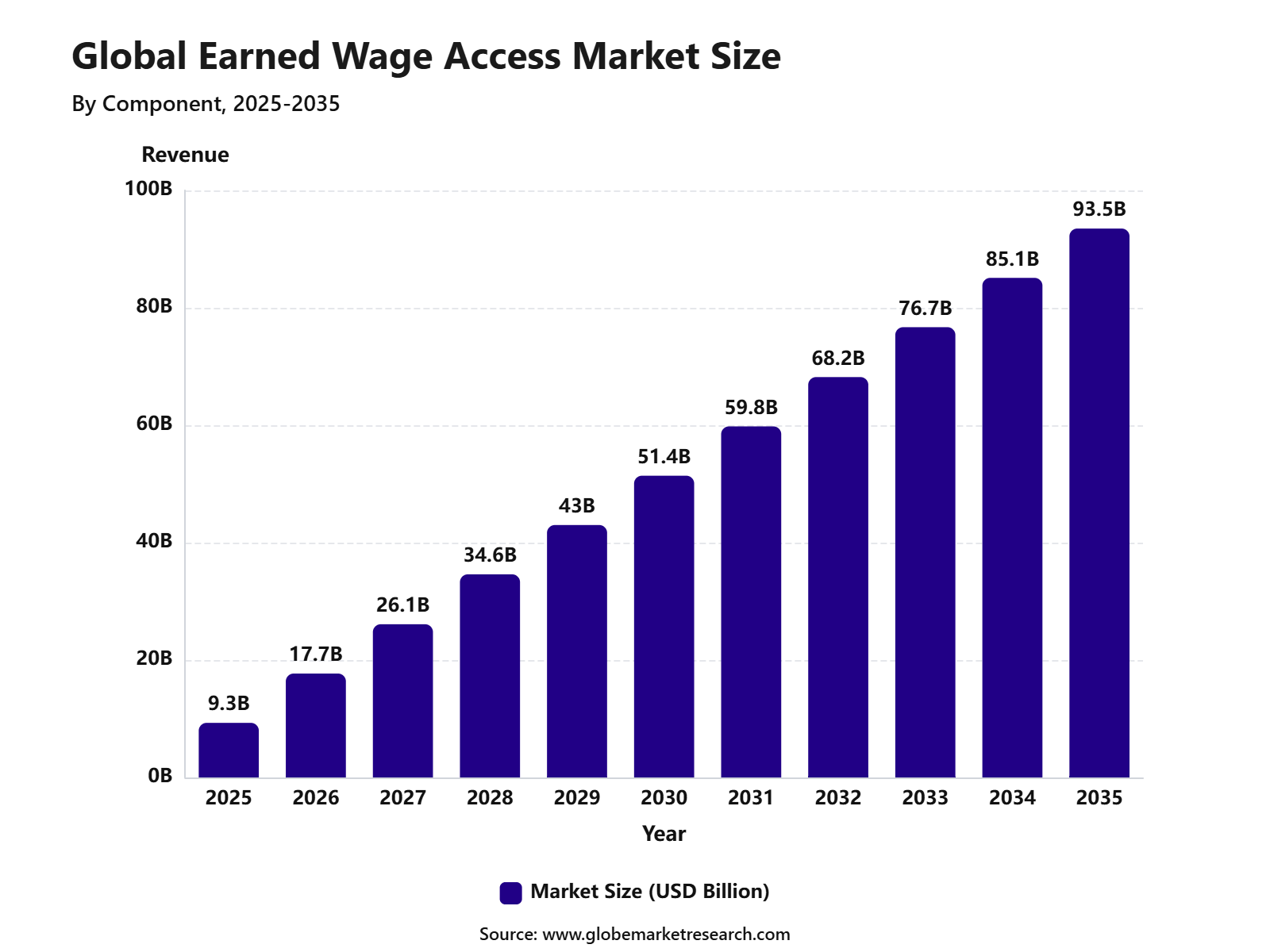
The earned wage access market is moving from a niche fintech service into a mainstream employee financial wellness benefit. The global earned wage access market was valued at USD 9.3 billion in 2025 and is expected to reach USD 93.5 billion by 2035, growing at a 25.9% CAGR. North America led with 45.2% share in 2025, supported by strong fintech adoption, digital payroll systems, and employer demand for flexible pay benefits.
Key Parameter | Report Details |
|---|---|
Market Revenue, 2025 | USD 9.3 Billion |
Projected Revenue, 2035 | USD 93.5 Billion |
CAGR, 2025-2035 | 25.9% |
Largest Region | North America, 45.2% Share |
Market Concentration | Medium |
Base Year | 2025 |
Forecast Period | 2025-2035 |
Earned wage access, also known as EWA or on-demand pay, allows employees to access a portion of wages they have already earned before the scheduled payday. It is commonly offered through employers, payroll providers, fintech platforms, HR technology systems, and workforce management platforms. The model is closely connected with payroll technology, digital payments, financial wellness, and employee retention.
The need for EWA is being supported by real household cash-flow pressure. The Federal Reserve’s 2026 report found that 59% of U.S. adults had at least one major unexpected expense in the prior 12 months, while only 63% could cover a USD 400 emergency expense using cash or its equivalent. This shows why many workers are looking for responsible tools that help bridge the gap between work completed and wages received.
Why Is Earned Wage Access Market Growing?
The growth of the earned wage access market can be attributed to rising employee financial stress, demand for faster wage access, and wider employer adoption of financial wellness benefits. Many workers are still paid biweekly, semimonthly, or monthly, which can create short-term cash-flow gaps between hours worked and wages received. EWA helps reduce this timing gap by giving access to already-earned wages.
Employee financial pressure is a strong demand driver. PwC’s 2026 Employee Financial Wellness Survey found that 59% of employees were stressed about their finances, while 49% said their compensation was not keeping up with costs. These figures show why employers are adding EWA to benefit programs, especially for hourly, frontline, retail, hospitality, healthcare, and logistics workers.
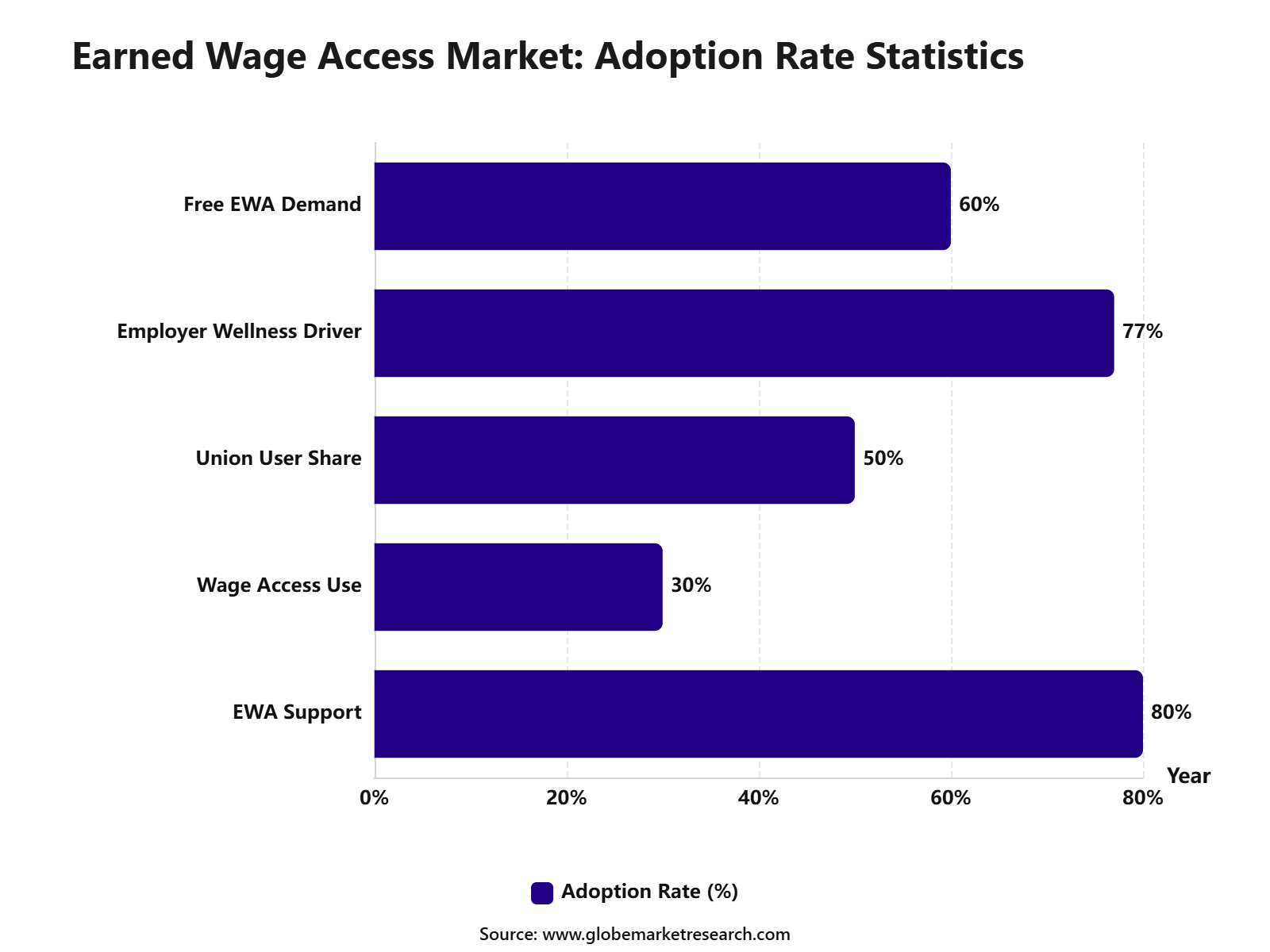
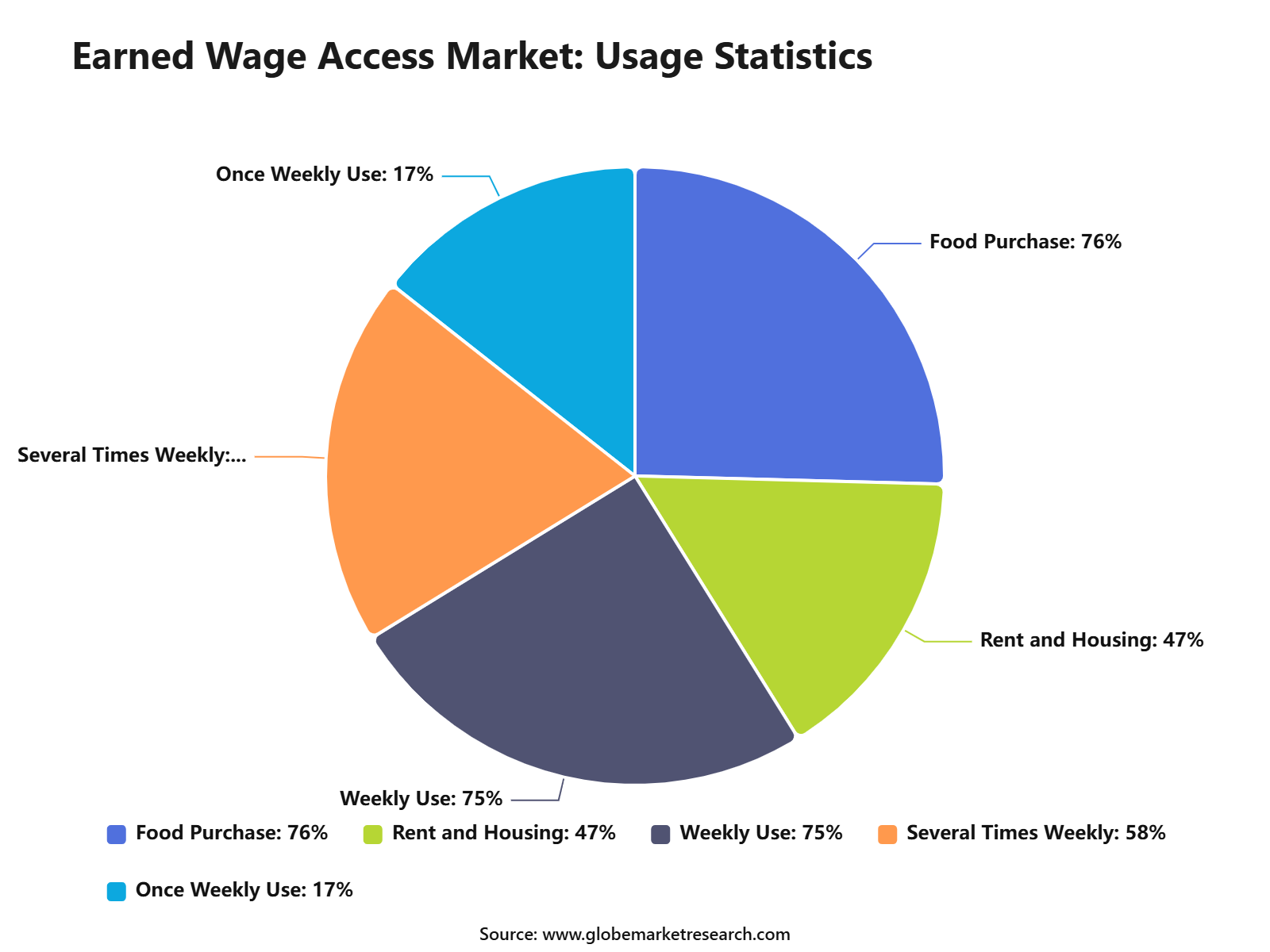
The market is also supported by strong adoption sentiment. The provided report notes that around 80% of surveyed voters supported access to earned wages before payday, while 30% had already used early wage access for urgent needs such as rent, groceries, and medical expenses. Usage was even higher among union members at 50%, showing that the model has relevance across organized and hourly workforce groups.
Solutions Lead the Component Segment
Solutions led the component segment with 63.4% share in 2025. This leadership is supported by demand for end-to-end wage access platforms that connect employees, employers, payroll systems, time-tracking tools, banking partners, and payment rails. These platforms help workers access earned wages while allowing employers to manage the benefit through structured payroll workflows.
The solutions segment is gaining strength because employers want scalable systems instead of manual wage advance processes. A strong EWA solution can support eligibility checks, available wage calculation, user authentication, transaction records, repayment workflows, and employee communication. This creates value for large employers that manage multi-location and shift-based workforces.
The next stage of growth will be shaped by integrated financial wellness features. Budgeting tools, savings prompts, bill-timing alerts, responsible withdrawal limits, and repayment visibility can improve the product’s value beyond early wage access. This is important because employers increasingly want EWA to reduce financial stress, not create repeated dependency.
Cloud-Based Deployment Is the Preferred Model
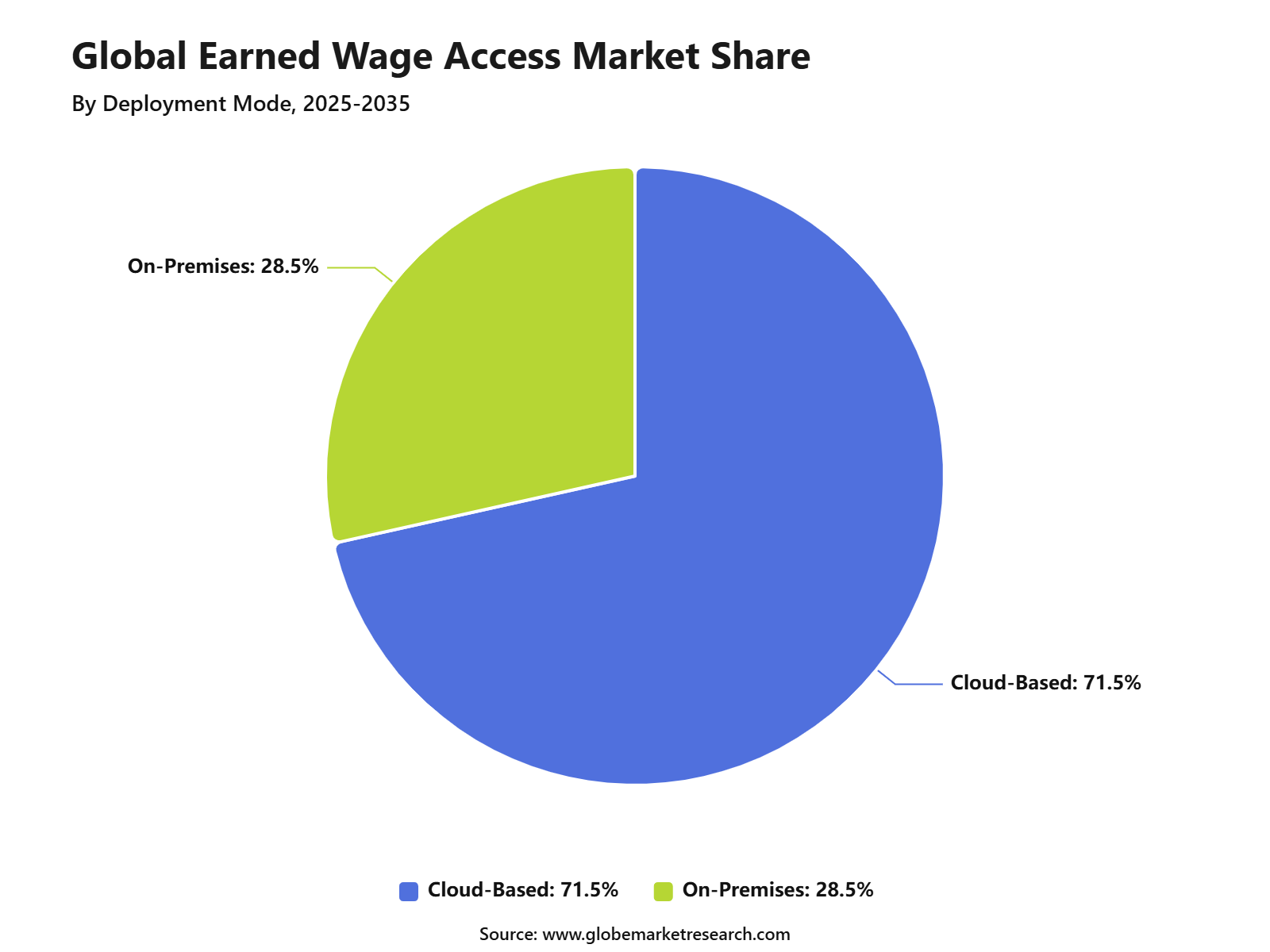
Cloud-based deployment accounted for 71.5% share in 2025. The segment is growing because cloud platforms are easier to integrate with payroll, HR, timekeeping, banking, and employee self-service systems. Cloud-based EWA also supports faster implementation across distributed workforces without heavy on-premise infrastructure.
Cloud delivery is particularly important for employers with large employee bases, multiple sites, and changing payroll cycles. It allows providers to manage real-time wage calculations, secure access controls, transaction histories, compliance logs, and software updates more efficiently. This makes the model suitable for large enterprises, gig platforms, and shift-heavy sectors.
At the same time, cloud-based EWA providers must manage data security and cost discipline carefully. Payroll data, employee identity details, bank account information, and wage records are highly sensitive. Providers that can demonstrate strong encryption, audit trails, access controls, and compliance readiness are likely to gain stronger employer trust.
Employer-Integrated EWA Is the Leading Access Type
Employer-integrated EWA held 69.3% share by access type in 2025. This model is preferred because it connects directly with employer-approved payroll and timekeeping data. It helps ensure that wage access is based on money already earned, while repayment is usually handled through the payroll process.
This structure offers stronger compliance control than many direct-to-consumer models. The CFPB’s advisory opinion explained that employer-partnered EWA providers generally contract with employers and use payroll processes to deduct accessed amounts at the next payroll event. It also noted that direct-to-consumer models often operate outside the employer relationship and may debit the worker’s regular transaction account.
For employers, the integrated model is better suited for workforce benefits, retention programs, and HR policy control. It allows employers to monitor usage, manage eligibility, set limits, and connect EWA with broader financial wellness initiatives. This makes employer-integrated EWA the most practical route for scaled enterprise adoption.
Employee Transaction Fee Pricing Leads the Market
Employee transaction fee pricing captured 43.8% share in 2025. This model is common because employees can use the service when needed and pay a small fee for instant or faster access. Standard transfers may be free or low-cost, while expedited access is often charged separately.
The pricing model must be managed carefully because fees can affect user trust and regulatory review. The provided report notes that expedited delivery fees commonly range from USD 2.50 to USD 5.99, depending on provider practice and delivery option. Fee transparency is important because workers should clearly understand the cost before using the service.
Employer-paid and hybrid models may gain more attention as companies position EWA as a formal employee benefit. If employers absorb some or all costs, the product may become more attractive to workers and reduce concerns about repeated transaction fees. However, providers must still build sustainable economics through employer contracts, integrations, and value-added services.
Large Enterprises Are the Strongest End Users
Large enterprises represented 59.3% share by end user in 2025. This leadership is supported by large workforce size, stronger HR technology budgets, payroll integration capacity, and rising focus on employee retention. Large employers are also more likely to have hourly, shift-based, and multi-location teams that benefit from flexible wage access.
EWA is especially relevant for sectors with high turnover and daily cash-flow sensitivity. Retail, hospitality, logistics, healthcare, food service, manufacturing, and gig work are key adoption areas because employees in these sectors often need faster access to earned income. For employers, EWA can support hiring appeal, workforce satisfaction, and reduced financial stress.
Small and medium enterprises also offer future growth potential, but adoption may be slower. Many smaller employers may lack payroll integration readiness, HR technology budgets, or awareness of EWA benefits. Partnerships with payroll software providers and HR platforms can help reduce this barrier.
North America Leads the Earned Wage Access Market
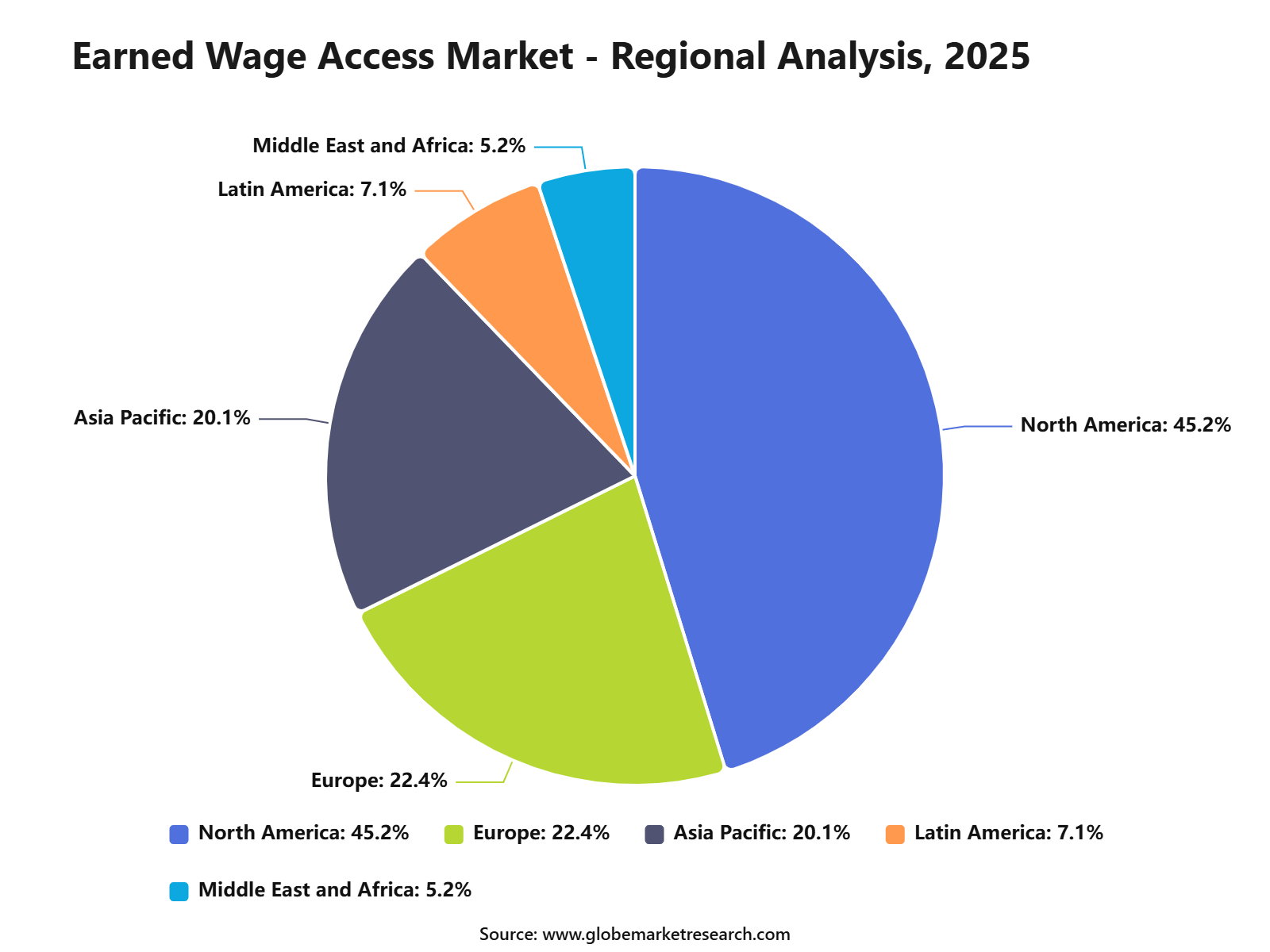
North America led the earned wage access market with 45.2% share in 2025. The region benefits from strong fintech adoption, mature payroll infrastructure, employer focus on benefits, and active regulatory development. The U.S. remains the key regional market because payroll-linked benefits and financial wellness tools are expanding together.
Worker financial pressure supports regional demand. The Federal Reserve reported that 59% of adults had at least one major unexpected expense in the prior year, while only 63% could cover a USD 400 emergency expense using cash or its equivalent. These numbers show that even employed workers may need better short-term liquidity tools.
Regulatory clarity is also improving. The Federal Register published the CFPB advisory opinion on earned wage access products, effective December 23, 2025, and noted that the CFPB was withdrawing a proposed interpretive rule. This development gives compliant providers more clarity, although fee design, disclosures, data privacy, and state-level rules remain important.
How AI Is Impacting the Earned Wage Access Market?
AI is improving EWA by making wage eligibility, risk control, and personalization more accurate. Providers can use payroll data, time and attendance records, transaction behavior, identity checks, and employer rules to calculate available earned wages more safely. This reduces manual work and supports real-time wage access at scale.
AI can also support responsible usage. It can recommend withdrawal limits, flag unusual activity, predict repayment issues, suggest savings prompts, and identify employees who may need financial education rather than repeated wage advances. This is important because EWA should support financial wellness, not encourage frequent short-term dependency.
For employers, AI can improve reporting and decision-making. It can help HR teams understand usage patterns, financial stress indicators, workforce engagement, and benefit effectiveness. However, AI use must be transparent and governed carefully because payroll and financial data are sensitive.
Analyst Perspective
What the Data Is Telling EWA Companies?
From an analyst perspective, the data shows that EWA is shifting from an optional fintech product to a formal workplace benefit. A market size of USD 9.3 billion in 2025 and a projected USD 93.5 billion by 2035 indicate strong demand, but long-term winners will be those that combine wage access with payroll trust, compliance, and responsible usage controls.
The segment data gives a clear signal. Solutions led with 63.4% share, cloud-based deployment held 71.5% share, employer-integrated EWA captured 69.3% share, and large enterprises accounted for 59.3% share. This indicates that the market is moving toward scalable, cloud-based, employer-approved platforms rather than isolated consumer apps.
For clients, the message is clear. EWA should be treated as part of workforce strategy, not only payment convenience. The best results are expected when the product is linked with employee retention, payroll accuracy, financial wellness, and transparent fee management.
What Opportunities Are Emerging?
The first major opportunity is employer-integrated EWA expansion. The report assigns this opportunity a +6.4% estimated CAGR impact, showing that payroll-linked models are expected to drive scalable adoption. Employers prefer this model because it offers better governance, direct wage validation, and stronger compliance control.
The second opportunity is cloud payroll partnerships, which carry a +5.2% estimated CAGR impact. Payroll providers, HR systems, and workforce platforms can help EWA companies reach employers faster. These partnerships are especially useful for small and mid-sized employers that may not adopt EWA through standalone procurement.
The third opportunity is gig worker wage access, with a +4.6% estimated CAGR impact. Gig workers often face irregular income timing, making fast access to earned income valuable. Financial wellness app integration and emerging market expansion also remain attractive because EWA can be bundled with budgeting, savings, bill payment, and low-cost digital accounts.
What Risks Should Companies Be Aware Of?
The first risk is responsible usage. The report identifies responsible usage as a challenge with a -3.1% estimated CAGR impact. Providers must ensure that workers do not overuse EWA in ways that reduce future paycheck stability.
The second risk is payroll data security, with a -2.7% estimated CAGR impact. EWA platforms depend on sensitive payroll and identity data, so cybersecurity failure can damage employer trust quickly. Secure integration and privacy-by-design systems should be treated as core requirements.
The third risk is multi-state compliance, especially in the U.S. Different states may define EWA, fees, licensing, disclosures, and employer responsibilities differently. Providers that expand without strong legal monitoring may face rollout delays, product changes, or higher compliance costs.
What Decisions Should Clients Make Next?
Clients should first decide whether EWA should be employer-paid, employee-paid, subscription-based, or hybrid. The report shows employee transaction fee pricing led with 43.8% share, but employer-paid models may improve worker trust when EWA is positioned as a benefit. The right pricing model should balance affordability, adoption, and provider sustainability.
Second, clients should prioritize employer-integrated and cloud-based models. These models offer stronger payroll accuracy, easier scalability, and better compliance visibility. They are better suited for large enterprises and shift-based industries where wage calculations must be accurate and auditable.
Third, clients should build EWA with guardrails. Usage limits, clear fee disclosure, savings prompts, hardship support, and employee education should be included. The goal should be to improve short-term liquidity without weakening long-term financial stability.
Competitive Landscape
The earned wage access market is competitive, with fintech companies, payroll platforms, HR technology providers, banks, and employee benefit platforms all entering the space. Key companies include DailyPay, Payactiv, Branch, Rain, Earnin, Wagestream, Tapcheck, ZayZoon, Chime Workplace, Instant Financial, Ceridian Dayforce Wallet, and Even. Competition is expected to increase as EWA becomes more connected with payroll systems and employee benefit programs.
Providers are likely to compete on integration speed, funding capacity, fee transparency, compliance controls, mobile experience, employer reporting, and financial wellness features. The strongest players will be those that can serve both employers and employees effectively. Employers need compliance, payroll accuracy, and workforce value. Employees need low-cost access, clear terms, fast payments, and tools that support better financial decisions.
Recent Developments
Market News
In 2026, DailyPay launched "The Future of Pay" campaign to position on-demand pay as a modern workplace benefit. The company said the campaign was built around the gap between real-time consumer services and traditional payroll schedules, showing that EWA providers are now using education-led brand campaigns to support employer adoption.
In 2026, ZayZoon went live inside Auris, giving more than 50,000 small and mid-sized businesses access to earned wage access, financial perks, and employee recognition directly within the Auris HR and payroll platform. This supports the shift toward embedded EWA inside payroll systems rather than separate employee benefit tools.
In 2025, Workday selected DailyPay as its strategic partner for on-demand pay in the United States and Canada. The partnership is important because Workday customers can offer employees access to earned pay through a large enterprise HCM and payroll ecosystem.
Funding
In 2026, DailyPay upsized its secured credit facility by USD 200 million, increasing total committed capacity to USD 960 million. The company said the expanded facility will help finance additional on-demand pay transfers and support continued platform adoption.
In 2025, Rain raised USD 75 million in Series B equity funding led by Prosus to expand its employer-integrated earned wage access and financial wellness app. This funding shows continued investor interest in EWA platforms that combine pay access with wider employee financial health tools.
In 2025, Clair raised more than USD 23 million in Series B funding to expand embedded earned wage access through payroll and workforce management platforms. Clair said it was available at more than 29,000 work locations across 29 industries, supported by its banking partnership with Pathward.
Mergers and Acquisitions
In 2025, Fiserv completed the acquisition of Payfare, a provider of program management solutions focused on new economy workforces. The acquisition strengthened Fiserv’s embedded finance offering with card program management, white-label consumer applications, and worker payment capabilities.
In 2025, Kredivo Group announced the 100% acquisition of GajiGesa, an earned wage access platform operating in Indonesia. The deal marked Kredivo’s entry into EWA and positioned GajiGesa as a separate business unit under Kredivo Group.
Conclusion
The earned wage access market is entering a strong growth phase as flexible pay becomes part of modern employee benefits. Growth is supported by financial stress, payroll digitization, employer-integrated platforms, cloud deployment, and rising demand for responsible alternatives to high-cost short-term borrowing.
Future growth will be led by employer-integrated EWA, cloud payroll partnerships, large enterprise adoption, gig worker wage access, financial wellness app integration, and responsible AI-based personalization. However, the market must manage regulatory scrutiny, fee transparency, payroll data security, and overuse risk carefully.