
Market Size and Growth Projections
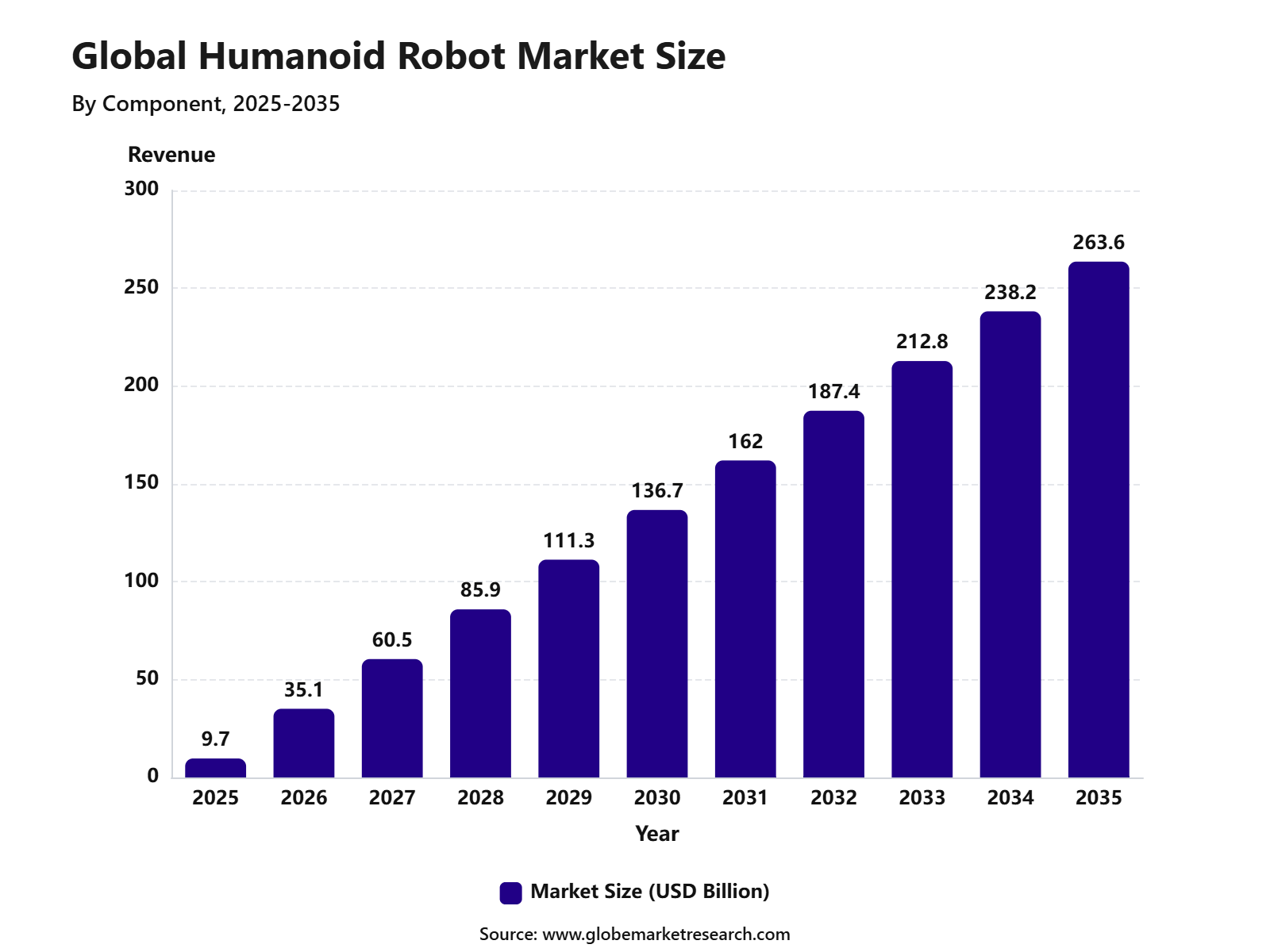
The humanoid robot market is moving from research labs and product demonstrations toward commercial use in factories, warehouses, retail stores, healthcare, hospitality, and public service environments. The global humanoid robot market was valued at USD 9.7 billion in 2025 and is projected to reach USD 263.6 billion by 2035, growing at a 39.1% CAGR. Asia Pacific led the market with 44.6% share in 2025, supported by robotics manufacturing, automation adoption, AI investment, and strong electronics supply chains.
Key Parameter | Report Details |
|---|---|
Market Revenue, 2025 | USD 9.7 Billion |
Projected Revenue, 2035 | USD 263.6 Billion |
CAGR, 2025-2035 | 39.1% |
Largest Region | Asia Pacific, 44.6% Share |
Market Concentration | Medium |
Base Year | 2025 |
Forecast Period | 2025-2035 |
Humanoid robots are human-like robotic systems designed to support mobility, object handling, interaction, communication, and decision support. Their growth is being supported by advances in artificial intelligence, machine vision, sensors, actuators, natural language processing, and battery systems. Demand is also increasing because companies are looking for machines that can support labor shortages, repetitive tasks, customer service, elderly care, and high-risk work environments.
The U.S. humanoid robot market was valued at USD 0.8 billion in 2025 and is expected to grow at a 17.15% CAGR. Growth in the U.S. is being supported by robotics startups, warehouse automation, healthcare robotics, defense applications, AI-based service robots, advanced semiconductor capabilities, and enterprise interest in general-purpose robots.
Why the Humanoid Robot Market Is Growing
The growth of the humanoid robot market can be attributed to the rising need for automation in human-designed environments. Many factories, warehouses, hospitals, hotels, stores, and public spaces are built around human movement, human tools, and human workstations. This makes humanoid robots attractive where companies want automation without redesigning the full operating environment.
The International Federation of Robotics stated in its 2026 robotics trends that humanoid robots are gaining attention for industrial use where flexibility is needed, especially in environments designed for humans. The automotive industry has been an early testing ground, while warehousing and manufacturing are becoming important use cases.
The wider robotics base is also improving. IFR reported that industrial robot installations in the U.S. increased 11% year over year to 38,000 units in 2025, with the automotive industry remaining the largest adopter at 13,500 units. This shows that industrial buyers are already familiar with robotics, which can support future humanoid robot adoption when reliability and payback become clearer.
Wheeled Humanoid Robots Lead the Market
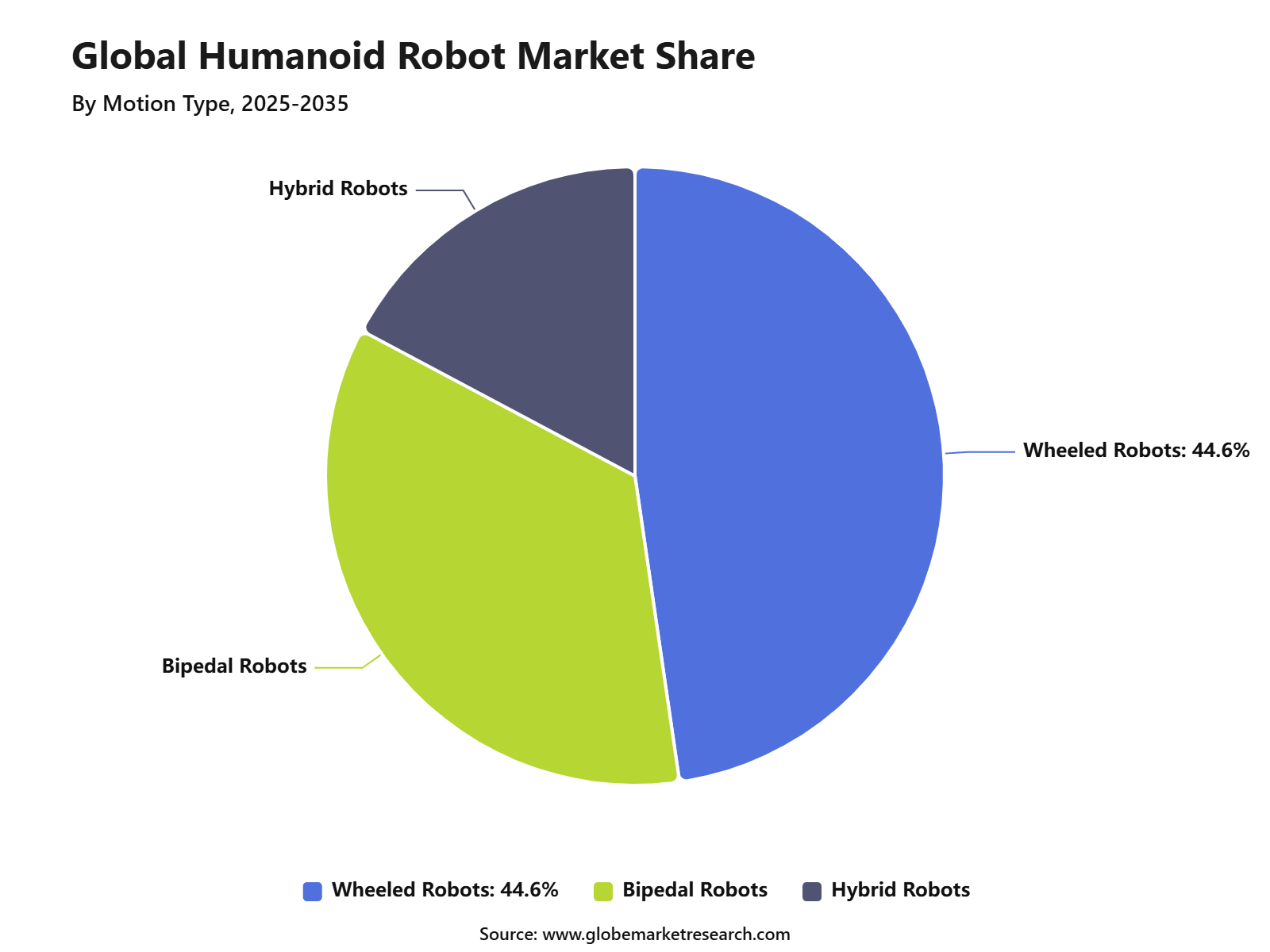
Wheeled humanoid robots led the motion type segment with 44.6% share in 2025. This leadership is supported by easier mobility, lower balance-control complexity, and safer movement in indoor environments such as retail stores, hospitals, airports, offices, hotels, and service facilities.
From a practical business view, wheeled humanoid robots are easier to commercialize than fully bipedal robots. They can support customer interaction, product guidance, delivery assistance, facility navigation, and basic service tasks without the same level of walking complexity. This makes them suitable for early adoption where safety, uptime, and cost control matter more than human-like walking.
Bipedal humanoid robots will remain important for factories, construction, logistics, and environments where stairs, uneven surfaces, or human-like movement are required. However, wider adoption will depend on balance control, battery life, safety validation, fall prevention, and maintenance cost. This is why wheeled robots are expected to remain a strong near-term commercial category.
Actuators Are the Most Critical Component
Actuators accounted for 60.2% share of the humanoid robot market by component in 2025. They are essential because they control movement across arms, hands, heads, wheels, legs, joints, and gripping systems. Strong actuator performance is needed for smooth motion, safe human interaction, object handling, and repeatable task execution.
The actuator segment is important because movement quality directly affects robot usefulness. If a humanoid robot cannot grip, lift, turn, bend, or move reliably, it cannot deliver commercial value. This creates opportunities for compact motors, torque-dense actuators, lightweight motion systems, energy-efficient joints, and safer actuation systems.
Sensors are also becoming more important as robots move closer to people. Vision systems, force sensors, touch sensors, depth cameras, inertial measurement units, and proximity sensors help robots understand surroundings and reduce safety risks. As humanoid robots become more autonomous, sensor quality and real-time processing will become central to deployment success.
Retail Is the Leading Application Area
Retail led the application segment with 28.3% share in 2025. Humanoid robots are being used for customer greeting, product guidance, store navigation, queue support, promotional engagement, and basic information services. Retail adoption is being supported by labor shortages, rising service expectations, and the need for more interactive store experiences.
Retail is well suited for early humanoid robot deployment because many tasks are repetitive, customer-facing, and location-based. Robots can answer basic questions, guide shoppers to product locations, collect feedback, and support brand engagement. This use case is especially relevant for shopping malls, supermarkets, electronics stores, airports, fashion outlets, and large-format retail stores.
Industrial and logistics applications are also becoming stronger. Boston Dynamics announced in January 2026 that it would begin manufacturing the product version of its new Atlas humanoid robot immediately, with 2026 deployments scheduled at Hyundai and Google DeepMind. The company stated that Atlas would be trained with AI foundation models for industrial tasks, beginning with automotive-sector use cases.
Asia Pacific Leads the Humanoid Robot Market
Asia Pacific held the largest regional share at 44.6% in 2025. The region benefits from strong robotics manufacturing, government support, advanced electronics supply chains, AI investment, and high automation adoption. China, Japan, South Korea, and India are important contributors due to their growing robotics ecosystems and expanding use of automation in service and industrial environments.
China is especially important because its robotics industry is moving toward scale manufacturing, while Japan and South Korea continue to support service robots, healthcare robots, industrial robots, and public-facing automation. Asia Pacific is expected to remain a key growth center as humanoid robots shift from pilot projects to commercial deployment.
North America remains important for AI robotics innovation, startup funding, enterprise pilots, warehouse automation, and advanced robot software. Europe is expected to benefit from industrial automation, automotive manufacturing, healthcare robotics, and strict safety-led deployment models. Local opportunities will depend on labor cost, regulation, customer acceptance, and the ability to prove return on investment.

Analyst Perspective
What the Data Is Telling Humanoid Robot Companies?
From an analyst perspective, the data shows that the humanoid robot market is moving from excitement to execution. A 39.1% CAGR shows strong growth potential, but the market will not reward all companies equally. Buyers will favor robots that solve real problems, operate safely, and deliver measurable return on investment.
The segment data also gives a practical signal. Wheeled humanoid robots led with 44.6% share, actuators held 60.2% share, and retail captured 28.3% share by application. This shows that early commercial value is being created around stable movement, reliable physical performance, and controlled service environments, rather than fully general human replacement.
The main message for clients is clear. Humanoid robots should be assessed as productivity tools, not as futuristic showpieces. The best near-term opportunities are likely to be found where tasks are repetitive, environments are controlled, and customer payback can be measured.
What Opportunities Are Emerging?
The first major opportunity is industrial automation. Manufacturing, automotive plants, warehouses, fulfillment centers, electronics assembly, and logistics operations have repetitive tasks, safety risks, and labor gaps. These sectors already understand automation, which makes them more ready for humanoid robot pilots.
The second opportunity is service automation in retail, hospitality, healthcare, and public environments. Retail already led the application segment with 28.3% share, showing that customer-facing and store-support tasks are strong early use cases. Healthcare and assisted living also offer long-term potential, especially in elderly care, patient support, and routine assistance.
The third opportunity is the component ecosystem. Actuators, sensors, AI chips, batteries, simulation software, fleet management platforms, and safety systems will all benefit as humanoid robot production scales. Companies that supply critical parts may see opportunity even before full robot adoption becomes mainstream.
What Risks Should Companies Be Aware Of?
The first risk is overestimating near-term autonomy. Many humanoid robots still need controlled environments, human supervision, teleoperation support, or limited task scope. Companies that promise full general-purpose capability too early may face customer disappointment.
The second risk is cost and maintenance. Humanoid robots are expensive to develop, integrate, repair, and support. If uptime is weak or maintenance is frequent, customers may prefer simpler automation systems such as robotic arms, autonomous mobile robots, or wheeled service robots.
The third risk is safety and public acceptance. Humanoid robots working near people must earn trust. Accidents, privacy concerns, unclear responsibility, or poor worker communication can slow adoption, especially in healthcare, homes, schools, stores, and public spaces.
What Decisions Should Clients Make Next?
Clients should first define the exact task they want to automate. The best starting point is not “buy a humanoid robot,” but “identify a repetitive, unsafe, costly, or labor-constrained task that can be measured.” This helps separate useful deployment from experimental adoption.
Second, clients should choose the right robot form factor. A wheeled humanoid may be better for retail, hospital corridors, airports, and indoor service environments. A bipedal humanoid may be more relevant where stairs, uneven spaces, or human-like mobility are required, but it usually brings higher technical risk.
Third, clients should build a pilot-to-scale plan. The pilot should measure uptime, task success rate, safety events, employee acceptance, maintenance cost, integration effort, and payback period. A full rollout should be approved only when the robot proves consistent value under real operating conditions.
Competitive Landscape
The humanoid robot market is highly competitive, with established robotics companies, AI firms, automotive groups, and startups all moving into the space. Key companies include UBTech Robotics, Unitree Robotics, Agility Robotics, Fourier Intelligence, SoftBank Robotics, PAL Robotics, Figure AI, Honda Motor, Toyota Motor, Boston Dynamics, Hanson Robotics, Sanctuary AI, NVIDIA, Tokyo Robotics, and other robotics developers.
Competition is expected to increase as companies race to improve motion control, robot hands, AI reasoning, battery performance, safety systems, and commercial deployment capability. The market will likely include both full humanoid robot makers and specialized suppliers focused on actuators, sensors, AI chips, safety software, and robot operating platforms. The strongest companies are likely to be those that can combine reliable hardware, strong AI software, safe movement, service support, and clear customer economics.
Recent Developments
Market News
In January 2026, Hyundai Motor Group announced plans to deploy Boston Dynamics’ Atlas humanoid robots at its U.S. manufacturing plant in Georgia from 2028. The robots are expected to start with high-risk and repetitive tasks, with planned expansion from parts sequencing to more complex manufacturing work by 2030. Hyundai also aims to manufacture 30,000 Atlas robots per year.
In 2026, Apptronik closed more than USD 935 million in Series A funding to scale production of its Apollo humanoid robot and expand commercial and pilot deployments. The company stated that the funding would support robot training, data collection, and use cases across retail, manufacturing, and logistics customers.
In 2026, Boston Dynamics unveiled the product version of its fully electric Atlas humanoid robot at CES. The company said 2026 deployments were already committed for Hyundai’s Robotics Metaplant Application Center and Google DeepMind, showing a clear shift from prototype demos to industrial deployment planning.
In 2026, Agility Robotics signed a Robots-as-a-Service agreement with Toyota Motor Manufacturing Canada after a successful pilot. Digit robots are planned to support manufacturing, supply chain, and logistics operations, which strengthens the use case for humanoids in automotive production.
Funding
In 2026, Unitree Robotics received approval for a Shanghai STAR Market listing to raise about USD 619.4 million. The proceeds are planned for robot AI model research, robot body research, new product development, and a smart robot manufacturing base.
In 2025, Figure AI raised more than USD 1 billion in Series C funding at a USD 39 billion post-money valuation. The capital is being used to scale humanoid robots into homes and commercial operations, expand BotQ manufacturing, and improve its Helix AI platform.
Conclusion
The humanoid robot market is entering a high-growth phase supported by physical AI, automation demand, actuators, sensors, and early commercial deployment across retail, manufacturing, logistics, healthcare, and service environments. The market was valued at USD 9.7 billion in 2025 and is projected to reach USD 263.6 billion by 2035, but growth will depend on reliability, safety, affordability, and proven business value.
For business leaders, the opportunity is strongest where humanoid robots solve real operating problems. Industrial automation, warehouse support, retail assistance, elderly care, and robot-as-a-service models are expected to offer strong growth potential. However, cost, safety, integration, battery life, regulation, and public trust must be managed carefully.