Revenue, 2025
$ 3.8 Bn
Forecast, 2035
$ 120.5 Bn
CAGR, 2025-2035
41.3%
Report Coverage
Global
Market Size and Forecast
The Global Agentic AI in HR & Recruitment Market was worth USD 3.8 billion in 2025 and is expected to reach USD 120.5 billion by 2035, growing at a CAGR of 41.3% from 2025 to 2035. North America held the largest regional share of 39.6% in 2025, valued at around USD 1.5 billion, supported by strong enterprise AI adoption, advanced HR technology spending, higher use of automated hiring tools, and rising demand for faster talent acquisition. The U.S. market was stated at USD 0.2 million in 2025 and is expected to grow at a CAGR of 40.6%, although this unit should be checked before publishing because it appears low compared with the North America value.
The Agentic AI in HR & Recruitment Market includes autonomous AI systems that can assist recruiters, HR teams, and hiring managers across sourcing, screening, interview scheduling, candidate engagement, onboarding, workforce planning, and employee support. These systems go beyond basic chatbots by completing multi-step HR workflows, ranking candidate profiles, drafting job descriptions, recommending talent pools, and supporting decision-making with human oversight. SHRM reported that 51% of organizations using AI in HR apply it to recruiting, with common use cases including job description writing, resume screening, candidate search automation, job posting customization, and applicant communication.
Key Parameter | Report Details |
|---|---|
Market Revenue, 2025 | USD 3.8 Billion |
Projected Revenue, 2035 | USD 120.5 Billion |
CAGR, 2025-2035 | 41.3% |
Largest Region | North America, 39.66% Share |
U.S. Market Revenue, 2025 | USD 0.2 Million |
U.S. CAGR | 40.6% |
Market Concentration | Medium |
Base Year | 2025 |
Forecast Period | 2025-2035 |
The market outlook remains positive as companies are under pressure to reduce hiring time, improve candidate quality, and manage recruitment costs while maintaining fair and transparent hiring processes. Growth can be attributed to wider use of AI-powered resume screening, conversational hiring assistants, skills-based matching, internal mobility tools, and automated HR service agents. SHRM found that 89% of HR professionals using AI for recruiting reported time savings or efficiency gains, while 36% said AI helped reduce recruitment, interviewing, or hiring costs.
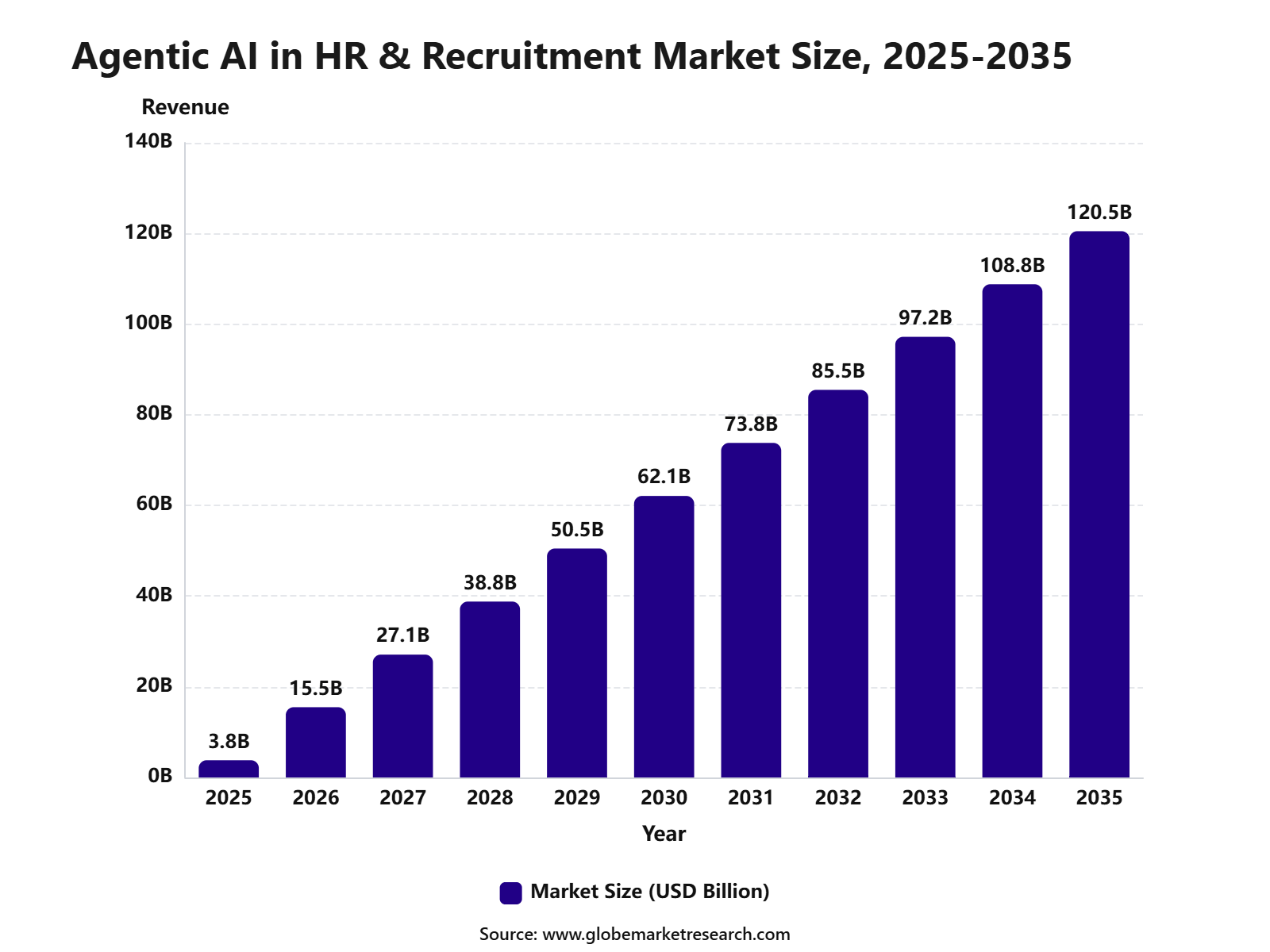 iThe graph shows projected market growth until 2035 based on CAGR analysis. Actual outcomes may vary depending on changing demand, competition, and economic factors.To gain greater insights - request a sample report PDF
Key Market Insights
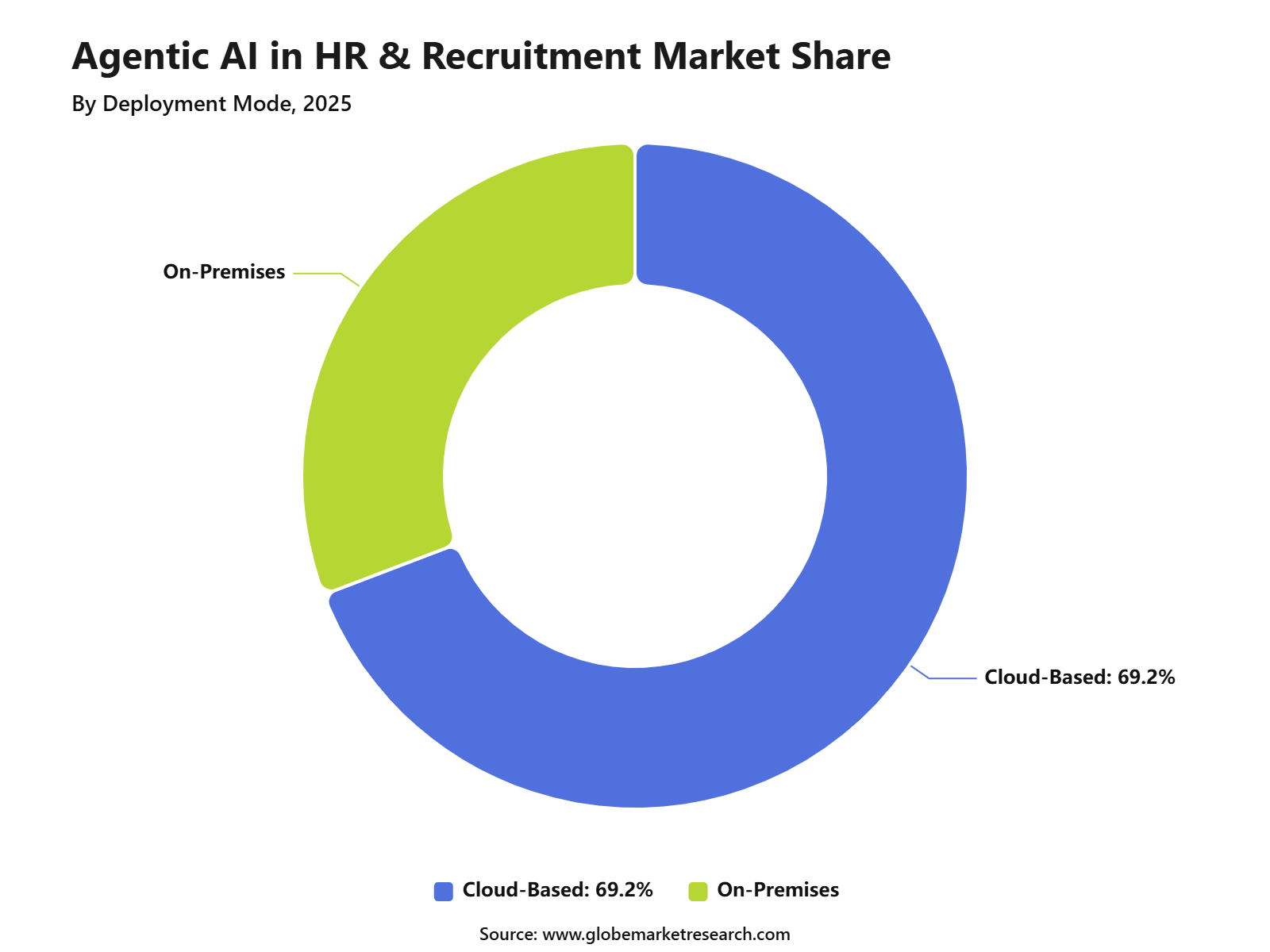
Cloud-based deployment led the market with 69.2% share , supported by faster implementation, scalable access, lower infrastructure needs, and easier integration with HR and recruitment platforms.
Large enterprises accounted for 60.5% share , driven by stronger technology budgets, high hiring volumes, and rising use of AI tools for workforce planning and recruitment automation.
Talent acquisition and recruitment held 48.9% share by application, supported by growing use of agentic AI for candidate screening, job matching, interview scheduling, and hiring workflow automation.
IT and telecommunications captured 38.3% share by end-user industry, driven by strong demand for skilled talent, faster hiring cycles, and wider adoption of AI-enabled HR systems.
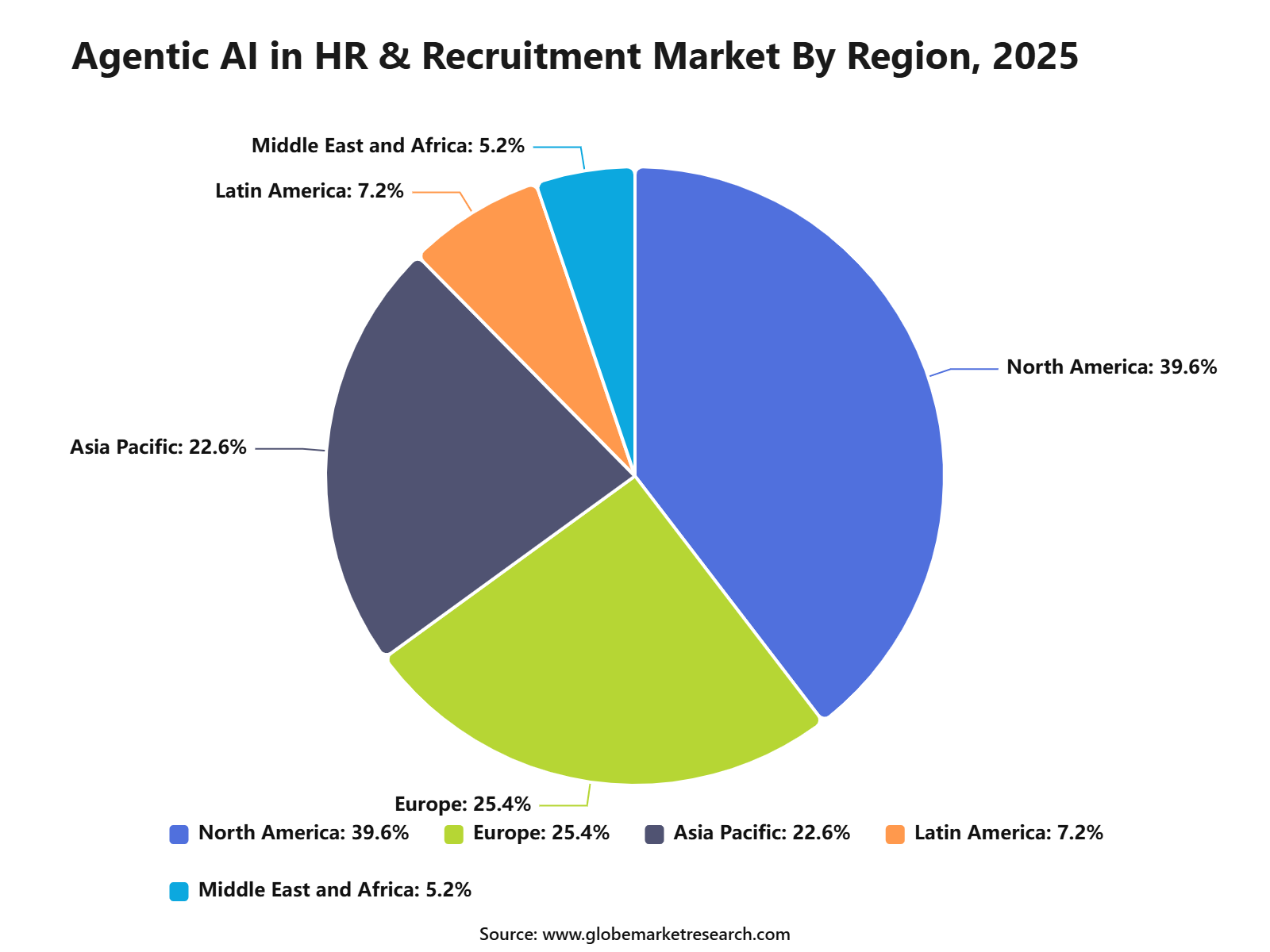
North America led the Agentic AI in HR & Recruitment market with 39.6% share , supported by early AI adoption, advanced HR technology infrastructure, and strong enterprise investment in recruitment automation.
The U.S. market was valued at USD 0.2 million in 2025 and is projected to grow at a CAGR of 40.6% , supported by rising demand for AI-powered hiring, employee analytics, and intelligent HR workflow tools.
Adoption Rate and Usage Area Statistics
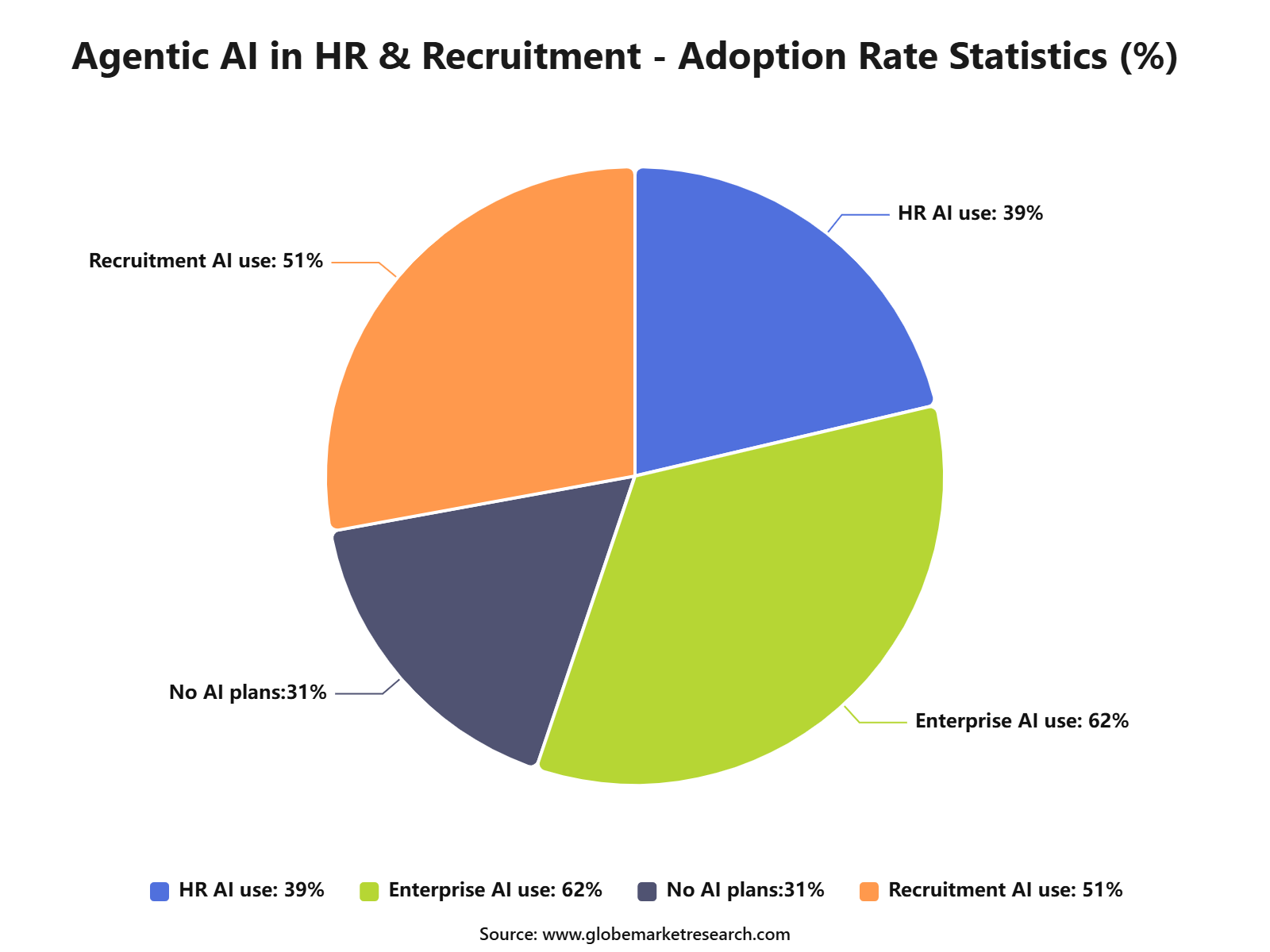 iThe graph shows projected market growth until 2035 based on CAGR analysis. Actual outcomes may vary depending on changing demand, competition, and economic factors.To gain greater insights - request a sample report PDF
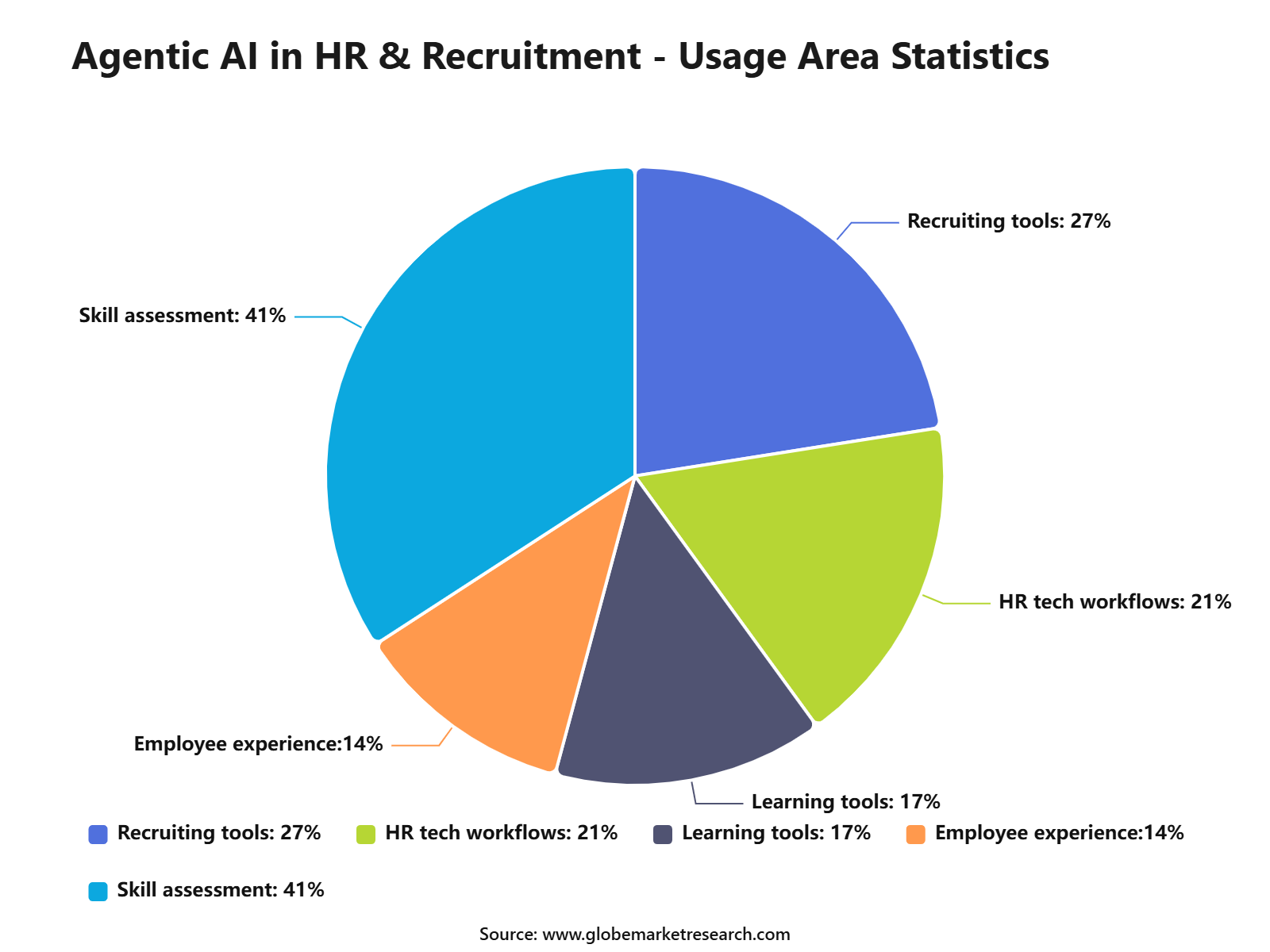 iThe graph shows projected market growth until 2035 based on CAGR analysis. Actual outcomes may vary depending on changing demand, competition, and economic factors.To gain greater insights - request a sample report PDF
Go-to-Market and Sales Economics
According to Globe Market Research, the go-to-market approach for the Agentic AI in HR & Recruitment Market should focus on workflow automation, recruiter productivity and human-supervised decision support. Agentic AI is being positioned beyond basic chatbots because it can screen resumes, schedule interviews, re-engage candidates, draft job posts, answer employee queries and move workflows forward with less manual prompting. SHRM reported that 46% of organizations expect to use AI in HR in 2026 , showing that HR buyers are moving from early awareness to structured adoption.
Sales economics are strongest in recruitment because hiring teams face high application volumes, slow screening cycles and pressure to improve candidate matching. SHRM found that AI use in HR is most common in recruiting, with 27% of organizations using AI in that practice area, ahead of HR technology, learning and employee experience. This makes recruitment the first practical entry point for agentic AI vendors targeting enterprise HR teams.
The strongest selling model is platform-led integration with applicant tracking systems, HCM suites and workforce data tools. Workday said its Recruiting Agent supported 14 million hiring processes in Q1 fiscal 2027 , up 44% year over year , while more than 4,000 customers were using at least one organically developed Workday agent. This shows that agentic AI is shifting from product concept to active HR workflow deployment.
Revenue Potential Analysis
Revenue Landscape Across
Revenue potential is spread across resume screening, candidate matching, interview scheduling, job description generation, sourcing, talent rediscovery, internal mobility, onboarding, HR service desk automation, workforce analytics and employee self-service. Large enterprises are the strongest early buyers because they manage higher hiring volumes and more complex workforce processes. SHRM reported that 60% of extra-large organizations have implemented AI tools in HR functions, compared with lower adoption among small and midsize companies.
Talent acquisition platforms are also becoming important revenue channels because clients want governance, compliance and measurable workflow control. iCIMS reported that 84% of talent acquisition leaders see improving recruiter efficiency through AI as a top priority for 2026, while concerns around legal compliance, candidate trust and bias remain major investment factors. This supports demand for agentic AI systems with audit trails, explainable recommendations and human review controls.
Candidate-facing AI interviews are creating another revenue pool, but the model must be handled carefully. Greenhouse reported in 2026 that 63% of job seekers had already experienced an AI interview, based on a survey of 2,950 active job seekers across the U.S., UK, Ireland, Germany and Australia. This indicates strong adoption of automated interviewing, but also raises the need for transparency, candidate communication and fair assessment design.
Financial Impact
The financial impact of agentic AI in HR and recruitment is mainly linked to lower administrative workload, faster hiring cycles and better recruiter capacity. Workday reported USD 2.542 billion in Q1 fiscal 2027 revenue and USD 2.354 billion in subscription revenue, reflecting strong demand for enterprise HR and finance platforms where AI agents can be monetized through subscriptions, platform credits and add-on modules.
The market also benefits from steady labor demand, which keeps hiring workflow investment relevant. The U.S. Bureau of Labor Statistics reported 7.6 million job openings and 5.2 million hires in May 2026, showing that employers still need efficient systems to manage requisitions, applications and candidate movement even in a cautious labor market.
The main financial risk is weak measurement. SHRM found that only 16% of HR professionals use their own ROI metric to assess AI success, while 56% do not formally measure AI investment success. This creates a gap between adoption and business value. Vendors that can prove time savings, lower cost per hire, better candidate quality and compliant decision support are expected to capture stronger long-term revenue.
Deployment Mode Analysis
Cloud-Based led the Agentic AI in HR & Recruitment Market with 69.2% share, supported by rising demand for scalable, flexible, and easily integrated HR automation platforms. Cloud deployment allows HR teams to use AI agents across hiring, onboarding, workforce analytics, employee engagement, and recruitment workflows without heavy internal infrastructure. The growth of this segment can be attributed to the wider use of digital HR systems, applicant tracking platforms, cloud-based talent suites, and AI-enabled workflow tools.
Public HR data shows that AI use in HR tasks increased to 43% in 2025, while recruiting remained the most active HR function using AI. Cloud-Based deployment is expected to remain the leading mode as enterprises continue to adopt AI agents for real-time screening, candidate communication, scheduling, interview support, and HR service delivery. Demand will remain supported by remote hiring, distributed workforces, API-based HR integrations, and the need for faster deployment across large recruitment operations.
 iThe graph shows projected market growth until 2035 based on CAGR analysis. Actual outcomes may vary depending on changing demand, competition, and economic factors.To gain greater insights - request a sample report PDF
Enterprise Analysis
Large Enterprises led the enterprise segment with 60.5% share, supported by higher AI budgets, larger hiring volumes, stronger HR technology maturity, and wider use of automation in workforce management. These companies are more likely to deploy agentic AI across recruitment, employee onboarding, skills mapping, workforce planning, and internal mobility.
The dominance of this segment can be linked to the need for faster hiring decisions, better candidate matching, lower manual workload, and stronger workforce data visibility. A 2026 HR survey found that 60% of extra-large organizations had implemented AI tools in HR, compared with 33% of small and 35% of midsize organizations.
Large Enterprises are expected to remain the leading buyer group as AI governance, compliance controls, and enterprise-grade HR platforms become more important. Future demand will remain strong among multinational companies, IT services firms, financial institutions, healthcare networks, and large retail employers handling high-volume recruitment.
Application Analysis
Talent Acquisition & Recruitment accounted for 48.9% share, making it the leading application segment in the Agentic AI in HR & Recruitment Market. AI agents are being used to support job description writing, resume screening, candidate sourcing, interview scheduling, applicant communication, and recruiter workflow automation.
The growth of this segment can be attributed to rising pressure on HR teams to reduce time-to-hire, improve candidate quality, and manage large application volumes. Public HR data shows that 51% of organizations now use AI to support recruiting, with common uses including job description writing at 66% , resume screening at 44%, and candidate search automation at 32%.
Talent Acquisition & Recruitment is expected to remain the strongest application area as AI agents move from task assistance toward workflow execution. Future growth will be supported by skills-based hiring, automated shortlisting, interview coordination, recruitment analytics, candidate engagement, and human-supervised AI decision support.
End-User Industry Analysis
IT & Telecommunications led the end-user industry segment with 38.3% share, supported by high hiring intensity, large technical talent needs, global workforce models, and strong readiness for digital HR transformation. Companies in this sector commonly manage fast-changing skill demand across software, cloud, cybersecurity, data, AI, telecom networks, and infrastructure roles.
The dominance of this segment can be attributed to the need for rapid candidate matching, skills validation, internal mobility, and workforce planning. AI-enabled recruitment tools are increasingly being used to handle large applicant pools, support technical screening, and improve recruiter productivity in knowledge-based hiring environments. LinkedIn noted that AI is helping recruiting teams automate time-consuming tasks and focus more on quality of hire and skills-based hiring.
IT & Telecommunications is expected to remain a major end-use industry as companies continue to compete for AI, cloud, cybersecurity, software engineering, and digital infrastructure talent. Opportunities are likely to remain strong in technical sourcing, candidate ranking, skills intelligence, workforce analytics, and AI-supported employee redeployment.
Regional Analysis
North America led the Agentic AI in HR & Recruitment Market with 39.6% share, supported by strong enterprise software adoption, mature HR technology infrastructure, and early use of AI in recruitment workflows. The U.S. market was valued at USD 0.2 million in 2025 and is expected to grow at a CAGR of 40.6%.
The region’s dominance can be attributed to strong demand from large enterprises, technology firms, staffing companies, financial institutions, and healthcare organizations. AI use in workplace systems is also rising, with SHRM’s 2026 workplace research showing that 47% of workers said their organizations had implemented AI.
North America is expected to remain the leading regional market as companies invest in responsible AI, candidate screening automation, workforce analytics, and compliance-ready recruitment systems. The U.S. Department of Labor has also published an AI and inclusive hiring framework, highlighting the need for transparency, accessibility, and reduced discrimination risk in AI-enabled hiring tools.
 iThe graph shows projected market growth until 2035 based on CAGR analysis. Actual outcomes may vary depending on changing demand, competition, and economic factors.To gain greater insights - request a sample report PDF
Segment Covered in the Report
By Deployment Mode
Cloud-Based
On-Premises
By Enterprises
Small and Medium Enterprises (SMEs)
Large Enterprises
By Application
Talent Acquisition & Recruitment
Employee Onboarding
Employee Engagement & Retention
Workforce Analytics
Others
By End-User Industry
IT & Telecommunications
Healthcare
Retail & E-commerce
BFSI
Manufacturing
Education
Others
By Region
North America
Europe
Asia Pacific
Latin America
Middle East and Africa
Drivers Impact Analysis
The Agentic AI in HR & Recruitment Market is driven by rising demand for automated hiring, intelligent candidate screening, resume matching, interview scheduling, onboarding support, workforce analytics, and employee engagement tools. Companies are adopting agentic AI to reduce hiring time, improve recruiter productivity, and manage large candidate pipelines with less manual work.
North America leads the market due to strong enterprise AI adoption, advanced HR technology spending, large recruitment volumes, and early use of automation across talent acquisition. The U.S. remains the main regional contributor because large enterprises, staffing firms, and technology companies are using AI agents to improve hiring speed and workforce decision-making.
Impact Factor | Estimated CAGR Impact | Regional Relevance | Market Impact |
|---|---|---|---|
Rising automation in recruitment workflows | +11.8% | North America, Europe, Asia Pacific | Drives core market growth. |
Demand for faster candidate screening | +9.6% | U.S., Canada, UK, India | Reduces hiring cycle time. |
Growth in enterprise HR digitalization | +8.2% | North America and Europe | Supports platform adoption. |
Expansion of AI-powered workforce analytics | +6.9% | Large enterprises globally | Improves workforce planning. |
Need to reduce recruiter workload | +5.7% | High-volume hiring markets | Builds operational value. |
Restraints Impact Analysis
The market faces restraints from data privacy concerns, algorithmic bias risk, regulatory scrutiny, and limited trust in fully automated hiring decisions. HR processes involve sensitive employee and candidate data, so companies must ensure transparency, fairness, and compliance.
Another restraint is integration complexity. Agentic AI tools need to connect with applicant tracking systems, HR information systems, payroll platforms, background verification tools, and communication channels, which can slow enterprise implementation.
Impact Factor | Estimated CAGR Impact | Regional Relevance | Market Impact |
|---|---|---|---|
Data privacy and candidate data risks | -6.4% | North America, Europe, Asia Pacific | Slows enterprise deployment. |
Bias and fairness concerns | -5.8% | Regulated hiring markets | Affects trust and compliance. |
Complex HR system integration | -4.9% | Large enterprises | Increases adoption barriers. |
Limited explainability in AI decisions | -4.2% | HR and legal teams | Reduces decision confidence. |
High implementation and governance cost | -3.5% | Mid-sized and regulated firms | Limits faster scale. |
Opportunities Impact Analysis
Opportunities are strong in talent acquisition, resume screening, interview automation, employee onboarding, workforce analytics, internal mobility, employee engagement, and performance support. Agentic AI can act across multiple HR workflows, making it valuable beyond only recruitment.
Higher-value opportunities are emerging in skills-based hiring, AI-powered talent intelligence, personalized employee support, workforce planning agents, and compliance-ready HR copilots. Vendors that provide transparent, secure, and human-supervised AI systems can capture stronger enterprise demand.
Impact Factor | Estimated CAGR Impact | Regional Relevance | Market Impact |
|---|---|---|---|
Talent acquisition automation | +11.2% | North America, Europe, Asia Pacific | Builds largest demand base. |
Skills-based hiring platforms | +9.1% | U.S., Canada, UK, Australia | Improves candidate matching. |
AI onboarding and employee support agents | +7.6% | Large enterprises globally | Expands use beyond hiring. |
Workforce planning and analytics agents | +6.3% | Enterprise HR teams | Supports strategic decisions. |
Compliance-ready HR AI tools | +5.2% | Regulated markets | Builds trust-led adoption. |
Challenges Impact Analysis
The main challenge is balancing automation with human judgment. Hiring decisions affect careers and workplace diversity, so companies need AI systems that support recruiters rather than replace accountability.
Another challenge is maintaining accurate, unbiased, and updated HR data. Agentic AI tools depend on job descriptions, skills data, candidate profiles, interview notes, employee records, and policy documents, so poor data quality can weaken outcomes.
Impact Factor | Estimated CAGR Impact | Regional Relevance | Market Impact |
|---|---|---|---|
Maintaining human oversight in hiring | -5.9% | Global enterprise markets | Protects decision quality. |
Managing bias in candidate evaluation | -5.2% | North America, Europe, Asia Pacific | Affects adoption confidence. |
Ensuring HR data quality | -4.4% | Large and complex organizations | Impacts AI accuracy. |
Building recruiter trust in AI outputs | -3.8% | Talent acquisition teams | Influences daily use. |
Keeping AI models aligned with policies | -3.1% | Regulated HR environments | Supports compliance. |
Recent Developments
Market News
In January 2026, Workday made Paradox Conversational ATS available through Workday to help frontline employers reduce manual hiring steps and improve candidate experience.
In April 2026, Oracle introduced Fusion Agentic Applications for HR, using specialized AI agents to support outcome-driven HR workflows across enterprise systems.
In April 2026, Eightfold AI expanded its Talent Agents across the interview journey with AI Interview Companion and new functional and coding interview capabilities.
In May 2026, Eightfold AI integrated agentic interviewing with Oracle Fusion Cloud Recruiting, allowing Oracle Recruiting customers to use autonomous interviewing capabilities inside Oracle workflows.
Acquisitions
In January 2026, Phenom acquired Included AI to add agentic people analytics and actionable workforce insights for HR professionals and business leaders.
In March 2026, HireVue acquired Hireguide technology to strengthen its agentic AI hiring strategy, starting with a voice-based AI interviewer for earlier candidate qualification.
Funding
In April 2026, HrFlow.ai secured USD 7.1 million in Pre-Series A funding led by 115K and EmergingTech Ventures to build AI infrastructure for HR data and labor market systems.
In June 2026, HeyMilo raised USD 6.1 million in total funding led by Category Ventures to scale agentic recruiting for high-volume hiring.
Research Methodology
Step 1: Primary Research - Primary research is conducted through direct discussions with manufacturers, suppliers, distributors, consultants, procurement teams, and industry experts. These interviews help understand real market demand, pricing movement, supply chain conditions, production trends, and customer requirements.
Step 2: Secondary Research - Secondary research is carried out using company filings, annual reports, regulatory databases, government publications, trade association data, and verified industry sources. This step helps collect reliable background information and supports the overall market assessment.
Step 3: Data Validation - Collected data is validated through source triangulation, historical trend review, demand-side checks, and supply-side assessment. Multiple sources are compared to reduce errors and improve the accuracy of the final insights.
Step 4: Market Estimation - Market estimation is completed using both bottom-up and top-down approaches. Product demand, regional consumption, company presence, application-level usage, and end-use industry adoption are reviewed to estimate the market size and structure.
Step 5: Forecasting Approach - Market forecasts are prepared by studying regulatory shifts, infrastructure investment, technology adoption, pricing trends, industrial expansion, and end-use demand. This approach helps identify future growth patterns and possible market changes.
Step 6: Quality Review - The final data and findings are reviewed by analysts through peer validation, outlier checks, internal consistency checks, and final publication approval. This ensures that the report maintains accuracy, clarity, and research quality.
Step 7: AI Policy - AI is not used as a primary data source. All published insights are checked against human-verified evidence, and final conclusions are reviewed by analysts before publication.
Competitive Landscape
The market is characterized by intense competition among established players and emerging companies. Strategic partnerships, mergers and acquisitions, and product innovation are key strategies employed by market participants.
Meet the Team
This report was prepared by our expert analysts with deep industry knowledge and research experience.
Pratiksha is market research analyst with strong experience in industry research, market forecasting, and competitive analysis. She specializes in identifying market trends, evaluating growth opportunities, and preparing data-driven insights across global industries. Her work supports businesses in understanding market dynamics, customer demand, regional opportunities, and strategic investment areas.
Sayali brings more than 5 years of experience to Globe Market Research, supporting the accuracy, clarity, and relevance of research content across multiple industries. She reviews market data, segment analysis, competitive insights, and industry trends to ensure each report meets strong quality standards and provides practical value to business decision-makers. Her expertise spans healthcare, information technology, consumer goods, and diverse cross-industry domains. With a strong focus on data reliability, structured analysis, and clear presentation, Sayali helps ensure that each research output delivers well-reviewed insights for clients, investors, consultants, and industry stakeholders.
Frequently Asked Questions
Related Reports
More in Information and Technology
AI Visual Inspection System Market Revenue to Hit USD 315.2 billion by 2035
Global AI Visual Inspection System Market Size, Growth Analysis By Offering (Hardware Systems, Industrial Cameras, Sensors and Imaging Hardware, Software Platforms, AI Inspection Software, Vision Analytics Tools, Services), By Technology (Deep Learning-Based Vision Systems, Machine Learning Algorithms, Traditional Computer Vision Systems, Edge AI Vision Processing, Other AI Vision Technologies), By Application (Defect Detection & Quality Control, Assembly Verification, Measurement & Gauging, Packaging & Label Inspection, Other Industrial Inspection Applications), By Industry Vertical (Electronics & Semiconductor Manufacturing, Automotive Industry, Pharmaceuticals & Healthcare, Food & Beverage Manufacturing, Logistics & Warehousing, Other Industrial Verticals), By Regional Insights, Business plan and Project Report, Investment Opportunities, Profitability, Industry Trends, Leading Companies and Growth Forecasts By 2025-2035
Cloud Computing Market Size to Surpass USD 17.5 Trillion by 2035
Global Cloud Computing Market Size, Share Analysis By Type (Public Cloud, Private Cloud, Hybrid Cloud), By Service Model (Software as a Service, Infrastructure as a Service, Platform as a Service), By Enterprise Type (Large Enterprises, Small and Medium Enterprises), By Industry (BFSI, IT and Telecommunications, Government, Consumer Goods and Retail, Healthcare, Manufacturing, Others), By Regional Insights, Business plan and Project Report, Investment Opportunities, Profitability, Industry Trends, Leading Companies and Growth Forecasts By 2025-2035
Agentic AI For Financial Services Market Size to Reach USD 315.5 billion by 2035
Agentic AI For Financial Services Market Size, Share Segmented by Application (Fraud Detection and Anti-Money Laundering, Virtual Assistants and Chatbots, Credit Assessment, Risk and Compliance Management, Investment Advisory, Claims Processing, and Others), By Component (Solutions and Services), By Deployment Mode (Cloud, On-Premise, and Hybrid), By End-User (Commercial Banks, Investment Banks, Asset Management Firms, and Other Financial Institutions), By Regional Insights, Business plan and Project Report, Investment Opportunities, Profitability, Industry Trends, Leading Companies and Growth Forecasts By 2025-2035
AI in Pulp and Paper Industry Market Size to Reach USD 21.3 Bn by 2035
Global AI in Pulp and Paper Industry Market Size, Go-to-Market and Sales Strategy Analysis By Component (Software, Hardware, Services), By Application (Process Optimization, Quality Control, Predictive Maintenance, Supply Chain Management, Others), By End User (Paper Manufacturers, Pulp Producers, Packaging Industry), By Regional Insights, Business plan and Project Report, Investment Opportunities, Profitability, Industry Trends, Leading Companies and Growth Forecasts By 2025-2035