

Revenue, 2025
$8.7 Bn
Forecast, 2035
$315.5 Bn
CAGR, 2025-2035
43.2%
Report Coverage
Global
Market Size and Forecast
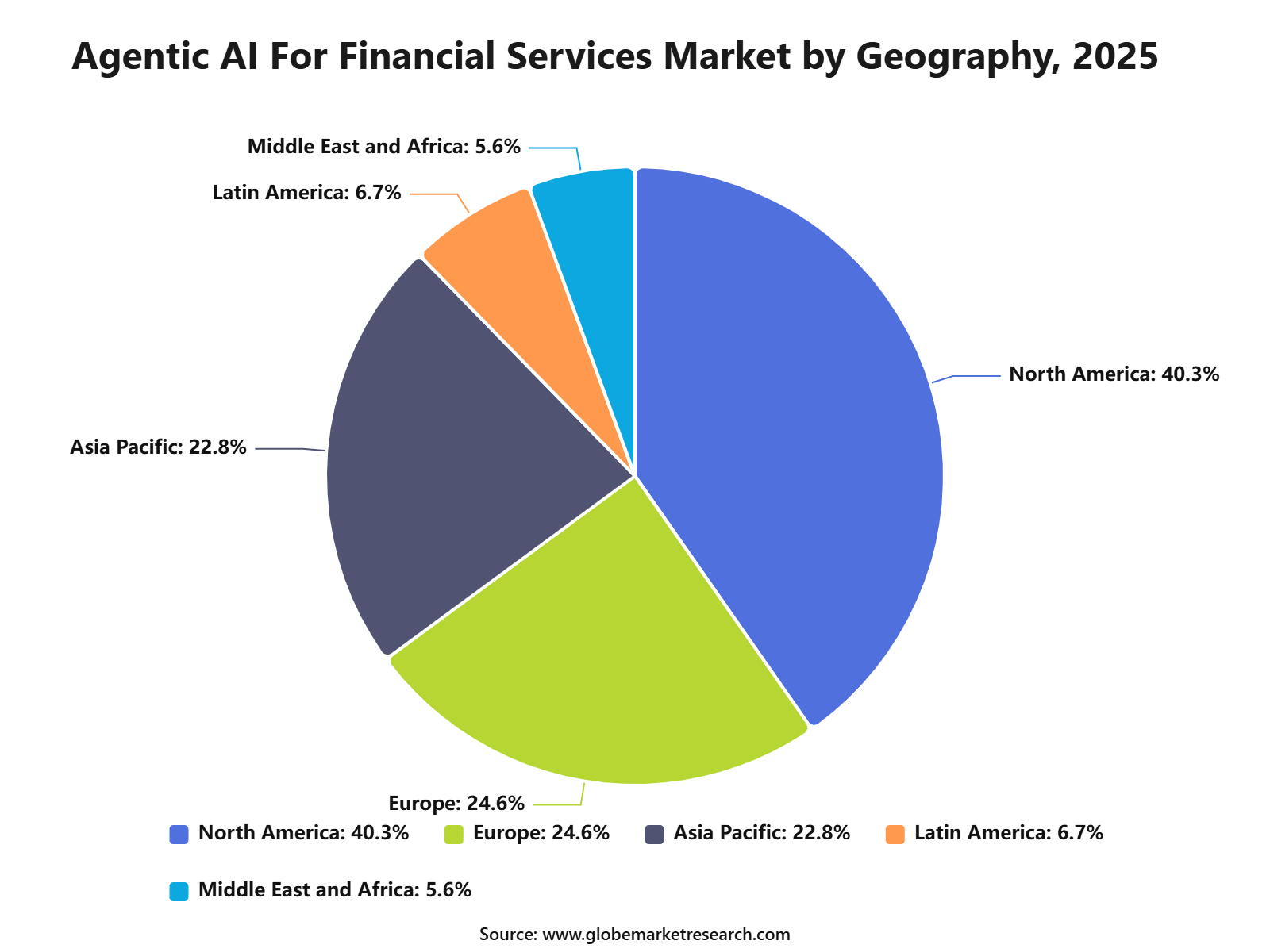
The Agentic AI for Financial Services Market was worth USD 8.7 billion in 2025 and is expected to reach approximately USD 315.5 billion by 2035, growing at a CAGR of 43.2% from 2025 to 2035. North America commanded the largest regional share of 40.3% in 2025, valued at around USD 3.5 billion, supported by advanced banking technology infrastructure, strong fintech adoption, high cloud AI spending, and rising use of automation in fraud detection, compliance, lending, insurance, and wealth management. Financial services remain one of the strongest AI adoption areas, as 32% to 39% of work across capital markets, insurance, and banking has high potential for full automation, while 34% to 37% has high augmentation potential.
Key Parameter | Report Details |
|---|---|
Market Revenue, 2025 | USD 8.7 Billion |
Projected Revenue, 2035 | USD 315.5 Billion |
CAGR, 2025-2035 | 43.2% |
Largest Region | North America, 40.3% Share |
Market Concentration | Medium |
Base Year | 2025 |
Forecast Period | 2025-2035 |
The Agentic AI for Financial Services Market includes autonomous AI systems that can plan, reason, take actions, and complete multi-step financial workflows with limited human supervision. These solutions are used across banking, insurance, payments, capital markets, lending, compliance, risk management, customer service, claims processing, portfolio monitoring, and financial crime prevention. Agentic AI systems differ from basic generative AI tools because they can use external tools, APIs, databases, and workflow systems to complete tasks, support decisions, and adapt to changing business conditions.
The market outlook remains highly positive as financial institutions are under pressure to improve speed, reduce operating costs, strengthen risk controls, and deliver more personalized digital services. Growth can be attributed to wider use of AI agents for fraud monitoring, regulatory reporting, customer engagement, credit analysis, claims automation, investment research, and internal process automation. Agentic AI is also gaining attention because it can reduce cycle times from days to minutes, lower manual errors, support audit trails, and help financial firms maintain compliance while scaling automation across high-value workflows.
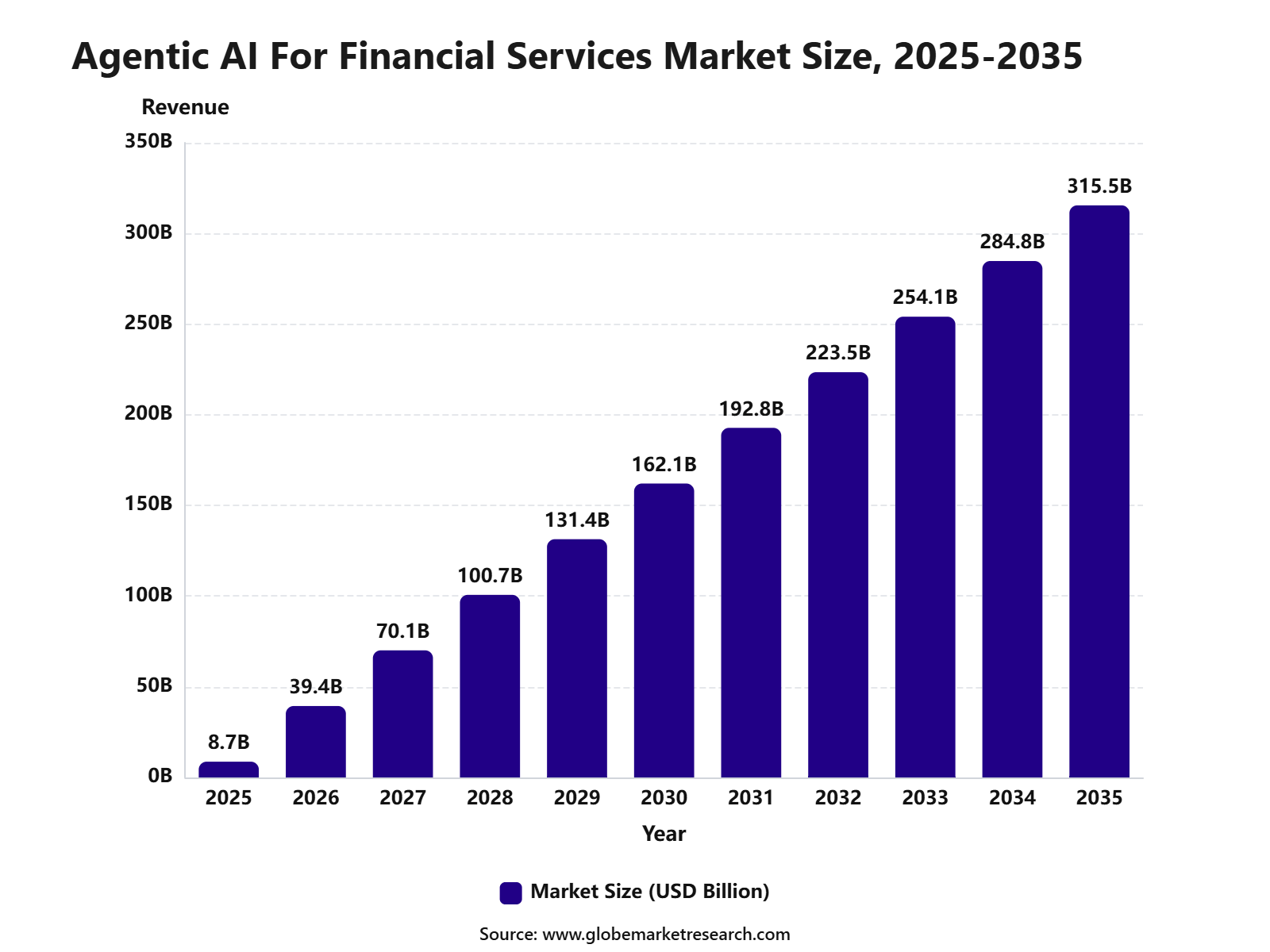 iThe graph shows projected market growth until 2035 based on CAGR analysis. Actual outcomes may vary depending on changing demand, competition, and economic factors.To gain greater insights - request a sample report PDF
Market Key Insights
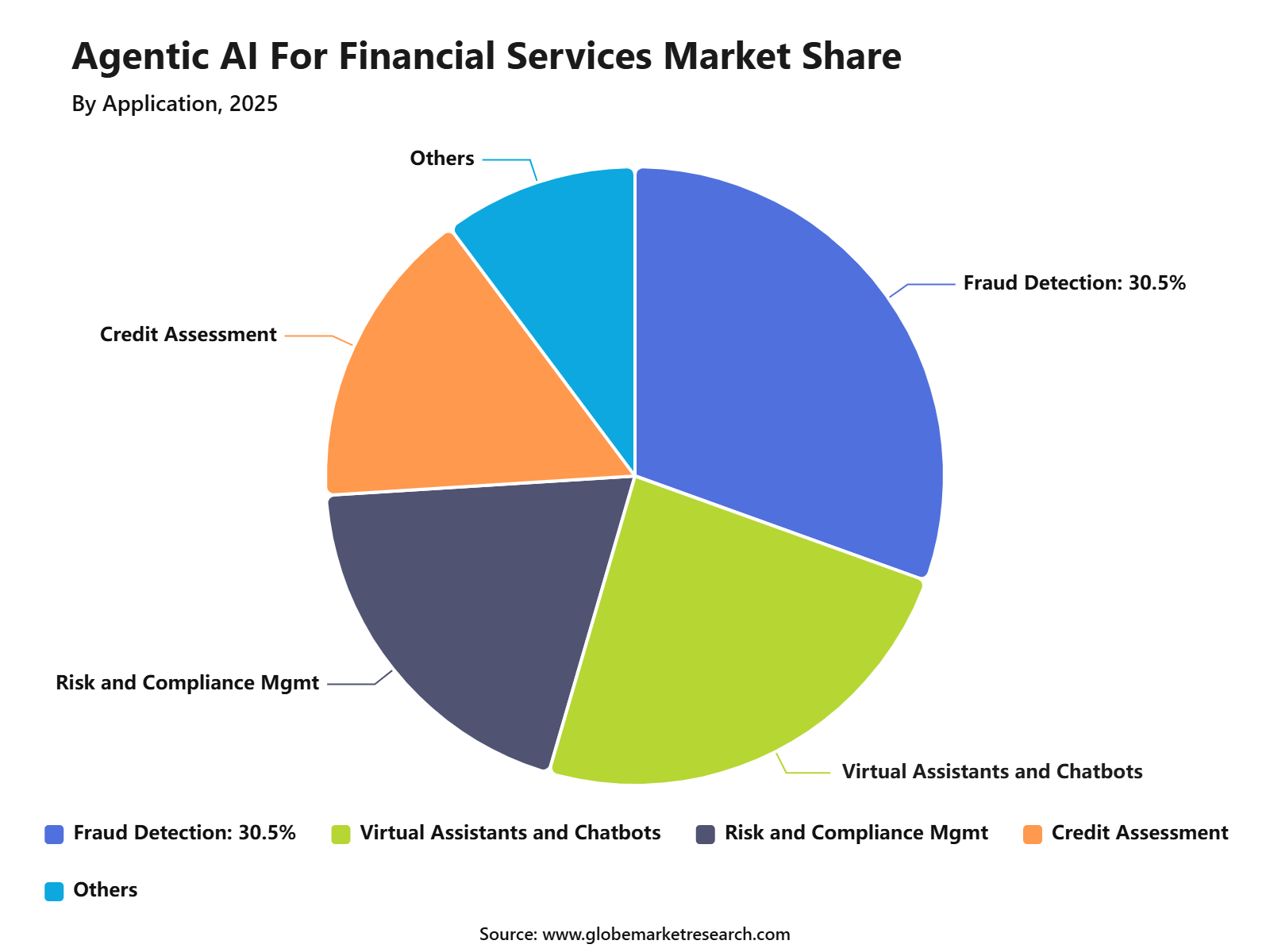
Fraud detection and anti-money laundering led the application segment with 30.5% share, supported by rising demand for real-time risk monitoring, suspicious transaction detection, compliance automation, and faster fraud response.
Solutions accounted for 64.4% share by component, driven by strong adoption of agentic AI platforms, decision-support tools, workflow automation systems, and intelligent financial service applications.
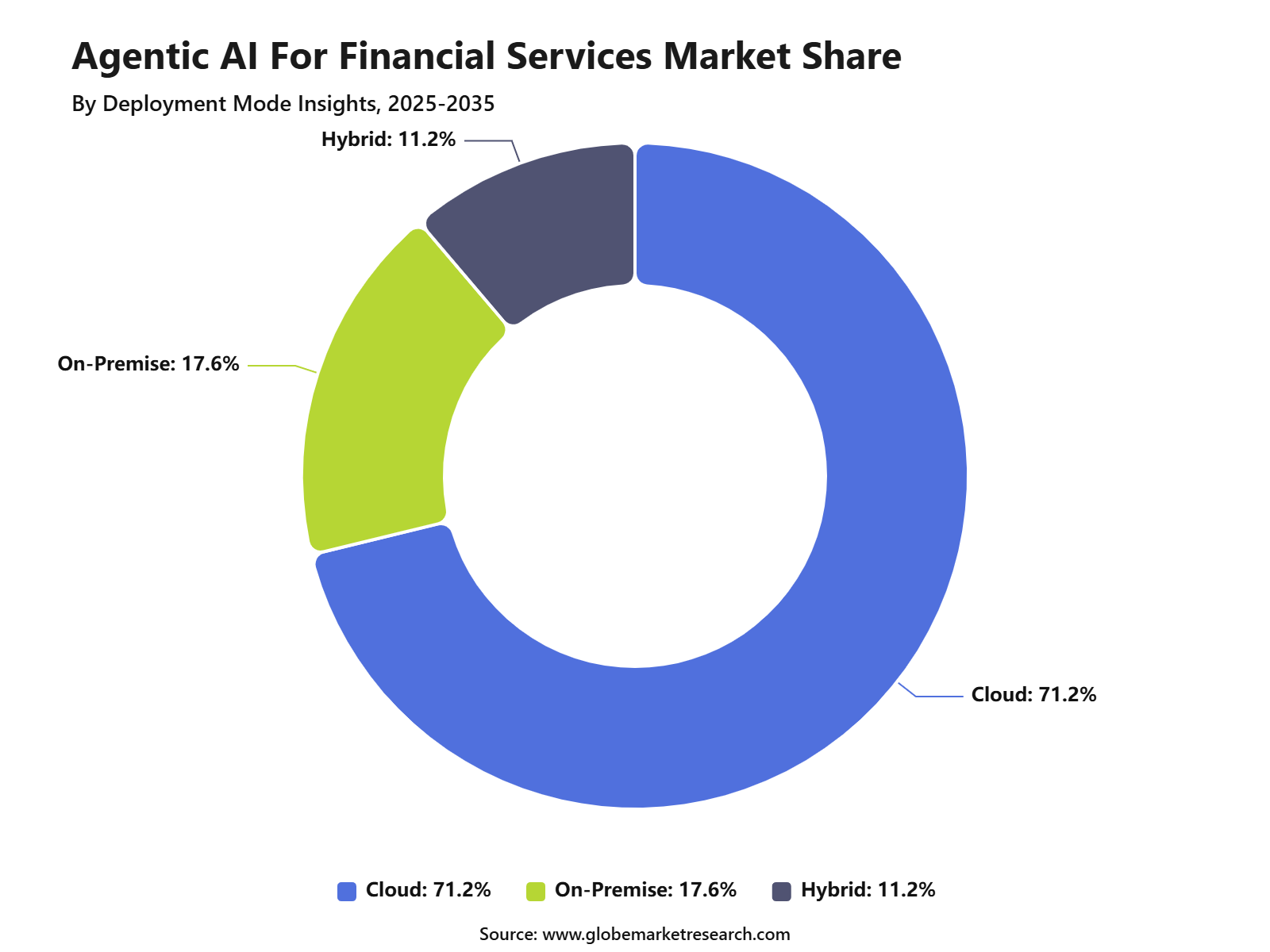
Cloud deployments held 71.2% share, supported by scalable infrastructure, faster implementation, lower IT burden, and easier integration with banking, compliance, and analytics systems.
Commercial banks led the end-user segment with 47.8% share, driven by high transaction volumes, strict regulatory needs, customer service automation, credit risk assessment, and fraud prevention requirements.
North America commanded 40.3% share of the agentic AI for financial services market, supported by advanced fintech adoption, strong banking technology investment, mature cloud infrastructure, and rising use of AI in financial compliance.
Adoption Rate and Usage Area Statistics
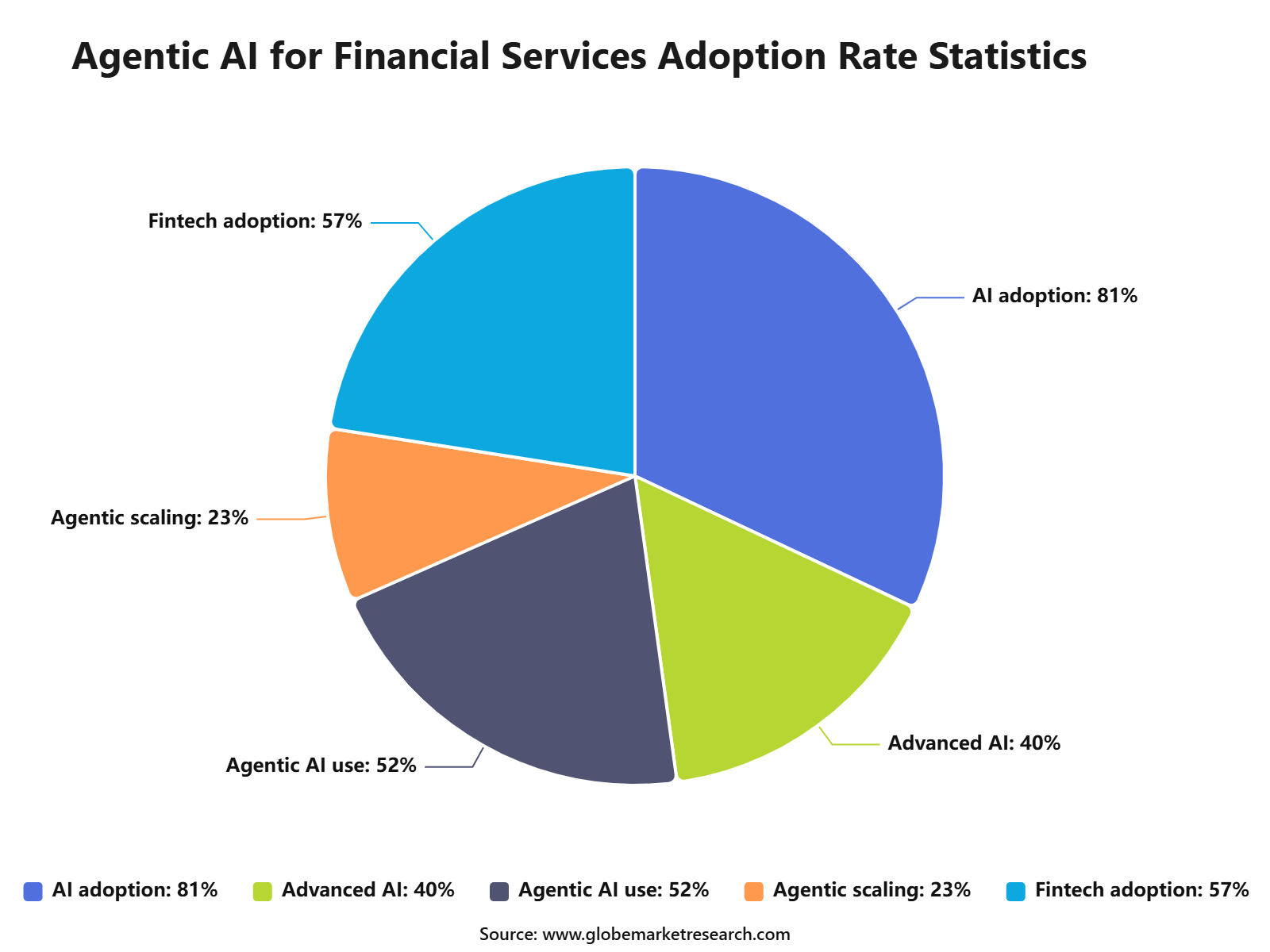
Agentic AI adoption in financial services is gaining strong momentum as banks, fintech firms, insurers, and asset managers move from AI testing to production-level use. Recent public data shows that 81% of financial services firms have adopted AI in some form, while 52% are already using agentic AI. Around 23% of firms are scaling or transforming agentic AI use, and 29% are still in pilot stages. Adoption is higher among fintech firms at 57%, while traditional financial institutions show 45% adoption due to stricter compliance, data security, and legacy system challenges.
 iThe graph shows projected market growth until 2035 based on CAGR analysis. Actual outcomes may vary depending on changing demand, competition, and economic factors.To gain greater insights - request a sample report PDF
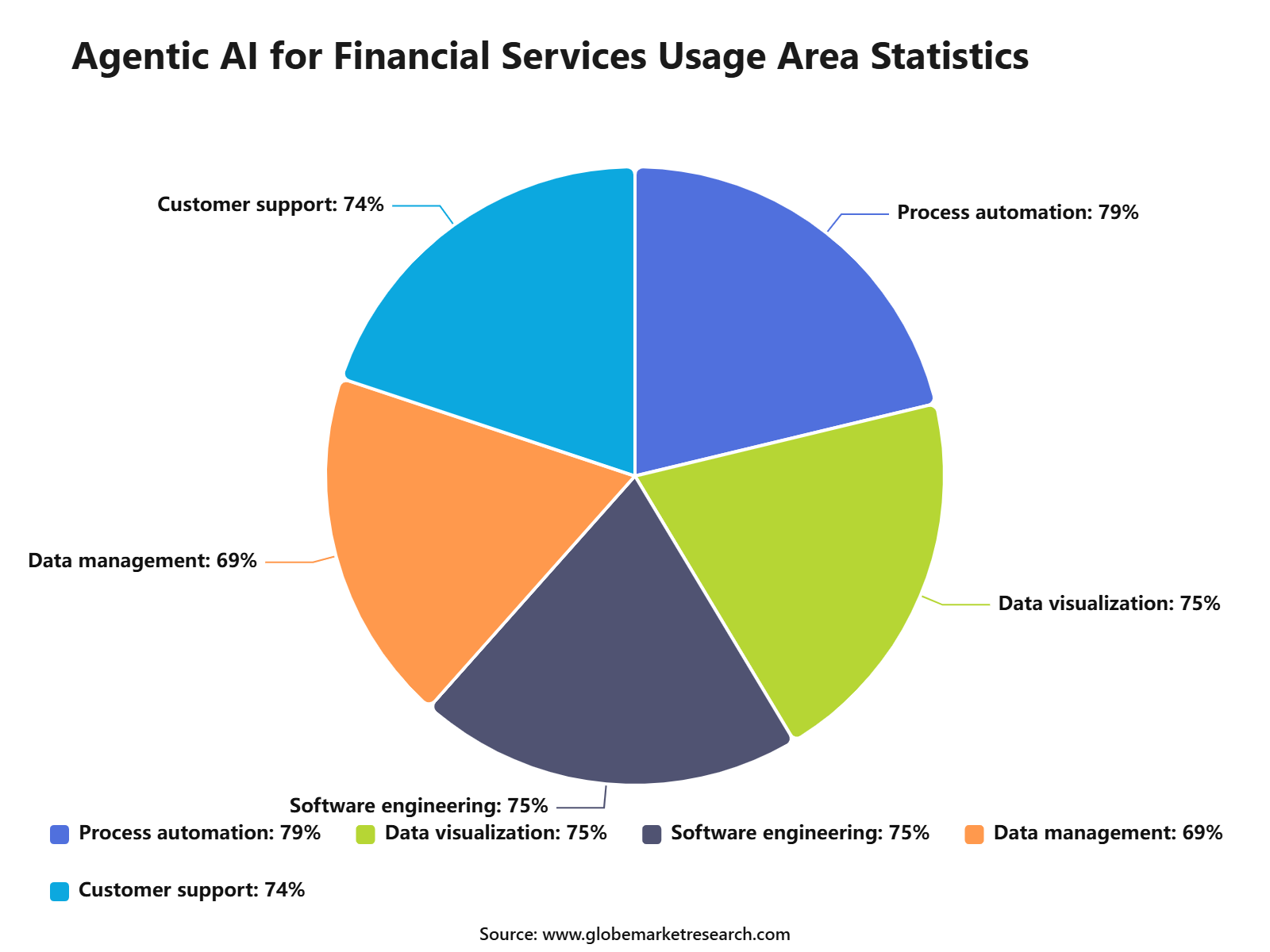
Based on data from Cambridge Judge Business School, Agentic AI is mainly being used in process automation, customer support, fraud detection, credit risk, software engineering, data management, and compliance workflows. Usage is strongest in process automation at 79%, data visualization at 75%, software engineering at 75%, customer support at 74%, data management at 69%, fraud detection at 58%, and credit risk at 54%. These systems help financial firms automate document-heavy processes, detect suspicious transactions, support KYC and AML checks, improve customer service, and assist teams in faster decision-making with human oversight.
 iThe graph shows projected market growth until 2035 based on CAGR analysis. Actual outcomes may vary depending on changing demand, competition, and economic factors.To gain greater insights - request a sample report PDF
Application Insights
Fraud Detection and Anti-Money Laundering led the Agentic AI For Financial Services Market with 30.5% share, supported by rising financial crime risks, digital payment fraud, identity theft, synthetic fraud, and stricter compliance monitoring. Agentic AI is being used to detect suspicious behavior, monitor transactions, flag unusual patterns, and support faster investigation workflows.
The growth of this segment can be attributed to the rising volume and complexity of digital financial crime. The FBI reported that its 2025 Internet Crime Report included more than 1 million complaints and reported losses exceeding USD 20 billion, highlighting the growing pressure on banks and financial institutions to strengthen fraud controls.
Fraud Detection and Anti-Money Laundering are expected to remain the leading application area as banks move from rule-based monitoring to AI-supported decision systems. Future demand will remain supported by real-time transaction screening, customer risk scoring, sanctions checks, suspicious activity monitoring, KYC automation, and human-supervised compliance workflows.
 iThe graph shows projected market growth until 2035 based on CAGR analysis. Actual outcomes may vary depending on changing demand, competition, and economic factors.To gain greater insights - request a sample report PDF
Component Insights
Solutions accounted for 64.4% share, making this the leading component segment in the Agentic AI For Financial Services Market. This segment includes AI platforms, fraud detection engines, compliance automation tools, customer service agents, credit risk models, workflow orchestration systems, and decision-support software.
The dominance of this segment can be linked to growing demand for ready-to-deploy AI tools that can be integrated with core banking, payment, lending, and compliance systems. The FCA reported that 75% of financial services firms were using AI, while 55% of AI use cases had some level of automated decision-making, showing strong demand for structured AI solutions with governance controls.
Solutions are expected to remain the leading component as financial institutions increase investment in AI-enabled automation, risk intelligence, and customer engagement. Demand will remain strong for agentic platforms that can manage multi-step workflows across fraud review, lending support, portfolio monitoring, claims handling, onboarding, and regulatory reporting.
Deployment Mode Insights
Cloud deployments held 71.2% share, supported by the need for scalable computing, faster AI model deployment, secure data processing, and flexible integration with banking applications. Cloud infrastructure allows financial institutions to run AI agents across fraud detection, customer support, compliance, risk analytics, and back-office automation with lower infrastructure complexity.
The growth of this segment can be attributed to cloud-led digital transformation across banking and insurance. Capgemini’s World Cloud Report for Financial Services 2025 noted that banks and insurers worldwide are using cloud to support digital transformation, operational efficiency, customer experience, data analytics, and faster product innovation.
Cloud deployments are expected to remain the leading deployment mode as banks adopt hybrid cloud, secure APIs, AI-ready data platforms, and real-time analytics. Future opportunities are likely to remain strong in cloud-native fraud monitoring, AI customer agents, automated compliance systems, credit decisioning, and scalable model governance.
 iThe graph shows projected market growth until 2035 based on CAGR analysis. Actual outcomes may vary depending on changing demand, competition, and economic factors.To gain greater insights - request a sample report PDF
End-User Insights
Commercial Banks led the end-user segment with 47.8% share, supported by their large customer base, high transaction volume, strong compliance burden, and broad need for digital service automation. Agentic AI is being adopted by banks to support fraud monitoring, customer service, credit analysis, account onboarding, regulatory reporting, and operational risk management.
The dominance of this segment can be attributed to the banking sector’s need to reduce manual processing, improve response speed, and manage risk across large transaction networks. A UK Parliamentary report noted that financial services substantially outpace other sectors in AI adoption, with the largest AI take-up among insurers and international banks operating in the UK.
Commercial Banks are expected to remain the leading end-user group as AI agents become more useful in regulated banking workflows. Future demand will be supported by real-time fraud alerts, digital lending, personalized banking, call-center automation, AML investigation support, treasury monitoring, and AI-assisted relationship management.
Geography Insights
North America commanded 40.3% share of the Agentic AI For Financial Services Market, supported by strong banking technology adoption, large fintech ecosystems, mature cloud infrastructure, and high investment in fraud prevention and compliance automation. The region has a strong base of commercial banks, payment networks, wealth platforms, insurers, and AI technology providers.
The region’s dominance can be attributed to early use of AI in financial crime prevention, digital banking, customer analytics, cyber risk management, and automated decision support. IBM’s 2025 data breach research reported that extensive use of AI in security delivered USD 1.9 million in cost savings compared with organizations that did not use these solutions, supporting stronger AI use in security-sensitive industries such as financial services.
North America is expected to remain the leading regional market as banks and financial institutions expand AI use across fraud detection, AML, customer service, credit risk, cybersecurity, and regulatory operations. Future growth will remain supported by strong cloud adoption, large transaction volumes, rising fraud risks, and continued demand for secure, explainable, and compliant AI systems.
 iThe graph shows projected market growth until 2035 based on CAGR analysis. Actual outcomes may vary depending on changing demand, competition, and economic factors.To gain greater insights - request a sample report PDF
Go-to-Market and Sales Economics
According to Globe Market Research, the go-to-market approach for the Agentic AI for Financial Services Market should focus on controlled automation, risk reduction and measurable workflow efficiency. Banks, insurers, payment firms and fintech companies are using AI agents for customer service, fraud detection, onboarding, credit workflows, compliance checks, claims support and internal operations. Cambridge Judge Business School reported in 2026 that 52% of financial services industry respondents were already actively adopting agentic AI, showing that the technology is moving beyond early experimentation.
Sales economics are strongest where AI agents can complete multi-step tasks with human supervision. Capgemini’s 2026 financial services cloud research found that only 10% of financial services firms had implemented AI agents at scale, while the wider industry was still at an early stage of deployment. This creates a clear opportunity for vendors that can offer secure, cloud-ready and audit-friendly AI agent platforms for regulated institutions.
The strongest selling model should combine software, integration, governance and managed services. Financial institutions need agentic AI systems that can connect with core banking platforms, CRM tools, fraud engines, payment systems, document workflows and risk controls. Cambridge reported that 23% of industry respondents were already at more mature scaling or transforming stages of agentic AI adoption, while 29% remained in the piloting stage, which supports a phased sales approach from pilot to enterprise deployment.
Revenue Potential Analysis
Revenue Landscape Across
Revenue potential is spread across customer support, fraud detection, AML monitoring, loan processing, credit risk modelling, wealth advisory support, insurance claims, regulatory reporting, software engineering and back-office automation. Cambridge found that AI use in financial services is already strongest in internal processes, with process automation at 79%, data visualization at 75%, software engineering at 75%, and data and knowledge management at 69% at pilot stage or beyond. These use cases create strong recurring revenue for AI platform providers, system integrators and compliance technology vendors.
Fraud and financial crime prevention represent one of the highest-value revenue channels. Nasdaq Verafin reported in 2026 that cyber-enabled scams reached USD 14.3 billion in 2025, while 90% of surveyed financial crime professionals reported an increase in AI-driven attacks over the previous two years. This supports demand for AI agents that can monitor suspicious activity, summarize cases, detect mule networks, reduce false positives and assist investigators.
Payments, onboarding and transaction monitoring are also major revenue pools. Visa noted that 83% of financial institutions plan to invest in new onboarding tools to detect synthetic identity fraud, while 36% plan to enhance account-management capabilities related to synthetic identity detection. This creates strong commercial demand for AI agents that can support identity verification, continuous authentication, real-time risk scoring and delegated-payment controls.
Financial Impact
The financial impact of agentic AI in financial services is mainly linked to lower manual workload, faster decision-making, reduced fraud losses and better customer experience. Mastercard reported that 85% of payment leaders saw returns from AI use in fraud case triage, transaction pattern recognition and real-time suspicious transaction detection. It also found that 83% said AI had significantly accelerated fraud investigation and case resolution, showing direct operational value for banks and payment firms.
Profitability gains are visible but still uneven. Cambridge reported that 40% of financial services respondents saw increased profitability from AI, while 43% reported no change. The same research found stronger impact among higher-spending organizations, where 62% of firms spending more than USD 100,000 annually on AI reported increased profitability. This shows that financial returns depend on data quality, implementation depth and workforce readiness.
Drivers Impact Analysis
The Agentic AI for Financial Services Market is driven by rising demand for fraud detection, anti-money laundering, credit risk analysis, customer service automation, wealth advisory, compliance monitoring, and financial workflow automation. Banks, insurers, fintech firms, and asset managers are adopting agentic AI to reduce manual work and improve decision speed.
North America leads the market due to strong banking technology adoption, high fintech investment, advanced cloud infrastructure, and early use of AI in risk, compliance, and customer operations. The U.S. remains the main regional contributor because large financial institutions are investing heavily in autonomous AI systems for fraud prevention, lending, trading, and back-office efficiency.
Impact Factor | Estimated CAGR Impact | Regional Relevance | Market Impact |
|---|---|---|---|
Rising fraud detection and AML automation | +12.4% | North America, Europe, Asia Pacific | Drives core market adoption. |
Growth in AI-powered risk management | +10.2% | U.S., Canada, UK, Singapore | Improves decision accuracy. |
Demand for automated customer service | +8.7% | Banks, insurers, fintech firms | Reduces service workload. |
Expansion of cloud-based financial AI | +7.4% | North America and Asia Pacific | Supports scalable deployment. |
Need for operational cost reduction | +6.2% | Global financial institutions | Builds long-term business value. |
Restraints Impact Analysis
The market faces restraints from strict financial regulation, data privacy concerns, explainability gaps, and model governance requirements. Financial institutions must ensure that agentic AI decisions are transparent, auditable, secure, and aligned with compliance rules.
Another restraint is the risk of over-automation in sensitive financial decisions. Banks and insurers need human oversight for lending, fraud reviews, investment decisions, and compliance alerts to avoid errors, bias, and reputational damage.
Impact Factor | Estimated CAGR Impact | Regional Relevance | Market Impact |
|---|---|---|---|
Strict financial compliance requirements | -6.8% | North America, Europe, Asia Pacific | Slows faster deployment. |
Data privacy and security concerns | -6.1% | Global financial markets | Raises adoption risk. |
Limited explainability in AI decisions | -5.4% | Regulated banking and insurance sectors | Affects trust. |
Model governance and audit burden | -4.6% | Large financial institutions | Increases implementation cost. |
Integration with legacy systems | -3.9% | Banks and insurers | Delays platform rollout. |
Opportunities Impact Analysis
Opportunities are strong in fraud detection, AML monitoring, credit underwriting, claims processing, personalized banking, robo-advisory, investment research, regulatory reporting, and financial document automation. Agentic AI can complete multi-step workflows, making it valuable across both front-office and back-office operations.
Higher-value opportunities are emerging in autonomous compliance agents, AI-powered financial copilots, real-time transaction monitoring, personalized wealth management, and intelligent loan processing. Vendors that offer secure, explainable, and regulation-ready systems can capture stronger enterprise demand.
Impact Factor | Estimated CAGR Impact | Regional Relevance | Market Impact |
|---|---|---|---|
Fraud detection and AML agents | +12.0% | North America, Europe, Asia Pacific | Builds largest use case demand. |
AI credit underwriting platforms | +9.8% | U.S., Canada, UK, India | Improves lending decisions. |
Autonomous compliance monitoring | +8.5% | Regulated financial markets | Reduces compliance workload. |
Personalized banking and advisory agents | +7.0% | Wealth and retail banking sectors | Improves customer engagement. |
Financial document automation | +5.9% | Banks, insurers, asset managers | Supports back-office efficiency. |
Challenges Impact Analysis
The main challenge is maintaining control over autonomous decision-making in high-risk financial workflows. Agentic AI can take actions across systems, so institutions need guardrails, approval rules, audit trails, and exception handling.
Another challenge is ensuring high-quality financial data. AI agents depend on transaction records, customer profiles, credit histories, claims data, market feeds, policy documents, and compliance rules, so poor data quality can reduce accuracy and increase risk.
Impact Factor | Estimated CAGR Impact | Regional Relevance | Market Impact |
|---|---|---|---|
Controlling autonomous financial decisions | -6.2% | Global banking and insurance markets | Protects operational safety. |
Managing AI bias in lending and risk | -5.5% | North America, Europe, Asia Pacific | Affects regulatory confidence. |
Ensuring high-quality financial data | -4.8% | Large financial institutions | Improves AI accuracy. |
Building trust among compliance teams | -4.1% | Regulated financial firms | Influences adoption speed. |
Preventing AI-driven operational errors | -3.4% | Banks, insurers, fintech firms | Reduces financial risk. |
Segment Covered in the Report
Segmented By Application
Fraud Detection and AML
Virtual Assistants and Chatbots
Risk Management
Credit Scoring and Underwriting
Portfolio Management
Customer Service Automation
Others
Segmented By Component
Solutions
Services
Segmented By Deployment Mode
Cloud
On-Premise
Hybrid
Segmented By End-User
Commercial Banks
Investment Banks and Asset Managers
Insurance Companies
Fintechs and Neobanks
Regulatory and Compliance Firms
Other Financial Institutions
Segmented By Region
North America
Europe
Asia Pacific
Latin America
Middle East and Africa
Recent Developments
Market News
In January 2026, Mastercard completed Australia’s first authenticated agentic transactions using Agent Pay, showing how AI agents can be governed inside payment flows.
In February 2026, Oracle introduced its agentic banking platform with pre-built AI agents for retail banking, credit decisions, application tracking, and banker support.
In April 2026, Visa expanded its Agentic Ready program to Asia Pacific and Latin America to help banks and payment partners test AI agent-initiated payments.
In June 2026, the Bank of England highlighted that agentic AI is reshaping cyber risk, markets, and payments, increasing the need for stronger financial system resilience.
Acquisitions
In February 2026, PayPal completed its acquisition of Cymbio to strengthen agentic commerce capabilities and help merchants become discoverable across AI-led shopping platforms.
In April 2026, ProCap Financial completed its acquisition of CFO Silvia, an AI agent lab for finance that supports portfolio monitoring, scenario planning, and financial analysis.
In June 2026, Backbase acquired Kasisto to add banking-grade agentic AI, governance controls, and regulatory safeguards to its AI-native Banking OS.
Funding
In February 2026, EnFi raised USD 15 million to deploy AI credit analyst agents for banks, with a focus on regional and community banking workflows.
In June 2026, Gradient Labs increased its Series A funding to USD 26 million to build specialist AI agents for customer operations in financial services.
In June 2026, Taktile raised USD 110 million in Series C funding led by Goldman Sachs to expand its agentic decision platform for banks and insurers.
In July 2026, Norm Ai raised USD 120 million in Series C funding at a USD 1.2 billion valuation to expand legal and supervisory AI agents for regulated enterprise workflows.
In July 2026, Monumint gained public attention after pivoting from OmniAI to conversational AI agents for banks, credit unions, and lenders, supported by USD 3.2 million in seed funding.
Market Impact
In 2026, agentic AI in financial services is shifting from employee assistance to bounded autonomy. Financial institutions are using AI agents for customer support, credit analysis, compliance review, onboarding, payments, document processing, portfolio monitoring, and fraud-related workflows.
In 2026, governance is becoming a major buying requirement. Banks and insurers are expected to prefer AI agents that include human-in-the-loop controls, audit trails, secure data access, role-based permissions, policy checks, and clear escalation rules.
In 2026, adoption signals are strong but still controlled. A 2026 global financial services study found that 81% of surveyed financial firms are adopting AI, while 40% report advanced AI adoption, with fintech firms ahead of incumbents.
In 2026, payments are becoming one of the most active agentic AI use cases. Visa and Mastercard updates show that AI agents are starting to move from product discovery into authenticated payments, where security, authorization, tokenization, and user consent are critical.
Research Methodology
Step 1: Primary Research - Primary research is conducted through direct discussions with manufacturers, suppliers, distributors, consultants, procurement teams, and industry experts. These interviews help understand real market demand, pricing movement, supply chain conditions, production trends, and customer requirements.
Step 2: Secondary Research - Secondary research is carried out using company filings, annual reports, regulatory databases, government publications, trade association data, and verified industry sources. This step helps collect reliable background information and supports the overall market assessment.
Step 3: Data Validation - Collected data is validated through source triangulation, historical trend review, demand-side checks, and supply-side assessment. Multiple sources are compared to reduce errors and improve the accuracy of the final insights.
Step 4: Market Estimation - Market estimation is completed using both bottom-up and top-down approaches. Product demand, regional consumption, company presence, application-level usage, and end-use industry adoption are reviewed to estimate the market size and structure.
Step 5: Forecasting Approach - Market forecasts are prepared by studying regulatory shifts, infrastructure investment, technology adoption, pricing trends, industrial expansion, and end-use demand. This approach helps identify future growth patterns and possible market changes.
Step 6: Quality Review - The final data and findings are reviewed by analysts through peer validation, outlier checks, internal consistency checks, and final publication approval. This ensures that the report maintains accuracy, clarity, and research quality.
Step 7: AI Policy - AI is not used as a primary data source. All published insights are checked against human-verified evidence, and final conclusions are reviewed by analysts before publication.
Market Concentration
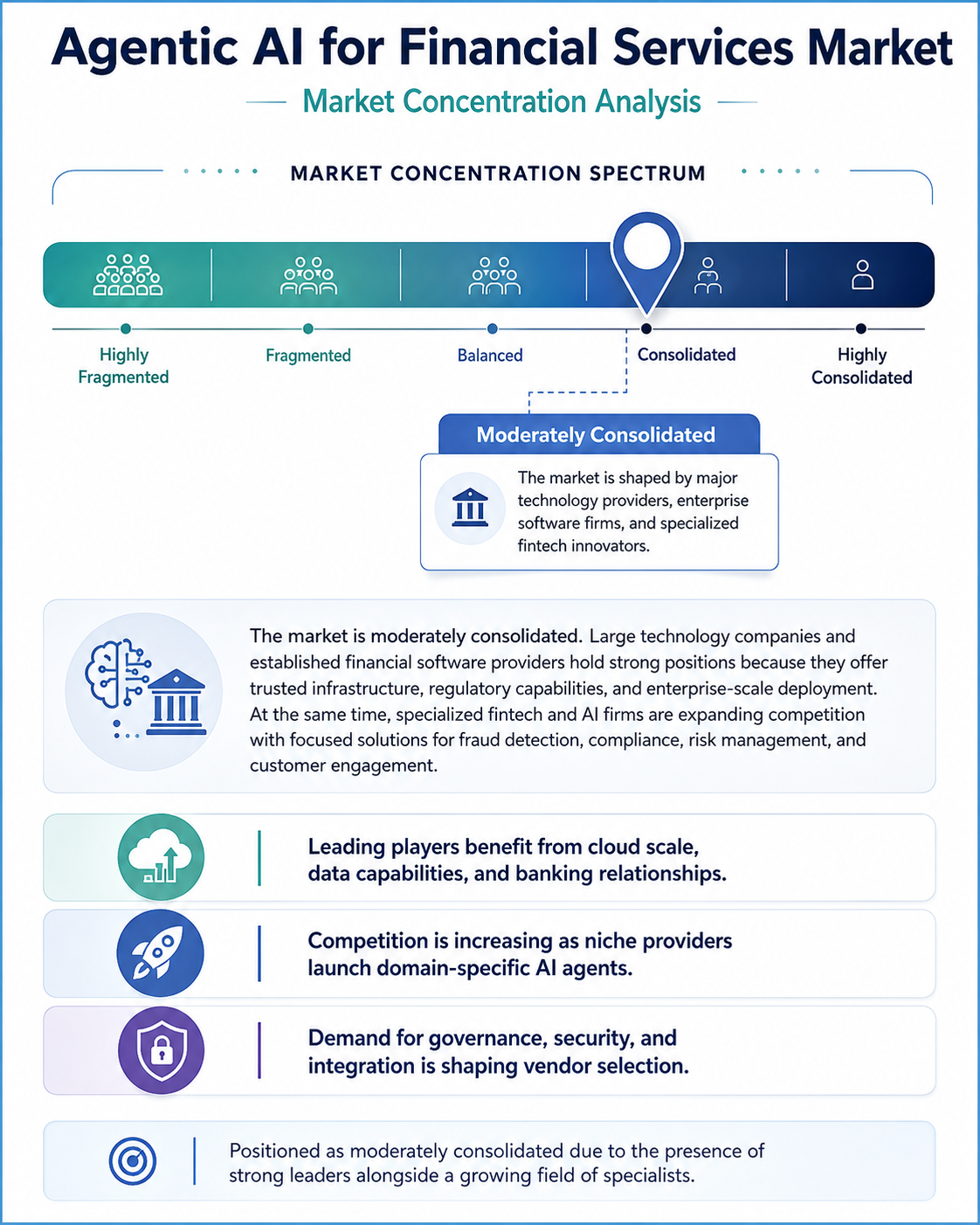
The Agentic AI for Financial Services Market is moderately consolidated, with established cloud providers, enterprise software companies, financial technology vendors, and AI platform developers holding strong positions. These companies benefit from secure cloud infrastructure, extensive financial datasets, regulatory expertise, established banking relationships, and the ability to integrate AI agents into complex enterprise systems. Agentic AI solutions are increasingly being applied across fraud detection, KYC and anti-money laundering, risk assessment, regulatory compliance, customer service, payments, and financial workflow automation.
However, the market is not controlled by only a small group of suppliers. Specialized AI companies and fintech firms are entering with focused solutions for compliance monitoring, document processing, credit assessment, investment support, and autonomous customer interactions. Cloud marketplaces and open development frameworks are also making agentic AI capabilities more accessible to smaller providers. Competition is therefore expected to increase as financial institutions demand domain-specific agents, stronger governance, transparent decision-making, data security, and reliable integration with existing banking systems.
 iThe graph shows projected market growth until 2035 based on CAGR analysis. Actual outcomes may vary depending on changing demand, competition, and economic factors.To gain greater insights - request a sample report PDF
Competitive Landscape
The market is characterized by intense competition among established players and emerging companies. Strategic partnerships, mergers and acquisitions, and product innovation are key strategies employed by market participants.
Key Market Players
International Business Machines Corporation (IBM)
Microsoft Corporation
Alphabet Inc. (Google)
Amazon Web Services, Inc.
SAS Institute Inc.
NVIDIA Corporation
Fair Isaac Corporation (FICO)
Oracle Corporation
Salesforce, Inc.
SAP SE
Moody’s Analytics, Inc.
Fidelity National Information Services, Inc. (FIS)
Fiserv, Inc.
Palantir Technologies Inc.
Temenos AG
Upstart Holdings, Inc.
Kensho Technologies, Inc.
Zest AI
Cognizant Technology Solutions Corporation
Darktrace Holdings plc
Feedzai SA
Others Key Players
Meet the Team
This report was prepared by our expert analysts with deep industry knowledge and research experience.
Prashant is a skilled research analyst with five years of practical experience in market intelligence, strategic research, and business consulting. His expertise covers primary research, secondary research, competitive benchmarking, and industry trend analysis across sectors such as semiconductors, automotive, transportation and logistics, machinery, and industrial equipment. Prashant focuses on delivering clear, data-backed insights that help clients understand market shifts, technology adoption, regulatory developments, and emerging growth opportunities.
Sayali brings more than 5 years of experience to Globe Market Research, supporting the accuracy, clarity, and relevance of research content across multiple industries. She reviews market data, segment analysis, competitive insights, and industry trends to ensure each report meets strong quality standards and provides practical value to business decision-makers. Her expertise spans healthcare, information technology, consumer goods, and diverse cross-industry domains. With a strong focus on data reliability, structured analysis, and clear presentation, Sayali helps ensure that each research output delivers well-reviewed insights for clients, investors, consultants, and industry stakeholders.
Frequently Asked Questions
Related Reports
More in Information and Technology
AI Visual Inspection System Market Revenue to Hit USD 315.2 billion by 2035
Global AI Visual Inspection System Market Size, Growth Analysis By Offering (Hardware Systems, Industrial Cameras, Sensors and Imaging Hardware, Software Platforms, AI Inspection Software, Vision Analytics Tools, Services), By Technology (Deep Learning-Based Vision Systems, Machine Learning Algorithms, Traditional Computer Vision Systems, Edge AI Vision Processing, Other AI Vision Technologies), By Application (Defect Detection & Quality Control, Assembly Verification, Measurement & Gauging, Packaging & Label Inspection, Other Industrial Inspection Applications), By Industry Vertical (Electronics & Semiconductor Manufacturing, Automotive Industry, Pharmaceuticals & Healthcare, Food & Beverage Manufacturing, Logistics & Warehousing, Other Industrial Verticals), By Regional Insights, Business plan and Project Report, Investment Opportunities, Profitability, Industry Trends, Leading Companies and Growth Forecasts By 2025-2035
Cloud Computing Market Size to Surpass USD 17.5 Trillion by 2035
Global Cloud Computing Market Size, Share Analysis By Type (Public Cloud, Private Cloud, Hybrid Cloud), By Service Model (Software as a Service, Infrastructure as a Service, Platform as a Service), By Enterprise Type (Large Enterprises, Small and Medium Enterprises), By Industry (BFSI, IT and Telecommunications, Government, Consumer Goods and Retail, Healthcare, Manufacturing, Others), By Regional Insights, Business plan and Project Report, Investment Opportunities, Profitability, Industry Trends, Leading Companies and Growth Forecasts By 2025-2035
Agentic AI in HR & Recruitment Market Size to Reach USD 120.5 billion by 2035
Global Agentic AI in HR & Recruitment Market Size, Go-to-Market and Sales Strategy Analysis By Deployment Mode (Cloud-Based, On-Premises), By Enterprises (Small and Medium Enterprises (SMEs), Large Enterprises), By Application (Talent Acquisition & Recruitment, Employee Onboarding, Employee Engagement & Retention, Workforce Analytics, Others), By End-User Industry (IT & Telecommunications, Healthcare, Retail & E-commerce, BFSI, Manufacturing, Education, Others), By Regional Insights, Business plan and Project Report, Investment Opportunities, Profitability, Industry Trends, Leading Companies and Growth Forecasts By 2025-2035
AI in Pulp and Paper Industry Market Size to Reach USD 21.3 Bn by 2035
Global AI in Pulp and Paper Industry Market Size, Go-to-Market and Sales Strategy Analysis By Component (Software, Hardware, Services), By Application (Process Optimization, Quality Control, Predictive Maintenance, Supply Chain Management, Others), By End User (Paper Manufacturers, Pulp Producers, Packaging Industry), By Regional Insights, Business plan and Project Report, Investment Opportunities, Profitability, Industry Trends, Leading Companies and Growth Forecasts By 2025-2035