

Revenue, 2025
$3.8 Bn
Forecast, 2035
$31.4 Bn
CAGR, 2026-2035
23.5%
Report Coverage
Global
Market Size and Forecast
The Agentic AI Travel Booking Platforms Market is expected to grow strongly from USD 3.8 billion in 2025 to USD 31.4 billion by 2035, supported by a CAGR of 23.5%. Market growth is driven by rising demand for automated trip planning, AI-based itinerary creation, dynamic pricing, personalized travel recommendations, and faster booking decisions across flights, hotels, and travel packages. North America led the market with 42.3% share in 2025, generating around USD 1.6 billion , supported by strong digital travel adoption , advanced AI infrastructure , and the presence of major travel technology companies.
Key Parameter | Report Details |
|---|---|
Current Revenue, 2025 | USD 3.8 Billion |
Projected Revenue, 2035 | USD 31.4 Billion |
CAGR, 2025 To 2035 | 23.5% |
Largest Region | North America |
Largest Region Revenue, 2025 | USD 1.6 Billion |
Fastest Growing Region | Asia Pacific |
Market Concentration | Medium |
Base Year | 2025 |
Forecast Period | 2025-2035 |
What Is the Agentic AI Travel Booking Platforms Market?
The Agentic AI Travel Booking Platforms Market refers to digital travel platforms that use AI agents to plan, compare, recommend, and support travel bookings with limited manual effort from users. These platforms can assist with flight selection, hotel booking, itinerary planning, price comparison, activity suggestions, travel alerts, policy-based corporate bookings, and post-booking support.
Unlike traditional travel search tools, agentic AI platforms can understand user goals, remember preferences, compare multiple options, take context into account, and guide users through booking decisions. In the future, these platforms are expected to support more advanced actions such as itinerary changes, disruption handling, loyalty optimization, and automated rebooking.
Air travel demand is also supporting platform adoption. IATA reported that international passenger demand increased by 7.1% in 2025 compared with 2024, while the international passenger load factor reached 83.5% . Higher passenger activity increases the need for smarter booking, real-time updates, schedule comparison, and disruption support.
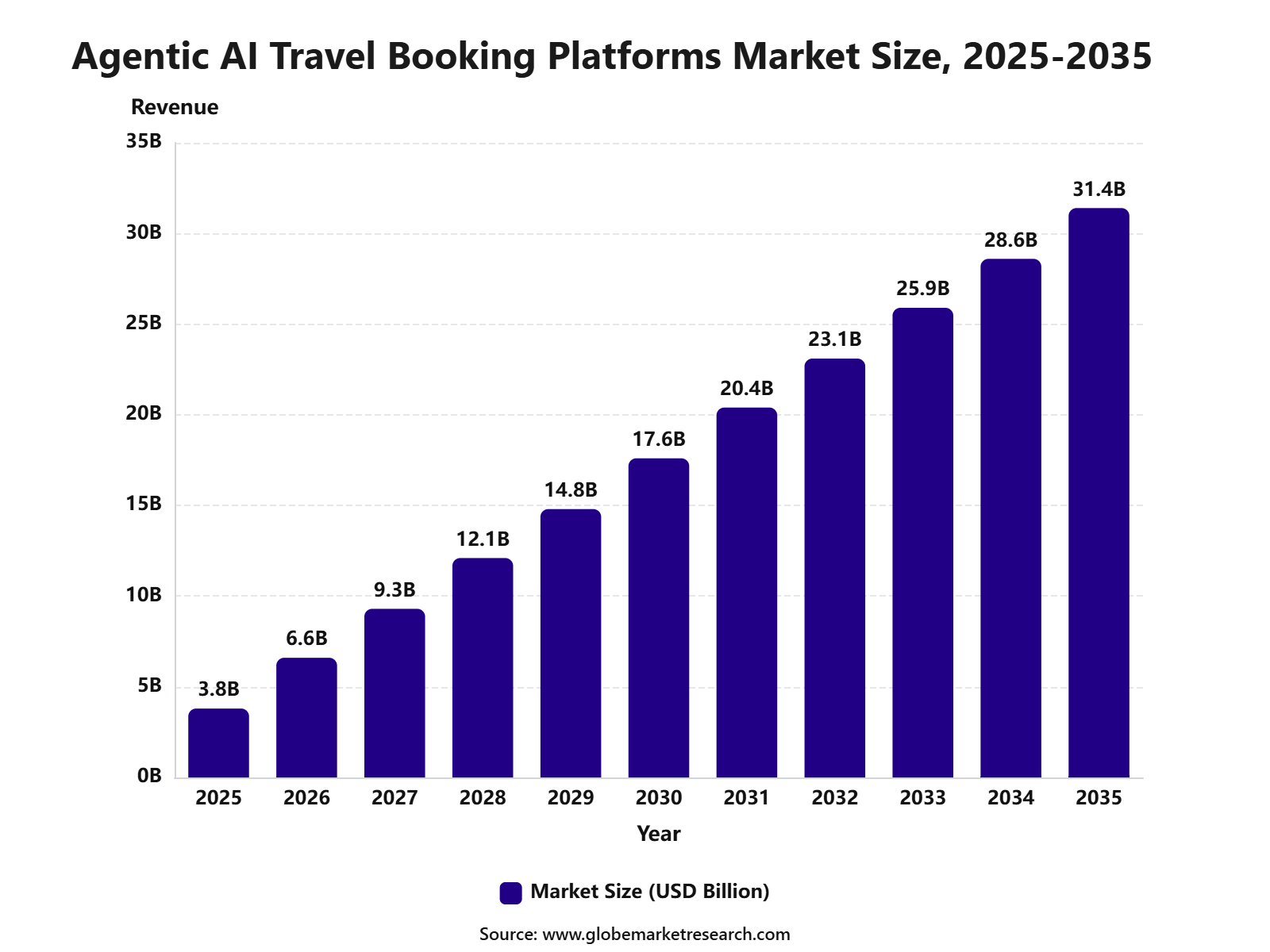 iThe graph shows projected market growth until 2035 based on CAGR analysis. Actual outcomes may vary depending on changing demand, competition, and economic factors.To gain greater insights - request a sample report PDF
Key Market Insights
By Technology, Autonomous Price Comparison led the market with 36.3% share in 2025, supported by rising demand for real-time fare tracking and automated booking decisions.
By User Type, Business Travelers accounted for an estimated 47.5% share in 2025, driven by frequent trip planning, corporate travel policies, and demand for time-saving digital tools.
North America held 42.3% share in 2025, supported by high digital travel adoption, strong online booking infrastructure, and early use of AI-based travel platforms.
AI Agents Are Becoming More Practical for Travel
AI agents are entering travel at a time when enterprises are already moving beyond basic generative AI use cases. Deloitte projected that 25% of enterprises using generative AI would deploy AI agents in 2025, increasing to 50% by 2027. This broader enterprise shift is expected to support adoption of agentic systems in travel, hospitality, aviation, and corporate booking platforms. Travel companies are also building more AI-led booking experiences.
Expedia Group announced new AI travel planning features in 2026, including an Activity Planner that uses natural language to help travelers describe the trip they want and turn open-ended ideas into personalized, bookable itineraries. AI can help travelers discover better options, but trust remains a major factor in actual booking. Expedia Group research in 2026 found that travelers are open to using AI chatbots and agents for trip planning, with 53% comfortable letting them help plan a trip.
However, the same research highlighted that trusted brands remain important when travelers move from discovery to booking. This is important for market growth because agentic AI travel platforms will need to combine automation with transparency. Users will expect clear pricing, reliable availability, secure payments, verified reviews, refund visibility, and human support when needed.
Top Funding and Investment Highlights
The Agentic AI Travel Booking Platforms Market is gaining investor attention as travel platforms move from simple itinerary suggestions to AI systems that can search, compare, personalize, assist, and support booking decisions. Investment is being driven by AI-native travel assistants, corporate travel automation, conversational booking, real-time fare discovery, itinerary building, and post-booking support.
Travel startup funding remains selective in 2026, but AI-driven travel companies are still attracting capital because investors are favoring platforms with clear revenue impact, workflow automation, API connectivity, and booking conversion potential. In Q1 2026, travel startups raised around USD 1 billion across 44 rounds, down from nearly USD 1.2 billion across 66 rounds in the same period of 2025, showing that funding is tighter but still active for AI-led models.
Company / Platform | Latest Signal | Investment Meaning |
|---|---|---|
Perk, formerly TravelPerk | Raised USD 200 million Series E in 2025 at a USD 2.7 billion valuation, with funding directed toward product, technology, AI, and U.S. expansion | Confirms strong capital flow into AI-enabled business travel and expense automation |
Perk | Secured USD 300 million private credit facility in 2026 | Supports global growth of AI-native travel and spend management platforms |
Navan | Raised about USD 923.1 million through IPO in 2025 | Shows public-market appetite for corporate travel, payments, expense, and AI-enabled booking platforms |
Airial Travel | Raised USD 3 million seed funding in 2025 | Highlights interest in AI agents that convert TikTok, Instagram Reels, and travel blogs into bookable itineraries |
TinyFish | Raised USD 47 million Series A in 2025 | Supports AI web agents for retail and travel tasks such as price monitoring, inventory tracking, and competitor intelligence |
Technology Insights
Autonomous price comparison led the technology segment with 36.3% share in 2025. The segment is gaining strong adoption because travel buyers need faster comparison across flights, hotels, packages, loyalty benefits, refund rules, baggage fees, and booking conditions. Unlike basic search filters, agentic AI tools can read user intent, compare multiple travel options, track price changes, and recommend the most suitable booking choice with less manual effort.
Growth is also supported by rising use of AI in travel discovery and booking support. A 2025 global consumer study reported that more than half of travelers were ready for AI agents to plan and book entire trips, while around 80% of respondents across airlines, hotels, and travel platforms were using generative AI tools. The same study highlighted that AI agents can monitor price changes in real time, integrate loyalty points, and support travelers when plans change.
User Type Insights
Business travelers led the user type segment with an estimated 47.5% share in 2025. This dominance can be attributed to the frequent need for fast booking, policy-compliant travel options, multi-city itinerary planning, expense control, rebooking support, and loyalty management. Business travelers also have less flexibility during disruptions, which makes AI-supported booking, alerts, and itinerary updates more valuable.
The segment is strongly supported by business travel recovery. Global business travel spending was forecast to reach USD 1.57 trillion in 2025 , while the U.S. was projected to be the largest business travel market at USD 395.4 billion . A survey of more than 7,300 business travelers across 33 countries also found that 86% rated business trips as worthwhile, and 74% took between one and five work trips in the past year.
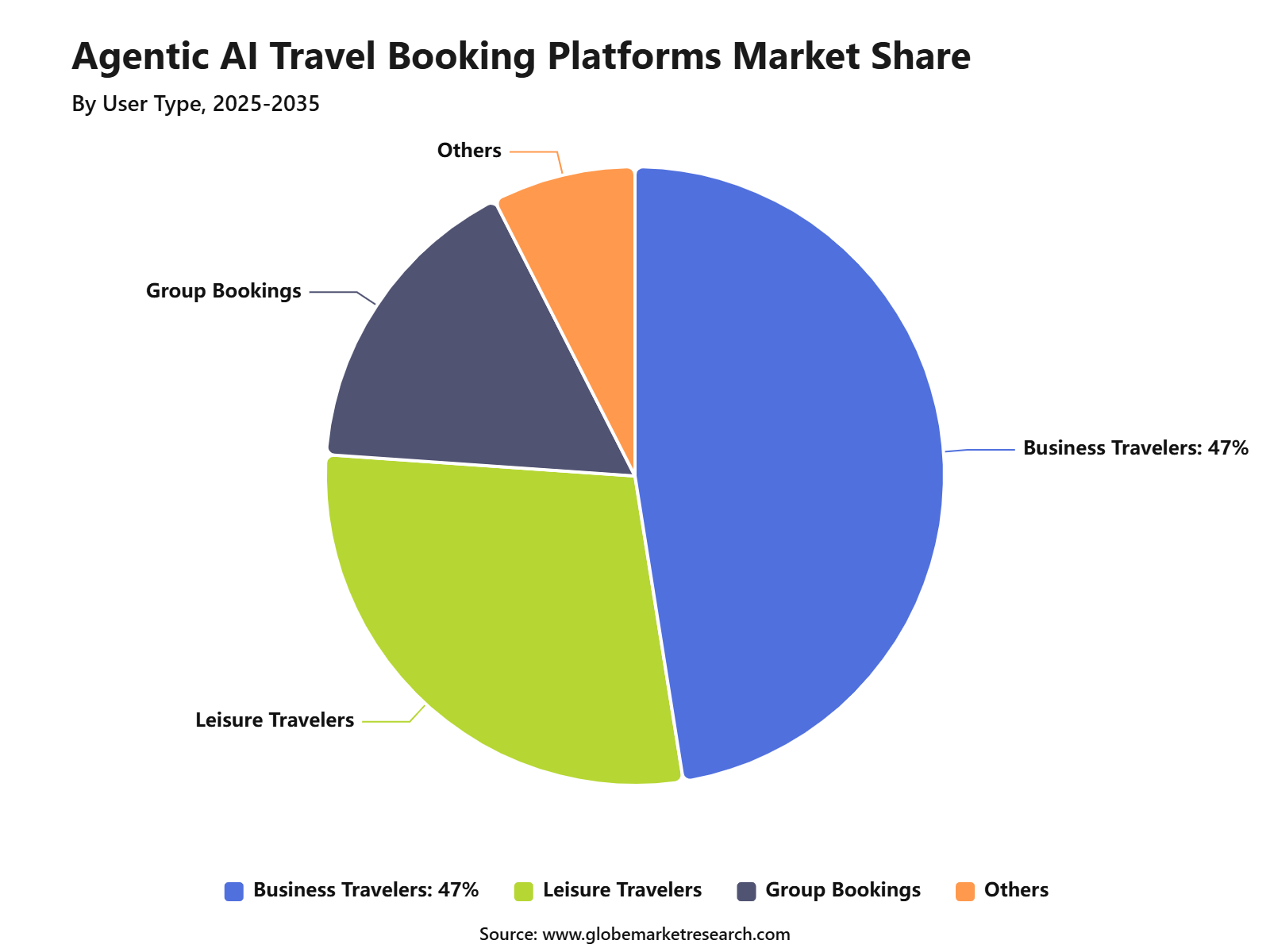 iThe graph shows projected market growth until 2035 based on CAGR analysis. Actual outcomes may vary depending on changing demand, competition, and economic factors.To gain greater insights - request a sample report PDF
Region Insights
North America accounted for 42.3% share of the Agentic AI Travel Booking Platforms Market in 2025. The region benefits from strong business travel demand, high digital booking adoption, large online travel ecosystems, and early use of AI-enabled customer service and itinerary management tools. Strong corporate travel activity in the U.S. also supports demand for agentic booking platforms that can reduce booking time and improve travel-policy compliance.
Digital travel behavior is also moving in favor of agentic booking. IATA’s 2025 passenger survey found that 54% of travelers wanted to deal directly with airlines, while web apps became the preferred booking choice for 19% of travelers, up from 16% in 2024. In addition, 78% of passengers wanted to use a smartphone that combines a digital wallet, digital passport, and loyalty cards to book, pay, and move through airport processes.
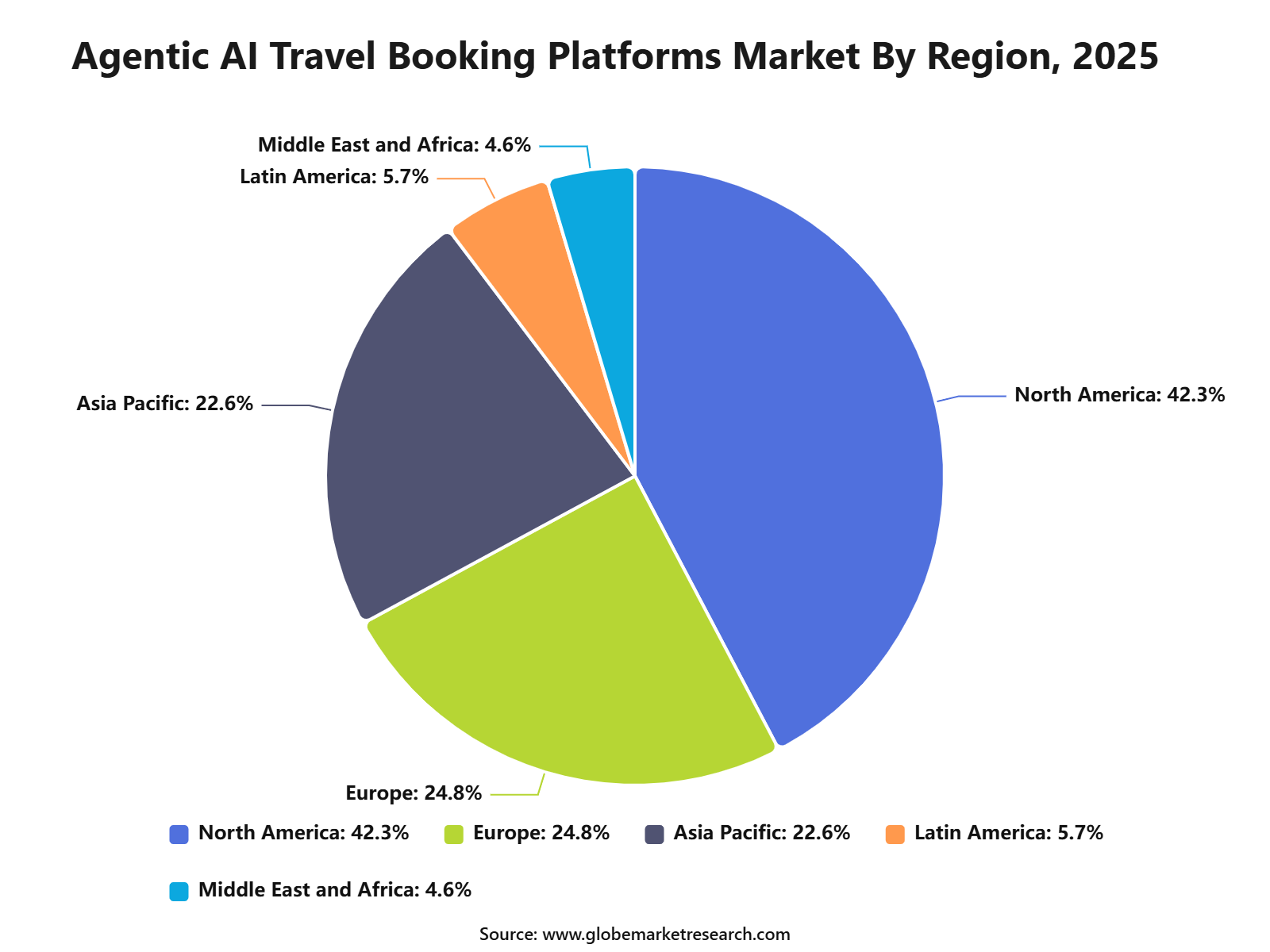 iThe graph shows projected market growth until 2035 based on CAGR analysis. Actual outcomes may vary depending on changing demand, competition, and economic factors.To gain greater insights - request a sample report PDF
Regional Impact Analysis
North America is expected to remain a strong value region due to advanced online travel adoption, corporate travel spending, AI startup activity, and strong digital payment infrastructure. The U.S. is likely to lead regional adoption because of its large business travel base and mature travel technology ecosystem.
Asia Pacific offers strong future growth through rising outbound travel, mobile-first booking, digital wallets, and expanding middle-class travel demand. Europe remains important due to cross-border travel, rail-air journey planning, and demand for transparent policy-compliant booking tools.
Impact Factor | Estimated CAGR Impact | Regional Relevance | Market Impact |
|---|---|---|---|
North America digital travel maturity | +5.2% | U.S. and Canada | Leads value adoption. |
U.S. corporate travel automation | +4.0% | U.S. | Drives enterprise demand. |
Asia Pacific mobile-first travel growth | +3.8% | China, India, Japan, Southeast Asia | Builds future scale. |
Europe cross-border travel complexity | +3.0% | Germany, UK, France, Italy | Supports itinerary automation. |
Middle East premium travel growth | +2.3% | UAE, Saudi Arabia, Qatar | Adds high-value demand. |
Segment Covered in the Report
By Technology
AI Trip Planning Agents
Machine-Readable Rate APIs
Loyalty Integration
Autonomous Price Comparison
Others
By User Type
Business Travelers
Group Bookings
Leisure Travelers
Others
By Region
North America
Europe
Asia Pacific
Latin America
Middle East and Africa
Go-To-Market and Sales Economics
Agentic AI travel booking platforms are moving from simple trip-planning chatbots to action-based assistants that can search, compare, personalize, and help complete travel bookings with user approval. The go-to-market opportunity is supported by strong travel demand, as global travel and tourism is forecast to contribute USD 12 trillion to the world economy in 2026 and support 376 million jobs. Digital innovation and AI are also being identified as key tools for improving traveler experience and operational efficiency.
Air travel demand remains a strong commercial base for these platforms. Full-year passenger demand increased by 5.3% in 2025, while international demand rose by 7.1%, supported by a record industry load factor of 83.6%. This creates a large transaction pool for AI-led trip discovery, itinerary building, rebooking, ancillary sales, and post-booking support.
Revenue Potential Analysis
Revenue Landscape Across
Revenue potential is strongest across online travel agencies, airline direct channels, hotel booking platforms, corporate travel tools, metasearch platforms, travel fintech, loyalty programs, and super apps. The most attractive revenue pools are expected to come from flight and hotel booking conversion, ancillary products, premium itinerary planning, travel insurance, airport services, eSIMs, ground transport, activity bookings, and paid subscription features. Agentic AI can improve monetization because it reduces search effort and guides users from intent to transaction in fewer steps.
Large travel platforms are already positioning AI as a distribution and conversion layer. Booking.com has developed AI Trip Planner, Smart Filters, Property Q&A, and AI review summaries to make travel search more intent-driven and personalized. Smart Filters use natural language prompts and analyze reviews, images, and listing details to surface more relevant results, which is directly linked to higher engagement and conversions.
Expedia is also expanding AI-led travel experiences, with new AI-powered traveler tools, partnerships, and marketplace capabilities aimed at making the platform a broader travel companion beyond basic booking. Its 2026 updates include AI capabilities, ground mobility, merchandising tools, and partnerships that help companies embed end-to-end travel experiences into their own customer journeys.
Financial Impact
The main financial impact will come from higher booking conversion, lower customer acquisition cost, improved attach rates, and lower service cost. Agentic AI can recommend bundled options such as hotels, flights, transfers, insurance, activities, and eSIMs based on user intent. This can raise average order value because users are offered relevant add-ons at the planning stage instead of after checkout.
A second financial benefit is customer-service automation. Travel is highly service-heavy because users often need support for cancellations, changes, refunds, delays, visa questions, baggage, and payment issues. AI agents can reduce repetitive support volume and route complex cases to human teams. This model is especially useful for online travel agencies, airlines, and travel management companies that handle high seasonal query loads.
Risk Factors and Market Barriers
Risk Factors
The biggest risk is trust at the point of payment. Consumers may accept AI for search, comparison, and itinerary support, but they are more cautious when money, passports, refunds, and non-refundable bookings are involved. HUMAN Security reported that AI-driven traffic grew 187% in 2025, with travel and hospitality among the top affected industries, while agentic browser traffic grew 7,851% year over year. This shows strong activity, but also raises concerns around control, fraud, and accountability.
Accuracy is another major risk. Travel information changes quickly across fares, room availability, visa rules, baggage policies, weather disruptions, strikes, and cancellation terms. If an AI agent recommends outdated information or books the wrong option, the platform may face refund losses, chargebacks, poor reviews, and regulatory scrutiny. Therefore, real-time inventory access, verified supplier APIs, and clear user approval steps will be required.
Regulatory exposure is also rising. From August, 2026, EU AI Act transparency obligations apply to certain AI-generated content and AI interactions, including rules related to marking, detection, and disclosure. Travel platforms using AI agents will need stronger transparency, audit trails, human oversight, and clear disclosure when users are interacting with AI systems.
Market Barriers
Integration complexity is a major barrier. Agentic travel platforms must connect with global distribution systems, airline APIs, hotel inventory systems, payment gateways, loyalty databases, insurance partners, identity verification tools, cancellation engines, and customer support systems. This requires strong data governance and supplier partnerships, which can be difficult for new entrants.
The second barrier is platform dependency. Travel brands may gain traffic from AI assistants, but they also risk losing direct customer relationships if discovery shifts to third-party AI interfaces. This is why many travel companies are likely to build their own AI layers while also integrating with external AI ecosystems.
The third barrier is compliance with digital platform rules. In Europe, Booking.com has been required to comply with the Digital Markets Act, including restrictions on parity clauses and requirements around data access for business users. These rules can affect pricing strategy, supplier relationships, data portability, and competitive positioning across travel booking platforms.
Emerging Trends
Agent-led travel discovery is becoming a new booking layer: Travel booking is shifting from manual search to agent-led discovery, where AI tools can interpret traveler intent, compare options, and support booking decisions. Industry analysis in 2026 stated that travel and hospitality discovery, comparison, booking, and service are increasingly being mediated by intelligent agents acting on behalf of guests. This trend is expected to change how travelers find airlines, hotels, and travel packages.
Voice-based and conversational booking is gaining traction: Travel platforms are moving toward natural voice and chat-led booking experiences. In 2026, a major travel platform launched an AI-native app with natural voice interaction, personalized travel recommendations, and agentic features that can manage travel tasks in the background. Its AI assistant resolved 3.81 million customer queries in Q3 FY26, compared with 2.11 million in Q4 FY25, showing rising acceptance of AI-led travel support.
Real-time disruption support is becoming more important: Travelers increasingly expect booking platforms to manage changes after the booking is completed. Agentic AI tools are being designed to update boarding passes, monitor gate changes, send alerts, adjust itineraries, and support rebooking during delays or cancellations. This is especially important for business travelers, where missed connections and schedule changes can create direct financial and operational impact.
Loyalty and personalization are becoming core features: Agentic AI booking platforms are improving by using traveler preferences, past booking behavior, loyalty status, budget limits, seat choices, hotel preferences, and company travel rules. This allows platforms to suggest more relevant options rather than only the cheapest option. In travel, personalization is becoming important because travelers want platforms that remember preferences and reduce decision effort.
Drivers Impact Analysis
The Agentic AI Travel Booking Platforms Market is driven by rising demand for automated trip planning, real-time fare comparison, personalized itinerary creation, and faster booking decisions. These platforms help travelers compare flights, hotels, transport, activities, budgets, and policy rules with less manual effort.
Growth is also supported by business travel automation, dynamic pricing, API-connected travel inventory, and AI assistants that can manage multi-step booking tasks. Travel companies are adopting agentic AI to reduce service load, improve conversion, and offer more personalized booking experiences.
Impact Factor | Estimated CAGR Impact | Regional Relevance | Market Impact |
|---|---|---|---|
Rising demand for automated travel planning | +6.2% | North America, Europe, Asia Pacific | Drives core platform adoption. |
Growth in real-time fare and hotel comparison | +5.4% | Global online travel markets | Improves booking decisions. |
Expansion of personalized itinerary tools | +4.8% | Business and leisure travel hubs | Builds user engagement. |
Increasing business travel automation | +4.1% | U.S., Europe, Asia Pacific | Supports corporate adoption. |
API-based travel inventory integration | +3.5% | Digital travel ecosystems | Expands booking coverage. |
Restraints Impact Analysis
The market faces restraints from data privacy concerns, booking accuracy risk, and dependency on travel supplier integrations. Agentic AI systems need access to user preferences, payment details, trip history, loyalty data, and live inventory, which raises trust and compliance requirements.
Another restraint is user hesitation around fully autonomous bookings. Many travelers still prefer human review before confirming expensive trips, complex itineraries, visa-linked travel, cancellation policies, or business travel bookings.
Impact Factor | Estimated CAGR Impact | Regional Relevance | Market Impact |
|---|---|---|---|
Data privacy and security concerns | -3.2% | North America, Europe, Asia Pacific | Slows user trust. |
Risk of incorrect booking decisions | -2.8% | Global travel platforms | Affects customer confidence. |
Dependence on supplier API access | -2.4% | Airlines, hotels, OTAs | Limits platform completeness. |
Low trust in fully autonomous purchases | -2.0% | Consumer and business travelers | Slows conversion. |
Regulatory and payment compliance burden | -1.7% | U.S., Europe, developed Asia | Raises operating complexity. |
Opportunities Impact Analysis
Opportunities are strong in autonomous price comparison, AI-powered itinerary planning, corporate travel assistants, voice-based travel agents, and post-booking trip management. These features can help users plan, book, change, cancel, and optimize travel through one intelligent interface.
Higher-value opportunities are also emerging in business traveler platforms, group booking automation, loyalty optimization, and personalized travel marketplaces. Platforms that combine accuracy, transparency, and human-in-the-loop controls can capture stronger long-term adoption.
Impact Factor | Estimated CAGR Impact | Regional Relevance | Market Impact |
|---|---|---|---|
Autonomous price comparison tools | +6.0% | Global travel booking markets | Builds core demand. |
AI itinerary planning platforms | +5.2% | Leisure and business travel hubs | Improves planning experience. |
Corporate travel automation | +4.5% | North America, Europe, Asia Pacific | Adds high-value users. |
Group booking and event travel tools | +3.8% | Business, education, tourism sectors | Expands use cases. |
Loyalty and rewards optimization | +3.2% | Mature travel markets | Supports premium engagement. |
Challenges Impact Analysis
The main challenge is ensuring that AI agents make reliable decisions across live prices, availability, cancellation rules, loyalty benefits, baggage policies, visa rules, and traveler preferences. Travel data changes quickly, so outdated or incomplete information can cause booking errors.
Another challenge is balancing automation with control. Users want faster booking, but they also need clear explanations, approval checkpoints, refund visibility, and easy escalation to customer support when travel plans change.
Impact Factor | Estimated CAGR Impact | Regional Relevance | Market Impact |
|---|---|---|---|
Maintaining live data accuracy | -3.0% | Global travel platforms | Reduces booking errors. |
Managing complex travel rules | -2.6% | Airlines, hotels, corporate travel | Adds decision complexity. |
Balancing automation with user control | -2.2% | Consumer and enterprise users | Affects adoption comfort. |
Handling cancellations and disruptions | -1.9% | Global travel markets | Raises service expectations. |
Preventing AI hallucination in bookings | -1.6% | Digital travel platforms | Protects user trust. |
Recent Developments
Expedia Group has been actively expanding its AI-led travel ecosystem. In May 2026, the company introduced new AI travel experiences and expanded partnerships with companies such as CLEAR and Uber. This development shows that AI travel booking platforms are becoming more connected with identity verification, ground mobility, hotel discovery, and post-booking services. For the market, this strengthens Expedia’s role as a core infrastructure provider for AI-driven travel journeys.
Uber also entered deeper into travel booking through its partnership with Expedia Group. In April 2026, Uber announced hotel booking features inside its app, supported by Expedia’s lodging inventory. This is an important development because travel booking is moving into non-traditional platforms where users already manage mobility, payments, and daily services. It also shows how agentic AI travel experiences may grow through embedded booking rather than only through standalone travel apps.
OpenAI has also become an important player in the market through travel app integrations. Booking.com and Expedia were included among early partners for apps inside ChatGPT, allowing users to explore travel options within a conversational interface. This development is important because conversational AI is becoming a new discovery layer for travel search, hotel selection, itinerary planning, and trip comparison.
Research Methodology
Methodology Area | Coverage Details |
|---|---|
Primary Research | Interviews with manufacturers, suppliers, distributors, consultants, procurement teams, and industry experts. |
Secondary Research | Company filings, annual reports, regulatory databases, government publications, trade associations, and verified industry sources. |
Data Validation | Cross-verification through source triangulation, historical trend review, demand-side checks, and supply-side assessment. |
Market Estimation | Bottom-up and top-down analysis based on product demand, regional consumption, company presence, and application-level usage. |
Forecasting Approach | Forecasts based on regulatory shifts, infrastructure investment, technology adoption, pricing trends, industrial expansion, and end-use demand. |
Quality Review | Analyst review, peer validation, outlier checks, internal consistency review, and final publication approval. |
AI Policy | AI is not used as a primary data source. All published insights are reviewed against human-verified evidence. |
Market Concentration
The Agentic AI Travel Booking Platforms Market has medium market concentration.
It is not highly concentrated because the market is still emerging and includes many participants, such as online travel agencies, AI travel assistants, search platforms, hotel groups, airline platforms, travel startups, and enterprise travel providers. New AI-native players are entering the space, while established travel brands are adding agentic tools for itinerary planning, real-time search, booking support, trip changes, and personalized recommendations.
However, it is not low concentration because large digital travel platforms and major technology companies have strong control over user access, travel inventory, payments, loyalty data, and booking trust. Expedia reported in 2026 that nearly 70% of travelers still prefer booking with trusted travel brands over AI chatbots and agents, which shows that established brands continue to hold strong influence at the booking stage.
Google has also expanded AI-powered travel planning and booking features, including AI Mode tools for travel planning, flight deals, and agentic actions across reservation platforms. This indicates that large search and AI platforms may become important gateways for travel discovery and booking decisions. Expedia and Booking.com are also integrating their services with AI agents and large language model platforms, showing that competition is shifting from simple OTA booking to AI-driven travel orchestration.
Exact Classification: Medium Concentration
Market Structure: Moderately Concentrated and Emerging
Reason: The supplier base is expanding with startups and AI tools, but large OTAs, search platforms, hotel groups, and AI ecosystem owners hold stronger control over inventory access, customer trust, payments, and booking conversion.
Competitive Landscape
The market is characterized by intense competition among established players and emerging companies. Strategic partnerships, mergers and acquisitions, and product innovation are key strategies employed by market participants.
Key Market Players
Booking.com
Expedia Group
OpenAI
Navan
MakeMyTrip
Trip.com Group
KAYAK
Hopper
Priceline
TravelPerk
Amadeus IT Group
Tripadvisor
Other Key Players
Meet the Team
This report was prepared by our expert analysts with deep industry knowledge and research experience.
Prashant is a skilled research analyst with five years of practical experience in market intelligence, strategic research, and business consulting. His expertise covers primary research, secondary research, competitive benchmarking, and industry trend analysis across sectors such as semiconductors, automotive, transportation and logistics, machinery, and industrial equipment. Prashant focuses on delivering clear, data-backed insights that help clients understand market shifts, technology adoption, regulatory developments, and emerging growth opportunities.
Sayali brings more than 5 years of experience to Globe Market Research, supporting the accuracy, clarity, and relevance of research content across multiple industries. She reviews market data, segment analysis, competitive insights, and industry trends to ensure each report meets strong quality standards and provides practical value to business decision-makers. Her expertise spans healthcare, information technology, consumer goods, and diverse cross-industry domains. With a strong focus on data reliability, structured analysis, and clear presentation, Sayali helps ensure that each research output delivers well-reviewed insights for clients, investors, consultants, and industry stakeholders.
Frequently Asked Questions
Related Reports
More in Information and Technology
Answer Engine Optimization (AEO) Market Size to Reach USD 91.3 Billion By 2035
Global Answer Engine Optimization (AEO) Market Size, Go-to-Market and Sales Strategy Analysis By Offering (Software / Platforms, Services), By Deployment Mode (Cloud-based, On-premises), By Organization Size (SMEs, Large Enterprises), By Channel Type (Search Engines, AI Chat Interfaces, Voice Search), By Functionality (Query & Intent Optimization, NLP / Semantic Optimization, Analytics & Performance Tracking), By End-Use Industry (BFSI, Retail & E-commerce, Healthcare, IT & Telecom, Media & Entertainment, Others), By Regional Insights, Business plan and Project Report, Investment Opportunities, Profitability, Industry Trends, Leading Companies and Growth Forecasts By 2025-2035
5G RAN Market Size to hit USD 108.5 billion by 2035
Global 5G RAN Market Size, Go-to-Market and Sales Strategy Analysis By Component (Hardware, Software, Services), By Architecture Type (Traditional RAN, Open RAN), By Deployment (Public Networks, Private Networks), By End Use (Telecom Operators, Enterprise and Industrial Users), By Regional Insights, Business plan and Project Report, Investment Opportunities, Profitability, Industry Trends, Leading Companies and Growth Forecasts By 2025-2035
Online Dating Market Size to hit USD 29.5 Bn by 2035
Global Online Dating Market Size, Go-to-Market Strategy Analysis By Type (Paying Online Dating, Non-Paying Online Dating), By Revenue Model (Subscription, Advertising-Supported, Other Model), By Platform (Web Portals, Applications), By Age Group (Adult, Baby Boomer, Generation X, Generation Z, Millennials), By Regional Insights, Business plan and Project Report, Investment Opportunities, Profitability, Industry Trends, Leading Companies and Growth Forecasts By 2025-2035
AI In Interior Design Market Size to hit USD 37.7 billion by 2035
Global AI In Interior Design Market Size, Go-to-Market Strategy Analysis By Component (Solution, Service), By Deployment (Cloud, On-Premises), By User Type (Homeowners, Real Estate Developers, Interior Designers, Architects, Corporate Clients), By Design Style (Traditional, Modern, Contemporary, Minimalist, Eclectic), By Technology Integration (3D Visualization Tools, Virtual Reality Solutions, Augmented Reality Applications, CAD Software, Machine Learning Algorithms), By Application (Residential Design, Commercial Design, Hospitality Design, Retail Spaces, Office Spaces), By Pricing Strategy (Subscription-Based, Freemium Model, Pay-Per-Use, One-Time License, Enterprise Licensing, Project-Based Pricing), By Regional Insights, Business plan and Project Report, Investment Opportunities, Profitability, Industry Trends, Leading Companies and Growth Forecasts By 2025-2035