

Revenue, 2025
$13.9 Bn
Forecast, 2035
$29.5 Bn
CAGR, 2025-2035
7.7%
Report Coverage
Global
Market Size and Forecast
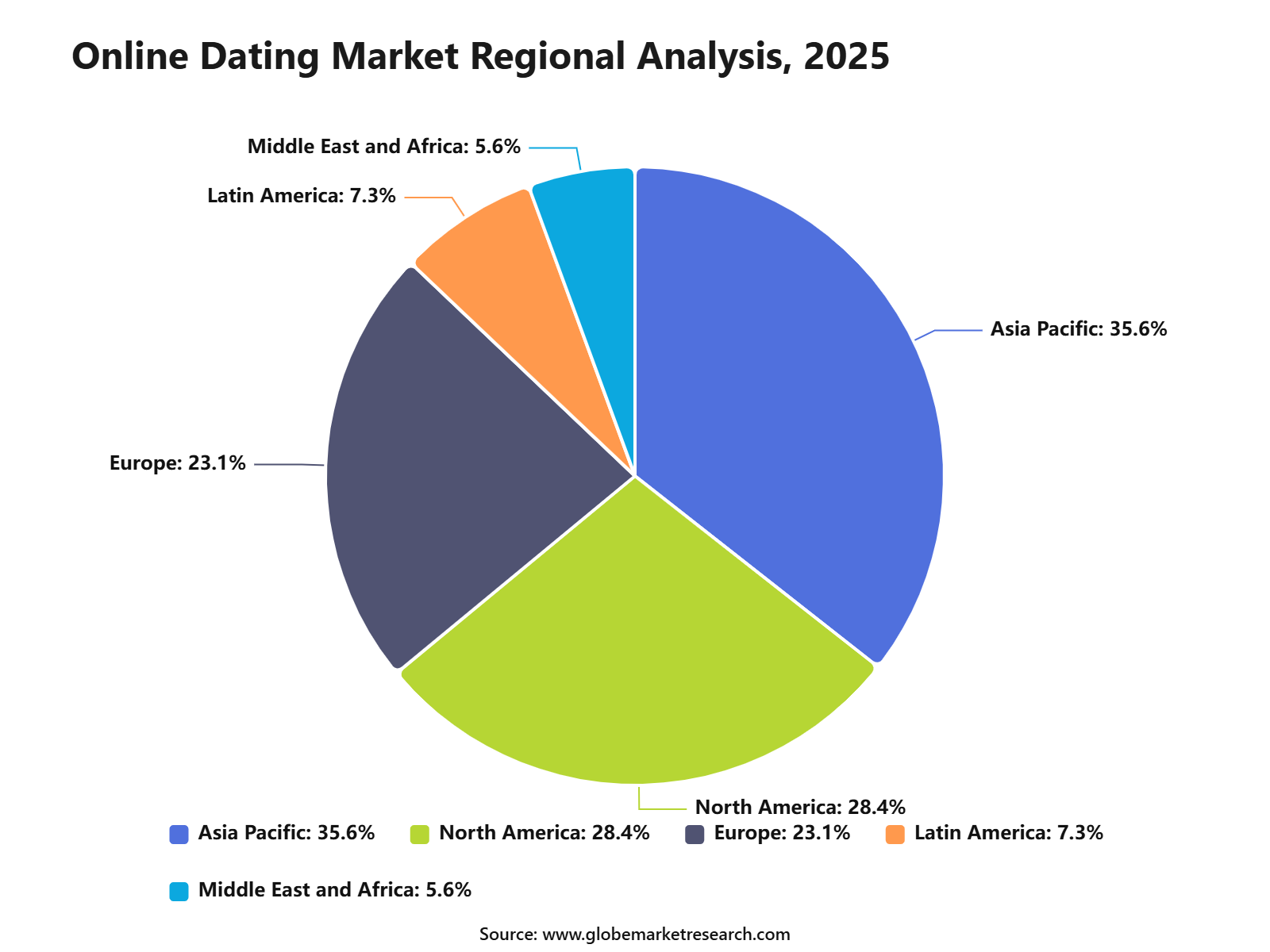
The Global Online Dating Market was worth USD 13.9 billion in 2025 and is expected to reach USD 29.5 billion by 2035, growing at a CAGR of 7.7% from 2025 to 2035. Asia Pacific held the largest regional share of 35.6% in 2025, supported by rising smartphone penetration, growing internet access, increasing acceptance of digital matchmaking, and strong adoption of dating apps among urban and younger populations.
The Online Dating Market includes digital platforms, mobile applications, and web-based services that help users connect, communicate, and build personal or romantic relationships. These platforms use profile matching, location-based search, subscription models, video interaction, identity verification, and AI-based recommendation tools. The market is widely used by individuals across different age groups and is closely linked with mobile technology, social networking, digital payments, and changing relationship preferences.
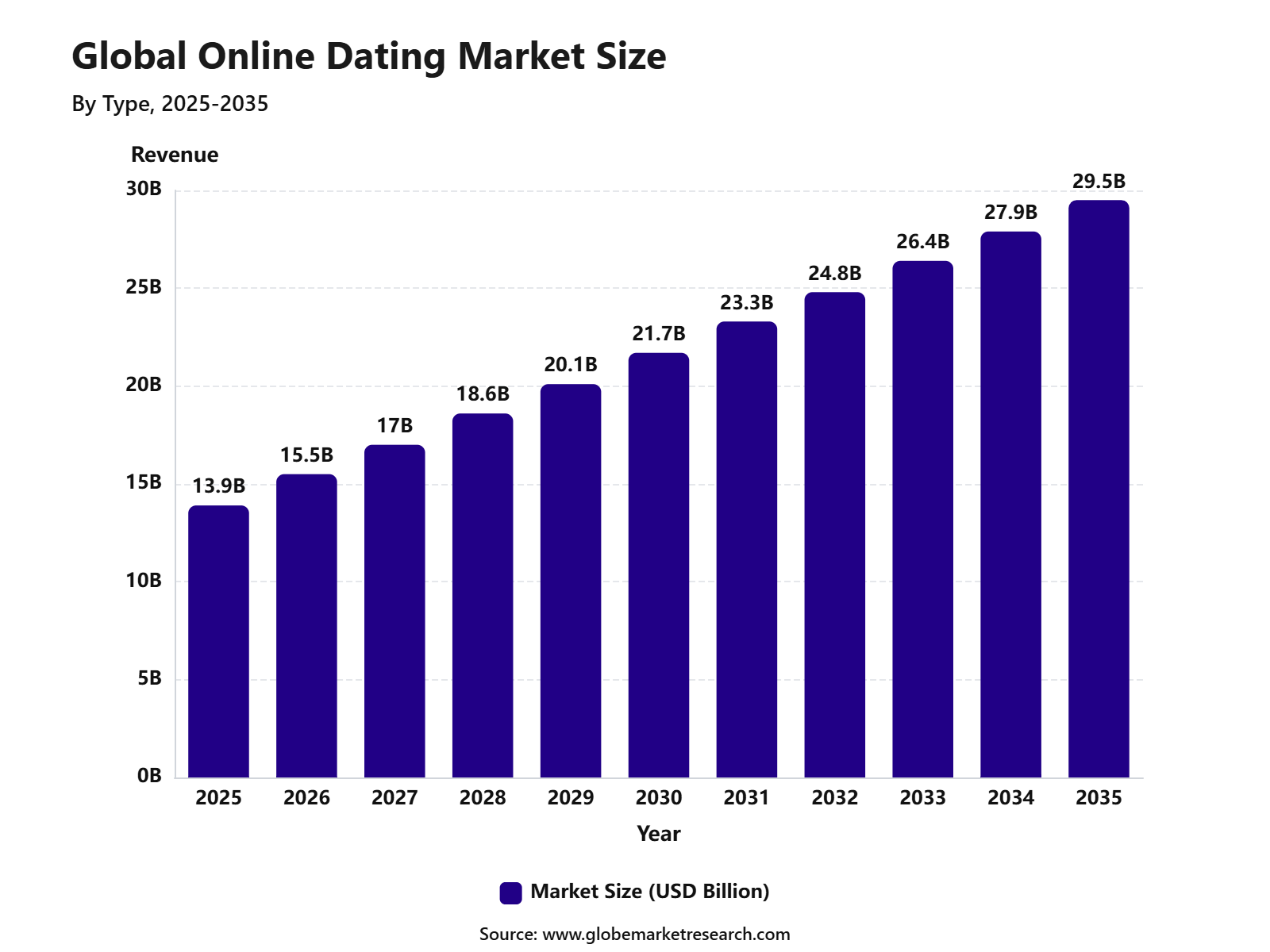 iThe graph shows projected market growth until 2035 based on CAGR analysis. Actual outcomes may vary depending on changing demand, competition, and economic factors.To gain greater insights - request a sample report PDF
The market outlook remains positive as consumers continue to prefer convenient, personalized, and app-based ways to meet new people. Growth can be attributed to rising digital lifestyles, increasing use of AI-powered matchmaking, and wider adoption of premium dating subscriptions. The expansion of video dating, safety-focused features, regional language platforms, and niche dating communities is expected to support long-term market growth.
Report Highlights | Details |
|---|---|
Market Revenue (2025) | USD 13.9 Billion |
Forecast Revenue (2035) | USD 29.5 Billion |
CAGR (2025-2035) | 7.7% |
Base Year for Estimation | 2025 |
Historic Data | 2020-2024 |
Forecast Period | 2025-2035 |
Key Market Insights
Paying online dating led the type segment with 70.5% share, supported by user demand for premium matchmaking, advanced filters, ad-free experiences, profile boosts, and stronger privacy features.
Subscription accounted for 55.5% share by revenue model, driven by recurring paid plans, tiered memberships, and steady user willingness to pay for better dating outcomes.
Applications held 86.3% share by platform, supported by mobile-first usage, real-time messaging, location-based matching, push notifications, and easier access to dating services.
Millennials represented 35.9% share by age group, driven by high smartphone usage, comfort with digital relationships, and strong adoption of app-based dating platforms.
Asia Pacific led the online dating market with 35.6% share, supported by rising smartphone penetration, expanding internet access, urban youth adoption, and growing acceptance of digital matchmaking.
Agentic AI in Online Dating
Agentic AI is expected to shift the Online Dating Market from passive swiping to active, intent-based matchmaking. AI agents can learn user preferences, relationship goals, communication style, lifestyle choices, and safety needs, then recommend more suitable matches. This can reduce swipe fatigue and improve user experience by making dating apps more guided and personalized.
The strongest impact will be seen in profile coaching, match screening, conversation support, date planning, and premium feature personalization. AI agents can help users improve bios, select better photos, suggest opening messages, summarize shared interests, and recommend safe public places for first meetings. For dating platforms, this can improve engagement, paid subscriptions, and user retention.
However, trust will remain a key barrier. Users may accept AI for practical support, but many may reject dating experiences that feel automated or artificial. Platforms must keep users in control, clearly disclose AI use, protect private data, and prevent misuse such as fake profiles, scam messages, and AI-generated manipulation. The best market impact will come when agentic AI supports real human connection rather than replacing it.
Adoption and Usage Areas Indicators
According to Pew Research Center, The Online Dating Market is supported by strong consumer adoption, especially among younger adults, LGB users, and never-married adults. Around 30% of U.S. adults have used a dating site or app, while usage rises to 53% among adults under 30 and 51% among LGB adults.
The main use cases include long-term partner search at 44%, casual dating at 40%, and friendship at 22%. However, trust and safety remain major concerns, as 52% of users reported possible scam encounters and 60% of adults support background checks before profile creation. This shows that future growth will depend on better verification, safer user experience, and stronger paid feature value.
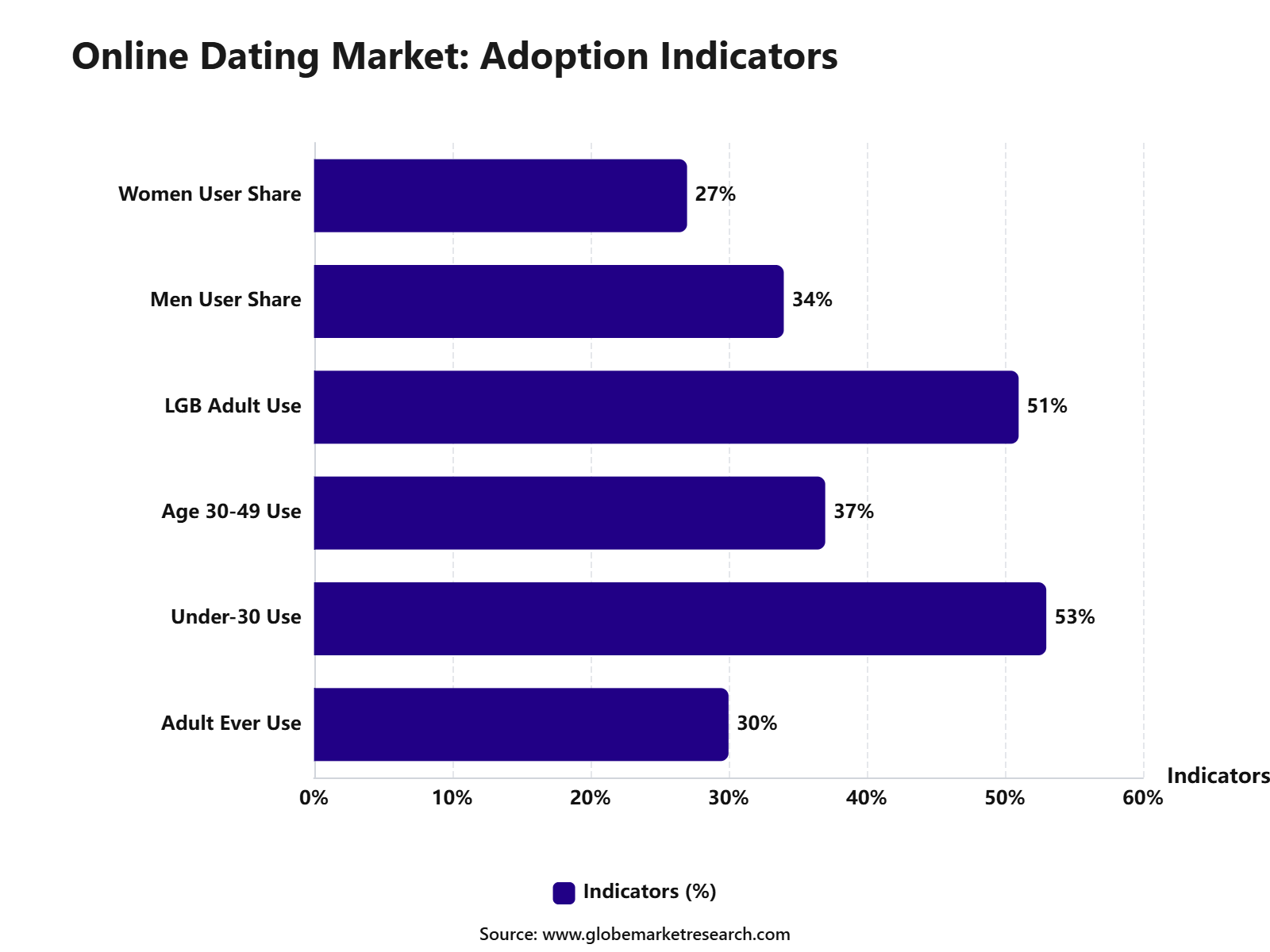 iThe graph shows projected market growth until 2035 based on CAGR analysis. Actual outcomes may vary depending on changing demand, competition, and economic factors.To gain greater insights - request a sample report PDF
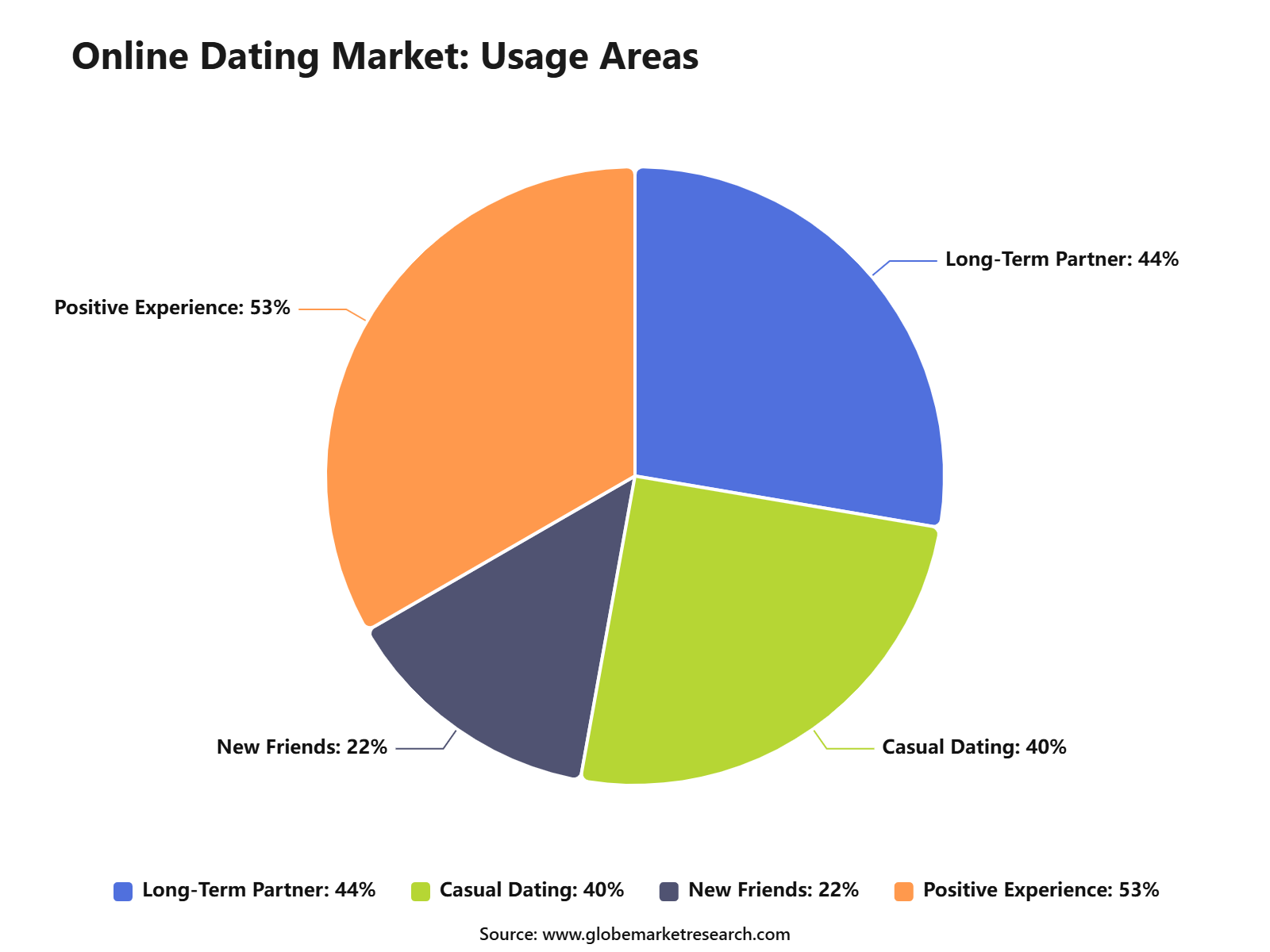 iThe graph shows projected market growth until 2035 based on CAGR analysis. Actual outcomes may vary depending on changing demand, competition, and economic factors.To gain greater insights - request a sample report PDF
By Type
Paying online dating led the type segment with 70.5% share, supported by users’ willingness to pay for better matching, advanced filters, profile visibility, and improved communication features. Paid dating services are preferred by users who seek more serious interactions and a more controlled experience.
The growth of this segment can be attributed to the rising need for trust, convenience, and better-quality matches. Paid platforms often offer features such as identity checks, priority likes, profile boosts, and enhanced privacy controls, which help improve user confidence.
Paying online dating also benefits from the shift toward personalized digital relationship services. Users are increasingly choosing premium plans when they see clear value in better discovery, reduced spam, and stronger chances of meaningful connections.
By Revenue Model
Subscription led the revenue model segment with 55.5% share, supported by recurring user demand for premium access, unlimited messaging, advanced search, and profile enhancement tools. This model gives platforms a steady revenue base while offering users continued access to exclusive features.
The segment is favored because subscriptions create a structured relationship between users and platforms. Instead of one-time payments, users can select monthly or longer-term plans based on their dating goals, usage habits, and need for better visibility. Subscription-based models also help online dating platforms improve service quality over time. Regular revenue supports product updates, safety tools, AI-based matching, moderation systems, and user experience improvements.
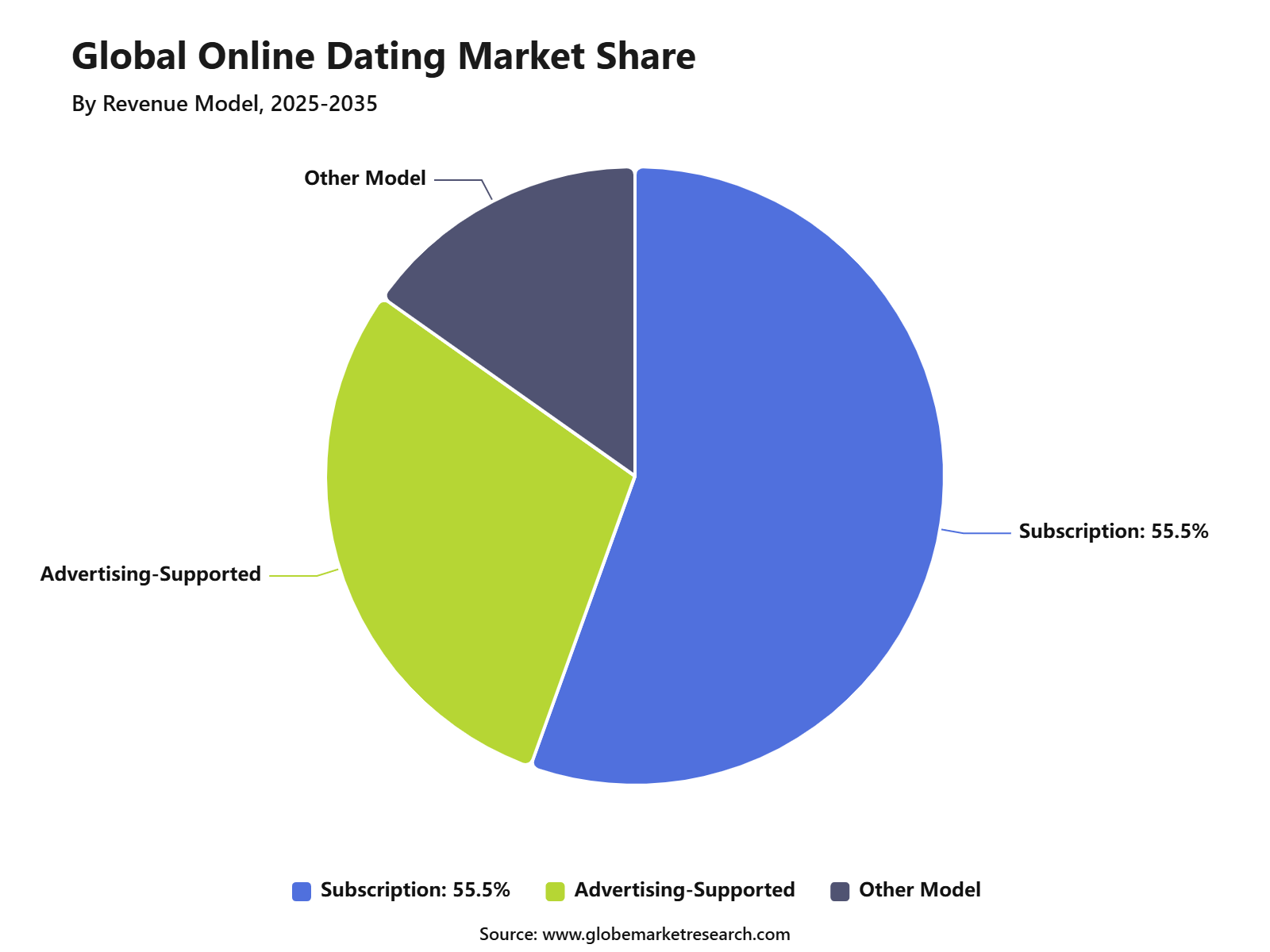 iThe graph shows projected market growth until 2035 based on CAGR analysis. Actual outcomes may vary depending on changing demand, competition, and economic factors.To gain greater insights - request a sample report PDF
By Platform
Applications led the platform segment with 86.3% share, driven by strong mobile usage and the convenience of app-based dating. Dating apps allow users to browse profiles, send messages, receive match alerts, and manage interactions directly from their smartphones. The segment is supported by the mobile-first nature of modern dating behavior.
Users prefer apps because they offer location-based matching, faster onboarding, simple swiping tools, and instant communication. Applications also provide better engagement opportunities for platforms. Push notifications, personalized match suggestions, in-app purchases, and real-time chat features make apps more active and user-friendly than traditional desktop-based dating services.
By Age Group
Millennials led the age group segment with 35.9% share, supported by strong digital adoption, comfort with app-based communication, and higher openness toward online relationship platforms. This group is highly familiar with mobile services and is more likely to use digital tools for social and personal connections. The segment is driven by busy lifestyles, urban living, and changing relationship preferences.
Millennials often use online dating platforms to save time, widen their social circle, and find matches based on interests, values, location, or lifestyle compatibility. Millennials also support paid and subscription-based services because they are more comfortable with digital payments and app memberships. Their demand for convenience, personalization, and safer dating experiences continues to strengthen their role in the online dating market.
By Region
Asia Pacific led the regional segment with 35.6% share, supported by rapid smartphone adoption, rising internet access, and growing acceptance of app-based dating across urban markets. The region has a large young population base, which supports steady use of mobile dating platforms. The segment is driven by changing social behavior, busy urban lifestyles, and wider use of digital communication for personal relationships.
Dating apps are becoming more common among users who prefer convenience, privacy, and broader access to potential matches. Asia Pacific also benefits from strong mobile-first platform usage. Localized apps, language support, flexible payment options, and culturally relevant safety features are helping online dating platforms expand across both developed and emerging markets in the region.
 iThe graph shows projected market growth until 2035 based on CAGR analysis. Actual outcomes may vary depending on changing demand, competition, and economic factors.To gain greater insights - request a sample report PDF
Top 5 Dating Apps
AppTweak reported Tinder at 63.7 million downloads and 9.1% download share, so the other shares below are calculated on the same estimated category base. AppTweak’s dataset was published in January 2026 and covers the top 500 dating apps globally. Tinder remained the leading dating app by global downloads in 2025, with more than double Bumble’s downloads. Hinge showed the strongest growth among the top five, supported by rising demand for more intent-based dating experiences. The top 10 dating apps together accounted for 31.6% of total download share among the top 500 dating apps, showing a concentrated but still competitive market.
Rank | Dating App | 2025 Global Downloads | Estimated Market Share | YoY Growth |
|---|---|---|---|---|
1 | Tinder | 63.7 million | 9.1% | 6.8% |
2 | Bumble | 29.2 million | 4.2% | -19.0% |
3 | Hinge | 21.3 million | 3.0% | 25.4% |
4 | Badoo | 19.5 million | 2.8% | -9.2% |
5 | Boo | 17.7 million | 2.5% | 7.1% |
Segment Covered in the Report
By Type
Paying Online Dating
Non-Paying Online Dating
By Revenue Model
Subscription
Advertising-Supported
Other Model
By Platform
Web Portals
Applications
By Age Group
Adult
Baby Boomer
Generation X
Generation Z
Millennials
By Region
North America
Europe
Asia Pacific
Latin America
Middle East and Africa
Go-to-Market and Sales Economics
The go-to-market approach for the Online Dating Market should focus on trust, profile quality, safer matching and stronger relationship outcomes. User growth is becoming more difficult, so platforms are shifting from mass sign-ups to better engagement, paid conversion and user retention. Match Group reported USD 864 million in Q1 2026 revenue, up 4% year over year, while payers declined 5% to 13.5 million, showing that monetization per paying user is becoming more important than user volume alone.
Sales economics are being shaped by subscription fatigue, user churn and pressure to improve product value. Bumble reported Q1 2026 total revenue of USD 212.4 million, down 14.1% year over year, while total paying users declined 21.1% to 3.2 million. This indicates that dating platforms need stronger pricing discipline, clearer premium benefits and better user experience to protect recurring revenue.
The strongest commercial model is expected to combine freemium access, premium subscriptions, à-la-carte boosts, verification tools, AI-assisted profile support and safety features. In the UK, Ofcom reported that 4.9 million adults used an online dating service in 2024, while Tinder reached 1.9 million adults, Hinge reached 1.4 million, and Bumble reached 1.1 million. This shows that multi-app usage remains common, making differentiation critical.
Revenue Potential Analysis
Revenue Landscape Across
Revenue potential is spread across paid subscriptions, profile boosts, super likes, read receipts, incognito browsing, verification, advertising, virtual events, social discovery and AI-supported matching. Match Group’s Q1 2026 revenue per payer increased 10% year over year to USD 20.90, showing that higher-value features can support revenue even when total payer count declines.
Premium dating apps have stronger opportunity where users are willing to pay for serious intent, safer discovery and better match quality. Hinge continues to act as a growth engine within Match Group, while Tinder’s March 2026 registrations returned to year-over-year growth and conversation coverage increased 6%. This suggests that product improvements can still revive engagement when user experience is made more intentional.
Mobile-first usage remains the main revenue route because discovery, messaging and paid upgrades are largely app-based. Sensor Tower reported that Tinder’s U.S. weekly revenue in Q4 2025 stayed around USD 7 million to USD 9 million, with downloads averaging about 130,000 per week and active users ending the quarter near 7 million. This supports continued demand for in-app monetization.
Financial Impact
The financial impact of the Online Dating Market is linked to paid-user retention, average revenue per payer and marketing efficiency. Bumble’s Q1 2026 average revenue per paying user increased 8.9% to USD 22.04, even as payer numbers fell. This shows that price increases and monetization changes can lift short-term revenue per user, but cannot fully offset weak engagement if churn remains high.
Trust and safety are becoming direct financial factors. Romance scams, fake profiles and AI-generated deception can reduce user confidence and increase compliance cost. In 2025, Washington State reported romance scam losses exceeding USD 22 million in the first three quarters alone, showing why verification, fraud detection, user education and secure messaging are becoming essential platform investments.
Profitability will be stronger for platforms that reduce acquisition cost and improve user outcomes. Match Group reported Q1 2026 adjusted EBITDA of USD 343 million, up 25% year over year, with an adjusted EBITDA margin of 40%. This shows that disciplined cost control, product focus and premium monetization can protect earnings even when the category faces slower user growth.
Drivers Impact Analysis
The Online Dating Market is driven by rising smartphone use, wider internet access, changing social behavior, and growing acceptance of app-based relationship discovery. Dating platforms are becoming a normal channel for meeting partners, especially among younger adults, urban users, and time-sensitive professionals. Growth is also supported by premium subscriptions, in-app purchases, profile boosts, video dating, and AI-based matchmaking. These features help platforms increase user engagement, improve compatibility, and create recurring revenue from paid users.
Impact Factor | Estimated CAGR Impact | Regional Relevance | Market Impact |
|---|---|---|---|
Rising smartphone-based dating usage | +2.0% | Global urban markets | Drives core adoption. |
Growth in paid subscriptions | +1.7% | North America, Europe, Asia Pacific | Supports revenue growth. |
Increasing social acceptance of online dating | +1.5% | Global | Expands user base. |
AI-based matchmaking and recommendations | +1.2% | U.S., Europe, Japan, South Korea | Improves user engagement. |
Video and interactive dating features | +1.0% | Global app users | Builds platform stickiness. |
Restraints Impact Analysis
The market faces restraints from user privacy concerns, fake profiles, subscription fatigue, and trust issues. Dating platforms handle sensitive personal data, so users expect strong safety, identity protection, and transparent data practices. Another restraint is high competition among dating apps. Many users switch between platforms, use free features only, or cancel paid plans when results are not strong, which can limit long-term monetization.
Impact Factor | Estimated CAGR Impact | Regional Relevance | Market Impact |
|---|---|---|---|
Privacy and data security concerns | -1.1% | North America, Europe, Asia Pacific | Reduces user trust. |
Fake profiles and scams | -1.0% | Global | Affects platform safety. |
Subscription fatigue among users | -0.8% | Mature app markets | Limits paid conversion. |
High competition between apps | -0.7% | Global | Pressures retention. |
Uneven user experience and match quality | -0.6% | Global | Increases churn. |
Opportunities Impact Analysis
Opportunities are strong in AI matchmaking, niche dating platforms, verified profiles, video-first dating, safety tools, and regional language apps. Users are seeking more personalized and safer dating experiences rather than generic swiping models. Higher-value growth can also come from premium memberships, background verification, relationship coaching, and event-based dating. Platforms that combine trust, personalization, and real-world connection can improve both retention and revenue per user.
Impact Factor | Estimated CAGR Impact | Regional Relevance | Market Impact |
|---|---|---|---|
AI-powered compatibility matching | +1.9% | North America, Europe, Asia Pacific | Improves match quality. |
Verified and safety-first dating apps | +1.6% | Global | Builds user confidence. |
Niche dating communities | +1.4% | U.S., Europe, India, Southeast Asia | Expands targeted users. |
Video-first dating experiences | +1.2% | Global app markets | Improves engagement. |
Regional language dating platforms | +1.0% | Asia Pacific, Latin America, Middle East | Supports local growth. |
Challenges Impact Analysis
The main challenge is building trust while maintaining user growth. Online dating platforms must manage scams, harassment, fake identities, and inappropriate behavior without making onboarding too difficult for new users. Another challenge is improving monetization without weakening the user experience. Excessive paywalls, too many ads, or poor match quality can push users away and reduce platform loyalty.
Impact Factor | Estimated CAGR Impact | Regional Relevance | Market Impact |
|---|---|---|---|
Balancing safety and easy onboarding | -1.0% | Global | Affects user growth. |
Reducing fake and inactive profiles | -0.9% | Global app platforms | Protects engagement. |
Improving paid user retention | -0.8% | North America, Europe, Asia Pacific | Supports revenue stability. |
Managing harassment and misuse | -0.7% | Global | Impacts brand trust. |
Avoiding over-monetization | -0.6% | Mature dating markets | Protects user loyalty. |
Recent Developments
In February 2026, Grindr reported fourth-quarter revenue of USD 126 million, up 29% year over year and above analyst estimates. The company launched Edge, an AI-powered subscription tier using its gAI system for chat summaries, personalized recommendations, and profile discovery. Grindr also guided 2026 revenue above USD 528 million, showing stronger monetization in LGBTQ+ dating compared with some broader dating platforms.
In May 2026, Bumble’s CEO Whitney Wolfe Herd said the company planned to remove its traditional swipe feature as part of a wider AI-led relaunch. The company is also expected to adjust its women-first messaging rule, which had been central to its brand identity. This indicates that leading dating platforms are moving toward curated matching, assisted discovery, and lower-pressure user experiences.
Funding
In February 2026, AI dating startup Ditto raised USD 9.2 million in seed funding led by Peak XV Partners, with participation from Gradient, Scribble Ventures, Alumni Ventures, and Llama Venture. Ditto is focused on college students and replaces swiping with AI-supported matchmaking, real-world date planning, and post-date feedback. The company had about 42,000 users across California college campuses and planned wider U.S. expansion.
In 2025, AI matchmaking app Sitch raised USD 5 million in seed funding from M13 and a16z speedrun, bringing its total funding to USD 7 million. The app uses AI-assisted onboarding, asks users detailed questions, and recommends matches without relying on endless swiping. This funding shows that investors are backing products designed to reduce dating app fatigue and improve match quality.
Match Group’s USD 100 million investment in Sniffies is one of the largest recent capital moves in the online dating space. The structure gives Match a minority stake and future acquisition option, which mirrors a strategic approach often used when large platforms want exposure to fast-growing products without immediately absorbing their brand identity.
Research Methodology
Methodology Area | Coverage Details |
|---|---|
Primary Research | Interviews with manufacturers, suppliers, distributors, consultants, procurement teams, and industry experts. |
Secondary Research | Company filings, annual reports, regulatory databases, government publications, trade associations, and verified industry sources. |
Data Validation | Cross-verification through source triangulation, historical trend review, demand-side checks, and supply-side assessment. |
Market Estimation | Bottom-up and top-down analysis based on product demand, regional consumption, company presence, and application-level usage. |
Forecasting Approach | Forecasts based on regulatory shifts, infrastructure investment, technology adoption, pricing trends, industrial expansion, and end-use demand. |
Quality Review | Analyst review, peer validation, outlier checks, internal consistency review, and final publication approval. |
AI Policy | AI is not used as a primary data source. All published insights are reviewed against human-verified evidence. |
Competitive Landscape
The market is characterized by intense competition among established players and emerging companies. Strategic partnerships, mergers and acquisitions, and product innovation are key strategies employed by market participants.
Key Market Players
Match Group, Inc.
Bumble Inc.
The Meet Group
Cupid Media Pty Ltd.
Happn SAS
TrulyMadly Matchmakers Pvt. Ltd.
Grindr LLC
eHarmony
Coffee Meets Bagel
Matrimony.com
Other Key Players
Meet the Team
This report was prepared by our expert analysts with deep industry knowledge and research experience.
Pratiksha is market research analyst with strong experience in industry research, market forecasting, and competitive analysis. She specializes in identifying market trends, evaluating growth opportunities, and preparing data-driven insights across global industries. Her work supports businesses in understanding market dynamics, customer demand, regional opportunities, and strategic investment areas.
Sayali brings more than 5 years of experience to Globe Market Research, supporting the accuracy, clarity, and relevance of research content across multiple industries. She reviews market data, segment analysis, competitive insights, and industry trends to ensure each report meets strong quality standards and provides practical value to business decision-makers. Her expertise spans healthcare, information technology, consumer goods, and diverse cross-industry domains. With a strong focus on data reliability, structured analysis, and clear presentation, Sayali helps ensure that each research output delivers well-reviewed insights for clients, investors, consultants, and industry stakeholders.
Frequently Asked Questions
Related Reports
More in Information and Technology
5G RAN Market Size to hit USD 108.5 billion by 2035
Global 5G RAN Market Size, Go-to-Market and Sales Strategy Analysis By Component (Hardware, Software, Services), By Architecture Type (Traditional RAN, Open RAN), By Deployment (Public Networks, Private Networks), By End Use (Telecom Operators, Enterprise and Industrial Users), By Regional Insights, Business plan and Project Report, Investment Opportunities, Profitability, Industry Trends, Leading Companies and Growth Forecasts By 2025-2035
AI In Interior Design Market Size to hit USD 37.7 billion by 2035
Global AI In Interior Design Market Size, Go-to-Market Strategy Analysis By Component (Solution, Service), By Deployment (Cloud, On-Premises), By User Type (Homeowners, Real Estate Developers, Interior Designers, Architects, Corporate Clients), By Design Style (Traditional, Modern, Contemporary, Minimalist, Eclectic), By Technology Integration (3D Visualization Tools, Virtual Reality Solutions, Augmented Reality Applications, CAD Software, Machine Learning Algorithms), By Application (Residential Design, Commercial Design, Hospitality Design, Retail Spaces, Office Spaces), By Pricing Strategy (Subscription-Based, Freemium Model, Pay-Per-Use, One-Time License, Enterprise Licensing, Project-Based Pricing), By Regional Insights, Business plan and Project Report, Investment Opportunities, Profitability, Industry Trends, Leading Companies and Growth Forecasts By 2025-2035
Facility Management Market Size to hit USD 4.3 Trillion by 2035
Global Facility Management Market Size, Go-to-Market Strategy Analysis By Service Type (Hard Services, Soft Services), By Offering (In-House, Outsourced), By End User (Commercial, Industrial, Government and Public Sector, Residential, Institutional, Others), By Service Provider (Single Service Providers, Integrated Facility Management Providers, Bundled Service Providers), By Contract Type (Annual Contracts, Flexible Contracts, Performance-Based Contracts), By Regional Insights, Business plan and Project Report, Investment Opportunities, Profitability, Industry Trends, Leading Companies and Growth Forecasts By 2025-2035
Earned Wage Access Market Size to Exceed USD 93.5 billion by 2035
Global Earned Wage Access Market Size, Go-to-Market Strategy Analysis By Component (Solutions, Services), By Deployment Mode (Cloud-Based, On-Premises), By Access Type (Employer-Integrated EWA, Direct-to-Consumer EWA), By Pricing Model (Employer-Paid, Employee Transaction Fee, Subscription-Based, Hybrid), By End User (Large Enterprises, Small and Medium Enterprises, Gig Workers, Others), By Regional Insights, Business plan and Project Report, Investment Opportunities, Profitability, Industry Trends, Leading Companies and Growth Forecasts By 2025-2035