

Revenue, 2025
$ 5.2 Bn
Forecast, 2035
$37.7 Bn
CAGR, 2025-2035
21.9%
Report Coverage
Global
Market Size and Forecast
The Global AI In Interior Design Market was worth USD 5.2 billion in 2025 and is expected to reach USD 37.7 billion by 2035, growing at a CAGR of 21.9% from 2025 to 2035. North America led the market with 40.6% share in 2025, supported by strong digital design adoption, high use of visualization software, rising smart home investments, and growing demand for AI-enabled space planning across residential, commercial, retail, and real estate applications.
The AI In Interior Design Market includes software platforms and digital tools that use artificial intelligence to support layout planning, furniture placement, color selection, lighting design, material matching, 3D visualization, and virtual staging. These solutions are widely used by interior designers, architects, real estate companies, furniture retailers, home improvement brands, and individual consumers. The market is closely linked with design automation, personalized home styling, augmented reality, virtual reality, and faster project execution.
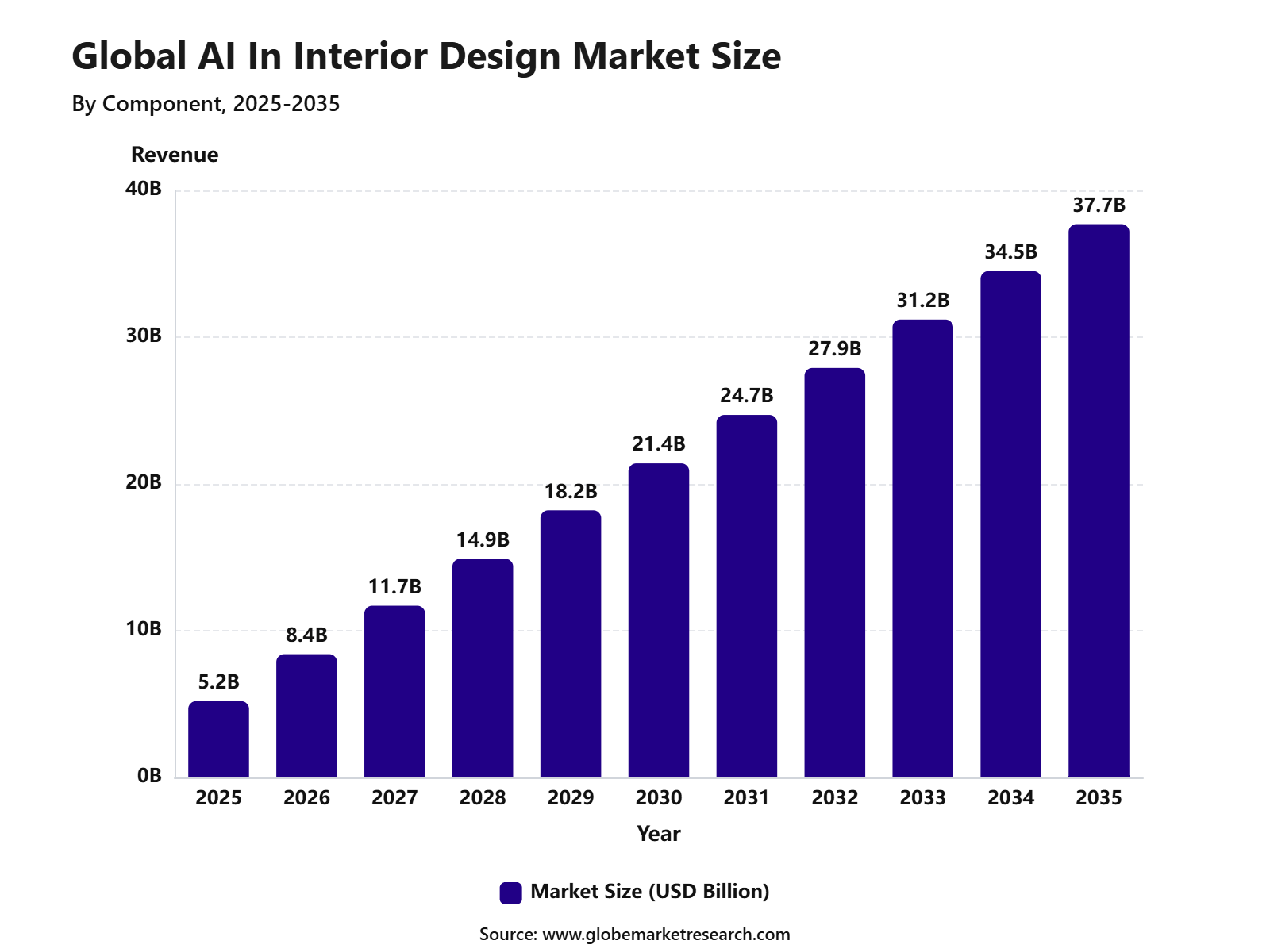 iThe graph shows projected market growth until 2035 based on CAGR analysis. Actual outcomes may vary depending on changing demand, competition, and economic factors.To gain greater insights - request a sample report PDF
The market outlook remains strong as consumers and businesses continue to seek faster, cost-effective, and more personalized design solutions. Growth can be attributed to rising demand for virtual interior design, increasing use of AI-powered recommendation engines, and wider adoption of cloud-based design platforms. The expansion of generative AI, smart room visualization, digital twin technology, and e-commerce-linked design tools is expected to support long-term market growth.
Report Highlights | Details |
|---|---|
Market Revenue (2025) | USD 5.2 Billion |
Forecast Revenue (2035) | USD 37.7 Billion |
CAGR (2025-2035) | 21.9% |
Base Year for Estimation | 2025 |
Historic Data | 2020-2024 |
Forecast Period | 2025-2035 |
Key Market Insights
Solution led the component segment with 62.1% share, supported by strong demand for AI-powered design platforms, layout planning tools, automation features, and digital interior visualization solutions.
Cloud deployment accounted for 70.5% share, driven by easier access, faster updates, scalable storage, and smooth collaboration between designers, clients, and project teams.
Interior designers held 42.3% share by user type, supported by growing use of AI tools for faster concept creation, space planning, mood boards, and client presentation workflows.
Contemporary design captured 36.8% share by design style, driven by rising preference for clean layouts, modern furniture, functional spaces, and technology-enabled design personalization.
3D visualization tools accounted for 37.2% share by technology integration, supported by their ability to improve design accuracy, client understanding, and realistic preview of interior spaces.
Residential design held 41.1% share by application, driven by rising demand for home renovation, personalized interiors, smart home planning, and digital design services.
Subscription-based pricing captured 42.3% share, supported by flexible access, lower upfront cost, recurring software use, and growing adoption among designers and small studios.
North America led the AI in interior design market with 40.6% share, supported by strong digital design adoption, high home improvement spending, and growing use of AI tools across interior design workflows.
How AI Impacts the Interior Design Market?
AI is changing the Interior Design Market by making design visualization faster, more affordable, and easier for clients to understand before a project begins. Designers can now use AI tools to create room concepts, mood boards, furniture layouts, color palettes, material combinations, and photorealistic renders from simple prompts or uploaded images. This is important because 1stDibs’ 2026 designer survey found that AI adoption among designers tripled to 29% in 2025, compared with 9% in 2023, while another 20% of designers planned to integrate AI tools into their work in 2026.
AI is also improving client decision-making. Many clients struggle to imagine how a room will look after renovation, especially when selecting paint, furniture, lighting, flooring, wall treatments, and décor. AI-powered visualization helps clients compare multiple design options quickly, reducing uncertainty and design revision cycles. Houzz’s 2026 U.S. Home Study reported that 54% of homeowners completed renovation activity, while 50% planned to undertake projects in 2026, showing that design decision support remains highly relevant in home improvement activity.
AI has a strong impact on renovation planning and budget control. Interior designers can use AI to estimate material needs, compare furniture prices, prepare design boards, suggest layouts, and identify cost-effective alternatives. Harvard’s Joint Center for Housing Studies projected that U.S. homeowner improvement spending would reach USD 518 billion by the end of 2026, which shows the scale of renovation activity linked to interiors, kitchens, bathrooms, flooring, lighting, and furnishing decisions.
AI Adoption and Workflow Usage
According to houzz, The AI In Interior Design Market is gaining strong traction as designers and design firms use AI for faster visualization, concept development, mood boards, and routine business tasks. Survey data shows that 82% of interior designers use AI regularly in creative workflows, while 31% of U.S. design firms use AI in business operations. Adoption is higher among larger design firms, where AI usage reaches 50%, showing that scale, project volume, and digital maturity are supporting faster implementation.
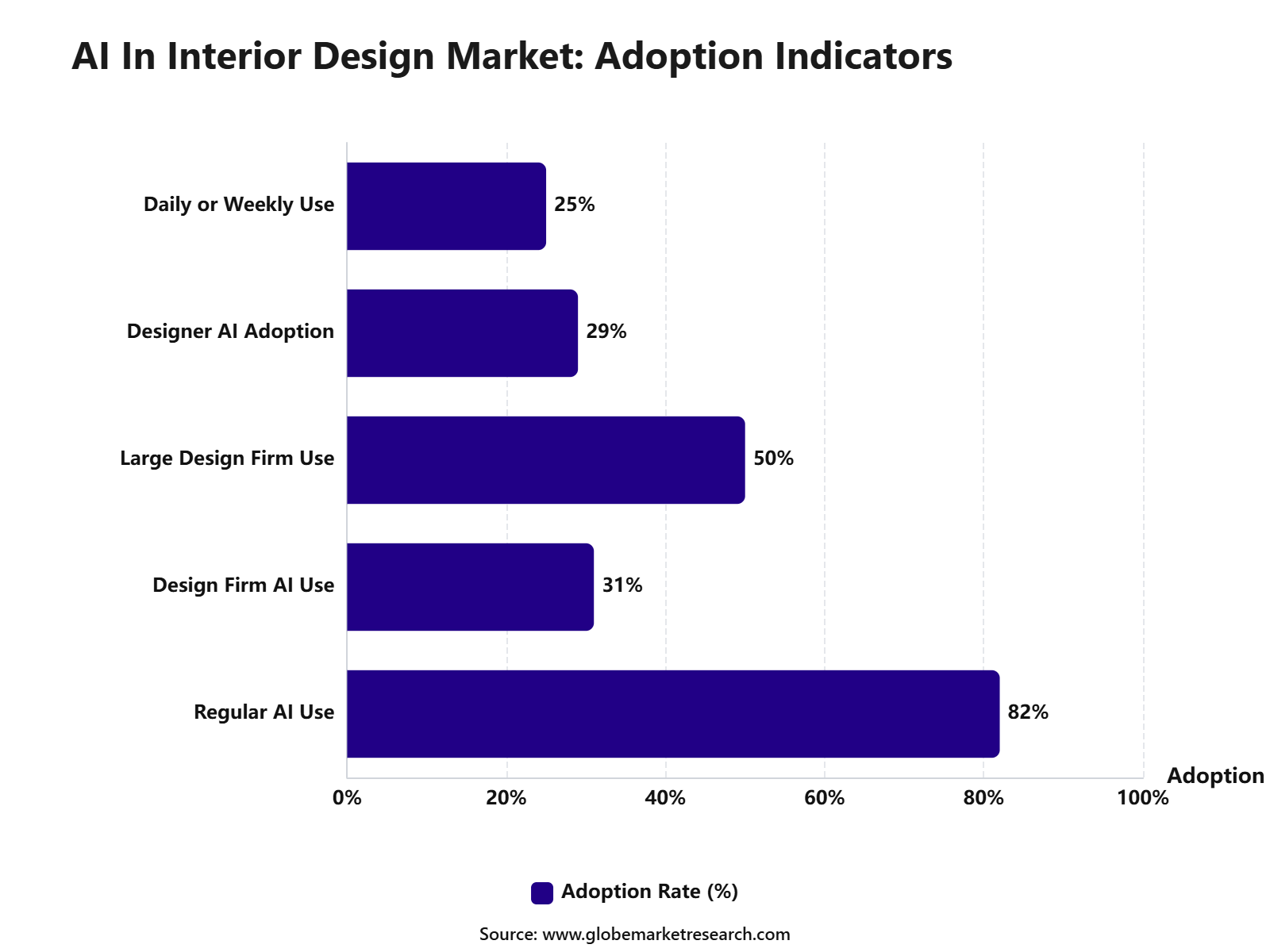 iThe graph shows projected market growth until 2035 based on CAGR analysis. Actual outcomes may vary depending on changing demand, competition, and economic factors.To gain greater insights - request a sample report PDF
AI usage is strongest in administrative tasks, sales and marketing, planning, and design visualization. Around 70% of designers use AI for admin tasks, 59% for sales and marketing, and 34% for planning and design activities. Creative use cases are also rising, with 69% using AI to visualize ideas, 58% for concepting, and 52% for moodboarding. This indicates that AI is becoming a practical support tool for productivity, client presentation, and early-stage design development.
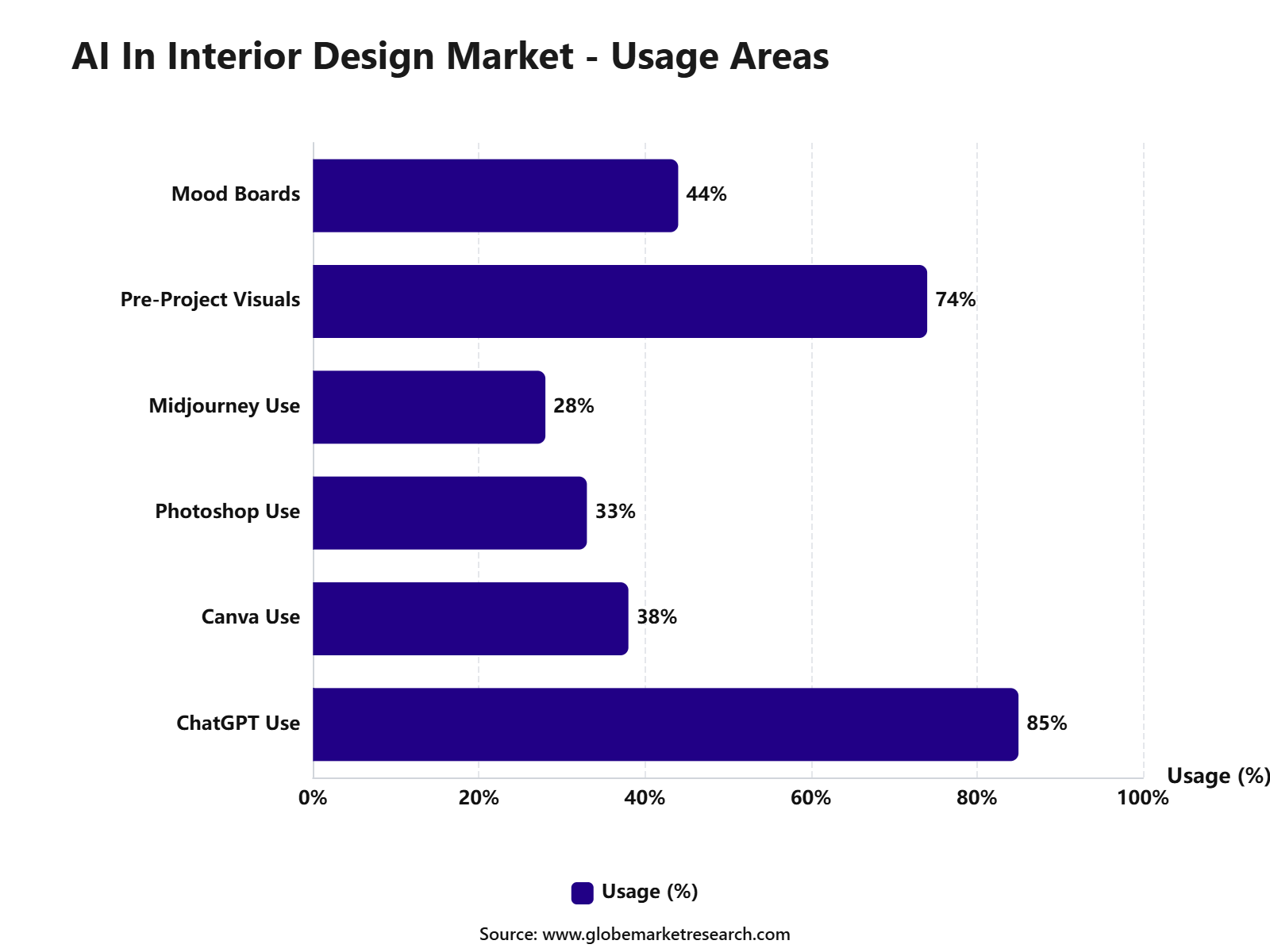 iThe graph shows projected market growth until 2035 based on CAGR analysis. Actual outcomes may vary depending on changing demand, competition, and economic factors.To gain greater insights - request a sample report PDF
Top Funding and Investment
Livspace raised USD 180.1 million in Series F funding led by KKR, with participation from Ingka Group Investments, Jungle Ventures, Venturi Partners, and Peugeot Investments. The company said the capital would support new market launches, platform technology, supply-chain expansion, and strategic investments in innovative companies. This remains one of the largest funding events in the technology-led interior design and renovation space.
Flipspaces raised USD 50.1 million in an expanded Series C round in September 2025, with investors including CE-Invests, Panthera Growth Partners, and SMBC Asia Rising Fund. The company planned to use the capital to expand in India and the U.S., strengthen its supply chain, and enhance AI-driven design technology.
HomeLane raised INR 225 crore in 2024 alongside its acquisition of DesignCafe. The funding came from existing investors of HomeLane and DesignCafe, along with external investment from Hero Enterprise. The combined platform was positioned to strengthen its presence in India’s organised home interiors market.
Drafted, an AI-powered home design startup, raised USD 16.1 million in seed funding in 2026 from investors including Buckley Ventures, Y Combinator, Ben Silbermann, and Ryan Tedder. The platform allows users to generate floor plans and 3D renderings by entering details such as lot size, room count, and design preferences.
By Component
Solution led the component segment with 62.1% share, supported by the rising use of AI-based design platforms for layout planning, mood board creation, furniture matching, space styling, and visual concept generation. These solutions help designers reduce repetitive work and produce faster design options for clients.
The growth of this segment can be attributed to the need for practical tools that combine creativity with workflow efficiency. AI solutions are being used to suggest room themes, recommend colors, compare materials, generate design alternatives, and support faster decision-making during the early design stage.
Solution-based platforms are also preferred because they can serve both professionals and non-design users. Interior designers use them for client presentations, while homeowners and property owners use them to test design ideas before moving into final planning or execution.
By Deployment
Cloud led the deployment segment with 70.5% share, supported by easy access, faster updates, and better collaboration between designers, clients, vendors, and project teams. Cloud-based tools allow users to work from different locations and review design concepts without depending on one fixed system.
The segment is gaining importance because interior design projects often require shared files, visual references, floor plans, product catalogs, and client feedback. Cloud deployment supports smoother project coordination by allowing design assets and revisions to remain available in one connected environment.
Cloud platforms are also preferred because they support flexible usage and lower technical barriers. Designers can use AI features, rendering tools, templates, and storage without maintaining heavy local infrastructure, which makes cloud deployment suitable for small studios as well as larger design firms.
By User Type
Interior designers led the user type segment with 42.3% share, supported by their direct need for faster visualization, client communication, and concept development. AI tools help designers convert early ideas into visual outputs that clients can understand more clearly.
The segment is driven by the growing pressure on designers to deliver more options in shorter project timelines. AI can support space planning, theme exploration, furniture placement, and material selection, while the designer remains responsible for final judgment, function, comfort, and execution quality.
Interior designers are also using AI to improve client engagement. Visual concepts, styled room images, and quick design variations help reduce confusion and support better discussions around taste, budget, space use, and final design direction.
By Design Style
Contemporary design led the design style segment with 36.8% share, supported by its clean layouts, flexible color schemes, functional furniture choices, and broad appeal across residential and commercial interiors. This style works well with AI tools because it is easy to translate into visual prompts and layout suggestions. The segment benefits from strong demand for modern, simple, and practical interiors.
Contemporary design is often preferred by homeowners, apartment buyers, offices, and hospitality spaces because it supports open layouts, natural light, neutral tones, and adaptable decor. AI tools also support contemporary design by helping users compare materials, furniture arrangements, lighting ideas, and room themes quickly. This makes it easier to test design balance before finalizing products, finishes, and space planning decisions.
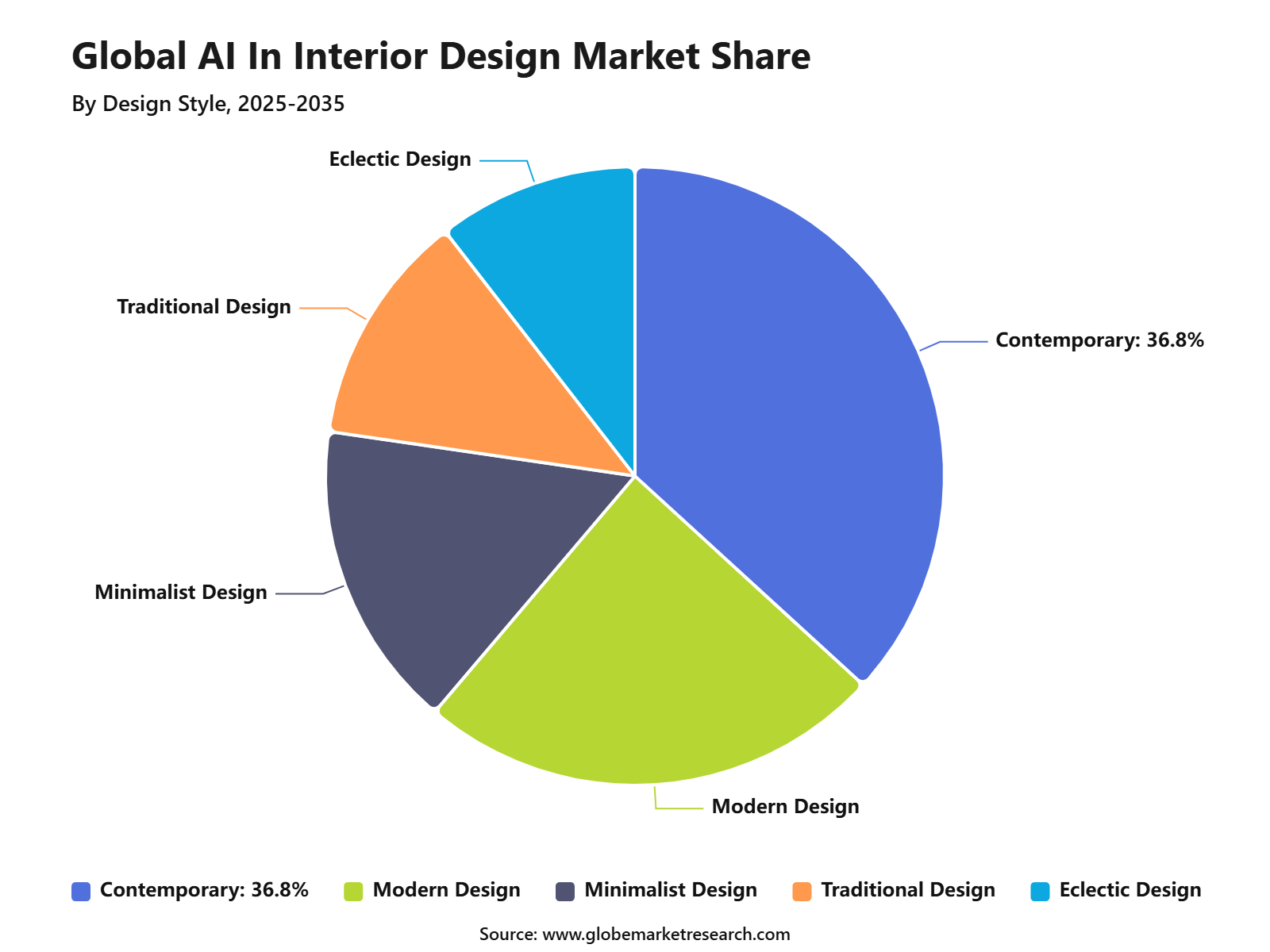 iThe graph shows projected market growth until 2035 based on CAGR analysis. Actual outcomes may vary depending on changing demand, competition, and economic factors.To gain greater insights - request a sample report PDF
By Technology Integration
3D visualization tools led the technology integration segment with 37.2% share, supported by their ability to turn design ideas into clear visual experiences. These tools help users see how furniture, colors, lighting, flooring, and decor may look inside a space before physical changes are made.
The segment is important because interior design decisions are often visual and emotional. 3D visualization reduces uncertainty by helping clients understand scale, layout, and overall room appearance more effectively than flat sketches or text-based descriptions.
AI-enabled 3D visualization tools also improve the design review process. Designers can present multiple room concepts, adjust style preferences, test product placement, and support faster approvals while still keeping human expertise central to the final design outcome.
By Application
Residential design led the application segment with 41.1% share, supported by rising use of AI tools for home renovation, room styling, furniture planning, and personalized decor. Homeowners are using AI-based design platforms to explore ideas before hiring professionals or purchasing products. The segment is driven by strong demand for practical, attractive, and personalized living spaces.
AI supports residential users by helping them test bedroom, kitchen, living room, dining area, and home office concepts based on room size, style preference, and functional needs. Residential design also benefits from growing interest in virtual staging and online design consultation. AI-generated visuals help users understand how a space can be improved, while designers can use these outputs as a starting point for more detailed planning.
By Pricing Strategy
Subscription-based pricing led the pricing strategy segment with 42.3% share, supported by the recurring use of AI design tools, cloud features, design libraries, rendering access, and project collaboration functions. This model gives users continued access to updates and new features. The segment is preferred because it reduces the need for large upfront software spending.
Designers, studios, and independent users can choose plans based on usage needs, project volume, rendering quality, and access to advanced AI features. Subscription-based pricing also supports long-term customer engagement for software providers. Regular feature updates, new templates, improved visualization tools, and better collaboration options make this model suitable for a market where design workflows continue to change quickly.
By Region
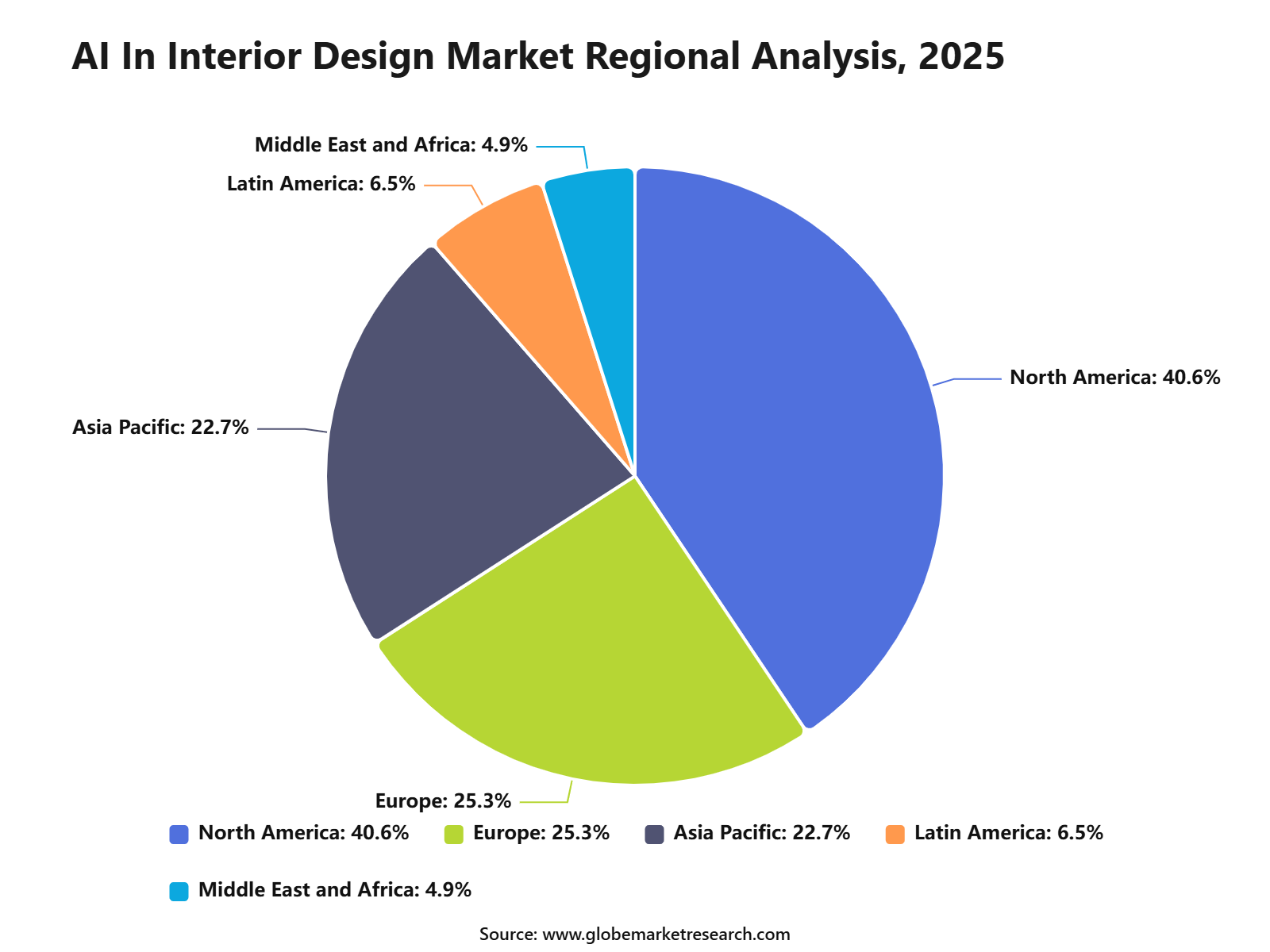
North America led the regional segment with 40.6% share, supported by strong digital design adoption, mature software usage, and high demand for home improvement, renovation, real estate staging, and professional interior design services. The region has a strong base of design firms, property owners, and technology users. The regional lead is also supported by wider acceptance of cloud-based creative tools and online design services.
Users in North America are more familiar with digital planning, virtual consultations, visual product selection, and AI-supported design experimentation. North America remains a key region because residential renovation, commercial redesign, real estate marketing, and design technology adoption are developing together. This creates a strong environment for AI-based interior design solutions focused on visualization, personalization, and faster project decisions.
 iThe graph shows projected market growth until 2035 based on CAGR analysis. Actual outcomes may vary depending on changing demand, competition, and economic factors.To gain greater insights - request a sample report PDF
Go-to-Market and Sales Economics
The go-to-market approach for the AI in Interior Design Market should focus on workflow tools, not only image generation. Interior designers need AI for faster mood boards, room visualization, furniture matching, client communication, proposal writing, scheduling and project documentation. Houzz reported that 31% of design firms were already using AI tools in 2025, while adoption reached 50% among design firms with 10 or more employees, showing that larger firms are becoming early commercial targets.
Sales economics should be built around productivity, client conversion and faster design approval. AI can reduce time spent on early concept visuals, social content, notes, client emails and routine planning work. Among design firms using AI, Houzz found that 70% used it for administrative tasks, 59% for sales and marketing and 34% for planning and design, which shows that the strongest paid use cases are currently business support and pre-design workflows.
Demand is also supported by active renovation pipelines. In Q2 2026, interior designers on Houzz reported an Expected Business Activity Indicator of 65, up from 61 in Q1 2026, supported by stronger project inquiries and new committed projects. This creates a favorable sales environment for AI tools that help designers respond faster, prepare proposals, present concepts and manage more client work with the same team size.
Revenue Potential Analysis
Revenue Landscape Across
Revenue potential is spread across AI room visualization, generative rendering, floor planning, furniture recommendation, material selection, design documentation, client communication, CRM, project management and e-commerce-linked product discovery. In the 2026 U.S. Houzz Renovation Plans Report, 93% of homeowners planning renovation projects said they expect to work with professionals, while 20% planned to hire interior designers. This supports revenue for AI platforms that connect designers, homeowners, suppliers and project teams.
Homeowner renovation activity provides another revenue base. The 2026 U.S. Houzz & Home Study reported that 50% of homeowners plan to undertake projects in 2026, while 41% plan decorating activity. Median planned renovation spend was USD 15,000, which indicates a broad addressable base for AI-assisted design, virtual styling, product selection and budget planning tools.
Financial Impact
The financial impact of AI in interior design is mainly linked to time savings, better proposal output and stronger client conversion. Houzz estimated that AI use generated an average annual productivity gain of USD 74,400 per design firm, based on reported weekly time savings and business revenue assumptions. This gives AI vendors a clear return-on-investment message when selling to design studios and design-build firms.
AI can also reduce project leakage caused by slow responses and repeated concept revisions. In 2026, Houzz found that homeowners expected challenges such as rising product and material costs, difficulty finding available professionals and design decisions. These pain points support demand for AI tools that help designers prepare options quickly, compare materials, explain budgets and improve client confidence before purchase decisions are finalized.
Segment Covered in the Report
By Component
Solution
Service
By Deployment
Cloud
On-Premises
By User Type
Homeowners
Real Estate Developers
Interior Designers
Architects
Corporate Clients
By Design Style
Traditional
Modern
Contemporary
Minimalist
Eclectic
By Technology Integration
3D Visualization Tools
Virtual Reality Solutions
Augmented Reality Applications
CAD Software
Machine Learning Algorithms
By Application
Residential Design
Commercial Design
Hospitality Design
Retail Spaces
Office Spaces
By Pricing Strategy
Subscription-Based
Freemium Model
Pay-Per-Use
One-Time License
Enterprise Licensing
Project-Based Pricing
By Region
North America
Europe
Asia Pacific
Latin America
Middle East and Africa
Drivers Impact Analysis
The AI in Interior Design Market is driven by rising use of AI-powered visualization, automated layout planning, 3D rendering, virtual staging, and personalized design recommendations. These tools help designers, architects, real estate firms, furniture brands, and homeowners reduce design time and improve decision-making.
North America leads the market because of strong adoption of digital design tools, high spending on home renovation, advanced real estate technology, and strong presence of AI software providers. The U.S. remains the key growth contributor due to demand from residential design, commercial interiors, and online furniture platforms.
Impact Factor | Estimated CAGR Impact | Regional Relevance | Market Impact |
|---|---|---|---|
Rising adoption of AI design software | +5.8% | North America, Europe, Asia Pacific | Drives core growth. |
Growth in 3D visualization tools | +4.9% | U.S., Canada, UK, Germany, Japan | Improves design accuracy. |
Demand for faster space planning | +4.2% | Residential and commercial design | Reduces project time. |
Expansion of online furniture retail | +3.7% | North America, Europe, Asia Pacific | Supports visual selling. |
Rising home renovation activity | +3.2% | U.S., Canada, Europe | Builds user demand. |
Restraints Impact Analysis
The market faces restraints from data privacy concerns, software cost, and limited technical skills among small design firms. Many users need training before they can fully use AI-based visualization, layout planning, and automated recommendation systems. Another restraint is the need for human creativity and judgment in interior design. AI can support planning and visualization, but final decisions often depend on client taste, cultural preferences, material quality, lighting, and practical site conditions.
Impact Factor | Estimated CAGR Impact | Regional Relevance | Market Impact |
|---|---|---|---|
Data privacy and image usage concerns | -2.6% | North America, Europe | Raises adoption caution. |
High subscription and software cost | -2.2% | Small design firms | Limits wider use. |
Limited AI skills among designers | -1.9% | Emerging and traditional markets | Slows adoption. |
Dependence on human design judgment | -1.6% | Global design industry | Limits full automation. |
Inaccurate material and lighting outputs | -1.4% | Professional design projects | Affects buyer trust. |
Opportunities Impact Analysis
Opportunities are strong in cloud-based design platforms, AI room planners, virtual staging, generative design, furniture visualization, and residential interior design. These applications help users create faster concepts, compare styles, and improve customer experience. Subscription-based platforms also offer strong growth potential because they allow designers and consumers to access AI design tools without heavy upfront software investment. Companies that combine AI, 3D visualization, AR, and product catalogs can capture strong commercial value.
Impact Factor | Estimated CAGR Impact | Regional Relevance | Market Impact |
|---|---|---|---|
Cloud-based AI design platforms | +5.4% | North America, Europe, Asia Pacific | Expands user access. |
Virtual staging for real estate | +4.6% | U.S., Canada, UK, Australia | Improves property marketing. |
AI-powered furniture visualization | +4.1% | Online retail markets | Supports purchase decisions. |
Residential design automation | +3.8% | North America, Asia Pacific | Builds mass adoption. |
Subscription-based design tools | +3.3% | Global software users | Supports recurring revenue. |
Challenges Impact Analysis
The main challenge is ensuring that AI-generated design outputs are realistic, practical, and aligned with client needs. Interior design requires accurate room dimensions, local materials, lighting behavior, budget limits, and lifestyle preferences. Another challenge is integrating AI tools with existing design workflows. Designers often use CAD, BIM, rendering software, mood boards, and project management tools, so AI platforms must connect smoothly with professional systems to gain long-term adoption.
Impact Factor | Estimated CAGR Impact | Regional Relevance | Market Impact |
|---|---|---|---|
Ensuring realistic design outputs | -2.4% | Global design users | Affects trust. |
Integration with CAD and BIM tools | -2.0% | Professional design firms | Slows workflow adoption. |
Managing client-specific preferences | -1.7% | Residential and commercial users | Requires customization. |
Quality gaps in AI-generated visuals | -1.5% | Online design platforms | Limits professional use. |
Competition from traditional design services | -1.3% | Global | Reduces automation speed. |
Recent Developments
In May 2026, Drafted raised USD 16 million in seed funding to build an AI-powered home design platform that turns user inputs into floor plans and 3D layouts. The company reported 250,000 visitors and more than 300,000 floor plans generated within five months of launch. This shows strong early demand for AI tools that reduce design time and make early-stage home planning more accessible.
In April 2026, Mattoboard introduced Design Stream, an AI concept and curation engine for interior projects using real materials. The company stated that the system helps designers source materials, compare product options, work with suppliers, and answer technical product questions. This development is important because professional interior design workflows are shifting from simple image generation toward material-aware and supplier-linked design support.
In 2026, Planner 5D continued to promote AI-enabled room design tools such as Design Generator, Smart Wizard, and AI floor plan recognition. These tools help users create 2D and 3D interiors, test furniture layouts, generate design concepts, and visualize rooms with less technical skill. This supports wider consumer and small-designer adoption of AI-based interior planning platforms.
In February 2026, academic work on AIDED showed how AI can support designer-client co-design by using multimodal client data, including questionnaires, gaze heatmaps, and AI-predicted overlays. The study found that questionnaire-based data was trusted and creativity-enhancing, while AI-predicted overlays improved communication but required clear human interpretation. This indicates that professional AI tools must support designer judgment rather than fully replace it.
Research Methodology
Methodology Area | Coverage Details |
|---|---|
Primary Research | Interviews with manufacturers, suppliers, distributors, consultants, procurement teams, and industry experts. |
Secondary Research | Company filings, annual reports, regulatory databases, government publications, trade associations, and verified industry sources. |
Data Validation | Cross-verification through source triangulation, historical trend review, demand-side checks, and supply-side assessment. |
Market Estimation | Bottom-up and top-down analysis based on product demand, regional consumption, company presence, and application-level usage. |
Forecasting Approach | Forecasts based on regulatory shifts, infrastructure investment, technology adoption, pricing trends, industrial expansion, and end-use demand. |
Quality Review | Analyst review, peer validation, outlier checks, internal consistency review, and final publication approval. |
AI Policy | AI is not used as a primary data source. All published insights are reviewed against human-verified evidence. |
Competitive Landscape
The market is characterized by intense competition among established players and emerging companies. Strategic partnerships, mergers and acquisitions, and product innovation are key strategies employed by market participants.
Key Market Players
Autodesk Inc.
Coohom, Inc.
Foyr
Infurnia Technologies Pvt. Ltd.
Interior AI
Planner 5D
REimagine Home
RoomGPT
RoomSketcher
Vectorworks, Inc.
Other Key Players
Meet the Team
This report was prepared by our expert analysts with deep industry knowledge and research experience.
Pratiksha is market research analyst with strong experience in industry research, market forecasting, and competitive analysis. She specializes in identifying market trends, evaluating growth opportunities, and preparing data-driven insights across global industries. Her work supports businesses in understanding market dynamics, customer demand, regional opportunities, and strategic investment areas.
Sayali brings more than 5 years of experience to Globe Market Research, supporting the accuracy, clarity, and relevance of research content across multiple industries. She reviews market data, segment analysis, competitive insights, and industry trends to ensure each report meets strong quality standards and provides practical value to business decision-makers. Her expertise spans healthcare, information technology, consumer goods, and diverse cross-industry domains. With a strong focus on data reliability, structured analysis, and clear presentation, Sayali helps ensure that each research output delivers well-reviewed insights for clients, investors, consultants, and industry stakeholders.
Frequently Asked Questions
Related Reports
More in Information and Technology
5G RAN Market Size to hit USD 108.5 billion by 2035
Global 5G RAN Market Size, Go-to-Market and Sales Strategy Analysis By Component (Hardware, Software, Services), By Architecture Type (Traditional RAN, Open RAN), By Deployment (Public Networks, Private Networks), By End Use (Telecom Operators, Enterprise and Industrial Users), By Regional Insights, Business plan and Project Report, Investment Opportunities, Profitability, Industry Trends, Leading Companies and Growth Forecasts By 2025-2035
Online Dating Market Size to hit USD 29.5 Bn by 2035
Global Online Dating Market Size, Go-to-Market Strategy Analysis By Type (Paying Online Dating, Non-Paying Online Dating), By Revenue Model (Subscription, Advertising-Supported, Other Model), By Platform (Web Portals, Applications), By Age Group (Adult, Baby Boomer, Generation X, Generation Z, Millennials), By Regional Insights, Business plan and Project Report, Investment Opportunities, Profitability, Industry Trends, Leading Companies and Growth Forecasts By 2025-2035
Facility Management Market Size to hit USD 4.3 Trillion by 2035
Global Facility Management Market Size, Go-to-Market Strategy Analysis By Service Type (Hard Services, Soft Services), By Offering (In-House, Outsourced), By End User (Commercial, Industrial, Government and Public Sector, Residential, Institutional, Others), By Service Provider (Single Service Providers, Integrated Facility Management Providers, Bundled Service Providers), By Contract Type (Annual Contracts, Flexible Contracts, Performance-Based Contracts), By Regional Insights, Business plan and Project Report, Investment Opportunities, Profitability, Industry Trends, Leading Companies and Growth Forecasts By 2025-2035
Earned Wage Access Market Size to Exceed USD 93.5 billion by 2035
Global Earned Wage Access Market Size, Go-to-Market Strategy Analysis By Component (Solutions, Services), By Deployment Mode (Cloud-Based, On-Premises), By Access Type (Employer-Integrated EWA, Direct-to-Consumer EWA), By Pricing Model (Employer-Paid, Employee Transaction Fee, Subscription-Based, Hybrid), By End User (Large Enterprises, Small and Medium Enterprises, Gig Workers, Others), By Regional Insights, Business plan and Project Report, Investment Opportunities, Profitability, Industry Trends, Leading Companies and Growth Forecasts By 2025-2035