Revenue, 2025
$2.3 Bn
Forecast, 2035
$91.3 Bn
CAGR, 2025-2035
62.1%
Report Coverage
Global
Market Size and Forecast
The Global Answer Engine Optimization (AEO) Market was worth USD 2.3 billion in 2025 and is expected to reach USD 91.3 billion by 2035, growing at a CAGR of 62.1% from 2025 to 2035. Based on this growth rate, the market is estimated to reach around USD 11.2 billion in 2026. North America held the largest regional share of 52.1% in 2025, supported by strong adoption of AI search platforms, enterprise content automation, structured data strategies, conversational search behavior, and the rapid shift from keyword ranking to answer-based visibility.
Key Parameter | Report Details |
|---|---|
Market Revenue, 2025 | USD 2.3 Billion |
Estimated Revenue, 2026 | USD 11.2 Billion |
Projected Revenue, 2035 | USD 91.3 Billion |
CAGR, 2025-2035 | 62.1% |
Largest Region | North America |
North America Revenue, 2025 | USD 1.1 Billion |
North America Share, 2025 | 52.1% |
U.S. Revenue, 2025 | USD 0.1 Billion |
U.S. Estimated Revenue, 2026 | USD 0.14 Billion |
U.S. CAGR | 41.6% |
Market Concentration | Medium |
Base Year | 2025 |
Forecast Period | 2025-2035 |
What is the Answer Engine Optimization Market?
The Answer Engine Optimization Market includes strategies, tools, and services that help brands appear in AI-generated answers, search summaries, chatbot responses, voice search, and conversational discovery platforms. It covers structured content, entity optimization, schema markup, FAQ optimization, technical SEO, brand authority building, and content formatting for AI Overviews, ChatGPT, Gemini, Perplexity, and similar systems.
The market outlook remains highly positive as businesses need visibility beyond traditional search results. Growth can be attributed to rising AI chatbot use, changing search behavior, and stronger demand for trusted, well-structured, source-backed content. Wider adoption across e-commerce, healthcare, finance, education, software, travel, and professional services is expected to support long-term demand for AEO solutions.
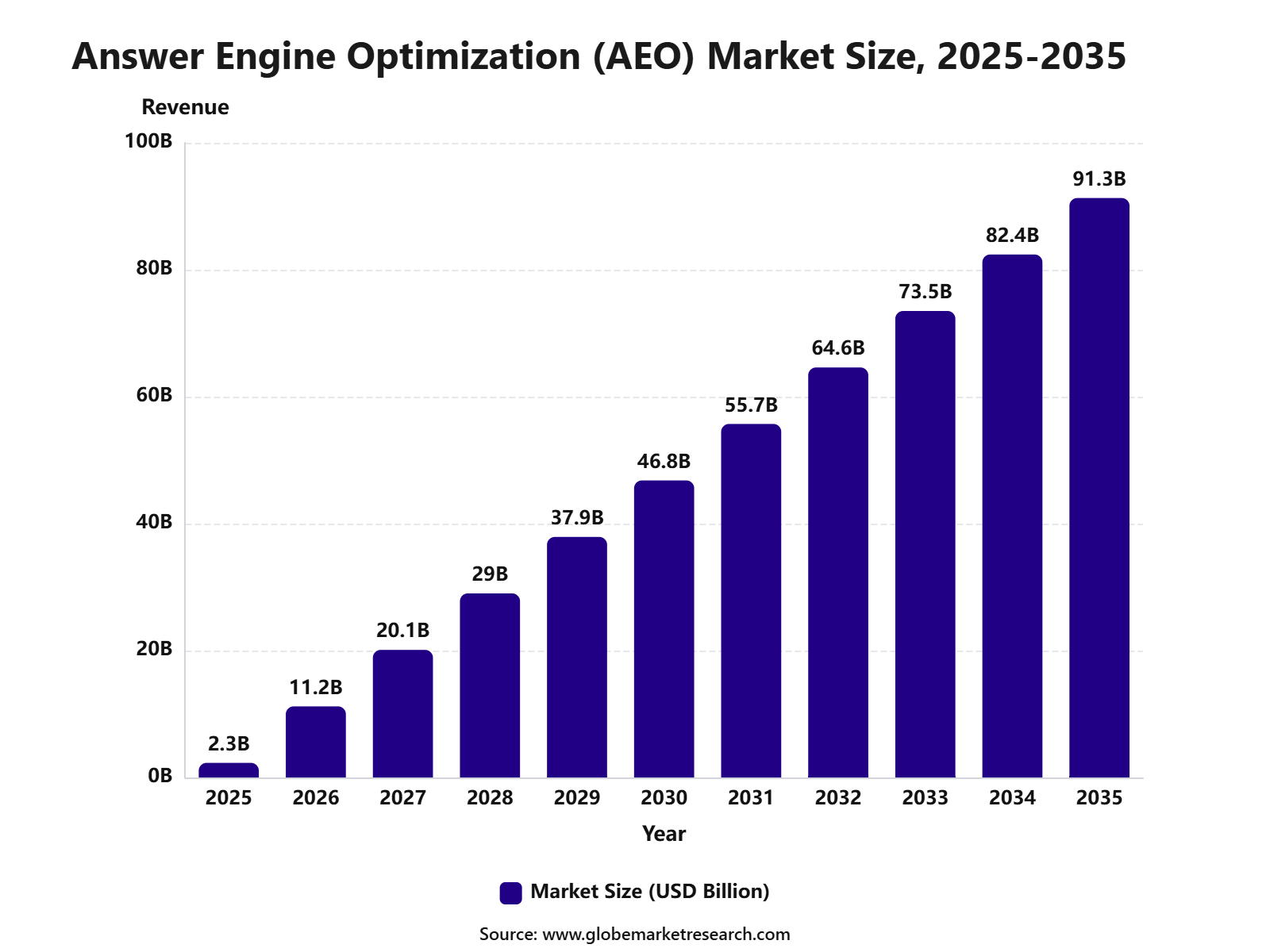 iThe graph shows projected market growth until 2035 based on CAGR analysis. Actual outcomes may vary depending on changing demand, competition, and economic factors.To gain greater insights - request a sample report PDF
Key Market Insights
Software and platforms led the offering segment with 63.3% share, supported by rising use of AI search optimization tools, structured content platforms, semantic analysis, and answer-focused visibility solutions.
Cloud-based deployment accounted for 72.8% share, driven by easier access, faster updates, flexible scaling, and smooth integration with digital marketing, analytics, and content management systems.
Large enterprises held 66.2% share in 2026, supported by higher spending on search visibility, AI-ready content strategies, brand protection, and multi-channel digital presence management.
AI chat interfaces captured 47.2% share by channel type, driven by the growing role of conversational search, AI assistants, and answer-based discovery in customer decision-making.
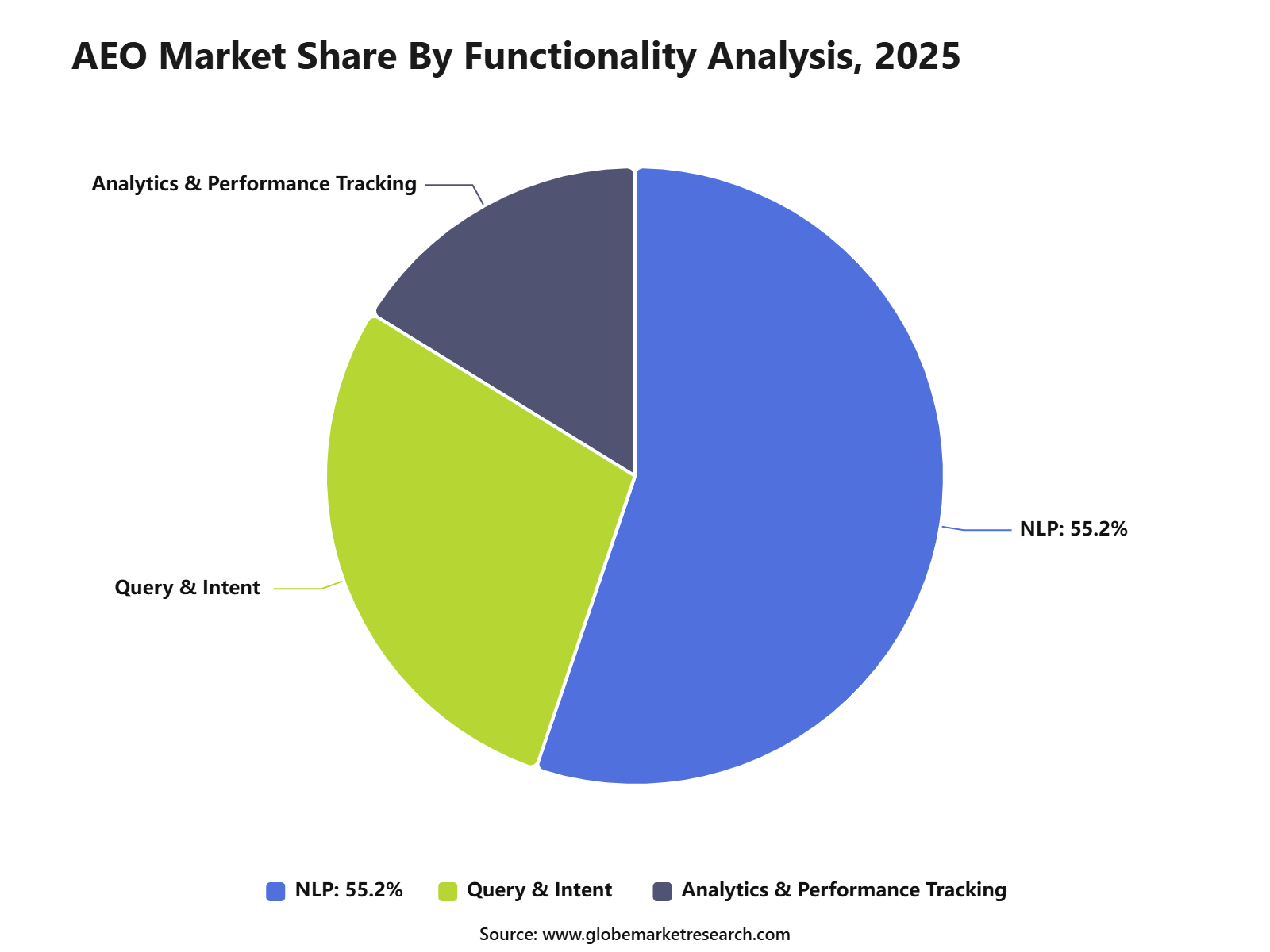
NLP and semantic optimization led the functionality segment with 55.2% share, supported by rising demand for content that can be understood, summarized, and ranked by AI-powered answer engines.
Retail and e-commerce accounted for 29.9% share by end-use industry, driven by strong need for product visibility, AI shopping recommendations, search-ready product content, and faster customer conversion.
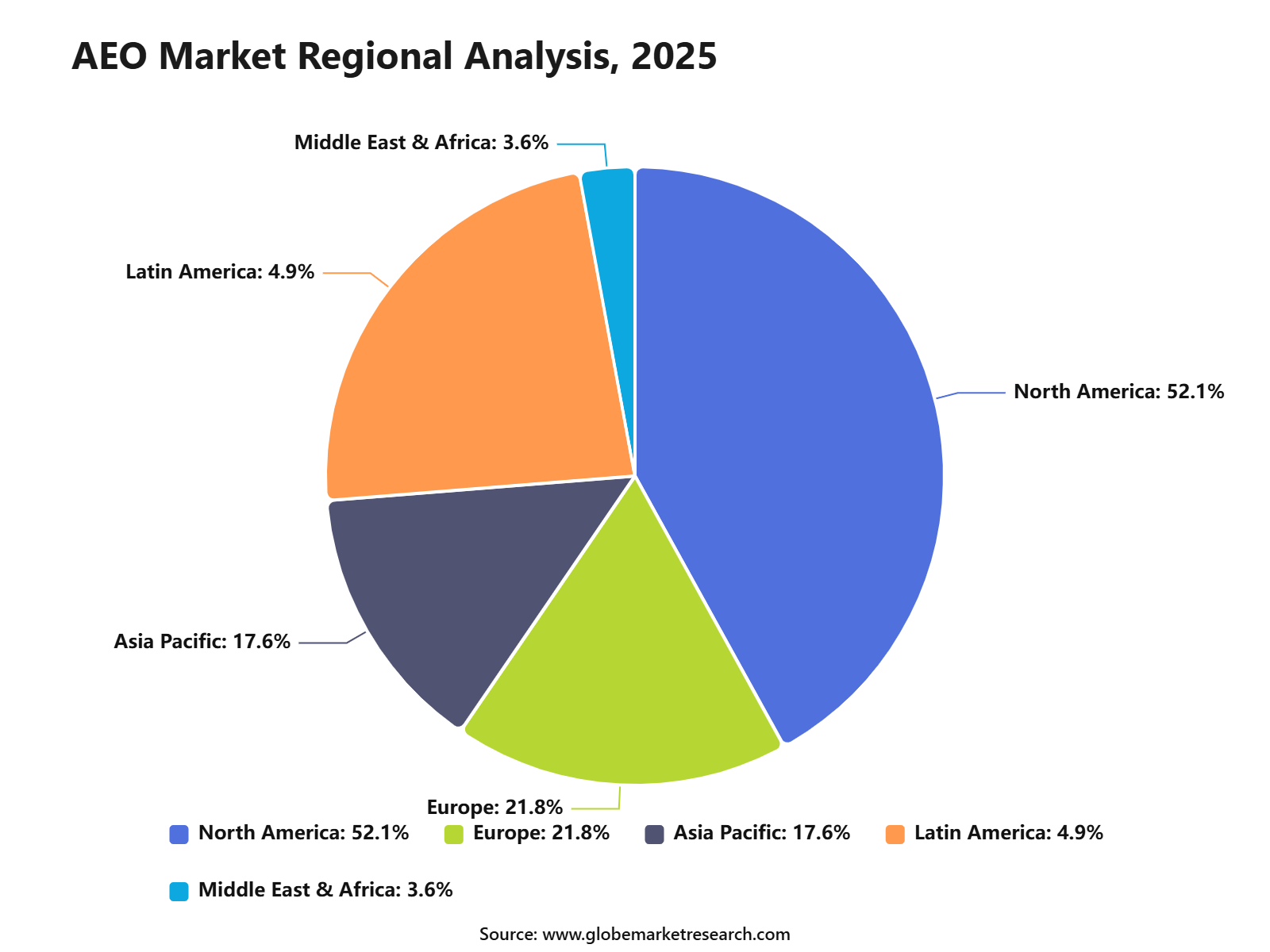
North America led the AEO market with 52.1% share and USD 1.1 billion in 2025 revenue, supported by early adoption of AI search tools, strong digital commerce activity, and advanced content optimization practices.
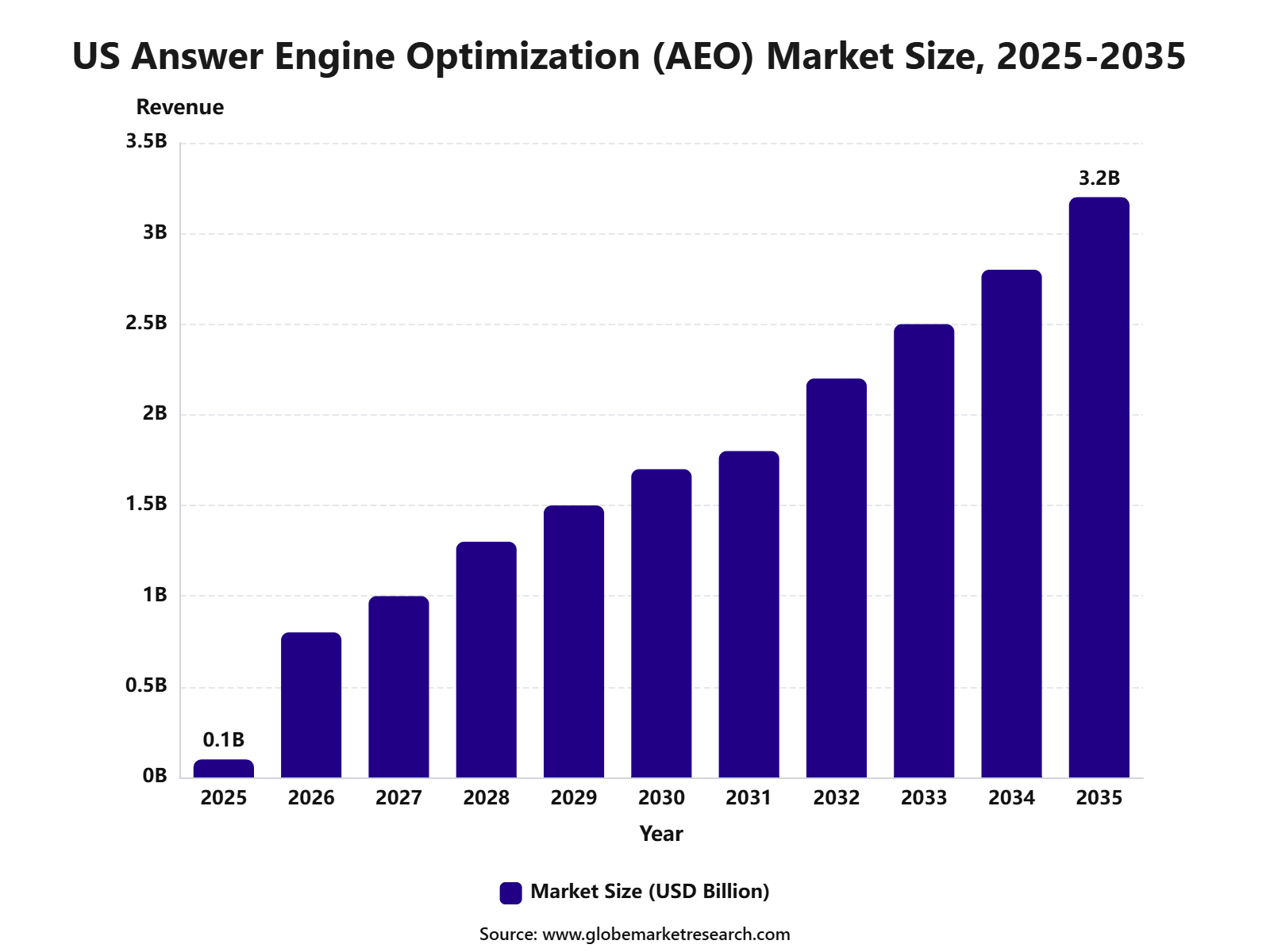
The U.S. AEO market was valued at USD 0.1 billion and is projected to grow at a CAGR of 41.6%, supported by rising enterprise investment in AI search visibility, generative answer optimization, and structured digital content.
By Offering Analysis
Software and platforms remained the leading offering segment with 63.3% share. The segment is gaining preference because brands now need tools that track AI search visibility, citation quality, structured content readiness, and answer-level performance across search and chat surfaces.
The growth of this segment can be linked to the shift from keyword ranking to answer visibility. Search engines now use AI features such as AI Overviews and AI Mode, while structured data helps search systems understand page content more clearly.
This segment is also supported by the need for continuous content testing. Businesses are checking how their pages appear in AI-generated answers, whether their content is being cited, and whether product or service information is clear enough for answer engines to use.
By Deployment Mode Analysis
Cloud-based deployment accounted for 72.8% share. This segment is leading because AEO platforms require continuous updates, real-time query tracking, prompt monitoring, and fast integration with analytics tools. Cloud deployment also supports large content libraries and multi-location websites, which are common among publishers, retailers, agencies, and enterprise brands.
Public cloud adoption continues to rise as companies move more digital workloads to scalable infrastructure. The segment is expected to remain preferred because cloud-based AEO systems can be scaled quickly across teams, regions, and websites. This makes them suitable for companies that need regular reporting on AI search performance without managing heavy in-house infrastructure.
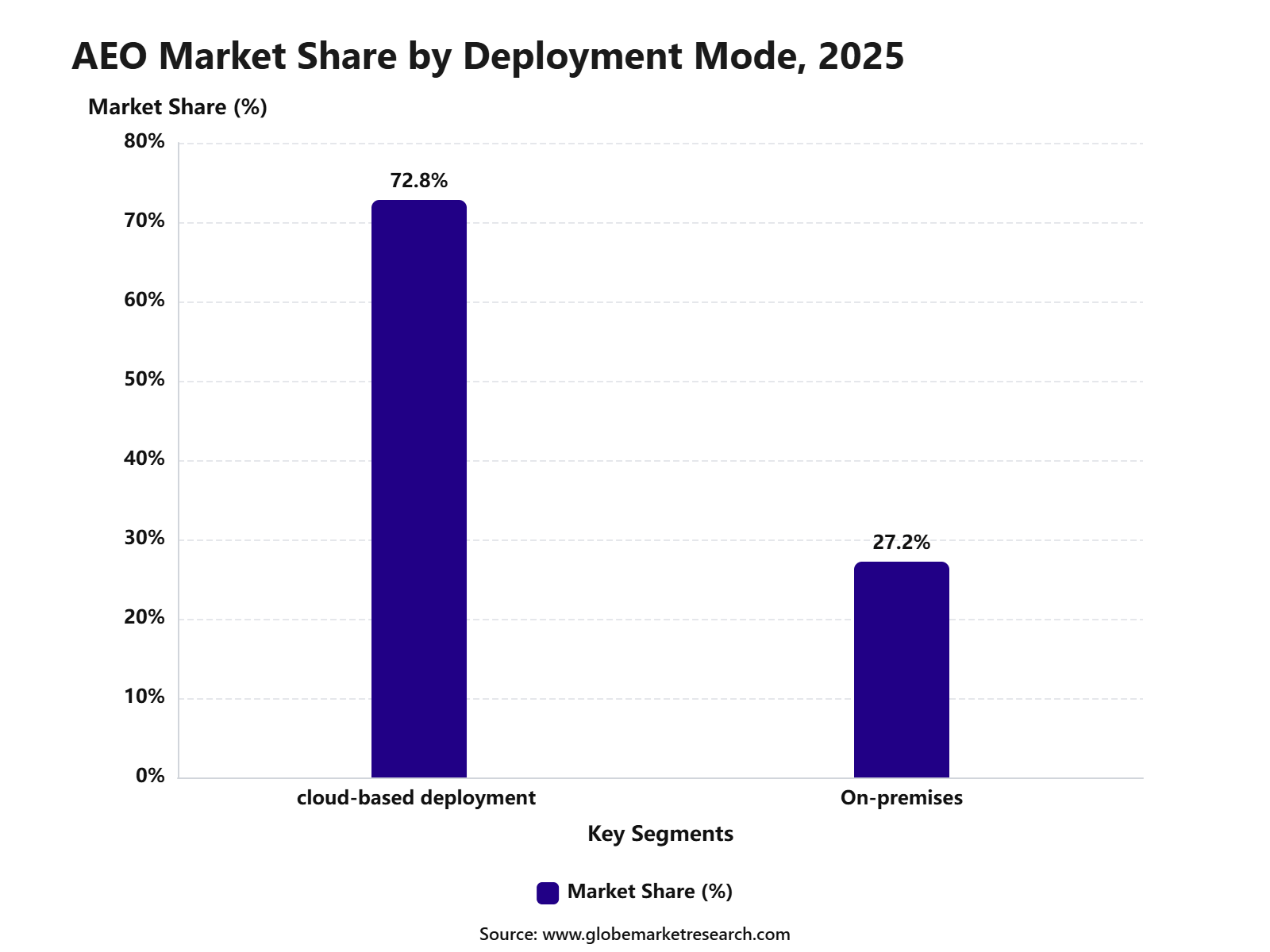 iThe graph shows projected market growth until 2035 based on CAGR analysis. Actual outcomes may vary depending on changing demand, competition, and economic factors.To gain greater insights - request a sample report PDF
By Organization Size Analysis
Large enterprises held 66.2% share in 2026. The segment is ahead because large companies manage wider content ecosystems, multiple product lines, higher search exposure, and stricter brand visibility requirements across AI-generated answers. Enterprise demand is also supported by broader AI adoption.
Stanford’s 2026 AI Index reported that organizational AI adoption reached 88%, showing that AI-driven discovery is moving from experimentation to routine business use. Large enterprises are also more likely to invest in governance, content audits, brand safety, and cross-channel measurement. These needs make AEO tools more valuable for teams managing SEO, content, product marketing, and digital commerce together.
By Channel Type Analysis
Chat interfaces with AI led the channel type segment with 47.2% share. This reflects the growing role of conversational discovery, where users ask direct questions and expect summarized answers instead of browsing multiple pages.
This segment is becoming important because AI assistants are being used for product research, service comparison, troubleshooting, and purchase guidance. Google’s AI search updates show that search is moving toward more conversational and task-based experiences.
As a result, brands are being pushed to make content more direct, complete, and easy for AI systems to interpret. Clear answers, product facts, FAQs, comparisons, and problem-solving content are becoming more important for visibility in chat-led discovery journeys.
By Functionality Analysis
NLP and semantic optimization accounted for 55.2% share. This segment is leading because AI search systems depend heavily on meaning, context, entities, intent, and answer clarity rather than only exact-match keywords. The importance of semantic optimization is rising as AI-generated search results select sources differently from traditional rankings.
Query & Intent Optimization accounted for 28.6% share, driven by the need to align digital content with user search behavior and question-based queries. Analytics & Performance Tracking held 16.2% share, supported by rising demand for tracking AI visibility, answer ranking, content performance, and optimization outcomes.
A 2026 study found that AI Overviews were activated for 13.7% of tracked trending queries and increased to 64.7% for question-form queries, making answer-ready content more valuable. This functionality is becoming central to AEO because it helps content match how people naturally ask questions. It also supports better topic coverage, entity clarity, and structured responses, which are important when AI systems summarize information from multiple sources.
 iThe graph shows projected market growth until 2035 based on CAGR analysis. Actual outcomes may vary depending on changing demand, competition, and economic factors.To gain greater insights - request a sample report PDF
By End Use Industry Analysis
Retail and e-commerce held 29.9% share. The segment is leading because shoppers increasingly use search engines and AI chat tools to compare products, check reviews, understand features, and make purchase decisions. AEO is becoming useful for retailers because product discovery is moving toward conversational and intent-based search.
Salesforce reported that 39% of consumers are already using AI for product discovery, with higher usage among Gen Z shoppers. Retailers are also using AEO to improve product pages, category content, buying guides, and comparison pages. This helps AI systems understand product attributes, customer questions, pricing context, and use cases more accurately during the discovery process.
By Regional Analysis
North America dominated the AEO Market with 52.1% share, supported by strong AI adoption, advanced digital marketing maturity, high enterprise spending on search optimization tools, and early use of generative AI platforms. The region benefits from a large base of technology providers, e-commerce businesses, media companies, and SaaS firms using AI-driven content optimization.
Europe held 21.8% share, supported by rising adoption of multilingual content optimization and stronger focus on compliant digital visibility. Asia Pacific accounted for 17.6% share due to fast digital commerce growth, mobile-first internet use, and expanding AI adoption across India, China, Japan, South Korea, and Southeast Asia. Latin America and Middle East & Africa represented smaller but emerging shares, supported by growing digital transformation and increasing online business visibility needs.
 iThe graph shows projected market growth until 2035 based on CAGR analysis. Actual outcomes may vary depending on changing demand, competition, and economic factors.To gain greater insights - request a sample report PDF
The U.S. market accounted for USD 0.1 billion and is expected to grow at a CAGR of 41.6%. Google’s 2026 search update also confirms that AI-powered search is becoming a central part of the search experience, which strengthens regional demand for AEO capabilities.
North America is also supported by a large base of digital-first retailers, SaaS providers, publishers, and enterprise brands. These companies are actively adjusting their content strategies as AI Overviews, AI Mode, and chat-led search change how users find and trust online information.
 iThe graph shows projected market growth until 2035 based on CAGR analysis. Actual outcomes may vary depending on changing demand, competition, and economic factors.To gain greater insights - request a sample report PDF
ROI of Investing in AEO Platforms
The ROI of investing in AEO platforms can be measured through higher AI visibility, stronger brand citations, better-qualified referral traffic, reduced dependence on paid search, and improved conversion efficiency. AEO is becoming important because users are no longer only searching through classic blue links. Google said at I/O 2026 that AI Overviews has more than 2.5 billion monthly active users, while AI Mode has crossed 1 billion monthly users, with AI Mode queries more than doubling every quarter since launch.
ROI From Higher AI Visibility and Brand Discovery: The first ROI layer comes from visibility in AI-generated answers. AEO platforms help track which questions trigger AI responses, whether a brand is cited, which competitors are mentioned, and which pages are being used as sources. This matters because a 2026 academic study of Google AI Overviews found that AI Overviews appeared for 13.7% of trending queries overall and rose to 64.7% for question-style queries. The same study found that nearly 30% of AI Overview cited domains did not appear in standard first-page results, showing that AI citation logic.
ROI From Higher-Quality AI Referral Traffic: The second ROI layer comes from traffic quality. Similarweb data from 2026 shows that ChatGPT referral traffic converted at 7.1%, placing it second only to paid search at 7.8% and ahead of direct, organic search, social, email, and display traffic across its tracked website panel. Similarweb also reported that after ChatGPT began surfacing clickable brand links inside answers on May 2026, total ChatGPT referrals increased 157.7% week over week, while homepage referrals increased 354.7%.
ROI From Protecting Organic Search Value: AEO investment also protects existing organic search value. Search behavior is shifting as AI answers reduce the need for users to click on basic informational results. Seer Interactive tracked 5.47 million queries, 2.43 billion organic impressions, and 296.9 million paid impressions from January 2025 to February 2026. Its 2026 update found that organic CTR on AI Overview queries recovered from 1.3% in December 2025 to 2.4% in February 2026, while transactional queries with an AI Overview and tracked brand citation improved from 0.7% CTR in January 2025 to 1.7% in December 2025.
ROI From Better Content Efficiency: AEO platforms improve content ROI by showing which content is useful for answer engines and which content is unlikely to be cited. Instead of creating large volumes of generic SEO content, businesses can invest in clearer answer pages, expert-led explainers, structured data, original statistics, product comparisons, and source-backed claims. Google recommends that structured data should match visible page content and that businesses should support multimodal search with high-quality images, videos, Merchant Center data, and updated Business Profile information.
Go-to-Market and Sales Economics
According to Globe Market Research, the go-to-market approach for the Answer Engine Optimization Market should focus on brand visibility inside AI-generated answers, not only traditional search ranking. Demand is being driven by Google AI Overviews, ChatGPT, Gemini, Perplexity and other answer-led discovery platforms where users receive direct answers before clicking websites. Google AI Overviews expanded to more than 200 countries and territories and over 40 languages in 2025, making AI search visibility a mainstream requirement for brands, publishers and e-commerce firms.
Sales economics are shifting because the search journey is becoming less dependent on website visits. A Pew Research Center analysis found that users who saw an AI summary clicked a traditional search result in only 8% of visits, compared with 15% of visits when no AI summary appeared. This creates a direct commercial need for AEO services that improve citation visibility, entity trust, structured content quality and answer inclusion.
The strongest selling model is advisory plus software, where agencies and platforms combine content audits, technical SEO, schema optimization, knowledge graph building, prompt monitoring and AI citation tracking. In a 2026 large-scale study of 55,393 trending queries, Google AI Overviews appeared in 13.7% of all tested queries and rose to 64.7% for question-form queries. This shows that AEO demand is strongest for informational, comparison, "best", "how", "what", "why" and product research queries.
Revenue Potential Analysis
Revenue Landscape Across
Revenue potential is spread across AEO consulting, AI visibility tracking tools, structured content services, product data optimization, digital PR, brand authority building, schema implementation, FAQ optimization, publisher licensing strategy and AI search reporting. U.S. search advertising revenue reached USD 114.2 billion in 2025, while search remained the largest digital ad format with 38.8% share of total digital ad revenue. This large search revenue base indicates why brands are now reallocating part of SEO and paid-search budgets toward AEO visibility.
Content owners and publishers are becoming an important customer group because AI answers can reduce referral traffic while still using web content as source material. Cloudflare reported that training-related crawling accounted for nearly 80% of AI bot activity by mid-2025, while Google referrals to news sites in March 2025 were down about 9% compared with January. This supports demand for crawler management, content licensing, AI bot monitoring and source attribution services.
Enterprise brands also represent a strong revenue pool because AI assistants are becoming a new customer research channel. Reuters reported that ChatGPT had more than 900 million weekly active users and more than 50 million paying consumer subscribers earlier in 2026. As users increasingly ask AI tools for product comparisons, buying guidance, service recommendations and research summaries, companies need AEO programs that make their brand more likely to be cited, summarized and recommended.
Financial Impact
The financial impact of AEO is mainly linked to protected search visibility, improved brand recall and lower dependence on paid acquisition. In 2025, U.S. digital advertising revenue reached USD 294.6 billion, up 13.9% year over year, showing that brands continue to spend heavily on measurable digital visibility. AEO can capture a growing portion of this budget as marketers shift from keyword ranking alone to answer inclusion, citation share and AI-driven discovery.
AEO can also reduce traffic loss from zero-click behavior by helping brands appear inside the answer layer itself. A 2026 study on Google AI Overviews and Wikipedia found that AI Overview exposure reduced daily traffic to exposed English Wikipedia articles by about 15%. This signals a wider risk for publishers, retailers and B2B sites that depend on informational search traffic.
The main financial challenge is measurement. Traditional SEO metrics such as ranking position, impressions and organic clicks are no longer enough because AI answers may mention a brand without sending traffic. The strongest AEO providers will be those that can measure citation frequency, answer sentiment, source quality, competitor visibility, crawler access and conversion influence across multiple answer engines. This makes AEO a performance and brand-protection service, not only a content-writing activity.
Segment Covered in the Report
By Offering
Software / Platforms
Services
By Deployment Mode
Cloud-based
On-premises
By Organization Size
SMEs
Large Enterprises
By Channel Type
Search Engines
AI Chat Interfaces
Voice Search
By Functionality
Query & Intent Optimization
NLP / Semantic Optimization
Analytics & Performance Tracking
By End-Use Industry
BFSI
Retail & E-commerce
Healthcare
IT & Telecom
Media & Entertainment
Others
By Region
North America
Europe
Asia Pacific
Latin America
Middle East and Africa
Drivers Impact Analysis
The Answer Engine Optimization Market is driven by the rapid shift from keyword-based search to AI-generated answers, conversational discovery, and zero-click information journeys. Brands now need their content to be visible inside AI Overviews, ChatGPT-style answers, Perplexity-like engines, Gemini responses, voice assistants, and enterprise AI search tools.
North America leads adoption because of strong AI software spending, advanced digital marketing budgets, high SaaS penetration, and early enterprise use of AI-driven content optimization. Companies are investing in AEO to improve brand visibility, content authority, structured data quality, and answer-level discoverability.
Impact Factor | Estimated CAGR Impact | Regional Relevance | Market Impact |
|---|---|---|---|
Rapid adoption of AI answer engines | +16.8% | North America, Europe, Asia Pacific | Drives core market demand. |
Rising need for brand visibility in AI results | +14.5% | U.S., Canada, UK, Germany | Supports enterprise adoption. |
Shift from traditional SEO to answer optimization | +12.9% | Global digital marketing markets | Expands service demand. |
Growth in structured content and schema usage | +10.6% | Advanced digital economies | Improves answer eligibility. |
Demand for content authority and E-E-A-T signals | +8.3% | Search-led business markets | Builds trust-based optimization. |
Restraints Impact Analysis
The market faces restraints from unclear ranking signals across AI answer engines, limited platform transparency, and fast-changing AI search behavior. Businesses may find it difficult to measure exactly why one brand is cited or summarized while another is excluded.
Another restraint is the lack of standardized AEO performance metrics. Unlike traditional SEO, answer visibility depends on prompts, sources, query intent, freshness, citations, context, and model behavior, which makes measurement more complex.
Impact Factor | Estimated CAGR Impact | Regional Relevance | Market Impact |
|---|---|---|---|
Limited transparency in AI answer ranking | -7.2% | Global AI search markets | Creates adoption uncertainty. |
Difficulty measuring AEO performance | -6.4% | Marketing and SaaS buyers | Slows budget allocation. |
Frequent AI platform algorithm changes | -5.8% | Search and content teams | Raises optimization complexity. |
High dependency on content quality | -4.9% | Enterprise and SME users | Limits quick results. |
Risk of AI-generated misinformation | -4.1% | Regulated and trust-sensitive sectors | Raises brand protection needs. |
Opportunities Impact Analysis
Opportunities are strong in AEO software platforms, content intelligence tools, AI visibility tracking, answer citation monitoring, semantic optimization, and knowledge graph management. Businesses want tools that show where their brand appears, how competitors are cited, and what content improves answer inclusion.
Service-led opportunities are also growing as companies need AEO audits, content restructuring, schema improvements, topic authority building, and AI-ready content strategies. Agencies that combine SEO, content strategy, analytics, and AI search expertise can capture strong demand.
Impact Factor | Estimated CAGR Impact | Regional Relevance | Market Impact |
|---|---|---|---|
AEO software platform development | +16.2% | North America, Europe, Asia Pacific | Builds scalable market value. |
AI visibility tracking tools | +14.0% | U.S., Canada, UK, India | Supports measurable adoption. |
Answer citation monitoring | +12.4% | Enterprise content teams | Improves brand control. |
Semantic and intent optimization services | +10.8% | Digital marketing agencies | Expands service revenue. |
Knowledge graph and entity optimization | +8.9% | Advanced search ecosystems | Improves AI discoverability. |
Challenges Impact Analysis
The main challenge is optimizing content for multiple answer engines at the same time. Search engines, AI chat interfaces, voice tools, and enterprise AI systems may use different sources, ranking logic, freshness signals, and answer-generation patterns.
Another challenge is maintaining human-quality content while adapting it for machines. Content must be clear, factual, structured, credible, and useful, but it should not read like content made only for algorithms.
Impact Factor | Estimated CAGR Impact | Regional Relevance | Market Impact |
|---|---|---|---|
Optimizing across multiple AI platforms | -7.0% | Global AEO users | Increases execution complexity. |
Maintaining content quality at scale | -6.2% | Agencies and enterprise teams | Affects answer trust. |
Handling changing prompt behavior | -5.4% | AI search and chatbot users | Makes tracking difficult. |
Building reliable source authority | -4.7% | New and mid-sized brands | Slows visibility gains. |
Avoiding over-optimization risk | -3.9% | Content-heavy businesses | Protects user-first quality. |
Recent Developments
News
In June 2026, Google also introduced dedicated Search Generative AI performance reports in Search Console. These reports are designed to show impressions from AI Overviews, AI Mode, and generative AI features in Discover. This is a major shift for AEO because AI visibility can now be measured more directly, instead of being estimated only through manual prompt checks or third-party dashboards.
OpenAI also expanded the AEO opportunity in March 2026 by introducing richer product discovery experiences in ChatGPT, powered by the Agentic Commerce Protocol. This update matters for e-commerce brands because product data, pricing, availability, descriptions, and merchant information are becoming part of AI-native shopping journeys. The AEO focus is therefore expanding from informational content to structured product discovery and AI commerce readiness.
HubSpot entered the AEO tools space in April 2026 with HubSpot AEO, a solution built to help marketers track, understand, and improve how their brands appear across answer engines such as ChatGPT, Gemini, and Perplexity. The tool includes visibility scoring, prompt tracking, citation analysis, competitor share of voice, and prioritized recommendations. This signals that AEO is moving into mainstream marketing software used by in-house teams, not only by specialist SEO agencies.
Acquisitions
Adobe completed its acquisition of Semrush on April 28, 2026. Adobe stated that the acquisition strengthens its ability to help businesses improve discoverability and conversion as AI interfaces and agents become a primary way customers discover, evaluate, and engage with brands. This is one of the clearest public signals that AI search visibility is becoming part of enterprise customer experience strategy.
Sitecore also acquired Scrunch in June 2026 to strengthen AI search visibility and brand presence capabilities. Sitecore said Scrunch helps brands understand and improve how they appear in AI search, including where their messages are appearing, missing, or being misrepresented in AI-driven discovery. This acquisition highlights a major AEO trend: brands want tools that do more than monitor AI answers. They want systems that connect AI visibility data to content improvement and digital experience workflows.
Funding
Profound raised USD 96 million in Series C funding in February 2026 at a USD 1 billion valuation, led by Lightspeed Venture Partners, with participation from existing investors including Sequoia Capital, Kleiner Perkins, Saga VC, South Park Commons, and Evantic. The funding brought Profound’s total funding to more than USD 155 million. This is one of the strongest funding signals for the AEO and AI visibility category in 2026.
PeakMetrics raised USD 6 million in Series A funding in 2026 for AI-powered media and reputation monitoring. While it is not a pure AEO platform, the funding is relevant because brand reputation, synthetic content, and AI-generated narratives are becoming closely linked with answer engine visibility. As AI tools increasingly summarize public information about companies, reputation monitoring and AEO are becoming connected functions for marketing and communications teams.
Lantern also gained attention in 2026 for its e-commerce-focused AI search optimization platform. The company is backed by USD 3.1 million in seed funding from 2025 and is positioning itself around product visibility in LLM-driven shopping queries. Its model shows how AEO is beginning to specialize by use case, especially in e-commerce where product recommendations from ChatGPT, Google AI Mode, and Perplexity can influence buying decisions before customers visit a brand website.
Research Methodology
Step 1: Primary Research
Primary research is conducted through direct discussions with manufacturers, suppliers, distributors, consultants, procurement teams, and industry experts. These interviews help understand real market demand, pricing movement, supply chain conditions, production trends, and customer requirements.
Step 2: Secondary Research
Secondary research is carried out using company filings, annual reports, regulatory databases, government publications, trade association data, and verified industry sources. This step helps collect reliable background information and supports the overall market assessment.
Step 3: Data Validation
Collected data is validated through source triangulation, historical trend review, demand-side checks, and supply-side assessment. Multiple sources are compared to reduce errors and improve the accuracy of the final insights.
Step 4: Market Estimation
Market estimation is completed using both bottom-up and top-down approaches. Product demand, regional consumption, company presence, application-level usage, and end-use industry adoption are reviewed to estimate the market size and structure.
Step 5: Forecasting Approach
Market forecasts are prepared by studying regulatory shifts, infrastructure investment, technology adoption, pricing trends, industrial expansion, and end-use demand. This approach helps identify future growth patterns and possible market changes.
Step 6: Quality Review
The final data and findings are reviewed by analysts through peer validation, outlier checks, internal consistency checks, and final publication approval. This ensures that the report maintains accuracy, clarity, and research quality.
Step 7: AI Policy
AI is not used as a primary data source. All published insights are checked against human-verified evidence, and final conclusions are reviewed by analysts before publication.
Competitive Landscape
The market is characterized by intense competition among established players and emerging companies. Strategic partnerships, mergers and acquisitions, and product innovation are key strategies employed by market participants.
Key Market Players
Relixir
Elsner Technologies
Marcel Digital
Profound
Surfer SEO
Amsive
BrightEdge
Semrush
NoGood
Behamics
Savit Interactive
Botify
Clearscope
GrowthBar
Other Key Players
Meet the Team
This report was prepared by our expert analysts with deep industry knowledge and research experience.
Prashant is a skilled research analyst with five years of practical experience in market intelligence, strategic research, and business consulting. His expertise covers primary research, secondary research, competitive benchmarking, and industry trend analysis across sectors such as semiconductors, automotive, transportation and logistics, machinery, and industrial equipment. Prashant focuses on delivering clear, data-backed insights that help clients understand market shifts, technology adoption, regulatory developments, and emerging growth opportunities.
Sayali brings more than 5 years of experience to Globe Market Research, supporting the accuracy, clarity, and relevance of research content across multiple industries. She reviews market data, segment analysis, competitive insights, and industry trends to ensure each report meets strong quality standards and provides practical value to business decision-makers. Her expertise spans healthcare, information technology, consumer goods, and diverse cross-industry domains. With a strong focus on data reliability, structured analysis, and clear presentation, Sayali helps ensure that each research output delivers well-reviewed insights for clients, investors, consultants, and industry stakeholders.
Frequently Asked Questions
Related Reports
More in Information and Technology
AI Inference Server Market Size to hit USD 112.8 billion by 2035
Global AI Inference Server Market Size, Go-to-Market and Sales Strategy Analysis By Cooling Type (Air Cooling, Liquid Cooling), By Processor Type (GPU-Based Inference Servers, CPU-Optimized Inference Servers, ASIC / FPGA-Based Inference Servers, Others), By Deployment Type (Cloud Deployment, Edge Deployment, On-Premise / Hybrid Deployment), By Application (IT and Communication, Intelligent Manufacturing, Electronic Commerce, Security, Finance, Others), By Regional Insights, Business plan and Project Report, Investment Opportunities, Profitability, Industry Trends, Leading Companies and Growth Forecasts By 2025-2035
Agentic AI Travel Booking Platforms Market Size to Reach USD 31.4 Billion By 2035
Global Agentic AI Travel Booking Platforms Market Size, Go-to-Market and Sales Strategy Analysis By Technology (AI Trip Planning Agents, Machine-Readable Rate APIs, Loyalty Integration, Autonomous Price Comparison and Others), By User Type (Business Travelers, Group Bookings, Leisure Travelers and Others), By Regional Insights, Business plan and Project Report, Investment Opportunities, Profitability, Industry Trends, Leading Companies and Growth Forecasts By 2025-2035
5G RAN Market Size to hit USD 108.5 billion by 2035
Global 5G RAN Market Size, Go-to-Market and Sales Strategy Analysis By Component (Hardware, Software, Services), By Architecture Type (Traditional RAN, Open RAN), By Deployment (Public Networks, Private Networks), By End Use (Telecom Operators, Enterprise and Industrial Users), By Regional Insights, Business plan and Project Report, Investment Opportunities, Profitability, Industry Trends, Leading Companies and Growth Forecasts By 2025-2035
Online Dating Market Size to hit USD 29.5 Bn by 2035
Global Online Dating Market Size, Go-to-Market Strategy Analysis By Type (Paying Online Dating, Non-Paying Online Dating), By Revenue Model (Subscription, Advertising-Supported, Other Model), By Platform (Web Portals, Applications), By Age Group (Adult, Baby Boomer, Generation X, Generation Z, Millennials), By Regional Insights, Business plan and Project Report, Investment Opportunities, Profitability, Industry Trends, Leading Companies and Growth Forecasts By 2025-2035