

Revenue, 2025
$ 116.7 Bn
Forecast, 2035
$ 1,027.5 Bn
CAGR, 2025-2035
24.3%
Report Coverage
Global
Market Size and Forecast
The Global AI in Digital Marketing Market was worth USD 116.7 billion in 2025 and is expected to reach USD 1,027.5 billion by 2035, growing at a CAGR of 24.3% from 2025 to 2035. North America held the largest regional share of 40.1% in 2025, supported by strong adoption of marketing automation, AI-powered advertising, customer data platforms, personalization engines, and advanced analytics across retail, media, BFSI, software, and consumer brands.
Key Parameter | Report Details |
|---|---|
Market Revenue, 2025 | USD 116.7 Billion |
Projected Revenue, 2035 | USD 1,027.5 Billion |
CAGR, 2025-2035 | 24.3% |
Largest Region | North America, 40.1% Share |
Market Concentration | Medium |
Base Year | 2025 |
Forecast Period | 2025-2035 |
What is AI in Digital Marketing Market?
The AI in Digital Marketing Market includes tools and platforms that use artificial intelligence to improve advertising, content creation, customer targeting, campaign planning, search visibility, email marketing, social media management, lead scoring, and customer engagement. These solutions help marketers analyze user behavior, create personalized messages, automate campaign testing, predict customer intent, and optimize spending across digital channels.
Adoption is being supported by the growing use of generative AI in marketing teams. Salesforce reported that 63% of marketers are already using generative AI. These tools are being used for content creation, predictive analytics, personalization, and campaign planning. Marketers are also using AI to improve customer engagement and deliver more relevant messages across digital channels.
The market outlook remains positive as brands are moving from manual campaign management to AI-assisted marketing decisions. Growth is being driven by rising demand for real-time personalization, automated content production, AI-based ad optimization, and conversational marketing. Google reported that advertisers using AI Max in Search campaigns typically achieve 14% more conversions or conversion value at a similar CPA or ROAS.
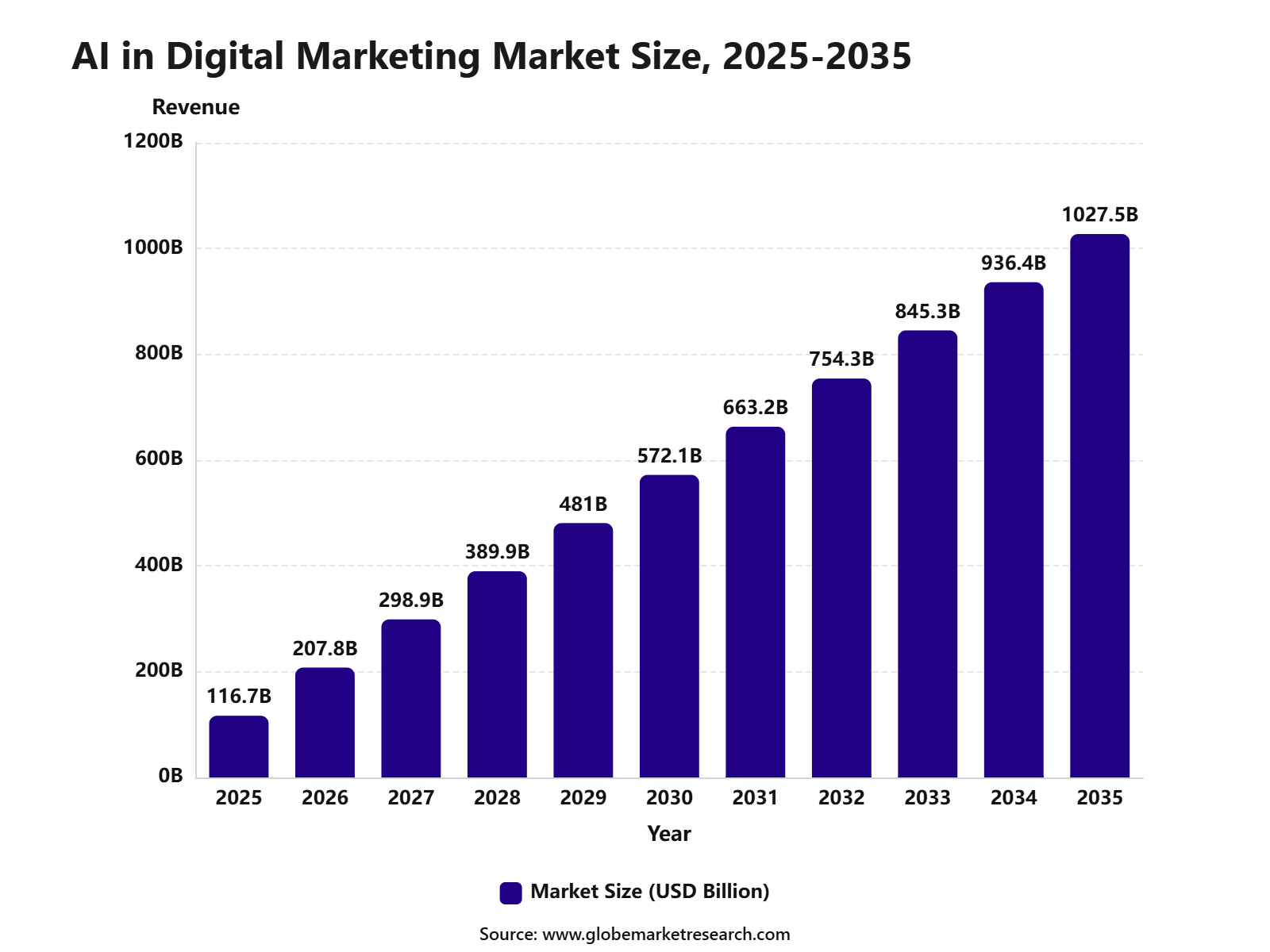 iThe graph shows projected market growth until 2035 based on CAGR analysis. Actual outcomes may vary depending on changing demand, competition, and economic factors.To gain greater insights - request a sample report PDF
Key Market Insights
Social media marketing led the channel segment with 65.8% share, supported by rising use of AI for audience targeting, content scheduling, sentiment analysis, ad personalization, and campaign performance tracking.
Content marketing accounted for 66.3% share by strategy, driven by growing adoption of AI tools for content creation, keyword optimization, customer intent analysis, and automated content recommendations.
Machine learning held 63.2% share by technology, supported by its strong role in predictive analytics, customer segmentation, campaign optimization, lead scoring, and real-time personalization.
Retail captured 34.4% share by end user, driven by high demand for AI-powered product recommendations, personalized promotions, customer journey mapping, and conversion-focused marketing.
North America led the AI in digital marketing market with 40.1% share, supported by strong digital advertising spending, early AI adoption, advanced marketing technology infrastructure, and high use of data-driven customer engagement tools.
Channel Insights
Social media marketing led the channel segment with 65.8% share. The segment remains dominant because social platforms are now used for brand awareness, product discovery, customer engagement, influencer-led campaigns, and direct shopping journeys.
AI is being widely used in social media marketing to improve audience targeting, content timing, creative testing, sentiment tracking, and campaign performance measurement. This is important because social media has become one of the most active digital touchpoints for consumers and brands.
The segment is also supported by high social platform usage among marketers. In 2026, Instagram was used by 70% of marketers, while Facebook was used by 69.6%, showing the continued importance of social platforms in digital marketing strategies.
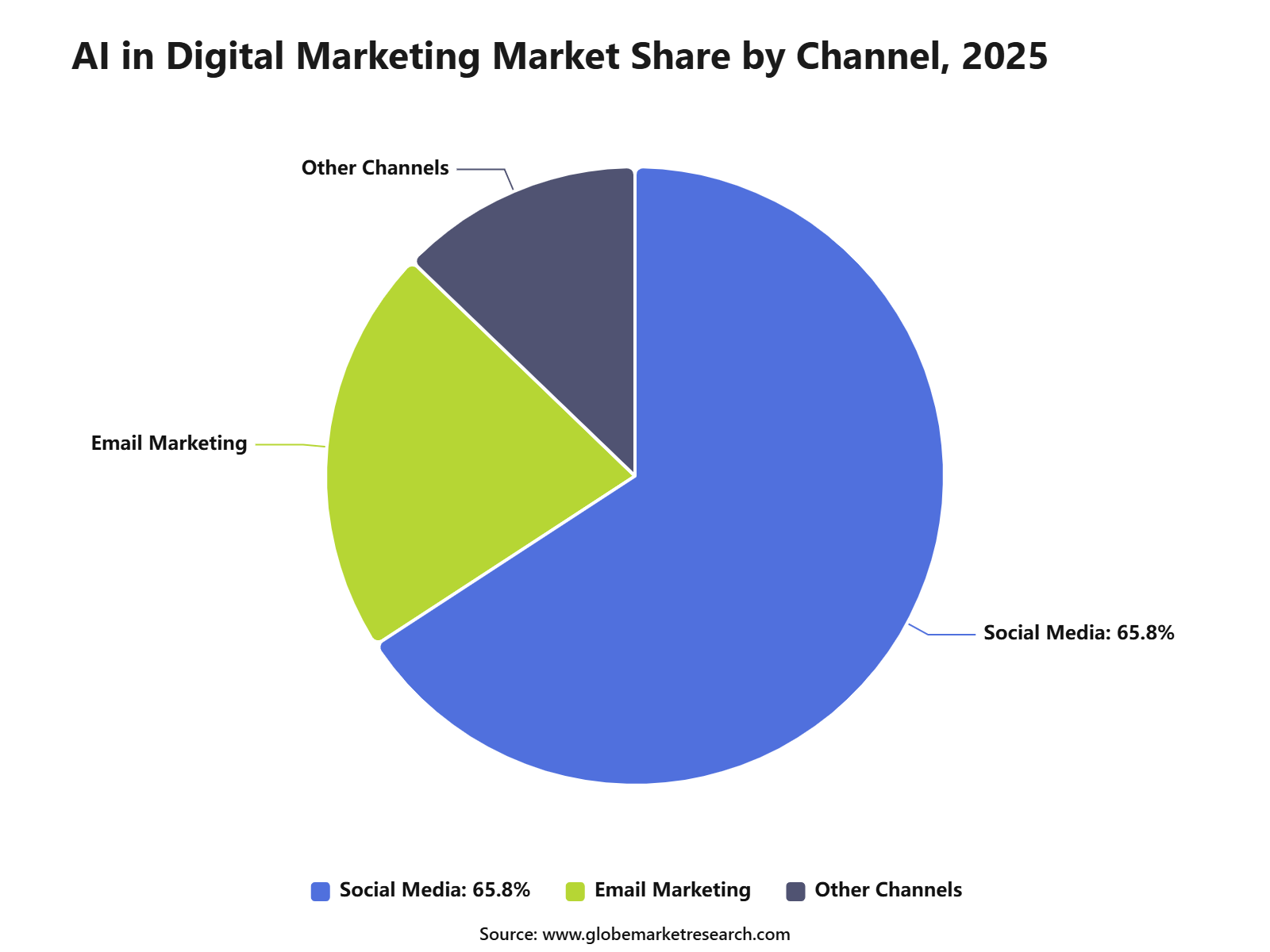 iThe graph shows projected market growth until 2035 based on CAGR analysis. Actual outcomes may vary depending on changing demand, competition, and economic factors.To gain greater insights - request a sample report PDF
Strategy Insights
Content marketing accounted for 66.3% share. The segment is leading because brands are using AI to create, edit, optimize, and personalize content across blogs, websites, emails, landing pages, product pages, and social campaigns.
AI-supported content marketing helps teams improve content speed, topic planning, keyword mapping, user intent matching, and performance tracking. This allows marketers to serve more relevant information to customers across different stages of the buying journey.
The segment is also gaining strength as AI becomes part of content production workflows. About 94% of marketers planned to use AI in their content creation processes in 2026, which shows how strongly AI is being adopted for content-led marketing.
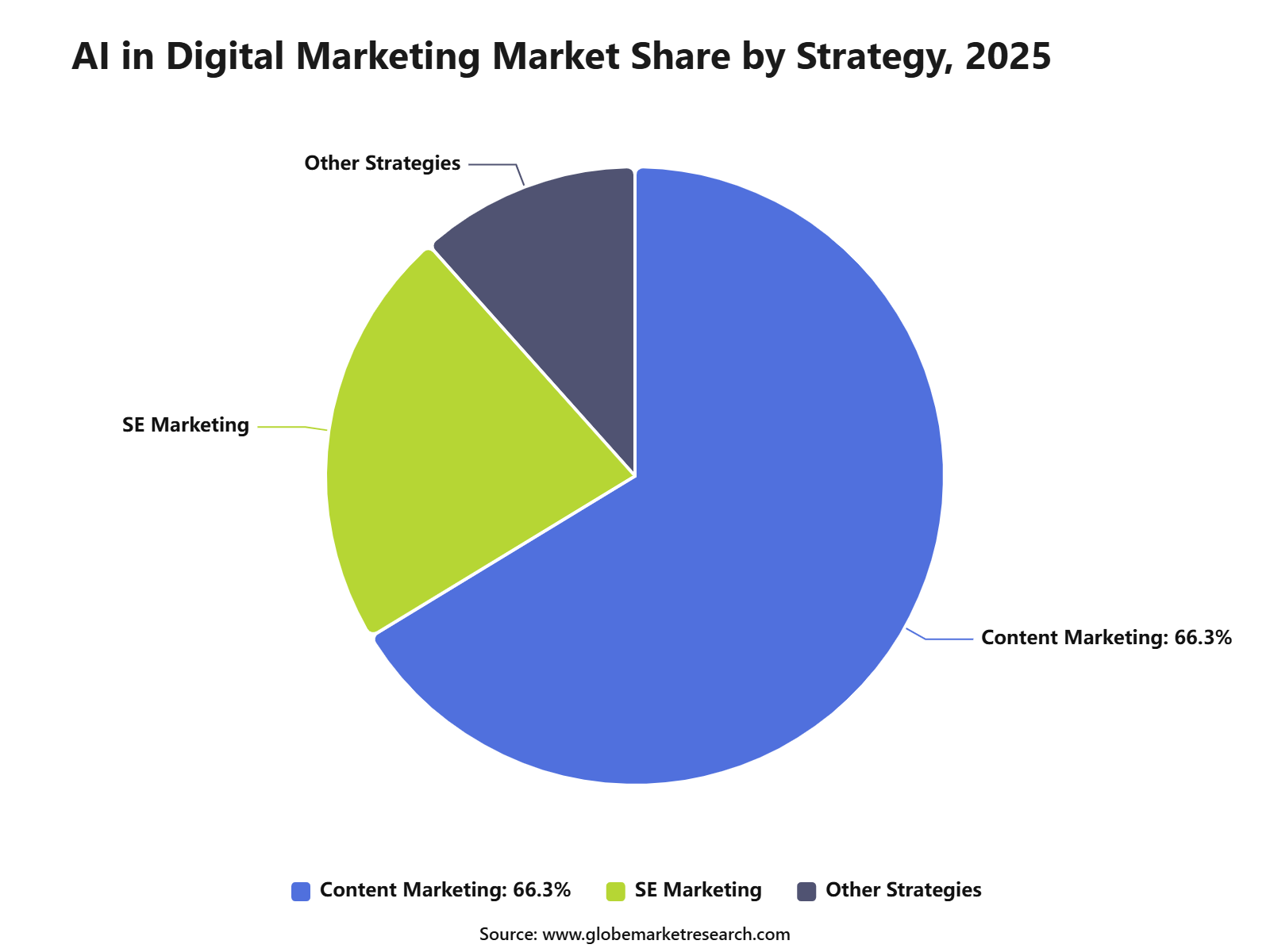 iThe graph shows projected market growth until 2035 based on CAGR analysis. Actual outcomes may vary depending on changing demand, competition, and economic factors.To gain greater insights - request a sample report PDF
Technology Insights
Machine learning led the technology segment with 63.2% share. The segment remains central to AI in digital marketing because machine learning supports predictive analytics, audience segmentation, recommendation engines, campaign scoring, and automated bidding.
Machine learning helps marketers understand patterns in customer behavior. It can analyze browsing activity, purchase history, campaign response, and engagement signals to improve targeting accuracy and reduce wasted spending.
The role of machine learning is also supported by the wider use of AI systems that learn from data and improve through pattern recognition. AI systems depend on data, algorithms, and computing power to identify useful relationships that may not be easy to detect manually.
End User Insights
Retail led the end user segment with 34.4% share. Retailers are strong adopters of AI in digital marketing because they need better personalization, product recommendations, customer retention, pricing support, and campaign automation.
AI is helping retail brands improve digital shopping journeys by matching products with customer needs more accurately. It also supports chatbots, virtual assistants, targeted promotions, cart recovery, and personalized product discovery.
Retail adoption is being supported by the wider use of AI-driven personalization. Retail companies are using algorithms to analyze large volumes of customer data and deliver tailored recommendations and personalized shopping experiences.
Regional Insights
North America dominated the regional segment with 40.1% share. The region leads due to strong digital advertising maturity, high AI adoption among marketers, advanced cloud infrastructure, and a large base of retail, media, technology, and e-commerce companies.
The region also benefits from early use of AI in campaign planning, audience segmentation, creative production, and performance measurement. This gives marketers better control over personalization, budget allocation, and customer engagement across digital channels.
AI adoption in advertising is moving forward across the region, but readiness still varies. In 2025, only 30% of agencies, brands, and publishers had fully integrated AI across the media campaign lifecycle, while many others were still building roadmaps and governance systems.
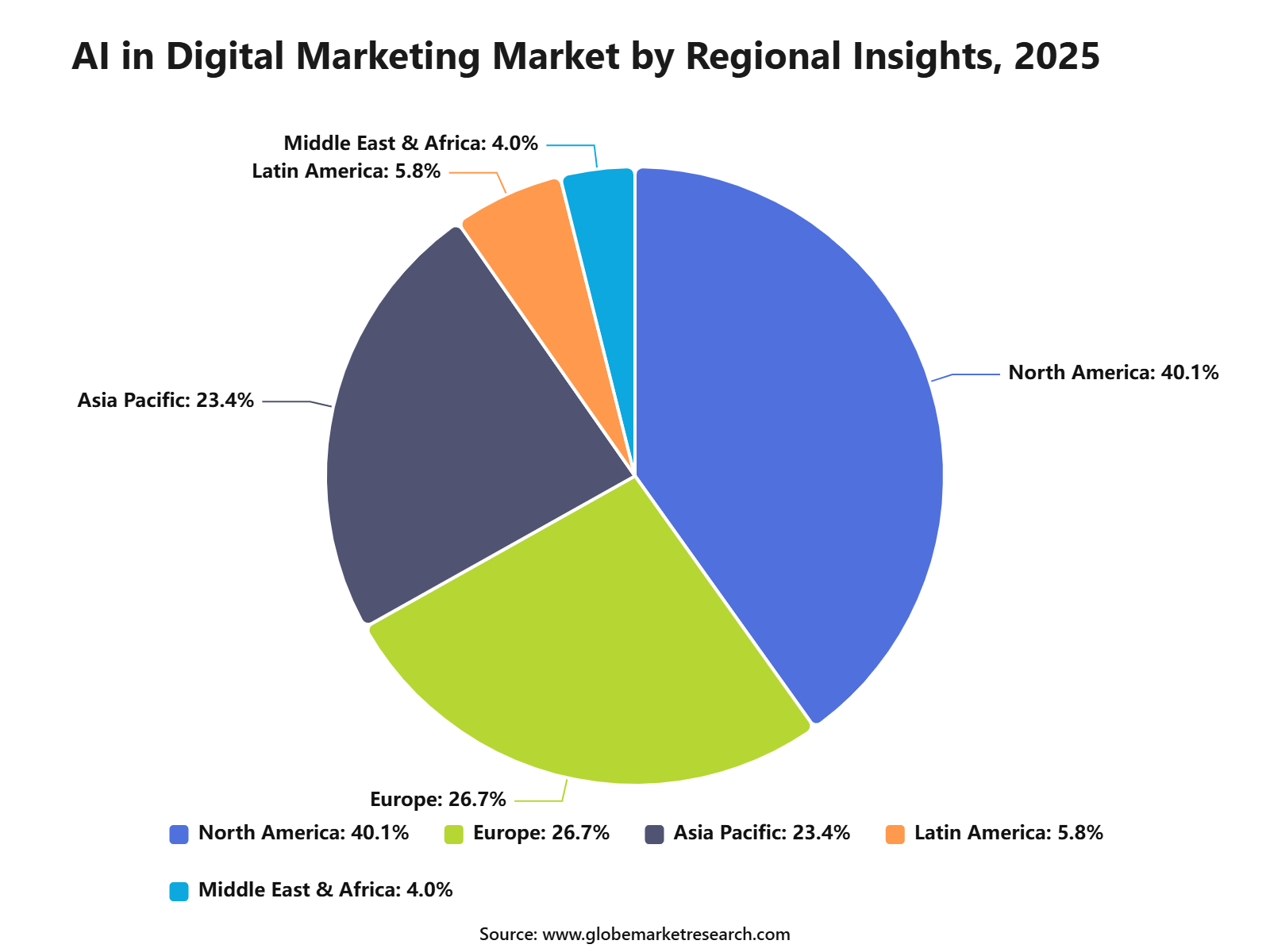 iThe graph shows projected market growth until 2035 based on CAGR analysis. Actual outcomes may vary depending on changing demand, competition, and economic factors.To gain greater insights - request a sample report PDF
Drivers Impact Analysis
The AI in Digital Marketing Market is driven by rising demand for automated content creation, customer targeting, campaign personalization, predictive analytics, social media optimization, and real-time advertising decisions. AI helps marketers improve conversion, reduce manual work, and deliver more relevant campaigns across search, social, email, video, and e-commerce channels.
North America leads the market due to strong digital ad spending, advanced marketing technology adoption, large enterprise software usage, and high AI readiness across brands and agencies. The U.S. remains the main regional contributor because of strong demand from retail, media, BFSI, technology, healthcare, and consumer goods companies.
Impact Factor | Estimated CAGR Impact | Regional Relevance | Market Impact |
|---|---|---|---|
Rising demand for personalized marketing | +6.5% | North America, Europe, Asia Pacific | Drives core market growth. |
Growth in AI-powered content creation | +5.7% | U.S., Canada, UK, India | Supports campaign speed. |
Expansion of predictive analytics | +5.0% | Enterprise marketing teams | Improves targeting accuracy. |
Increasing digital ad automation | +4.3% | Global advertising markets | Raises campaign efficiency. |
Growth in social media marketing | +3.7% | Consumer-facing industries | Builds audience engagement. |
Restraints Impact Analysis
The market faces restraints from data privacy rules, customer consent requirements, and rising concerns around AI-generated content quality. Digital marketers need to manage personal data carefully while still delivering targeted and relevant campaigns.
Another restraint is overdependence on automation. Poorly trained AI models, weak prompts, inaccurate customer data, and generic content can reduce campaign performance and damage brand trust.
Impact Factor | Estimated CAGR Impact | Regional Relevance | Market Impact |
|---|---|---|---|
Data privacy and consent regulations | -3.4% | North America, Europe, developed Asia | Slows targeting flexibility. |
Risk of generic AI-generated content | -2.9% | Global marketing teams | Reduces brand differentiation. |
Poor data quality and fragmented systems | -2.5% | Enterprise and SME users | Limits campaign accuracy. |
High platform and integration cost | -2.1% | Mid-sized businesses | Slows adoption. |
Consumer distrust of automated messaging | -1.8% | Regulated and sensitive sectors | Affects engagement. |
Opportunities Impact Analysis
Opportunities are strong in AI-powered campaign management, content marketing, customer journey automation, conversational marketing, programmatic advertising, influencer analytics, and AI-based SEO and AEO tools. These areas benefit from brands wanting faster execution and better marketing performance.
Higher-value opportunities are also emerging in retail media, e-commerce personalization, generative AI creative testing, and predictive customer lifetime value analysis. Companies that combine automation with brand-safe controls and measurable ROI can capture stronger adoption.
Impact Factor | Estimated CAGR Impact | Regional Relevance | Market Impact |
|---|---|---|---|
AI campaign automation platforms | +6.3% | North America, Europe, Asia Pacific | Builds scalable demand. |
AI-powered content marketing tools | +5.5% | Agencies, brands, publishers | Speeds content production. |
E-commerce personalization solutions | +4.8% | Retail and online marketplaces | Improves conversion. |
Conversational marketing and chatbots | +4.1% | B2C and B2B businesses | Enhances customer engagement. |
AI-based SEO and AEO optimization | +3.5% | Digital-first companies | Expands search visibility. |
Challenges Impact Analysis
The main challenge is balancing automation with human creativity, brand voice, and customer trust. AI can generate and optimize content quickly, but marketers still need human review, brand governance, and strategy-led decision making.
Another challenge is measuring AI’s true contribution across multiple channels. Attribution becomes complex when campaigns run across paid search, social media, email, influencer content, marketplaces, websites, and AI-assisted customer journeys.
Impact Factor | Estimated CAGR Impact | Regional Relevance | Market Impact |
|---|---|---|---|
Maintaining brand voice at scale | -3.1% | Global brands and agencies | Affects content quality. |
Measuring cross-channel ROI | -2.7% | Enterprise marketers | Creates budget uncertainty. |
Avoiding biased targeting outcomes | -2.3% | Regulated and consumer markets | Raises compliance risk. |
Managing AI content review workflows | -2.0% | Marketing and legal teams | Slows execution speed. |
Keeping up with fast-changing tools | -1.7% | Agencies and SMEs | Increases training needs. |
Segment Covered in the Report
By Channel
Social Media Marketing
Email Marketing
Search Engine Marketing
Display Advertising
Video Marketing
Mobile Marketing
Other Channels
By Strategy
Content Marketing
Search Engine Optimization
Search Engine Marketing
Social Media Strategy
Programmatic Advertising
Customer Personalization
Campaign Automation
Other Strategies
By Technology
Machine Learning
Natural Language Processing
Data Analytics
Computer Vision
Generative AI
Predictive Analytics
Other Technologies
By End User
Retail
Hospitality
Telecommunications
BFSI
Healthcare
Media and Entertainment
Consumer Goods
Other End Users
By Region
North America
Europe
Asia Pacific
Latin America
Middle East and Africa
Go-to-Market and Sales Economics
The go-to-market approach for the AI in Digital Marketing Market should focus on measurable performance, faster content production and customer personalization. Brands are using AI for campaign planning, audience segmentation, content creation, ad targeting, SEO, email optimization, customer journey mapping and performance reporting. U.S. digital advertising revenue reached USD 294.6 billion in 2025, up 13.9% year over year, showing that AI-led marketing tools are being adopted within a large and growing digital media environment.
Sales economics are shifting from manual campaign management toward automation-supported execution. Salesforce reported in 2026 that 75% of marketers using AI were satisfied with their ability to connect customer touchpoints, compared with 60% of marketers not using AI. This shows that AI is becoming a practical tool for improving campaign coordination across email, social, paid media, CRM, commerce and customer service channels.
The strongest sales model is expected to combine AI software subscriptions with advisory, integration and performance measurement services. Marketers do not only need tools, they need clean data, brand-safe content workflows, prompt libraries, approval systems and campaign reporting. Jasper’s 2026 marketing AI report stated that 91% of marketers are actively using AI in their work, while 50% are bringing campaigns to market faster, which supports strong demand for AI platforms that reduce production time and improve output consistency.
Revenue Potential Analysis
Revenue Landscape Across
Revenue potential is spread across AI content generation, predictive analytics, customer segmentation, AI-powered SEO, media buying automation, social listening, email personalization, chatbot marketing, creator campaign management, video ad generation and marketing attribution. Search remains a major revenue channel, as IAB reported that search advertising accounted for the largest share of U.S. digital ad revenue in 2025. This supports demand for AI tools that optimize traditional search, AI-powered search, answer engines and structured content visibility.
Social media and creator marketing are becoming high-growth revenue areas for AI in digital marketing. IAB reported that U.S. creator economy ad spend is projected to reach USD 37 billion in 2025, up 26% year over year and growing nearly four times faster than the broader media industry. This creates revenue opportunities for AI tools used in influencer discovery, creator matching, content briefing, campaign tracking, sentiment analysis and automated performance reporting.
Video marketing is another strong revenue pool because brands need faster production and more personalized creative assets. IAB projected that U.S. digital video ad spending will surpass USD 80 billion in 2026, growing 11% year over year. This supports demand for AI video editing, creative testing, audience-level personalization, connected TV optimization, social video production and short-form ad generation.
Financial Impact
The financial impact of AI in digital marketing is mainly linked to lower content production cost, faster campaign launch cycles and better targeting efficiency. HubSpot’s 2026 marketing data showed that more than 92% of marketers plan to use or already use SEO optimization for traditional and AI-powered search engines. This indicates that AI search visibility is becoming a budget priority for brands that want to protect organic reach as search results become more answer-led.
AI also improves financial returns by helping teams produce more campaign variations without increasing headcount at the same pace. However, the strongest return is expected where AI is connected to customer data, brand governance and performance analytics. Writer’s 2026 enterprise AI survey found that 59% of companies invest at least USD 1 million annually in AI technology, but only 29% report significant returns, showing that tool adoption alone is not enough without workflow integration and clear measurement.
The main financial risk is content quality, data privacy, platform dependency and weak attribution. AI-generated campaigns can reduce cost, but poor prompts, inaccurate customer data and low-quality automated content can weaken brand trust. The best-positioned companies will use AI to support human-led strategy, verified data, compliance-safe personalization and measurable campaign outcomes across paid media, search, social, email and commerce channels.
Recent Developments
In June 2026, Google introduced new AI-powered advertising tools at Google Marketing Live, including AI Max, Ask Advisor, and AI-led search ad formats.
In April 2026, Microsoft Advertising expanded AI Visibility in Microsoft Clarity to help brands understand how AI systems read, cite, and interpret their websites.
In June 2026, Salesforce launched Agentforce Marketing Goals Agent to help marketers plan campaigns, build audiences, test messages, and optimize channels through AI agents.
In January 2026, OpenAI announced plans to test clearly labeled ads in ChatGPT for logged-in adults on Free and Go plans in the U.S.
Acquisitions
Adobe completed its acquisition of Semrush on April 28, 2026, strengthening its customer experience and marketing capabilities. Adobe stated that the deal expands its ability to support SEO, generative engine optimization, and agentic search optimization as AI-led discovery becomes more important for brands. This acquisition is highly relevant because AI in digital marketing is now closely tied to brand visibility across search engines, AI answer engines, and agent-led discovery platforms.
Salesforce completed its acquisition of Qualified on April 1, 2026. Qualified provides agentic AI marketing solutions designed to engage and convert inbound buyers through conversational website experiences. Salesforce said the acquisition would help customers deploy marketing agents that autonomously generate pipeline. This shows that AI-powered buyer engagement is becoming a key part of B2B digital marketing and revenue operations.
HubSpot’s acquisition agreement for XFunnel remained important for AI marketing in 2026 because XFunnel is designed to help businesses monitor, test, and improve how they appear across LLMs through answer engine optimization. HubSpot said XFunnel would be integrated into its marketing products to give marketers clearer insight into how brands appear across AI tools and what actions should be taken.
Sitecore acquired Scrunch in June 2026 to strengthen AI search visibility and brand presence capabilities. The acquisition gives marketers tools to understand where brands appear, where they are missing, and where they are misrepresented in AI-generated answers. This is directly relevant to digital marketing because AI search optimization, content governance, and digital experience management are becoming connected functions.
Funding
Profound raised USD 96 million in Series C funding in February 2026 at a USD 1 billion valuation. The round was led by Lightspeed Venture Partners, with participation from Sequoia Capital, Kleiner Perkins, Saga VC, South Park Commons, and Evantic. Profound said it is building marketing infrastructure for an internet where brand discovery is mediated by AI, and its platform tracks visibility, sentiment, and performance across AI answer engines.
Gradial raised USD 65 million in Series C funding in June 2026 for its agentic AI marketing platform. Axios reported that Gradial is building an operating system for marketing where AI agents execute work across enterprise tools such as Adobe, Salesforce, ServiceNow, and Databricks. The company’s customer examples include regulated sectors such as healthcare and financial services, where approval workflows and compliance controls are critical for AI marketing adoption.
Lantern also gained attention in 2026 for its e-commerce-focused AI search optimization platform. The company had raised USD 3.1 million in seed funding in 2025 and pivoted toward helping e-commerce brands improve product visibility inside LLM-led discovery. This is relevant because AI in digital marketing is expanding from campaign creation to product recommendation visibility, catalog optimization, and agentic shopping readiness.
Market Impact
The AI in Digital Marketing Market is becoming more execution-focused in 2026. Earlier adoption was centered on content drafts, image generation, email copy, and keyword support. The latest updates show stronger movement toward autonomous agents, AI search visibility, real-time creative personalization, structured product data, customer journey orchestration, and measurable brand presence inside AI-generated answers.
For advertisers, the practical focus is moving upstream. Campaign success is increasingly dependent on clean first-party data, strong conversion signals, high-quality product feeds, brand-safe creative rules, clear audience context, and machine-readable content. Microsoft’s 2026 AI Visibility update is especially important because it shows that marketers now need to know how AI systems interpret their webpages, cite their content, and compare them with competitors before a click takes place.
For marketing teams, AI is changing the workflow model. Marketers are expected to spend less time manually building campaigns and more time setting strategy, rules, budgets, brand voice, compliance limits, and performance goals. Salesforce’s Agentforce Marketing update shows this clearly, as campaign creation, channel selection, message testing, audience building, and optimization can be managed by AI agents within human-defined boundaries.
For vendors, the strongest opportunity is expected in AI campaign operations, AI-powered search visibility, customer data activation, creative intelligence, agentic commerce, and cross-platform workflow automation. Platforms that can connect insight with action will be better positioned than tools that only generate copy or report dashboards. The market is therefore moving toward AI systems that diagnose visibility gaps, recommend content changes, launch campaigns, update assets, and measure business outcomes through one connected marketing loop.
Competitive Landscape
The market is characterized by intense competition among established players and emerging companies. Strategic partnerships, mergers and acquisitions, and product innovation are key strategies employed by market participants.
Key Market Players
Google LLC
Adobe Inc.
Salesforce Inc.
IBM Corporation
Amazon Web Services
Microsoft Corporation
Meta Platforms, Inc.
Meta Platforms, Inc.
HubSpot Inc.
SAP SE
Klaviyo Inc.
Braze Inc.
Twilio Inc.
Sprout Social Inc.
Jasper AI
Other Key Players
Research Methodology
This market study is prepared using a combination of primary and secondary research. Primary research includes discussions with manufacturers, suppliers, distributors, consultants, industry experts, and end users. Secondary research covers company reports, government databases, trade associations, technical publications, regulatory sources, and trusted industry documents. The collected information is used to assess market demand, pricing trends, technology adoption, competitive activity, and regional performance.
AI language models are not used as primary data sources, and publicly available AI-generated content is not treated as market evidence. Computational tools may be used to support data processing, translation, data classification, and pattern identification. However, every published assessment is supported by verified sources, human review, and primary market discussions.
Market estimates are developed through top-down and bottom-up approaches and validated using data triangulation. Revenue, production, shipment, pricing, and application-level data are compared across multiple sources. Forecasts consider economic conditions, regulatory changes, investment activity, innovation, supply chain developments, and industry risks. All findings are reviewed through source verification and internal quality checks before publication.
Part I
Source Management & Input Data Standards
Who provides data, how sources are qualified, and what types of evidence are admissible.
Part II
Research Scope & Market Coverage
How we define the markets we assess and the parameters that govern each product.
Part III
Data Collection, Verification & Submission
The mechanics of gathering, cross-checking, and hierarchically ranking evidence.
Part IV
Assessment Determination & Quality Controls
How raw data becomes a published assessment — normalisation, expert judgement, and outlier exclusion.
Part V
Publication, Corrections & Revision
Our publication schedule, corrections policy, and methodology review cycle.
Part VI
Independence, Ethics & Complaints
Conflict-of-interest policies, editorial independence, and how clients raise concerns.
Google · Preferred Sources
Don't miss the latest market research insights and industry updates on Google.
Add Globe Market Research as a preferred source in the Google app to see our reports, analysis, and market stories in your news suggestions.
Meet the Team
This report was prepared by our expert analysts with deep industry knowledge and research experience.
Pratiksha K. is a Senior Research Analyst with more than five years of experience in market research, industry analysis, competitive intelligence, and business strategy. She has contributed to detailed market reports, customized research studies, company profiling, market sizing, trend analysis, and strategic consulting projects for clients across different regions. Her industry expertise covers Chemical and Material, Consumer Goods, Food & Beverages and Energy & Power. She closely evaluates changing customer requirements, technology developments, regulatory conditions, supply chain structures, investment activity, and competitive strategies to provide clear and practical market insights.
Sayali brings more than 7 years of experience to Globe Market Research, supporting the accuracy, clarity, and relevance of research content across multiple industries. She reviews market data, segment analysis, competitive insights, and industry trends to ensure each report meets strong quality standards and provides practical value to business decision-makers. Her expertise spans healthcare, information technology, consumer goods, and diverse cross-industry domains. With a strong focus on data reliability, structured analysis, and clear presentation, Sayali helps ensure that each research output delivers well-reviewed insights for clients, investors, consultants, and industry stakeholders.
Frequently Asked Questions
Related Reports
More in Information and Technology
Edtech SaaS Tools Market Size to hit USD 217.6 billion by 2035
EdTech SaaS Tools Market Size, Share, Trends and Growth Analysis Report By Software (Classroom Management Systems, Document Management Systems, Learning and Gamification Platforms, Learning Management Systems, Student Collaboration Systems, Assessment and Analytics Tools, Content Authoring Tools, Other Software), By Sector (Preschool, K-12, Higher Education, Other Education Sectors), By Deployment (Cloud-Based, Hybrid), By End Use (Businesses, Educational Institutions, Individual Learners and Consumers), By Regional Insights, Technology Trends, Competitive Landscape, Strategic Opportunities and Growth Forecast, 2026–2035
Marketing Technology Market Size to Reach USD 3,810.8 billion by 2035
Marketing Technology Market Size, Share, Trends and Growth Analysis Report By Marketing Type (Digital Marketing, Offline Marketing), By Product (Social Media Tools, Content Marketing Tools, Rich Media Tools, Marketing Automation Tools, Data and Analytics Tools, Sales Enablement Tools), By Deployment (Cloud-Based, On-Premises, Other Deployment Models), By Enterprise Type (Large Enterprises, Small and Medium-Sized Enterprises), By Application (IT and Telecommunication, Retail and E-commerce, Healthcare, Media and Entertainment, Sports and Events, BFSI, Real Estate, Other Applications), By Regional Insights, Technology Trends, Competitive Landscape, Strategic Opportunities and Growth Forecast, 2026-2035
AI Watermarking Market Size to hit USD 10.9 billion by 2035
AI Watermarking Market Size, Share, Trends and Growth Analysis Report By Type (Invisible Watermarking, Visible Watermarking), By Technology (Non-Reversible Watermarking, Reversible Watermarking), By Deployment (Cloud, On-Premises), By Application (Copyright Protection, Authentication and Security, Branding and Marketing, Other Applications), By Content Type (Video, Image, Model Watermarking, Audio, Text), By End Use (Media and Entertainment, BFSI, Healthcare, Government and Defense, Retail and E-commerce, Other End-Use Industries), By Regional Insights, Technology Trends, Regulatory Landscape, Competitive Analysis, Strategic Opportunities and Growth Forecast, 2026-2035
Environmental, Social and Governance (ESG) Consulting Market to hit USD 49.4 billion by 2035
Environmental, Social and Governance (ESG) Consulting Market Size, Share, Trends and Growth Analysis Report By Service Type (Testing, Auditing and Verification, Technical Support, Sustainability Marketing, Strategy and Planning, Other Services), By Enterprise Size (Small and Medium-Sized Enterprises, Large Enterprises), By End User (Corporates, Investors, Government Bodies, Non-Profit Organizations, Other End Users), By Industry Vertical (BFSI, Energy and Utilities, Manufacturing, Healthcare, Retail and Consumer Goods, IT and Telecom, Transportation and Logistics, Other Industries), By Regional Insights, Regulatory Trends, Competitive Landscape, Strategic Opportunities and Growth Forecast, 2026-2035