

Revenue, 2026
USD 1.2 Bn
Forecast, 2035
USD 10.9 Bn
CAGR, 2026-2035
27.8%
Report Coverage
Global
Market Size and Forecast
AI watermarking uses visible labels, invisible signals, metadata and content-provenance records to identify material created or modified by artificial intelligence. The technology can be applied to images, video, audio, text and AI models for copyright protection, content authentication, regulatory compliance and synthetic-media detection. Developers are increasingly combining embedded watermarks with C2PA Content Credentials because metadata can provide creation history while invisible signals may remain detectable after common edits or file conversions.
The global AI Watermarking Market was valued at USD 1.2 billion in 2026 and is projected to reach approximately USD 10.9 billion by 2035, growing at a CAGR of 27.8% from 2026 to 2035. North America accounted for around 40.5% of the market, equivalent to approximately USD 0.4 Billion at the stated 2026 value. Regional leadership is being supported by extensive generative AI adoption, advanced cybersecurity capabilities, major content platforms and growing demand for copyright protection, content verification and responsible AI governance.
Key Parameter | Report Details |
|---|---|
Market Revenue, 2026 | USD 1.2 Billion |
Projected Revenue, 2035 | USD 10.9 Billion |
CAGR, 2026-2035 | 27.8% |
Largest Region | North America, 40.5% Share |
Market Concentration | Medium |
Base Year | 2025 |
Forecast Period | 2026-2035 |
Commercial adoption is accelerating as the volume of synthetic media increases. Google reported in May 2026 that SynthID had been used to watermark more than 100 billion images and videos and 60,000 years of audio, while its verification tools had already been used 50 million times globally. The Content Authenticity Initiative reached 5,000 members in August 2025, reflecting wider implementation of provenance technology across software, media, cameras, smartphones and internet infrastructure. Demand is also being strengthened by the European Union’s Article 50 transparency obligations, which will require machine-readable marking and detection of AI-generated content.
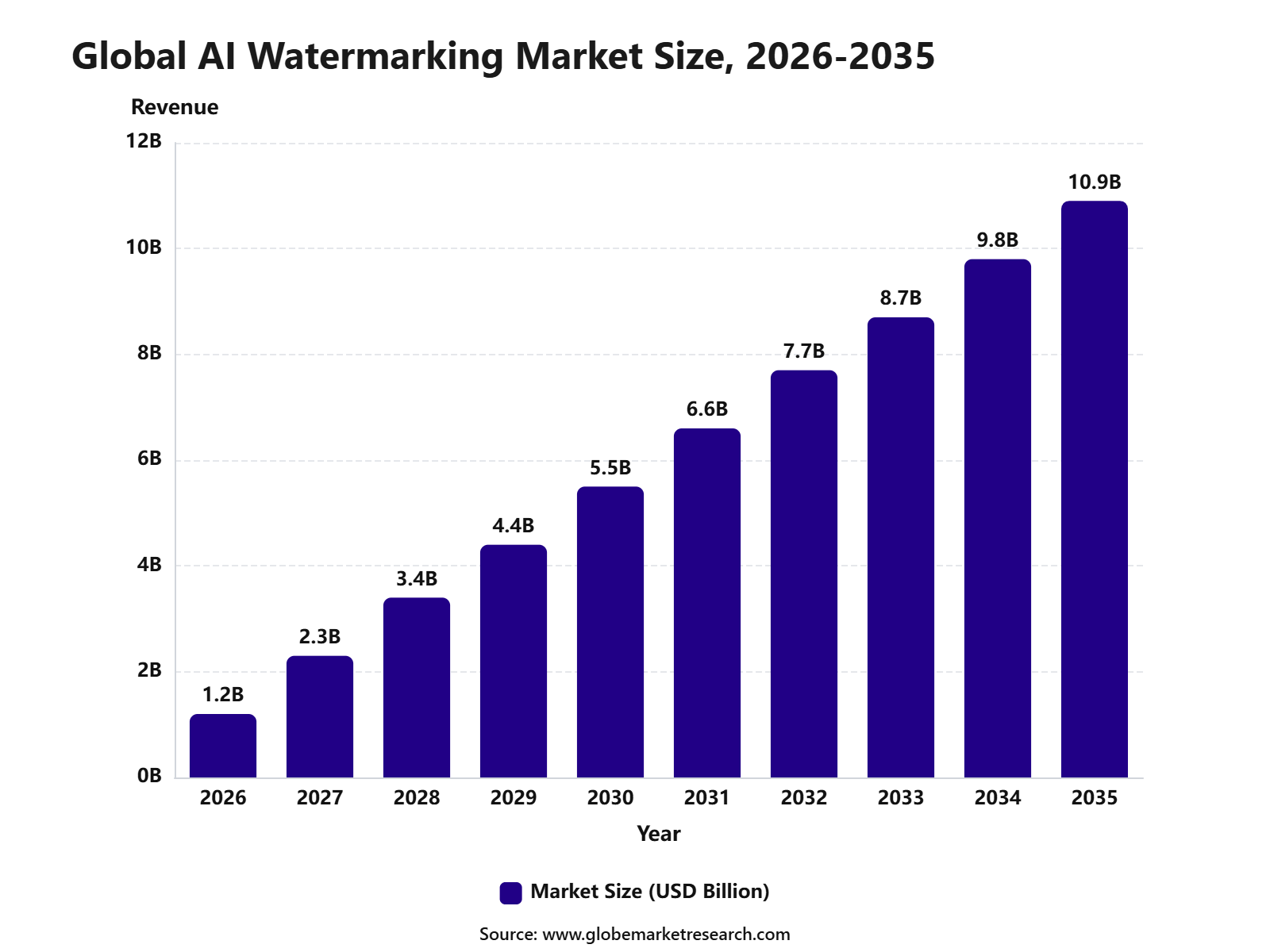 iThe graph shows projected market growth until 2035 based on CAGR analysis. Actual outcomes may vary depending on changing demand, competition, and economic factors.To gain greater insights - request a sample report PDF
AI Watermarking Market Key Insights
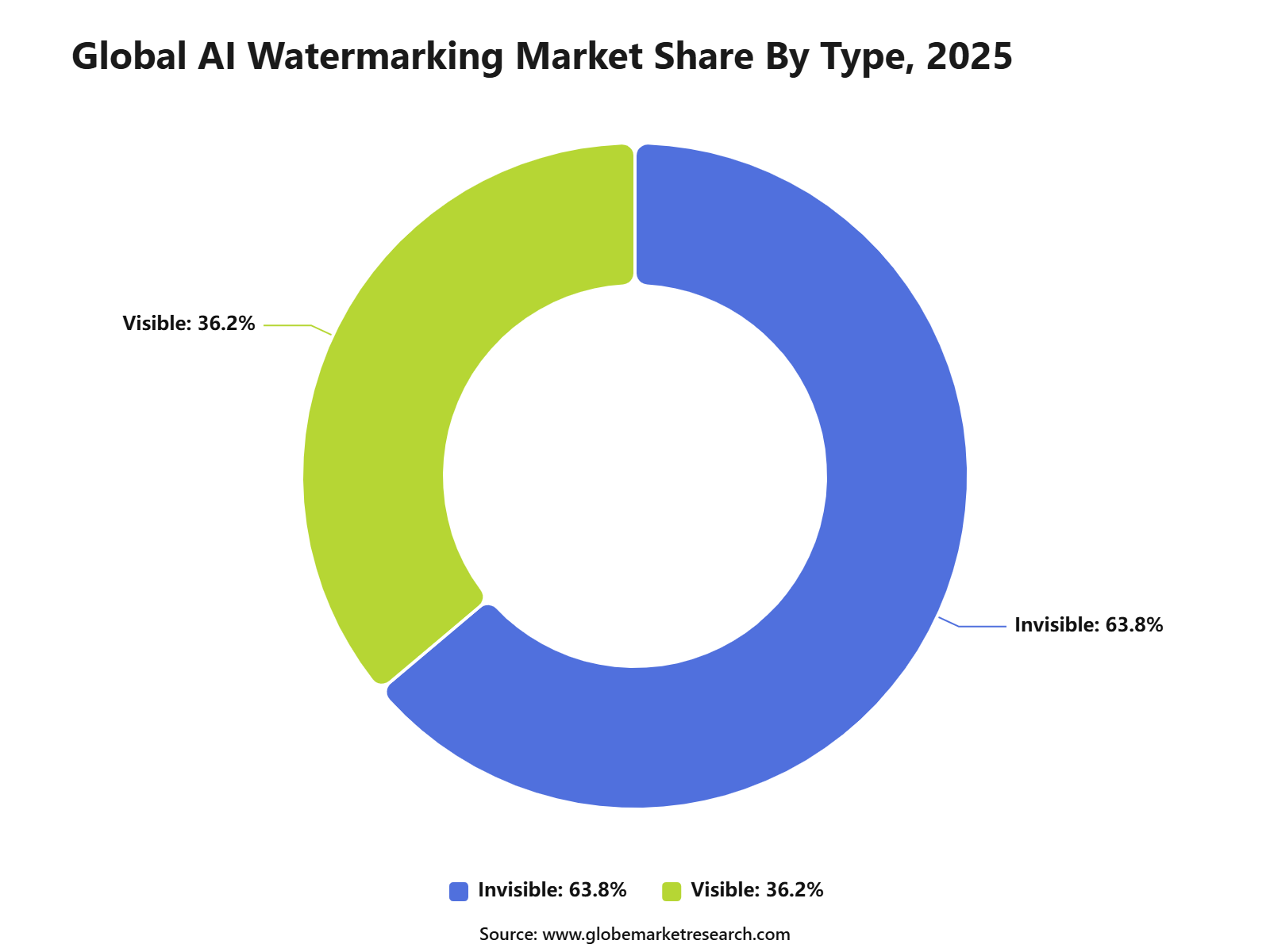
Invisible watermarking led the type segment with 63.8% share, supported by its ability to protect digital content without affecting visual quality, user experience, or content presentation.
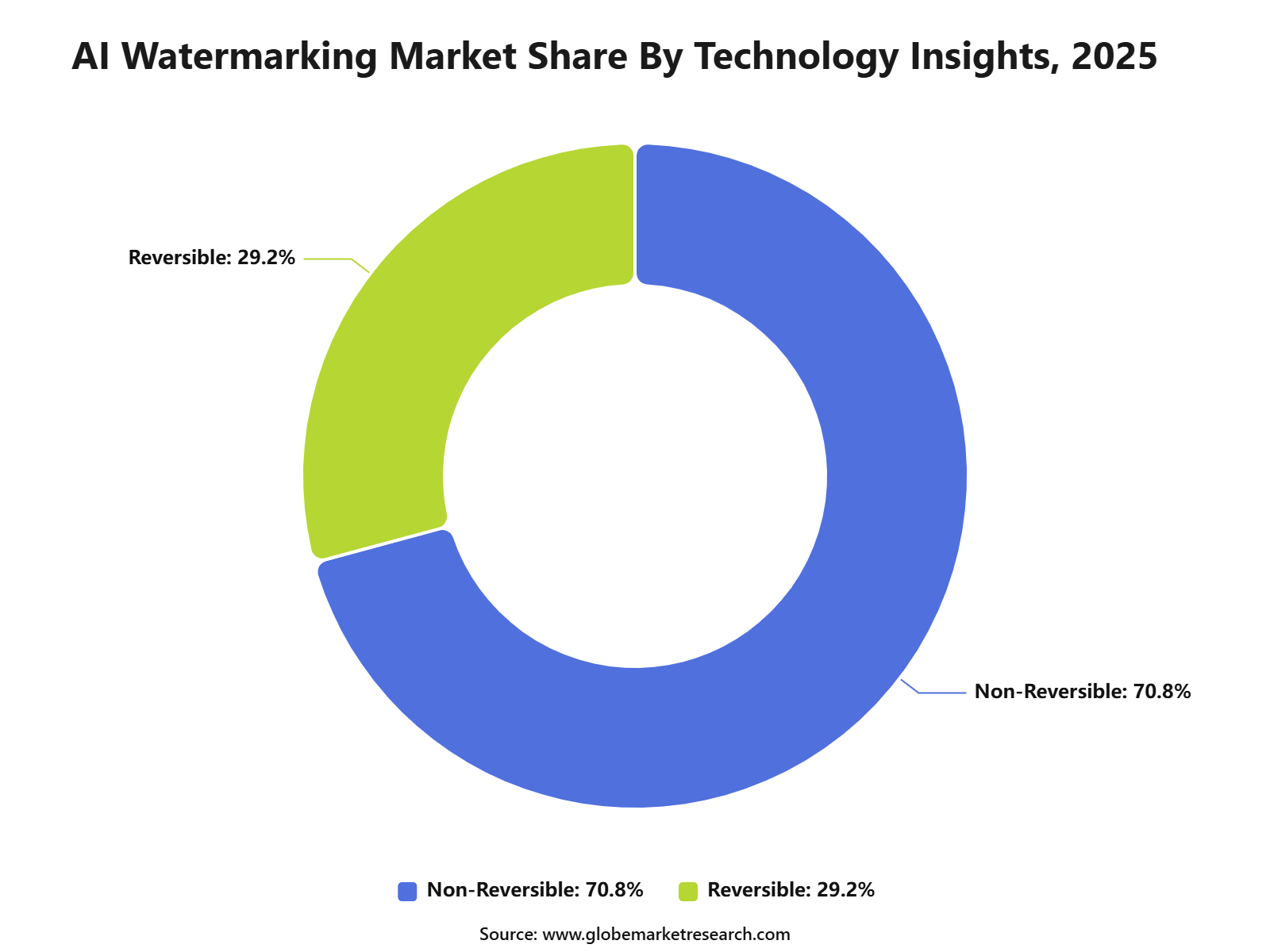
Non-reversible watermarking accounted for 70.8% share by technology, driven by stronger tamper resistance, better content authentication, and wider use in ownership protection.
Cloud deployment held 73.3% share, supported by scalable processing, easier integration with AI platforms, faster content tracking, and lower infrastructure requirements.
Copyright protection captured 40.9% share by application, driven by rising concerns over AI-generated content misuse, unauthorized distribution, plagiarism, and digital ownership disputes.
Video content accounted for 42.8% share, supported by strong demand for watermarking in streaming media, short-form videos, advertising, entertainment, and creator-generated content.
Media and entertainment led the end-use segment with 39.6% share, driven by high content production, digital rights protection needs, and growing use of AI-generated media assets.
North America led the AI watermarking market with 40.5% share, supported by strong AI adoption, advanced media technology infrastructure, high digital content creation, and rising focus on content authenticity.
Adoption Rate and Usage Statistics
According to TikTok and Adobe, the adoption of AI labeling, content provenance, and watermarking technologies is increasing as synthetic content expands across digital platforms. TikTok reported an 81% increase in automatically labeled AI content and a 36% rise in creator-labeled AI videos. Adobe found that 93% of consumers consider content-creation transparency important, while 74% have questioned the authenticity of online images or videos.
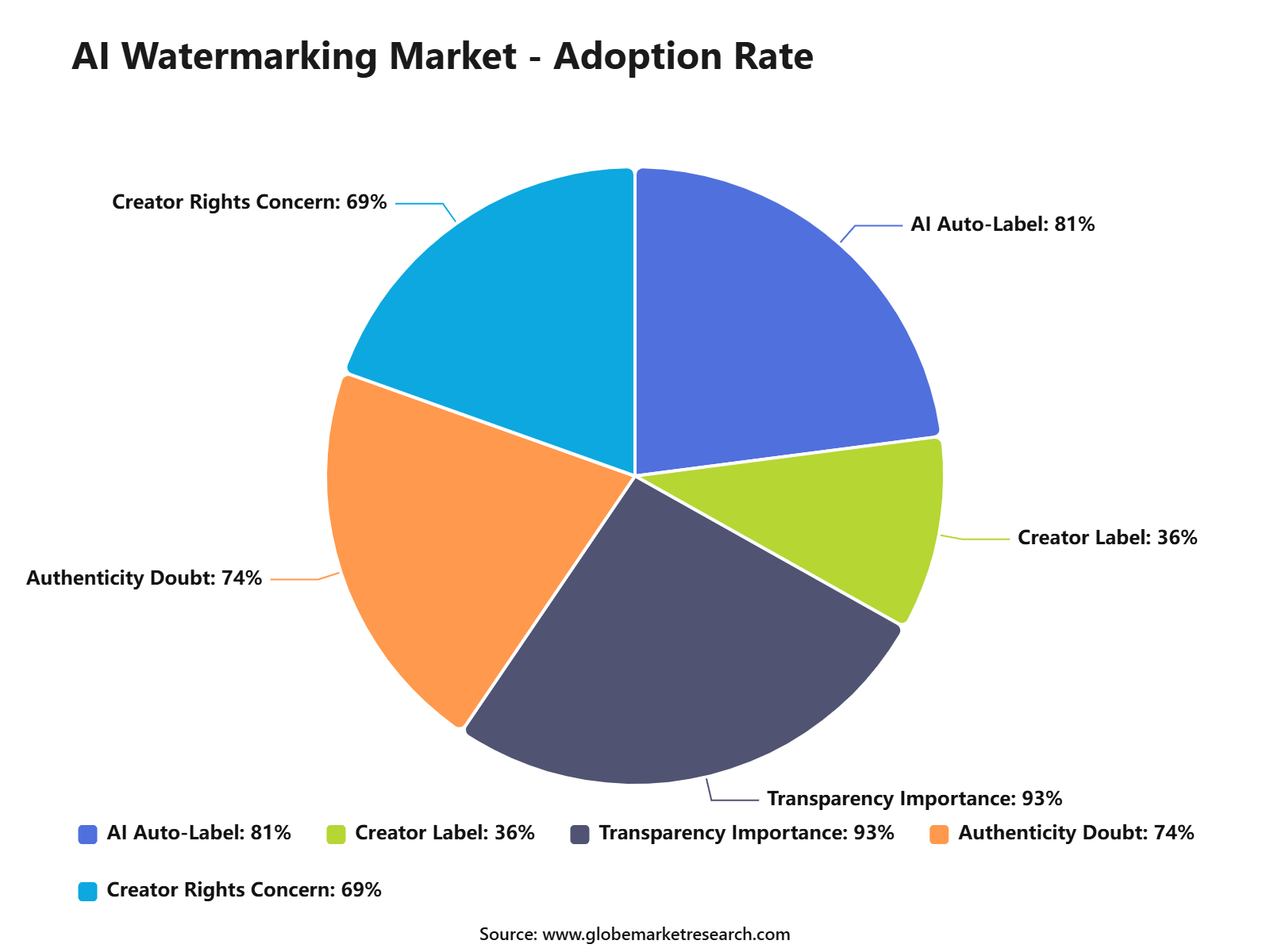 iThe graph shows projected market growth until 2035 based on CAGR analysis. Actual outcomes may vary depending on changing demand, competition, and economic factors.To gain greater insights - request a sample report PDF
According to Google DeepMind, TikTok, and the Coalition for Content Provenance and Authenticity, SynthID has been applied to more than 20 billion AI-generated images, videos, audio files, and text outputs. TikTok’s transparency systems have labeled more than 1.3 billion videos, including approximately 5.5 million automatically labeled AI-content items. The Content Credentials ecosystem has also expanded to more than 500 participating companies.
Metric | Usage Value |
|---|---|
SynthID Content | Over 20 billion items |
TikTok Labeled Videos | Over 1.3 billion |
C2PA Companies | Over 500 companies |
Creator-Labeled Videos | Over 8.7 million |
Auto-Labeled Content | Around 5.5 million items |
Type Insights
Invisible watermarking accounted for 63.8% of the AI Watermarking Market by type. Its leading position is supported by the ability to add identification information without placing a noticeable symbol over the content. This allows images, videos, audio and text to retain their original appearance while still carrying information about their artificial origin.
The C2PA specification defines an invisible watermark as information incorporated into digital content in a substantially imperceptible form. It can be used to identify an asset or connect it with a verified provenance record. Current systems can apply invisible signals across images, audio, text and video generated by AI models.
Invisible watermarking is particularly suitable for professional content because visible labels can interfere with design quality and audience experience. However, users still require accessible detection tools to read the embedded signal. Wider adoption will depend on watermark durability after compression, resizing, editing, format conversion and distribution through social media platforms.
 iThe graph shows projected market growth until 2035 based on CAGR analysis. Actual outcomes may vary depending on changing demand, competition, and economic factors.To gain greater insights - request a sample report PDF
Technology Insights
Non-reversible watermarking represented 70.8% of the market by technology. This method permanently modifies selected characteristics of the generated content to embed an identification signal. The original unmarked version cannot be reconstructed through the normal watermark extraction process, which supports persistent content tracking and evidence of origin.
NIST’s updated 2025 adversarial machine learning guidance identifies watermarking as a method that developers and deployers can use to distinguish AI-generated material from human-created content. NIST also states that watermarking and synthetic content detection require further evaluation of effectiveness, resilience and performance across different content formats.
Non-reversible methods are suitable for large-scale content generation because the watermark can be added during output creation without requiring a separate original file for later comparison. No watermark is completely resistant to deliberate removal. Providers must therefore combine robust embedding, provenance metadata and detection models instead of depending on one technical measure.
 iThe graph shows projected market growth until 2035 based on CAGR analysis. Actual outcomes may vary depending on changing demand, competition, and economic factors.To gain greater insights - request a sample report PDF
Deployment Insights
Cloud deployment accounted for 73.3% of the AI Watermarking Market. Cloud-based systems allow content to be marked and checked through application programming interfaces, online media platforms and centralized generative AI services. This model is suitable for organizations processing large and changing volumes of images, videos, documents and audio files.
Eurostat reported that 52.74% of EU enterprises purchased cloud computing services in 2025, an increase of 7.42% points compared with 2023. Among enterprises using paid cloud services, 96.44% purchased at least one software-as-a-service application and 77.25% purchased infrastructure-as-a-service resources.
Deployment | Market Share |
|---|---|
Cloud | 73.3% |
On-Premises | 26.7% |
Cloud deployment allows watermarking rules and detection models to be updated centrally as manipulation techniques change. It also supports automated checking during content creation, upload and distribution. Buyers will continue to assess data privacy, processing latency, service availability and the cost of checking high volumes of media.
Application Insights
Copyright protection accounted for 40.9% of the market by application. AI watermarking can help creators, publishers and rights holders demonstrate when content was generated, edited or distributed. It also provides supporting evidence for licensing, ownership claims, unauthorized reuse investigations and management of content containing both human and AI-generated elements.
The U.S. Copyright Office received more than 10,000 comments during its wider consultation on copyright and artificial intelligence, with approximately half addressing copyrightability. Its January 2025 report concluded that AI-assisted material may receive protection when sufficient human-authored expression, selection, arrangement or creative modification is present.
Application | Market Share |
|---|---|
Copyright Protection | 40.9% |
Authentication and Security | 28.7% |
Branding and Marketing | 18.4% |
Other Applications | 12.0% |
Watermarks cannot determine legal ownership by themselves, but they can improve the documentation available during a dispute. Effective copyright protection will require links between watermarks, licensing records, creator identities and production histories. Detection results must also be reliable enough to avoid incorrectly identifying legitimate content as unauthorized or artificially generated.
Content Type Insights
Video accounted for 42.8% of the AI Watermarking Market by content type. Video requires strong authentication because individual files combine moving images, audio, speech, text and visual effects. AI-generated scenes can also be clipped, compressed, resized, dubbed or edited before distribution, making persistent identification more difficult than in static content.
More than 20 million videos are uploaded to YouTube on an average day, while YouTube Shorts records over 200 billion daily views. This scale illustrates why platforms require automated systems that can identify content origin without relying entirely on manual review. Current generative video systems are increasingly applying invisible watermarks during output creation.
Content Type | Market Share |
|---|---|
Video | 42.8% |
Image | 20.4% |
Model Watermarking | 14.7% |
Audio | 12.1% |
Text | 10.0% |
Video watermarking must remain detectable across individual frames and after routine production changes. Strong systems should withstand cropping, frame removal, re-encoding, screen recording and soundtrack replacement. Demand will be strongest for tools that combine watermark detection with metadata, visual analysis and clear review workflows for uncertain results.
End-Use Insights
Media and entertainment accounted for 39.6% of the market by end use. Studios, streaming services, broadcasters, music companies, publishers and digital creators manage large volumes of copyrighted content. AI watermarking can be used to identify synthetic material, protect production assets and provide audiences with clearer information about how media was created.
Nielsen reported that streaming represented 44.8% of total U.S. television viewing in May 2025, exceeding the combined 44.2% share held by broadcast and cable for the first time. The growing volume of digitally distributed content increases the need for machine-readable identification that can move across platforms and devices.
End Use | Market Share |
|---|---|
Media and Entertainment | 39.6% |
BFSI | 14.8% |
Government and Defense | 12.7% |
Other End-Use Industries | 11.4% |
Retail and E-commerce | 11.3% |
Healthcare | 10.2% |
Media organizations are expected to integrate watermarking into editing, post-production and publishing systems rather than treat it as a final manual step. Adoption will depend on whether marks can be added without reducing image or sound quality. Clear policies will also be required for AI-assisted content that contains substantial human creative work.
Regional Insights
North America accounted for 40.5% of the AI Watermarking Market. The region benefits from a large concentration of generative AI developers, cloud platforms, streaming services, media companies and digital creators. Copyright disputes, impersonation risks and synthetic media concerns are supporting investment in watermarking, provenance and content-authentication systems.
Google reported in May 2026 that its invisible watermarking technology had been used across more than 100 billion generated images and videos, as well as approximately 60,000 years of generated audio. This implementation scale demonstrates that watermarking has moved beyond limited testing within major North American AI platforms.
Regional demand is expected to be shaped by technical standards, copyright enforcement and voluntary platform commitments. Organizations will increasingly require systems that support multiple watermark formats instead of remaining restricted to one model provider. Interoperability with provenance standards and independent detection tools will become an important purchasing factor.
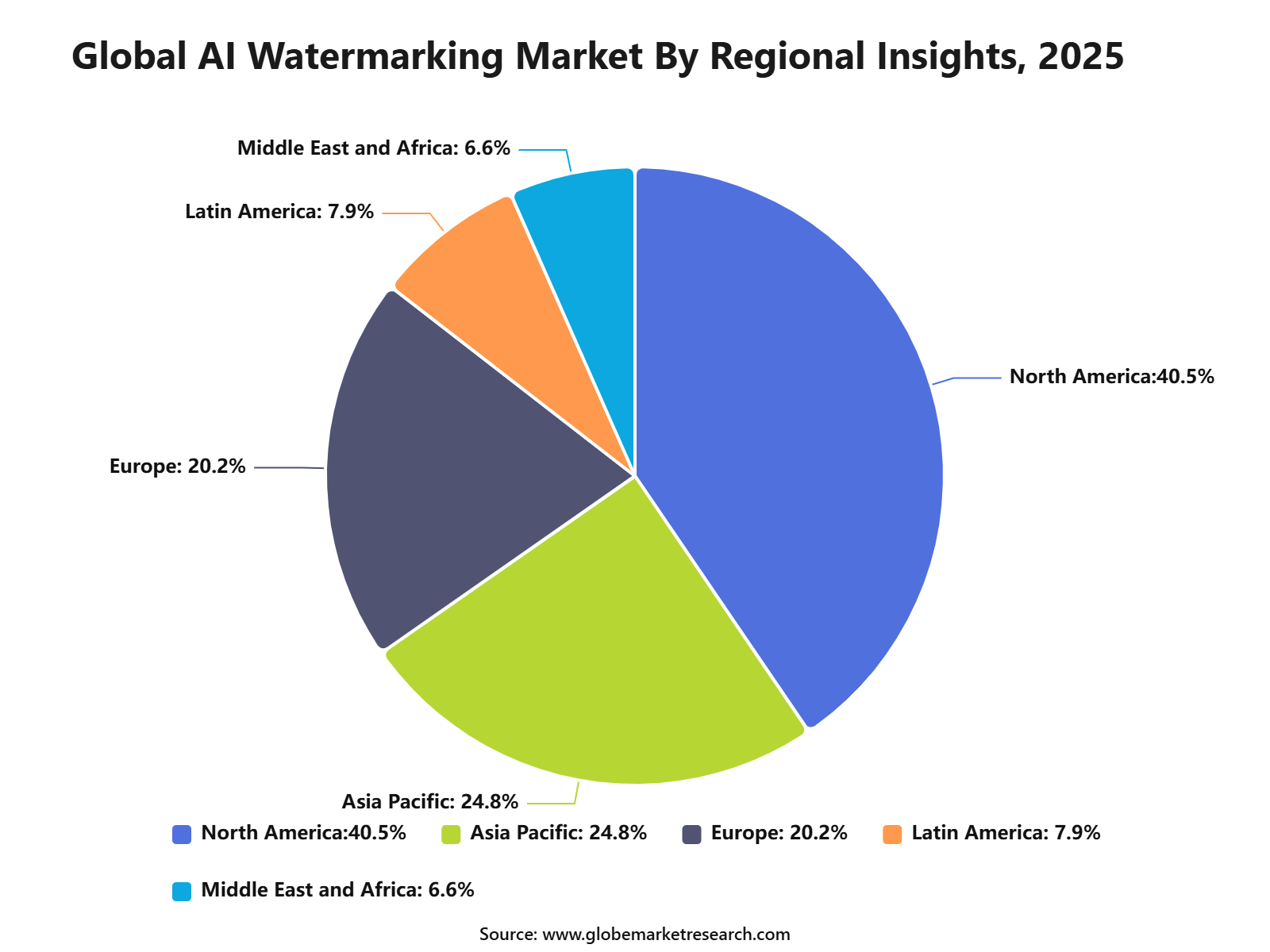 iThe graph shows projected market growth until 2035 based on CAGR analysis. Actual outcomes may vary depending on changing demand, competition, and economic factors.To gain greater insights - request a sample report PDF
U.S. AI Watermarking Market Insight
The U.S. AI watermarking market is supported by high enterprise AI adoption, extensive media production and continuing debate over copyright and synthetic content. Demand is developing among AI model providers, social platforms, entertainment companies, government bodies and organizations concerned about impersonation, fraud and unauthorized reuse.
The U.S. Census Bureau reported in May 2026 that 37% of businesses with at least 250 employees used AI in their operations. Adoption was considerably stronger among large businesses than among smaller firms, increasing the number of organizations that require formal controls for AI-generated marketing, training and communication content.
Europe AI Watermarking Market Insight
Europe is becoming a regulation-driven market for AI watermarking. Providers of generative AI systems and professional users of synthetic media must prepare for common requirements covering machine-readable marking, deepfake disclosure and labelling of certain AI-generated text. This creates demand for both watermark insertion and content-detection services.
The European Commission confirmed that Article 50 transparency obligations will apply from August 2026. The rules require providers to mark AI-generated or manipulated outputs in a machine-readable form, while deployers must clearly disclose deepfakes and certain AI-generated publications addressing matters of public interest.
U.K. AI Watermarking Market Insight
The U.K. market is being influenced by growing AI use, copyright policy discussions and concern about deepfakes. Government agencies are examining technologies that identify synthetic video, audio, images and text. Media companies and public institutions are also evaluating content provenance as part of wider cyber and information-integrity controls.
A U.K. government impact assessment published in 2026 reported that 25% of businesses were using at least one AI technology by December 2025, compared with 16% in January 2025. Adoption among large businesses reached approximately 44%, expanding the number of organizations that may generate or distribute synthetic material.
Germany AI Watermarking Market Insight
Germany offers a developing market for watermarking across industrial marketing, publishing, broadcasting and enterprise communication. Adoption is being influenced by the rapid use of generative AI and the approaching application of EU transparency obligations. German organizations are expected to emphasize data protection, technical documentation and reliable evidence.
The ifo Institute reported that 54.5% of German companies used AI in their business processes in May 2026, compared with 40.9% one year earlier. Higher AI use increases the need for internal policies that distinguish original, AI-assisted and fully synthetic content before it is published or shared externally.
Asia-Pacific AI Watermarking Market Insight
Asia-Pacific provides a diverse growth environment for AI watermarking because the region combines large digital populations, advanced AI economies and fast-growing online content markets. Requirements differ considerably across countries. China has introduced mandatory labelling rules, while Japan emphasizes AI safety and several other economies are aligning with international standards.
The International Telecommunication Union reported that 77% of the Asia-Pacific population used the internet in 2025. This large connected audience creates substantial volumes of social media, streaming, advertising and creator content that may require automated provenance and synthetic-content identification.
Japan AI Watermarking Market Insight
Japan’s AI watermarking market is developing within a broader national focus on AI safety, intellectual property and reliable information. Demand is expected from media companies, manufacturers, public institutions and digital service providers. Watermarking is being considered alongside content provenance, access controls and synthetic-content risk management.
OECD research published in 2025 found that 23.5% of Japanese small and medium-sized enterprises used generative AI. Japan’s AI Safety Institute has also identified watermarking, AI labels and provenance mechanisms as relevant activities for protecting information integrity and managing synthetic content.
China AI Watermarking Market Insight
China has established one of the clearest regulatory structures for marking AI-generated content. The national rules cover synthetic text, images, audio, video and virtual scenes. They distinguish between explicit labels that users can notice and implicit labels embedded within file data, directly supporting demand for invisible watermarking technology.
China’s official AI-generated content labelling measures were issued in March 2025 and became effective on September 2025, together with a mandatory national technical standard. The framework assigns responsibilities to content-generation providers, distribution platforms and users involved in publishing synthetic material.
China reported 602 million generative AI users by December 2025. By April 2026, 868 generative AI services and 530 applications or functions had completed the relevant filing or registration processes. This large regulated ecosystem creates significant demand for automatic marking, metadata preservation, platform verification and detection at upload.
Segment Covered in the Report
By Type
Invisible Watermarking
Visible Watermarking
By Technology
Non-Reversible Watermarking
Reversible Watermarking
By Deployment
Cloud
On-Premises
By Application
Copyright Protection
Authentication and Security
Branding and Marketing
Others
By Content Type
Video
Image
Model Watermarking
Audio
Text
By End Use
Media and Entertainment
BFSI
Healthcare
Government and Defense
Retail and E-commerce
Others
By Region
North America
Europe
Asia Pacific
Latin America
Middle East and Africa
Market Dynamics
Drivers Impact Analysis
The AI Watermarking Market is driven by rising use of generative AI content, deepfake detection needs, copyright protection, digital media authentication, and demand for content provenance. As AI-generated images, videos, audio, and text increase, companies need watermarking tools to identify, verify, and track synthetic content.
North America leads the market due to strong AI platform adoption, advanced media and entertainment activity, large technology companies, and growing enterprise focus on digital trust. Demand is also supported by content creators, publishers, social platforms, governments, and brands that need to protect intellectual property and reduce misuse of AI-generated media.
Impact Factor | Estimated CAGR Impact | Regional Relevance | Market Impact |
|---|---|---|---|
Rising generative AI content creation | +8.2% | North America, Europe, Asia Pacific | Drives core watermarking adoption. |
Growth in deepfake and misinformation risks | +6.9% | Media, government, social platforms | Increases demand for verification tools. |
Copyright and creator protection needs | +5.8% | Entertainment, publishing, design | Supports content ownership tracking. |
Enterprise digital trust requirements | +4.9% | Technology, BFSI, healthcare, retail | Builds compliance and governance demand. |
Platform-level AI content labeling | +4.1% | Social media and cloud platforms | Expands large-scale deployment. |
Restraints Impact Analysis
The market faces restraints from watermark removal risk, uneven technical standards, model compatibility issues, and uncertainty around legal enforcement. AI watermarking must remain detectable even after compression, editing, cropping, paraphrasing, or format conversion, which is technically difficult.
Another restraint is user and platform resistance. Some creators, developers, and organizations may view watermarking as limiting privacy, creativity, or content flexibility, while others may delay adoption until stronger standards and regulatory guidance are established.
Impact Factor | Estimated CAGR Impact | Regional Relevance | Market Impact |
|---|---|---|---|
Watermark removal and tampering risk | -4.2% | Global AI content ecosystem | Reduces trust in weak solutions. |
Lack of common technical standards | -3.5% | North America, Europe, Asia Pacific | Slows interoperability. |
Model and format compatibility issues | -3.0% | Text, image, audio, video systems | Increases deployment complexity. |
Privacy and user acceptance concerns | -2.4% | Consumer and creator platforms | Limits aggressive adoption. |
Legal enforcement uncertainty | -2.0% | Regulated and cross-border markets | Delays enterprise decisions. |
Opportunities Impact Analysis
Opportunities are strong in invisible watermarking, content authentication, copyright protection, AI image and video tracking, text watermarking, model watermarking, and enterprise media governance. These use cases support digital trust across media, advertising, education, legal, government, and online publishing.
Higher-value opportunities are emerging in multimodal watermarking, provenance metadata, API-based detection tools, social platform integration, brand safety systems, and AI model ownership protection. Vendors that combine robust detection, low false positives, and cross-format support can capture stronger long-term demand.
Impact Factor | Estimated CAGR Impact | Regional Relevance | Market Impact |
|---|---|---|---|
Invisible watermarking adoption | +7.8% | Media, platforms, enterprise users | Builds core market opportunity. |
AI video and image authentication | +6.5% | Entertainment, advertising, social media | Supports high-value content verification. |
Text watermarking for AI writing | +5.4% | Education, publishing, enterprise content | Adds broad software demand. |
Model watermarking for IP protection | +4.6% | AI developers and cloud platforms | Protects proprietary AI assets. |
API-based detection platforms | +3.9% | SaaS and enterprise workflows | Improves scalable adoption. |
Challenges Impact Analysis
The main challenge is creating watermarks that are both hidden and durable. A useful AI watermark must survive editing, compression, screen capture, format changes, and adversarial attacks while avoiding visible damage to content quality. Another challenge is reducing false positives and false negatives. If a system wrongly labels human content as AI-generated, or fails to detect synthetic content, users may lose confidence in the technology and avoid relying on it for compliance or trust decisions.
Impact Factor | Estimated CAGR Impact | Regional Relevance | Market Impact |
|---|---|---|---|
Durability against editing and compression | -4.0% | Image, video, audio platforms | Affects detection reliability. |
False positive and false negative risk | -3.4% | Education, legal, publishing | Reduces user trust. |
Adversarial attack resistance | -2.9% | Security-sensitive applications | Raises R&D requirements. |
Cross-platform verification difficulty | -2.3% | Social media and enterprise systems | Limits interoperability. |
Balancing watermarking with content quality | -1.9% | Creative and media industries | Affects creator adoption. |
Top 5 Use Cases of the AI Watermarking Market
1. AI-Generated Content Identification: Invisible watermarks can be embedded in AI-generated images, videos, audio and text, allowing platforms and users to determine whether content was created or modified using artificial intelligence. Google’s SynthID supports watermarking across these major content formats without visibly affecting the user experience.
2. Copyright and Intellectual Property Protection: AI watermarking allows creators, media companies and software providers to attach ownership or source information to digital assets. The embedded marker can support copyright claims, licensing controls and unauthorized-use investigations, including situations where standard metadata has been removed. NIST identifies digital watermarking as an important method for content authentication, provenance tracking and copyright-related verification.
3. Deepfake and Misinformation Detection: News organizations, governments and online platforms can use AI watermarks to identify synthetic media that may be presented as authentic. Watermark detection can support the verification of political videos, public statements, disaster images and other sensitive content before publication or distribution. NIST includes watermarking, provenance records and synthetic-content detection among the key methods for reducing risks associated with manipulated media.
4. Content Authentication and Modification Tracking: AI watermarking can be combined with Content Credentials to document how digital content was created, edited and distributed. C2PA-based records preserve information about an asset’s origin and modification history, while invisible watermarks can remain detectable when metadata is lost through screenshots, downloads or platform processing.
5. Platform Compliance and Automated Content Labelling: Social media platforms, search engines, generative AI providers and digital advertising networks can use watermark detection to automatically label AI-generated content. This supports internal content policies, responsible AI governance and compliance with emerging synthetic-media disclosure requirements. Google reported in May 2026 that SynthID had been applied to more than 100 billion AI-generated images and videos and approximately 60,000 years of generated audio.
Recent Developments
In February 2026, the Coalition for Content Provenance and Authenticity released Content Credentials 2.3. The update strengthened tamper detection, improved cloud integration, and expanded support for provenance information across live video, generative AI, editing, publishing, and online distribution workflows.
In February 2026, Google introduced Lyria 3 music generation in the Gemini application. All music generated through the application is embedded with SynthID, while Gemini can examine uploaded audio to determine whether a SynthID watermark from Google AI is present.
In March 2026, TikTok expanded its approach to AI-generated content disclosure. The platform continued using C2PA Content Credentials, creator disclosure tools, automated labelling, and invisible watermarking to recognise content created or significantly modified using artificial intelligence.
In March 2026, Synamedia launched ContentArmor Edge Watermarking for streaming video. The solution inserts unique identifiers directly into compressed video streams at the content delivery network edge, cutting watermark insertion and extraction times and reducing total piracy-disruption time to below five minutes.
In June 2026, Superhuman agreed to acquire GPTZero, an AI content detection and authenticity platform. GPTZero provides AI-generated text detection, authorship analysis, plagiarism checking, hallucination identification, developer APIs, and AI Vision for identifying generated content across websites and online platforms.
Competitive Landscape
The market is characterized by intense competition among established players and emerging companies. Strategic partnerships, mergers and acquisitions, and product innovation are key strategies employed by market participants.
Key Market Players
Google LLC
Adobe Inc.
Digimarc Corporation
Microsoft Corporation
NVIDIA Corporation
OpenAI
Meta Platforms, Inc.
IMATAG
Verimatrix, Inc.
ZOO Digital Group plc
Clarifai, Inc.
Truepic Inc.
NAGRA
Irdeto
Sensity AI
Other Key Players
Research Methodology
This market study is prepared using a combination of primary and secondary research. Primary research includes discussions with manufacturers, suppliers, distributors, consultants, industry experts, and end users. Secondary research covers company reports, government databases, trade associations, technical publications, regulatory sources, and trusted industry documents. The collected information is used to assess market demand, pricing trends, technology adoption, competitive activity, and regional performance.
AI language models are not used as primary data sources, and publicly available AI-generated content is not treated as market evidence. Computational tools may be used to support data processing, translation, data classification, and pattern identification. However, every published assessment is supported by verified sources, human review, and primary market discussions.
Market estimates are developed through top-down and bottom-up approaches and validated using data triangulation. Revenue, production, shipment, pricing, and application-level data are compared across multiple sources. Forecasts consider economic conditions, regulatory changes, investment activity, innovation, supply chain developments, and industry risks. All findings are reviewed through source verification and internal quality checks before publication.
Part I
Source Management & Input Data Standards
Who provides data, how sources are qualified, and what types of evidence are admissible.
Part II
Research Scope & Market Coverage
How we define the markets we assess and the parameters that govern each product.
Part III
Data Collection, Verification & Submission
The mechanics of gathering, cross-checking, and hierarchically ranking evidence.
Part IV
Assessment Determination & Quality Controls
How raw data becomes a published assessment — normalisation, expert judgement, and outlier exclusion.
Part V
Publication, Corrections & Revision
Our publication schedule, corrections policy, and methodology review cycle.
Part VI
Independence, Ethics & Complaints
Conflict-of-interest policies, editorial independence, and how clients raise concerns.
Google · Preferred Sources
Don't miss the latest market research insights and industry updates on Google.
Add Globe Market Research as a preferred source in the Google app to see our reports, analysis, and market stories in your news suggestions.
Meet the Team
This report was prepared by our expert analysts with deep industry knowledge and research experience.
Prashant S. is a Research Analyst at Globe Market Research with more than four years of experience in market research and industry analysis. He specializes in the Aerospace and Defence, Automotive and Transportation, Semiconductor and Electronics, Information and Technology sectors, with expertise in market sizing, trend analysis, competitive assessment, and industry forecasting. He applies primary and secondary research, data validation, company analysis, and market estimation methods to deliver reliable insights for strategic planning and business decision-making.
Sayali brings more than 7 years of experience to Globe Market Research, supporting the accuracy, clarity, and relevance of research content across multiple industries. She reviews market data, segment analysis, competitive insights, and industry trends to ensure each report meets strong quality standards and provides practical value to business decision-makers. Her expertise spans healthcare, information technology, consumer goods, and diverse cross-industry domains. With a strong focus on data reliability, structured analysis, and clear presentation, Sayali helps ensure that each research output delivers well-reviewed insights for clients, investors, consultants, and industry stakeholders.
Frequently Asked Questions
Related Reports
More in Information and Technology
Physical AI Market Size to hit USD 2,129.0 billion by 2035
Physical AI Market Size, Share, Trends and Growth Analysis Report By Component (Hardware, Software, Services), By Technology (Computer Vision, Machine Learning and Deep Learning, Natural Language Processing, Edge AI, Other Technologies), By Product (Robots, Exoskeletons, Autonomous Systems, Smart Appliances), By Application (Automation and Manufacturing, Logistics and Supply Chain, Healthcare, Automotive, Defense and Security, Retail, Education, Other End Uses), By Regional Insights, Technology Trends, Competitive Landscape, Strategic Opportunities and Growth Forecast, 2026-2035
Edtech SaaS Tools Market Size to hit USD 217.6 billion by 2035
EdTech SaaS Tools Market Size, Share, Trends and Growth Analysis Report By Software (Classroom Management Systems, Document Management Systems, Learning and Gamification Platforms, Learning Management Systems, Student Collaboration Systems, Assessment and Analytics Tools, Content Authoring Tools, Other Software), By Sector (Preschool, K-12, Higher Education, Other Education Sectors), By Deployment (Cloud-Based, Hybrid), By End Use (Businesses, Educational Institutions, Individual Learners and Consumers), By Regional Insights, Technology Trends, Competitive Landscape, Strategic Opportunities and Growth Forecast, 2026–2035
Marketing Technology Market Size to Reach USD 3,810.8 billion by 2035
Marketing Technology Market Size, Share, Trends and Growth Analysis Report By Marketing Type (Digital Marketing, Offline Marketing), By Product (Social Media Tools, Content Marketing Tools, Rich Media Tools, Marketing Automation Tools, Data and Analytics Tools, Sales Enablement Tools), By Deployment (Cloud-Based, On-Premises, Other Deployment Models), By Enterprise Type (Large Enterprises, Small and Medium-Sized Enterprises), By Application (IT and Telecommunication, Retail and E-commerce, Healthcare, Media and Entertainment, Sports and Events, BFSI, Real Estate, Other Applications), By Regional Insights, Technology Trends, Competitive Landscape, Strategic Opportunities and Growth Forecast, 2026-2035
Environmental, Social and Governance (ESG) Consulting Market to hit USD 49.4 billion by 2035
Environmental, Social and Governance (ESG) Consulting Market Size, Share, Trends and Growth Analysis Report By Service Type (Testing, Auditing and Verification, Technical Support, Sustainability Marketing, Strategy and Planning, Other Services), By Enterprise Size (Small and Medium-Sized Enterprises, Large Enterprises), By End User (Corporates, Investors, Government Bodies, Non-Profit Organizations, Other End Users), By Industry Vertical (BFSI, Energy and Utilities, Manufacturing, Healthcare, Retail and Consumer Goods, IT and Telecom, Transportation and Logistics, Other Industries), By Regional Insights, Regulatory Trends, Competitive Landscape, Strategic Opportunities and Growth Forecast, 2026-2035