

Revenue, 2026
USD 60.9 Bn
Forecast, 2035
USD 217.6 Bn
CAGR, 2026-2035
15.2%
Report Coverage
Global
Market Size and Forecast
The global EdTech SaaS Tools Market was valued at USD 60.9 billion in 2026 and is projected to reach approximately USD 217.6 billion by 2035, growing at a CAGR of 15.2% from 2026 to 2035. North America accounted for around 40.8% of the market, equivalent to approximately USD 24.8 billion at the stated 2026 value. Regional leadership is supported by high cloud adoption, established digital learning infrastructure, widespread use of learning management systems and growing investment in artificial intelligence-based education tools.
EdTech SaaS tools are cloud-based platforms used to manage teaching, learning, assessment and institutional operations. Major solutions include learning management systems, virtual classrooms, student information systems, assessment platforms, content-authoring software, tutoring applications, collaboration tools and education analytics. Subscription-based delivery allows schools, universities, training providers and businesses to access regularly updated software without maintaining extensive on-premises infrastructure.
Key Parameter | Report Details |
|---|---|
Market Revenue, 2026 | USD 60.9 Billion |
Projected Revenue, 2035 | USD 217.6 Billion |
CAGR, 2026-2035 | 15.2% |
Largest Region | North America, 40.8% Share |
Market Concentration | Medium |
Forecast Period | 2026-2035 |
Digital learning and AI adoption are strengthening platform demand. Microsoft’s 2026 education study found that 92% of students and education leaders and 88% of educators had used AI for school-related purposes, while 58% of education leaders said their institutions were implementing or scaling AI. Eurostat reported that 34.8% of EU internet users took an online course or used digital learning materials in 2025, up from 33.4% in 2024 and 21.4% in 2019. The OECD’s 2026 Digital Education Outlook also highlighted growing demand for curriculum-aligned AI resources, digital infrastructure and professional learning, supporting continued adoption of cloud-based education software.
Agentic AI is shifting EdTech SaaS tools from passive learning platforms to systems that can independently complete educational and administrative workflows. AI agents can develop standards-aligned lesson plans, adjust learning paths, generate assessments, provide tutoring, identify students requiring support and coordinate information across learning management, student information and communication platforms. In 2026, 92% of students and education leaders and 88% of educators reported using AI for school-related purposes, while 58% of education leaders stated that their institutions were implementing or scaling AI.
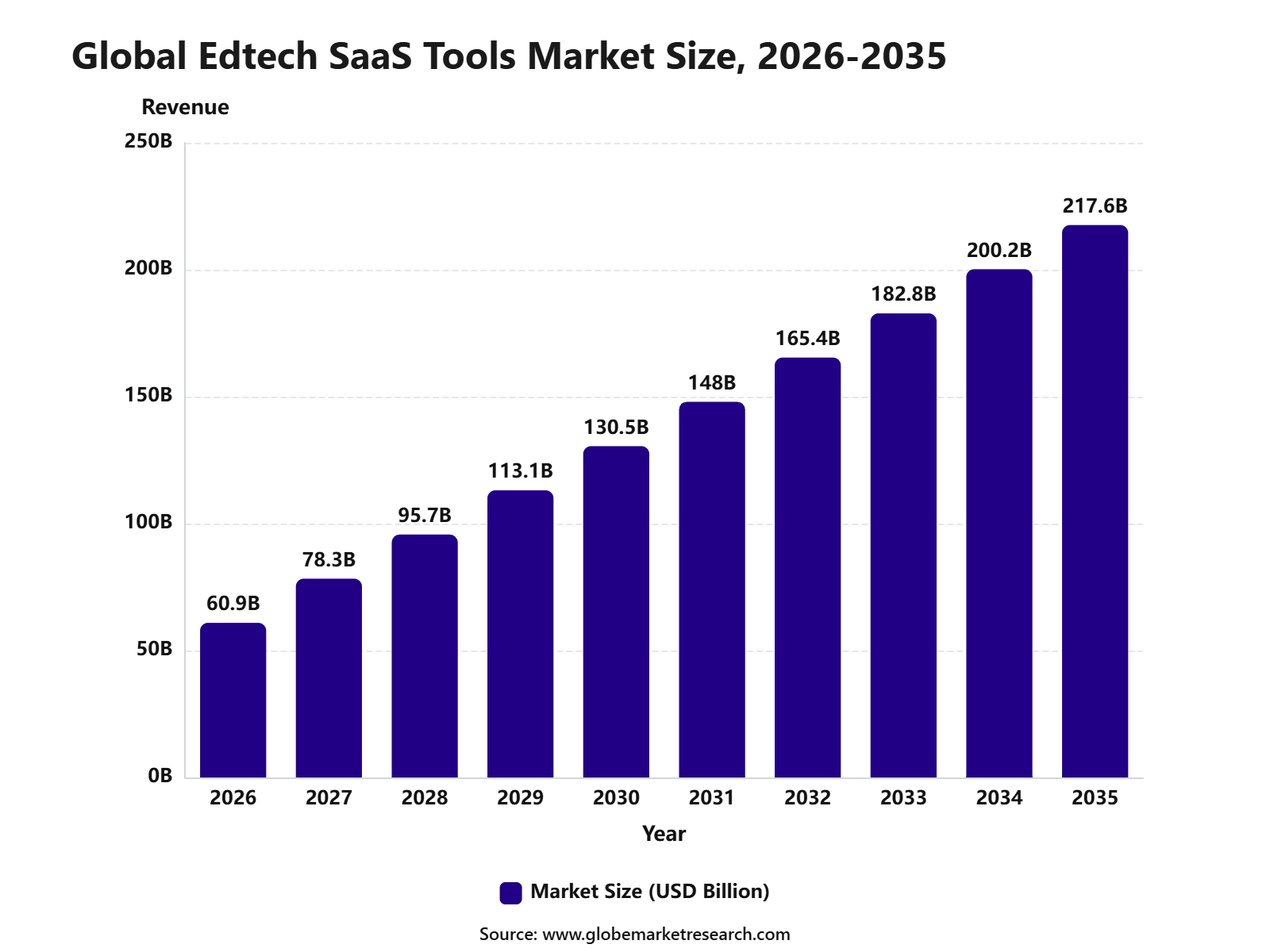 iThe graph shows projected market growth until 2035 based on CAGR analysis. Actual outcomes may vary depending on changing demand, competition, and economic factors.To gain greater insights - request a sample report PDF
Key Market Insights
Learning Management Systems led the software segment with 48.2% share, supported by strong use in course delivery, student tracking, assessments, content management, and online learning administration.
K-12 accounted for 43.5% share by sector, driven by rising adoption of digital classrooms, remote learning tools, interactive content, and school-based learning platforms.
Business end use held 67.3% share, supported by growing demand for employee training, corporate learning, skill development, compliance education, and workforce upskilling.
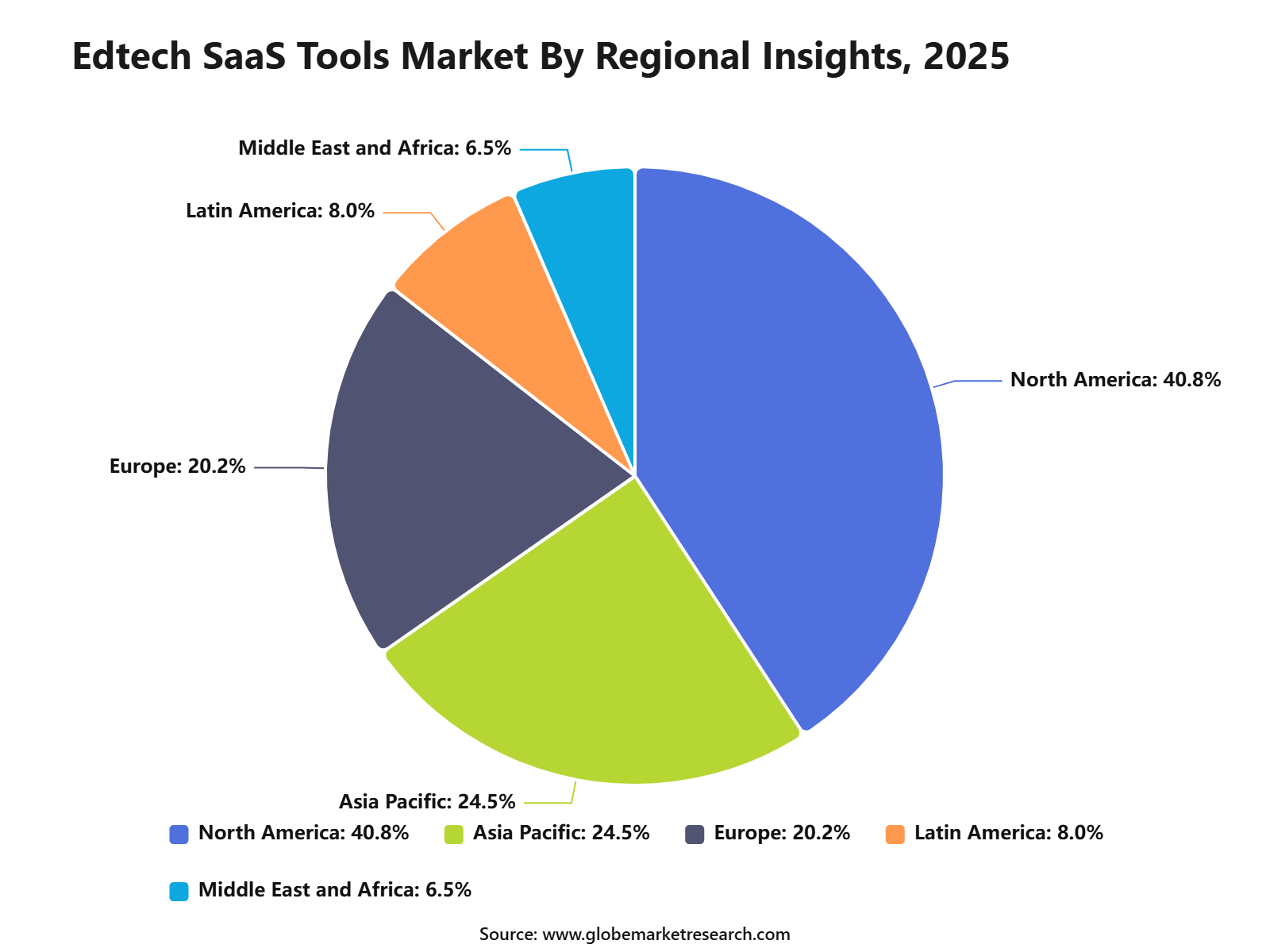
North America led the Edtech SaaS Tools market with 40.8% share, supported by strong digital education adoption, advanced SaaS infrastructure, higher technology spending, and widespread use of online learning platforms.
Adoption Rate and Usage Statistics
According to the Digital Education Council, Cengage Group, and Gallup-Walton Family Foundation, student AI-tool adoption reached 92%, while 63% of K-12 teachers or school districts had integrated generative AI into teaching. Higher-education instructor adoption stood at 49%, and 60% of surveyed teachers had used AI during the school year. However, only 19% reported that their school had a formal AI policy, indicating that technology adoption is progressing faster than institutional governance.
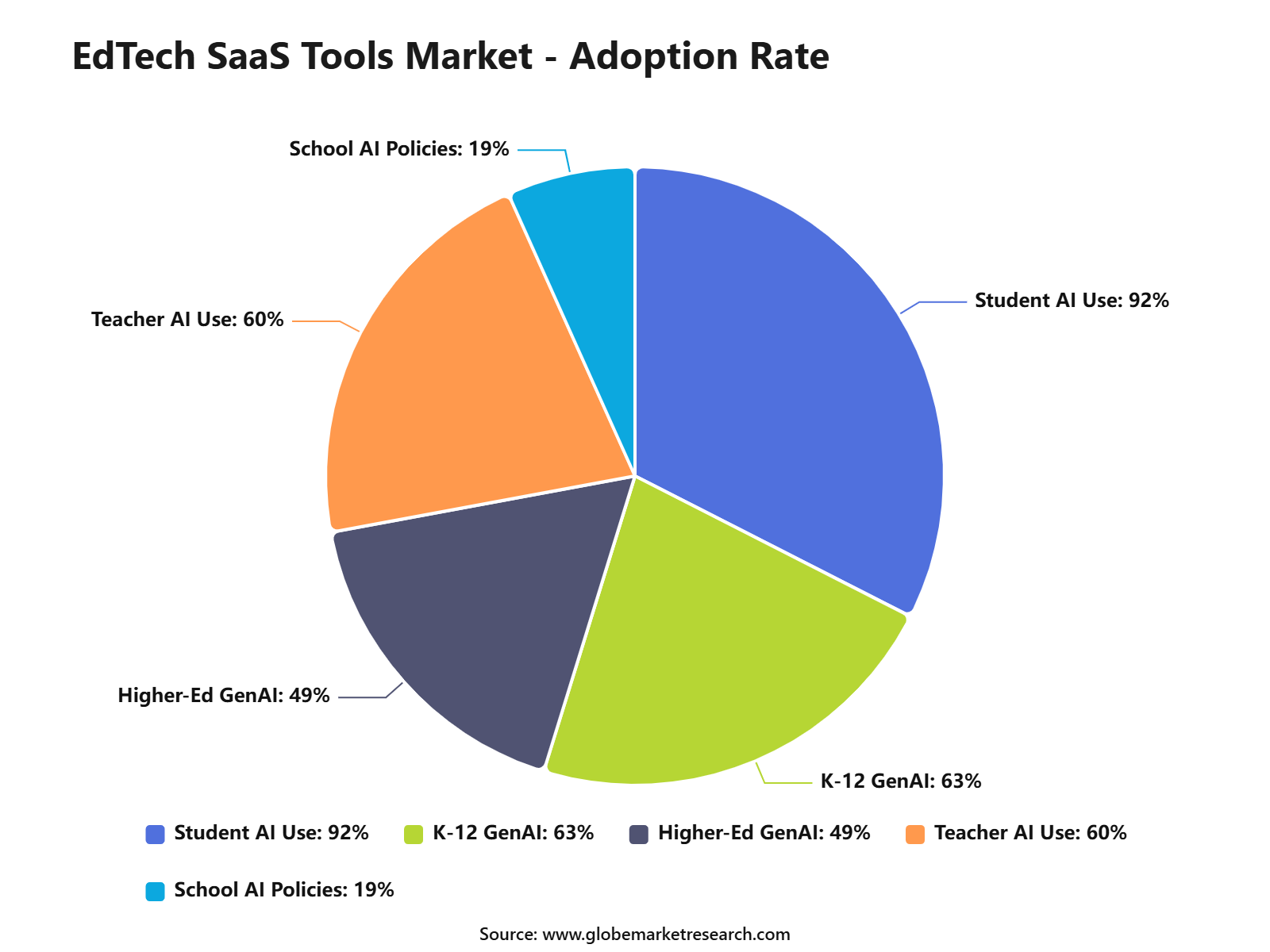 iThe graph shows projected market growth until 2035 based on CAGR analysis. Actual outcomes may vary depending on changing demand, competition, and economic factors.To gain greater insights - request a sample report PDF
According to Coursera, the Digital Education Council, HEPI, and Gallup-Walton Family Foundation, Coursera reached 205 million registered learners and added 7.6 million new learners during the first quarter of 2026. Around 67% of surveyed students used AI daily or weekly, while 88% of UK undergraduate respondents had used generative AI for assessments. Teachers using AI tools at least weekly saved an average of 5.9 hours per week, supporting demand for cloud-based learning, content creation, tutoring, assessment, and classroom-management tools.
Metric | Usage Value |
|---|---|
Coursera Learners | 205 million |
New Quarterly Learners | 7.6 million |
Frequent Student AI Use | 67% |
Assessment AI Use | 88% |
Weekly Time Saved | 5.9 hours |
Software Insights
Learning management systems accounted for 48.2% of the EdTech SaaS Tools Market by software. Their leading position is supported by the need to manage courses, assignments, assessments, learner records and communication through one platform. Educational institutions and businesses can also use these systems to track completion, participation and performance.
The U.K. Technology in Schools Survey 2025 found that 76% of school leaders considered evidence of good technology use before making investment decisions. Another 52% considered national digital and technology standards, showing that buyers are increasingly selecting education software through structured evaluation rather than basic feature comparison.
Software | Market Share |
|---|---|
Learning Management Systems | 48.2% |
Classroom Management Systems | 11.4% |
Learning and Gamification Platforms | 9.8% |
Assessment and Analytics Tools | 8.5% |
Student Collaboration Systems | 7.1% |
Document Management Systems | 5.9% |
Content Authoring Tools | 5.2% |
Other Software | 3.9% |
Demand is shifting toward learning management systems that combine administration with analytics, AI-assisted content, virtual classrooms and personalized learning paths. Integration with student information, human resources and identity-management systems will remain important. Vendors must also provide reliable data controls and accessible interfaces for learners with different needs.
Sector Insights
K-12 education represented 43.5% of the market by sector. Schools use SaaS tools to distribute lessons, collect assignments, manage assessments and communicate with students and parents. Cloud delivery is particularly valuable for school districts that need to apply common learning resources across several campuses.
China’s national smart education platform contained more than 110,000 primary and secondary school resources by April 2025. The scale of this public digital library shows that K-12 learning is becoming increasingly dependent on centrally managed online content, course-delivery tools and teacher-support systems.
K-12 purchasing decisions are likely to focus on curriculum alignment, child safety, ease of use and measurable learning outcomes. Products must function across different devices and connection speeds. Teacher training and technical support will remain essential because software value depends on how effectively it is used during daily instruction.
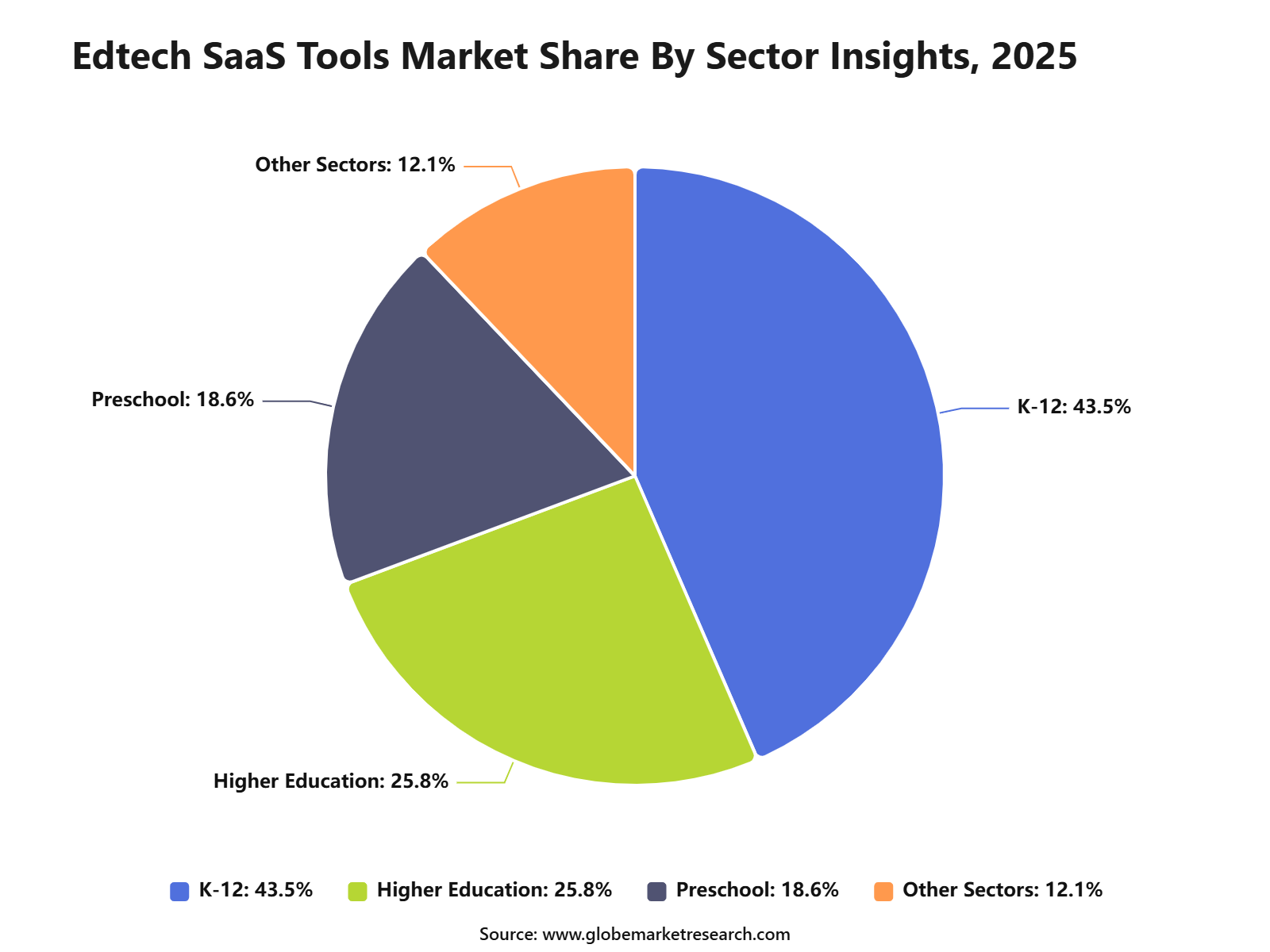 iThe graph shows projected market growth until 2035 based on CAGR analysis. Actual outcomes may vary depending on changing demand, competition, and economic factors.To gain greater insights - request a sample report PDF
Deployment Insights
Cloud-based deployment accounted for 72.4% of the EdTech SaaS Tools Market. Cloud platforms allow institutions to access learning applications through web browsers without maintaining extensive on-site servers. Software updates, security improvements and new learning features can also be delivered centrally.
Eurostat reported that 52.74% of EU enterprises purchased cloud computing services in 2025. Adoption was considerably higher among large enterprises, where 84.67% used paid cloud services. The widespread use of cloud infrastructure supports the delivery of scalable education and workforce-training applications.
Deployment | Market Share |
|---|---|
Cloud-Based | 72.4% |
Hybrid | 27.6% |
Cloud deployment is particularly useful when student numbers and course activity change during the academic year. Institutions can increase storage and user capacity without purchasing additional physical equipment. Buyers will continue to evaluate service reliability, data location, cybersecurity and integration with existing education systems.
End-Use Insights
Business users accounted for 67.3% of the EdTech SaaS Tools Market by end use. Companies use digital learning platforms for employee onboarding, compliance instruction, product training, leadership development and technical upskilling. SaaS delivery allows training to be distributed across departments and countries without requiring employees to attend the same physical location.
The 2025 Training Industry Report found that 34% of employee training hours were delivered through online or computer-based technologies. Mobile learning represented 6% of training hours, while AI-supported instruction increased to 2%, indicating that corporate learning is gradually becoming more digital and automated.
Business demand will favor platforms that connect learning activity with employee roles, skill requirements and performance goals. Companies also require tools for certification management, compliance records and automated course assignment. Flexible content formats and integration with workforce systems will influence purchasing decisions.
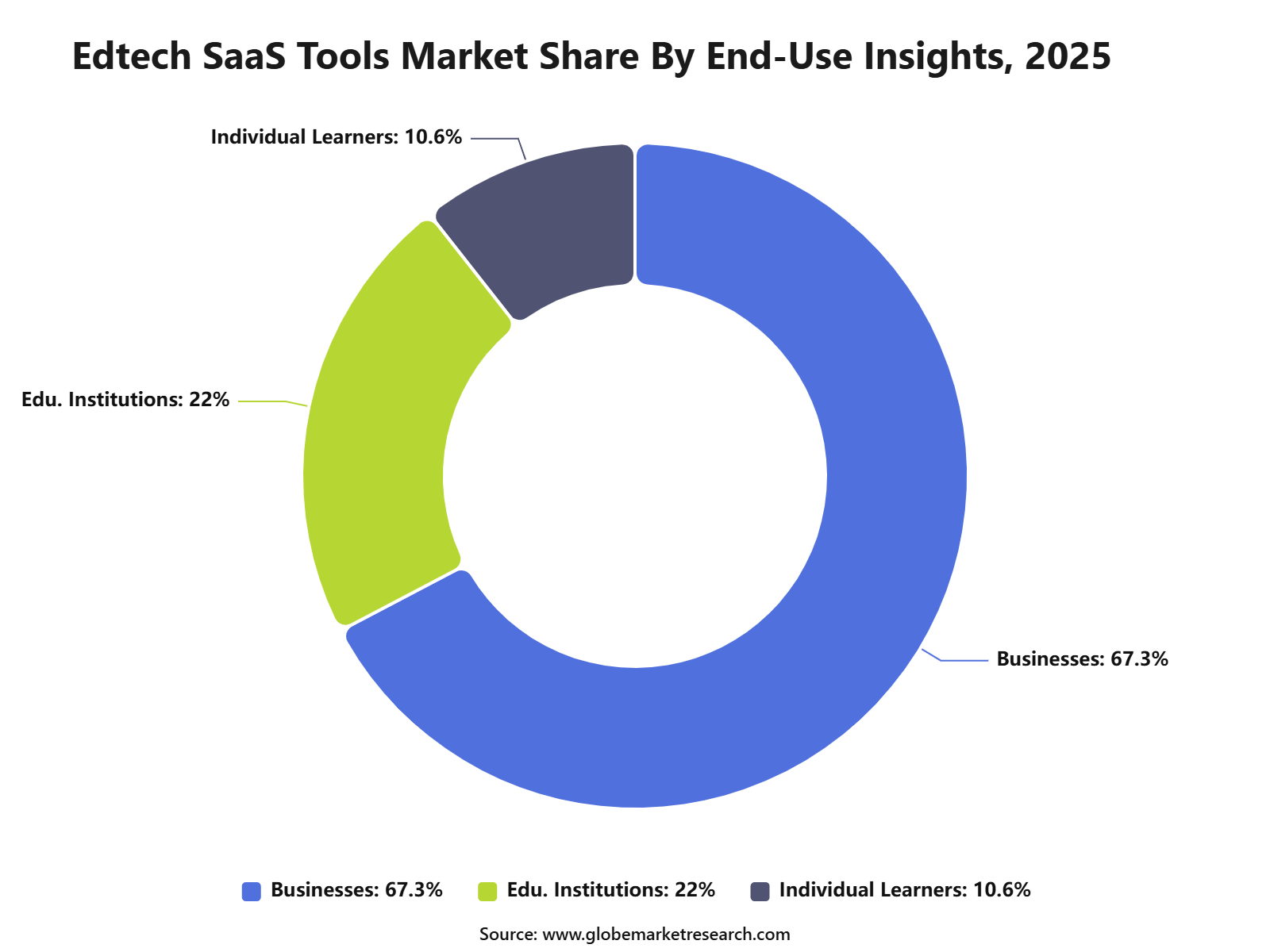 iThe graph shows projected market growth until 2035 based on CAGR analysis. Actual outcomes may vary depending on changing demand, competition, and economic factors.To gain greater insights - request a sample report PDF
Regional Insights
North America accounted for 40.8% of the EdTech SaaS Tools Market. Regional leadership is supported by established cloud infrastructure, widespread digital-device use and significant adoption of learning platforms across schools, universities and businesses. The United States represents the primary market, while Canada provides a large connected education system.
Statistics Canada reported that 49% of Canadians aged 18 to 24 participated in education during the 2024/2025 academic year. University-level participation reached 31%, supporting continued demand for digital course administration, learner communication and online educational resources.
North American buyers increasingly expect software to demonstrate measurable educational or workforce results. Data security, system interoperability and accessible content are becoming central selection factors. Platforms offering strong implementation support and reliable analytics are likely to achieve better retention.
 iThe graph shows projected market growth until 2035 based on CAGR analysis. Actual outcomes may vary depending on changing demand, competition, and economic factors.To gain greater insights - request a sample report PDF
U.S. EdTech SaaS Tools Market Insight
The U.S. market is supported by extensive K-12 technology use, large higher-education networks and strong corporate learning expenditure. Schools and employers are using SaaS platforms to manage instruction, assessments, employee skills and education data across distributed locations.
The 2025 State EdTech Trends Report found that 27% of participating state education leaders identified improved academic outcomes as a leading priority. Educator recruitment, retention and training were cited by 18%, while workforce readiness was selected by 15%, supporting demand for learning, assessment and professional-development platforms.
Europe EdTech SaaS Tools Market Insight
Europe’s market is being influenced by growing participation in online learning and stronger digital education policies. Educational institutions require multilingual platforms, secure learner-data management and tools that can comply with national and EU privacy requirements. Eurostat reported that 34.8% of EU internet users completed an online course or used online learning materials in 2025. This represented an increase of 1.4 percentage points from 2024 and showed continued movement toward digitally delivered education.
U.K. EdTech SaaS Tools Market Insight
The U.K. market benefits from government-supported school connectivity programs and an established education technology supplier base. SaaS tools are used for teaching, safeguarding, administration, assessment and communication across primary, secondary and further education. By March 2025, connectivity funding had benefited 1.3 million pupils across 3,700 schools. A further 1,000 schools were selected to receive support through a £45 million investment covering wireless network and fibre improvements.
Germany EdTech SaaS Tools Market Insight
Germany’s market is supported by digital transformation across education and business training. Demand is growing for platforms that provide structured course delivery, secure data storage and German-language content while meeting strict privacy expectations. Germany’s Federal Statistical Office reported that 63% of enterprises with at least ten employees had access to high-speed internet in 2025. Wider business connectivity supports cloud-based employee training, certification and workforce-development systems.
Asia-Pacific EdTech SaaS Tools Market Insight
Asia-Pacific represents a large and diverse opportunity because of its extensive student population and mobile-first digital behavior. Demand covers school learning, exam preparation, professional education and corporate skills development across markets with different income and infrastructure levels. Internet use reached 77% of the Asia-Pacific population in 2025. This provides a substantial foundation for SaaS learning platforms, although performance on lower-cost mobile devices and limited-bandwidth networks remains important in several countries.
Japan EdTech SaaS Tools Market Insight
Japan’s market is being shaped by the GIGA School program, one-device-per-student infrastructure and growing interest in AI-assisted education. Schools require platforms that can organize digital content, assessment information and communication while maintaining clear governance controls.
A 2025 education survey found that 55% of Japanese local authorities gathered information on generative AI by directly testing the technology. School-based practices were used by 38.8%, while government briefings and seminars were used by 32.8%, indicating demand for structured training and approved digital-learning environments.
China EdTech SaaS Tools Market Insight
China provides a major digital-learning environment supported by large-scale public platforms and widespread use of online educational resources. SaaS tools are used across school education, vocational training, higher education and lifelong learning. The Smart Education of China platform exceeded 164 million registered users by April 2025 and had recorded more than 61.3 billion page views. It was accessed from over 220 countries and regions, demonstrating the operating scale that digital education platforms can achieve within China.
Key Market Segments
By Software
Classroom Management Systems
Document Management Systems
Learning and Gamification Platforms
Learning Management Systems
Student Collaboration Systems
Assessment and Analytics Tools
Content Authoring Tools
Others
By Sector
Preschool
K-12
Higher Education
Others
By Deployment
Cloud-Based
Hybrid
By End Use
Businesses
Educational Institutions
Individual Learners and Consumers
By Region
North America
Europe
Asia Pacific
Latin America
Middle East and Africa
Key Market Drivers
Expansion of digital education infrastructure: Schools, universities, training institutes, and governments are increasing the use of cloud-based learning and education management platforms. As of 2025, more than 94% of World Bank education projects included an EdTech component, covering digital infrastructure, learning platforms, management systems, and digital skills development.
Growing use of artificial intelligence in education: AI tools are increasingly being used for lesson planning, content development, tutoring, grading assistance, research, and administrative work. A 2025 UNESCO survey covering 400 respondents across 90 countries found that nine in ten respondents used AI in their professional work, while nearly half were experimenting with AI in teaching.
Demand for personalized learning experiences: Educational institutions are adopting SaaS tools that adjust lessons, assessments, and recommendations according to individual learner performance. Personalized learning can help institutions support students with different skill levels while allowing teachers to focus on learners who require additional assistance.
Need for scalable and flexible learning delivery: Cloud-based EdTech tools allow educational content, assessments, classes, and student records to be accessed from multiple locations and devices. Subscription-based platforms also reduce the need for institutions to maintain large on-site technology systems.
Increasing pressure to improve teacher productivity: SaaS tools are being used to automate attendance tracking, lesson preparation, assignment management, grading workflows, reporting, and communication. The technology is mainly being positioned as a system that supports teachers rather than replacing their role in education.
Emerging EdTech SaaS Trends
AI tutoring and learning assistants: AI-powered tutors are being introduced to explain concepts, answer student questions, recommend learning materials, and provide immediate feedback. These systems are increasingly being integrated into learning management and digital classroom platforms.
Teacher-focused AI copilots: New tools are being designed to help teachers prepare lesson plans, create quizzes, summarize student performance, develop learning activities, and adapt content for different ability levels. Human review remains important for maintaining accuracy and educational relevance.
Adaptive learning pathways: EdTech platforms are using student performance data to adjust lesson difficulty, recommend suitable content, and identify knowledge gaps. This approach supports more individualized learning without requiring teachers to manually create a separate plan for every student.
Learning analytics and early-warning systems: Educational institutions are using dashboards to examine attendance, engagement, assignment completion, assessment results, and platform activity. These insights can help educators identify students who may require academic or personal support.
Interoperable education ecosystems: Open standards and common data formats are becoming important purchasing requirements. In 2025, a European higher education interoperability framework developed by more than 280 experts introduced common standards for exchanging data across teaching and learning platforms.
AI governance and institutional policies: Universities are establishing formal rules for acceptable AI use, academic integrity, assessment, privacy, and disclosure. UNESCO reported that 19% of surveyed institutions had a formal AI policy in 2025, while another 42% were developing guidance.
5 Best EdTech SaaS Tools and Technologies
AI-Powered Adaptive Learning Platforms: These systems analyze learner performance and provide personalized lessons, practice exercises, explanations, and feedback. They are most useful for mathematics, languages, professional training, test preparation, and skills development.
Cloud Learning Management Systems: Learning management systems provide centralized tools for course delivery, assignments, assessments, attendance, communication, certificates, and progress tracking. They remain the foundation of most school, university, and corporate learning technology environments.
Learning Analytics and Student Success Platforms: These tools convert student activity and performance data into dashboards, risk indicators, and actionable insights. They help institutions monitor engagement, improve course design, identify learning gaps, and support students before academic problems become severe.
Digital Assessment and Academic Integrity Tools: These platforms support online examinations, automated grading, question banks, skills assessment, identity verification, plagiarism review, and feedback management. Demand is being supported by the expansion of remote learning and AI-generated academic content.
Education Management and Interoperability Platforms: These systems connect learning management software, student information systems, content libraries, payment tools, identity services, and administrative applications. Their value is based on reducing duplicated data, simplifying workflows, and creating a consistent experience for students, teachers, and administrators.
Market Dynamics
Drivers Impact Analysis
The EdTech SaaS Tools Market is driven by rising adoption of cloud-based learning platforms, learning management systems, classroom management tools, student collaboration software, digital assessment platforms, and AI-enabled education tools. Schools, universities, and enterprises are using SaaS tools to improve access, reduce administrative work, and support personalized learning.
North America leads the market due to strong digital learning infrastructure, high cloud adoption, large enterprise training demand, and widespread use of learning platforms across K-12, higher education, and business learning. The U.S. remains the main contributor because of strong institutional spending and mature SaaS adoption.
Impact Factor | Estimated CAGR Impact | Regional Relevance | Market Impact |
|---|---|---|---|
Growth in cloud-based learning platforms | +4.3% | North America, Europe, Asia Pacific | Drives core SaaS adoption. |
Rising demand for learning management systems | +3.7% | Schools, universities, enterprises | Supports recurring platform revenue. |
Expansion of enterprise training tools | +3.2% | U.S., Canada, UK, India | Adds workforce learning demand. |
AI-enabled personalized learning | +2.7% | Digital-first education markets | Improves student engagement and outcomes. |
Hybrid and remote education models | +2.2% | Global education systems | Strengthens online learning usage. |
Restraints Impact Analysis
The market faces restraints from budget limits, data privacy concerns, integration issues, digital access gaps, and platform fatigue. Many schools and institutions face pressure to manage software spending while ensuring that platforms meet learning, security, and accessibility needs. Another restraint is fragmented technology adoption. Institutions may use multiple tools for content, assessment, attendance, communication, analytics, and classroom management, which can create workflow complexity for teachers and administrators.
Impact Factor | Estimated CAGR Impact | Regional Relevance | Market Impact |
|---|---|---|---|
Education budget constraints | -1.9% | Public schools and universities | Slows premium SaaS adoption. |
Student data privacy concerns | -1.6% | North America, Europe | Raises compliance requirements. |
Integration complexity | -1.3% | Institutional users | Delays implementation. |
Digital access inequality | -1.1% | Emerging and rural markets | Limits full platform usage. |
Platform fatigue among teachers | -0.9% | K-12 and higher education | Reduces active adoption. |
Opportunities Impact Analysis
Opportunities are strong in learning management systems, classroom management software, student collaboration platforms, AI tutors, digital assessment tools, skill development platforms, and workforce learning SaaS. These tools support flexible learning across schools, universities, businesses, and individual learners.
Higher-value opportunities are emerging in AI-based tutoring, learning analytics, multilingual platforms, adaptive assessments, career-based learning, and SaaS tools for employee upskilling. Vendors that combine usability, data security, integrations, and measurable learning outcomes can capture stronger demand.
Impact Factor | Estimated CAGR Impact | Regional Relevance | Market Impact |
|---|---|---|---|
AI tutoring and adaptive learning | +4.1% | North America, Europe, Asia Pacific | Builds high-value product demand. |
Digital assessment platforms | +3.4% | Schools and universities | Supports exam and progress tracking. |
Workforce upskilling SaaS | +2.9% | Enterprise learning markets | Expands business user base. |
Learning analytics tools | +2.4% | Institutional education systems | Improves performance visibility. |
Multilingual and mobile-first platforms | +1.9% | Asia Pacific, Latin America, Africa | Supports wider adoption. |
Challenges Impact Analysis
The main challenge is proving measurable learning impact. Buyers increasingly expect platforms to show improvements in student engagement, teacher productivity, assessment performance, course completion, and workforce skill development. Another challenge is maintaining simple user experience across diverse users. EdTech SaaS tools must work for teachers, students, parents, administrators, corporate trainers, and learners with different digital skills and learning needs.
Impact Factor | Estimated CAGR Impact | Regional Relevance | Market Impact |
|---|---|---|---|
Proving learning outcomes | -1.8% | Schools, universities, enterprises | Affects renewal and budget approval. |
User experience complexity | -1.5% | K-12 and higher education | Impacts daily usage. |
Teacher training requirements | -1.2% | Institutional education markets | Slows adoption speed. |
Content quality variation | -1.0% | Digital learning platforms | Affects learner trust. |
Cybersecurity risk | -0.8% | Cloud-based education systems | Raises platform selection pressure. |
EdTech SaaS Tools Case Study
Oulu University of Applied Sciences
Oulu University of Applied Sciences in Finland provides a practical example of how cloud-based learning platforms can support curriculum modernization, online course delivery and career readiness. The institution serves approximately 10,000 students and employs around 500 people. As nearly half of its information and communication technology instruction moved online, the university needed scalable digital content that could provide specialized skills without placing additional pressure on faculty resources.
The university adopted Coursera as an institutional EdTech SaaS platform and embedded professional certificates from Google, Meta and Microsoft directly into its academic programs. The certificates were not provided as optional external courses. They were integrated into the curriculum, used to replace or supplement existing subjects and aligned with European Credit Transfer and Accumulation System credits. Single sign-on and university-funded licenses also reduced technical and financial barriers for students.
The implementation produced measurable academic outcomes. Student intake increased by 35% between 2020 and 2025, while students completed approximately 2,500 industry certifications during 2025. Completion rates exceeded 80% among students in the later years of their programs, compared with around 50% among first-year students. The results indicate that career-focused digital courses achieve stronger participation when they are introduced after students have developed clearer employment objectives.
Go-to-Market and Sales Economics
According to Globe Market Research, the go-to-market approach for the EdTech SaaS Tools Market should focus on learning management, personalized instruction, assessment automation, student engagement and administrative efficiency. Vendors should target schools, universities, training providers and corporate learning departments with role-specific demonstrations. Microsoft’s 2026 AI in Education Report found that 92% of students and education leaders had used AI for education-related purposes, showing that digital learning tools are becoming part of regular academic activity.
Sales strategies should begin with free trials, limited classroom pilots and departmental deployments before institution-wide contracts are proposed. Product demonstrations should measure learner participation, course completion, instructor time saved and integration with existing systems. Coursera added a record 7.6 million new registered learners during the first quarter of 2026, demonstrating continued demand for accessible cloud-based learning platforms.
The strongest commercial model will combine per-user subscriptions, institutional licences, premium AI features, implementation services and technical support. Consumer platforms can use free basic access to encourage adoption before converting active learners to paid plans. Duolingo recorded 12.2 million paid subscribers at the end of the fourth quarter of 2025, showing the revenue potential of freemium learning applications with recurring subscription plans.
Revenue Potential Analysis
Revenue Landscape Across
Higher education and professional learning platforms can generate recurring revenue through course subscriptions, certification programmes, enterprise licences and university partnerships. Revenue can also be earned from assessment services, verified certificates and job-relevant learning paths. Coursera generated USD 66.2 million in enterprise revenue during the first quarter of 2026, supported by demand from businesses, governments and educational institutions.
Corporate learning represents another important revenue channel as employers require continuous training in artificial intelligence, cybersecurity, data analytics and leadership. EdTech SaaS providers can sell annual access based on employee numbers, content libraries and learning activity. Udemy generated USD 566 million in consolidated subscription revenue during 2025, confirming the importance of recurring licences within digital skills development.
Government and large education-system contracts provide opportunities through teacher training, curriculum delivery, digital classrooms and platform administration. These contracts may include onboarding, certification, analytics and long-term technical support. Microsoft’s AI for Teachers initiative trained 160,507 educators between October 2025 and March 2026, demonstrating the scale that can be achieved through national education partnerships.
Financial Impact
The financial performance of EdTech SaaS companies will depend on renewal rates, customer expansion, content expenses and platform-support costs. Institutional contracts generally provide greater revenue stability than individual purchases, but vendors must demonstrate continuing educational and administrative value. Udemy reported a 97% net dollar retention rate among large customers at the end of 2025, showing that established enterprise relationships can support predictable recurring income.
Artificial intelligence will increase product value but will also create costs related to model usage, teacher training, academic integrity and governance. Institutions require clear policies covering approved use, assessment practices and student-data handling. A 2025 UNESCO survey found that 19% of higher education institutions had formal AI policies, while additional institutions were still developing governance frameworks.
Cybersecurity, privacy and regulatory compliance will remain direct operating costs because EdTech platforms manage student identities, academic records, attendance information and learning behaviour. Vendors must provide encryption, role-based access, data-retention controls and incident-response systems. The U.S. Department of Education reports that school districts experience an average of five cyber incidents per week, making security capabilities an important factor in software procurement and contract renewal.
Recent Developments
Market News
In March 2026, Instructure launched IgniteAI Agent for Canvas. The AWS-powered system can create and organise course modules, generate rubrics, align content, review discussions, change due dates, and locate complementary learning resources from a single educator instruction.
In April 2026, Docebo introduced AgentHub, Enterprise Knowledge, Skills Intelligence, an MCP server, Companion, and an AI Tutor. Enterprise Knowledge connects with more than 20 information sources, while AgentHub can prepare courses, assessments, media plans, learning reminders, and skills campaigns.
In July 2026, Zoho launched Classes 2.0, an AI-powered LMS that automates lesson planning, course creation, assignments, quizzes, assessments, and institutional administration. The platform supports all 22 scheduled Indian languages and is being offered without product licensing charges to government-run educational institutions in India.
Mergers
In May 2026, Coursera completed its combination with Udemy, creating a unified skills-development company valued at approximately USD 2.5 billion when the transaction was announced. The platforms remain separately accessible while integration work is conducted across content, skills discovery, credentials, enterprise subscriptions, and AI-supported learning.
In July 2026, the Competition Commission of India approved the proposed UpGrad-Unacademy merger. The transaction represents an important consolidation of India’s higher education, test preparation, professional learning, and online course platforms.
Acquisitions
In January 2026, Docebo acquired AI skills-intelligence provider 365Talents for approximately USD 54.6 million in cash, with up to USD 5.1 million in additional earn-out consideration. The acquisition connects workforce skills data with personalised learning, mobility, and talent-development workflows.
In June 2026, Superhuman acquired GPTZero, an AI-content detection and academic-integrity platform. GPTZero had surpassed 19 million registered users and USD 30 million in annual recurring revenue, while its detection, citation, plagiarism, and authorship capabilities are expected to be integrated with Superhuman’s wider productivity platform.
Funding
Preply raised USD 150 million: In January 2026, Preply raised USD 150 million to expand its AI-enhanced language-learning platform. The investment is being directed toward product development, tutor-support technology, personalisation, global expansion, and the integration of human instruction with AI learning tools.
Subject secured USD 28 million: In February 2026, Subject secured a USD 28 million investment led by Vistara Growth. The company plans to expand its AI-powered curriculum, accredited online learning services, and personalised K-12 programmes for schools and education organisations.
Nectir raised USD 12.5 million: In March 2026, Nectir raised USD 12.5 million to expand AI infrastructure developed specifically for higher education. The platform provides institution-controlled AI assistants and learning environments designed to support faculty, students, academic engagement, and course-level knowledge
Stepful raised USD 55 million: In June 2026, Stepful raised USD 55 million in Series C funding to scale its AI-powered healthcare training platform. The company plans to expand institutional partnerships and introduce additional programmes covering nursing, imaging, and other healthcare workforce categories.
Competitive Landscape
The market is characterized by intense competition among established players and emerging companies. Strategic partnerships, mergers and acquisitions, and product innovation are key strategies employed by market participants.
Key Market Players
Microsoft Corporation
Coursera, Inc.
Google LLC
Instructure Holdings, Inc.
PowerSchool Holdings, Inc.
Anthology Inc.
Kahoot! ASA
Brightwheel, Inc.
McGraw Hill LLC
Blackboard Inc.
D2L Corporation
Docebo Inc.
Pearson plc
Thinkific Labs Inc.
Other Key Players
Research Methodology
This market study is prepared using a combination of primary and secondary research. Primary research includes discussions with manufacturers, suppliers, distributors, consultants, industry experts, and end users. Secondary research covers company reports, government databases, trade associations, technical publications, regulatory sources, and trusted industry documents. The collected information is used to assess market demand, pricing trends, technology adoption, competitive activity, and regional performance.
AI language models are not used as primary data sources, and publicly available AI-generated content is not treated as market evidence. Computational tools may be used to support data processing, translation, data classification, and pattern identification. However, every published assessment is supported by verified sources, human review, and primary market discussions.
Market estimates are developed through top-down and bottom-up approaches and validated using data triangulation. Revenue, production, shipment, pricing, and application-level data are compared across multiple sources. Forecasts consider economic conditions, regulatory changes, investment activity, innovation, supply chain developments, and industry risks. All findings are reviewed through source verification and internal quality checks before publication.
Part I
Source Management & Input Data Standards
Who provides data, how sources are qualified, and what types of evidence are admissible.
Part II
Research Scope & Market Coverage
How we define the markets we assess and the parameters that govern each product.
Part III
Data Collection, Verification & Submission
The mechanics of gathering, cross-checking, and hierarchically ranking evidence.
Part IV
Assessment Determination & Quality Controls
How raw data becomes a published assessment — normalisation, expert judgement, and outlier exclusion.
Part V
Publication, Corrections & Revision
Our publication schedule, corrections policy, and methodology review cycle.
Part VI
Independence, Ethics & Complaints
Conflict-of-interest policies, editorial independence, and how clients raise concerns.
Google · Preferred Sources
Don't miss the latest market research insights and industry updates on Google.
Add Globe Market Research as a preferred source in the Google app to see our reports, analysis, and market stories in your news suggestions.
Meet the Team
This report was prepared by our expert analysts with deep industry knowledge and research experience.
Prashant S. is a Research Analyst at Globe Market Research with more than four years of experience in market research and industry analysis. He specializes in the Aerospace and Defence, Automotive and Transportation, Semiconductor and Electronics, Information and Technology sectors, with expertise in market sizing, trend analysis, competitive assessment, and industry forecasting. He applies primary and secondary research, data validation, company analysis, and market estimation methods to deliver reliable insights for strategic planning and business decision-making.
Sayali brings more than 7 years of experience to Globe Market Research, supporting the accuracy, clarity, and relevance of research content across multiple industries. She reviews market data, segment analysis, competitive insights, and industry trends to ensure each report meets strong quality standards and provides practical value to business decision-makers. Her expertise spans healthcare, information technology, consumer goods, and diverse cross-industry domains. With a strong focus on data reliability, structured analysis, and clear presentation, Sayali helps ensure that each research output delivers well-reviewed insights for clients, investors, consultants, and industry stakeholders.
Frequently Asked Questions
Related Reports
More in Information and Technology
South Korea Physical AI Market Size to Reach USD 3.6 billion by 2035
South Korea Physical AI Market Size, Share, Trends and Growth Analysis Report By Deployment (On-Device AI, Cloud-Based AI), By Component (Hardware, Software, Services), By Technology (Computer Vision, Speech and Natural Language Processing, Gesture and Movement Recognition, Reinforcement Learning and Control Systems, Other Technologies), By Robot Type (Service Robots, Humanoid and Social Robots, Collaborative Robots, Exoskeletons and Prosthetics, Mobile Robots and Drones, Industrial Robots), By Application (Healthcare, Manufacturing and Automotive, Logistics and Warehousing, Retail and Hospitality, Other Applications), By Technology Trends, Competitive Landscape, Strategic Opportunities and Growth Forecast, 2026-2035
Physical AI Market Size to hit USD 2,129.0 billion by 2035
Physical AI Market Size, Share, Trends and Growth Analysis Report By Component (Hardware, Software, Services), By Technology (Computer Vision, Machine Learning and Deep Learning, Natural Language Processing, Edge AI, Other Technologies), By Product (Robots, Exoskeletons, Autonomous Systems, Smart Appliances), By Application (Automation and Manufacturing, Logistics and Supply Chain, Healthcare, Automotive, Defense and Security, Retail, Education, Other End Uses), By Regional Insights, Technology Trends, Competitive Landscape, Strategic Opportunities and Growth Forecast, 2026-2035
Marketing Technology Market Size to Reach USD 3,810.8 billion by 2035
Marketing Technology Market Size, Share, Trends and Growth Analysis Report By Marketing Type (Digital Marketing, Offline Marketing), By Product (Social Media Tools, Content Marketing Tools, Rich Media Tools, Marketing Automation Tools, Data and Analytics Tools, Sales Enablement Tools), By Deployment (Cloud-Based, On-Premises, Other Deployment Models), By Enterprise Type (Large Enterprises, Small and Medium-Sized Enterprises), By Application (IT and Telecommunication, Retail and E-commerce, Healthcare, Media and Entertainment, Sports and Events, BFSI, Real Estate, Other Applications), By Regional Insights, Technology Trends, Competitive Landscape, Strategic Opportunities and Growth Forecast, 2026-2035
AI Watermarking Market Size to hit USD 10.9 billion by 2035
AI Watermarking Market Size, Share, Trends and Growth Analysis Report By Type (Invisible Watermarking, Visible Watermarking), By Technology (Non-Reversible Watermarking, Reversible Watermarking), By Deployment (Cloud, On-Premises), By Application (Copyright Protection, Authentication and Security, Branding and Marketing, Other Applications), By Content Type (Video, Image, Model Watermarking, Audio, Text), By End Use (Media and Entertainment, BFSI, Healthcare, Government and Defense, Retail and E-commerce, Other End-Use Industries), By Regional Insights, Technology Trends, Regulatory Landscape, Competitive Analysis, Strategic Opportunities and Growth Forecast, 2026-2035