

Revenue, 2026
USD 13.2 Bn
Forecast, 2035
USD 49.4 Bn
CAGR, 2026-2035
15.8%
Report Coverage
Global
Market Size and Forecast
ESG consulting services help organisations measure environmental and social impacts, strengthen corporate governance, prepare sustainability disclosures and manage regulatory requirements. Services commonly cover climate-risk assessments, carbon accounting, decarbonisation planning, materiality analysis, supply-chain due diligence, sustainable finance, data assurance and reporting-framework implementation. Demand is increasing as investors, regulators, customers and business partners require more consistent, comparable and verifiable sustainability information.
According to Globe Market Research, global Environmental, Social and Governance (ESG) Consulting Market was valued at USD 13.2 billion in 2026 and is projected to reach approximately USD 49.4 billion by 2035, growing at a CAGR of 15.8% from 2026 to 2035. Growth is being supported by expanding sustainability disclosure requirements, greater demand for climate-transition planning, stronger scrutiny of corporate claims and the integration of ESG performance into enterprise risk management, financing decisions, executive incentives and supplier assessments.
Key Parameter | Report Details |
|---|---|
Market Revenue, 2026 | USD 13.2 Billion |
Projected Revenue, 2035 | USD 49.4 Billion |
CAGR, 2026-2035 | 15.8% |
Largest Region | North America: 40.2% Share |
Market Concentration | Medium |
Base Year | 2025 |
Forecast Period | 2026-2035 |
Regulatory adoption and assurance requirements are creating sustained consulting demand. By June 2025, 36 jurisdictions had adopted, used or were finalising the introduction of ISSB sustainability disclosure standards. EFRAG’s 2026 assessment reviewed 905 assured sustainability statements, with 99% identifying climate change as a material topic and 69% disclosing a climate-transition plan. The global ISSA 5000 sustainability assurance standard becomes effective on December 2026, strengthening demand for reporting controls, data verification and assurance-readiness support.
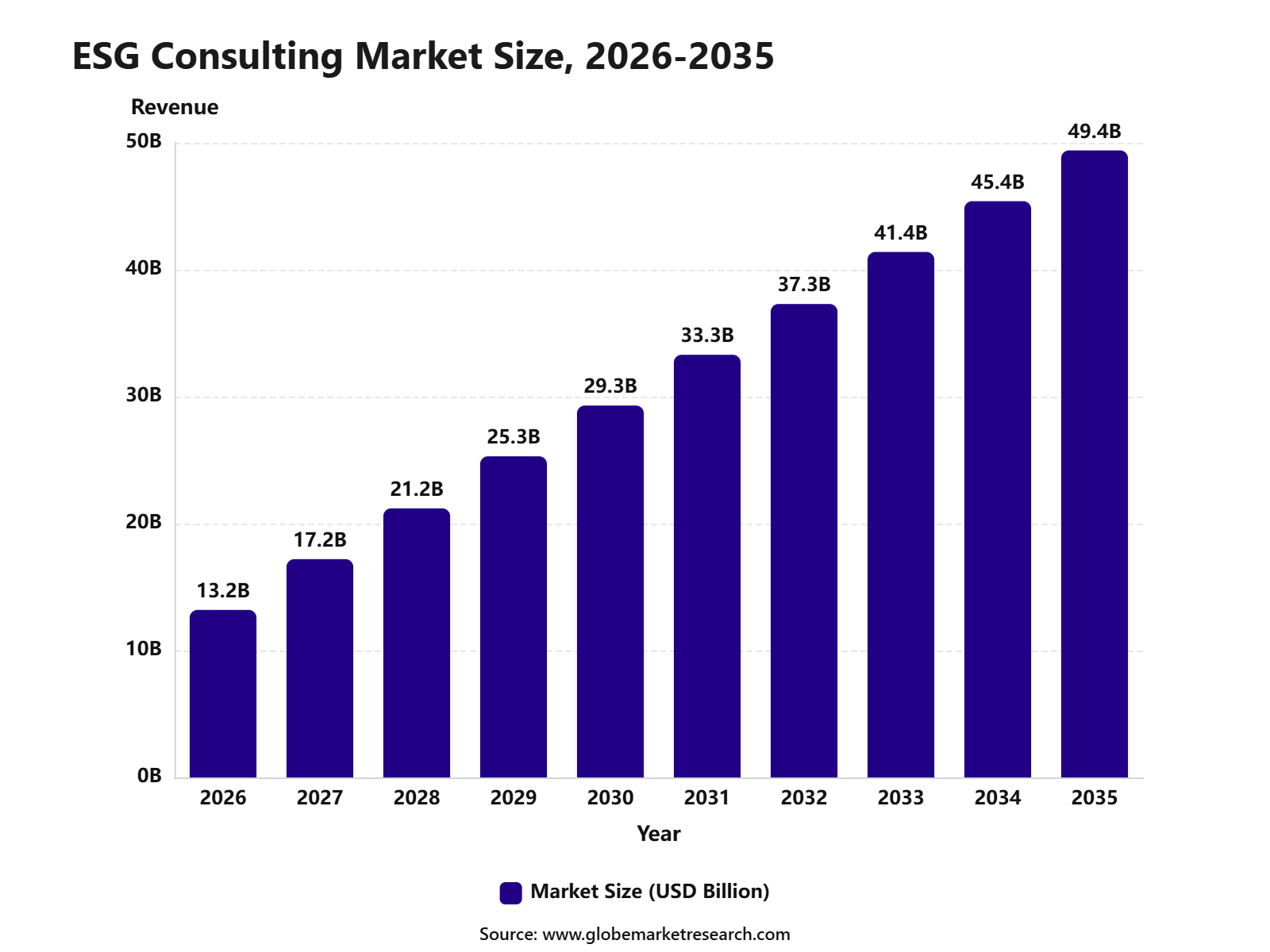 iThe graph shows projected market growth until 2035 based on CAGR analysis. Actual outcomes may vary depending on changing demand, competition, and economic factors.To gain greater insights - request a sample report PDF
Key Market Insights
Strategy and planning led the service type segment with 36.8% share, supported by rising demand for ESG roadmaps, sustainability frameworks, climate strategies, compliance planning, and long-term corporate responsibility programs.
Corporates accounted for 48.2% share by end user, driven by growing pressure to improve ESG reporting, reduce environmental risk, meet investor expectations, and strengthen brand reputation.
Large enterprises held 70.5% share by enterprise size, supported by higher consulting budgets, complex supply chains, strict disclosure needs, and wider adoption of ESG governance practices.
North America led the ESG consulting market with 40.2% share, supported by strong corporate sustainability adoption, investor-led ESG pressure, evolving disclosure standards, and mature consulting service demand.
Adoption Rate and Usage Statistics
According to the OECD, Deloitte, and BNP Paribas, companies representing 91% of global listed-market capitalization disclosed sustainability-related information. Scope 1 and 2 emissions reporting covered 88% of market capitalization, while Scope 3 reporting reached 76%. Deloitte found that 83% of executives increased sustainability investment, and 79% of Asia-Pacific institutional investors integrated ESG criteria into investment decisions. These trends are increasing demand for ESG strategy, reporting, risk assessment, emissions accounting, and regulatory compliance consulting.
Metric | Adoption Rate |
|---|---|
ESG Disclosure | 91% of global market capitalization |
Scope 1 and 2 Reporting | 88% of global market capitalization |
Scope 3 Reporting | 76% of global market capitalization |
Sustainability Investment | 83% of executives increased investment |
APAC ESG Integration | 79% of institutional investors |
According to the OECD, nearly 12,900 listed companies disclosed sustainability-related information, and 5,458 obtained independent external assurance. GRI standards were used by 6,548 companies, TCFD recommendations by 4,857 companies, and SASB standards by 3,497 companies. The simultaneous use of several reporting frameworks is supporting demand for ESG consultants capable of managing materiality assessments, data collection, framework alignment, assurance readiness, and investor disclosures.
Metric | Consulting Usage |
|---|---|
Reporting Companies | Nearly 12,900 companies |
Assured Reports | 5,458 companies |
GRI Framework Users | 6,548 companies |
TCFD Framework Users | 4,857 companies |
SASB Framework Users | 3,497 companies |
Service Type Insights
Strategy and planning accounted for 36.8% of the Environmental, Social and Governance Consulting Market by service type. Organizations require advisory support to identify material ESG issues, establish measurable targets and connect sustainability priorities with financial and operational decisions. Consulting assignments commonly cover climate transition plans, governance structures, stakeholder engagement and reporting roadmaps.
Deloitte’s 2025 global survey of more than 2,100 executives across 27 countries found that sustainability remained among the top three priorities for business leaders. Around 83% of surveyed executives increased their sustainability investments during the previous year, showing that ESG planning is being supported by active corporate spending rather than reporting requirements alone.
Service Type | Market Share |
|---|---|
Strategy and Planning | 36.8% |
Testing, Auditing and Verification | 22.8% |
Technical Support | 17.1% |
Sustainability Marketing | 13.4% |
Others | 9.9% |
Planning requirements are also becoming more standardized across jurisdictions. By November 2025, nearly 40 jurisdictions representing almost 60% of global GDP were adopting or otherwise using the International Sustainability Standards Board standards. This is increasing demand for readiness assessments, reporting gap analysis and implementation strategies aligned with local regulations.
End User Insights
Corporates represented 48.2% of the market by end user. Companies use ESG consultants to manage emissions reporting, supply-chain risks, employee policies, governance practices and investor communication. External advisers are particularly valuable when sustainability information is distributed across finance, procurement, operations, legal and human-resource departments.
A global study published by the Global Reporting Initiative in 2026 analyzed 14,682 listed companies with annual revenue above USD 250 million. It found that 87% produced a sustainability report in 2025, while 40% used the GRI Standards. This high reporting activity creates continued demand for data collection, materiality assessment and disclosure support.
Corporate demand is also being influenced by mandatory disclosure frameworks. The OECD reported that at least 1,800 companies listed in the European Union were subject to the European Sustainability Reporting Standards in 2025. Companies must therefore develop reliable controls for environmental and social information that may previously have been managed through voluntary reporting processes.
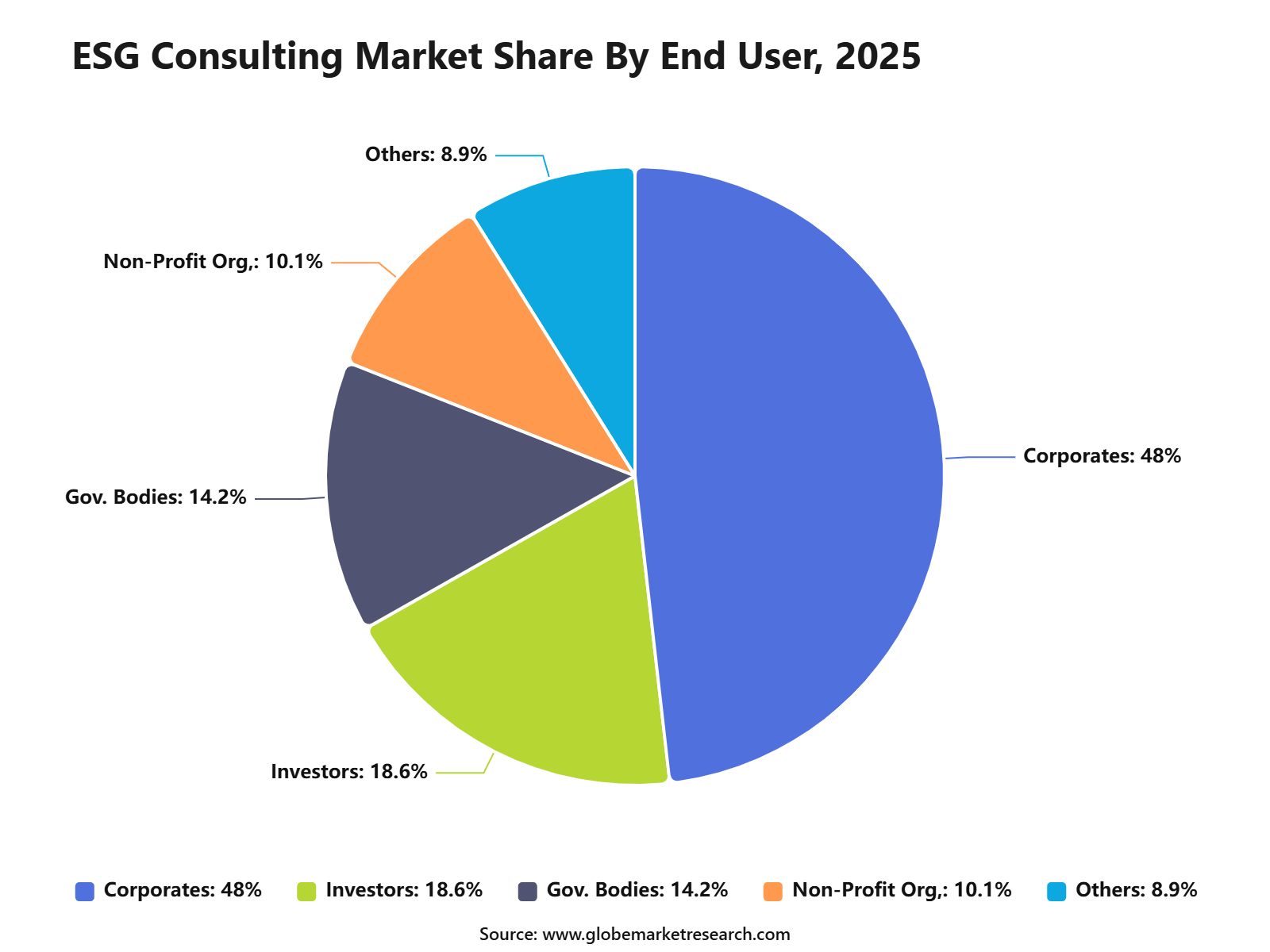 iThe graph shows projected market growth until 2035 based on CAGR analysis. Actual outcomes may vary depending on changing demand, competition, and economic factors.To gain greater insights - request a sample report PDF
Enterprise Size Insights
Large enterprises accounted for 70.5% of the market by enterprise size. These organizations commonly operate across several countries, manage extensive supplier networks and face closer attention from investors, regulators and customers. Their ESG consulting needs include global reporting coordination, climate-risk analysis, assurance preparation and sustainability integration across multiple business units.
United Nations data show that 96% of the world’s 250 largest companies by revenue publish sustainability reports. Reporting was also conducted by 79% of the 100 largest companies in each country included in the underlying survey. This reflects the institutionalization of sustainability disclosure among large organizations.
Assurance requirements are further increasing the complexity of large-enterprise reporting. A 2026 IFAC, AICPA and CIMA study covering 1,400 major companies across G20 jurisdictions found that audit firms performed 59% of sustainability assurance engagements. Large companies require consultants to improve data quality, document reporting controls and prepare disclosures for independent review.
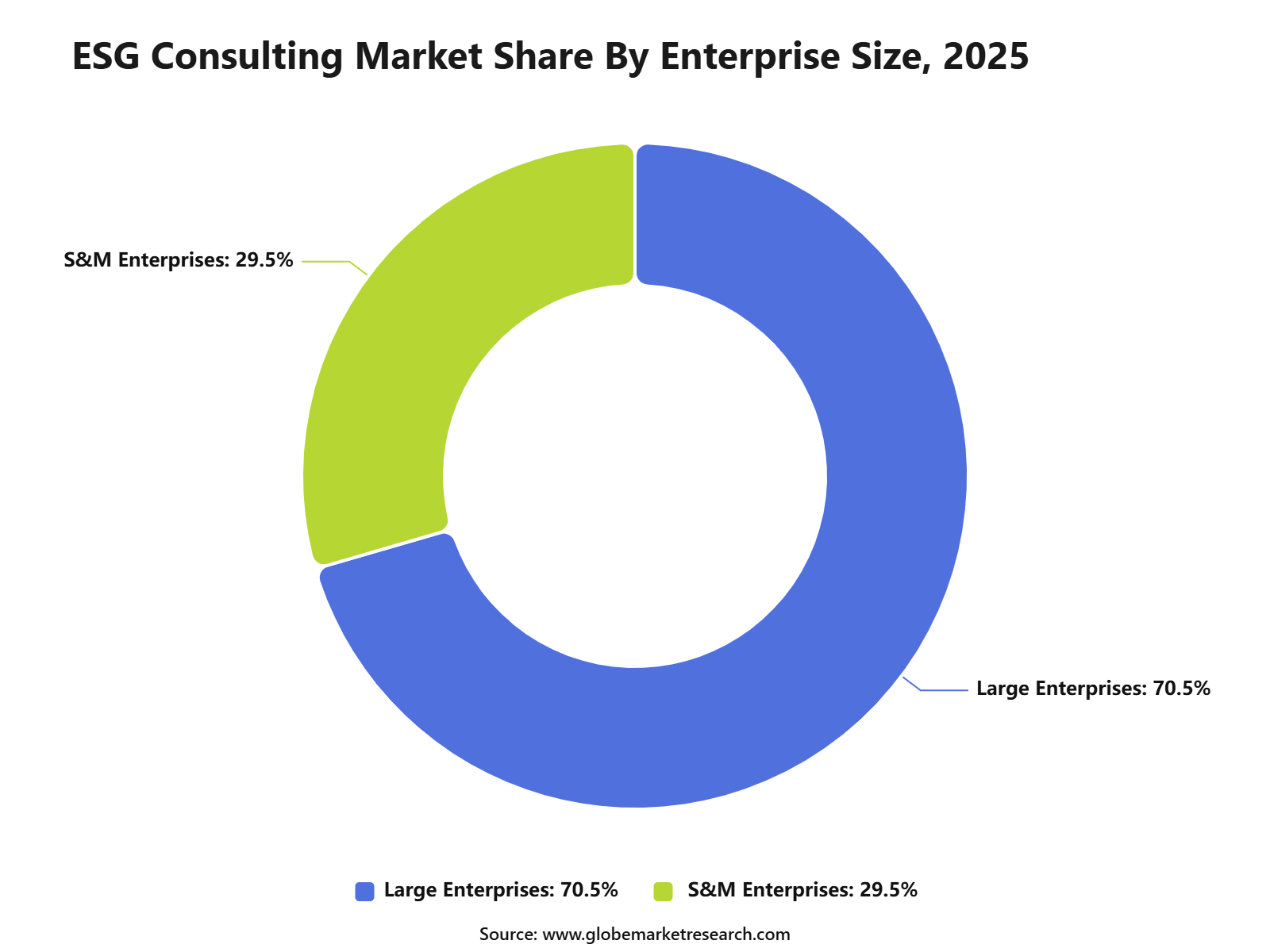 iThe graph shows projected market growth until 2035 based on CAGR analysis. Actual outcomes may vary depending on changing demand, competition, and economic factors.To gain greater insights - request a sample report PDF
Regional Insights
North America accounted for 40.2% of the Environmental, Social and Governance Consulting Market. Regional demand is supported by large publicly listed companies, institutional investor expectations and growing attention to climate risk, supply-chain transparency and sustainability performance. Consulting work increasingly focuses on measurable business outcomes rather than the use of ESG terminology alone.
Deloitte’s 2025 U.S. executive survey found that 83% of respondents increased their companies’ sustainability investments during the year. These investments included new technologies, employee capabilities and redesigned operating processes, demonstrating that sustainability programs remain active despite changes in political language and disclosure priorities.
Reporting complexity remains an important demand driver across the region. A 2025 review of 250 leading Canadian companies assessed 76 climate and sustainability disclosure points and identified continuing gaps in reporting preparedness. In the United States, California’s corporate climate programs are designed to cover companies with annual revenue above USD 1 billion for emissions reporting and above USD 500 million for climate-risk disclosure.
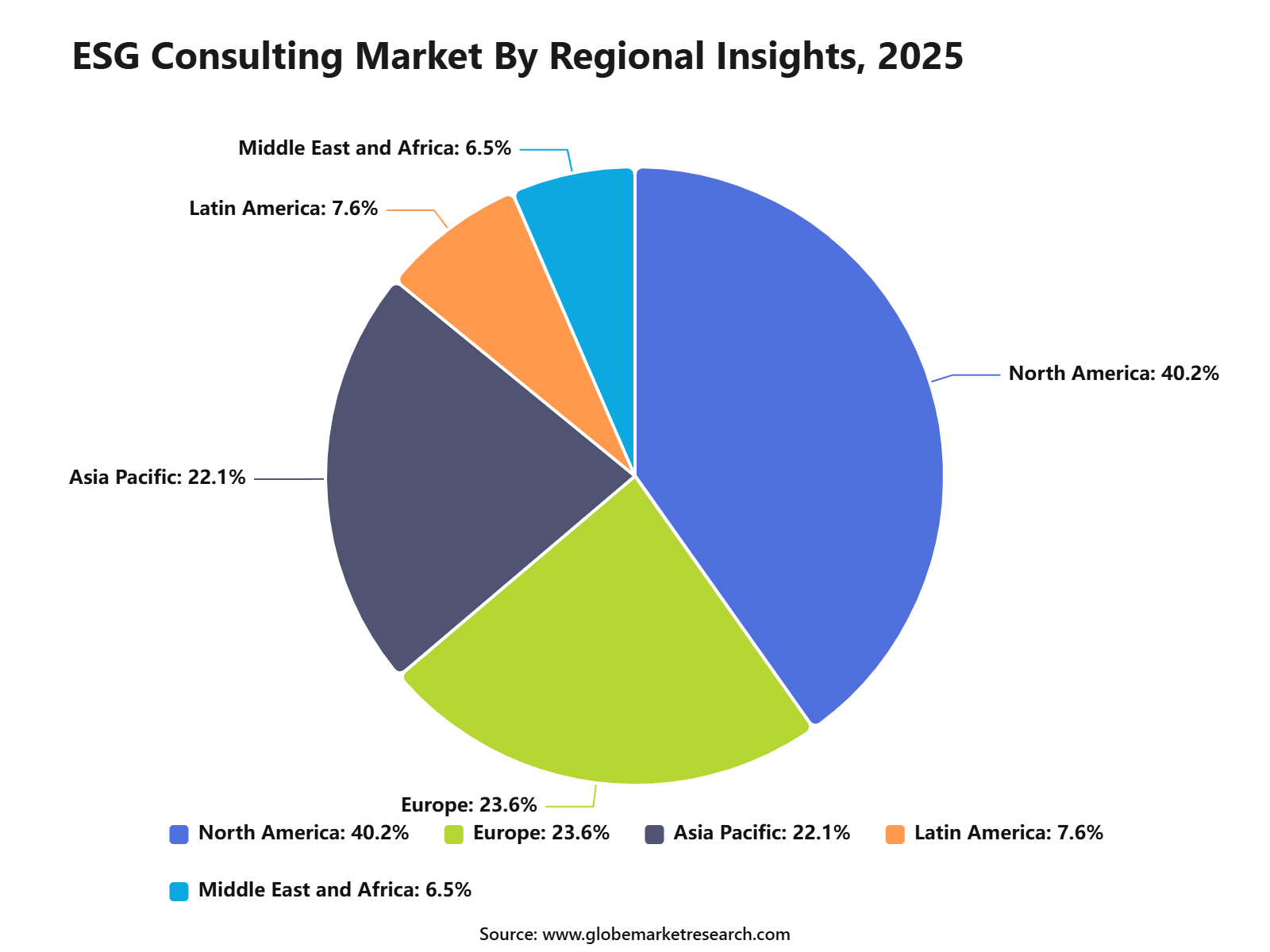 iThe graph shows projected market growth until 2035 based on CAGR analysis. Actual outcomes may vary depending on changing demand, competition, and economic factors.To gain greater insights - request a sample report PDF
U.S. ESG Consulting Market Insight
The U.S. ESG consulting market is being shaped by a complex mix of state disclosure laws, investor expectations and international reporting obligations. Companies increasingly require support with greenhouse gas inventories, climate-risk assessment, supplier data collection and internal reporting controls. Demand remains strongest among large corporations operating across multiple states and international markets.
In February 2026, the California Air Resources Board approved implementation provisions for the state’s corporate climate transparency programs. Companies with more than USD 1 billion in annual revenue that conduct business in California are required to report Scope 1 and Scope 2 emissions beginning in 2026, followed by Scope 3 emissions in 2027.
Europe ESG Consulting Market Insight
Europe represents a major ESG consulting market because sustainability reporting is closely connected with corporate governance, financial reporting and supply-chain management. Advisory work commonly covers double-materiality assessments, European Sustainability Reporting Standards implementation, climate-transition planning and preparation for limited assurance.
On July 3, 2026, the European Commission adopted revised European Sustainability Reporting Standards and a voluntary reporting standard for smaller companies. The changes were intended to reduce administrative burdens while maintaining comparable sustainability information for investors and other stakeholders.
U.K. ESG Consulting Market Insight
The U.K. ESG consulting market is supported by established climate-reporting practices, active financial institutions and increasing alignment with international sustainability standards. Companies require advice on climate risk, transition planning, sustainability governance and the connection between non-financial information and enterprise value.
The U.K. government published UK Sustainability Reporting Standards S1 and S2 on February 25, 2026. The standards were developed from the ISSB framework following a public consultation conducted between June and September 2025. They provide a national reference for general sustainability-related financial information and climate-related disclosures.
Germany ESG Consulting Market Insight
Germany provides a strong ESG consulting environment due to its large industrial base, export-oriented economy and extensive corporate supply chains. Manufacturers, automotive companies, chemical producers and financial institutions require support with emissions data, product-level sustainability information and European reporting requirements.
Companies already covered by Germany’s CSR Directive Implementation Act were required to publish reports in 2025 covering the 2024 financial year. These organizations must report sustainability information under the European Sustainability Reporting Standards, while the wider CSRD implementation timetable continues to be adjusted through European and national legislative processes.
Asia-Pacific ESG Consulting Market Insight
Asia-Pacific is developing into a broad ESG consulting market as governments and stock exchanges introduce sustainability disclosure frameworks. Demand varies by country, but common consulting areas include ISSB alignment, climate-risk reporting, greenhouse gas accounting, supply-chain due diligence and sustainable finance.
An IFRS Foundation survey conducted in February 2025 received responses from 49 jurisdictions, including 16 from Asia-Oceania. Of all participating jurisdictions, 47 had adopted, planned to adopt or intended to otherwise use ISSB standards. Implementation schedules include major Asia-Pacific markets such as Australia, Hong Kong, Malaysia, Singapore, the Philippines, Indonesia and Thailand.
Japan ESG Consulting Market Insight
Japan’s ESG consulting market is being supported by the formal development of national sustainability disclosure standards. Listed companies require assistance with governance, climate risks, greenhouse gas measurement and the integration of sustainability information into annual securities reporting.
The Sustainability Standards Board of Japan issued its inaugural standards on March 2025. The framework was developed to remain aligned with ISSB standards. On March 2026, the board amended three standards in response to updates concerning greenhouse gas emissions disclosures under IFRS S2.
China ESG Consulting Market Insight
China’s ESG consulting market is developing as national authorities establish a unified sustainability disclosure system. Demand is being generated among listed companies, state-owned enterprises, financial institutions and businesses operating in carbon-intensive industries. Key advisory areas include climate-risk assessment, emissions measurement and internal reporting controls.
China’s Ministry of Finance issued the Sustainability Disclosure Standards for Business Enterprises No. 1, Climate, on December 25, 2025. The climate standard followed the country’s basic sustainability disclosure standard and detailed application guidance issued during 2025. A separate basic standard for sustainability assurance engagements was issued in January 2026.
ESG Investing vs. Other Investment Strategies
ESG investing evaluates environmental, social and governance factors alongside financial measures such as revenue growth, profitability, valuation and balance-sheet strength. It is mainly used to identify sustainability-related risks and opportunities that could affect long-term investment performance. Unlike strict ethical investing, an ESG portfolio may still hold companies from carbon-intensive or controversial sectors when risks are considered manageable or when investor engagement is expected to improve performance.
Investment Strategy | Primary Objective | Investment Selection | Main Difference |
|---|---|---|---|
ESG investing | Financial returns with sustainability-risk assessment | Financial performance, emissions, labour practices, board quality and business ethics | ESG factors are integrated into financial analysis |
Traditional investing | Maximize risk-adjusted financial returns | Revenue, profit, valuation, cash flow and economic conditions | Sustainability factors may only be considered when financially material |
Socially responsible investing | Align investments with ethical values | Excludes sectors such as tobacco, weapons, gambling or fossil fuels | Uses stronger negative screening than general ESG investing |
Impact investing | Generate measurable social or environmental benefits with financial returns | Renewable energy, affordable housing, healthcare access and financial inclusion | Requires an intentional and measurable positive impact |
Thematic investing | Gain exposure to a specific structural trend | Clean energy, water, electric vehicles, circular economy or climate technology | Focuses on a particular theme rather than company-wide ESG performance |
What Are ESG Regulations?
ESG regulations are laws and regulatory requirements governing how companies, asset managers, investment funds and ESG rating providers report and market environmental, social and governance information. Most ESG rules do not require a business to become sustainable. Instead, they require accurate, comparable and decision-useful disclosures, while reducing misleading sustainability claims or greenwashing.
ESG regulations generally cover corporate sustainability reporting, greenhouse-gas emissions, climate-related financial risks, fund names and labels, sustainability objectives, supply-chain impacts, ESG ratings and assurance of reported data. The exact requirements depend on the jurisdiction, company size, listing status and type of financial product.
Major ESG Regulatory Frameworks
European Union: The Sustainable Finance Disclosure Regulation has applied since March 2021 and requires financial market participants to explain how sustainability risks and adverse impacts are addressed. In November 2025, the European Commission proposed amendments intended to simplify the framework, but proposed changes should not be treated as final requirements until the legislative process is completed.
United Kingdom: The Financial Conduct Authority’s Sustainability Disclosure Requirements include an anti-greenwashing rule, naming and marketing controls, consumer disclosures and four sustainability investment labels. Firms have been permitted to use the labels since July 2024.
United States: ESG regulation is more fragmented. The SEC’s Names Rule generally requires funds using names that suggest particular investment characteristics to maintain at least 80% of assets in investments consistent with that name. The SEC withdrew its proposed ESG disclosure rules for funds and advisers in June 2025. It also proposed rescinding the federal climate-disclosure rules on May, 2026, so their status should be checked before making compliance decisions.
India: SEBI requires the top 1,000 listed companies by market capitalization to publish Business Responsibility and Sustainability Reports. The BRSR Core framework introduces key ESG indicators, assurance requirements and value-chain disclosures. SEBI also formed a working group in February 2026 to review the regulatory framework for ESG rating providers.
Global standards: IFRS S1 and IFRS S2, issued by the International Sustainability Standards Board, provide a global baseline for investor-focused sustainability and climate disclosures. These standards are not automatically laws. They become mandatory when adopted or incorporated into a country’s regulatory framework.
Key Market Segments
By Service Type
Testing
Auditing and Verification
Technical Support
Sustainability Marketing
Strategy and Planning
Others
By Enterprise Size
Small and Medium-Sized Enterprises
Large Enterprises
By End User
Corporates
Investors
Government Bodies
Non-Profit Organizations
Others
By Industry Vertical
BFSI
Energy and Utilities
Manufacturing
Healthcare
Retail and Consumer Goods
IT and Telecom
Transportation and Logistics
Others
By Region
North America
Europe
Asia Pacific
Latin America
Middle East and Africa
Market Dynamics
Drivers Impact Analysis
The ESG Consulting Market is driven by rising corporate sustainability reporting, climate risk disclosure, investor pressure, carbon reduction planning, supply chain audits, and regulatory compliance. Companies are using ESG consultants to improve reporting accuracy, reduce risk exposure, and build stronger sustainability strategies.
North America leads the market due to strong corporate disclosure activity, investor-led ESG screening, climate risk management, and demand from large enterprises. The U.S. remains the key contributor because companies need support with sustainability reporting, emissions tracking, governance improvement, and stakeholder communication.
Impact Factor | Estimated CAGR Impact | Regional Relevance | Market Impact |
|---|---|---|---|
Rising ESG reporting requirements | +4.5% | North America, Europe, Asia Pacific | Drives core consulting demand. |
Investor pressure for transparency | +3.8% | U.S., Canada, Europe | Supports ESG strategy and disclosure work. |
Growth in carbon reduction planning | +3.2% | Large enterprises and manufacturers | Increases climate consulting demand. |
Supply chain sustainability audits | +2.6% | Retail, manufacturing, technology | Expands vendor assessment services. |
Corporate governance improvement | +2.1% | Public and private companies | Supports board-level ESG advisory. |
Restraints Impact Analysis
The market faces restraints from inconsistent ESG standards, high consulting cost, greenwashing concerns, data quality gaps, and client uncertainty around reporting frameworks. Many companies struggle to collect reliable environmental, social, and governance data across departments and suppliers. Another restraint is growing scrutiny of ESG claims. Clients now need evidence-based reporting, credible metrics, and clear audit trails, which increases project complexity and can slow decision-making.
Impact Factor | Estimated CAGR Impact | Regional Relevance | Market Impact |
|---|---|---|---|
Inconsistent ESG standards | -2.1% | Global consulting markets | Creates reporting complexity. |
High consulting service cost | -1.7% | SMEs and mid-market clients | Limits faster adoption. |
Greenwashing risk | -1.4% | North America and Europe | Raises verification needs. |
Poor ESG data quality | -1.2% | Enterprise supply chains | Affects reporting accuracy. |
Framework confusion | -1.0% | Global companies | Delays project execution. |
Opportunities Impact Analysis
Opportunities are strong in climate risk advisory, ESG strategy, sustainability reporting, carbon accounting, Scope 3 emissions assessment, supply chain due diligence, sustainable finance support, and assurance-ready reporting. These services are becoming critical as companies move from voluntary ESG messaging to measurable performance management.
Higher-value opportunities are emerging in ESG software implementation, AI-based data collection, sector-specific ESG advisory, biodiversity reporting, circular economy consulting, and transition planning. Consulting firms that combine regulatory knowledge, analytics, and industry expertise can capture stronger demand.
Impact Factor | Estimated CAGR Impact | Regional Relevance | Market Impact |
|---|---|---|---|
Carbon accounting services | +4.2% | North America, Europe, Asia Pacific | Builds high-demand ESG service area. |
Scope 3 emissions consulting | +3.6% | Large supply chain companies | Adds complex advisory demand. |
ESG software implementation | +3.0% | Enterprise clients | Supports data-driven reporting. |
Climate risk and transition planning | +2.5% | Finance, energy, manufacturing | Adds strategic consulting value. |
Assurance-ready ESG reporting | +2.0% | Public companies | Improves credibility and compliance. |
Challenges Impact Analysis
The main challenge is converting ESG goals into measurable business actions. Companies often set sustainability targets but need help with data systems, governance ownership, supplier engagement, and operational execution. Another challenge is proving the financial value of ESG consulting. Clients expect consultants to connect ESG work with risk reduction, cost savings, investor confidence, brand trust, and regulatory readiness.
Impact Factor | Estimated CAGR Impact | Regional Relevance | Market Impact |
|---|---|---|---|
Turning goals into execution | -1.9% | Corporate ESG teams | Slows implementation progress. |
Measuring ESG return on investment | -1.5% | C-suite and finance teams | Affects budget approval. |
Supplier data collection difficulty | -1.3% | Global supply chains | Limits Scope 3 accuracy. |
Talent shortage in ESG advisory | -1.1% | Consulting firms | Restricts service scale. |
Changing regulatory expectations | -0.9% | North America, Europe, Asia Pacific | Requires continuous updates. |
Major ESG Consulting Use Cases
ESG Strategy and Roadmap Development: Consultants help companies identify material environmental, social and governance issues based on business activities, geographic exposure and stakeholder expectations. The output generally includes an ESG policy, measurable objectives, implementation responsibilities, performance indicators and a multiyear action plan. Materiality assessments are increasingly linked with financial planning and enterprise risk management. Under European reporting requirements, companies are expected to assess both how sustainability issues affect financial performance and how business activities affect people and the environment.
Sustainability Reporting and Disclosure: ESG consultants support the preparation of reports aligned with ESRS, ISSB, GRI and national disclosure requirements. Services include reporting-boundary selection, data collection, disclosure mapping, policy documentation, narrative preparation and consistency checks. The spread of ISSB-based requirements across 36 jurisdictions is creating demand for consultants who can reconcile global standards with national rules. Companies operating in multiple countries require reporting structures that reduce duplication while maintaining compliance with local requirements. Source: IFRS Foundation.
Carbon Accounting and Decarbonization: Carbon accounting services are used to calculate Scope 1, Scope 2 and relevant Scope 3 greenhouse gas emissions. Consultants may also develop emission-reduction targets, renewable energy strategies, energy-efficiency programs and supplier decarbonization plans. These assignments commonly involve selecting organizational boundaries, validating activity data, applying emission factors and creating audit trails. The findings are then used to establish reduction priorities, capital requirements and operational responsibilities.
Climate Risk Assessment: Physical climate risks such as flooding, extreme heat, drought and storms can be assessed across facilities and supply chains. Transition risks associated with carbon pricing, regulation, changing technology and customer preferences can also be evaluated. Consultants frequently translate climate scenarios into financial implications, including asset impairment, insurance costs, supply interruptions, operating expenses and capital investment requirements. This allows climate risks to be included within enterprise risk management and financial planning.
Supply Chain ESG Due Diligence: Companies use ESG consulting services to identify environmental, labor, human rights and governance risks within their supplier networks. The process may include supplier screening, questionnaires, risk scoring, document reviews, site audits and corrective action plans. The revised European due diligence framework focuses on the largest companies with significant influence over their value chains. Even suppliers outside the direct regulatory scope may receive sustainability data requests from customers that must meet the requirements. Source: Council of the European Union.
Recent Developments
Market News
In January 2026, ERM partnered with Auquan to deploy agentic artificial intelligence across sustainability due-diligence workflows for financial institutions. The technology scans news, regulatory disclosures, litigation records, and stakeholder reports to identify controversies and reputational risks involving potential investments and business partners.
In January 2026, SLR acquired WAP Sustainability, a United States-based consultancy with nearly 100 employees. WAP provides life-cycle assessments, environmental product declarations, carbon accounting, ESG data solutions, and product-sustainability services for the construction materials, packaging, textile, electronics, and consumer goods industries.
In February 2026, the Council of the European Union approved amendments simplifying the Corporate Sustainability Reporting Directive and Corporate Sustainability Due Diligence Directive. The changes reduced reporting burdens, limited the transfer of information demands to smaller suppliers, and changed the number and type of companies required to comply.
Acquisitions
In January 2026, SLR acquired WAP Sustainability to expand its product-sustainability and ESG data capabilities. The transaction added expertise in carbon accounting, environmental product declarations, life-cycle assessments, sustainable sourcing, and technology-supported ESG advisory services.
In February 2026, SLR acquired SB&CO to strengthen sustainability strategy, technical advisory, stakeholder engagement, and corporate communications. The combination allows SLR to support clients from initial sustainability planning through implementation and public reporting.
Competitive Landscape
The market is characterized by intense competition among established players and emerging companies. Strategic partnerships, mergers and acquisitions, and product innovation are key strategies employed by market participants.
Key Market Players
Accenture plc
Deloitte Touche Tohmatsu Limited
PricewaterhouseCoopers International Limited
Ernst & Young Global Limited
KPMG International Limited
Bain & Company
Environmental Resources Management
WSP Global Inc.
Jacobs Solutions Inc.
Sphera Solutions, Inc.
Diligent Corporation
Other Key Players
Research Methodology
This market study is prepared using a combination of primary and secondary research. Primary research includes discussions with manufacturers, suppliers, distributors, consultants, industry experts, and end users. Secondary research covers company reports, government databases, trade associations, technical publications, regulatory sources, and trusted industry documents. The collected information is used to assess market demand, pricing trends, technology adoption, competitive activity, and regional performance.
AI language models are not used as primary data sources, and publicly available AI-generated content is not treated as market evidence. Computational tools may be used to support data processing, translation, data classification, and pattern identification. However, every published assessment is supported by verified sources, human review, and primary market discussions.
Market estimates are developed through top-down and bottom-up approaches and validated using data triangulation. Revenue, production, shipment, pricing, and application-level data are compared across multiple sources. Forecasts consider economic conditions, regulatory changes, investment activity, innovation, supply chain developments, and industry risks. All findings are reviewed through source verification and internal quality checks before publication.
Part I
Source Management & Input Data Standards
Who provides data, how sources are qualified, and what types of evidence are admissible.
Part II
Research Scope & Market Coverage
How we define the markets we assess and the parameters that govern each product.
Part III
Data Collection, Verification & Submission
The mechanics of gathering, cross-checking, and hierarchically ranking evidence.
Part IV
Assessment Determination & Quality Controls
How raw data becomes a published assessment — normalisation, expert judgement, and outlier exclusion.
Part V
Publication, Corrections & Revision
Our publication schedule, corrections policy, and methodology review cycle.
Part VI
Independence, Ethics & Complaints
Conflict-of-interest policies, editorial independence, and how clients raise concerns.
Google · Preferred Sources
Don't miss the latest market research insights and industry updates on Google.
Add Globe Market Research as a preferred source in the Google app to see our reports, analysis, and market stories in your news suggestions.
Meet the Team
This report was prepared by our expert analysts with deep industry knowledge and research experience.
Prashant S. is a Research Analyst at Globe Market Research with more than four years of experience in market research and industry analysis. He specializes in the Aerospace and Defence, Automotive and Transportation, Semiconductor and Electronics, Information and Technology sectors, with expertise in market sizing, trend analysis, competitive assessment, and industry forecasting. He applies primary and secondary research, data validation, company analysis, and market estimation methods to deliver reliable insights for strategic planning and business decision-making.
Sayali brings more than 7 years of experience to Globe Market Research, supporting the accuracy, clarity, and relevance of research content across multiple industries. She reviews market data, segment analysis, competitive insights, and industry trends to ensure each report meets strong quality standards and provides practical value to business decision-makers. Her expertise spans healthcare, information technology, consumer goods, and diverse cross-industry domains. With a strong focus on data reliability, structured analysis, and clear presentation, Sayali helps ensure that each research output delivers well-reviewed insights for clients, investors, consultants, and industry stakeholders.
Frequently Asked Questions
Related Reports
More in Information and Technology
South Korea Physical AI Market Size to Reach USD 3.6 billion by 2035
South Korea Physical AI Market Size, Share, Trends and Growth Analysis Report By Deployment (On-Device AI, Cloud-Based AI), By Component (Hardware, Software, Services), By Technology (Computer Vision, Speech and Natural Language Processing, Gesture and Movement Recognition, Reinforcement Learning and Control Systems, Other Technologies), By Robot Type (Service Robots, Humanoid and Social Robots, Collaborative Robots, Exoskeletons and Prosthetics, Mobile Robots and Drones, Industrial Robots), By Application (Healthcare, Manufacturing and Automotive, Logistics and Warehousing, Retail and Hospitality, Other Applications), By Technology Trends, Competitive Landscape, Strategic Opportunities and Growth Forecast, 2026-2035
Physical AI Market Size to hit USD 2,129.0 billion by 2035
Physical AI Market Size, Share, Trends and Growth Analysis Report By Component (Hardware, Software, Services), By Technology (Computer Vision, Machine Learning and Deep Learning, Natural Language Processing, Edge AI, Other Technologies), By Product (Robots, Exoskeletons, Autonomous Systems, Smart Appliances), By Application (Automation and Manufacturing, Logistics and Supply Chain, Healthcare, Automotive, Defense and Security, Retail, Education, Other End Uses), By Regional Insights, Technology Trends, Competitive Landscape, Strategic Opportunities and Growth Forecast, 2026-2035
Edtech SaaS Tools Market Size to hit USD 217.6 billion by 2035
EdTech SaaS Tools Market Size, Share, Trends and Growth Analysis Report By Software (Classroom Management Systems, Document Management Systems, Learning and Gamification Platforms, Learning Management Systems, Student Collaboration Systems, Assessment and Analytics Tools, Content Authoring Tools, Other Software), By Sector (Preschool, K-12, Higher Education, Other Education Sectors), By Deployment (Cloud-Based, Hybrid), By End Use (Businesses, Educational Institutions, Individual Learners and Consumers), By Regional Insights, Technology Trends, Competitive Landscape, Strategic Opportunities and Growth Forecast, 2026–2035
Marketing Technology Market Size to Reach USD 3,810.8 billion by 2035
Marketing Technology Market Size, Share, Trends and Growth Analysis Report By Marketing Type (Digital Marketing, Offline Marketing), By Product (Social Media Tools, Content Marketing Tools, Rich Media Tools, Marketing Automation Tools, Data and Analytics Tools, Sales Enablement Tools), By Deployment (Cloud-Based, On-Premises, Other Deployment Models), By Enterprise Type (Large Enterprises, Small and Medium-Sized Enterprises), By Application (IT and Telecommunication, Retail and E-commerce, Healthcare, Media and Entertainment, Sports and Events, BFSI, Real Estate, Other Applications), By Regional Insights, Technology Trends, Competitive Landscape, Strategic Opportunities and Growth Forecast, 2026-2035