

Revenue, 2026
USD 570.4 Bn
Forecast, 2035
USD 3,810.8 Bn
CAGR, 2026-2035
23.5%
Report Coverage
Global
Market Size and Forecast
The global Marketing Technology Market was valued at USD 570.4 billion in 2026 and is projected to reach approximately USD 3,810.8 billion by 2035, growing at a CAGR of 23.5% from 2026 to 2035. North America accounted for around 35.8% of the market, equivalent to approximately USD 204.2 billion at the stated 2026 value. The U.S. held the largest country-level share in 2025, supported by high digital advertising expenditure, advanced enterprise software adoption and the presence of major cloud, advertising and marketing-platform providers.
Marketing technology includes software and digital tools used to plan, execute, automate, measure and improve marketing activities. Major solutions include customer relationship management systems, marketing automation, customer data platforms, advertising technology, content management, social media tools, email platforms, analytics and artificial intelligence. Businesses are increasingly connecting these systems to create unified customer profiles, automate campaign workflows, personalise content and measure performance across digital and physical channels.
Key Parameter | Report Details |
|---|---|
Market Revenue, 2026 | USD 570.4 Billion |
Projected Revenue, 2035 | USD 3,810.8 Billion |
CAGR, 2026-2035 | 23.5% |
Largest Region | North America, 35.8% Share |
Fastest Growing Region | Asia Pacific |
Leading Country | United States, Largest Share in 2025 |
Market Concentration | Medium |
Forecast Period | 2026-2035 |
Salesforce’s 2026 research found that 75% of marketers were using AI, while 78% required more personalised content than their teams could produce. Adobe reported that 62% of companies plan to use agentic AI for conversational customer engagement within 18 months, although only 39% currently have a shared customer data platform capable of supporting large-scale deployment. U.S. internet advertising revenue reached nearly USD 300 billion in 2025, increasing by 13.9% year over year, which is supporting continued investment in campaign automation, analytics, content creation and customer-data technology.
Agentic AI is shifting marketing technology from task-based automation to autonomous campaign planning, execution and optimisation. AI agents can analyse customer behaviour, create content variations, identify audience segments, allocate media budgets and adjust campaigns across email, search, social media and commerce platforms. Around 83% of marketers recognise the growing importance of personalised, two-way customer communication, but only one in four are satisfied with how their data supports these interactions.
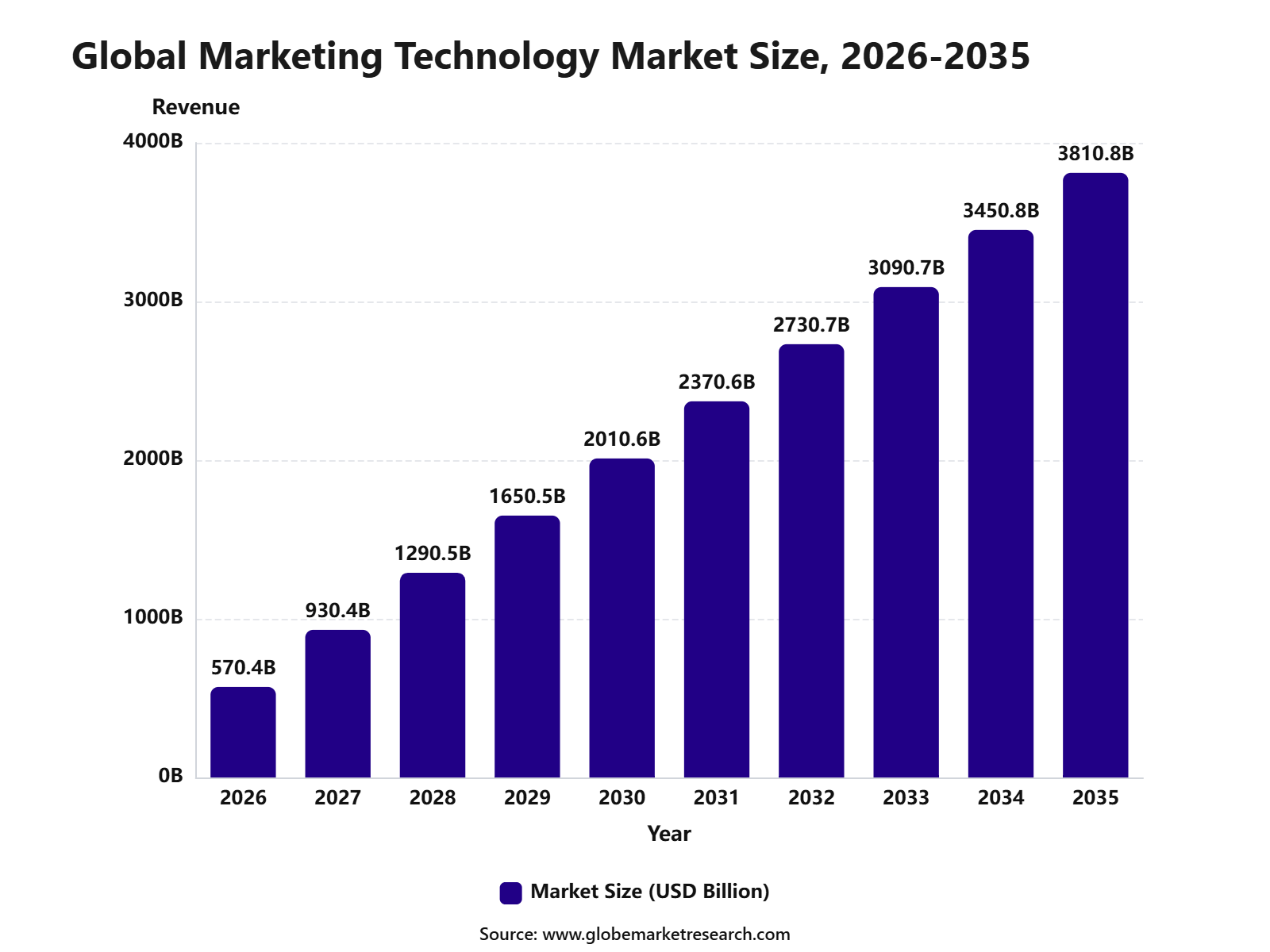 iThe graph shows projected market growth until 2035 based on CAGR analysis. Actual outcomes may vary depending on changing demand, competition, and economic factors.To gain greater insights - request a sample report PDF
Key Market Insights
Digital marketing led the marketing type segment with 64.5% share, supported by strong use of online campaigns, search marketing, email automation, social media promotion, and data-driven customer targeting.
Social media tools accounted for 28.2% share by product, driven by rising demand for content scheduling, audience engagement, influencer marketing, campaign tracking, and brand visibility across digital platforms.
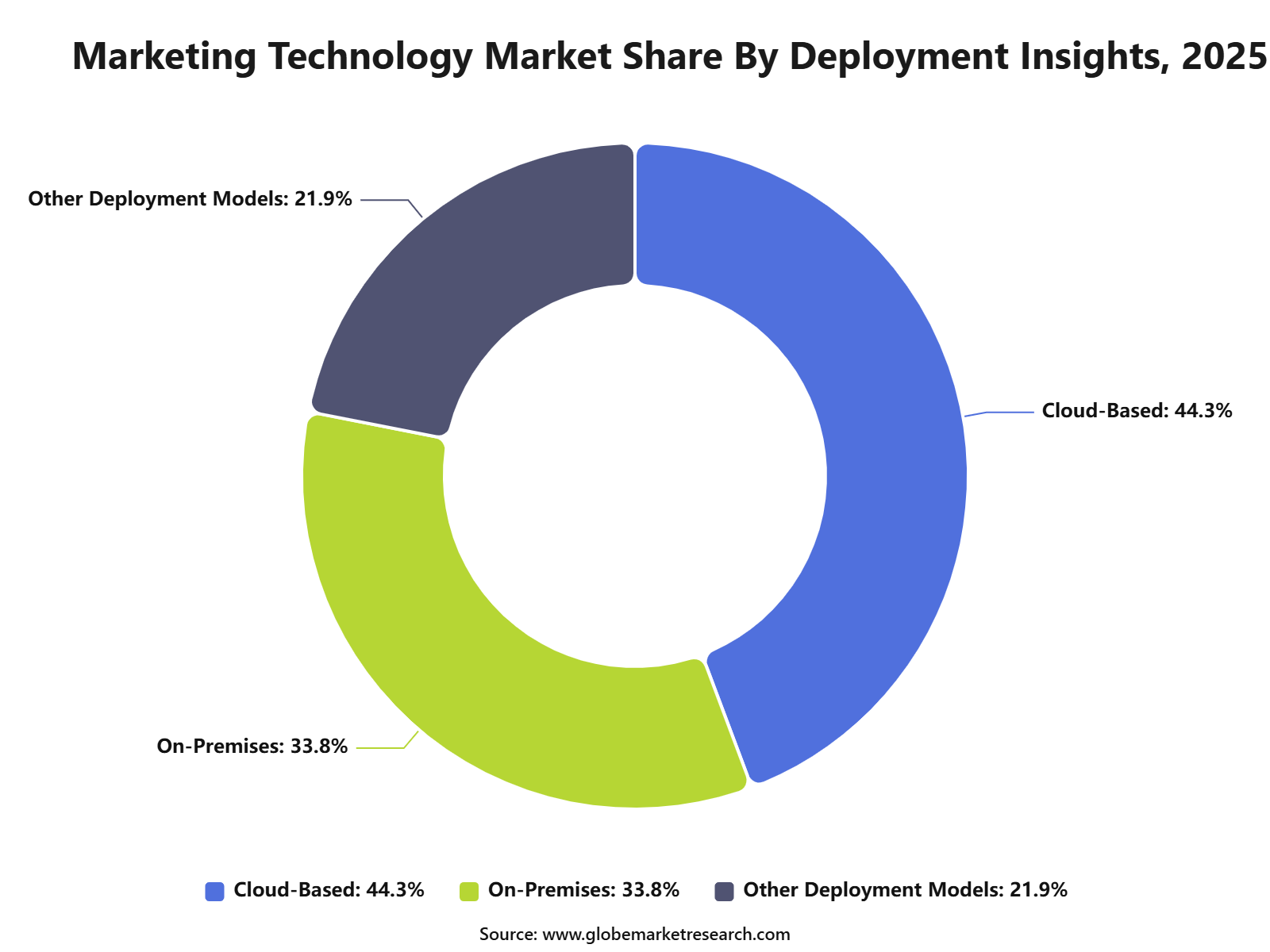
Cloud-based deployment held 44.3% share, supported by easier scalability, remote access, faster updates, lower infrastructure needs, and smooth integration with CRM and analytics systems.
Large enterprises captured 59.3% share by enterprise type, driven by higher marketing budgets, complex customer journeys, multi-channel campaigns, and stronger adoption of automation tools.
Healthcare led the application segment with 23.6% share, supported by rising use of marketing technology for patient engagement, digital outreach, brand communication, appointment campaigns, and personalized healthcare content.
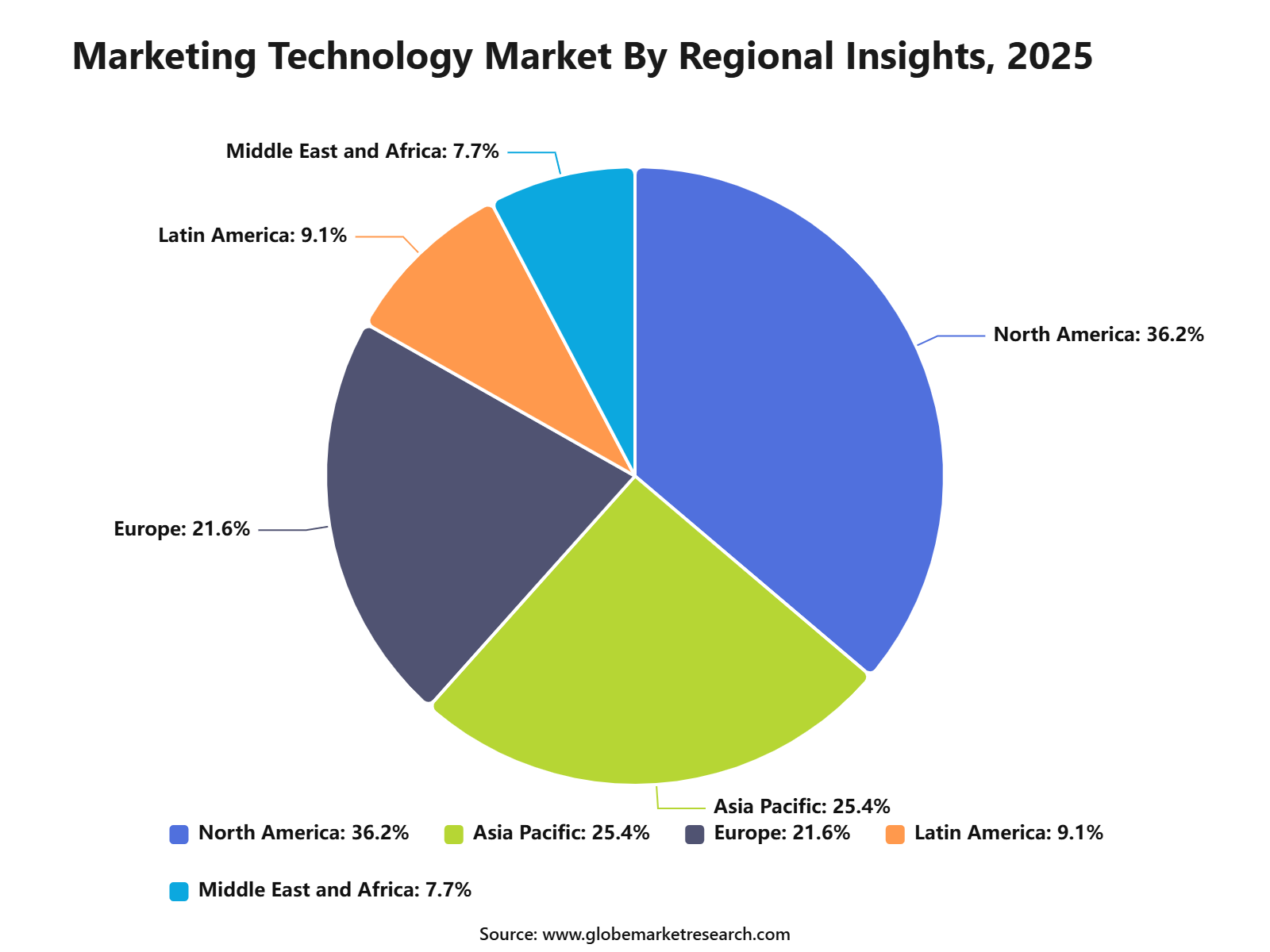
North America led the marketing technology market with 36.2% share, supported by mature digital advertising ecosystems, strong enterprise software adoption, advanced analytics usage, and high spending on customer engagement platforms.
Adoption Rate and Usage Statistics
According to Salesforce and HubSpot, 86.4% of marketing teams use AI in at least several marketing functions, while 88% have started optimizing content for AI-generated search responses. Around 69.2% use customer data to create personalized experiences, 47.4% are adopting marketing automation, and 13% have progressed to agentic AI systems capable of performing more complex marketing workflows.
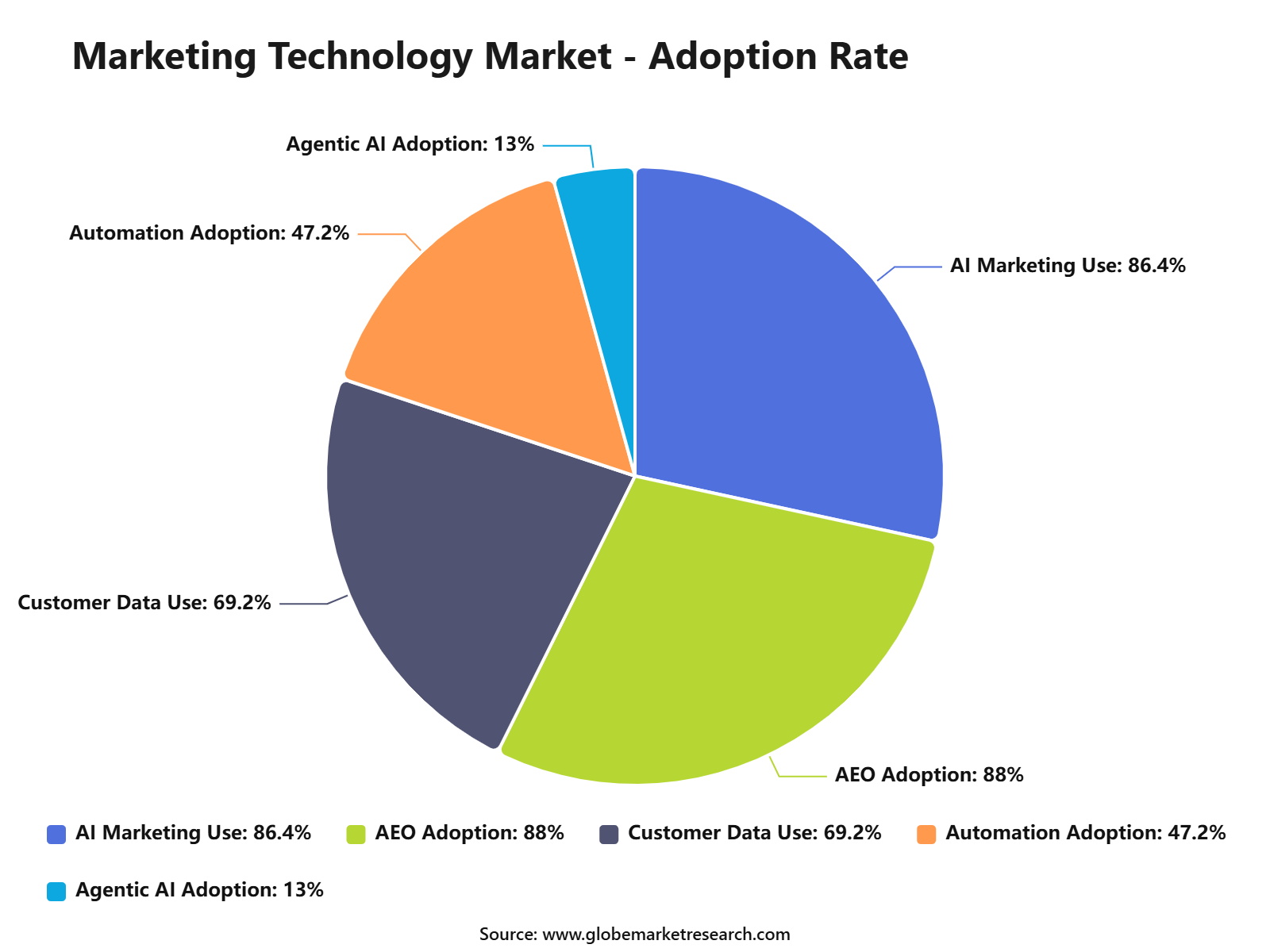 iThe graph shows projected market growth until 2035 based on CAGR analysis. Actual outcomes may vary depending on changing demand, competition, and economic factors.To gain greater insights - request a sample report PDF
According to HubSpot and Chiefmartec, the global marketing technology ecosystem contained 15,505 software products in 2026. Approximately 80.5% of marketers used AI for content creation, 76.1% used it for administrative automation, and 70.6% applied it to advertising automation and optimization. A combined 92.7% reported at least some productivity improvement from AI-supported marketing tools.
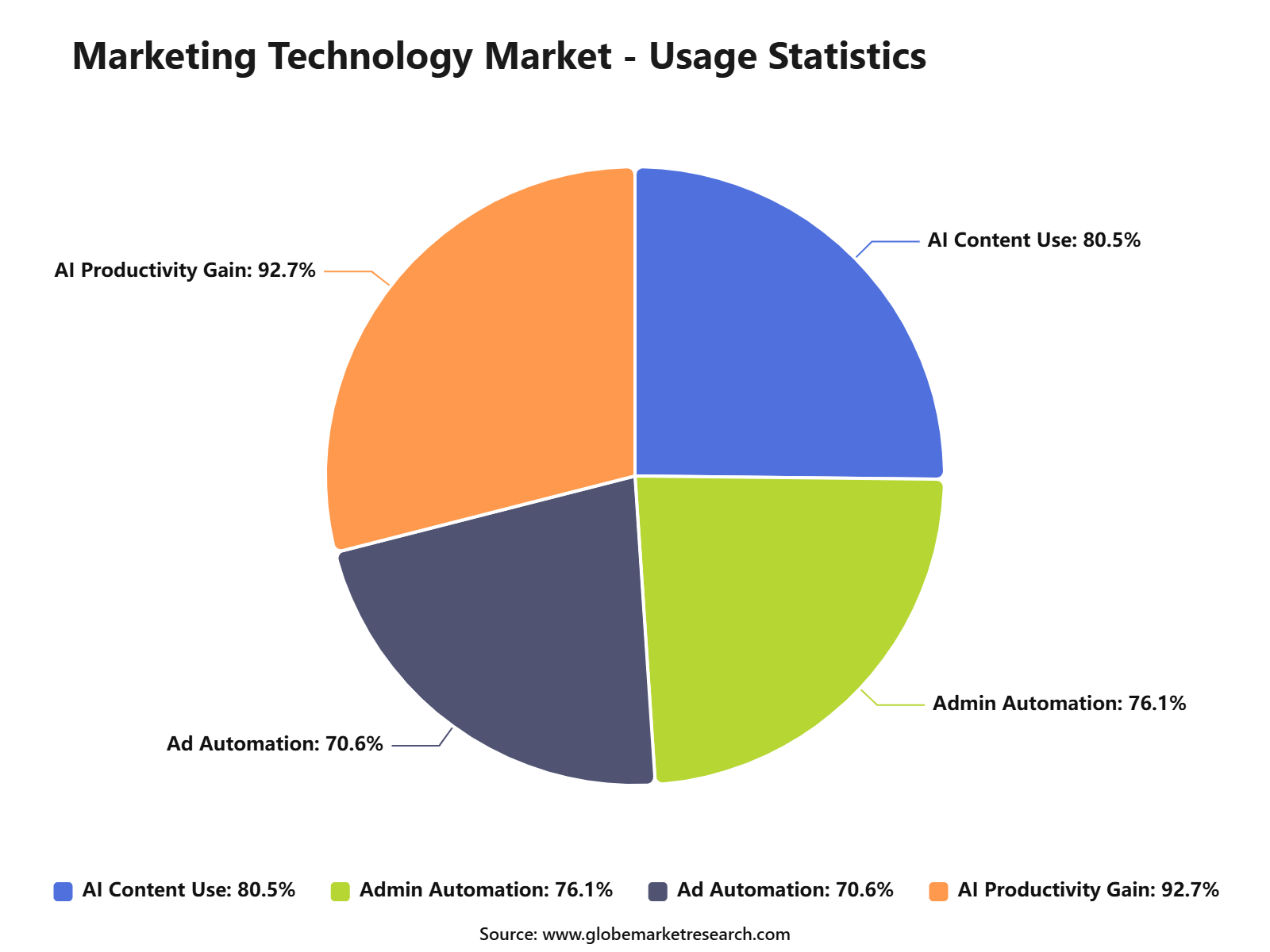 iThe graph shows projected market growth until 2035 based on CAGR analysis. Actual outcomes may vary depending on changing demand, competition, and economic factors.To gain greater insights - request a sample report PDF
Marketing Type Insights
Digital marketing accounted for 64.5% of the Marketing Technology Market by marketing type. Its leading position is supported by the shift from print, television and direct mail toward search engines, websites, social media, email, mobile applications and connected video. Digital channels allow marketers to measure user actions and adjust campaigns using current performance data.
The Interactive Advertising Bureau reported that U.S. internet advertising revenue reached USD 294.6 billion in 2025, increasing by 13.9% from the previous year. Growth was supported by video, social media, commerce media and automated advertising, showing that marketing budgets continue to move toward measurable digital channels.
Organizations are increasingly connecting campaign planning, customer data, content creation and performance measurement through digital platforms. Demand will remain strongest for technologies that can identify useful audience signals, maintain consistent communication across channels and connect marketing activity with sales or customer-retention outcomes.
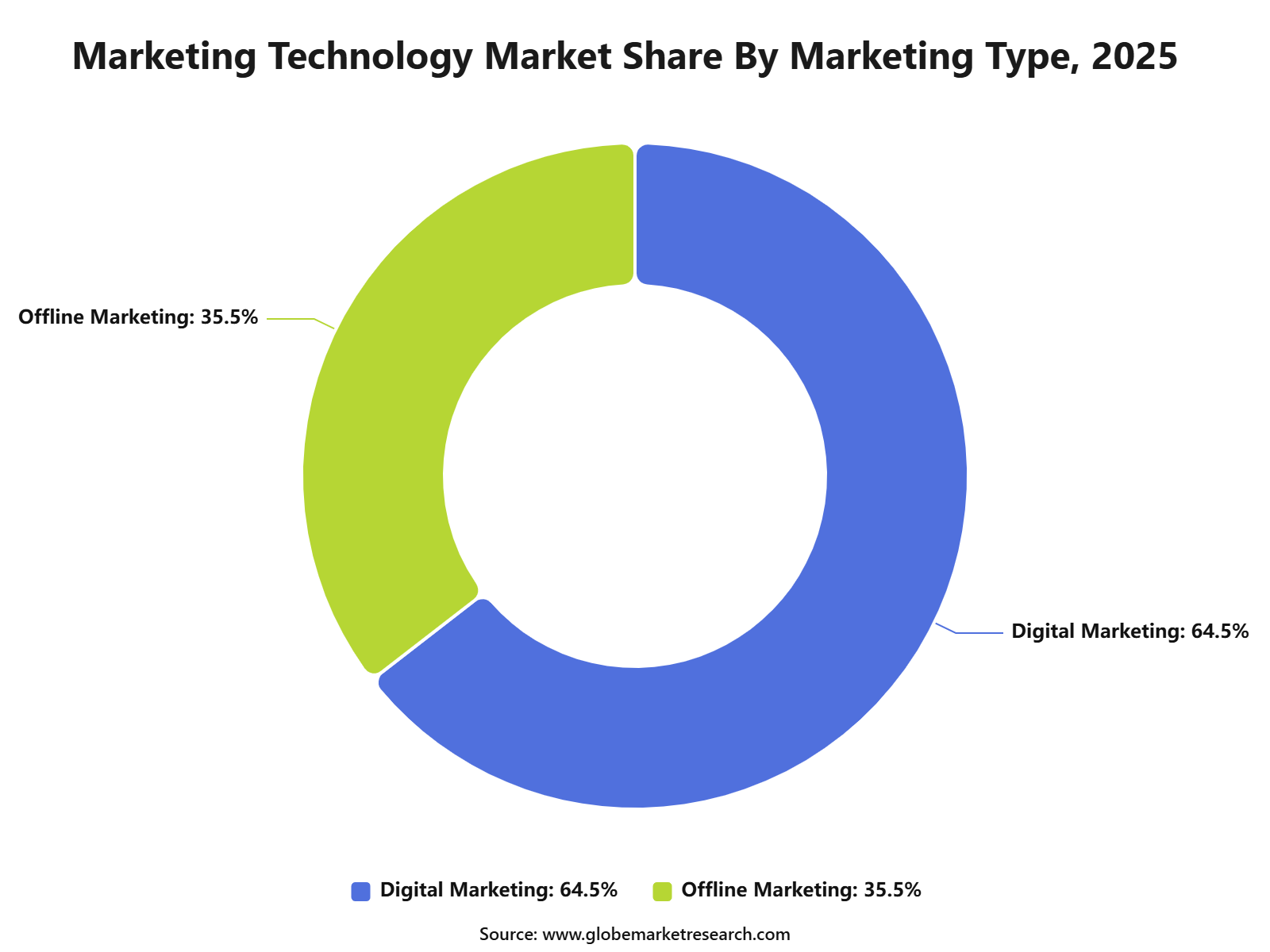 iThe graph shows projected market growth until 2035 based on CAGR analysis. Actual outcomes may vary depending on changing demand, competition, and economic factors.To gain greater insights - request a sample report PDF
Product Insights
Social media tools represented 28.2% of the market by product. These tools support content scheduling, social listening, community management, creator campaigns, advertising, customer response and performance reporting. Their position is strengthened by the ability to manage several social networks through one dashboard.
DataReportal estimated that 5.24 billion active social media user identities were present worldwide in 2025, increasing by 4.1% over the preceding 12 months. Social media was used by an estimated 94.2% of internet users, demonstrating its importance as a channel for audience discovery, communication and product promotion.
Product | Market Share |
|---|---|
Social Media Tools | 28.2% |
Marketing Automation Tools | 18.6% |
Data and Analytics Tools | 16.1% |
Content Marketing Tools | 14.2% |
Sales Enablement Tools | 12.4% |
Rich Media Tools | 10.5% |
Marketing teams require social media tools that can separate useful customer signals from high volumes of posts, comments and messages. Future product demand will be influenced by short-form video management, creator tracking, automated response support and clearer attribution between social activity and completed purchases.
Deployment Insights
Cloud-based deployment accounted for 44.3% of the Marketing Technology Market. Cloud platforms allow marketing teams to access campaign data, customer profiles and content tools from different locations. Updates can be delivered centrally, while computing and storage capacity can be increased as customer records and campaign volumes expand.
Eurostat reported that 52.74% of EU enterprises purchased paid cloud services in 2025, an increase of 7.42% points compared with 2023. Among companies purchasing cloud services, 27.91% used cloud-based customer relationship management applications, which are directly relevant to lead management and personalized marketing.
Cloud deployment also makes it easier to connect marketing platforms with sales, customer service, commerce and analytics systems. Buyers will continue to evaluate data security, integration quality, service availability and usage costs. Platforms offering controlled data access and reliable connections with existing applications are likely to gain wider adoption.
 iThe graph shows projected market growth until 2035 based on CAGR analysis. Actual outcomes may vary depending on changing demand, competition, and economic factors.To gain greater insights - request a sample report PDF
Enterprise Type Insights
Large enterprises held 59.3% of the market by enterprise type. These organizations manage extensive customer databases, multiple brands and campaigns across several countries. Marketing technology is used to coordinate customer segmentation, advertising, content approval, campaign automation and performance reporting across large teams.
The U.S. Census Bureau reported that 37% of companies with at least 250 employees used AI in their business operations during the six-month period ending in May 2026. This compared with 32% of businesses employing between 100 and 249 people, confirming that larger organizations remain more active users of advanced business technologies.
Enterprise Type | Market Share |
|---|---|
Large Enterprises | 59.3% |
Small and Medium-Sized Enterprises | 40.7% |
Large enterprises can spread platform, integration and training costs across more customers, brands and employees. However, they require stronger governance because several departments may use the same customer information. Centralized permissions, brand controls, consent management and detailed activity records will remain important purchasing requirements.
Application Insights
Healthcare accounted for 23.6% of the Marketing Technology Market by application. Healthcare providers use marketing platforms for patient education, appointment reminders, service information, outreach campaigns and communication across websites, email, mobile applications and patient portals. Trust and accuracy are especially important because messages may influence healthcare decisions.
The American Medical Association reported in February 2025 that approximately two-thirds of surveyed physicians were using health-related AI, representing a 78% increase from 2023. The survey covered nearly 1,200 physicians and indicated that digital tools are becoming more integrated into healthcare communication and operating workflows.
Application | Market Share |
|---|---|
Healthcare | 23.6% |
IT and Telecommunication | 16.8% |
Retail and E-commerce | 15.4% |
BFSI | 12.7% |
Media and Entertainment | 10.5% |
Real Estate | 8.2% |
Sports and Events | 6.9% |
Other Applications | 5.9% |
Healthcare marketing technology must operate within strict privacy, consent and medical-information requirements. Providers should clearly separate promotional communication from clinical advice and ensure that published content is reviewed by qualified personnel. Secure personalization and accurate patient segmentation will be more important than high message volume.
Regional Insights
North America accounted for 36.2% of the Marketing Technology Market. Regional leadership is supported by high digital advertising expenditure, widespread use of customer relationship management software and strong adoption of automated campaign systems. The United States remains the main contributor through its large technology, retail, media and service sectors.
Programmatic advertising revenue in the United States reached USD 162.4 billion in 2025, increasing by 20.5% from the previous year. Automated buying added USD 27.6 billion in new spending, demonstrating the scale at which North American marketers use technology to purchase, target and measure digital advertising.
North American buyers increasingly require platforms that connect advertising data with customer, commerce and sales information. Privacy controls and measurement accuracy will influence purchasing decisions as third-party data becomes less dependable. Providers that support first-party data, transparent attribution and cross-channel reporting will be better placed to maintain demand.
 iThe graph shows projected market growth until 2035 based on CAGR analysis. Actual outcomes may vary depending on changing demand, competition, and economic factors.To gain greater insights - request a sample report PDF
U.S. Marketing Technology Market Insight
The U.S. market is supported by large digital advertising budgets, advanced customer-data systems and strong adoption of automated campaign tools. Marketing teams are investing in creator management, social listening, retail media, customer analytics and attribution platforms to improve audience targeting and measure business outcomes.
The Interactive Advertising Bureau estimated that U.S. creator advertising expenditure reached USD 37 billion in 2025, increasing by 26% from the previous year. Nearly 48% of surveyed advertising buyers classified creators as a necessary media channel, increasing demand for campaign management, audience verification and creator-performance measurement tools.
Europe Marketing Technology Market Insight
Europe’s marketing technology market is being influenced by growing enterprise AI adoption, multilingual campaign requirements and strict customer-data regulations. Businesses require platforms that can support personalization while maintaining consent records, transparent audience segmentation and compliant data processing across multiple national markets.
Eurostat reported that 34.70% of EU enterprises using AI in 2025 applied the technology to marketing or sales. This indicates growing use of automated content creation, customer analysis, campaign optimization and lead-management systems within European commercial functions.
U.K. Marketing Technology Market Insight
The U.K. has an established digital advertising ecosystem supported by high online media consumption, widespread e-commerce and a large professional services industry. Demand is being generated for search marketing, digital video, commerce media, campaign automation and customer-data technologies.
IAB UK reported that digital advertising expenditure reached £40.5 billion in 2025, increasing by 10% year over year. Digital video investment rose by 20% to £9.3 billion, supporting demand for video campaign management, audience measurement and cross-channel attribution platforms.
Germany Marketing Technology Market Insight
Germany’s market is supported by the digitalization of manufacturing, retail and professional services. Marketing platforms are increasingly being used to automate content preparation, analyze customer behaviour and coordinate campaigns between online and offline sales channels.
The IFO Institute reported that 54.5% of German companies used AI in their business processes in May 2026. Adoption reached 58.7% in manufacturing, 56.2% among service providers and approximately 45% in trade, creating a broad enterprise base for AI-enabled marketing applications.
Asia-Pacific Marketing Technology Market Insight
Asia-Pacific presents a diverse marketing technology environment shaped by mobile-first consumers, expanding digital commerce and strong use of social and video platforms. Businesses require tools that can manage multiple languages, local payment environments and country-specific customer journeys.
Dentsu estimated that digital advertising expenditure across Asia-Pacific reached USD 171.6 billion in 2025, representing growth of 9.3%. Programmatic media buying was identified as a leading growth driver, supporting demand for automated bidding, audience analytics and campaign-performance platforms.
Japan Marketing Technology Market Insight
Japan’s market is being supported by the continued movement of advertising budgets toward internet, video and social media channels. Businesses are adopting marketing platforms to manage customer engagement, digital content and campaign reporting while maintaining the accuracy and formality expected in Japanese commercial communication.
Advertising expenditure in Japan reached JPY 8,062.3 billion in 2025, increasing by 5.1% from the previous year. Internet advertising represented 50.2% of total expenditure for the first time, demonstrating the growing importance of digital campaign management and measurement technologies.
China Marketing Technology Market Insight
China’s marketing technology market is closely connected with e-commerce, short-form video, livestream shopping and mobile payment platforms. Businesses use marketing tools to coordinate digital advertising, customer recommendations, product promotions and sales conversion within large online marketplaces.
China’s National Bureau of Statistics reported that online retail sales reached CNY 9,982.8 billion during the first eight months of 2025, increasing by 9.6% year over year. Online sales of physical goods represented 25.0% of total consumer-goods retail sales, strengthening demand for commerce analytics, personalization and advertising automation.
Key Market Drivers
Rapid adoption of AI-powered marketing tools: Artificial intelligence is being integrated into content development, campaign planning, audience targeting, media production, and performance optimization. In 2026, 80% of marketers use AI for content creation, while 75% use it for producing images, videos, and other media assets.
Growing demand for personalized customer experiences: Businesses are using behavioral data, purchase histories, browsing activity, and customer preferences to deliver more relevant messages. Around 93% of marketers report that personalization improves lead generation or customer purchases, making personalization technology a core investment priority.
Need for faster campaign execution: Marketing teams are adopting automation to reduce manual work across scheduling, documentation, reporting, lead nurturing, and customer communication. Approximately 93% of marketers use automation for administrative activities, while 92% use it for data analysis and reporting.
Expansion of data-driven decision-making: Reliable customer data is required for segmentation, predictive modeling, attribution, and budget allocation. Around 66% of B2B marketers and 69% of B2C marketers consider their audience data to be high quality, supporting wider use of customer data platforms and analytics systems.
Rising investment in digital video and social channels: Marketing technology demand is being strengthened by the movement of advertising budgets toward video, social media, connected television, and creator-led campaigns. In the UK, digital video investment increased by 20% in 2025, while social media spending grew by 21%. Video represented 59% of total social media investment.
Emerging Marketing Technology Trends
Agentic AI is moving beyond basic content generation: Marketing teams are beginning to use AI systems that can analyze data, recommend actions, coordinate workflows, and support campaign execution with limited manual intervention. About 95% of B2B marketers use AI at least weekly, while 65% use it daily.
AI performance is being linked to business outcomes: Organizations are moving from isolated AI experiments toward measurable productivity, customer experience, and revenue improvements. Generative AI users reported improvements in content ideation and production at 76%, employee productivity at 69%, and marketing-supported revenue growth at 65%.
Answer engine optimization is becoming part of SEO: Content strategies are being adjusted for AI Overviews, ChatGPT, Gemini, and other conversational discovery platforms. Around 85% of marketers state that AI is reshaping their SEO strategies, while 88% have started optimizing content for AI-generated answers.
Retail media is expanding beyond retailer websites: Retailers and advertisers are activating first-party transaction data across social platforms, display advertising, connected television, audio, and out-of-home channels. The proportion of buyers allocating comparable retail media budgets to off-site channels increased from 30% to 46%, although network fragmentation and limited standardization remain important barriers.
Privacy-preserving measurement is gaining importance: Marketing platforms are introducing modeled conversions, consent-based data collection, enhanced conversions, and on-device measurement. Google expanded its on-device conversion measurement system in 2025 to use de-identified application event data while maintaining privacy protections.
5 Best Marketing Technologies in 2026
AI-Powered Content and Campaign Platforms: These technologies support content drafting, image and video production, audience analysis, campaign optimization, and personalized recommendations. Generative AI has already been adopted by 63% of marketers, showing that AI functionality is becoming a standard part of the marketing technology stack.
Customer Data Platforms and AI-Enabled CRM: These systems combine customer information from websites, applications, email, sales, support, and transactions into unified profiles. Their importance is increasing because AI-generated recommendations and personalization depend heavily on accurate, connected, and consented customer data. In India, 81% of marketers had adopted AI by mid-2026, with unified customer data identified as a central requirement for effective engagement.
Marketing Automation and Journey Orchestration: Automation platforms manage email sequences, lead scoring, campaign triggers, customer journeys, audience segmentation, and follow-up communication. Around 47% of marketers use automation specifically to improve the efficiency of marketing processes.
Marketing Analytics and Attribution Technology: Analytics systems help companies measure campaign contribution, conversion rates, acquisition costs, customer value, and return on investment. The most closely tracked marketing indicators in 2026 include lead quality at 39%, lead-to-customer conversion at 34%, and return on investment at 31%.
SEO, AEO, and Search Intelligence Platforms: Modern search technology must monitor traditional search rankings, AI citations, conversational queries, content visibility, technical SEO, and changing customer search behavior. More than 92% of marketers are already using or planning to use optimization strategies covering both traditional search engines and AI-powered discovery platforms.
Key Market Segments
By Marketing Type
Offline Marketing
By Product
Social Media Tools
Content Marketing Tools
Rich Media Tools
Marketing Automation Tools
Data and Analytics Tools
Sales Enablement Tools
By Deployment
Cloud-Based
On-Premises
Others
By Enterprise Type
Large Enterprises
Small and Medium-Sized Enterprises
By Application
IT and Telecommunication
Retail and E-commerce
Healthcare
Media and Entertainment
Sports and Events
BFSI
Real Estate
Others
By Region
North America
Europe
Asia Pacific
Latin America
Middle East and Africa
Go-to-Market and Sales Economics
According to Globe Market Research, the go-to-market approach for the Marketing Technology Market should focus on measurable revenue improvement, customer-data integration, campaign automation and personalized engagement. Vendors should target marketing, sales, commerce and customer-service teams that need a shared view of customer activity. In 2026, 75% of surveyed marketers reported using artificial intelligence, confirming that AI has become a central part of modern marketing technology adoption.
Sales strategies should begin with specific use cases such as lead scoring, email automation, media optimization, content personalization or customer journey management. Limited pilot programs can be used to demonstrate conversion improvement, lower manual workloads and faster campaign deployment. HubSpot’s 2026 survey found that 47.38% of marketers were prioritizing automation, indicating continued demand for platforms that reduce repetitive campaign work.
The strongest commercial model will combine software subscriptions, usage-based AI charges, implementation services, data migration, system integration and managed campaign support. Vendors should offer modular products that can be expanded as customer requirements increase. U.S. advertising spending is projected to grow by 9.5% in 2026, creating a favorable spending environment for platforms that improve media planning, campaign execution and performance measurement.
Market Dynamics
Drivers Impact Analysis
The Marketing Technology Market is driven by rising digital marketing spend, AI-based campaign automation, customer data platforms, CRM integration, social media management, content personalization, and analytics-led decision-making. Businesses are using marketing technology to improve targeting, reduce manual work, track customer journeys, and increase conversion rates across digital channels.
North America leads the market due to strong enterprise software adoption, large digital advertising budgets, mature SaaS usage, and high demand for customer engagement tools. The U.S. remains the main contributor because of strong activity across retail, e-commerce, healthcare, BFSI, media, software, and technology-led marketing teams.
Impact Factor | Estimated CAGR Impact | Regional Relevance | Market Impact |
|---|---|---|---|
Rising digital marketing adoption | +6.8% | North America, Europe, Asia Pacific | Drives core martech spending. |
AI-based campaign automation | +6.1% | U.S., Canada, UK, India | Improves personalization and scale. |
Growth in customer data platforms | +5.2% | Enterprise and mid-market users | Supports unified customer insights. |
Expansion of social media marketing tools | +4.4% | Global digital-first brands | Increases content and engagement management. |
Demand for measurable marketing ROI | +3.7% | Large enterprises and SMEs | Strengthens analytics adoption. |
Restraints Impact Analysis
The market faces restraints from data privacy rules, rising software subscription costs, platform complexity, integration gaps, and marketing technology overload. Many companies use multiple tools across CRM, email, content, analytics, advertising, and social media, which can create fragmented workflows.
Another restraint is skill shortage. Marketing teams need people who can manage automation, data analytics, AI tools, consent management, campaign attribution, and customer journey optimization. Without proper training, companies may not gain full value from their technology investments.
Impact Factor | Estimated CAGR Impact | Regional Relevance | Market Impact |
|---|---|---|---|
Data privacy and consent rules | -3.2% | North America, Europe, global brands | Raises compliance and data-use limits. |
High software subscription cost | -2.6% | SMEs and mid-market firms | Slows adoption of premium tools. |
Tool fragmentation | -2.2% | Enterprise marketing teams | Reduces workflow efficiency. |
Integration complexity | -1.8% | CRM-heavy organizations | Delays implementation. |
Martech skill shortage | -1.5% | Global marketing departments | Limits effective usage. |
Opportunities Impact Analysis
Opportunities are strong in AI marketing automation, customer data platforms, predictive analytics, personalization engines, social media tools, content marketing platforms, sales enablement, and omnichannel campaign management. These solutions help companies manage campaigns across search, social, email, mobile, web, and commerce channels.
Higher-value opportunities are emerging in generative AI content workflows, privacy-safe data clean rooms, first-party data platforms, account-based marketing, retail media technology, and customer journey orchestration. Vendors that combine automation, analytics, compliance, and easy integration can capture stronger enterprise demand.
Impact Factor | Estimated CAGR Impact | Regional Relevance | Market Impact |
|---|---|---|---|
Generative AI marketing tools | +6.5% | North America, Europe, Asia Pacific | Adds content and campaign automation value. |
First-party data platforms | +5.4% | Privacy-focused markets | Supports compliant targeting. |
Predictive analytics and lead scoring | +4.7% | B2B and e-commerce sectors | Improves campaign efficiency. |
Retail media technology | +3.9% | U.S., Europe, China, India | Creates commerce-linked growth. |
Account-based marketing platforms | +3.2% | B2B enterprise markets | Improves targeted sales alignment. |
Challenges Impact Analysis
The main challenge is proving measurable business impact. Companies want clear evidence that marketing technology improves lead quality, customer acquisition, retention, conversion, and revenue growth, not only campaign activity.
Another challenge is managing customer data responsibly. Marketing teams must balance personalization with privacy, consent, security, and brand trust. Poor data governance can reduce customer confidence and increase compliance risk.
Impact Factor | Estimated CAGR Impact | Regional Relevance | Market Impact |
|---|---|---|---|
Difficulty proving ROI | -3.0% | Enterprise and SME buyers | Slows software budget approval. |
Customer data governance risk | -2.5% | North America, Europe | Raises compliance pressure. |
Campaign attribution complexity | -2.0% | Omnichannel marketing teams | Makes performance measurement harder. |
Vendor selection confusion | -1.7% | Mid-market companies | Delays purchasing decisions. |
Low adoption after implementation | -1.4% | Large organizations | Reduces platform value. |
Market Trend Analysis
The market trend is moving toward AI-powered personalization, integrated customer data platforms, automated content creation, omnichannel journey management, and privacy-first marketing. Companies are shifting from disconnected tools toward connected martech stacks that support customer acquisition and retention.
North America remains the largest value region because of strong software spending, advanced advertising technology, and high enterprise adoption of CRM, analytics, automation, and AI marketing tools. Asia Pacific is expanding quickly as digital commerce, mobile-first campaigns, and social media advertising grow across India, China, Southeast Asia, Japan, and Australia.
Impact Factor | Estimated CAGR Impact | Regional Relevance | Market Impact |
|---|---|---|---|
AI personalization becomes mainstream | +6.3% | North America and digital markets | Improves customer engagement. |
Omnichannel campaign tools expand | +5.1% | Retail, BFSI, healthcare, media | Supports consistent brand communication. |
Privacy-first marketing grows | +4.2% | U.S., Canada, Europe | Strengthens consent-based targeting. |
Social commerce tools increase | +3.6% | Asia Pacific and North America | Links content with sales conversion. |
Integrated martech stacks gain demand | +3.0% | Large enterprises | Reduces platform fragmentation. |
Financial Impact
The financial impact of marketing technology depends on implementation expenses, software utilization, campaign improvement and customer retention. Purchasing several disconnected systems can increase integration costs and create duplicate customer records. Salesforce found that only 58% of marketers had complete access to customer-service data, showing that incomplete information remains a major barrier to coordinated marketing operations.
Marketing measurement platforms can improve financial accountability by connecting campaign activity with leads, sales and repeat purchases. However, attribution remains difficult because customer journeys extend across search, social media, connected television, retail platforms and offline channels. Measuring marketing return on investment was identified as the leading challenge by 33% of marketers in 2026.
Privacy compliance will remain a direct operating cost for marketing technology providers and their customers. Platforms must manage consent, data retention, audience targeting and third-party data sharing according to applicable regulations. The FTC’s updated children’s privacy rule requires separate parental consent before children’s personal information can be disclosed for targeted advertising or other third-party purposes.
Marketing Technology Case Study: Salesforce
Salesforce provides a practical example of how customer data platforms, marketing automation, website personalization, analytics, and conversational AI can be combined within one marketing technology system. The company connected CRM records, website activity, webinars, events, and third-party information through Data Cloud. Around 1 billion records from 85 data sources were organized into approximately 90 million unified customer profiles, giving marketing and sales teams a consistent view of customer behaviour.
These profiles were used to create real-time audience segments based on actions such as attending an event, watching product content, opening an email, or visiting a pricing page. Relevant emails, trial offers, event recommendations, and website content could then be delivered to each audience. Salesforce reported a 165% increase in engagement from personalized website content and offers, along with a 60% increase in marketing lead revenue and contract value per lead. The system also identified USD 23 million in potential customer renewal revenue and supported a projected reduction of 98,000 support cases during the first half of 2025.
Salesforce expanded this marketing technology structure by introducing an AI website agent in February 2025. The agent was connected to more than 2,000 website pages and 400 product records, allowing visitors to receive immediate answers about products, pricing, and services. It handled more than 100,000 customer conversations, generated over 30,000 new leads, supported 11 languages, and reduced lead qualification time by 40% year over year.
Recent Developments
Latest Market News
In February 2026, Salesforce reported that 75% of marketers had adopted artificial intelligence. However, fragmented customer information, poor data quality, and disconnected systems remained the main barriers to effective personalisation and AI-supported customer engagement.
In February 2026, Braze published its 2026 Customer Engagement Review, highlighting the growing role of AI, first-party data, real-time decisioning, and consumer trust. The company reported that brands are under pressure to make customer interactions more relevant without increasing message volume or weakening privacy controls.
In February 2026, WPP and Adobe expanded their global partnership to combine Adobe’s customer experience technology with WPP’s marketing operations. The collaboration supports agentic workflows, media optimisation, personalised content creation, customer experience orchestration, and brand-controlled generative AI.
In March 2026, Adobe and NVIDIA established a strategic partnership to develop the next generation of Firefly models and AI-supported creative and marketing workflows. The collaboration combines Adobe’s creative and customer experience applications with NVIDIA computing, AI models, agent tools, and three-dimensional digital-twin technology.
Acquisitions
In March 2026, Publicis Groupe acquired AdgeAI to expand its predictive content-measurement capabilities. The acquired technology is intended to help brands determine which creative assets are likely to perform, compare content across platforms, and adjust campaigns more quickly.
In April 2026, Publicis acquired 160over90 from WME Group. The sports and culture marketing company is being integrated with Publicis Sports and connected with Epsilon identity data, media capabilities, and marketing measurement technology.
In April 2026, Adobe completed its approximately USD 1.9 billion acquisition of Semrush. The transaction gives Adobe additional capabilities in conventional search optimisation, AI search visibility, competitive research, digital advertising, content marketing, and social media intelligence.
Funding
In February 2026, Profound raised USD 96 million in Series C funding at a USD 1 billion valuation. The company develops tools that allow brands to measure, understand, and improve their visibility across AI answer engines and automated discovery platforms.
In April 2026, Pomo raised USD 4.5 million in seed funding led by Kindred Ventures. The platform uses AI agents to monitor competitors, analyse market activity, review advertising performance, prepare campaign recommendations, and create marketing content based on brand guidelines.
In April 2026, Hightouch raised USD 150 million at a USD 2.75 billion valuation. The round was led by Goldman Sachs Alternatives and Bain Capital Ventures, with participation from existing investors and TD7, the venture investment arm of The Trade Desk.
Competitive Landscape
The market is characterized by intense competition among established players and emerging companies. Strategic partnerships, mergers and acquisitions, and product innovation are key strategies employed by market participants.
Key Market Players
Amazon Web Services, Inc
Apple Inc.
Adobe Inc.
Amdocs
Konnect Insights
Buzzoole
Content Grow
Fullcircl
Google LLC
Oracle
Microsoft Corporation
SAP SE
Teradata Corporation
Cheetah Digital
SharpSpring, Inc.
SAS Institute Inc.
Other Key Players
Research Methodology
This market study is prepared using a combination of primary and secondary research. Primary research includes discussions with manufacturers, suppliers, distributors, consultants, industry experts, and end users. Secondary research covers company reports, government databases, trade associations, technical publications, regulatory sources, and trusted industry documents. The collected information is used to assess market demand, pricing trends, technology adoption, competitive activity, and regional performance.
AI language models are not used as primary data sources, and publicly available AI-generated content is not treated as market evidence. Computational tools may be used to support data processing, translation, data classification, and pattern identification. However, every published assessment is supported by verified sources, human review, and primary market discussions.
Market estimates are developed through top-down and bottom-up approaches and validated using data triangulation. Revenue, production, shipment, pricing, and application-level data are compared across multiple sources. Forecasts consider economic conditions, regulatory changes, investment activity, innovation, supply chain developments, and industry risks. All findings are reviewed through source verification and internal quality checks before publication.
Part I
Source Management & Input Data Standards
Who provides data, how sources are qualified, and what types of evidence are admissible.
Part II
Research Scope & Market Coverage
How we define the markets we assess and the parameters that govern each product.
Part III
Data Collection, Verification & Submission
The mechanics of gathering, cross-checking, and hierarchically ranking evidence.
Part IV
Assessment Determination & Quality Controls
How raw data becomes a published assessment — normalisation, expert judgement, and outlier exclusion.
Part V
Publication, Corrections & Revision
Our publication schedule, corrections policy, and methodology review cycle.
Part VI
Independence, Ethics & Complaints
Conflict-of-interest policies, editorial independence, and how clients raise concerns.
Google · Preferred Sources
Don't miss the latest market research insights and industry updates on Google.
Add Globe Market Research as a preferred source in the Google app to see our reports, analysis, and market stories in your news suggestions.
Meet the Team
This report was prepared by our expert analysts with deep industry knowledge and research experience.
Prashant S. is a Research Analyst at Globe Market Research with more than four years of experience in market research and industry analysis. He specializes in the Aerospace and Defence, Automotive and Transportation, Semiconductor and Electronics, Information and Technology sectors, with expertise in market sizing, trend analysis, competitive assessment, and industry forecasting. He applies primary and secondary research, data validation, company analysis, and market estimation methods to deliver reliable insights for strategic planning and business decision-making.
Sayali brings more than 7 years of experience to Globe Market Research, supporting the accuracy, clarity, and relevance of research content across multiple industries. She reviews market data, segment analysis, competitive insights, and industry trends to ensure each report meets strong quality standards and provides practical value to business decision-makers. Her expertise spans healthcare, information technology, consumer goods, and diverse cross-industry domains. With a strong focus on data reliability, structured analysis, and clear presentation, Sayali helps ensure that each research output delivers well-reviewed insights for clients, investors, consultants, and industry stakeholders.
Frequently Asked Questions
Related Reports
More in Information and Technology
Physical AI Market Size to hit USD 2,129.0 billion by 2035
Physical AI Market Size, Share, Trends and Growth Analysis Report By Component (Hardware, Software, Services), By Technology (Computer Vision, Machine Learning and Deep Learning, Natural Language Processing, Edge AI, Other Technologies), By Product (Robots, Exoskeletons, Autonomous Systems, Smart Appliances), By Application (Automation and Manufacturing, Logistics and Supply Chain, Healthcare, Automotive, Defense and Security, Retail, Education, Other End Uses), By Regional Insights, Technology Trends, Competitive Landscape, Strategic Opportunities and Growth Forecast, 2026-2035
Edtech SaaS Tools Market Size to hit USD 217.6 billion by 2035
EdTech SaaS Tools Market Size, Share, Trends and Growth Analysis Report By Software (Classroom Management Systems, Document Management Systems, Learning and Gamification Platforms, Learning Management Systems, Student Collaboration Systems, Assessment and Analytics Tools, Content Authoring Tools, Other Software), By Sector (Preschool, K-12, Higher Education, Other Education Sectors), By Deployment (Cloud-Based, Hybrid), By End Use (Businesses, Educational Institutions, Individual Learners and Consumers), By Regional Insights, Technology Trends, Competitive Landscape, Strategic Opportunities and Growth Forecast, 2026–2035
AI Watermarking Market Size to hit USD 10.9 billion by 2035
AI Watermarking Market Size, Share, Trends and Growth Analysis Report By Type (Invisible Watermarking, Visible Watermarking), By Technology (Non-Reversible Watermarking, Reversible Watermarking), By Deployment (Cloud, On-Premises), By Application (Copyright Protection, Authentication and Security, Branding and Marketing, Other Applications), By Content Type (Video, Image, Model Watermarking, Audio, Text), By End Use (Media and Entertainment, BFSI, Healthcare, Government and Defense, Retail and E-commerce, Other End-Use Industries), By Regional Insights, Technology Trends, Regulatory Landscape, Competitive Analysis, Strategic Opportunities and Growth Forecast, 2026-2035
Environmental, Social and Governance (ESG) Consulting Market to hit USD 49.4 billion by 2035
Environmental, Social and Governance (ESG) Consulting Market Size, Share, Trends and Growth Analysis Report By Service Type (Testing, Auditing and Verification, Technical Support, Sustainability Marketing, Strategy and Planning, Other Services), By Enterprise Size (Small and Medium-Sized Enterprises, Large Enterprises), By End User (Corporates, Investors, Government Bodies, Non-Profit Organizations, Other End Users), By Industry Vertical (BFSI, Energy and Utilities, Manufacturing, Healthcare, Retail and Consumer Goods, IT and Telecom, Transportation and Logistics, Other Industries), By Regional Insights, Regulatory Trends, Competitive Landscape, Strategic Opportunities and Growth Forecast, 2026-2035