

Revenue, 2026
USD 115.9 Bn
Forecast, 2035
USD 2,129.0 Bn
CAGR, 2026-2035
33.5%
Report Coverage
Global
Market Size and Forecast
The global Physical AI Market was valued at USD 115.9 billion in 2026 and is projected to reach approximately USD 2,129.0 billion by 2035, growing at a CAGR of 38.2% from 2026 to 2035. North America accounted for around 33.5% of the market, equivalent to approximately USD 38.8 billion at the stated 2026 value. Regional growth is supported by advanced AI computing infrastructure, robotics investment, autonomous-vehicle deployment and strong adoption of intelligent machines across manufacturing, logistics, healthcare, defence and transportation.
Physical AI refers to artificial intelligence systems that can sense, understand and interact with the physical environment. It includes industrial robots, humanoid robots, autonomous vehicles, drones, warehouse systems, medical robots and smart machines. These systems combine computer vision, sensors, simulation, edge computing and AI models to perform navigation, object handling, inspection, decision-making and other real-world tasks with limited human intervention.
Key Parameter | Report Details |
|---|---|
Market Revenue, 2026 | USD 115.9 Billion |
Projected Revenue, 2035 | USD 2,129.0 Billion |
CAGR, 2026-2035 | 38.2% |
Largest Region | North America, 33.5% Share |
Market Concentration | Medium |
Forecast Period | 2026-2035 |
Commercial activity accelerated further in 2026. The International Federation of Robotics reported that the value of global industrial robot installations reached a record USD 16.7 billion, with AI-enabled autonomy and humanoid reliability identified among the leading robotics trends. Waymo was operating more than 4 million fully autonomous miles each week by June 2026 and had accumulated approximately 170 million driverless miles in the United States. Its vehicles recorded 92% fewer serious or fatal injury crashes than human-driven vehicles across comparable operating areas.
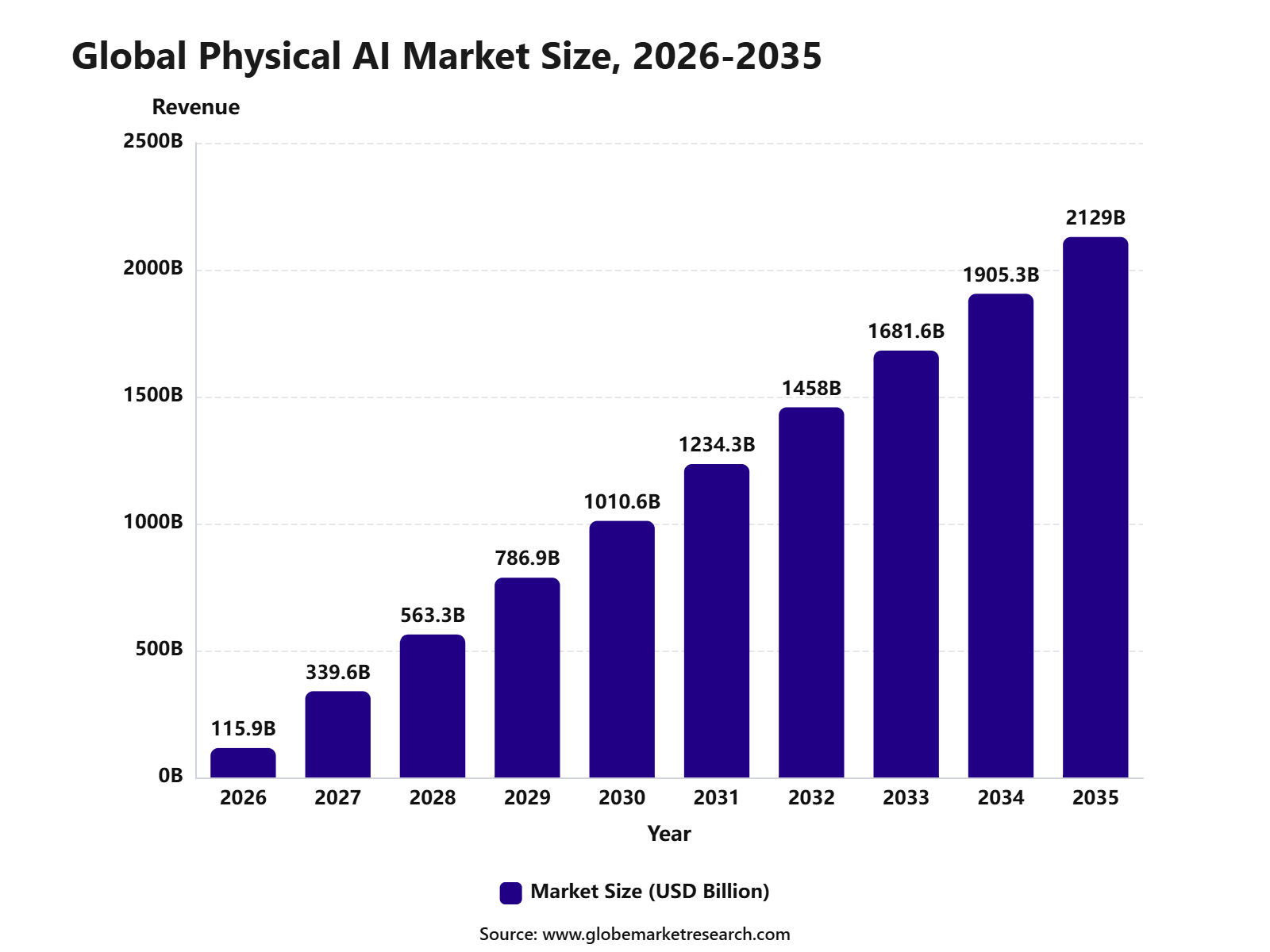 iThe graph shows projected market growth until 2035 based on CAGR analysis. Actual outcomes may vary depending on changing demand, competition, and economic factors.To gain greater insights - request a sample report PDF
Key Market Insights
Hardware led the component segment with 53.2% share, supported by strong demand for sensors, processors, actuators, cameras, edge devices, and physical AI systems used in real-world automation.
Robots accounted for 45.8% share by product, driven by rising adoption of intelligent machines for automation, mobility, inspection, assistance, and task execution across physical environments.
Healthcare held 40.8% share by end use, supported by growing use of physical AI in surgical robots, patient monitoring, rehabilitation devices, hospital automation, and assisted care systems.
North America led the physical AI market with 33.5% share, supported by advanced robotics adoption, strong healthcare technology investment, mature AI infrastructure, and rising demand for intelligent automation.
Adoption Rate and Usage Statistics
According to Rockwell Automation and the International Federation of Robotics, 95% of manufacturers had invested in or planned to invest in AI and machine learning, while 81% reported that operating pressures were accelerating digital transformation. Half planned to use AI for quality control, and 41% used AI and automation to address workforce shortages. Asia represented 74% of new industrial robot deployments, supporting the expansion of embodied AI across factories, warehouses and logistics operations.
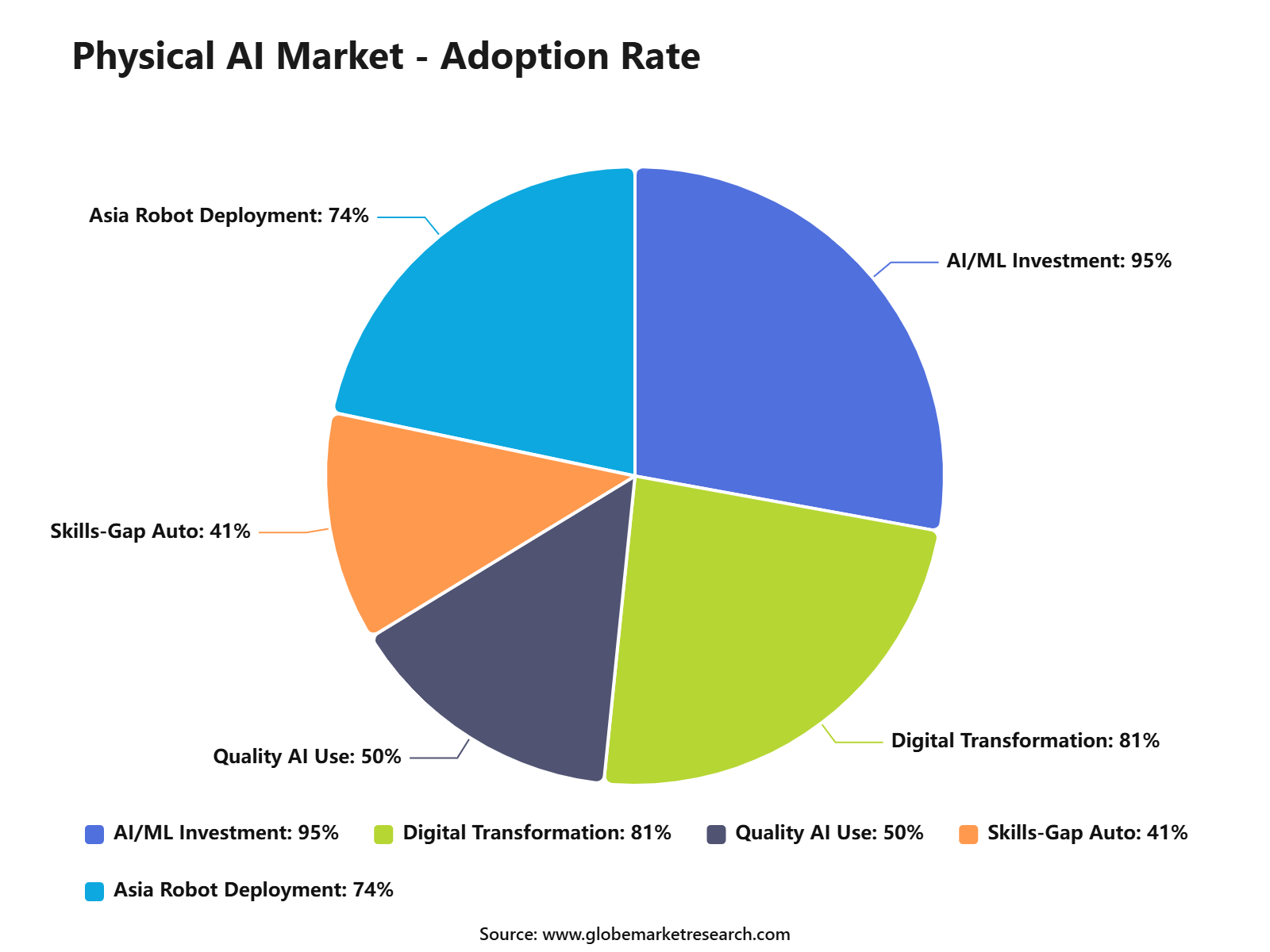 iThe graph shows projected market growth until 2035 based on CAGR analysis. Actual outcomes may vary depending on changing demand, competition, and economic factors.To gain greater insights - request a sample report PDF
According to the International Federation of Robotics, Amazon and Agility Robotics, approximately 4.66 million industrial robots were operating globally, while 542,000 new units were installed during the latest reporting year. Professional service robot sales reached nearly 200,000 units. Amazon operates more than one million robots across its fulfilment network, while Agility Robotics’ Digit humanoid completed over 100,000 tote movements in a live commercial logistics deployment.
Metric | Usage Value |
|---|---|
Robots in Operation | 4.66 million units |
Annual Installations | 542,000 robots |
Amazon Robot Fleet | Over 1 million robots |
Service Robot Sales | Nearly 200,000 units |
Humanoid Tote Handling | Over 100,000 totes |
Component Insights
Hardware accounted for 53.2% of the Physical AI Market by component. Physical AI systems rely on processors, cameras, sensors, actuators, motors, controllers and communication modules to observe their surroundings and perform physical actions. Hardware determines movement precision, response speed, operating reliability and the ability to process information close to the machine.
A Semiconductor Industry Association report published in June 2026 found that one advanced AI server rack can contain more than 4,500 packaged chips, including processors, memory, networking chips, power devices, controllers and sensors. Physical AI systems require a similarly coordinated hardware structure to combine sensing, computing and movement.
Demand is shifting toward compact and energy-efficient hardware that can run AI models directly on robots, vehicles and industrial equipment. Buyers are also placing greater attention on sensor accuracy, thermal management and hardware durability. Components must continue operating under vibration, dust, temperature changes and other conditions found outside controlled data centers.
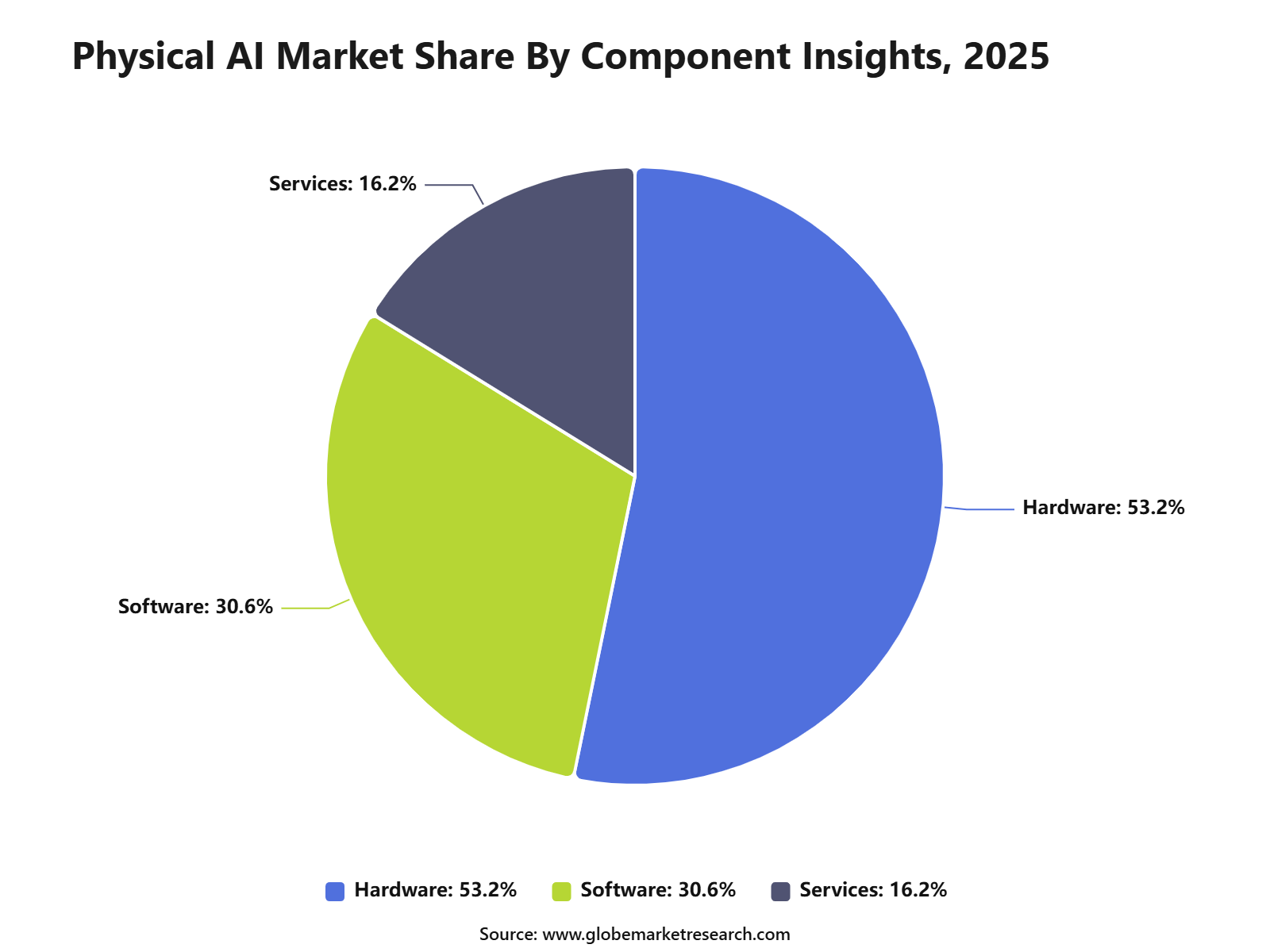 iThe graph shows projected market growth until 2035 based on CAGR analysis. Actual outcomes may vary depending on changing demand, competition, and economic factors.To gain greater insights - request a sample report PDF
Physical AI Technology Insights
Computer vision accounted for 45.6% of the Physical AI Market by technology. It enables robots and autonomous machines to identify objects, measure distance, track movement and interpret surrounding conditions. The technology is widely used for robotic navigation, visual inspection, medical imaging, warehouse operations and workplace safety.
In July 2025, approximately 60% of autonomous mobile robots and humanoid robots worldwide were reported to use 3D vision cameras from one major vision technology provider. The provider also served more than 3,000 active customers, indicating strong demand for depth sensing and visual perception across physical AI application.
Technology | Market Share |
|---|---|
Machine Learning and Deep Learning | 32.8% |
Computer Vision | 26.4% |
Edge AI | 18.9% |
Natural Language Processing | 13.2% |
Other Technologies | 8.7% |
Computer vision is becoming more important as physical AI systems move from controlled environments into active workplaces. Future adoption will depend on accurate object recognition, dependable performance under different lighting conditions and low-latency processing. Systems must also combine visual data with movement controls to complete tasks safely and consistently.
Product Insights
Robots represented 45.8% of the Physical AI Market by product. Robots provide the main physical platform through which AI can identify objects, interpret surroundings, make decisions and complete real-world tasks. They are being deployed across manufacturing, warehousing, food processing, electronics, logistics and other operational settings.
North American companies ordered 36,766 robots in 2025, with the total order value reaching USD 2.25 billion. Demand was supported by industries beyond traditional automotive manufacturing, including food and consumer goods, semiconductors, electronics and life sciences.
Robotic products are moving beyond fixed and repetitive programming toward more adaptive operation. Physical AI allows robots to adjust movements, recognize unfamiliar objects and respond to changing conditions. Adoption will depend on easier programming, dependable machine vision and the ability to work safely around employees.
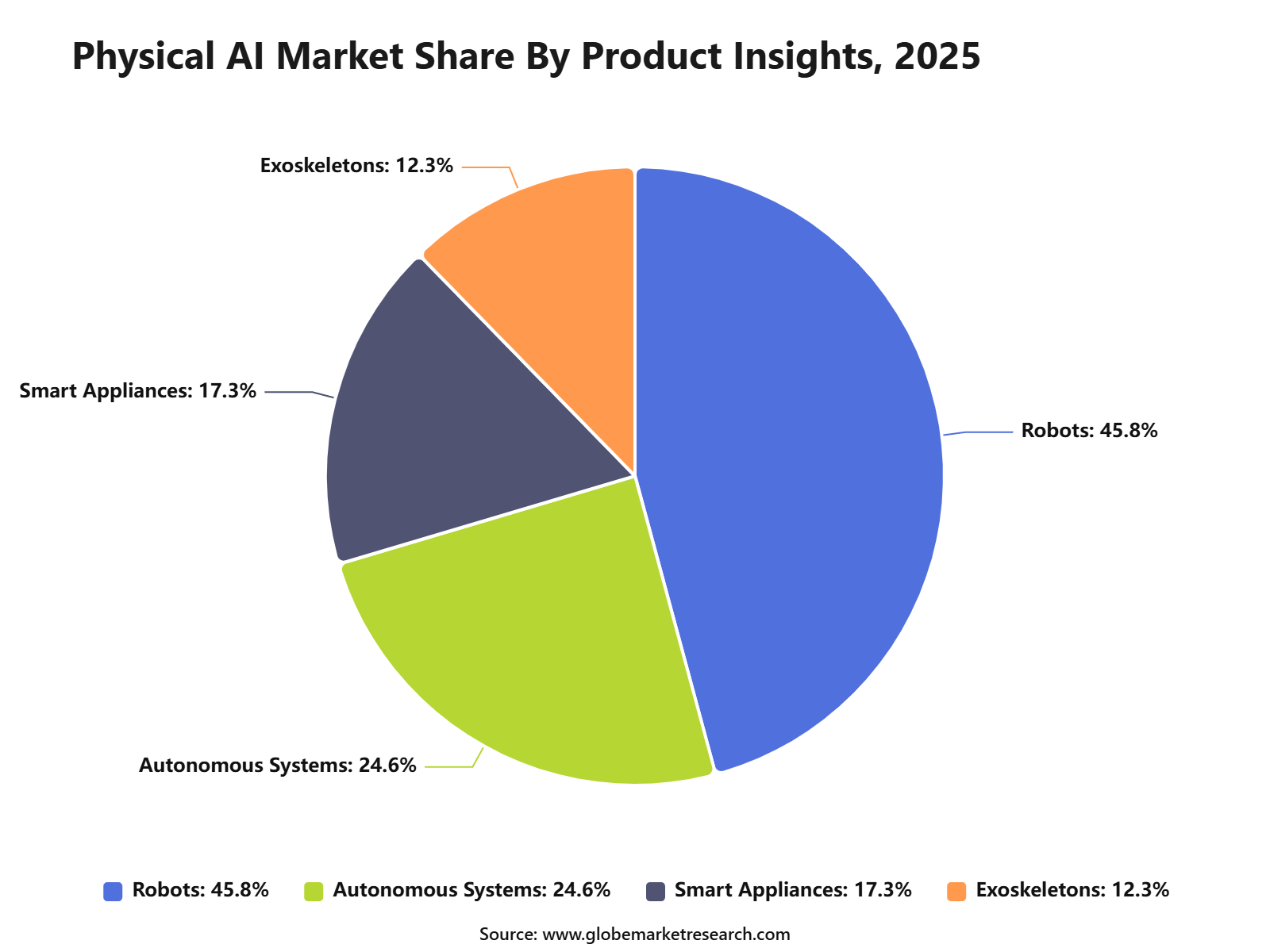 iThe graph shows projected market growth until 2035 based on CAGR analysis. Actual outcomes may vary depending on changing demand, competition, and economic factors.To gain greater insights - request a sample report PDF
Application Insights
Healthcare accounted for 40.8% of the Physical AI Market by end use. Physical AI systems are being applied in surgery, rehabilitation, diagnostics, patient movement, pharmacy operations and hospital logistics. These technologies can support clinical precision while reducing repetitive and physically demanding work for healthcare employees.
In the first quarter of 2026, collaborative robots represented 60.7% of total robot orders within the North American life sciences, pharmaceutical and biomedical sector. This indicates strong demand for flexible systems that can operate near employees and support laboratory, production and medical-device workflows.
Healthcare systems must meet strict standards for safety, accuracy, cybersecurity and human supervision. Performance must be tested under real clinical conditions before systems are widely deployed. Providers that combine useful automation with clear human controls and reliable operating records are expected to gain stronger acceptance.
Applications | Market Share |
|---|---|
Healthcare | 40.8% |
Automation and Manufacturing | 17.6% |
Automotive | 12.4% |
Defense and Security | 10.2% |
Logistics and Supply Chain | 8.3% |
Retail | 5.1% |
Education | 3.2% |
Other End Uses | 2.4% |
Regional Insights
North America accounted for 33.5% of the Physical AI Market. Regional leadership is supported by advanced robotics research, established semiconductor capabilities and strong automation demand across manufacturing, healthcare and logistics. The United States remains the main contributor due to its large industrial and technology base.
Industrial robot installations in the United States reached approximately 38,000 units in 2025, representing an 11% annual increase. Food production and other non-manufacturing sectors contributed strongly to the improvement, showing that robotic adoption is expanding beyond conventional automotive applications.
Regional demand is increasingly focused on systems that can handle changing tasks rather than operate within fixed production cells. Wider adoption will require skilled integrators, secure AI models and updated safety standards. Companies will also require clear evidence that physical AI can deliver consistent performance in active workplaces.
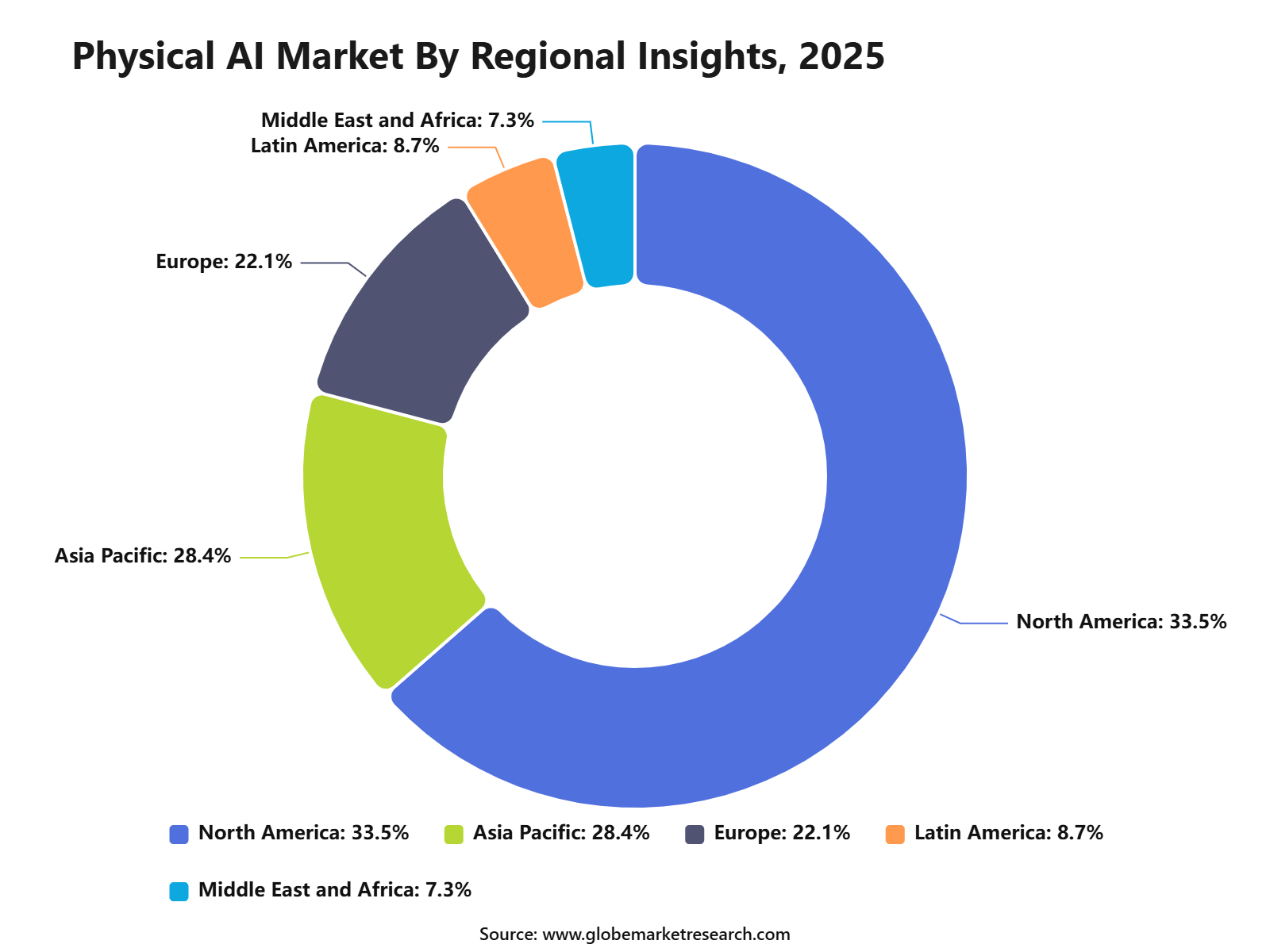 iThe graph shows projected market growth until 2035 based on CAGR analysis. Actual outcomes may vary depending on changing demand, competition, and economic factors.To gain greater insights - request a sample report PDF
Report Segmentation
By Component
Hardware
Software
Services
By Technology
Computer Vision
Machine Learning and Deep Learning
Natural Language Processing
Edge AI
Other Technologies
By Product
Robots
Exoskeletons
Autonomous Systems
Smart Appliances
By End Use
Automation and Manufacturing
Logistics and Supply Chain
Healthcare
Automotive
Defense and Security
Retail
Education
Other End Uses
By Region
North America
Europe
Asia Pacific
Latin America
Middle East and Africa
Market Dynamics
Drivers Impact Analysis
The Physical AI Market is driven by rising adoption of intelligent robots, autonomous machines, smart factories, AI-powered vehicles, humanoid robots, warehouse automation, industrial vision systems, and real-world AI decision-making systems. Physical AI helps machines understand, move, interact, and operate safely in real environments.
North America leads the market due to strong AI infrastructure, robotics investments, advanced manufacturing, autonomous vehicle testing, defense modernization, logistics automation, and enterprise adoption of AI-enabled machines. The U.S. remains the main contributor because of its strong AI ecosystem and high automation demand.
Impact Factor | Estimated CAGR Impact | Regional Relevance | Market Impact |
|---|---|---|---|
Rising intelligent robotics adoption | +10.8% | North America, Europe, Asia Pacific | Drives core Physical AI demand. |
Growth in warehouse and logistics automation | +9.6% | U.S., Canada, China, Japan | Supports real-world AI deployment. |
Expansion of autonomous machines | +8.7% | Manufacturing, mobility, defense | Adds high-value automation use cases. |
Smart factory transformation | +7.9% | Industrial economies | Improves production efficiency. |
Demand for AI-powered sensing and vision | +6.8% | Robotics, vehicles, healthcare | Strengthens machine perception capability. |
Restraints Impact Analysis
The market faces restraints from high hardware cost, safety risk, complex integration, limited skilled workforce, and slow regulatory approval in autonomous systems. Physical AI requires sensors, chips, actuators, robots, edge computing, simulation tools, and real-time control systems, which can raise deployment cost.
Another restraint is reliability in real-world conditions. Physical AI systems must operate safely around people, handle unexpected environments, and maintain accuracy in dynamic settings such as factories, roads, hospitals, warehouses, farms, and public spaces.
Impact Factor | Estimated CAGR Impact | Regional Relevance | Market Impact |
|---|---|---|---|
High robotics and hardware cost | -5.4% | Global adopters | Slows small-business adoption. |
Safety and liability concerns | -4.8% | Autonomous and human-facing systems | Raises approval and testing needs. |
Complex integration with existing systems | -4.1% | Industrial and logistics users | Delays deployment timelines. |
Shortage of robotics and AI talent | -3.5% | North America, Europe, Asia Pacific | Limits scaling speed. |
Real-world reliability challenges | -3.0% | Mobility, healthcare, defense | Affects customer confidence. |
Opportunities Impact Analysis
Opportunities are strong in humanoid robots, autonomous mobile robots, industrial AI robots, smart warehouses, AI-powered drones, surgical robotics, agriculture robots, defense systems, and autonomous vehicles. These use cases benefit from labor shortages, safety needs, productivity pressure, and demand for 24/7 operations.
Higher-value opportunities are emerging in embodied AI, robot foundation models, synthetic training environments, edge AI chips, digital twins, simulation-based robot training, and AI-powered machine control. Vendors that combine software intelligence with reliable physical performance can capture stronger long-term value.
Impact Factor | Estimated CAGR Impact | Regional Relevance | Market Impact |
|---|---|---|---|
Humanoid robot commercialization | +10.5% | North America, Asia Pacific, Europe | Builds major future opportunity. |
Autonomous mobile robot expansion | +9.2% | Warehousing and manufacturing | Supports scalable automation. |
AI-powered industrial robots | +8.3% | Smart factories | Improves productivity and precision. |
Robot foundation models | +7.4% | Advanced AI markets | Enhances machine learning capability. |
Edge AI and real-time control systems | +6.5% | Robotics, vehicles, drones | Supports faster physical decisions. |
Challenges Impact Analysis
The main challenge is ensuring safe, predictable, and explainable machine behavior. Physical AI systems interact with people, equipment, vehicles, and infrastructure, so even small errors can create safety, operational, or financial risk.
Another challenge is moving from prototypes to commercial scale. Many Physical AI systems perform well in controlled trials, but large-scale deployment requires durability, service networks, cost reduction, regulatory approval, and measurable return on investment.
Impact Factor | Estimated CAGR Impact | Regional Relevance | Market Impact |
|---|---|---|---|
Safe human-machine interaction | -5.0% | Robotics, healthcare, mobility | Affects real-world adoption. |
Prototype-to-scale difficulty | -4.3% | Startups and manufacturers | Slows commercialization. |
Hardware durability requirements | -3.7% | Industrial and outdoor systems | Increases engineering cost. |
Regulatory uncertainty | -3.1% | Autonomous systems | Delays market entry. |
ROI measurement difficulty | -2.6% | Enterprise buyers | Slows purchasing decisions. |
Key Market Drivers
Rising industrial automation investment: Manufacturers are increasing the use of intelligent robots to improve production speed, quality, flexibility, and workplace safety. The value of global industrial robot installations reached a record USD 16.7 billion, while more than 500,000 robots were installed annually for the fourth consecutive year.
Shortage of skilled industrial workers: Physical AI systems are being introduced for repetitive, hazardous, physically demanding, and precision-based activities. Robots can support material handling, inspection, assembly, heavy lifting, and machine operation while allowing employees to concentrate on higher-value responsibilities.
Demand for flexible production systems: Traditional industrial robots are generally programmed for predefined activities. Physical AI enables machines to perceive changing conditions, interpret instructions, plan actions, and adapt their movements, supporting shorter production runs and frequently changing product configurations.
Strong growth in robot deployment: The United States installed approximately 38,000 industrial robots in 2025, representing an 11% annual increase. Food-industry adoption rose by 30%, demonstrating that intelligent automation is expanding beyond automotive manufacturing into food processing, consumer goods, electronics, and general industry.
Advances in multimodal and embodied AI: Vision-language-action models combine visual information, natural-language instructions, spatial understanding, and physical movement. Recent systems have more than doubled performance on generalization tests compared with earlier advanced models, improving their ability to handle unfamiliar objects, environments, and tasks.
Emerging Physical AI Trends
AI-powered robot autonomy: Analytical, generative, and agentic AI are being combined to help robots understand conditions, anticipate problems, create action plans, and perform tasks with less human intervention. The shift is moving robotics from fixed automation toward adaptable decision-making systems.
Vision-language-action models: VLA models are becoming an important control layer for intelligent robots. These models convert visual observations and spoken or written instructions into physical movements, allowing robots to understand everyday language and respond to environmental changes.
Simulation-first development: Robots are increasingly trained and validated inside physics-based virtual environments before real-world deployment. Digital twins and synthetic data allow developers to test dangerous, uncommon, and highly variable conditions without damaging equipment or placing workers at risk.
On-device physical AI: Robotics models are being optimized to run directly on local hardware. This reduces latency, protects sensitive operational data, and allows robots to continue functioning in factories, farms, warehouses, and remote locations with limited network connectivity.
IT and operational technology integration: Robot data is being connected with enterprise software, production equipment, warehouse systems, cloud platforms, and analytics tools. This integration supports real-time decisions, predictive maintenance, coordinated workflows, and centralized fleet management.
Humanoid robots for industrial work: Humanoids are being evaluated for environments originally designed for people, particularly manufacturing and warehousing facilities. However, reliability, cycle time, energy use, safety, maintenance expenses, and practical productivity remain key requirements for commercial adoption.
5 Best Physical AI Technologies in 2026
Vision-Language-Action Foundation Models: These models combine computer vision, language understanding, spatial reasoning, planning, and movement control. They allow robots to interpret instructions, recognize objects, adapt to unexpected conditions, and complete complex multi-stage activities.
Digital Twins and Robotics Simulation: Simulation platforms create virtual versions of robots, factories, warehouses, roads, and other physical environments. They are used to train AI models, generate synthetic data, evaluate safety, test layouts, and reduce expensive real-world development cycles.
Edge and On-Device AI Systems: Edge AI enables perception, reasoning, and control to be processed directly inside the robot or vehicle. The technology is particularly valuable for low-latency operations, intermittent connectivity, data privacy, emergency responses, and safety-critical decisions.
Autonomous Mobile and Manipulation Systems: These technologies combine navigation, computer vision, robotic arms, sensors, and intelligent planning. Major applications include warehouse transportation, picking and packing, manufacturing, hospital logistics, agriculture, inspection, and last-mile delivery.
Physical AI Safety and Validation Platforms: Safety platforms test robot behavior across normal, unusual, and hazardous situations. They support collision prevention, operational monitoring, cybersecurity, risk assessment, regulatory compliance, human intervention, and continuous performance validation.
Physical AI Case Study: BMW Group
BMW Group provides a practical example of how physical AI can move from controlled testing into daily manufacturing. Physical AI combines artificial intelligence with machines, sensors, computer vision, robotics, and real-world operating data. At BMW Group Plant Spartanburg in the United States, humanoid robot was integrated into an existing automotive body shop to retrieve, handle, and position sheet-metal components for welding.
The robot operated for approximately 1,250 hours over a ten-month deployment. It worked ten-hour shifts from Monday to Friday, moved more than 90,000 components, completed around 1.2 million steps, and supported the production of over 30,000 BMW X3 vehicles. The robot performed repetitive component-positioning tasks with millimetre-level precision under real production conditions.
BMW reported that movement sequences trained in a laboratory could be transferred into stable factory operations faster than expected. Standardized interfaces were used to connect the humanoid robot with BMW’s existing smart robotics environment. The deployment also identified practical requirements such as improved 5G coverage, additional safety barriers, close coordination with production IT teams, and early employee involvement.
Recent Developments
Market News
In January 2026, Arm reorganised its operations to establish a dedicated Physical AI unit covering robotics and automotive applications. The move reflects increasing demand for energy-efficient processors and software platforms that can support perception, control, sensor processing, and real-time decision-making at the edge.
In March 2026, NVIDIA introduced new Isaac simulation frameworks, Cosmos world models, and Isaac GR00T open models for developing, training, and deploying intelligent robots. The platform is being used across industrial robotics, humanoid systems, healthcare, logistics, manufacturing, and autonomous machines.
In March 2026, Boston Dynamics and FieldAI announced a collaboration focused on robots operating in construction and other changing environments. FieldAI’s physics-first foundation models are being combined with Boston Dynamics hardware to improve risk-aware navigation, perception, and multi-robot coordination.
Mergers
In June 2026, Agility Robotics entered into a business combination agreement with Churchill Capital Corp XI. The transaction values Agility at USD 2.5 billion before new investment and is expected to provide more than USD 620 million in gross proceeds.
In July 2026, NVIDIA expanded cooperation with Fujitsu, FANUC, Yaskawa Electric, Kawasaki Heavy Industries, and other Japanese companies. The programme combines AI infrastructure with Japan’s established manufacturing and robotics capabilities.
Acquisitions
In January 2026, Mobileye agreed to acquire humanoid robotics company Mentee Robotics for USD 900 million, including approximately USD 612 million in cash and Mobileye shares. The transaction extends Mobileye’s autonomy technology from vehicles into general-purpose humanoid robots.
In April 2026, Skild AI acquired Zebra’s robotics operations, including its Symmetry Fulfillment orchestration platform. The combination connects warehouse automation software with Skild Brain, a foundation model designed to control different robot types without complete retraining.
In May 2026, Renesas completed the acquisition of Irida Labs, a developer of embedded vision AI software. The technology is being integrated with Renesas processors to support machine vision, industrial inspection, robotics, smart cities, agriculture, healthcare, and other physical AI applications.
Funding
In January 2026, Skild AI raised USD 1.4 billion at a valuation exceeding USD 14 billion. The financing was led by SoftBank and included NVIDIA, Macquarie Capital, Bezos Expeditions, LG, Schneider Electric, Salesforce Ventures, and other investors.
In February 2026, Apptronik raised USD 520 million in additional Series A financing, bringing the total round to more than USD 935 million. Funding is being used to expand Apollo humanoid production, robot training facilities, data collection, and commercial deployments.
In April 2026, Sereact completed a USD 110 million Series B round led by Headline. The funding supports the expansion of its Cortex physical AI platform, entry into the United States, and deployment across warehouse, manufacturing, picking, returns, and inventory applications.
In June 2026, NEURA announced a Series C round backed by NVIDIA, Amazon, Qualcomm, Bosch, Schaeffler, Tether, the European Investment Bank, and other investors. Funding will support serial production, cognitive robot development, and real-world robot training facilities.
Competitive Landscape
The market is characterized by intense competition among established players and emerging companies. Strategic partnerships, mergers and acquisitions, and product innovation are key strategies employed by market participants.
Key Market Players
ABB Ltd.
1X Technologies AS
AGIBOT Innovation Technology Co., Ltd.
Apptronik, Inc.
Covariant
DataMesh Inc.
NEURA Robotics GmbH
Sanctuary Cognitive Systems Corporation
Toyota Motor Corporation
Unitree Robotics
Boston Dynamics, Inc.
Figure AI, Inc.
Other Key Players
Research Methodology
This market study is prepared using a combination of primary and secondary research. Primary research includes discussions with manufacturers, suppliers, distributors, consultants, industry experts, and end users. Secondary research covers company reports, government databases, trade associations, technical publications, regulatory sources, and trusted industry documents. The collected information is used to assess market demand, pricing trends, technology adoption, competitive activity, and regional performance.
AI language models are not used as primary data sources, and publicly available AI-generated content is not treated as market evidence. Computational tools may be used to support data processing, translation, data classification, and pattern identification. However, every published assessment is supported by verified sources, human review, and primary market discussions.
Market estimates are developed through top-down and bottom-up approaches and validated using data triangulation. Revenue, production, shipment, pricing, and application-level data are compared across multiple sources. Forecasts consider economic conditions, regulatory changes, investment activity, innovation, supply chain developments, and industry risks. All findings are reviewed through source verification and internal quality checks before publication.
Part I
Source Management & Input Data Standards
Who provides data, how sources are qualified, and what types of evidence are admissible.
Part II
Research Scope & Market Coverage
How we define the markets we assess and the parameters that govern each product.
Part III
Data Collection, Verification & Submission
The mechanics of gathering, cross-checking, and hierarchically ranking evidence.
Part IV
Assessment Determination & Quality Controls
How raw data becomes a published assessment — normalisation, expert judgement, and outlier exclusion.
Part V
Publication, Corrections & Revision
Our publication schedule, corrections policy, and methodology review cycle.
Part VI
Independence, Ethics & Complaints
Conflict-of-interest policies, editorial independence, and how clients raise concerns.
Google · Preferred Sources
Don't miss the latest market research insights and industry updates on Google.
Add Globe Market Research as a preferred source in the Google app to see our reports, analysis, and market stories in your news suggestions.
Meet the Team
This report was prepared by our expert analysts with deep industry knowledge and research experience.
Prashant S. is a Research Analyst at Globe Market Research with more than four years of experience in market research and industry analysis. He specializes in the Aerospace and Defence, Automotive and Transportation, Semiconductor and Electronics, Information and Technology sectors, with expertise in market sizing, trend analysis, competitive assessment, and industry forecasting. He applies primary and secondary research, data validation, company analysis, and market estimation methods to deliver reliable insights for strategic planning and business decision-making.
Sayali brings more than 7 years of experience to Globe Market Research, supporting the accuracy, clarity, and relevance of research content across multiple industries. She reviews market data, segment analysis, competitive insights, and industry trends to ensure each report meets strong quality standards and provides practical value to business decision-makers. Her expertise spans healthcare, information technology, consumer goods, and diverse cross-industry domains. With a strong focus on data reliability, structured analysis, and clear presentation, Sayali helps ensure that each research output delivers well-reviewed insights for clients, investors, consultants, and industry stakeholders.
Frequently Asked Questions
Related Reports
More in Information and Technology
South Korea Physical AI Market Size to Reach USD 3.6 billion by 2035
South Korea Physical AI Market Size, Share, Trends and Growth Analysis Report By Deployment (On-Device AI, Cloud-Based AI), By Component (Hardware, Software, Services), By Technology (Computer Vision, Speech and Natural Language Processing, Gesture and Movement Recognition, Reinforcement Learning and Control Systems, Other Technologies), By Robot Type (Service Robots, Humanoid and Social Robots, Collaborative Robots, Exoskeletons and Prosthetics, Mobile Robots and Drones, Industrial Robots), By Application (Healthcare, Manufacturing and Automotive, Logistics and Warehousing, Retail and Hospitality, Other Applications), By Technology Trends, Competitive Landscape, Strategic Opportunities and Growth Forecast, 2026-2035
Edtech SaaS Tools Market Size to hit USD 217.6 billion by 2035
EdTech SaaS Tools Market Size, Share, Trends and Growth Analysis Report By Software (Classroom Management Systems, Document Management Systems, Learning and Gamification Platforms, Learning Management Systems, Student Collaboration Systems, Assessment and Analytics Tools, Content Authoring Tools, Other Software), By Sector (Preschool, K-12, Higher Education, Other Education Sectors), By Deployment (Cloud-Based, Hybrid), By End Use (Businesses, Educational Institutions, Individual Learners and Consumers), By Regional Insights, Technology Trends, Competitive Landscape, Strategic Opportunities and Growth Forecast, 2026–2035
Marketing Technology Market Size to Reach USD 3,810.8 billion by 2035
Marketing Technology Market Size, Share, Trends and Growth Analysis Report By Marketing Type (Digital Marketing, Offline Marketing), By Product (Social Media Tools, Content Marketing Tools, Rich Media Tools, Marketing Automation Tools, Data and Analytics Tools, Sales Enablement Tools), By Deployment (Cloud-Based, On-Premises, Other Deployment Models), By Enterprise Type (Large Enterprises, Small and Medium-Sized Enterprises), By Application (IT and Telecommunication, Retail and E-commerce, Healthcare, Media and Entertainment, Sports and Events, BFSI, Real Estate, Other Applications), By Regional Insights, Technology Trends, Competitive Landscape, Strategic Opportunities and Growth Forecast, 2026-2035
AI Watermarking Market Size to hit USD 10.9 billion by 2035
AI Watermarking Market Size, Share, Trends and Growth Analysis Report By Type (Invisible Watermarking, Visible Watermarking), By Technology (Non-Reversible Watermarking, Reversible Watermarking), By Deployment (Cloud, On-Premises), By Application (Copyright Protection, Authentication and Security, Branding and Marketing, Other Applications), By Content Type (Video, Image, Model Watermarking, Audio, Text), By End Use (Media and Entertainment, BFSI, Healthcare, Government and Defense, Retail and E-commerce, Other End-Use Industries), By Regional Insights, Technology Trends, Regulatory Landscape, Competitive Analysis, Strategic Opportunities and Growth Forecast, 2026-2035